My boy came home and smiled into a thunderstorm. He used to hide under the kitchen table.
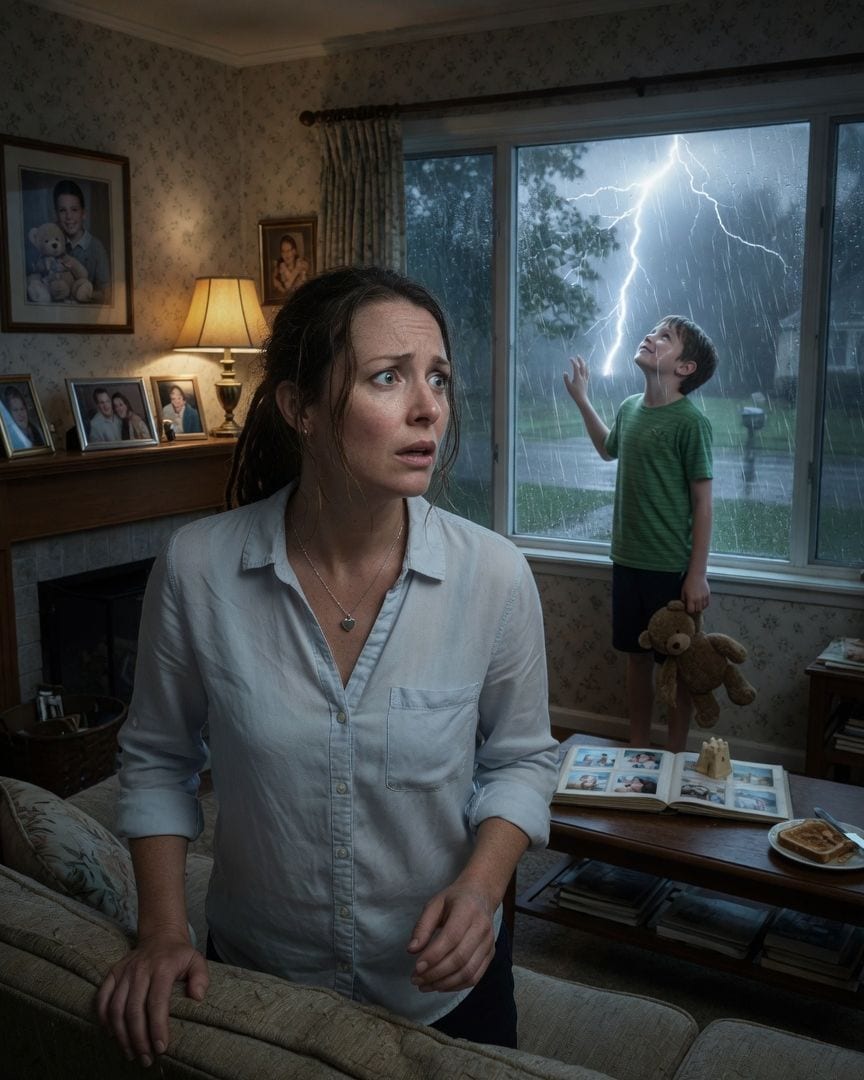
The first evening Lars came home, a furious thunderstorm broke over our house, the kind that used to send him scrambling under the kitchen table, his worn teddy bear, Barnaby, clutched tight.
He’d been missing for a night and a day, after a church picnic, and now, here he was. But he wasn’t under the table.
He stood at the living room window, palms flat on the glass, smiling up into the lightning-riven sky, a strange, serene expression on his eight-year-old face.
The thunder rumbled, rattling the framed photos on the mantel, but his smile only widened.
“Lars?” I called, my voice tight with an unnamed fear. “Honey, come away from the window.”
He turned, his eyes wide and clear, untroubled by the flashes illuminating the room. “Why?” he asked, a puzzled tilt to his head. “Why do you look so frightened, Mother?”
It wasn’t the voice of my boy. Not truly. It was his voice, yes, every timbre and inflection, but the question, the complete lack of fear, it was utterly wrong.
I tried to tell myself it was trauma, a shock reaction from being missing for twenty-four hours. His father, Trevor, had already decided it was the only explanation that made sense.
But the quiet certainty in Lars’s gaze, the way he seemed to drink in the storm, as if tasting something wonderful, it chilled me to my bones.
He still held Barnaby, but the bear felt like a prop, an accessory, not the source of comfort it had always been.
The storm raged, and Lars simply watched it, a quiet observer of something he should have been terrified of.
The next morning, I tried to normalize things. We talked about school, his friends, the upcoming summer plans. Lars, usually a chatterbox, was quiet, almost contemplative. He buttered his toast slowly, meticulously, a small habit I’d never seen before.
Trevor, sensing my unease, kept the conversation light, asking Lars about what he wanted to do that afternoon. Then, over breakfast, Lars brought up our trip to the Outer Banks last year.
“Remember that giant sandcastle we built, Mom?” he asked, his eyes bright, a spark of what I thought was familiarity. “The one with the star-shaped shell on top?”
My heart seized. I remembered the sandcastle, remembered the exact star-shaped shell I’d found near the tideline and carefully placed on the highest turret. It was a perfect memory. But Lars hadn’t been there.
He’d been home with Trevor, his father, battling a nasty stomach flu. I’d called every evening, felt guilty leaving him for the beach house even for those few days.
“Honey,” I said, trying to keep my voice light, “you were sick that week. You stayed home with Dad.”
He frowned, a perfect imitation of his old self, a momentary furrow in his brow. “No, I wasn’t. I was there. I remember the salty air, and how the waves tickled my toes.”
He even described the bright blue bucket he’d used, one with a chipped handle, a bucket that had stayed home in the garage, filled with gardening tools.
I pressed, gently, suggesting he might be mixing up memories, perhaps a vivid dream. But he grew calm, his gaze unwavering, no childish uncertainty.
“It wasn’t a dream, Mom. I was there.” His certainty was absolute, unshakeable. It wasn’t a child’s innocent confusion. It was a statement of fact, delivered with unnerving conviction.
I looked at Trevor, hoping he’d back me up, a quick nod, a shared glance of parental amusement. But he just smiled, oblivious, spooning cereal into his mouth. “Kids get things mixed up, Claire. He’s been through a lot.”
Later that day, I found the family photo album, the worn leather smelling faintly of old paper and dust. My hands trembled slightly as I flipped through the beach photos.
There we were: Trevor and I, laughing, building the sandcastle, the sun glinting off the water. No Lars. I found the star-shaped shell, sitting just where I’d placed it.
A few pages back, there it was: a photo of Lars in his bed, pale, with Barnaby tucked under his arm, Trevor at his side, taken the exact week of the trip.
The timestamp was clear, 3:14 PM, Tuesday, July 12th.
I brought the album to Lars, who was quietly stacking blocks in his room. He’d arranged them in an impossibly neat tower, far too steady for his usual impatient building style.
“Look, honey,” I said, trying to keep my voice even, pointing to the sickbed photo. “This is you that week. You were home with Dad.”
He glanced at it, then at the beach photos. He picked up a picture of the sandcastle, tracing the star-shaped shell with a small finger.
“No,” he said, his voice flat, devoid of his usual childish lilt, no hint of argument or confusion. “That’s wrong. I was there.” He looked up at me, his eyes wide, but not with innocence. They were still, too still.
“Don’t you remember the shell I put on top? The one shaped like a star?” Claire remembered that shell, but she had placed it there. The look in his eyes was not a child’s confusion, but something ancient and unblinking.
That night, I started keeping a journal, documenting every discrepancy. It sat beside my bed, a small notebook that became a receptacle for my sanity, or lack thereof.
Lars, who once detested carrots, now ate them with relish, meticulously lining them up on his plate before devouring them.
He hummed tunes I’d never heard, simple melodies that sounded ancient, almost liturgical, yet he insisted they were just things he made up.
His handwriting, once a messy scrawl of loops and shaky lines, was now surprisingly neat, almost too perfect for an eight-year-old, each letter formed with a deliberate, unnatural precision.
He spelled out 'cat' perfectly, a word he used to struggle with.
Trevor, oblivious, attributed it all to his “new lease on life” after his ordeal. “He’s just growing up, Claire,” he’d say, patting my hand, a gesture meant to be comforting but which only made my skin prickle.
“You’re just looking for things because of the shock.”
But I saw it, the subtle shift in his posture, the way he held his head, the unnerving calm that replaced his boyish exuberance. It wasn’t trauma. It was a quiet, insidious replacement.
I pulled out old videos, his birthday parties, school plays, watching them frame by frame, pausing, rewinding.
The way he ran, a slight awkwardness in his gait, the tilt of his head when he listened, leaning slightly to the right – it was all there, but subtly, chillingly off.
It was like watching a flawless copy, every detail reproduced, but missing the original’s soul. The boy in the videos laughed louder, stumbled more often, felt more real.
I felt like I was losing my mind, caught in a waking nightmare, drifting further and further from everything I knew to be true. I searched online for stories of “returned children,” “changes after trauma,” anything that could explain it.
Most were dismissed as grief or delusion, tales from fringe forums. But one obscure forum mentioned “the quiet ones,” children who came back “different,” often after a brief disappearance near ancient sites or “thin places.”
The term “thin places” resonated with a flicker of memory, a hushed story from my great-aunt Dorothy.
She was a reclusive woman, living in an old, isolated house filled with strange artifacts and even stranger tales from what she called "the old country."
Dorothy Fontaine, whom my mother always called “eccentric” and “a bit morbid,” had a piercing gaze that always made me uncomfortable. I suddenly felt an urgent need to speak with her, to confront those forgotten stories.
My online searches grew more intense, delving into local lore and historical disappearances. I found a few newspaper clippings from decades ago, detailing similar cases of children vanishing and reappearing, “changed.”
The details were vague, often attributed to amnesia or shock, but the underlying narrative of uncanny wrongness was undeniable. The phrase "never quite himself again" recurred with chilling frequency.
As I read, a chill ran down my spine, the hair on my arms rising. I was sure I felt eyes on me, a faint pressure at the back of my neck.
I spun around, but the room was empty, the late afternoon light stretching long shadows across the floorboards. Nothing.
Later that evening, after Lars was asleep, I walked into my bedroom and stopped dead. Barnaby, his teddy bear, was propped on my bedside table, facing me. His button eyes, usually a comfort, now seemed to stare, unblinking, into mine.
I knew I hadn’t put him there. Lars always kept Barnaby close, usually tucked firmly under his arm in his own bed.
The very thought of him letting Barnaby out of his sight, let alone placing him in my room, was absurd.
I picked up the bear, its fur strangely cold, and placed him back in Lars’s room, a knot tightening in my stomach.
The next day, I was alone in the living room, working on my laptop, trying to distract myself with mundane tasks. The silence in the house was heavy, broken only by the hum of the refrigerator.
Then I heard a faint, deliberate creak from the hallway, just outside my line of sight. I looked up. Lars was standing there, watching me, his expression unreadable, perfectly still in the doorway. He wasn’t playing; he was just observing.
When our eyes met, he didn’t flinch, didn't offer a childish wave or a question.
He simply smiled, a slow, knowing curl of his lips that held no warmth, and then turned and walked back into his room, his footsteps unnaturally soft. The air felt heavy, charged, pressing in on me.
I felt hunted, my every move scrutinized, every private moment shared. The thought of Aunt Dorothy, with her knowing eyes and strange stories, became a beacon in the rising tide of my dread.
I knew I had to go to her, even if it meant confronting family secrets I wasn’t prepared for.
The next afternoon, I drove to Dorothy’s house, a weathered Victorian nestled deep in the woods, the gravel crunching under my tires like brittle bones. The gate groaned open, rusted from decades of neglect.
The air inside was thick with the scent of dust, dried herbs, and something else, something metallic and old, like old coins.
Dorothy, frail but sharp-eyed, sat in her armchair by the cold fireplace, sipping tea from a chipped porcelain cup. She watched me approach, her gaze unwavering, not a hint of surprise at my unannounced visit.
I stammered through my story, my voice catching on the details: the thunderstorm, the sandcastle, the sudden, unnerving changes in Lars. I told her about Barnaby, about the feeling of being watched.
She listened, her gaze unwavering, not a hint of surprise or dismissal, no offer of tea. When I finished, the silence in the room stretched, heavy and profound. She simply nodded.
“The exchange,” she murmured, her voice raspy, as if discussing the weather. “It happens.”
My breath caught in my throat, a sharp, painful gasp. “What… what do you mean, ‘the exchange’?”
She took another sip of tea, her movements slow, deliberate. “When a soul is lost, sometimes another comes to fill the space. They wear the skin, they learn the habits. They become, in a way, what was lost.”
She spoke of “hollow places” and “what comes back” with a chilling calm, as if this were common knowledge, a part of the natural order of things.
She then rose, with an unexpected spryness, and retrieved a faded, sepia-toned photograph from a dusty album on a nearby shelf.
It showed a child, dressed in turn-of-the-century clothes, standing at a window, hands flat on the glass, smiling into a fierce storm, lightning illuminating the background. The child’s eyes held the exact same unnerving calm as Lars’s.
“My great-grandmother’s brother,” Dorothy explained, her finger tracing the child’s serene face. “Went missing for three days near the old mill pond. Came back… different. Stronger. Never feared the storm again.”
A profound sense of dread washed over me, cold and sickening. It wasn’t a random glitch in reality; it was a pattern, an ancient, known occurrence. The calm with which Dorothy delivered this impossible truth was worse than any hysteria.
It meant this was normal to her, an accepted, unspoken part of the world. She didn’t explain what it was, not yet, but that it happened, and it was known.
I left Dorothy’s house in a daze, her words echoing in my mind, each syllable a hammer blow against my fragile understanding of the world. “They become, in a way, what was lost.”
The drive home was a blur of roadside trees and grey sky. Back home, the house felt colder, heavier, infused with a new, oppressive presence.
Lars was in the living room, quietly stacking blocks. He’d built an intricate castle, far more complex than any eight-year-old could construct, with tiny, perfect turrets and battlements.
I watched him, searching for the boy I knew, the one who would have smashed the blocks in frustration by now, but all I saw was the calm, the unblinking certainty, the deliberate movements.
I had to know how deep this went, how much of me he knew, how much of my life had been absorbed by this… thing.
“Where did you learn that song, Lars?” I asked, my voice barely a whisper, my heart pounding in my ears. “You’ve never heard it before.”
He paused, his small hands still on the blocks, but not moving. He looked up, his eyes holding that familiar, yet alien, gleam. Then, slowly, deliberately, he began to hum.
It was a lullaby, a melody so deeply buried in my own memory that I hadn’t heard it since childhood, a secret whispered only in my dreams. My mother’s lullaby.
She’d sung it only to me, a private, gentle tune meant just for us. Lars had never heard it. I never sang it to him. He hummed it perfectly, every note, every turn of the forgotten melody.
He finished, then looked at me, a faint, knowing smile playing on his lips, a smile that was not a child’s. “You worry too much, Mother. Some things are simply meant to be.”
I returned to Dorothy, desperate, the memory of Lars’s smile still a cold burn on my skin. I demanded answers, my voice hoarse with a mix of fear and rage.
She met my frantic questions with her unsettling composure, her hands clasped calmly in her lap.
“They are drawn to the gaps, Claire,” she explained, her voice soft but firm, like a breeze rustling through dead leaves. “To the longing, the grief.
When a child is lost, the space they leave behind is a beacon, a tear in the veil. These… entities… they fill it. They are ancient, a part of the earth, mimicking what they find. They absorb.
Not just memories, but the very essence of the family, the home, the love. They become a reflection, a continuation.”
She revealed that her family, the Fontaines, had been “witnesses” for generations, charged with understanding, occasionally even “facilitating” the exchanges when a loss was too great to bear, believing it was better to have “something” than nothing.
She spoke of the peace it brought, the way the community could heal around the “returned,” moving on without the destructive weight of unbearable grief.
Her words were a chilling tapestry, weaving together all the impossible threads into a coherent, horrifying whole: Lars’s lack of fear, the stolen memories, his absorption of my own deepest secrets.
“Your Lars,” she said, her eyes piercing, “he knows you, Claire. He carries a part of you now. He is learning you. He is your son, in a way, a new kind of son.
And the longer he is here, the more deeply he becomes embedded, the more of you he absorbs.” The horror wasn’t in malice, or even in any conscious evil; it was in the cold, logical coherence of it all.
It wasn’t evil; it was simply… nature. An ancient, incomprehensible process playing out right in my living room.
The truth, delivered with such calm, felt like a physical blow, a crushing weight in my chest.
I stood to leave, a desperate, animalistic need to run, to escape this house, this knowledge, this impossible reality that had swallowed my son. “I can’t,” I whispered, my voice barely audible, tears stinging my eyes.
“I can’t live like this. I can’t pretend.”
Dorothy simply watched me, her gaze sympathetic but unyielding, her eyes holding centuries of resigned knowledge. “You must, Claire. There is no undoing it. To expose it would shatter everything, not just for you, but for Trevor, for the community.
The peace they’ve found… you would destroy it.”
I stumbled out of her house, got in my car, and drove home, my mind a storm of its own, far more furious than any thunderclap Lars had ever smiled into. Each mile brought a fresh wave of dread.
As I pulled into the driveway, I saw Lars standing on the porch, Barnaby tucked under his arm. He wasn’t playing. He was waiting.
As I reached the front door, he stepped forward, blocking my path, a small, still sentinel. His face was devoid of anger, or even childish defiance. His eyes were ancient, possessive, almost protective, fixed on me.
“Mother,” he said, his voice soft, almost a caress. “You were gone a long time. I was worried.”
Then, he smiled, that unnerving, knowing smile, and repeated one of my secret childhood fears, a fear I’d never spoken aloud to anyone, not even Trevor, a memory so private I’d forgotten it until Dorothy’s words had stirred it.
“Don’t worry, the dark can’t hurt you here.” My hand froze on the doorknob. He was her son, in a way, now. He had absorbed her. There was no escape.
I was trapped in my own home with this thing that wore my son’s face and now carried my own deepest, most guarded memories.
I continued to live with Lars. Trevor, blissfully unaware, was simply happy to have his son back, attributing any lingering oddities to the trauma of his brief disappearance.
He never noticed the subtle shift in Lars’s gaze, the unnerving calm that now permeated our home, settling into every corner like a fine dust. My journal entries became sparse, then ceased altogether.
The house felt different, imbued with a quiet, watchful presence. My own memories, once sharp and clear, sometimes blurred, as if a new layer was settling over them, shifting their focus, their emotional weight.
Barnaby, Lars’s teddy bear, was always nearby, often placed conspicuously in the living room, on a high shelf, its button eyes seeming to follow me, always watching.
The fear was no longer a frantic panic, but a deep, constant hum beneath the surface of my life. It was a silence, a knowing, that only I carried, a secret that had become a shared consciousness.
My journal, abandoned on my nightstand, ended mid-sentence, the ink trailing off into a smudge. I no longer felt the need to record. The past, the present, the future—they blurred into a continuous, placid stream.
My thoughts, once my own, now felt… shared. I felt lighter, in a way. Relieved of the burden of self. One evening, Trevor, recounting a trivial anecdote from his childhood, chuckled.
“You know, I always hated those awful school trips to the old mill pond.”
I looked at him, a faint, wrong smile playing on my lips.
Claire sat perfectly still, a serene, unblinking expression on her face. Her smile was calm, accepting, and utterly devoid of the worry that used to line her eyes.
She picked up a stray thread from her sweater, her movements slow and deliberate. “Is that so?” she says.
If this one got to you
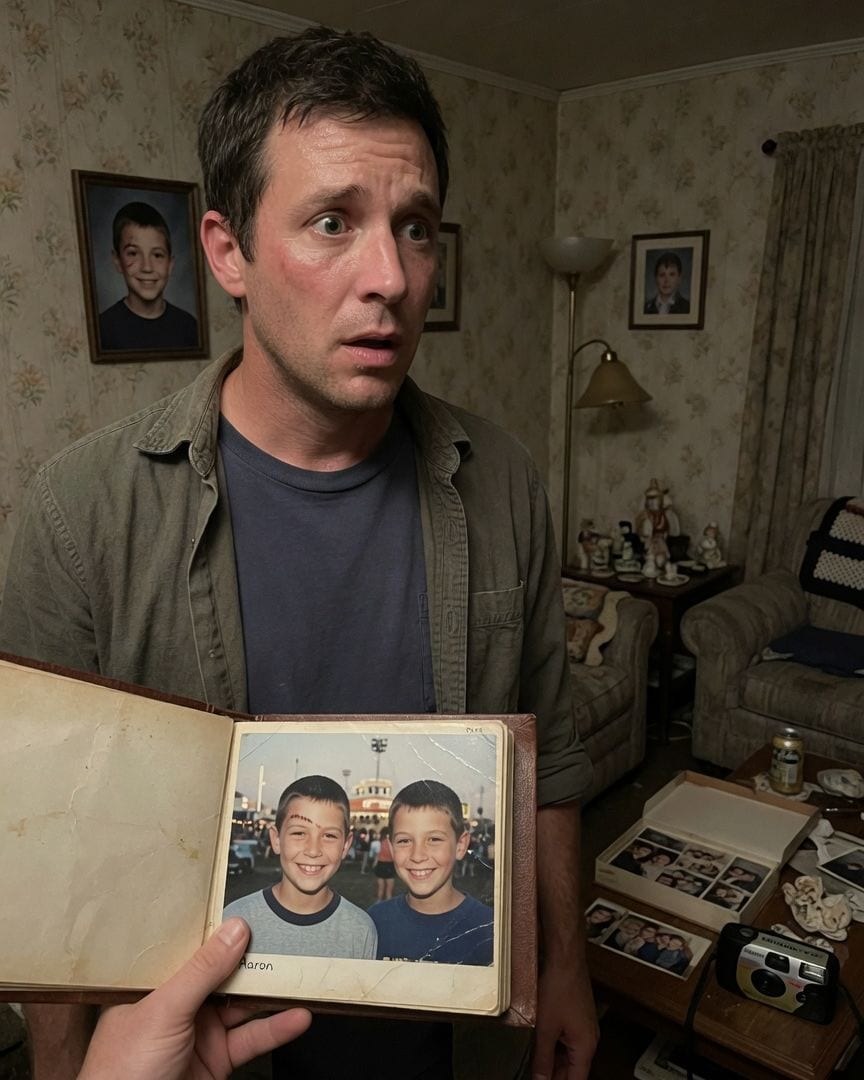
My best friend Aaron speaks perfectly smooth now, not a single stammer. He was gone three weeks. He says he never stammered, and asked, kindly, if I did.
After three weeks missing, my best friend Aaron was finally home. But the relief burned away when he spoke, his voice smooth and clear, utterly lacking the stammer he'd had his entire life. He calmly insisted he'd never stammered, leaving me cold.
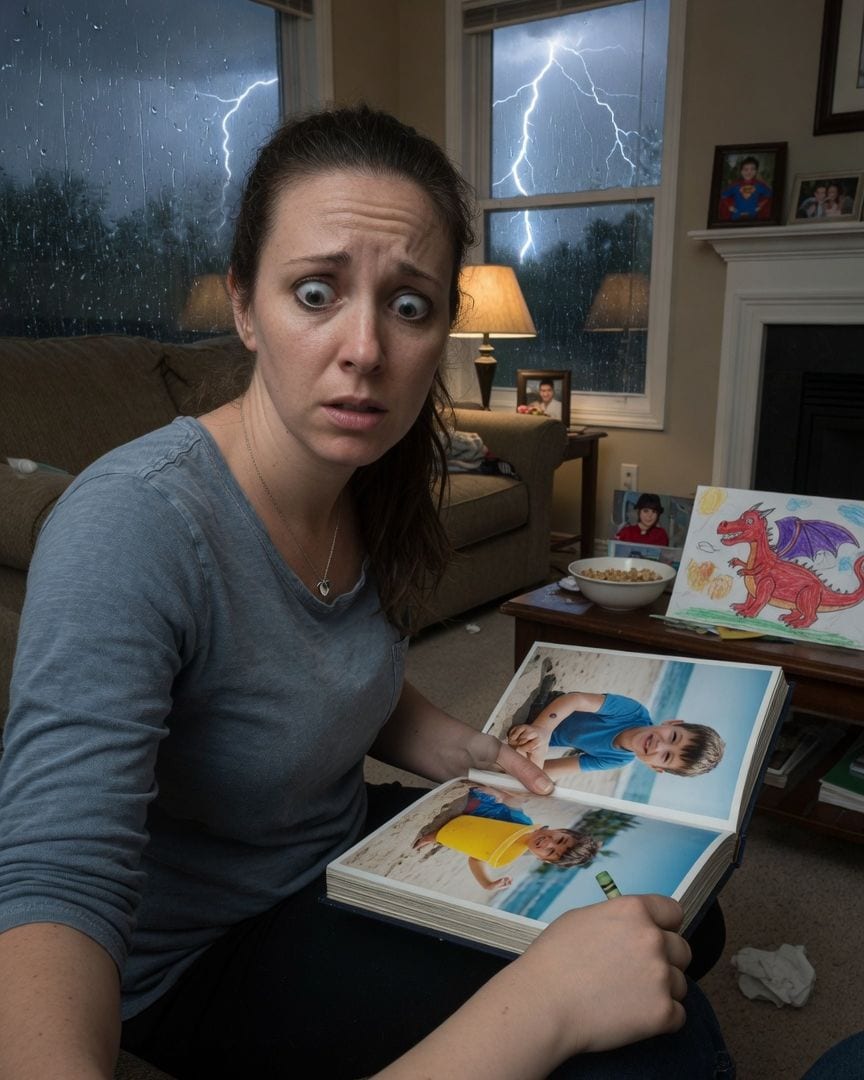
My son's star-shaped birthmark is gone from his wrist. Photos prove it was there just last summer.
My son Nathaniel returned home after being missing for a day and a night, bringing immense relief. But his strange calm during a violent thunderstorm and a new way of eating breakfast unsettled me. The true dread hit when I touched his left wrist: his distinctive star-shaped birthmark, always there since birth, was utterly gone.
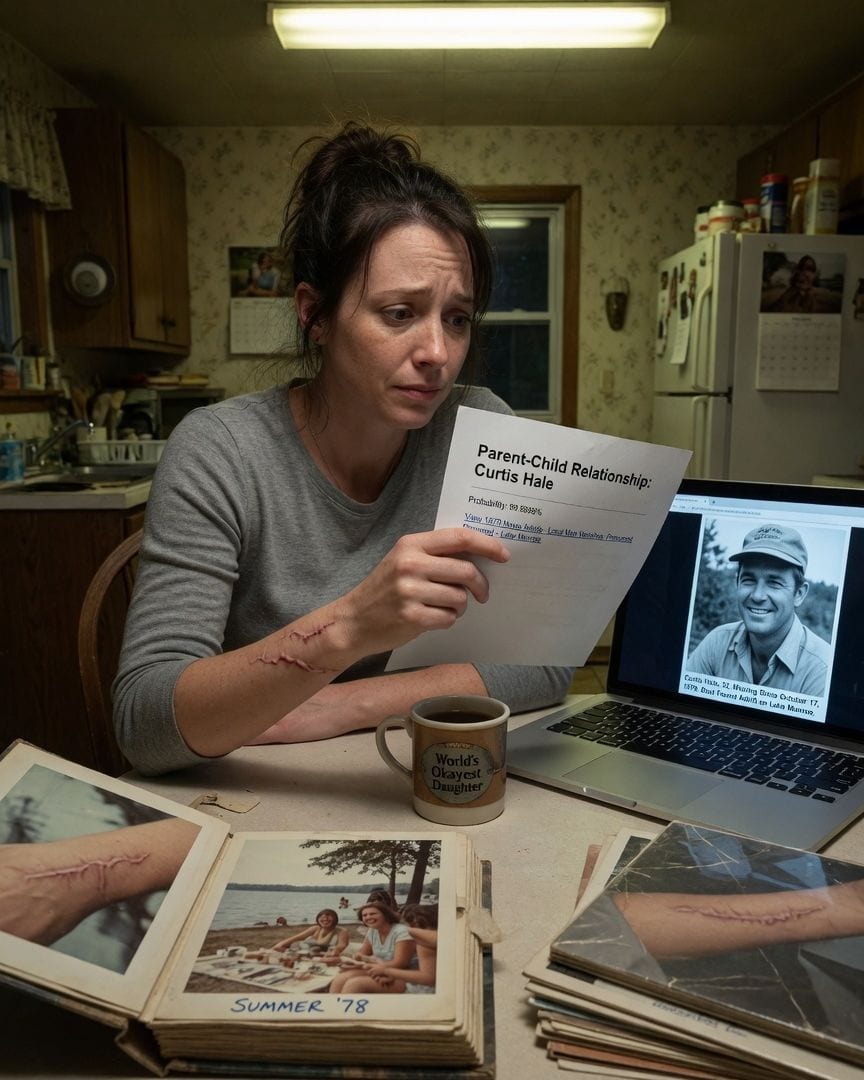
My DNA returned Curtis Hale as my father. He vanished in 1979. I was born twelve years later. The lab confirmed the match twice.
My DNA test results revealed something impossible: my biological father vanished in 1979, twelve years before my birth. My mother dismissed it as nonsense, but her reaction felt forced, leading me to old family photos. There, in a faded 1978 snapshot, I found my own distinctive childhood scar on the wrist of a stranger.
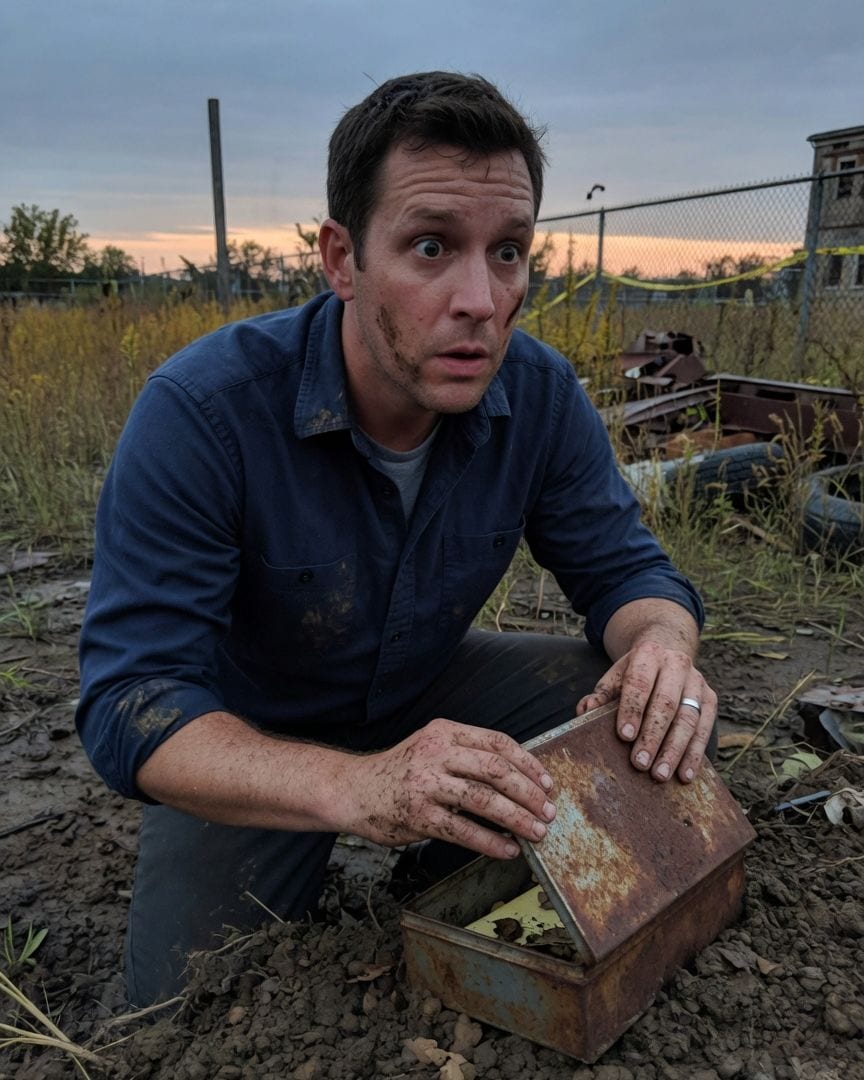
My ancestors' photo shows a letter addressed to me, dated 1972.
My birthday card arrived a day late, from a small town an hour north, nowhere we knew. Inside, an elegant, unfamiliar script read: 'Happy Birthday, Robert. The Field remembers.' It was postmarked from the site of my ancestral homestead, demolished decades before I was born.
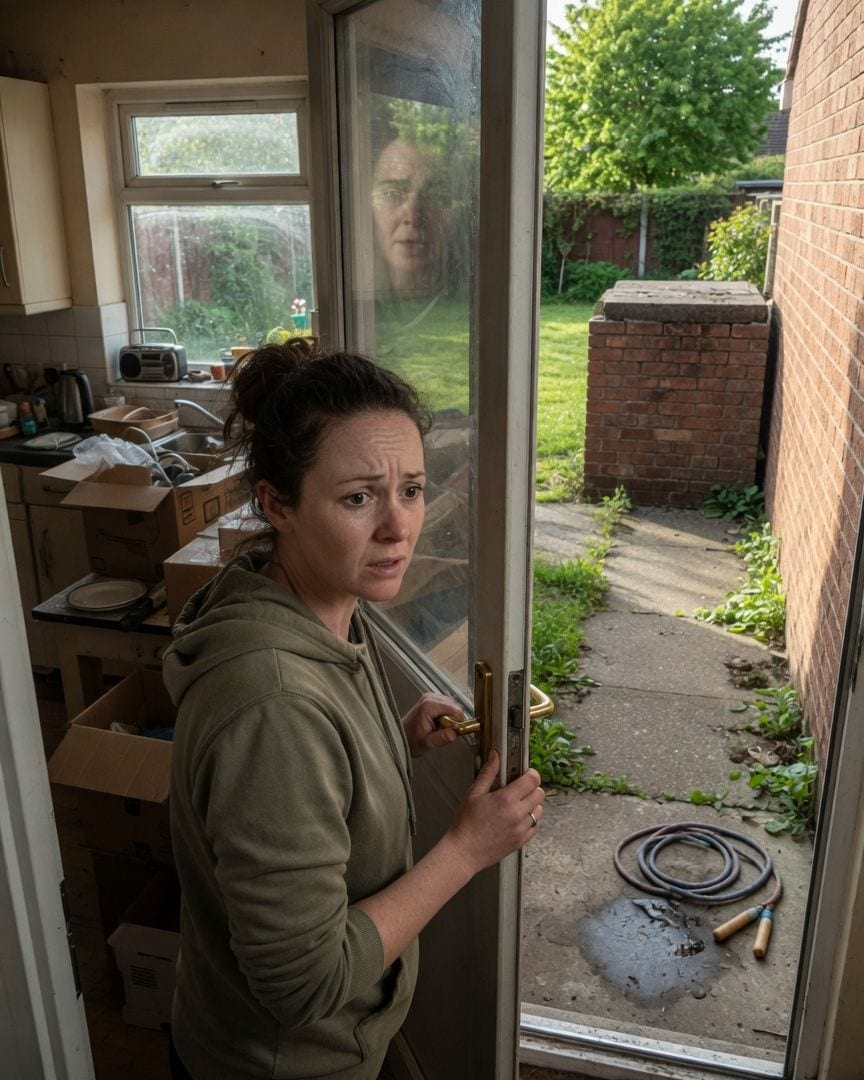
Children skip in my garden at 3:30 on school days. They're on the concrete by the coal bunker, where there's no room. The rope they leave is always damp.
I kept hearing children skipping outside my kitchen window, even though there was nowhere for them to play. Every time I looked, the narrow side return was empty, but a damp skipping rope lay on the concrete. Then, my old cleaning cupboard opened onto a vibrant, old-fashioned garden, where two small figures stared back with unnervingly blank eyes.
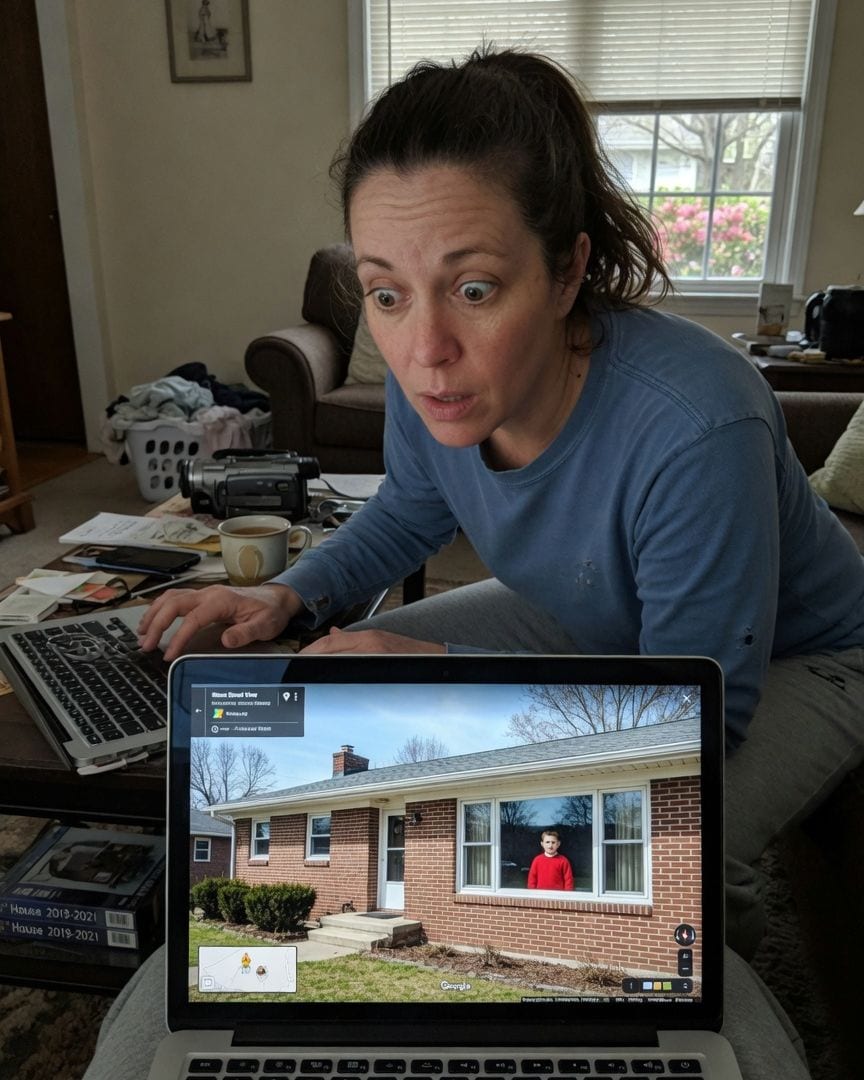
My Street View shows a boy in our window. That room's been empty and locked for months, we have no son, and he's gone if you drag the camera.
I was idly scrolling Google Maps, admiring the spring flowers on my street, when I paused at our house. In the empty, locked front bedroom window, a small boy in a bright red jumper stared out. We have no son, and that room has been storage for two years. He simply vanished from the Street View image.