Children skip in my garden at 3:30 on school days. They're on the concrete by the coal bunker, where there's no room. The rope they leave is always damp.
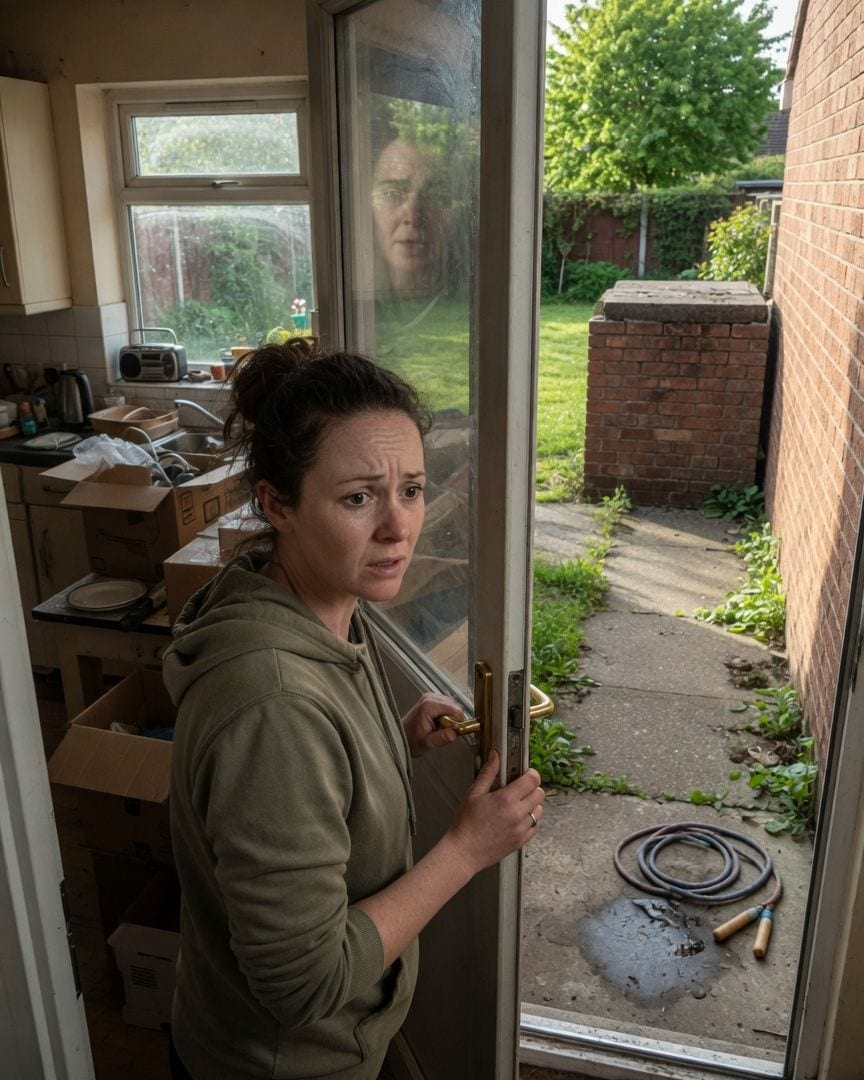
The rhythm started subtly at first, a faint, muffled thud from outside, like a bag of laundry hitting concrete. Then it resolved itself, a distinct thwack-slap-thwack-slap, underscored by a breathless, chanted counting rhyme.
One, two, three… I froze, a half-unpacked box of crockery still in my hands. It was the unmistakable sound of children skipping, right outside my kitchen window.
My kitchen faces the side return, a narrow concrete strip, maybe four feet wide, that runs between my house and the neighbor's brick wall. It's overgrown with weeds and ends abruptly at the old, bricked-up coal bunker.
There is nowhere to skip. Certainly no room for two children, and I could hear two distinct voices, one higher, one slightly deeper, counting in unison.
I put the box down, slowly, the clatter of china jarring in the sudden silence of the house. The counting continued, clear as a bell through the glass, rising now to eight, nine, ten! The thwack-slap grew more energetic.
What kids? My new neighbors have teenagers, and the nearest park is three blocks away. This was directly outside, the sounds so close I could almost feel the vibration through the floorboards.
I walked to the back door, my hand on the cold brass handle. The chanting swelled to 'thirteen! fourteen! fifteen!' – then stopped, mid-syllable, as abruptly as if a switch had been flipped. Absolute silence.
I pulled the door open, quickly.
The side return was empty. Of course it was. Nothing but the grey concrete, a few tenacious dandelions pushing through cracks, and the blank, red-brick face of the coal bunker. No children. No discarded toys. No sign of anyone.
But on the concrete step, precisely where the sounds had been loudest, a child’s skipping rope lay coiled. It was a simple thing, faded blue and red, with wooden handles.
And it was visibly damp, though the afternoon had been dry and still.
Over the next week, it became a routine. Every school day, at precisely 3:30 PM, the skipping would start. Always two voices. Always by the coal bunker. Always stopping the moment I opened the door or looked too hard.
And always, the damp rope.
I tried to rationalize it. Neighborhood kids, as a prank, scaling the low wall from the alley behind. Condensation from the old brickwork. I even installed a cheap motion-activated camera I bought online, pointing it directly at the side return.
For three days, it recorded nothing but the rustle of leaves and the occasional stray cat. Never a child. Never a rope appearing. Yet, when I came home, there it would be, coiled on the step, glistening with moisture.
I felt a growing sense of unease, a cold knot in my stomach that had nothing to do with drafts.
One afternoon, after the familiar chorus had ceased and the rope had materialized, I decided to examine the side return more closely. I walked the length of the narrow strip, checking the ground for footprints, the wall for handprints. Nothing.
But as I traced my hand along the brickwork of the house itself, near the kitchen window that overlooked the strip, I noticed something odd.
A subtle warping, an almost imperceptible shimmer, like heat haze rising from asphalt, but the bricks were cold to the touch.
It wasn't a crack, not a defect in the mortar, just… a visual ripple in the air directly against the wall, about eye-level.
I leaned closer, my fingers brushing the oddly cool brick. The ripple seemed to deepen.
And as I glanced up, through the grimy pane of the window above the sink – a window I’d always meant to clean – the view was wrong.
For a split second, it wasn't the dense, overgrown hedge and the neighbor's rusty fence. Instead, I saw a vibrant, manicured lawn, stretched wide and green.
A different, much larger tree stood where my spindly birch is now, its branches full and lush. And tucked under it, a small, wooden play structure, freshly painted, not something I’d ever seen in this garden.
Then, as quickly as it appeared, it was gone, replaced by my familiar, messy view, the grimy glass reflecting my own startled face.
I stumbled back, my heart hammering against my ribs. A trick of the light, I told myself, my eyes playing up.
But the image had been too vivid, too distinct to be a mere reflection or a momentary lapse in vision. I retreated inside, the chill from the brickwork still lingering on my fingertips.
I stared at the window, then at the wall beneath it, where the shimmer had been. There’s a small, old wooden cupboard built into the wall here, right next to the back door, usually for storing cleaning supplies.
I rarely open it, just a dusty repository for bleach and a mop. Compelled, almost against my will, I unlatched the cupboard door.
Inside, it was just as expected: dusty shelves, a half-empty bottle of floor cleaner. But as I reached in, a faint, cold breeze, smelling faintly of damp earth and something sweet, brushed my hand.
I looked up, and through the open cupboard door, instead of the dark, unlit cavity I expected to see, the vibrant, old-fashioned garden flickered again, clearer than before.
And this time, two small figures, a boy and a girl in faded, old-fashioned clothing, stood perfectly still by the play structure, looking directly back at me with unnervingly blank eyes.
I slammed the cupboard door shut, the sound echoing in the silent kitchen. My breath hitched in my throat. The vision, the children, their blank, knowing stare – it was undeniable. This wasn’t my imagination. Something was wrong. Deeply wrong.
The next few days were a blur of frantic searching. I haunted the local library, spending hours hunched over microfiche readers, scrolling through blurry newspaper archives, and poring over brittle property deeds.
The house, I discovered, was much older than I thought, built in the late 1800s, and had been known as 'Forsythe House' for generations. The name kept cropping up: Forsythe, Forsythe, Forsythe.
I found old maps from the 1930s that clearly showed the side return area – not as the concrete strip I knew, but as an open patch of earth with a small, circular marking labelled 'Well (Uncovered).'
The well, I learned, was poorly covered after a 'minor incident' in 1937, then properly sealed and the coal bunker built over it in 1968.
I even found a faded photograph of 'Forsythe House' from 1935 in a local history book. The garden in the picture matched my fleeting vision perfectly: the wide, manicured lawn, the sprawling tree, the small, wooden play structure. Every detail.
The 'minor incident.' That phrase stuck in my mind, a polite euphemism that felt like a slap in the face. I tried to find living descendants of the Forsythes, a challenging task given the passage of time.
Eventually, through persistent cross-referencing of local records, I traced a distant relative: Robert Forsythe, age 72, who lived in an adjacent, smaller property that once belonged to the same sprawling estate.
I sent Robert Forsythe a polite, carefully worded letter, explaining I was the new owner of Forsythe House and was researching its history, hoping he might have some family anecdotes.
A few days later, I was in my garden, clearing an especially stubborn patch of weeds, when I became aware of a presence. I looked up. In the garden next door, an old man was meticulously tending to his roses.
It was Robert. He didn’t wave, didn't acknowledge me, but his gaze, when he thought I wasn't looking, was fixed intently on my house. Specifically, on the side return.
He watched with an unnerving stillness, his posture straight, his expression unreadable. I found myself deliberately turning my back, feeling his eyes on me like a physical weight.
Later that evening, I found a small, neatly folded note tucked under my front door. It was typewritten, brief, almost clinical: "Some things are best left undisturbed. The house has its own way." There was no signature.
A shiver, colder than any draft, ran down my spine. I knew it was from Robert.
The next day, I couldn't bear the suspense. I walked straight over to his fence, my heart pounding. He was out again, pruning a rose bush. He looked up as I approached, his face serene, almost pleasant.
"Mr. Forsythe?" I began, trying to keep my voice steady. "I received your note."
He paused, a slight smile playing on his lips. "Did you now, dear?" His eyes, a pale, watery blue, seemed to twinkle with an unsettling placidity. He didn't deny writing it.
"What did you mean?" I pressed, my voice tighter than I wanted. "'The house has its own way'? What are you talking about?"
He sighed, a slow, patient sound, as if dealing with a particularly slow child. "Just a friendly warning, dear. Some memories are better off sleeping." He clipped a dead rose head with a sharp snip.
"What memories? What's going on with this house?" My fear was rapidly turning to anger, a desperate need for answers.
Robert finally put down his clippers. "The house remembers, Kathleen. It remembers the strong things. The joy, yes, but mostly the shock, the loss." He turned, gesturing vaguely towards my house with an open hand.
"In 1937, my distant cousins, Vera and Daniel, they lived there. Vera was ten, Daniel was eight. They were playing in that side return."
A cold dread settled in my stomach. The skipping. The rope.
"There was an old well there," he continued, his voice calm, measured, "poorly maintained. They were playing a game with their skipping rope, a game they played every day after school. Daniel, he fell.
Vera, she tried to pull him out with the rope, but she fell too."
My breath caught. The skipping. The rope. The dampness. All of it.
"The family covered it up, quickly," Robert went on, his gaze fixed on some distant point, as if recalling a dusty film reel. "Didn't want the scandal. The well was bricked over, properly sealed later, the coal bunker built.
Pretended it never happened." He finally looked at me, his pale eyes unnervingly direct. "But the house… the house held onto it."
He explained that the house sometimes "plays back" these intense moments, especially when a new, sensitive occupant arrives. "It's like a film reel, stuck on a loop. The children, their game, the fall."
I thought of the damp rope, the empty side return, the vivid flash of the old garden through my window. It all clicked into place, horribly.
The house wasn't haunted by a ghost; it was a living echo, replaying a tragedy.
A wave of nausea washed over me. "So it just… repeats?" I asked, my voice barely a whisper. "And I'm just watching it?"
Robert smiled faintly, a knowing, almost pitying expression. "Sometimes, yes. But the house likes an audience. Sometimes it likes a participant."
He walked into his living room, beckoning me to follow with a slight tilt of his head. He returned a moment later with a small, leather-bound album. He opened it to a brittle, yellowed newspaper clipping.
The headline, dated 1978, screamed: "Two Children Missing from Forsythe House – Local Police Baffled."
My breath caught in my throat. The accompanying article detailed a strikingly similar incident: two children, a boy and a girl, playing in the side return, disappeared without a trace. Their skipping rope was found damp by the coal bunker.
I stared at the clipping, my eyes darting from the date to the details, then to Robert, who was watching me intently, his expression unreadable. He gestured to the date on the clipping.
"It's been forty years," he said, his voice flat, "almost to the day."
His gaze dropped to my hands, then back to the clipping, where a faint, almost imperceptible detail in the background of a photograph showed a small, damp skipping rope coiled on a step, precisely where I find hers.
Robert explained the horrifying cycle in full, his voice still unnervingly calm, as if discussing the weather. "The house doesn't just remember, Kathleen. It demands a re-enactment.
Every forty years or so, it finds someone new, someone who can see, who can hear. And it draws them in."
He told me how his own parents, after the 1978 incident involving their neighbors’ children, had sold the house in a hurry, moving next door but never speaking of it again.
He was a young man then, and he’d heard the skipping, too. "The children, Vera and Daniel, they don't know they're gone. They're just playing their game, waiting for the fall.
And the house… it wants that moment to be witnessed, to be complete."
He described how the 'Door Onto The Wrong Year' – my shimmering window, my cupboard – grows stronger, pulling the observer not just into seeing the past, but into being present in it. "You'll start to hear their voices more clearly.
You'll feel the chill of the well. And eventually, you won't just be watching. You'll be standing right there, in 1937, in their last moments."
The calm in his voice was chilling, not a trace of empathy, only a detached, academic interest in a phenomenon he'd long accepted as inevitable.
I realized the full horror: I wasn't just an observer; I was being groomed for a role in the next, unending performance.
I backed away from Robert, a scream trapped in my throat. "No!" I whispered, "I won't let it!"
I ran back to my house, fumbling with the lock, my hands shaking so hard I dropped my keys. Once inside, I slammed the door shut, securing the deadbolt. But the sounds were already different.
The skipping wasn't just outside anymore; it echoed faintly from the upstairs landing, a light, rhythmic thudding on the floorboards above.
I raced to the kitchen, to the cupboard door that led to the 'wrong year.' I had to stop it. I grabbed a hammer and a handful of nails from my toolbox.
My hands shook as I tried to hold a nail steady against the wooden frame, but as I drove the first nail, the cupboard door shimmered. The image of the 1937 garden pushed through, clearer, more solid than ever.
The two children, Vera and Daniel, were there, turning to look at me, their blank eyes now holding a faint, expectant curiosity. The air grew heavy, thick with the scent of damp earth and old wood, a cold, cloying smell.
I felt a profound pull, a dizzying sensation of being stretched across time, a sickening lurch in my stomach. I stumbled back, hitting the wall. The hammer clattered to the floor.
The skipping sounds crescendoed, now coming from inside the house, from the side return area directly adjacent to the kitchen. I glanced frantically out the kitchen window, and through the glass, I didn't see my messy, overgrown garden.
I saw the manicured lawn of 1937, a pristine, vibrant green. And the two children were there, no longer by the play structure, but standing at the very edge of the open well, looking down into its dark mouth.
They turned, their faces no longer blank, but smiling, wide and innocent, beckoning. The rope, I realized, was no longer on my step. It was in Daniel's hand, being offered.
Kathleen Delaney’s house went quiet after that. Her car remained in the driveway, her mail piled up. Neighbors noticed the curtains were always drawn.
Robert Forsythe, next door, continued tending his roses, his gaze occasionally drifting towards the silent house, a familiar, unbothered calm on his face.
The local police, after a perfunctory check, filed a missing persons report, noting no signs of forced entry, no struggle, just an untouched, slightly damp skipping rope coiled neatly on the kitchen step.
Months later, a new 'For Sale' sign appeared on the overgrown lawn of Kathleen Delaney's house. It sold quickly, a good deal for the right buyer.
A young couple, excited by the prospect of an old house with 'character,' moved in. On their second week, the wife, busy in the kitchen, paused, listening.
She heard it: a faint, rhythmic slap and a child's counting rhyme, coming from the narrow side return. She walked to the back door, pulled it open. The sounds stopped. The side return was empty.
But on the concrete step, precisely where the sounds originated, a child's skipping rope lay coiled, visibly damp. She called her husband, laughing, 'Kids must be playing pranks already!' He came to look, picked up the rope, and shrugged.
She smiled, a soft, distant look in her eyes. 'Isn't that so?' she asked, a faint, wrong little smile playing on her lips. The skipping rope, freshly damp, lay coiled on the step, waiting.
If this one got to you
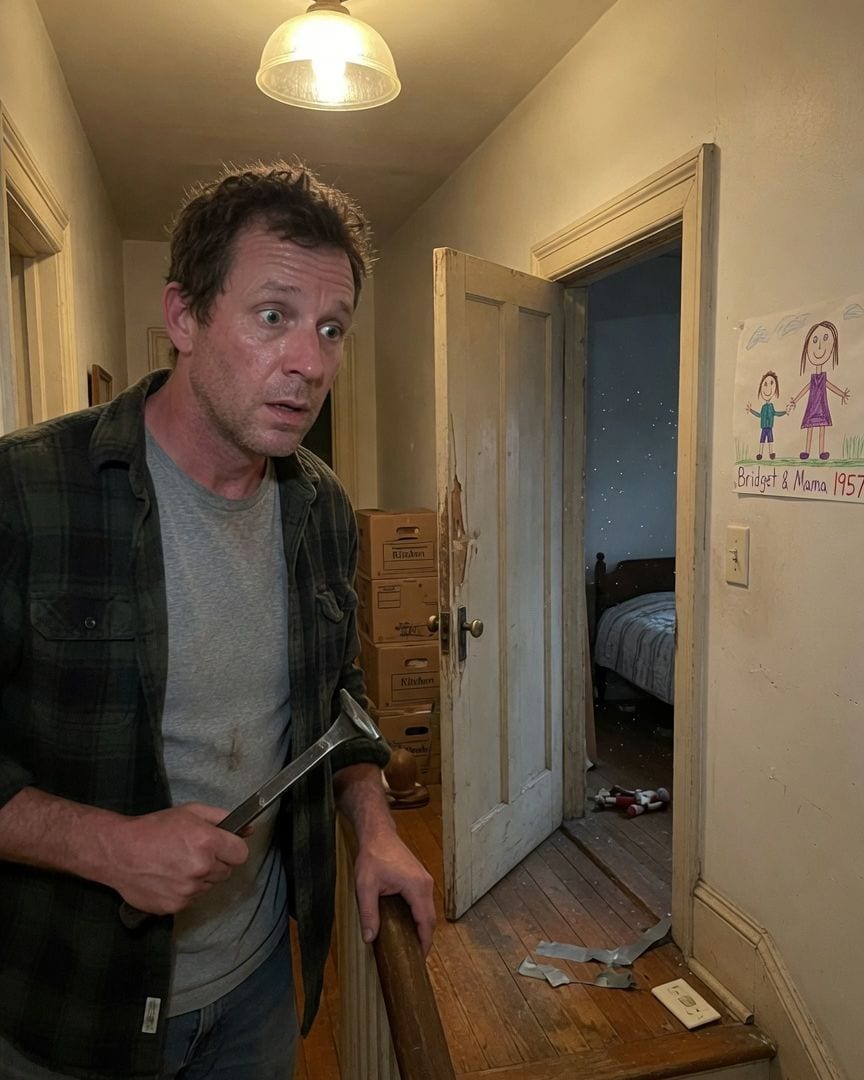
My landing light switches itself off at 9:40 every night. I've watched the switch flick down under nothing, the tape peeled back. The house holds its breath.
My great-uncle's old house was a quiet gift, a place to finally settle. But as I unpacked, a strange worn path on the floorboards led me to a small, barely visible door, perfectly blended into the wall. It was undeniably locked, and felt like a deliberately obscured secret.
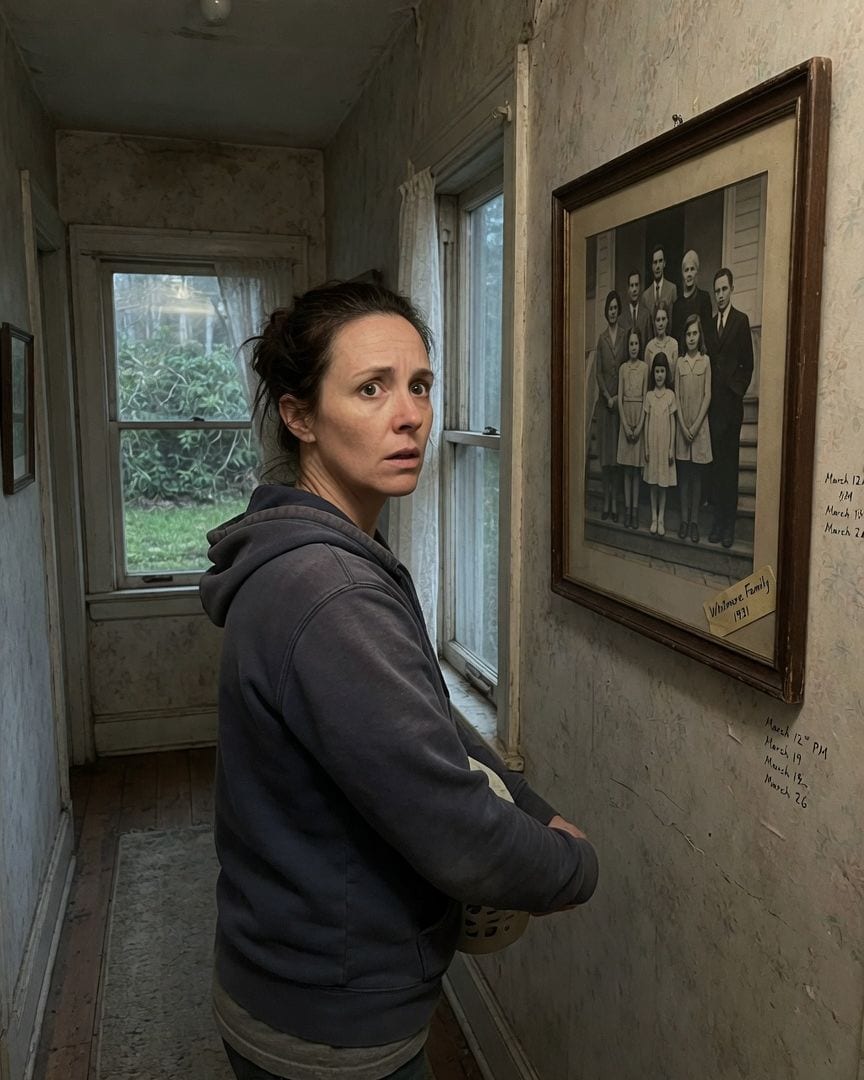
My inherited family portrait. The child's face in it is slowly, steadily turning to watch me.
I inherited an old New England coast house, a quiet place full of history. Among boxes, I found a 1931 family photograph; soon, the child's face in it began to slowly, undeniably, turn towards me.
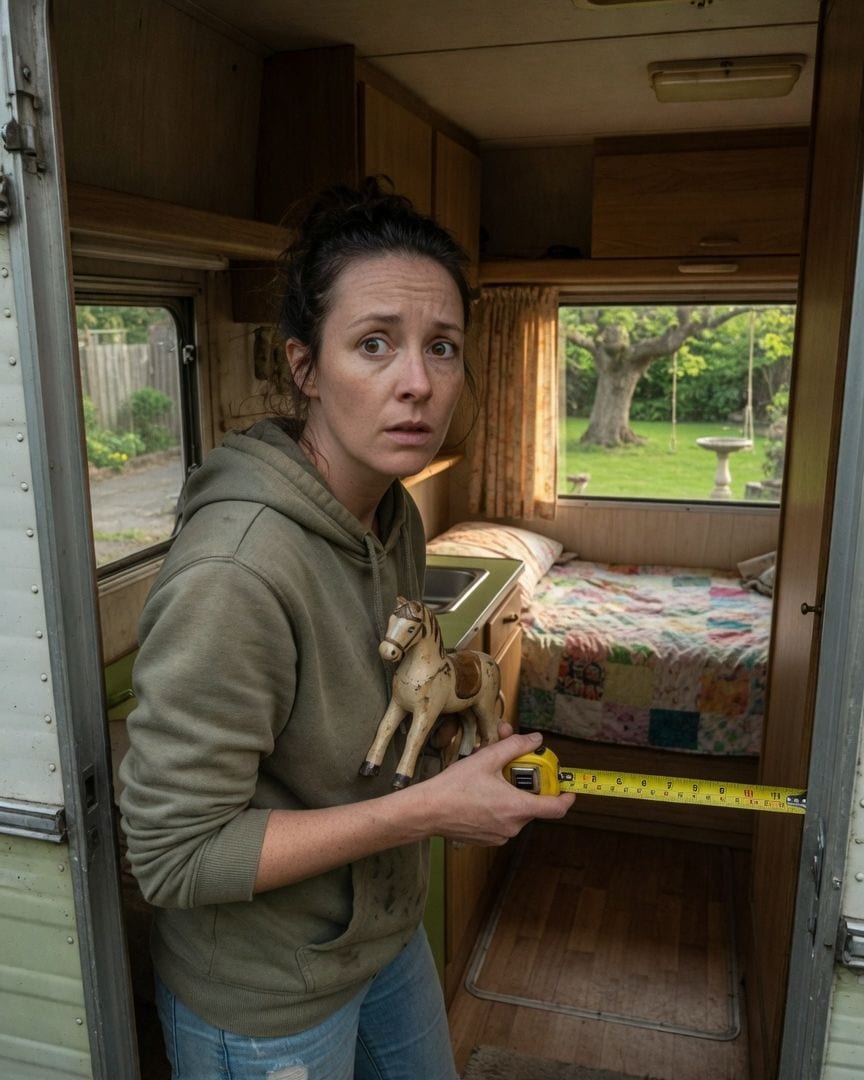
My new caravan's corridor runs longer than the caravan itself. Eleven feet of hallway past the end wall, to a room with a made bed and a window looking out on a garden it's never been parked in.
I finally bought my dream vintage caravan, a twelve-foot beauty. But when I measured inside for a mattress, the numbers didn't add up. Beyond where the wall should be, an impossible room with a window looked out onto a manicured garden I'd never seen before, a garden that couldn't possibly exist.
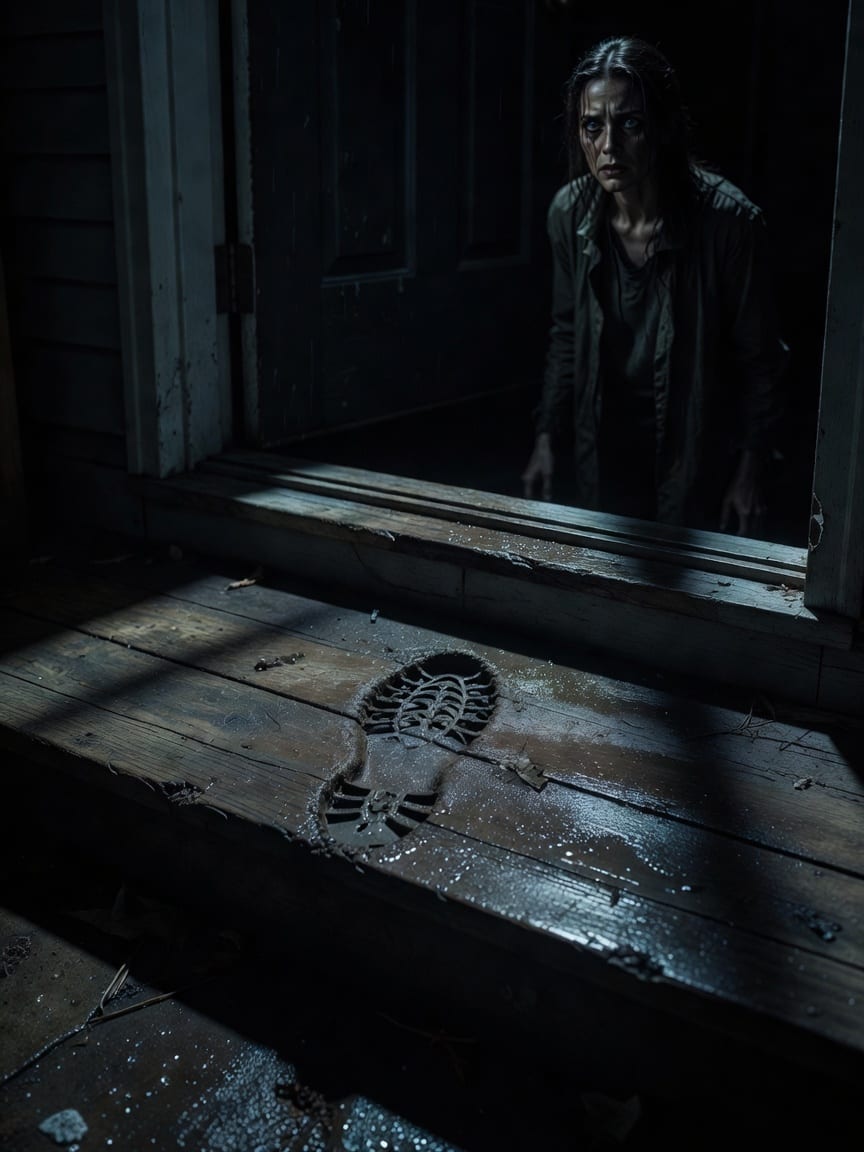
My landlord's only rule: never let the outside tap run after sundown. Last week it dripped. This morning, wet bootprints ringed the back step from the tap to my door, all the same size. The tap was off.
We'd just settled into Waterside House, with its strange landlord rule about the outside tap. After the washer broke, I found perfect, wet bootprints leading from the tap to our back door, but the tap was cranked completely off, tighter than I could manage.
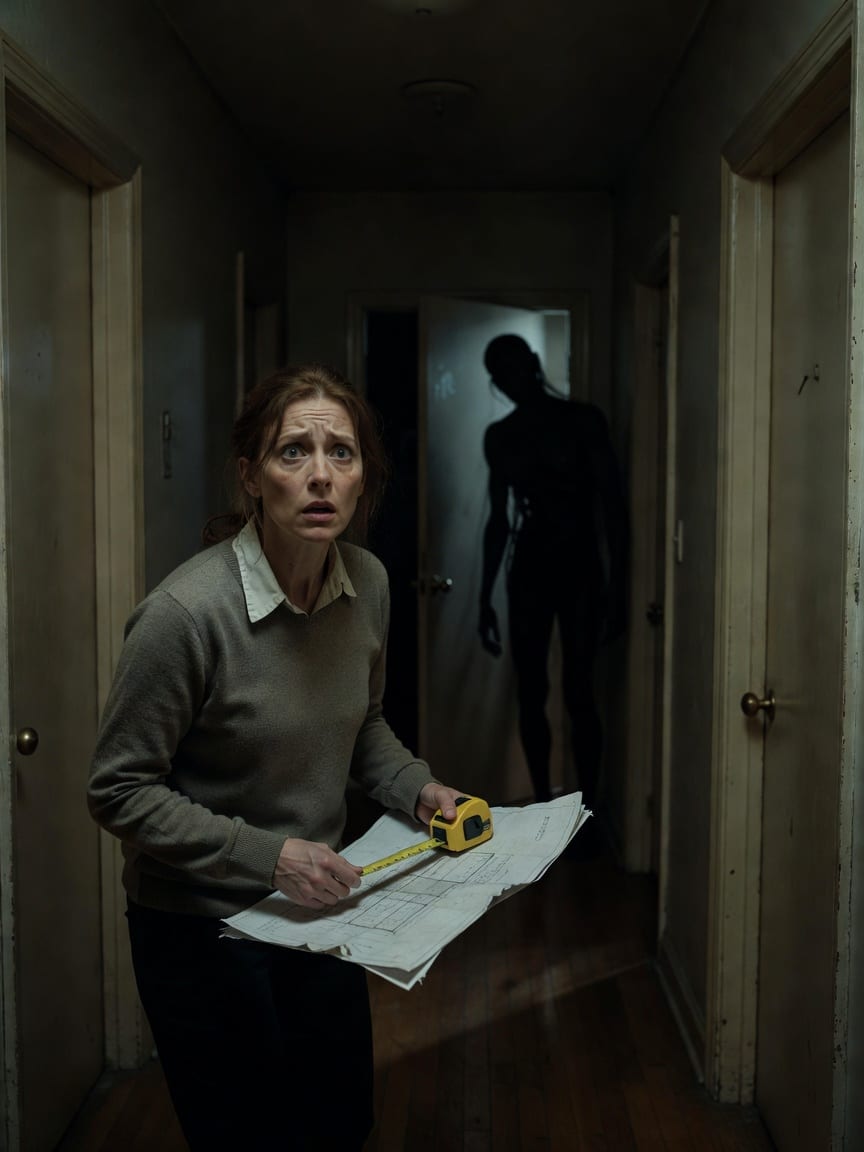
My front door has a dented gate and a dead hydrangea. I walked past it six times, trying to reach the corner shop just a hundred yards away. The pavement kept bringing me back to my own porch, and the shop's light never moved.
My morning started like any other, a quick walk to the corner shop from my home at Number 14, Elm Terrace. But after walking what felt like two minutes, I found myself back at my own front door, the shop no closer. I tried six times, faster and slower, but my street kept compressing, refusing to let me leave.
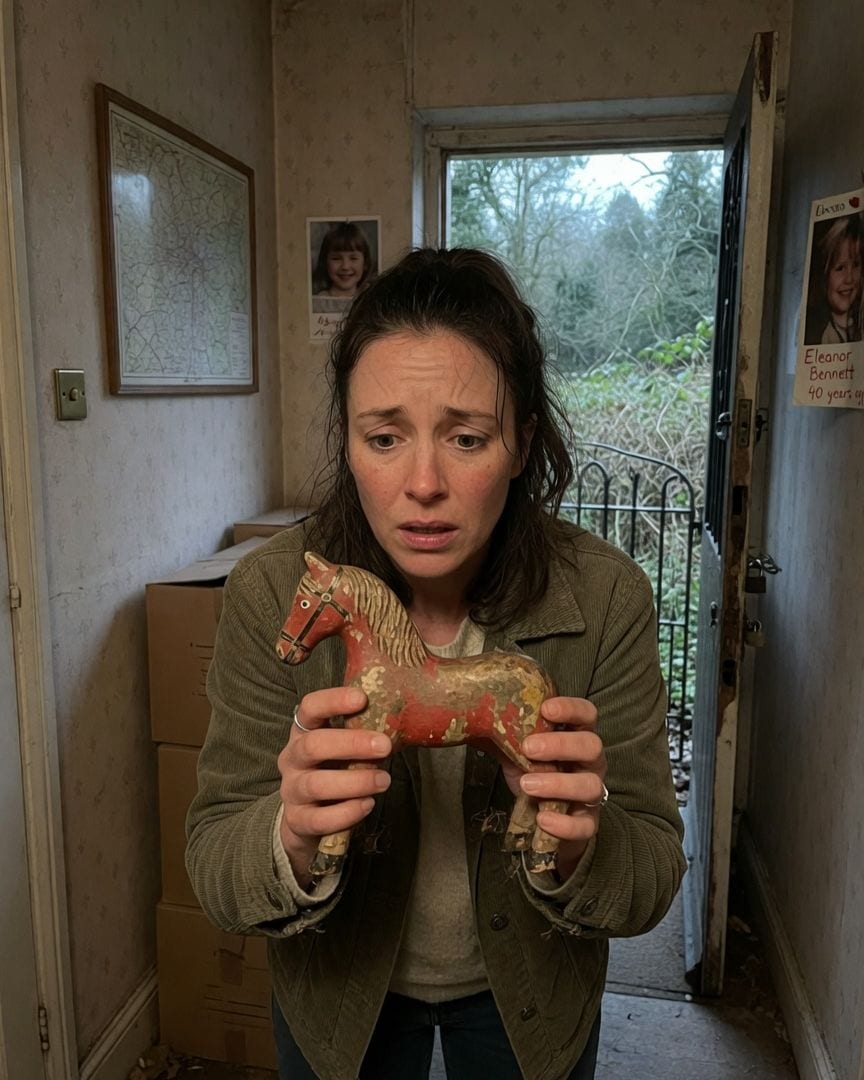
My black gate stands open, the padlock hanging closed but the hasp unscrewed clean out of wood untouched for years. The parish keeps that gate shut. It's the rule.
I'd settled into my new village, accepting the old farmer's gruff rule about the black wrought-iron gate that guarded the ancient woods. But last Sunday, I found that heavy gate wide open, a gaping maw in the orderly lane. The padlock still dangled from its frame, securely locked, but the metal hasp was unscrewed clean out of the gatepost.