Chief Yates's muster found 25 men on a ship meant for 24. Forty years earlier, an old logbook showed a sailor's name 'retained' after the same impossible count.
Chief Boatswain's Mate Ronald Yates squinted through the driving spray, the Bering Sea gale howling around the USS Vance. He stood on the pitching weather deck, the bitter wind whipping his foul-weather gear as he ran the abandon-ship muster.
Twenty-four hands were aboard, twenty-four billets for the rafts, according to his current watch bill.
He called each name off the sodden sheet, one by one, watching faces turn to the dim work lights, hoods pulled tight against the freezing spray.
"Petty Officer Sutton!" "Here, Chief!" "Ensign Romano!" "Here, Chief!"
Every man sounded off, his voice battling the wind. Yet, when the final tally came in, the count was twenty-five.
Yates ran it again, slower, more deliberately, his gloved thumb moving down the list, checking each face against the name, but the numbers refused to align.
Twenty-five distinct men stood at their stations, each claiming his name, while the deck log, held tight in his hand, swore there were only twenty-four aboard.
The discrepancy was a physical weight in the churning air, a cold knot in his gut that no amount of rationalization could loosen. He felt the spray sting his face, but the cold dread was deeper.
He looked up at the huddled figures, trying to spot the extra man, the phantom among his crew, but they were just his crew, sodden and shivering, waiting for him to dismiss them.
The gale subsided by morning, leaving a glassy, frigid sea. Yates, still unsettled by the muster, spent hours in the ship's office. He cross-referenced the current watch bill with personnel manifests, then checked the recent transfers.
Every official record, signed and stamped, confirmed a crew of twenty-four. He even double-checked the last port call's log for stowaways, finding nothing.
It had to be fatigue, a trick of the light, a shared name, or some kind of unit prank gone too far. He tried to convince himself. Petty Officer Preston Sutton, a quiet, by-the-book sailor, swore he’d counted twenty-four.
Ensign Monica Romano, sharp and new to the Vance, confirmed the same.
"Twenty-four, Chief. I counted them twice myself," Romano had said, her brow furrowed in concentration.
But Yates had seen twenty-five. The memory of that extra face, indistinct but undeniably present, clung to him like the salt spray.
He decided to consult the ship’s historical archives, a dusty, rarely accessed compartment belowdecks, hoping to find a similar clerical error in past records, a precedent that might normalize the impossible.
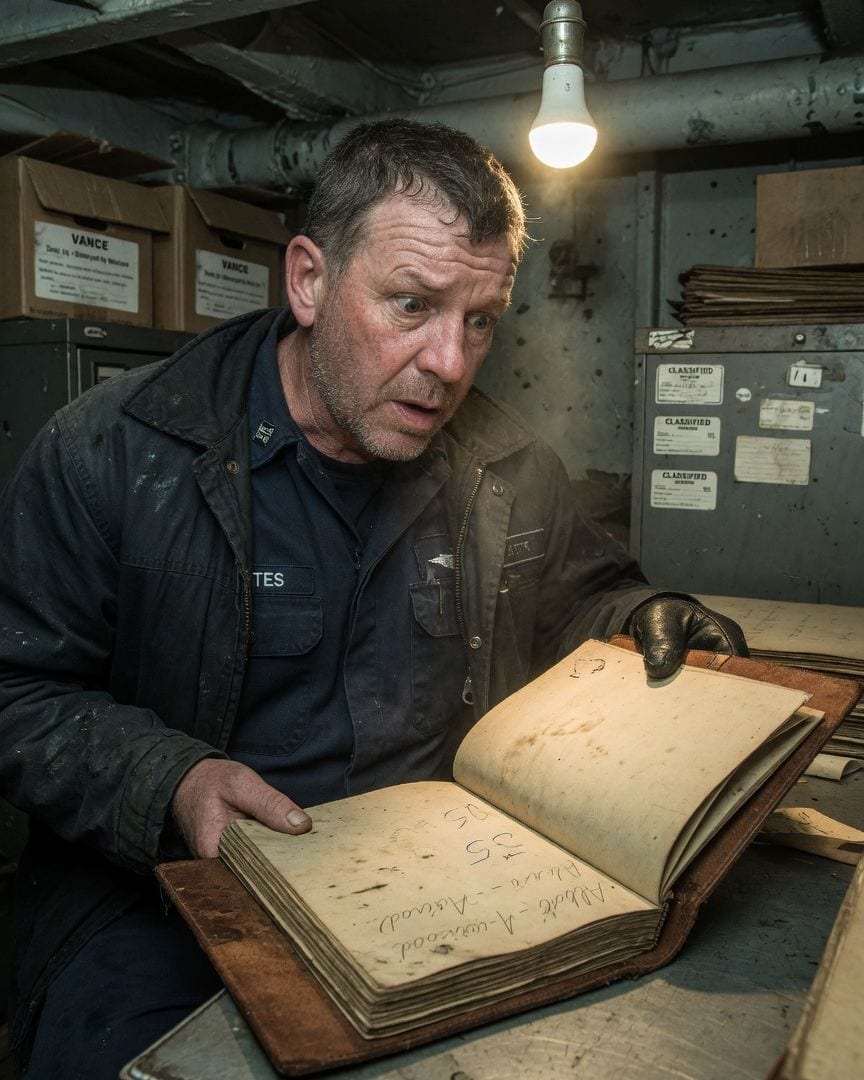
The room smelled of mildew and stale paper, the ship’s ancient heart humming a low vibration through the deck plating. He found a bound, leather-covered logbook, older than the current electronic system, its pages yellowed and brittle.
Flipping through entries from decades past, he found a muster from a severe storm, dated forty years prior. The entry, signed by a long-dead Chief Boatswain’s Mate, recorded a crew count of 25.
Beneath it, scrawled in faded ink, was an unofficial, almost completely defaced notation.
Yates leaned closer, the single bare bulb in the archive swaying, casting the old logbook in fractured light. The air in the compartment felt heavy and cold, the damp clinging to his uniform.
He carefully traced the faint, almost erased words beneath the anomalous muster entry. The ink was so faded, the paper so worn, but he could just make out the letters.
He breathed out slowly, his breath fogging slightly in the cold, damp air. His thumb ran over the rough paper, feeling the impression of the impossible truth. 'Abbott, H. - retained.'
The name didn't ring a bell from the current crew, but the word 'retained' hung in the cold air, heavy and wrong. What could it possibly mean?
Why would a name be 'retained' after a muster, especially one that came out a man too many?
The word 'retained' gnawed at Yates. He spent the next day searching for a 'Hugo Abbott' in the ship's internal personnel files, then in the broader Coast Guard archives.
The ship's internal network, usually sluggish, seemed to resist his queries, spitting out error messages before finally relenting. He found a service record for a Seaman Hugo Abbott.
Abbott had been assigned to the USS Vance decades ago, during the period of the old logbook entry.
His record showed a deployment on the Vance, followed by a 'missing in action, presumed lost at sea' designation during another Bering Sea patrol, with no body recovered.
The file was officially closed, his next of kin notified, but there was a peculiar lack of finality in the digital record – no formal transfer out, just a cessation of active duty.
It was as if the system, in its meticulous accounting, couldn't quite bring itself to definitively close the book on Abbott's presence aboard the Vance.
Yates compared the dates. Hugo Abbott's disappearance coincided almost perfectly with the muster entry in the old logbook that recorded 25 men.
He cross-referenced Abbott's service number with various ship manifests from that era, finding it present on all of them, right up until the 'presumed lost' declaration. Yet, the old log still listed him as 'retained' even after that date.
He tried to find any official doctrine or regulation regarding 'retained' personnel in such a context, but came up empty. It felt like a ghost entry, a system trying to account for something that wasn't there, or shouldn't be.
Yates felt a growing unease, the kind that came when the established order, the very bedrock of his military life, began to fray at the edges. His rational mind, honed by decades of service, struggled to reconcile the conflicting data.
It had to be a bureaucratic oversight, a quirk in antiquated record-keeping. But the feeling persisted, a cold, persistent tremor that resonated with the memory of the extra man at muster.
He decided to approach Captain Felix Ellison, a man known for his encyclopedic knowledge of the Vance's history, hoping for a rational explanation for the cryptic notation. He scheduled a meeting for after the evening watch.
That evening, as Yates made his way to Captain Ellison’s quarters, he noticed Ensign Monica Romano walking down the narrow corridor ahead of him, clutching a tablet.
The Vance was a labyrinth of dim lights and shadowed corners after dark, and the quiet click of her boots echoed faintly. As she passed the ship’s main operations office, the door, usually secured, was ajar.
Romano paused, glanced inside, and then, inexplicably, stepped in. Yates, curious, stopped a few paces back, his own boots silent on the deck. He heard a low murmur of voices, too indistinct to make out words.
The ship's ventilation system hummed, a low, steady sound that seemed to swallow all others.
Then, he saw Romano’s silhouette through the frosted glass of the internal window, standing beside a figure he couldn’t identify, their heads bowed together over a screen. A faint blue glow emanated from within.
It looked like the current crew manifest was displayed. Romano’s posture seemed stiff, almost unnatural, her shoulders hunched, her head tilted at an odd angle. A prickle of unease ran down Yates’s spine.
He wasn't sure what he was seeing, but it felt wrong. This wasn't a casual conversation. As he watched, Romano straightened, her head turning slowly towards the door, as if sensing his presence.
Yates quickly stepped back into the shadows of a recessed equipment locker, his heart thudding, a sudden, frantic rhythm against his ribs.
The door to the ops office remained ajar for another moment, then slowly, silently, clicked shut, the sound oddly deliberate in the quiet corridor. Yates waited, listening to the muffled sounds of the ship, before continuing to Ellison’s quarters.
The encounter left him shaken. Had Romano seen him? Was she involved in this strange discrepancy? Or was he simply seeing shadows and misinterpreting a routine conversation on a ship that was already unnerving him?
The ship, once a familiar and ordered environment, now felt like a labyrinth of unseen eyes and hushed secrets, its bulk groaning around him like a living thing.
Captain Ellison greeted Yates with his usual calm, almost detached professionalism. The captain’s cabin was sparse, functional, and smelled faintly of brine and old paper.
He listened to Yates's account of the muster, the old logbook, and the 'Abbott, H. - retained.' notation without interruption, his gaze steady, his hands resting clasped on his desk.
The quiet hum of the ship seemed to amplify in the small room. “A curious find, Chief,” Ellison finally said, his voice level, betraying no surprise. “The Vance has a long memory. Longer than most.”
Yates pressed him. “Captain, what does 'retained' mean? Seaman Abbott was listed as lost at sea. His record is closed.” He tried to keep his voice even, but a tremor of frustration edged it.
Ellison leaned back, a faint, unreadable smile playing on his lips. “Officially, yes. But the ship… the ship keeps its own books, Chief. Some souls, once accounted for, remain so.
The system, in its infinite drive for accountability, doesn’t truly let go.” He opened his own tablet, navigating to a secure folder with practiced ease. “You understand the principle of a ship’s complement, Chief.
Every billet filled, every man accounted for. It’s the bedrock of our order.”
Yates nodded, confused by the philosophical turn. “Yes, Captain. Twenty-four. But we counted twenty-five.”
Ellison’s smile widened, a chilling, almost paternal expression. “Indeed. And the ship, in its wisdom, found a way to account for all of them. Even those who are… no longer with us in the conventional sense.”
He scrolled through a document on his tablet. The screen glowed, illuminating the slight lines around his eyes. “This is an internal, non-standard manifest. A deeper layer of accounting, if you will.
The kind that ensures no one is truly forgotten by the vessel they served.” Ellison then brought up a current digital crew manifest. It was identical to the official one Yates had access to.
“Now, Chief, observe.” He highlighted Ensign Monica Romano's entry. Beneath her active service number, a second, fainter number appeared, grayed out, inactive. Yates stared. The inactive number pulsed with a faint, almost imperceptible light.
It was Hugo Abbott's service number, the one from the 'missing in action' file. The dread solidified, sharp and cold, a heavy weight in his chest. It wasn't just old records; it was happening now.
The ship was accounting for Abbott, through Romano.
Ellison’s finger tapped the screen, drawing Yates’s attention back to Romano’s entry. “The system, Chief, abhorring a vacuum, finds a way to balance the books. A billet must be filled. An accountability must be met.”
The captain’s calm voice was the worst part, a dispassionate explanation for an impossible horror. The air in the cabin seemed to thicken, pressing in on Yates.
He felt his rational mind straining, trying to find a mundane explanation for the two service numbers, for the subtle, insidious linking of a living officer to a long-dead sailor.
He thought of Romano in the ops office, her stiff posture, her head bowed over a screen, perhaps unknowingly entangled in this very mechanism.
He thought of the extra man at muster, the one who answered to a name that was also someone else's.
The ship wasn't just holding onto ghosts; it was making them, or reassigning their identities to the living.
As Yates stared at the screen, a chilling thought struck him, a new layer of dread, cold and absolute: If Ensign Romano could be linked to Hugo Abbott, then what about himself?
What did the ship’s 'deeper layer of accounting' say about Ronald Yates, a man nearing the end of his service on a vessel about to be decommissioned, a man whose presence would soon become a vacancy that the ship might seek to fill?
Yates's gaze flicked from Romano's dual entry to Ellison's placid face. The captain's composure was unnerving, an impenetrable shield against the impossible truth. “Captain, what does this mean for Ensign Romano?” he demanded, his voice tight, barely above a whisper.
Ellison sighed, a sound of mild regret, as if discussing an unfortunate but necessary procedure. “It means the ship ensures its complement is always full. When a vacancy occurs, particularly one unresolved by conventional means, the vessel’s deeper protocols activate.
It finds… a suitable candidate to carry the weight of that unfulfilled accountability.” He paused, letting the words sink in, watching Yates’s face with an almost clinical interest.
“Ensign Romano, being a new transfer, perhaps still finding her footing, was a prime candidate to absorb the lingering presence of Seaman Abbott. It’s a subtle process, Chief. Not possession, not a haunting in the vulgar sense.
More like a layering of identities, a shared burden of service that the ship itself orchestrates. The records, you see, reflect the ship’s truth, not merely the human one.”
Yates felt a wave of nausea, the ship’s low hum now a sickening vibration through the deck. “So the 25th man at muster… that was Abbott, speaking through someone, or… or just an echo the ship projected?”
“Both, in a sense,” Ellison confirmed. “The ship knows he is here. It ensures he is accounted for, whether as an extra presence, or by merging his identity with a living crewman. It fills the gap. Always.”
Yates thought of his own long service, the approaching decommissioning, the transfer that would leave his billet empty. He remembered the watch bill he held in his hand, his own signature on the log.
He remembered the cold knot in his gut from the muster, a premonition he now understood. “And what happens when the ship is decommissioned, Captain? What happens to these… retained souls?”
Ellison's expression remained calm, but his eyes held a distant, unsettling glint, like a deep-sea creature glimpsed in the dark. “The ship transfers its manifest, Chief. Its full manifest.”
“Transfers it where?” Yates asked, his voice barely a whisper, a sudden dryness in his throat.
Ellison rose, walking to the porthole and gazing out at the vast, indifferent Bering Sea, now a flat, gray expanse under the overcast sky. “Wherever the new accountability dictates. To another vessel, perhaps.
Or to those who were once part of its crew, now ashore. The ship ensures its continuity, its ledger always balanced.” He turned back, his gaze meeting Yates’s, an unsettling intensity in his eyes.
“You, Chief, have served the Vance well. Your dedication, your meticulous attention to detail… the ship recognizes such qualities.”
Yates felt a profound chill that had nothing to do with the cold air. He was not being praised; he was being marked. He remembered the conversation in the ops office, Romano’s stiff posture, her turning head.
Had she already begun to feel the layering? Was she slowly becoming Abbott? He looked at the captain, a man who clearly understood this terrifying system, a man who was utterly calm in the face of it.
“You knew all along,” Yates stated, not a question, the words tasting like ash in his mouth.
Ellison merely inclined his head. “It is a truth as old as the Vance herself. A necessity. The military demands accountability, Chief. The ship merely fulfills that demand, in its own way.” Yates felt a surge of desperate clarity.
He had to get off this ship, and he had to warn Romano. But even as the thought formed, a strange, heavy lethargy began to spread through his limbs.
The hum of the ship’s engines, once a familiar comfort, now felt like a low, resonant thrum deep within his own bones, a vibration that threatened to displace him from himself.
He looked at his hands, seeing the faint, almost imperceptible tremor in them. He tried to stand, to move, to shout, but the words caught in his throat, a thick, unyielding mass. The ship was decommissioning. Its manifest was transferring.
And he was on it. He was a vacancy about to be filled, a new entry in a very old log. The cabin around him seemed to draw in, the bulkheads groaning softly as if settling around him.
The USS Vance was decommissioned a week later, its final flag ceremony held in a cold, driving rain. Most of the crew transferred to new assignments, eager to leave the old cutter behind.
Captain Ellison received a commendation for his long service and quietly retired from the Coast Guard.
Ensign Monica Romano was reassigned to a shore station, her colleagues noting a new, quiet intensity in her demeanor, a slight vacantness in her eyes, as if she were always listening for something just beyond human hearing.
Chief Boatswain's Mate Ronald Yates also received his transfer orders, to a desk job at a remote administrative outpost in Alaska. His colleagues remarked on his unusual stillness, his methodical, almost robotic efficiency.
He rarely spoke, and when he did, his voice carried a faint, unfamiliar resonance, a slight echo that wasn't quite his own.
Days turned into weeks at the administrative outpost. Yates worked tirelessly, processing manifests and records, his movements precise, his focus unwavering. He never complained, never showed emotion.
His new supervisor, Commander Patricia Forsythe, found him exceptionally efficient, if a little unnerving. One evening, she saw him poring over an old, faded printout of a ship's manifest, his finger tracing names with an almost obsessive care.
The fluorescent lights of the office hummed overhead, making the paper seem to glow with an inner light. She approached him. “Chief Yates? Something wrong with that old record?” Yates looked up, his eyes meeting hers.
There was a flicker of something in them, a deep, ancient knowing, yet utterly devoid of personal recognition. A faint, almost imperceptible smile touched his lips, not his own, but a thin, distant echo of Captain Ellison’s.
“No, Commander,” he said, his voice flat, yet carrying that faint, resonant echo. “Just ensuring everyone is accounted for.”
If this one got to you
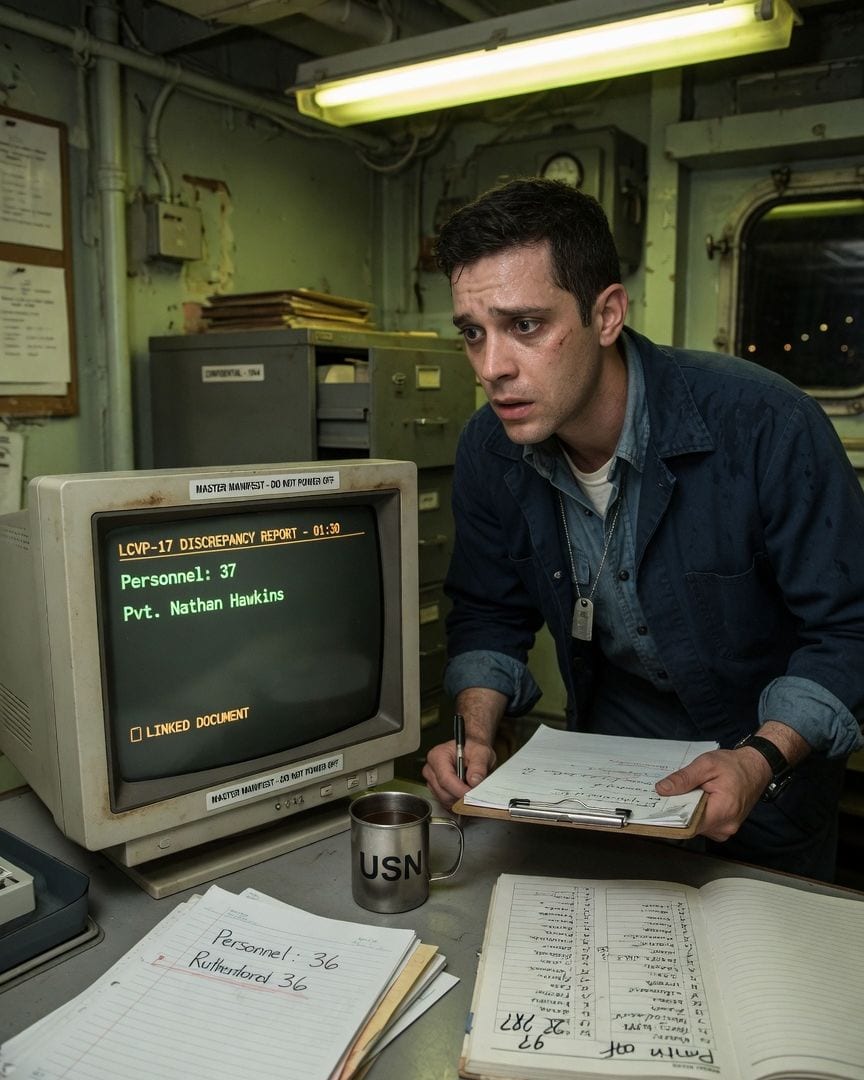
Coxswain's Mate Rutherford counted thirty-seven men in his landing craft, but the manifest logged only thirty-six. A hidden report, filed hours before, named Private Nathan Hawkins.
Coxswain's Mate Donald Rutherford, 28, began his final count for a standard load of thirty-six men in LCVP-17, the salty spray stinging his eyes. Halfway to the beach, a violent wave slammed the craft, throwing the men against each other. When the vessel settled, Rutherford instinctively recounted, his heart knocking against his ribs. This time, his count came back thirty-seven bodies crowded into the small boat. Official logs confirmed only thirty-six men, yet a hidden report, dated hours before his deployment, listed an extra man by name: Private Nathan Hawkins.
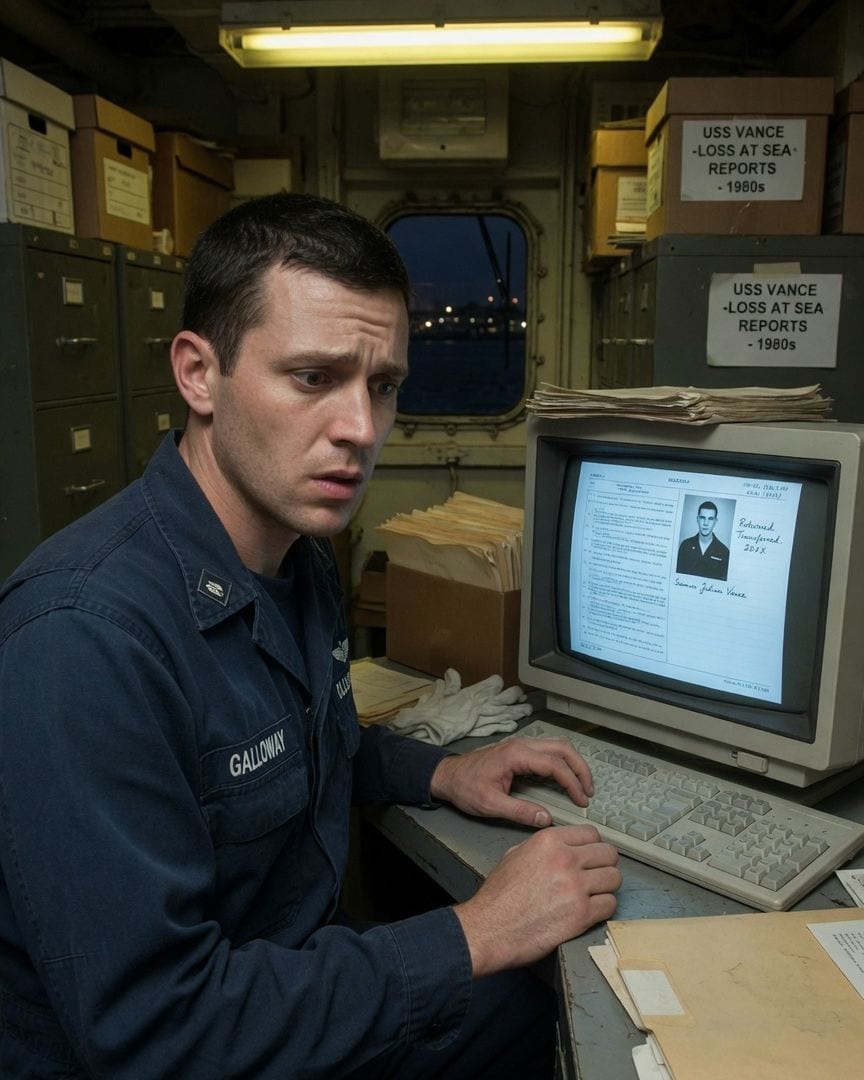
Petty Officer Galloway logged a sailor onto his ship. The man died at sea 40 years ago.
Petty Officer Joel Galloway scanned a sailor's ID on the USS Vance quarterdeck. The man's name, 'Seaman Julian Vance,' and his out-of-date uniform pricked at Galloway's memory. Later, the ship's berthing count came back one over, with an extra entry in the system but no physical body.
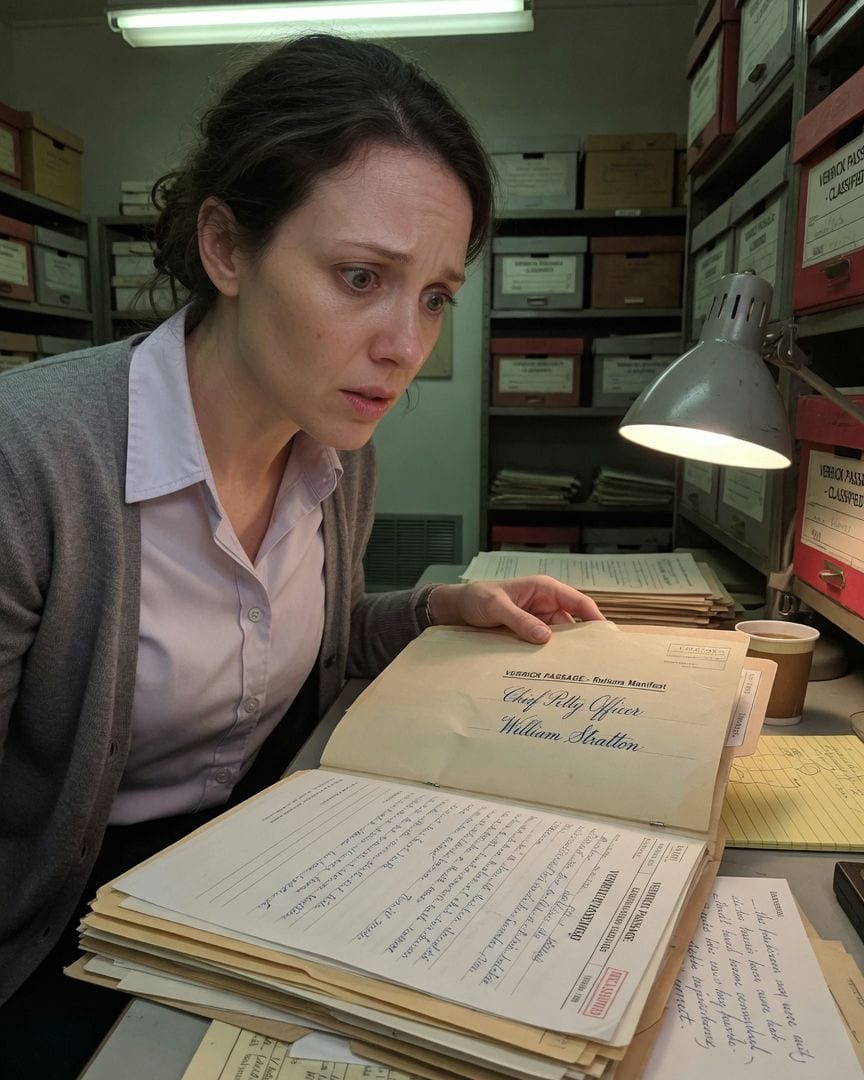
A records reviewer found personnel files for men lost 80 years ago, still being signed in an identical, perfect hand.
In the sterile hush of the declassified archives, meticulous reviewer Ione Fash had a routine task: cross-referencing witness statements from the Verrick Passage file. But as she reviewed files eighty years thick with official silence, she found nine separate interviews containing the exact same chilling sentence, all in an identical, precise hand. Her rational mind sought explanation, yet then she discovered something worse: personnel files for men lost in 1943, still being updated with modern requisitions and payroll runs. Each impossible entry, including a manifest signed just two weeks ago by a casualty from eighty years prior, bore the same unnervingly perfect signature. The file wasn't just a record of the lost; it was still being signed.
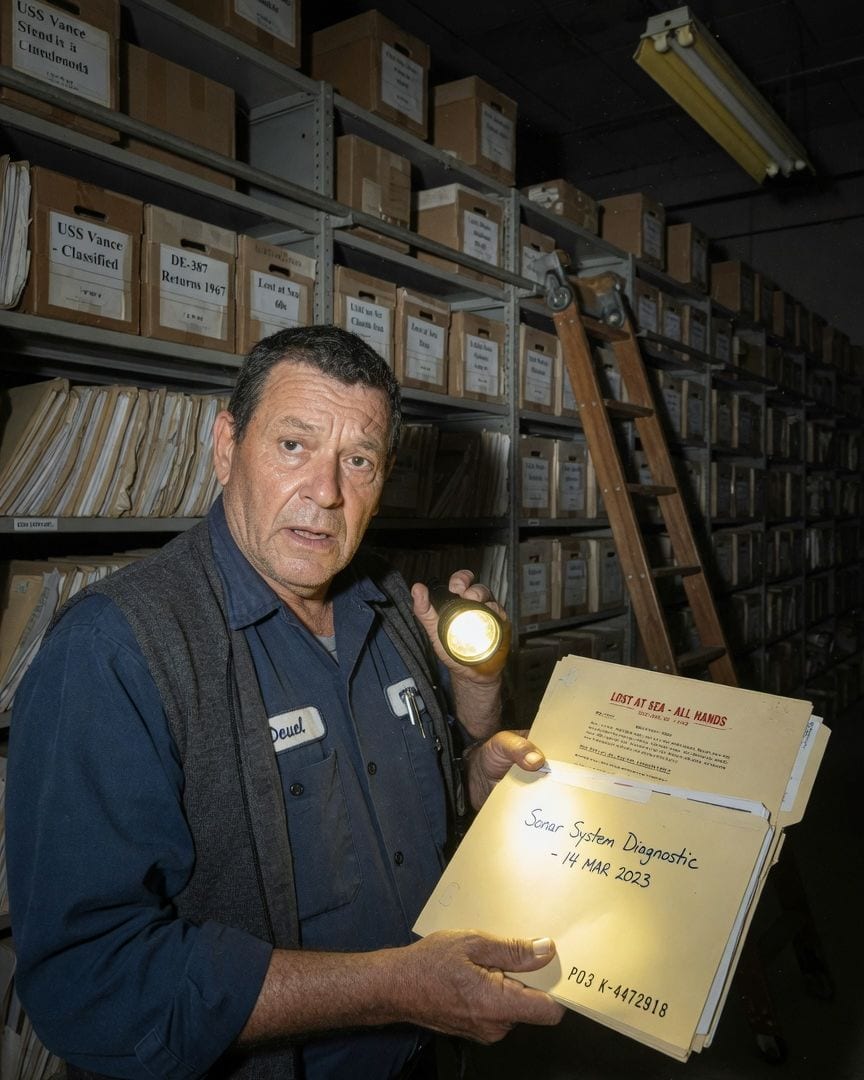
An archivist, alone in the Suitland annex, finds a 1968 lost Cold War ship file with a handwritten entry dated last Tuesday. The ink looks damp, but feels dry.
Carmine Deuel, 62, spent forty years amidst the dust and forgotten files of the Suitland annex. One night, alone in the cavernous space, a sticky squeal and the faint sway of a rolling ladder broke the silence. He found a classified file from the USS Vance, a ship lost in 1968, pulled from its shelf. Inside, a typed form held a handwritten entry: a routine sonar check, dated last Tuesday. The ink, impossibly, looked damp yet was perfectly dry. Who had accessed the file, and how could its entry be so recent?
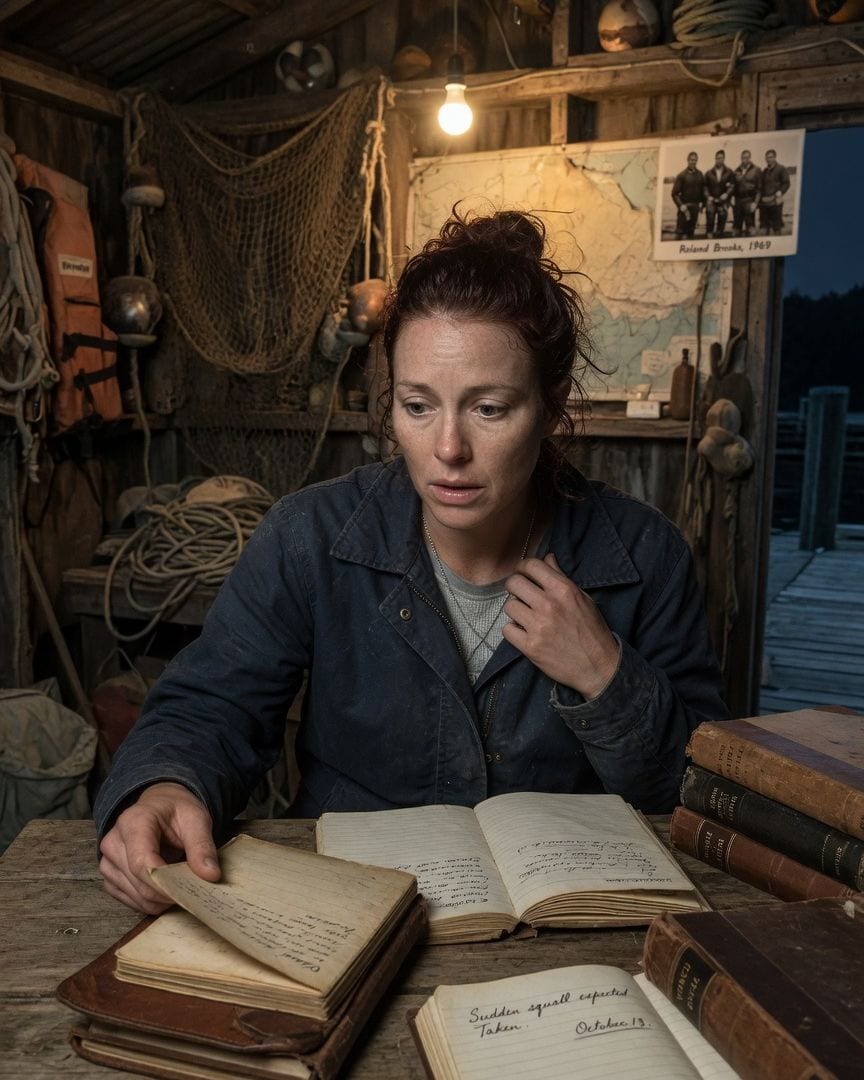
Tomorrow's gale was already written in the skipper's logbook — in his dead father's handwriting. His father drowned off that boat in 1969, and I'd whistled aboard.
My new deckhand job on the fishing boat was simple, until I saw Skipper Henry’s logbook. For *tomorrow’s* date, his dead father’s unmistakable handwriting had already scrawled “Gale Warning. Heavy Seas.” and “Payment Due.” The man drowned decades ago, and the entry leaves me cold.
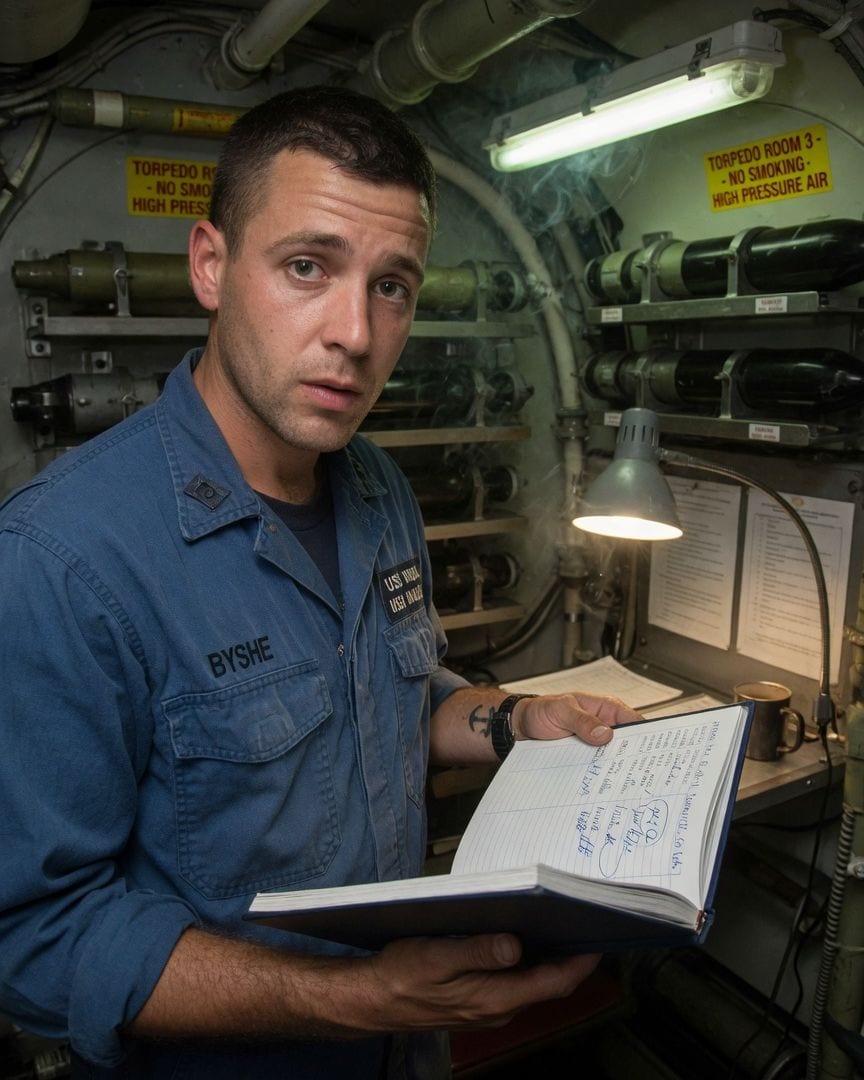
A torpedoman found his own signature in the USS Vanguard's duty log for a watch he never stood, beside a name not on the master crew manifest.
Torpedoman Oscar Bysshe, a rational sailor on his first deep patrol aboard the USS Vanguard, dismissed the messcook's nervous claim of an extra man at the table. He attributed the perfectly clean, untouched tray left behind to a prank. But later, during a routine systems check, Bysshe discovered his own familiar signature in the official duty logbook, for a watch he had been asleep through. Beside it was a name he didn't recognize, a name that shouldn't be there. A frantic check of the master crew manifest confirmed the impossible: the name appeared in the 'temporary assignments' section, dated just yesterday, scrawled in a hand eerily similar to his own.