On a final survey, a Coast Guard lieutenant spots smoke from a Cold War station abandoned since 1996. Its mess hall is set for dinner.
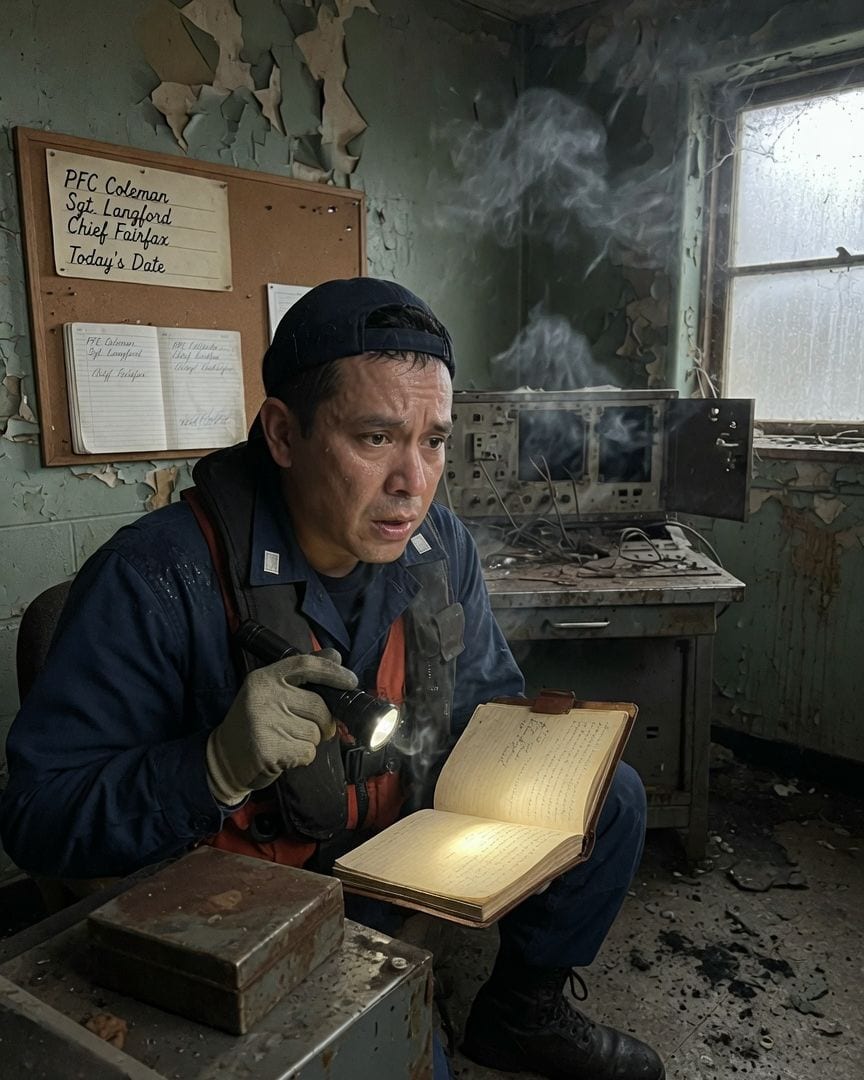
The Coast Guard buoy tender's launch cut through the Aleutian fog, its engine a muffled thrum against the vast silence. Lieutenant Victor Ferro, Executive Officer of the tender, scanned the shoreline of the long-abandoned LORAN station.
Its tower was a skeletal ruin, quarters stripped, a derelict monument to a bygone era. Their mission was a final survey before demolition, a formality, a last check of a forgotten outpost.
But as the boat neared the black-sand beach, Oscar Fairfax, the boatswain's mate, pointed.
"Sir, look."
From the galley stovepipe, a thin plume of grey smoke curled lazily into the damp air. Ferro stared, a cold knot tightening in his gut. The station had been officially decommissioned in 1996, abandoned for nearly thirty years.
No one should have been there.
The three-man shore party, with Ferro leading, landed in silence, their boots crunching on the volcanic sand. The smoke was undeniable, a faint scent of stale coffee and woodsmoke now carried on the wind, a strange, impossible invitation.
Weapons at the ready, they moved inland, past the collapsed antenna array and the peeling paint of the main building. The galley door, which should have been boarded shut and locked by heavy chains, stood ajar.
Inside, the mess hall was eerily neat. Tin plates and mugs were set on the long communal tables, as if awaiting a meal. A battered coffee pot sat on a cold stove, still emitting a faint, metallic tang.
The air, despite the open door, felt unnaturally still, trapped. On a corkboard near the door, a watch bill was tacked up, its paper crisp, the ink still dark and fresh. Ferro pulled it down, his brow furrowing.
The names listed for the current duty section – a 'PFC Coleman,' a 'Sgt. Langford,' and a 'Chief Fairfax' – were not his men, nor anyone he recognized from official Coast Guard rolls, current or past.
Beneath it, an open, official-looking station log lay on a small desk, its pages turned to the current date, with the same impossible names signed across it. Ferro checked the date again, then the names against his internal roster.
The discrepancy was stark, chilling. He ruled out squatters; no one would set up such a meticulous, official-looking charade.
Ferro tried to rationalize it: a prank by a former crew, perhaps, or a very dedicated, very strange squatter attempting a historical reenactment. But the meticulousness, the official log, the freshness of it all didn't fit.
He sent Simon Coleman and Brandon Langford to secure the perimeter, keeping Oscar Fairfax with him. They moved through the empty barracks, then the radio room.
Every piece of equipment had been stripped decades ago, wires torn from the walls, consoles just empty husks. Yet in the radio room, tucked behind a loose access panel near a rusted, defunct console, Fairfax's flashlight beam found something.
A small, tarnished metal box, its surface pitted with corrosion. Ferro pulled it free, the hinges groaning in protest, the sound amplified in the dead air of the room.
He pried open the lid, revealing a brittle, leather-bound journal inside, its pages filled with elegant, faded script. The date on the first visible entry was 1957.
Back on the buoy tender, Ferro locked the journal in his cabin.
He spent the next few hours poring over the old logbook and the new watch bill, then cross-referencing every name with official Coast Guard personnel manifests, both current and historical. Nothing. The names — 'PFC Coleman,' 'Sgt.
Langford,' and 'Chief Fairfax' – simply did not exist in any record associated with the LORAN chain or any other US military branch. The silence from the Coast Guard archives office on his secure line was deafening.
He called the ship's comms officer, requesting a deep dive into archived decommissioning reports for the Aleutian LORAN stations. The response was definitive: no personnel had been assigned to the island since 1996.
The station was a dead zone, a ghost on the books.
Growing increasingly uneasy, Ferro turned to the 1957 journal. The entries, written by a Lieutenant Commander Henry Winslow, detailed the daily life of the station, but interspersed with mundane observations were increasingly frantic notes about 'discrepancies.'
Winslow wrote of 'extra' men appearing in formation, of radio checks receiving replies from call signs not on the roster, of 'the count' coming out 'plus one' no matter how many times he ran it.
The fog, Winslow noted, was always thickest then. Ferro felt a chill that had nothing to do with the Aleutian weather. He had to find out if anyone knew anything about Winslow or these alleged 'ghost' crews.
The old pages crackled under his touch, the paper thin as a promise.
Ferro’s investigation wasn't going unnoticed.
While he was absorbed in the journal, a faint, garbled transmission crackled over the buoy tender's secure net – a voice, just barely intelligible, repeating a series of numbers that matched the duty roster from the phantom logbook.
The comms officer, a seasoned veteran, swore it was impossible: no other vessel or station was in range, and the numbers were gibberish.
Later, back on the island to retrieve more equipment, Ferro found the galley door, which he had personally secured with a padlock, standing open again. The lock lay smashed on the ground.
Inside, the tin plates on the mess table had been rearranged, one of them turned upside down, a small, deliberate act of defiance.
A fresh, almost imperceptible scent of woodsmoke hung in the air, though the stove was cold and inert.
He felt a prickle on the back of his neck, the distinct sensation of being watched. He scanned the empty, fog-shrouded barracks, his hand instinctively going to his sidearm. Nothing.
Just the vast, oppressive silence of the island, a silence that now felt heavy, observant. But the message was clear: someone, or something, knew he was digging.
He decided to reach out to Ruth Winslow, Henry Winslow's daughter, a retired Coast Guard archivist he'd found listed in an old service record. He knew he was stepping into something far beyond protocol.
Ruth Winslow, a sharp-eyed woman of 72, met Ferro in a small café in Kodiak. Her hands, gnarled with age, held a steaming mug of coffee.
She listened patiently as he recounted his findings: the impossible smoke, the set mess, the phantom log, her father's journal, the impossible radio transmissions, the re-opened door. When he finished, she didn't dismiss him.
Her eyes, the same piercing grey as her father's in an old photo, met his.
"My father wasn't crazy, Lieutenant," she said, her voice quiet but firm, cutting through the clatter of the café. "He tried to tell them. They called it 'fog madness,' a common affliction on isolated LORAN stations."
She pulled a worn leather pouch from her purse. "But he kept records. Not just the journal. He had a theory. He believed the station… it wasn't just a building. It was a kind of anchor.
He said that when the fog rolled in, thick as soup, the station would… shift." She produced a brittle, yellowed diagram, hand-drawn by her father.
It showed the LORAN station, but overlaid with strange, swirling lines and a series of dates, annotated with 'plus one' or 'disappeared.'
"He believed the station would periodically pull in, or perhaps duplicate, crews from other times, other places.
Or maybe," she paused, her gaze distant, looking past Ferro as if seeing decades into the past, "it was drawing from a pool of those who had already vanished there. He recorded three major cycles before he was forcibly retired."
The diagram showed patterns of dates, often 15-20 years apart, each marked by similar anomalies. Ferro felt the pieces click into place, the impossible names from the present-day log echoing the 'extra men' from Winslow's 1957 entries.
The count that wouldn't reconcile was a recurring nightmare, a pattern across rotations and dates, across time itself. The chill that had started in his gut now spread through his veins.
Ruth Winslow then produced a final, smaller, even more fragile slip of paper from her pouch. Her hands trembled slightly as she laid it on the table.
"This," she said, her voice barely a whisper, "was the last thing my father ever wrote in his journal. He said it was a 'premonition.'
A final watch bill, he called it, for a crew that vanished shortly after he was pulled off duty."
Ferro took the paper, his hands trembling. It was a crude drawing of a watch bill, similar in format to the one he’d found in the galley. It listed a duty section, with familiar-sounding surnames: Coleman, Langford, Fairfax.
And then, scrawled beneath them, in a hand eerily similar to his own, was a new, impossible entry. 'XO V. Ferro – Bridge Watch – 0200-0600.'
The date on the slip was for the following morning, the exact date his buoy tender was scheduled to leave the island.
Outside the cafe window, the fog, which had been light when he arrived, began to thicken, obscuring the distant mountains of Kodiak.
Back on the island, the fog had completely enveloped the LORAN station, a silent, swirling whiteout. Ferro, ignoring his crew’s protests, had ordered them back to the station. He had to prove it, or perhaps, disprove it.
The 'final watch bill' from Winslow's journal wasn't a premonition; it was a blueprint, a schedule. He found the original 1957 watch bill in the old journal, matching the names.
Then he compared it to the 'fresh' watch bill he'd found earlier in the galley. The names were variations, echoes. 'PFC Coleman' and 'Sgt. Langford' in 1957, and now his own men, Oscar Fairfax, Simon Coleman, Brandon Langford.
The station wasn't just pulling in phantom crews; it was completing a cycle. It was taking real crews and either duplicating them or replacing them, adding them to its own impossible roster.
The 'plus one' count Winslow had written about was the station itself, or the anomaly, adding itself to the roll, or absorbing the next victim.
Ferro realized the smoke from the stovepipe, the set mess, the freshly posted watch bill were not for some abstract phantom crew, but for his crew.
The station was preparing for them, had always been preparing for them, following a pattern set decades ago.
The names on the log, those impossible names, were the station's record of those it had claimed, or those it was about to claim. And his name was now on that list, for tomorrow morning.
Ferro found his men in the galley, huddled around the cold stove, their faces grim in the dim light of their flashlights. The room felt colder than outside, the silence thick and humming.
"We're leaving," he announced, his voice tight, rough. "Now. Don't touch anything. Don't look back." As they moved towards the beach, the fog pressed in tighter, swallowing the faint outline of their buoy tender.
The radio on Ferro's belt crackled, a distorted voice calling, "XO Ferro, report for bridge watch, 0200-0600." It was his own voice, yet subtly wrong, warped by distance and something else utterly alien. He ignored it, urging his men faster.
The path to the beach seemed to stretch, the familiar landmarks blurring into the white. Oscar Fairfax stumbled, falling to his knees, his face pale. "Sir, my compass is spinning!" Simon Coleman swore, pointing into the swirling mist.
"I hear something. Footsteps. Coming from the barracks." Ferro spun around, seeing nothing but the impenetrable white. He felt a profound sense of disorientation, the island itself seeming to shift beneath their feet, trying to hold them.
He pushed his men forward, the cold dread turning to stark terror. They reached the beach, the surf a distant roar, barely audible through the fog. The launch, anchored just offshore, was a dark silhouette, a desperate promise.
As they waded into the icy water, Ferro felt a hand close on his shoulder from behind, cold and firm, impossible. He didn't turn. He couldn't.
He just pushed his men into the boat, his eyes fixed on the distant, fading lights of the tender.
The buoy tender eventually found the shore party, adrift in their launch, several miles from the LORAN station, their compasses useless, their faces etched with a shared, unspeakable fright.
The station itself, when they returned to demolish it a few weeks later, appeared just as it always had: derelict, stripped, no signs of smoke, no set mess, no logbook.
The official reports noted a 'brief navigational anomaly' and 'fatigue' among the shore party. Lieutenant Victor Ferro was transferred shortly after, citing 'personal reasons.'
The incident was closed, filed away as another strange tale from the isolated Aleutians, dismissed by those who had never seen the fog.
Months later, in a quiet office far from the fog-locked islands, a new XO sat at his desk, reviewing incoming personnel manifests. He paused, frowning.
A new name had appeared on the roster for a remote LORAN station being recommissioned for a scientific outpost: 'Victor Ferro, XO.'
The entry was dated for a year in the future, and beside it, a small, handwritten note read, 'plus one.'
His eyes, when he returned, were the same grey as the Aleutian fog, and he never once used his own name again.
If this one got to you
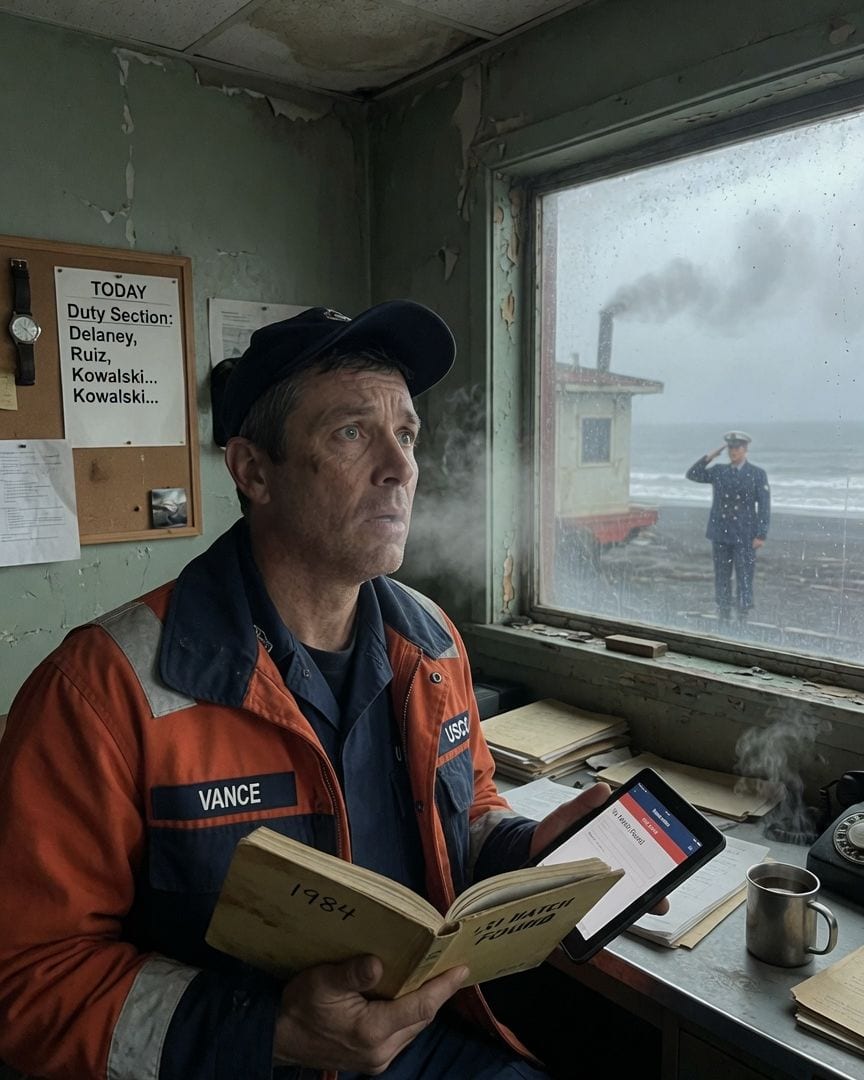
A Coast Guard XO's final survey found an abandoned Cold War LORAN station's stovepipe smoking, forty years after a man vanished.
Lieutenant Harold Vance, XO of the USCGC Whitfield, led a final survey mission to a remote Aleutian LORAN station, slated for demolition after years of dereliction. The fog-locked island was a stark silhouette as their boat approached, marking the station's lonely end. But as they neared the black-sand beach, Vance spotted a faint wisp of smoke curling from the galley stovepipe – impossible for a building stripped and abandoned since 2010. Ashore, the impossible scent of coffee filled the air. Inside, the mess hall was set with trays, a fresh watch bill, and a logbook dated today, listing unknown names. His unease grew when a second logbook revealed a signature from Lieutenant Commander Richard Delaney, reported MIA from this station four decades ago, with a chilling final entry.
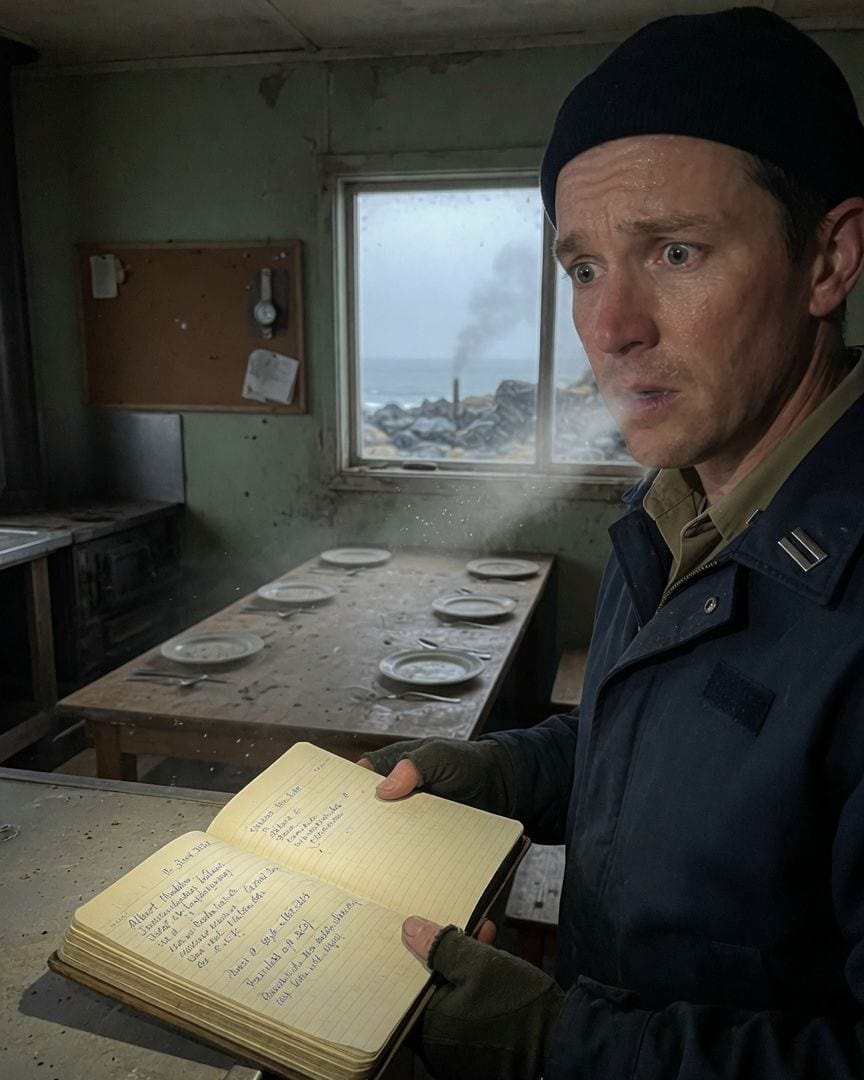
Coast Guard Lieutenant Thatcher finds an old crew photo dated today, June 15, 2024.
Lieutenant Daniel Thatcher leads a survey crew to a derelict LORAN station in the frigid Aleutians, officially abandoned for over a decade. But as they enter, a heavy-bound station log lies open on a counter, its ink startlingly wet, detailing a routine watch from today with names unknown to the Coast Guard.
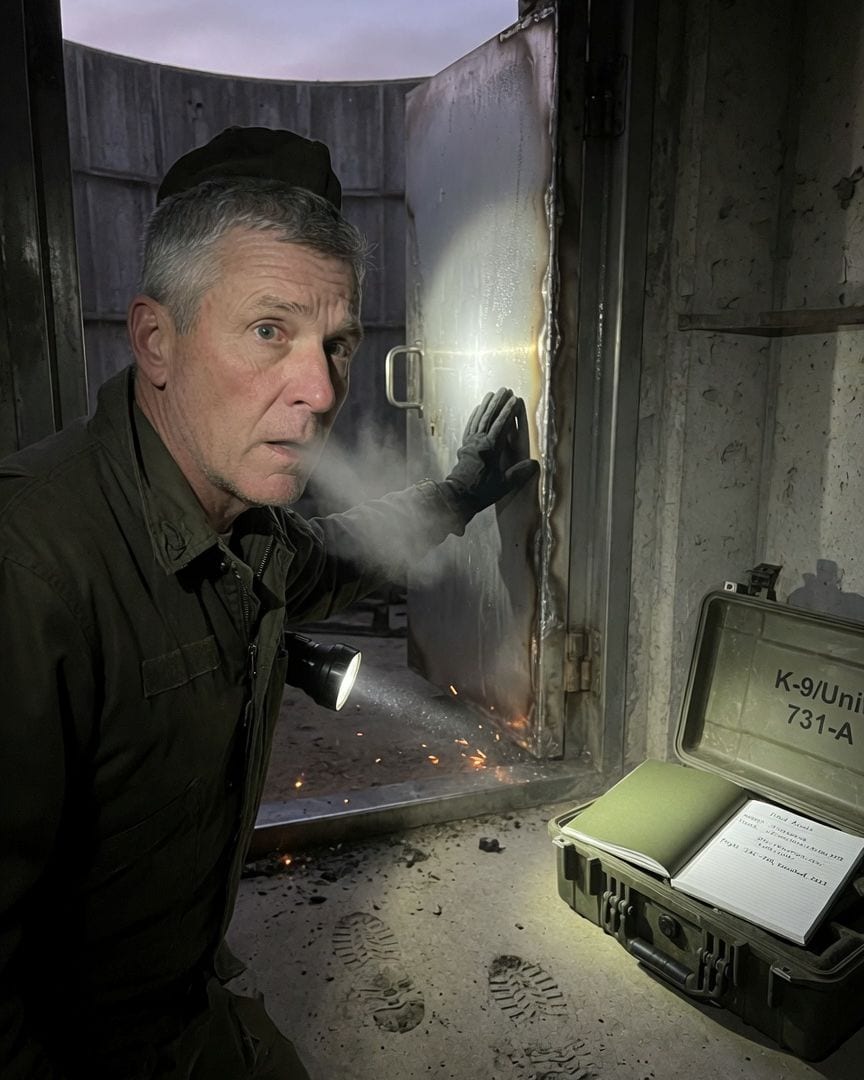
The Cold War silo was welded shut in 1968. A Captain found lights burning, fresh prints leading inside, and a logbook with a vanishing from last week.
Captain Merrit Sable faced a deadline at Silo K-9: one cold morning to retrieve classified hardware before its scheduled demolition at noon. The silo, officially welded shut by the Air Force in 1968 and long off-grid, should have been a tomb of forgotten machinery. Yet, through a cracked port, he saw nine work lights burning steadily forty feet down, and felt the faint suction of an active ventilation system. After breaching the decades-old weld, Merrit found more than just lights; fresh boot prints led deeper into the meticulously clean shaft, but none returned. A hidden compartment in an empty, warm hardcase revealed a logbook, its crisp pages detailing notorious military disappearances, with the latest entry dated just last week.
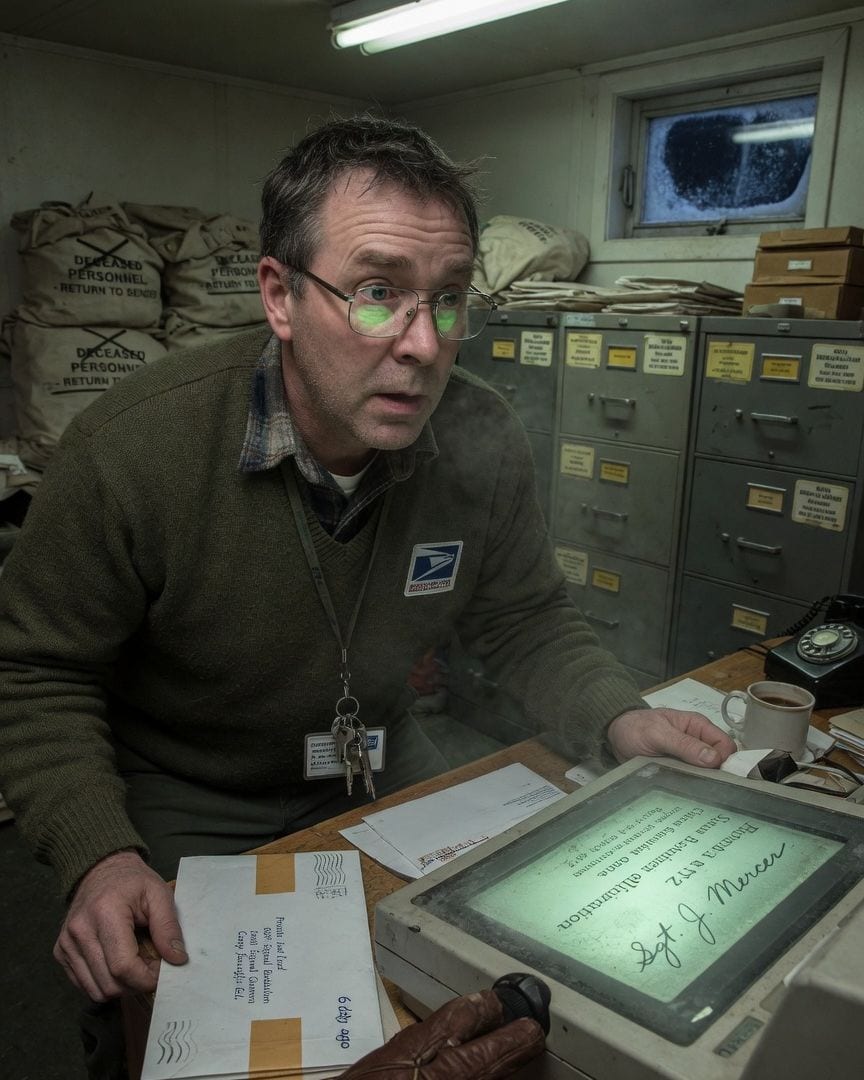
A postmaster at a Cold War Alaskan outpost still received mail for soldiers declared dead in 1969. Then he found their base was active three years later.
Postmaster Rowan Ashcroft had spent two decades watching the weekly mail plane land at Camp Bidwell Annex, a lonely outpost in the bitter Alaskan wind. His methodical mind, accustomed to order, was jolted when the latest mail sack contained forty-three letters for men officially declared dead in 1969. Each envelope, postmarked within days, was addressed to a soldier who wasn't coming back, and Rowan found one already opened and neatly resealed. Driven by duty, he began to sift through declassified Army archives, only to uncover a chilling maintenance log entry for the camp's equipment, dated three years after the base was officially shuttered. What was still happening at Camp Bidwell?
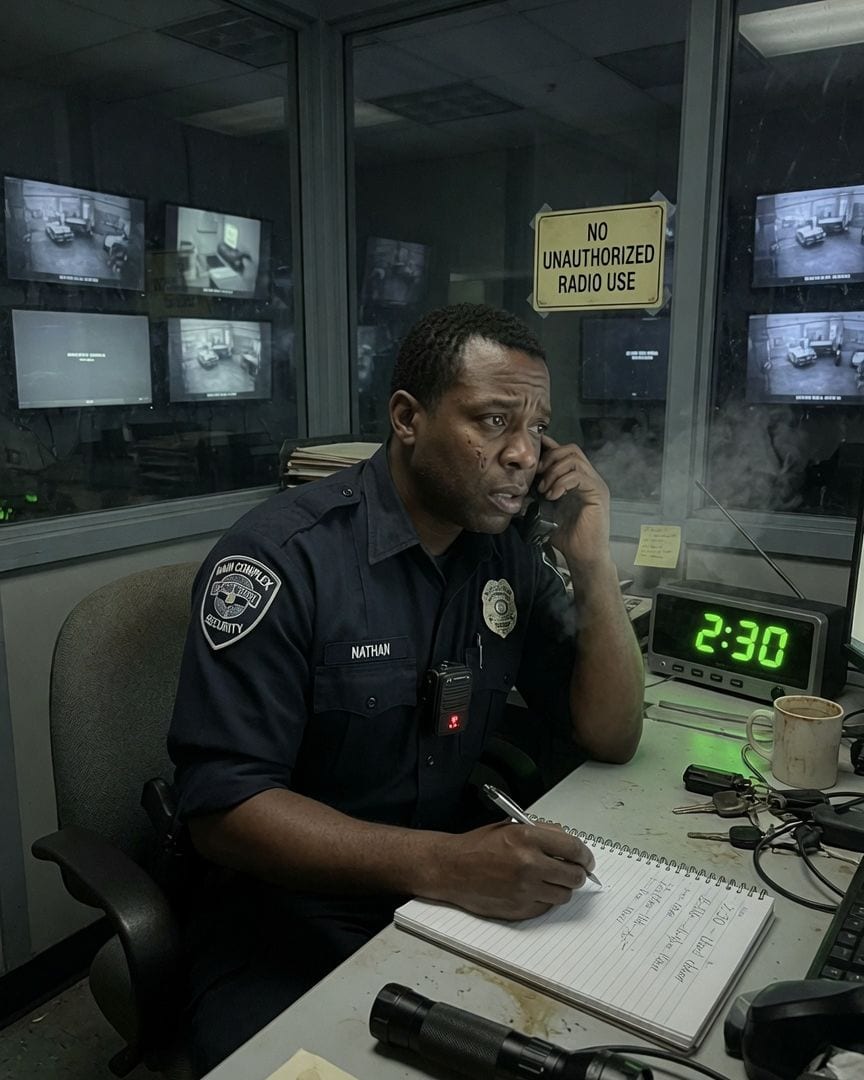
I radio Cole every night. My supervisor says his dock post was cut two years ago, and no Cole exists. But I just found Cole’s old logbook.
My graveyard shift usually consists of monotonous hourly check-ins with Cole, the guard at the loading dock. But my supervisor just revealed that the dock post was cut two years ago, and no one named Cole has ever worked for the company. I've been talking to someone who simply isn't there.
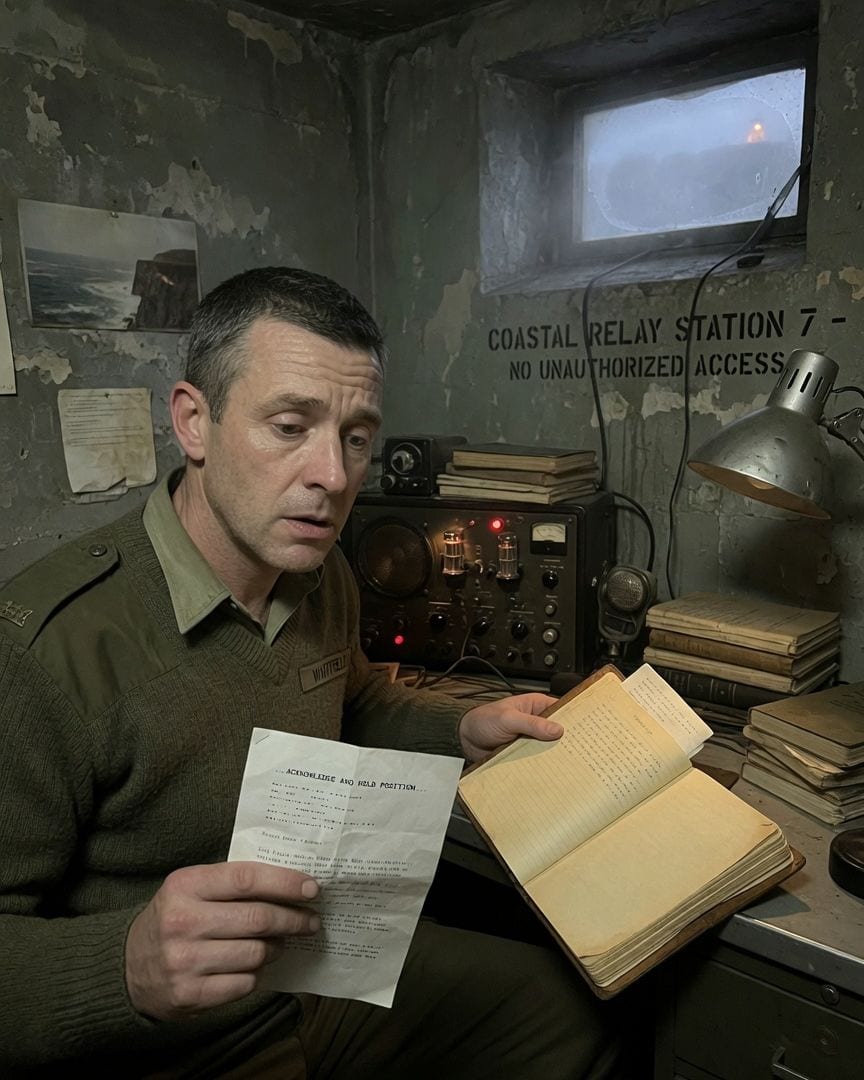
A corporal on his last watch decoded a Morse order for his station. It was sent forty years ago, for *this* very night.
Corporal Greg Whitfield stood watch on one of the final nights before his old coastal relay station was mothballed. The fog-bound English coast echoed with the lonely boom of the sea, the bunker's ancient equipment humming its last familiar tune. Suddenly, a burst of Morse code cut through the static on a long-dead frequency, an impossible convoy sighting for a shipping lane closed for forty years. Decrypted, the message named his exact station and tonight's date, instructing the operator to acknowledge and hold position, no matter what. Later, a dusty archive revealed a logbook entry from precisely forty years ago, recording the same message, acknowledged by a Private Barlow, followed by a chilling blank page. What happened to the last operator who acknowledged a forty-year-old ghost order?