Coast Guard Lieutenant Thatcher finds an old crew photo dated today, June 15, 2024.
The USCGC Narwhal’s launch cut through the frigid Aleutian swells toward the derelict LORAN station, its engine a steady thrum against the vast silence of the sea.
Lieutenant Daniel Thatcher, the buoy tender’s Executive Officer, stood at the bow, his hands gripping the rail, his breath pluming white in the biting cold air.
His orders were clear: survey the site, officially abandoned since the LORAN chain was decommissioned in the 2010s, its towering antenna dismantled years ago, its quarters supposedly stripped.
But as they neared the desolate, rock-strewn beach, a thin, ethereal wisp of gray smoke curled from the galley stovepipe, rising against the stark, cloud-heavy sky, dissolving quickly into the endless expanse above.
Thatcher’s hand went up, a silent, urgent command for the boat crew to hold position. The launch’s engine died with a sigh, leaving only the rhythmic lapping of waves against the hull and the distant cries of gulls.
He scanned the station with his binoculars, a knot tightening in his stomach. No boat, no fresh tracks on the sand, no obvious sign of life beyond that impossible plume, a smudge on the otherwise desolate landscape.
"Bennett, Lambert," Thatcher said, his voice low, a controlled edge to it. "Arm yourselves. We’re going in." Boatswain's Mate George Bennett and Quartermaster Grace Lambert nodded, their faces grim under their helmets, their movements precise as they secured their sidearms.
They secured the boat, then followed Thatcher up the craggy incline to the station’s main building. The heavy steel door hung ajar, groaning faintly on its hinges in the gentle breeze.
Inside, the air was still and cold, a damp chill that seeped into their bones, yet a faint, incongruous scent of stale coffee and something like burnt toast lingered, ghosting in the quiet corridors.
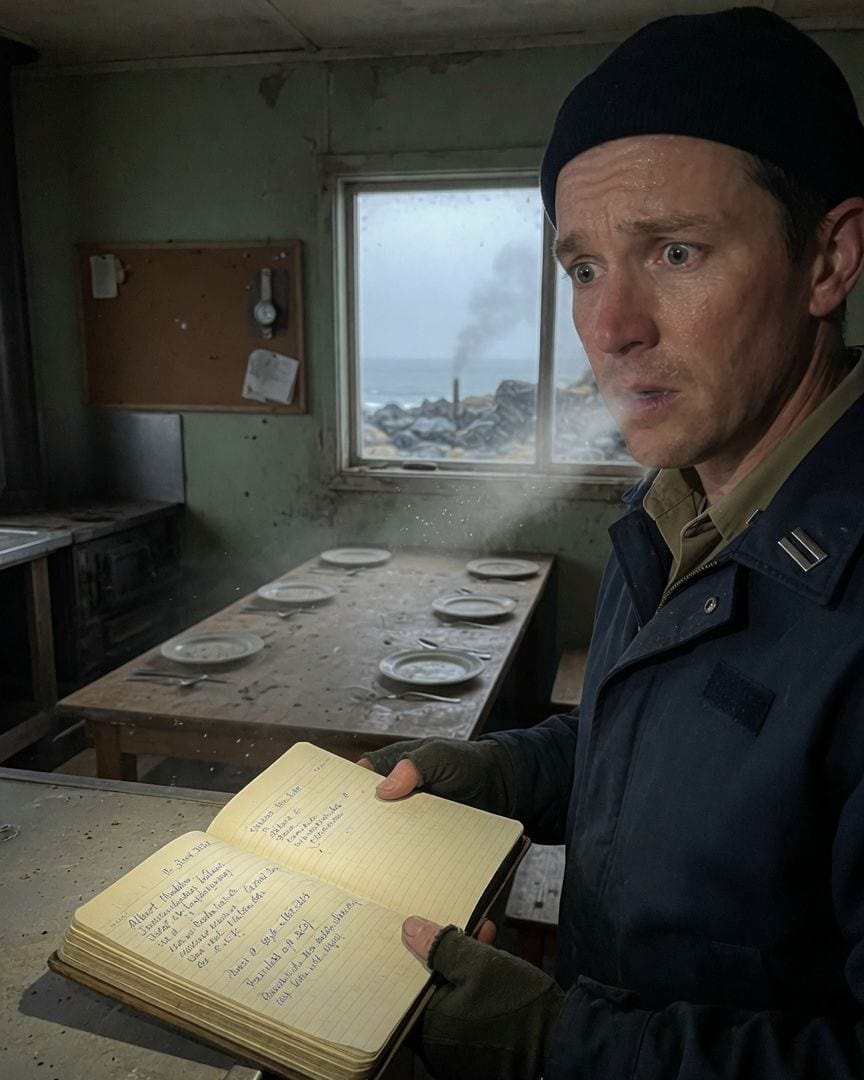
They moved cautiously through the silent hallways until they reached the mess hall. The room was unsettlingly ready.
Plates and cutlery were aligned with military precision on a long wooden table, each setting perfectly spaced, as if a meal was imminent. A watch bill, stark white against the faded corkboard, was pinned prominently, dated today, June 15th, 2024.
It listed names: Albert Maddox, Josephine Vaughn, Julian Rutherford. Thatcher knew, with a sudden, sickening jolt, that the Coast Guard’s official personnel rolls had never held these names in recent history.
A single, heavy-bound station log lay open on the counter, its pages smooth, its ink still startlingly wet, detailing a routine 0800-1200 watch with those same impossible names.
Thatcher’s survey crew moved through the silent station, their flashlights cutting through the thick gloom. Dust motes danced in the beams like phantom snowflakes, a stark contradiction to the fresh-looking entries in the log.
The mess hall was indeed cold, the air stagnant, the plates showing a fine film of grit that the precise setting couldn't hide.
Thatcher ran a gloved finger over a fork; it left a clean streak in the grime, revealing the dull metal beneath.
The stove in the galley, despite the earlier smoke he had witnessed with his own eyes, was cold to the touch.
He pressed his palm against the heavy cast iron, then pulled it away, a distinct, deep chill seeping into his glove. Where had the smoke come from? And why was everything else so desolate, so untouched by recent human presence?
He tried to reconcile the conflicting details, searching for a logical explanation.
"Sir, look at this," Bennett called from the radio room, his voice tight with an unfamiliar tension. Thatcher moved quickly, Lambert close behind, their boots crunching softly on the fine dust covering the floor.
Bennett pointed to a stack of neatly filed message traffic on the console. All recent, all dated within the last week, reporting routine weather conditions and equipment checks to a call sign that hadn’t been active for over a decade.
The console itself was dark, powered down, cold and unresponsive. Thatcher picked up the station log again, its pages stiff and yellowed in places, smelling faintly of mildew and old paper, a testament to its age.
But the current entry, on the topmost page, was shockingly crisp, its ink a rich, dark blue, clearly detailing a 0800-1200 watch performed by Maddox, Vaughn, and Rutherford.
He flipped back, finding entries for months, then years, all in the same firm, distinct hand, always these same names, always reporting routine operations at a station officially decommissioned in 2010.
Thatcher tried to force a mundane explanation into place: a squatter, perhaps, playing a sophisticated prank, or an elaborate art installation.
But the sheer volume of detailed, consistent, official-looking entries, spanning dates the station was definitively stripped and empty, made his stomach clench. This wasn't a prank.
It was a complete, parallel reality documented with impossible precision, right down to the minute weather reports and equipment statuses, each detail mocking logical sense.
A cold, sudden breath seemed to blow through the silent, dusty room, raising the hairs on his neck, despite the absence of any discernible draft.
Thatcher continued to examine the logbook, a cold dread settling over him, an unwelcome weight in his chest.
He ran a gloved finger over the recent entries, the ink still seeming to shimmer faintly, wet and alive, defying the dust and chill of the station.
He flipped further back, past the crisp, impossible logs, into genuinely old, faded pages from the 1970s. The paper was brittle now, crumbling slightly at the edges, the ink a sepia ghost of its former self.
Tucked between two such brittle leaves, he found a photograph.
It was a black and white shot of a LORAN crew, four men posed stiffly in front of a radar dish, their uniforms dated, clearly from an earlier era of the Coast Guard.
Beneath it, scrawled in faded ink, were their names: 'Maddox, Vaughn, Rutherford, and Crewman X.' But the man identified as Albert Maddox, standing front and center, wore something utterly out of place, an impossible anachronism.
It was a modern digital-camouflage watch cap, pulled low over his brow, almost obscuring his eyes, the fabric sharply detailed in the grainy photo.
And the date stamped on the corner of the photograph, in stark, un-faded black ink, clearly read '2024-06-15' — today.
Back aboard the Narwhal, the photograph still clutched in his hand, Thatcher stared at the impossible date, the stark numbers a direct affront to reason.
He locked the logbook and the photograph in his cabin safe, the metal clunking shut with an unsettling finality that echoed in the small space.
He spent the next day in the ship’s small office, methodically cross-referencing every name from the logbook’s impossible watch bills against official Coast Guard personnel records, both active and retired.
Albert Maddox, Josephine Vaughn, Julian Rutherford—he searched for every permutation, every possible record, sifting through decades of data. There were no active service members by those names. No recent retirees.
More disturbingly, he found no records of them ever serving at LORAN Station ADK-7, save for the very old Albert Maddox, a Boatswain's Mate, who had died in 1982. A Josephine Vaughn, a Quartermaster, had been discharged honorably in 1975.
Julian Rutherford remained a ghost entirely, unlisted in any official capacity within the Coast Guard’s meticulous records. The discrepancies were far too precise, far too consistent to be a clerical error.
He ran multiple searches, tried different databases, but the results were uniformly consistent: these were not real people, or at least, not real current Coast Guard personnel assigned to this station in any accountable way.
He requested access to archived anomaly reports, a category usually reserved for strange weather events or equipment malfunctions, focusing specifically on the Aleutian chain.
Commander Wallace, his commanding officer, had raised an eyebrow at the unusual request, a silent question in his gaze, but approved it without further comment.
Thatcher spent hours sifting through digital files, some dating back decades, scanning reports of the bizarre and the inexplicable.
He found dozens of dismissed reports: brief, inexplicable radio chatter from 'decommissioned' stations, unusual power surges detected in remote areas where no infrastructure remained, supply requisitions mysteriously filed for stations long since stripped of their equipment.
Each report had been filed away as 'unsubstantiated' or 'equipment malfunction,' neatly categorized and dismissed. The common thread was their dismissal.
He started to map the dates on a separate spreadsheet, looking for a pattern, a rhythm to the impossible activity. The dates seemed to recur, not annually, but in longer, irregular cycles, always centered around certain isolated LORAN outposts.
A chill began to set in, deeper and colder than the Aleutian wind, a cold that settled deep within his bones.
Thatcher began to feel a subtle shift in his routine, a quiet intrusion that felt almost personal.
His secure terminal, usually private and predictable, started displaying strange pop-ups at odd hours, interrupting his work: 'Review pending request for LORAN Station ADK-7 maintenance logs.' He hadn't initiated such a request, nor had anyone under his command.
He dismissed them, but they kept returning, insistent, like a persistent child. Then, a message appeared in his secure inbox, sender unknown, subject line: 'Operational Readiness.'
The body was a single, cryptic line: 'The watch is relieved only when the next stands ready.' He dismissed it as spam, but a cold prickle ran up his spine. The email's timestamp was from mere minutes ago.
Later that evening, on the bridge, the Narwhal’s long-range radar picked up a faint, impossible blip. "XO, contact bearing 270, range 10 miles," reported the radar operator, his voice tinged with confusion.
"Looks like a small vessel, sir, but it’s not on any AIS. And it’s not moving." Thatcher looked at the screen. The blip was precisely where LORAN Station ADK-7 lay, a fixed point of impossible existence.
He ordered a visual check with the night optics. The operator zoomed in, adjusting for the low light and distance, fighting the atmospheric distortion.
The image was grainy, distorted by the cold air, but clear enough: a lone figure, impossibly tall and thin, standing motionless on the station's concrete pad.
It was looking directly at the Narwhal, a dark, featureless silhouette against the faint, icy glow of the western sky. It didn't wave. It didn't move an inch.
It simply stood, watching them, an unblinking sentinel in the deepening twilight, an unnerving stillness. A shiver, not from the cold, traced its way down Thatcher's spine.
The air in the bridge seemed to thicken, suddenly colder, despite the humming electronics and warmth of the enclosed space.
The next morning, Thatcher confronted Commander Wallace. He laid out the logbook, the photograph with its anachronistic watch cap and impossible date, and the growing list of historical anomaly reports he had painstakingly compiled.
Wallace, a career officer with decades of service etched into the lines around his eyes, listened patiently, his face unreadable, his gaze fixed on the photograph.
"Lieutenant, I appreciate your diligence," Wallace said, picking up the photo with a practiced, careful hand, turning it over as if inspecting its quality. "This is… unusual. Highly unusual. But these are all circumstantial.
Old records, dismissed reports, a strange photograph that could be a hoax or an elaborate bit of mischief." He tried to dismiss it, to frame it in the mundane, but his eyes lingered on the image.
Thatcher pressed, his voice firm, convinced. "Sir, the names, the dates, the consistency across decades. The fresh ink in the logbook at a station that's been stripped bare. The radio traffic. It’s a pattern.
A cycle of something refusing to stay buried, refusing to be decommissioned."
Wallace sighed, leaning back in his chair, the leather creaking softly. He tapped the photograph against his desk, a slow, deliberate rhythm. "There are stories, Lieutenant. Things you don't put in official reports.
Things that happen out here, at the edge of the world, where the land and the sea forget their names and the rules of time get… fuzzy."
He paused, his gaze distant, staring out the porthole at the gray, churning sea, as if recalling something deeply unsettling. "LORAN Station ADK-7. We lost a crew there, back in the late seventies. A routine patrol. Just… vanished.
No distress, no wreckage, no bodies. They searched for months. The official explanation was a rogue wave, a total loss. They rebuilt the station, changed the personnel, tried to move on. But the manifests were never quite right after that.
Always a name that didn't fit, a signature that wasn't authorized, on equipment requisitions or patrol reports that were long after the fact."
He looked back at Thatcher, his eyes suddenly sharp, piercing, holding a profound weariness. "The system tries to account for everything, Lieutenant. Every man, every vessel, every piece of gear. But sometimes… sometimes the system itself gets overwritten.
It forgets a name, then it remembers it again, years later, when it needs to fill a gap. Like a phantom limb that still aches, still demands attention."
The words hung in the air, heavy and cold, settling like a layer of ice over Thatcher's previous assumptions.
The pieces clicked for Thatcher, falling into place with a horrific, sickening precision. The impossible watch bill with its familiar names, the photograph from 'today' with an anachronistic detail, the recurring anomalies that never quite went away.
It wasn't just a lost crew; it was a crew that refused to stay lost, pulled back into duty by the very accountability system that had tried to erase them.
They weren't ghosts in the spectral sense, but indelible records, existing outside of official reality, yet somehow within it. The station was still operational, still manned, still running its watches, a persistent, self-correcting error.
Wallace’s words echoed in Thatcher's mind as he returned to his cabin, the logbook heavy in his hands, its weight feeling immense, almost a burden. 'The system itself gets overwritten.'
He sat at his desk, the cabin silent save for the low hum of the ship and the distant creak of bulkheads. He opened his laptop, logging into the secure Coast Guard portal to check his own service record.
It was a routine he performed almost daily, a habit of a squared-away officer, a way to maintain control and order in a chaotic world. He navigated through the familiar screens: deployments, commendations, training records.
Everything was as it should be. His last deployment, his most recent physical, his next scheduled leave. All correct, all verifiable.
But as he scrolled down, a new section caught his eye, one he'd never seen before on his own record, one that simply appeared from nowhere, labeled 'Temporary Duty Assignments.' His heart lurched, a sickening jump against his ribs.
Underneath, a single entry had appeared, stark and impossible against the familiar data: 'LORAN Station ADK-7, Aleutian Chain, 2024-06-16 to Present.' Today was June 15th. The entry was dated for tomorrow.
Below it, a new commendation, one he had never received, had materialized: 'For exceptional diligence in maintaining operational readiness under adverse conditions.'
It was signed with his own digital signature, dated just hours ago, for a deployment he never made, to a station he was only supposed to survey.
His name was now on a record that swore he was already there, part of the impossible crew, already serving a watch that hadn't yet begun.
The cabin seemed to grow colder, the porthole reflecting his face back at him, pale and drawn in the screen's blue light, a stranger looking back.
Thatcher stared at the screen, the blue light reflecting in his wide, disbelieving eyes, blurring the impossible words. His own digital signature. The system hadn't just 'forgotten' names; it had a chilling, insidious mechanism to fill them.
A profound, coherent logic settled over him, cold and complete.
This was not an external haunting, not a spectral presence, but an internal one, a glitch in the very fabric of official record-keeping that had taken on a terrifying life of its own, a self-perpetuating duty cycle.
He tried to delete the entry, his fingers trembling as he clicked the 'remove' button, desperate to erase the impossible. The system returned an immediate error: 'Unauthorized modification attempt. This record is locked.'
He tried to log out, to break the connection, to escape the digital trap, but a pop-up blocked his path: 'Confirm duty status at LORAN Station ADK-7 before exiting.'
He was trapped within the digital record, a prisoner of a system that now claimed him, already on the books.
He remembered Wallace’s words, a cold whisper in his mind: 'The watch is relieved only when the next stands ready.'
The previous crew, the Maddoxes and Vaughns, were not just ghosts, but placeholders, their names etched into the anomaly's internal log, cycling through their duties, waiting for relief.
The 'decommissioned' station was merely a façade, a gap in official accountability that the anomaly exploited, a silent, ravenous maw consuming what was left behind, always demanding a presence.
It wasn't about a specific person, a living soul, but about maintaining the 'duty' itself, the continuous, unbroken operation of the LORAN station, even if by impossible means, with impossible personnel.
The figures on the watch bill were not names of individuals, but roles to be filled, a constant requirement for 'operational readiness' that superseded all logic. And now, Thatcher's name was officially designated to fill one.
His identity, his entire career, had been overwritten, slotted into a loop of endless, forgotten duty from which there was no escape.
A chilling calm settled over Thatcher, a profound acceptance that was far more terrifying than any panic. He picked up the secure satellite phone, his hand steady, the cold plastic a strange comfort.
His initial intention was to make one last, desperate call to Command, to report the impossible truth, to scream into the void of official channels, to warn someone, anyone.
But as he dialed the familiar sequence, the phone crackled, not with a dial tone, but with a distorted voice, familiar yet alien, speaking directly into his ear.
It was a voice he dimly recognized as his own, yet it was layered, echoing, like a recording played through static, detached and emotionless. 'Lieutenant Thatcher,' it said, flat and devoid of warmth. 'Your relief has arrived.
The watch is yours.'
He dropped the phone. It clattered to the floor, the static-laden voice continuing to speak, though he could no longer make out the words through the distorted white noise.
He knew, with absolute, gut-wrenching certainty, that the figure Bennett had seen on the concrete pad, the one watching the Narwhal through the night optics, had been him. Or rather, his 'relief.'
The version of him already subsumed into the system, already on duty, waiting to complete the cycle. He looked at his reflection in the dark porthole, searching for some sign, some outward change that would betray the profound alteration within.
His face seemed subtly different, a little gaunter, perhaps, his eyes holding a deeper, unblinking intensity, as if he had already seen too much, understood too much, as if a part of him had already been consumed.
His uniform, too, felt subtly wrong, stiff and unyielding, as though it were the uniform of a different man. He knew he had to get back to the station.
Not to escape it, not to fight the impossible, but to take his place. To relieve the watch.
He moved to the door of his cabin, each step feeling less like his own, more like a programmed motion.
The weight of his service record, now rewritten, stretched before him, an inescapable gravity pulling him toward the open sea, toward the distant, impossibly manned station. He had to relieve the watch. He had to assume his post.
The email's message, 'The watch is relieved only when the next stands ready,' now made terrifying, absolute sense. He was ready.
Lieutenant Daniel Thatcher never returned from the survey of LORAN Station ADK-7. His launch was found adrift a day later, empty, bobbing gently in the frigid swells, a silent testimony to his disappearance.
The USCGC Narwhal conducted an exhaustive search, its radar sweeping the desolate coastline, its crew combing the rocky shores. They found no trace of him. His service record, however, remained curiously complete.
A 'discrepancy' for a brief period of 'unaccounted for' time, quickly noted and just as quickly resolved, followed by a transfer to 'Special Operations - Classified.'
Commander Wallace, upon reviewing the final reports, simply closed the file, the barest hint of a troubled look on his face, a secret he would carry alone. The LORAN station, once again, was officially 'unmanned.'
The digital watch bill cycled, its names re-ordering themselves, waiting.
A week later, a new junior officer, Ensign Howard Thornton, was assigned to the Narwhal as the new Executive Officer.
During his initial in-brief, familiarizing himself with the ship’s logs, he noticed a faded, almost imperceptible entry in the ship’s bridge log, tucked away between routine reports of weather and engine checks: 'LORAN Station ADK-7, Aleutian Chain.
Patrol conducted, station operational. XO Thatcher.' The date beside it was two days after Thatcher was reported missing, two days after he was officially gone. He paused, his brow furrowed in confusion, rereading the line. This seemed wrong, deeply contradictory.
Lieutenant Thatcher was gone. He mentioned it to Commander Wallace, holding open the thick, paper logbook, his finger pointing to the entry.
Wallace paused, running a hand over his chin, his gaze distant for a moment.
He then looked at the young ensign, a faint, almost imperceptible smile playing on his lips, a smile that didn't quite reach his eyes, holding an unsettling composure. "Is that so?"
If this one got to you
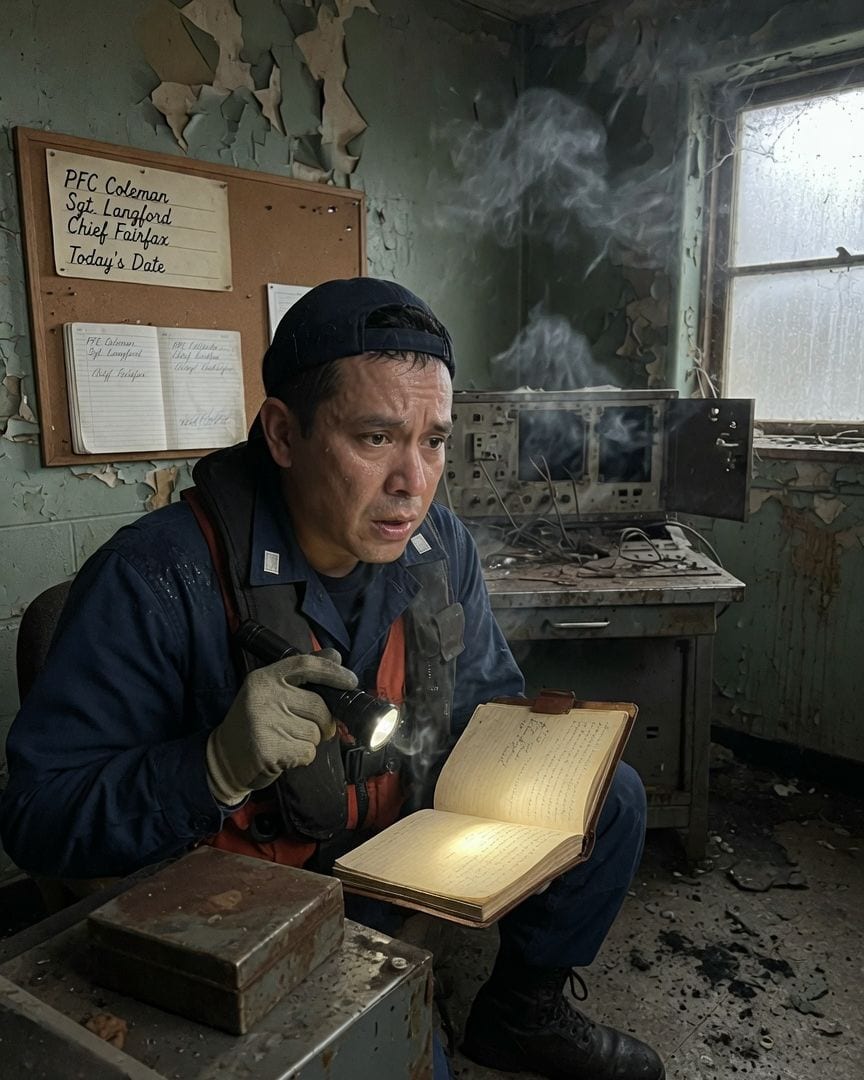
On a final survey, a Coast Guard lieutenant spots smoke from a Cold War station abandoned since 1996. Its mess hall is set for dinner.
Lieutenant Victor Ferro led a final survey team to a long-abandoned LORAN station in the desolate Aleutian fog, a last check before its demolition erased it from memory. But as their boat neared the black-sand beach, a thin plume of smoke curled from the galley stovepipe – from a station officially decommissioned nearly thirty years prior. Inside, the mess hall was eerily neat, tin plates set for a meal, and on a corkboard, a crisp, freshly-inked watch bill listed names unknown to any Coast Guard roll, past or present. The station log lay open to the current date, bearing the same impossible signatures. Who was here, and for whom was dinner being prepared?
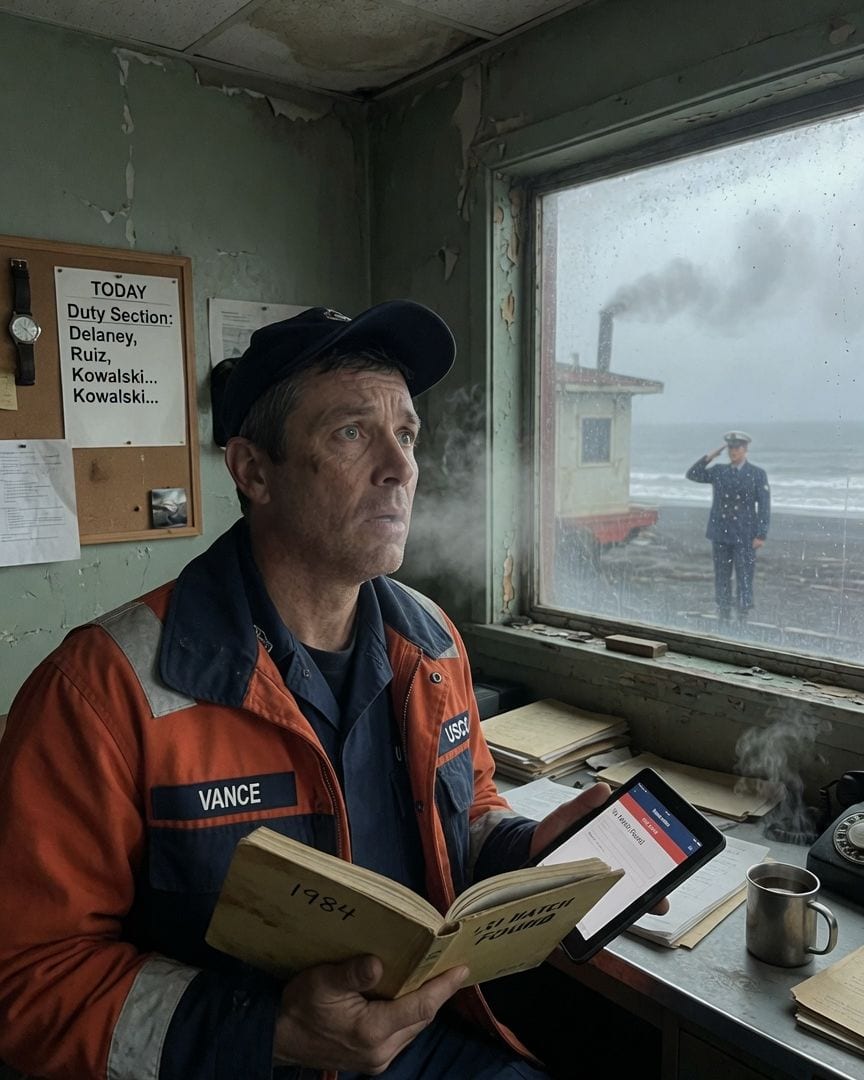
A Coast Guard XO's final survey found an abandoned Cold War LORAN station's stovepipe smoking, forty years after a man vanished.
Lieutenant Harold Vance, XO of the USCGC Whitfield, led a final survey mission to a remote Aleutian LORAN station, slated for demolition after years of dereliction. The fog-locked island was a stark silhouette as their boat approached, marking the station's lonely end. But as they neared the black-sand beach, Vance spotted a faint wisp of smoke curling from the galley stovepipe – impossible for a building stripped and abandoned since 2010. Ashore, the impossible scent of coffee filled the air. Inside, the mess hall was set with trays, a fresh watch bill, and a logbook dated today, listing unknown names. His unease grew when a second logbook revealed a signature from Lieutenant Commander Richard Delaney, reported MIA from this station four decades ago, with a chilling final entry.
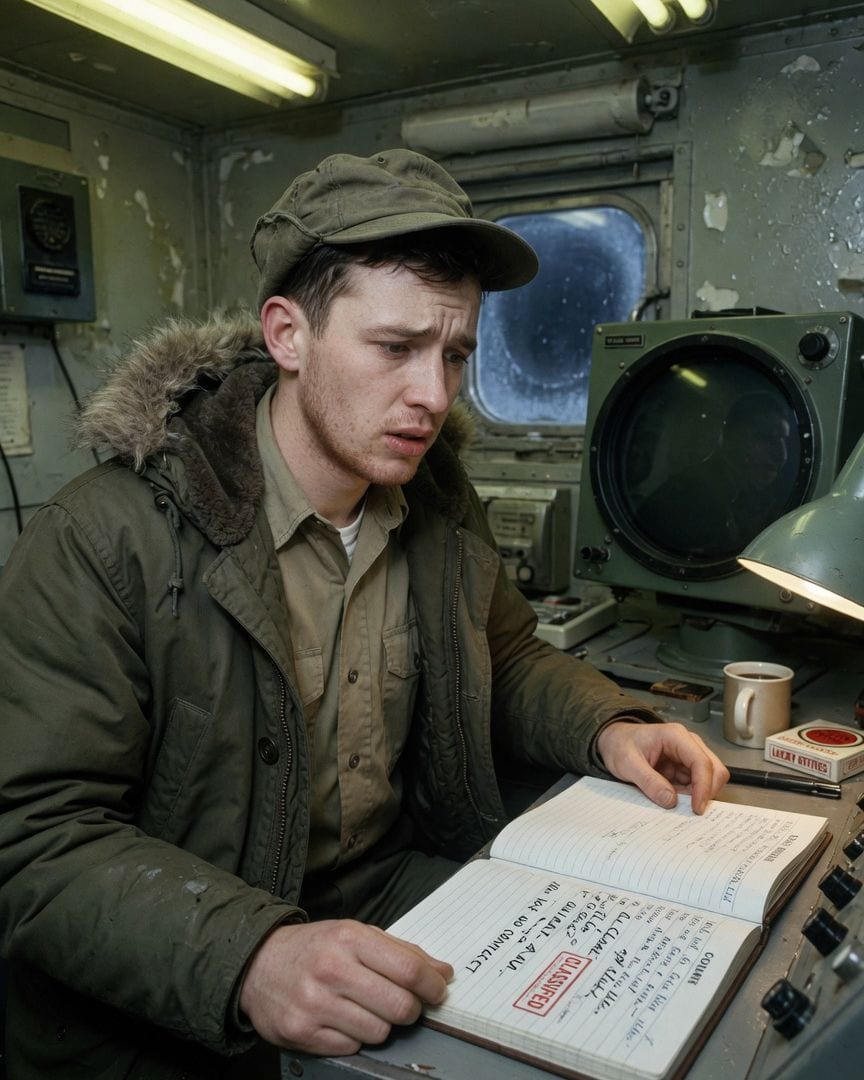
A Cold War airman logs an impossible radar contact on his last sweep. But his official logbook entry is stamped 'CLASSIFIED' and then contradicted by a hastily scrawled 'ALL CLEAR' dated moments before it.
Airman Ordway Vance, 22, manned the radar dome at Site Pellin in the biting North Atlantic dark of January 1962, running the last calibration sweep before its decommissioning. His scope picked up a faint, impossible return, growing closer with each pass, though the ocean remained empty to the eye. When Vance detailed the contact in his official logbook, a 'CLASSIFIED' stamp appeared, followed by a hastily scrawled 'ALL CLEAR' dated moments before his own entry, contradicting his every word. Commander Hartley dismissed it as equipment malfunction, but Vance sensed a chilling, official erasure behind the lie. He soon found a locked cabinet marked 'SITE PELLIN ANOMALIES,' hinting at a deeper truth buried within the base's final days.
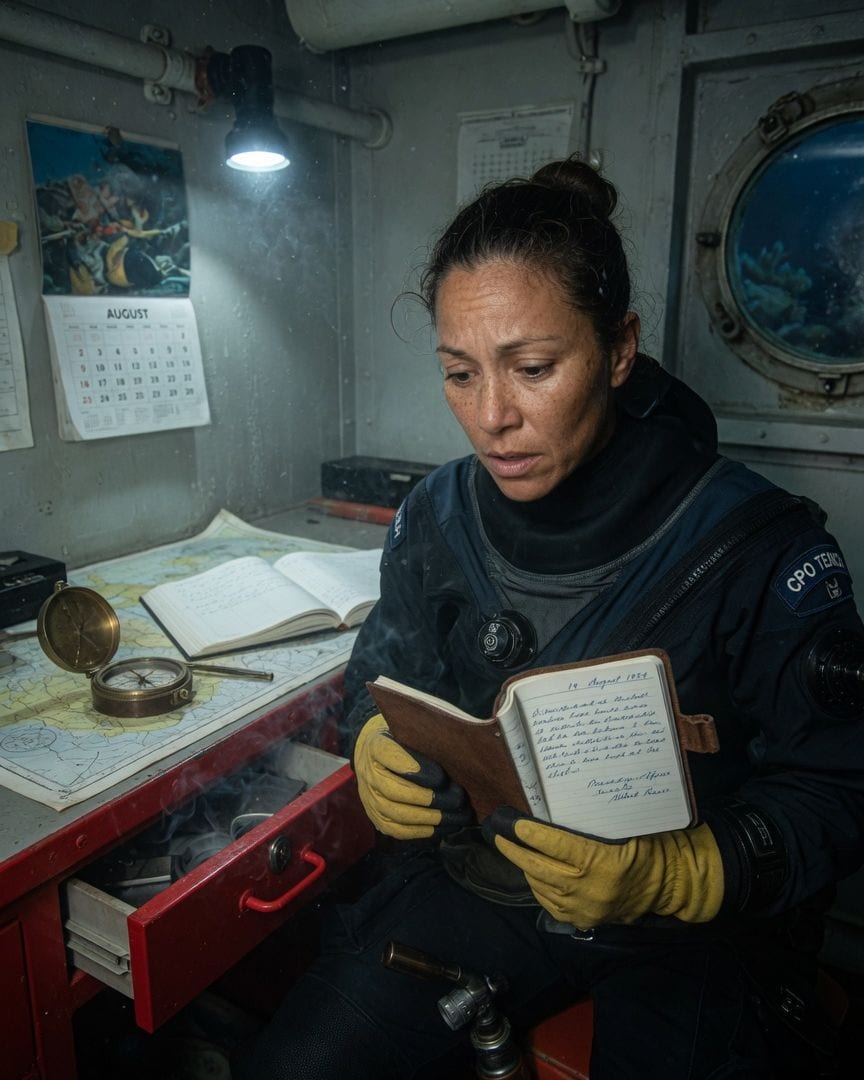
A deep-sea diver found a Cold War target ship's logbook dated months after it was vaporized in 1954.
Chief Petty Officer Marlo Tench, a methodical deep-sea diver, stared in disbelief at the ROV feed. Her team watched with her as the USS Triton, a target ship from the 1954 Castle Bravo nuclear test, appeared pristine and upright ninety feet below. It was supposed to have been vaporized, yet its hull number was unmistakable, its paint unburned, and its internal systems inexplicably active. Descending into the eerie silence, Marlo found a logbook dated five months after the ship’s destruction, and a journal entry naming a crewman officially listed as 'unmanned target.' What impossible force kept the Triton a living ghost decades after its fiery end?
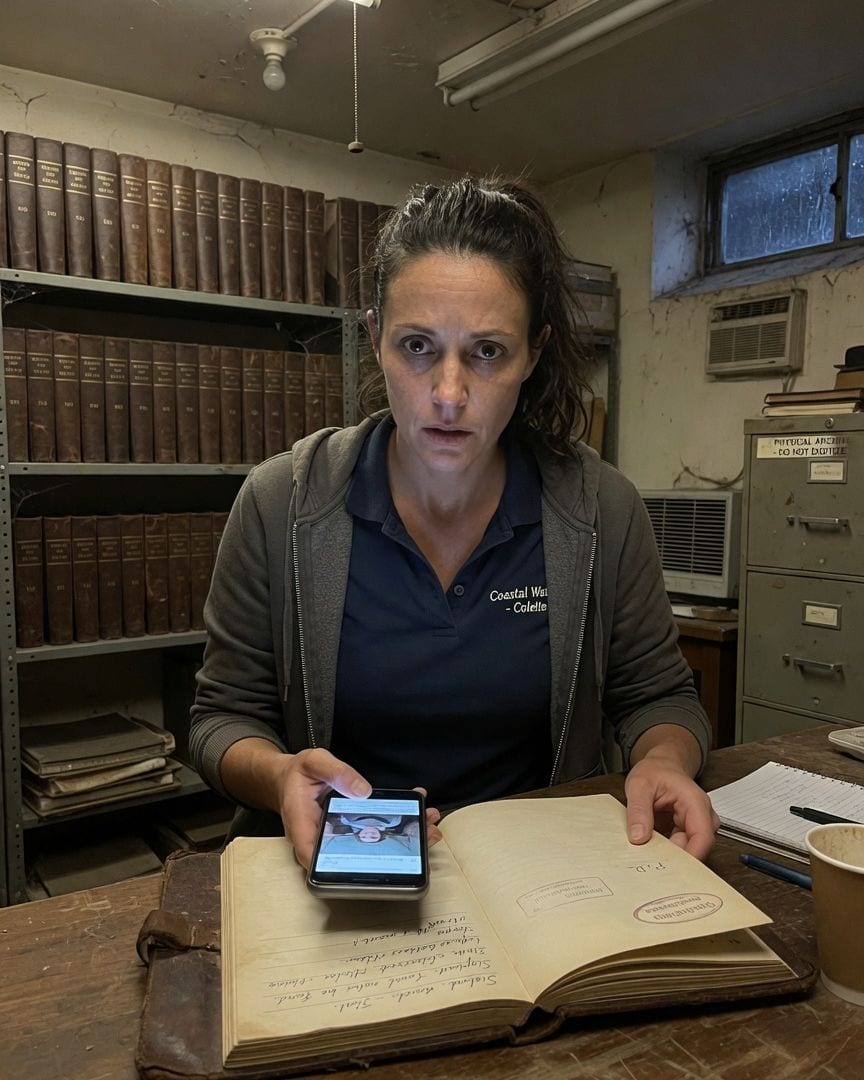
My coastguard log noted Sighting 9 again tonight, a light where no vessel showed. The old logs carry Sighting 9 off Skerry Point at 3:14am every tenth year since 1954, always 'nothing found,' always 'send no boat.'
On my watchtower night shift, the radar screen glowed green and the ocean was quiet. Then, a familiar light appeared off Skerry Point, exactly on cue, just as it had every tenth year for decades. But digging deeper, I found a hidden stamp in an old logbook: 'Operation Skerry. Status: Complete.' It left me with a chilling sense of finality.
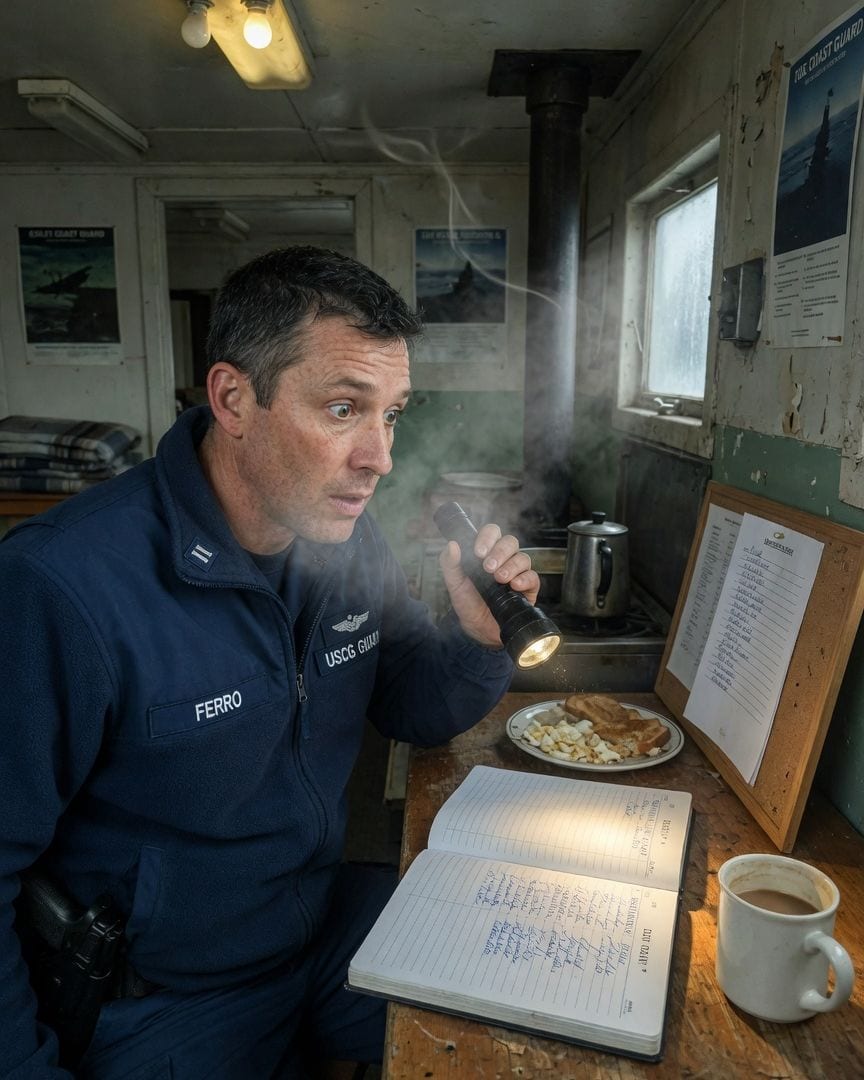
Lieutenant Ferro surveyed a station set for demolition, but its galley stovepipe curled fresh woodsmoke.
Lieutenant Theodore Ferro, Executive Officer of the USCGC Steadfast, braced against the biting Aleutian air, leading a final survey of LORAN Station 14-J before its demolition. The station, officially abandoned for over a decade, should have been a cold, gutted shell on the black-sand beach. Instead, a thin, acrid plume of fresh woodsmoke curled unmistakably from the galley stovepipe, twisting into the thick, low-hanging fog. Inside the unlocked building, a subtle warmth lingered alongside the scent of cooked breakfast, and a crisply printed duty roster listed a full watch section for today, bearing names Lieutenant Ferro knew should not be there. Who could be manning a long-decommissioned post, and why were their freshly laundered uniforms hanging ready for duty?