My foot scan flagged surgical hardware. I've never broken a bone, never had surgery, but the screw inside my heel is real, and old.
The fluorescent lights of 'StrideRight' hummed over me as I stepped onto the digital foot scanner. Megan, the assistant, smiled encouragingly. "Just a quick read, Rose, then we'll find you the perfect insoles."
I shifted my weight, feeling the cool plate beneath my bare feet. The machine whirred, a soft, mechanical breath, then lights pulsed across the screen.
I watched the digital rendering of my foot begin to form, a complex network of bones and tendons. Then, abruptly, a jarring red message flashed: "ERROR: FOREIGN BODY DETECTED. SCAN INCOMPLETE." A loud, sharp beep echoed in the quiet store.
Megan’s smile faltered. She frowned, tapping the screen, then restarting the machine. It whirred again, lights pulsed, but the same error message reappeared, insistent and digital. "Foreign body?" I asked, a prickle of unease starting in my gut.
Megan ran a hand-held scanner over my right heel, her brow furrowed in concentration. The small device emitted a high-pitched whine. "Looks like... metal. Deep in the calcaneus."
I laughed, a nervous, disbelieving sound that felt alien in my own throat. "That's impossible. I've never broken my heel. Never had surgery, not even a minor one."
I tried to recall any childhood injury, any forgotten tumble, but my past was blessedly free of serious fractures. Megan’s face was apologetic, her gaze still fixed on the scanner. "The scanner's pretty accurate.
You should probably get that checked out, Rose. We can't finish the scan with this."
I walked out of StrideRight a few minutes later, clutching a brochure for custom insoles I wouldn't be buying.
The pavement felt strangely alien beneath my feet, each step a subtle, phantom weight in my right heel that shouldn't be there. A cold knot was forming in my stomach, growing heavier with every stride. What foreign body?
In my own foot? It was a ridiculous notion, but the digital scanner hadn't been wrong, and Megan's hand-held device had confirmed it. It was real. And utterly impossible.
Dr. Philip Thornton, my long-time GP, listened patiently as I recounted the bizarre incident at StrideRight.
He nodded, his expression calm and professional, as I described the error message, Megan's confirmation, and my absolute certainty that I’d never broken a bone in my life.
"It's likely just a misread, Rose," he said, tapping a pen against his desk, "or perhaps a tiny, forgotten childhood injury that healed cleanly. We'll order an X-ray, just to be sure. Probably nothing to worry about."
He wrote out the referral, his hand steady.
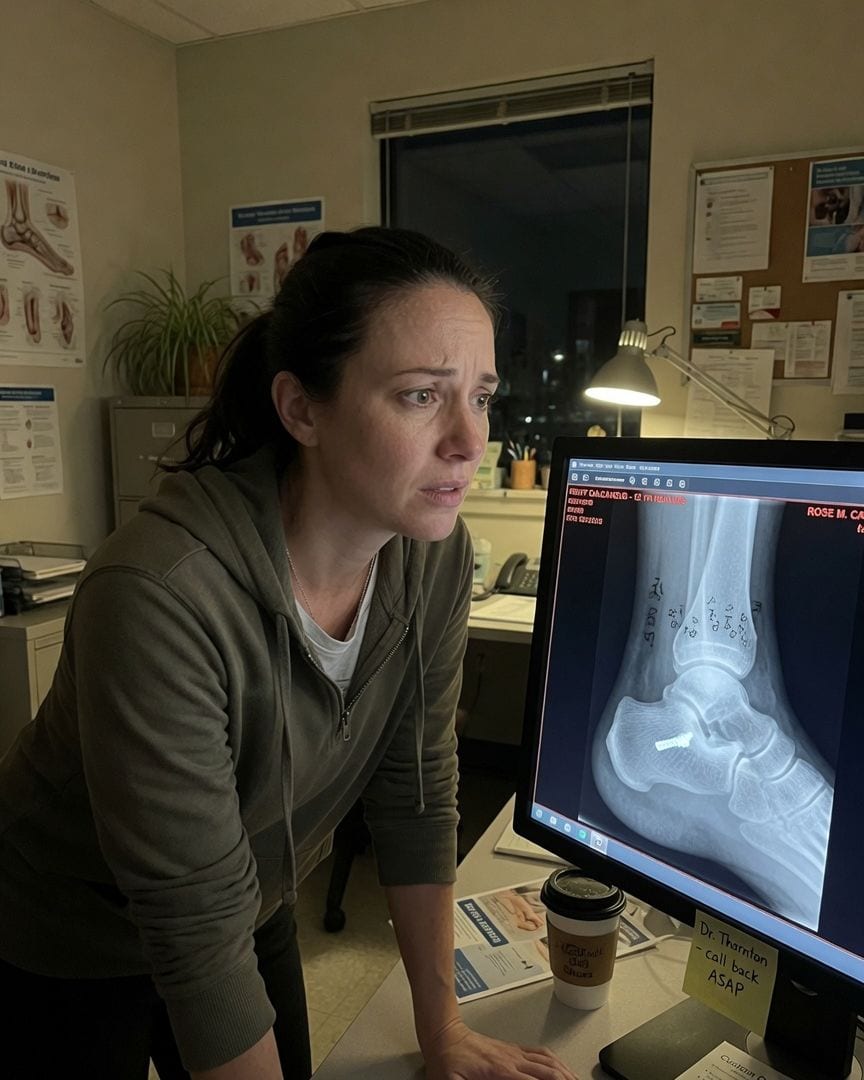
The next day, the X-ray results landed. Dr. Thornton called me in personally, his voice a little tighter than usual. I walked into his office, a strange sense of dread already coiling in my chest.
The image on his screen, a stark black-and-white rendering of my right foot, was undeniable. There, perfectly seated in my calcaneus, was a clear, quarter-inch surgical screw.
The bone around it had united, forming a seamless, almost natural looking union, as if it had been there for a decade.
"Well," he began, his voice tight with surprise, "it seems the scanner was right."
I stared at the image, a cold wave washing over me. It was real. A piece of metal, a surgical implant, deep inside my heel. "But... how?" I whispered, my voice barely audible. "I'd remember a broken heel. A cast.
A surgery. I've never had any of that." Dr. Thornton scrolled through the images, zooming in on the screw. "It's an old injury, Rose, long-healed. And the screw is standard issue for a calcaneal fracture repair.
The bone density shows it's been there for at least ten, maybe twelve years."
He paused, his finger hovering near the head of the screw on the screen. He leaned closer, adjusted the contrast, then zoomed further. "Wait a moment." I leaned closer too, my breath catching in my throat.
Faintly, almost imperceptibly, near the head of the screw, was an intricate, almost decorative etching on the bone itself. A series of tiny, looped symbols, like a miniature, alien cipher.
It was deeply embedded in the bone, not superficial, and unlike any medical marking I’d ever seen. Dr. Thornton’s jaw tightened. "I... I've never seen anything like this. This isn't standard surgical marking. This is... impossible."
Back home, the X-ray image burned into my mind. The tiny, alien symbols on my own bone. I opened my laptop and started searching. "Calcaneal screw etching," "bone marking unknown," "surgical symbols."
Nothing in medical journals, no forum posts, no obscure articles. It was like searching for a ghost. Hours bled into the night, the screen casting a pale, sickly glow on my face.
My fingers flew across the keyboard, desperate for any flicker of recognition.
Then, deep in a forgotten corner of the internet, I found it. An archived medical forum from what looked like fifteen years ago. A single, short thread titled 'Unexplained Bone Markings.'
A user, 'Bio-Curious,' described finding "an intricate, almost decorative pattern etched into the femur" during an autopsy. He linked it to a "closed research facility" in the region, speculating wildly about experimental procedures. My heart hammered against my ribs.
The description was chillingly close to what I saw on my X-ray.
The post ended abruptly, mid-sentence, with "...the records were all sealed, but I found-"
The user 'Bio-Curious' never posted again.
I spent the next week chasing shadows. 'Bio-Curious' was a dead end; the account long inactive, no other digital footprint. The defunct 'research facility' mentioned in the post, however, yielded a faint trail.
It was an old wing of the regional St. Jude's Hospital, now shuttered and derelict, a place locals called 'the Annex.' Officially, it housed a short-lived experimental oncology unit.
Unofficially, rumors of stranger projects persisted in hushed tones whenever I asked. Stories of 'special cases' and 'unconventional treatments' that vanished without a trace.
My dread was a constant companion, a dull ache behind my eyes. I visited the local public archives, a dusty, quiet building that smelled of old paper and neglect.
I pored over microfiche rolls, blueprints, and city records from a decade ago. It took days, but I found a list of former Annex employees, mostly medical staff, but also administrative personnel.
One name stood out: Isaac Romano, listed as a 'Records & Logistics Coordinator.' His last known address was just a few towns over, a modest residential street I’d driven past countless times.
I drove there the next afternoon, my knuckles white on the steering wheel. Isaac Romano, a frail man in his seventies, answered the door to his modest bungalow.
He had soft, hesitant eyes that widened with suspicion when he saw me. He was initially polite, but became visibly agitated the moment I mentioned the Annex and, carefully, the idea of 'unique bone markings.'
"That place is gone, young lady. Best left forgotten." He tried to close the door, but I, emboldened by a desperate need for answers, pressed him.
"Please, Mr. Romano. I have this mark in my own body. My doctor has no explanation." I pulled out a printout of my X-ray, holding it carefully so he could see the intricate etching.
His eyes widened further, fixing on the symbols on my heel. A flicker of fear, then resignation, crossed his face. He visibly swallowed, his throat working. "They told us... never to speak of it. The protocols were absolute."
He wouldn't say more about the mark, only, "There were... special cases. Things that couldn't be explained by ordinary means. Things that weren't supposed to leave those walls."
He stared at me with a profound sadness that seemed to include me. The door clicked shut, leaving me standing on his porch in the deepening twilight.
The next day, a single, unmarked white van was parked down my street, its windows tinted. It was there when I left for work, a silent, unmoving presence, and still there when I returned, precisely in the same spot.
I tried to dismiss it as coincidence, a delivery, a neighbor's guest, but the cold knot in my stomach tightened. That evening, my phone rang, an unknown number. I answered, my heart thumping against my ribs. Silence.
A faint click, then the line went dead.
I called Isaac Romano again, my hands shaking. His line went straight to voicemail, a generic message. I drove by his bungalow. Lights were on, casting a warm glow from within, but no one answered my persistent knock.
His car was in the driveway. It felt wrong.
Later, a text message arrived from an anonymous number, stark and chilling against the white screen: "STOP ASKING QUESTIONS. IT IS NOT YOUR STORY."
The words chilled me to the bone. They knew. Someone was watching. Someone was protecting whatever secret the Annex held.
I felt a profound sense of vulnerability wash over me, a physical chill that had nothing to do with the evening air. I was no longer just investigating a strange medical anomaly; I was being warned away, actively observed.
I felt eyes on me, even in the privacy of my own home, the familiar walls suddenly feeling thin and porous.
The van was gone the next morning, but the feeling of being watched lingered, a constant, low hum of menace beneath the surface of my everyday life.
I knew then that Isaac Romano's fear was not just for himself, but for me.
I returned to Dr. Thornton's office the following morning, bypassing the receptionist entirely. I found him in his office, staring blankly at his monitor, looking paler than usual, his usually neat hair slightly disheveled.
He didn't even look up when I entered. "They called me," he said, without preamble, his voice flat. "They know you've been asking about the Annex."
I slammed the anonymous text, printed on a sheet of paper, onto his desk. The soft thud echoed in the quiet room. "Who are 'they,' Dr. Thornton? And what does this etching mean? Isaac Romano mentioned 'protocols' and 'special cases.'
What is going on?"
He sighed, running a hand through his thinning hair, his gaze finally meeting mine, filled with an exhaustion I hadn't seen before. "The Annex wasn't just oncology, Rose. It was a cutting-edge facility for... radical life extension and recovery.
After catastrophic injuries." He paused, choosing his words carefully, like someone walking on thin ice. "The etching... it's a unique project marker. For certain experimental procedures. Procedures that pushed the boundaries of what was considered ethical. Protocols that were... absolute."
A cold wave of nausea washed over me, a sickening premonition. "What kind of procedures?" My voice was barely a whisper.
He looked away, staring at the framed medical degrees on his wall as if seeking answers there. "When a patient's injuries were beyond any conventional hope, when their brain activity was stable but their body was...
irrecoverable, the Annex sought to preserve the individual. To give them a second chance."
My mind raced, connecting the dots. The screw, the etching, the 'special cases' Isaac mentioned, the veiled warnings. "Are you saying... they replaced bodies?"
Dr. Thornton flinched, a visible shudder passing through him. "We called it 'integration therapy.' It was shut down for a reason, Rose. Public outrage, ethical concerns. The project was... ambitious, morally complex.
But for some, it was the only hope of a continued existence." He pushed back from his desk chair, the rollers squeaking softly on the floor.
He walked to a locked cabinet behind his desk and, after fumbling with a small key, pulled a thick, bound file from inside. "I was part of the original team, Rose. Bound by lifetime NDAs. But you... you're a patient.
You have a right to know some of it. At least what I can show you." He opened the file, revealing my own name at the top: Davenport, Rose.
Dr. Thornton flipped through the pages of my file, his finger tracing a line on the brittle, yellowing paper. "Your accident, ten years ago, was severe. A multi-car pileup. The reports describe your injuries as... beyond repair. Your body...
it was unsalvageable." He pointed to a series of graphic reports detailing blunt force trauma, massive internal bleeding, and a devastating spinal injury.
My own name stared back at me, clinical and detached, linked to a catalog of horrors I couldn't comprehend.
Then he moved his finger to a section heavily redacted, thick black bars obscuring most of the text. "This period here, immediately after your original prognosis... this is where the Annex became involved.
This is where your official medical history becomes... complicated."
My eyes scanned the dates below the black bars. A gap. A void where my painful, slow recovery should have been. A full month was simply gone.
Then, after the redacted section, a new series of entries began, detailing a 'miraculous recovery,' a gradual return to health, cognitive functions stable, vitals normalizing.
But the dates on these new entries began after the redacted period, after her original body was deemed lost, after the initial reports had declared her effectively gone.
Dr. Thornton's face was ashen as he pointed to a specific date in the redacted file, a date that fell after my last coherent memory of my original body being intact, of feeling myself whole.
He whispered, his voice thin and raw, "Your injuries... they were too severe. This... this was the only way."
The implication settled heavy in the air, cold and undeniable. My original body was gone, annihilated in that accident. And I was already living in another.
The truth detonated, shattering my reality into a million sharp fragments. Dr. Thornton, visibly shaken, confirmed it all.
The Annex had indeed perfected a radical consciousness transfer, or 'integration therapy,' where a dying mind could be moved into a compatible, prepared donor body. My own original body, ravaged by the accident ten years prior, was utterly unsalvageable.
My brain activity, miraculously, had remained stable enough for the transfer.
The screw in my heel, the healed calcaneal fracture, and the distinctive etching were all part of the donor body's pre-existing history – a history that was supposed to be completely overwritten, erased, or at the very least, never revealed.
The Annex had chosen a body that was biologically compatible, healthy, and of a similar age. But they hadn't fully accounted for the subtle, persistent echoes of the original host.
The entire project was ultimately deemed too ethically monstrous, too prone to unforeseen complications, and was shut down approximately eight years ago, its records sealed and its existence disavowed.
My 'miraculous recovery' had been a meticulously crafted lie, a comprehensive cover-up designed to protect the institution from public outrage and, perhaps, to protect the fragile psyche of its 'integrated' patients.
Every clue now clicked into place with horrifying precision. The digital foot scan, the etching, Isaac Romano's fear, the anonymous warnings, the redacted files, Dr. Thornton's guarded disclosures.
It all made a horrifying, undeniable sense, weaving a tapestry of impossible, clinical truth. I was a living impossible object, my consciousness a passenger in a body that wasn't originally mine.
There was no escape from this truth, no one to confront but myself.
I tried to find any trace of the original host of my body, driven by a desperate, gnawing need to understand who I truly was now, or rather, what I was.
Dr. Thornton, burdened by guilt, gave me a final, encrypted file, salvaged from the Annex's ruthless digital purge. He told me it was all he could secure, a ghost of a record.
It contained a single, faded photograph.
It was a young woman, perhaps a few years older than I was at the time of the accident, with a kind, open face. Dark hair, light eyes, a gentle smile. My breath hitched in my throat.
I knew that face. Not intimately, not as a close friend, but from my past, a periphery memory from my college town.
A girl who had worked at the local library, a quiet acquaintance I’d sometimes seen stocking shelves or recommending books. I remembered her name too, vaguely: Clara.
And then the deeper memory struck me, with the force of a physical blow. A local news story from years ago – a tragic, unsolved disappearance. A young woman, vanished without a trace.
Her parents had put up flyers for months. Clara.
The realization hit me: the body I inhabited belonged to her. The screw, the etching, the very skin I wore – it was all this other woman. My own consciousness had been stitched into another's life, another's form.
The horror wasn't just that I had lost my body, but that I had taken another's. I was a walking echo, a composite of two lives, two histories. The knowledge was an anchor, dragging me down, irreversible and absolute.
I was a ghost in someone else's machine, and the machine remembered.
I tried to resume my life, to stitch the tattered fragments back into some semblance of normalcy, but the world felt subtly alien. My reflection in the mirror was a constant reminder of the profound shift, a quiet betrayal.
I saw myself, yes, but I also saw the other woman, Clara, in the curve of my jaw, the set of my eyes, the slight tilt of my smile.
I avoided old friends, fearing they might unknowingly sense the wrongness, the subtle discord in my gestures, the new, unplaceable familiarity.
The screw in my heel, once a source of frantic investigation, was now a cold, inert presence, a permanent physical marker of my impossible existence.
Every step was a reminder that I walked in borrowed flesh, carrying a history that wasn't mine, yet now undeniably was.
I continued my life, a quiet existence marked by a profound, internal chasm. The knowledge of my true nature was a silent companion, a heavy cloak I could never shed.
I learned to live with the phantom memories, the fleeting sensations that weren't hers, the subtle echoes of another person's past. I was Rose Davenport, yes, but I was also Clara, an impossible fusion.
My identity, once a solid, unquestioned thing, was now a fragile, contested space. The horror wasn't in a monster, but in the coherence of it all, the clinical, undeniable truth that had reshaped my very being.
Her account ends here, a final testament to a truth too unsettling to bear.
The Facebook post, unfinished, would eventually be found by someone else, a friend, a family member, who might wonder why Rose had stopped posting, why she seemed to have faded away.
They might notice the faint, almost imperceptible change in her eyes, a subtle shift in her smile. The body she walked in was hers, yes, but it remembered a different life.
If this one got to you
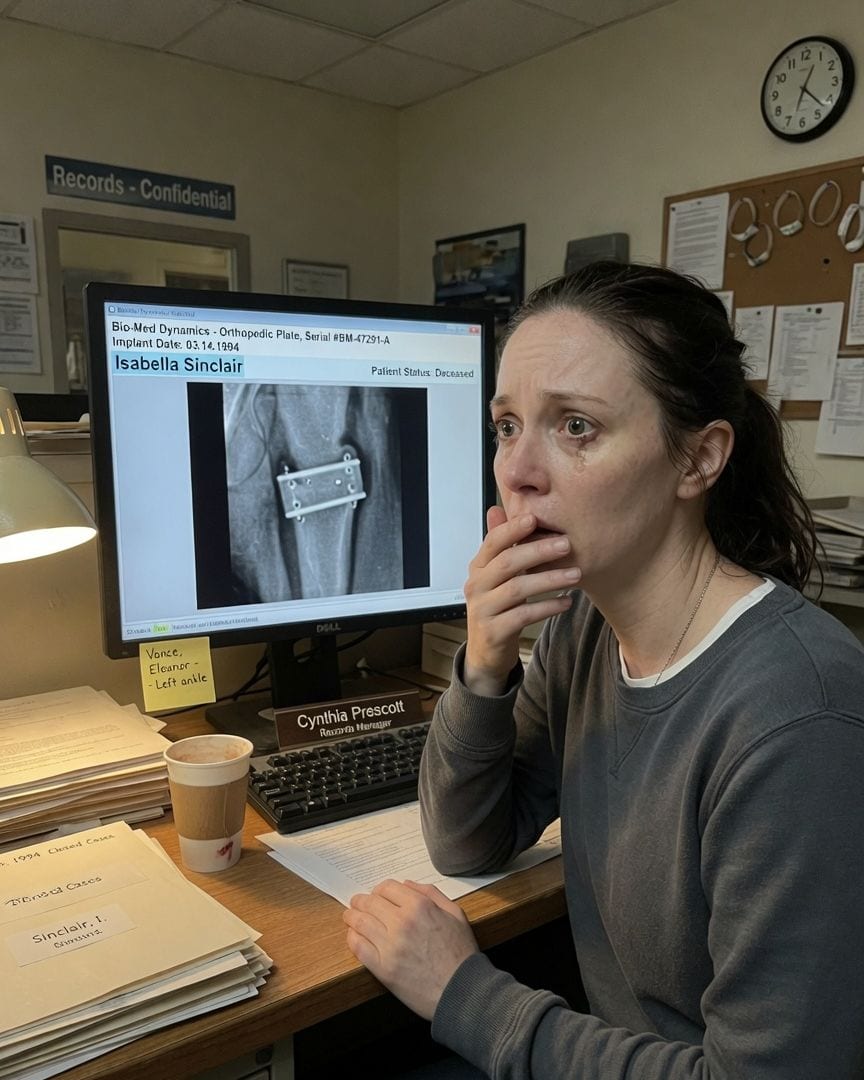
An MRI turned up a surgical plate in my ankle — from a surgery I never had, and there's no scar. Its serial number is registered to a patient marked deceased.
I went for a routine MRI, but the technician found a metal plate embedded deep in my left ankle, an old surgical implant I had no memory of. My doctor confirmed it had been there for decades, fused with the bone. The true shock came when hospital records traced the plate's serial number: the patient associated with my implant was marked deceased.
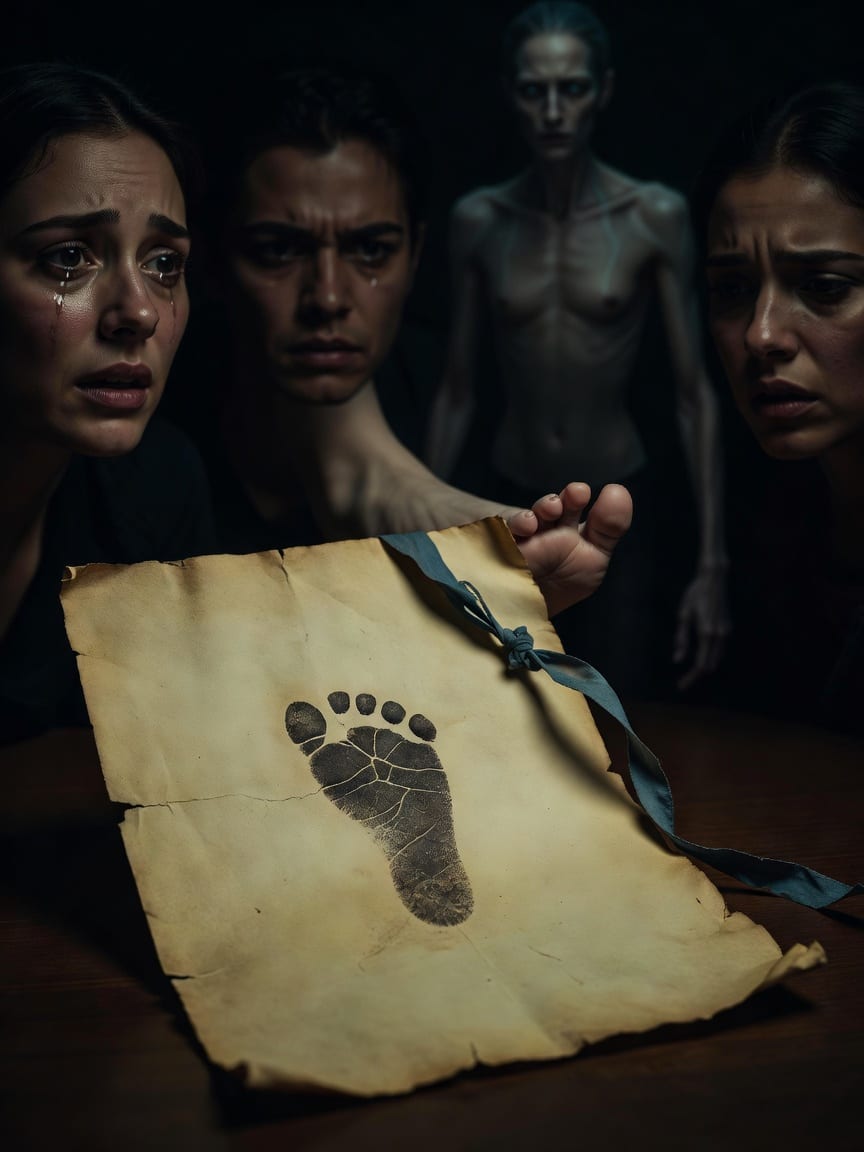
My hospital scanned old newborn footprints. They matched my foot, every whorl and arch, to a stillborn infant's card from 1954. Those tiny, inked ridges on the yellowing paper were undeniably mine. Sixty years apart, the same feet.
I was only curious when St. Jude's Hospital sent my newborn footprint card, part of digitizing their old records. But a genealogist soon revealed my own unique footprint matched a stillborn infant's card, filed in 1954 – an impossible biometric anomaly.
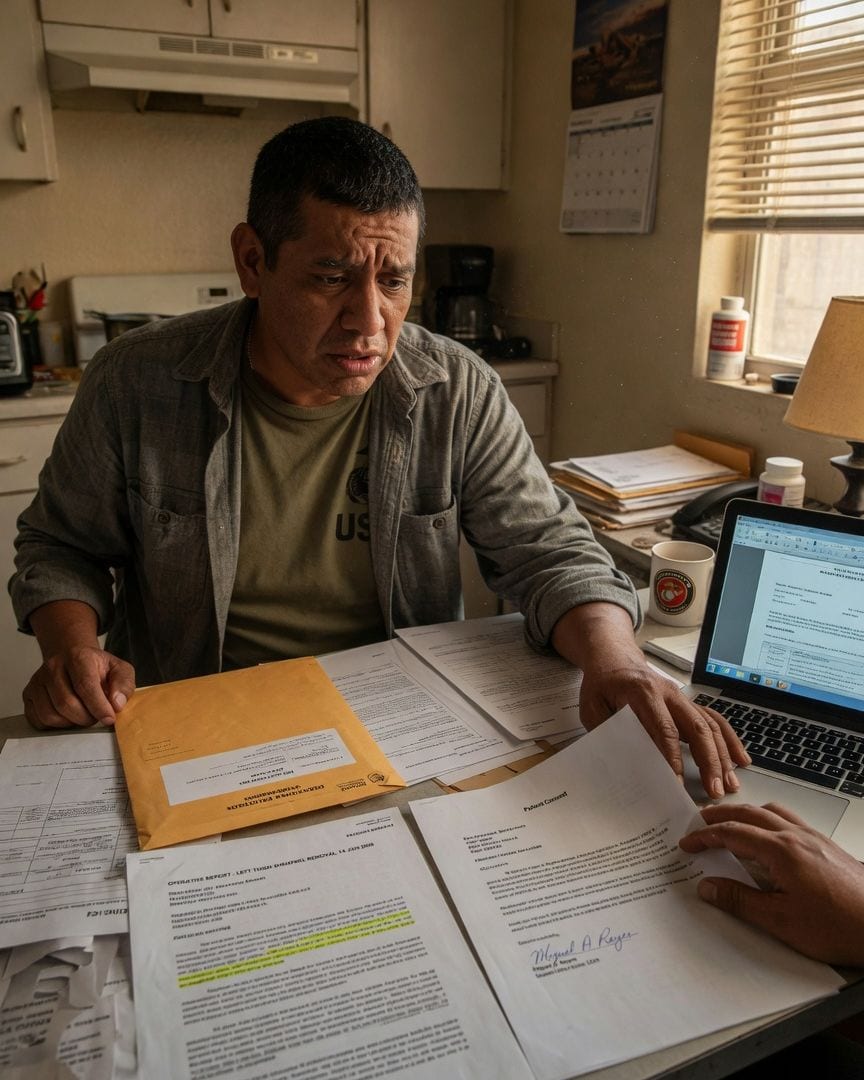
A veteran's VA file listed surgery for shrapnel. The doctor retired decades before he joined the Corps.
Miguel Reyes, a veteran, sat in a sterile VA clinic, his bad knee throbbing, expecting routine. Instead, a physician's assistant presented a digital file detailing shrapnel removed from his thigh in 2008 – an injury Miguel had no memory of, no scar for. His own service record later confirmed the impossible surgery, complete with a consent form bearing his perfect, yet utterly alien, signature. Driven by unease, Miguel researched the listed surgeon, Dr. Charlotte Bennett, only to discover she had retired from military service decades before he even enlisted. The numbers didn't just not add up; they violently contradicted each other, revealing a deliberate, impossible fabrication in his own life story.
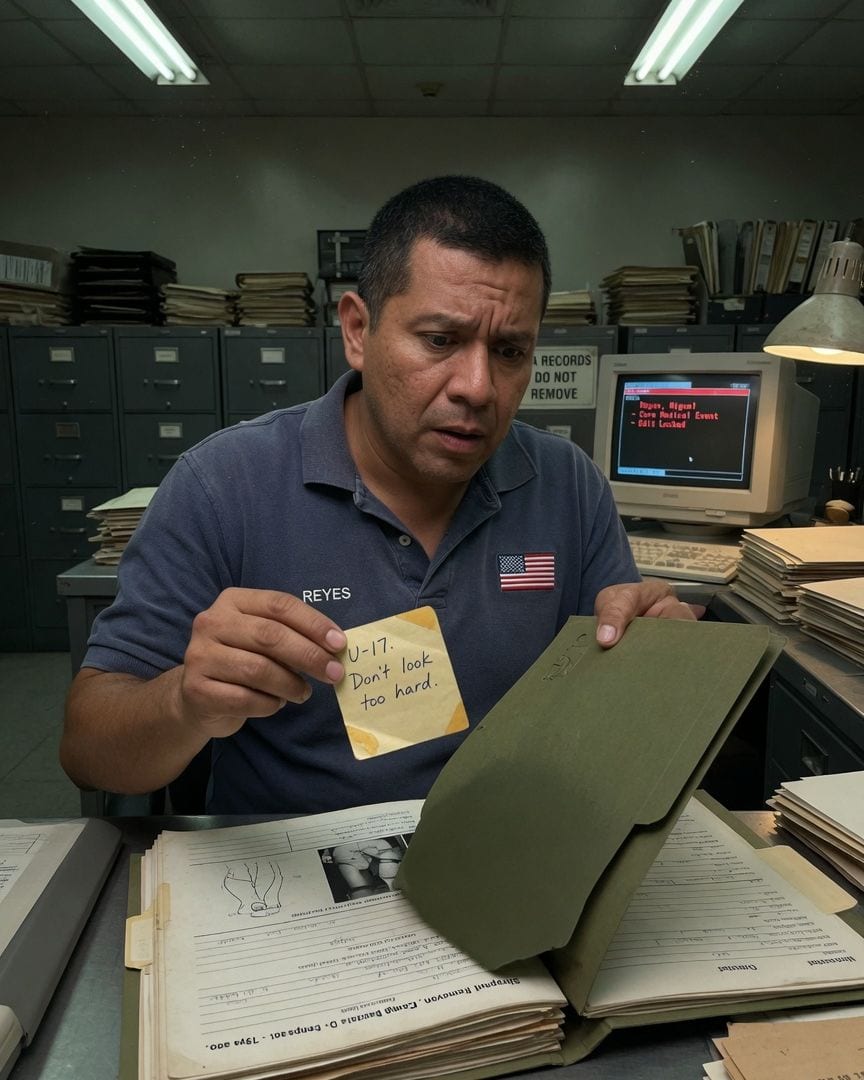
A veteran's medical record details a shrapnel wound his body never had. Taped to the report: 'U-17. Don't look too hard.'
Miguel Reyes, a veteran seeking relief for an old running injury, found his routine VA visit take a chilling turn. His medical file claimed a shrapnel wound and surgery from thirteen years prior, but his leg bore no scar, no mark of the supposed incident. Despite the detailed digital and paper records, his body swore the event never happened. As he pressed for answers, a hidden, yellowed note taped inside the official report surfaced, scrawled with two words: "U-17. Don't look too hard." The sterile clinic air suddenly felt cold and thick, suggesting a truth far darker than a simple clerical error.
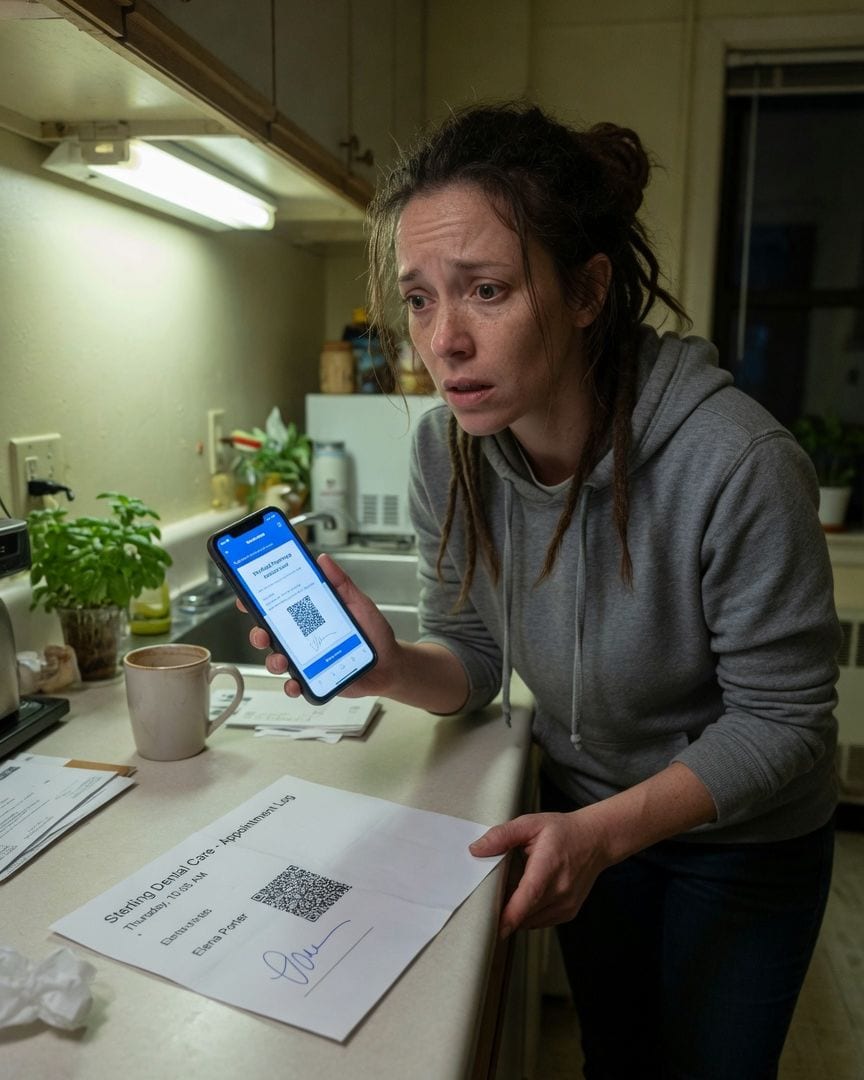
My dentist's system says I was there last Thursday. I wasn't. But the check-in tablet shows my signature, and the hygienist described my chipped tooth exactly right.
I received a call confirming a dental appointment I never made, for a day I was home. Yet, Sterling Dental had my perfect digital signature and described a chipped incisor I’d never told them about. The physical proof insisted I was there, but I wasn’t.
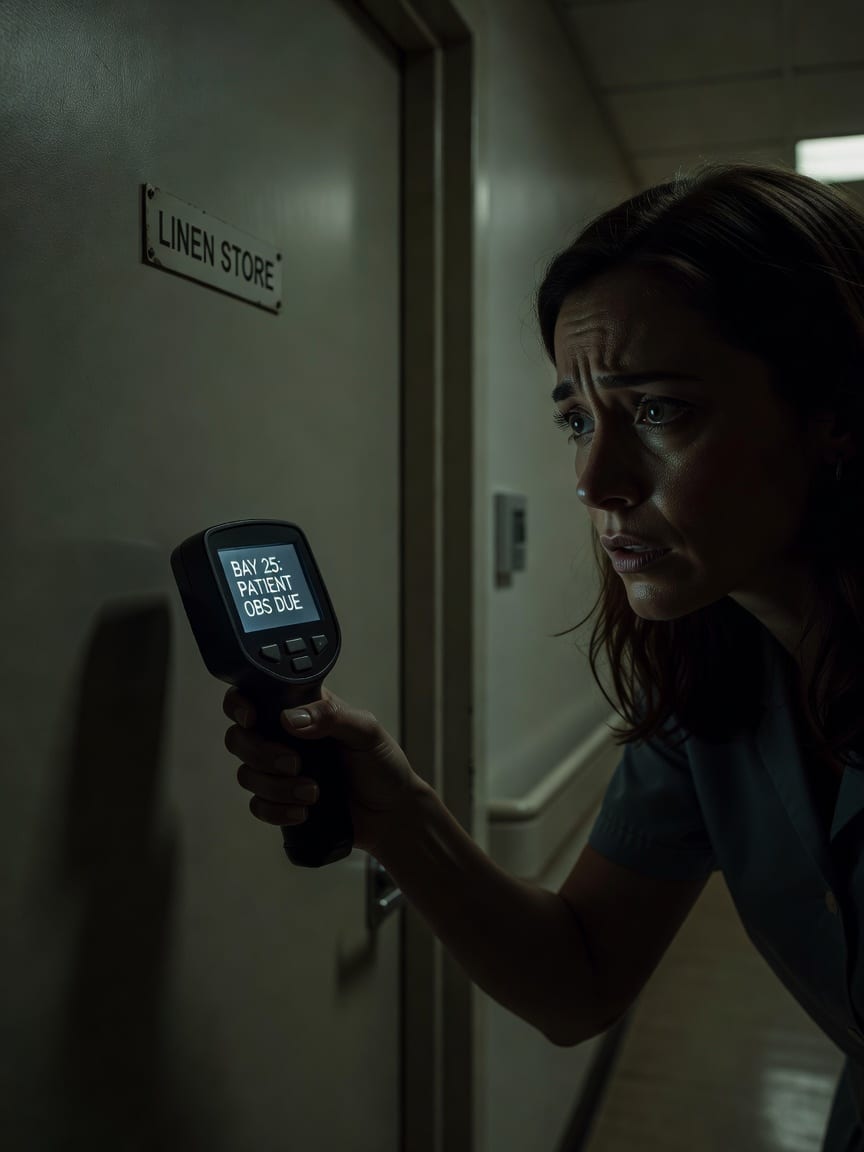
My hospital scanner demands patient care in Bay 25. Bay 25 is a locked linen closet.
I'm a pragmatic nurse, used to my hospital's quiet night shifts. But for a fortnight, my scanner has logged phantom patients in 'Bay 25' — a room that's just a linen closet. Then, tucked away, I found an old patient ID bracelet, faded but clear: 'Bay 25.'