My front door opens onto a gaslit street with a cab horse, not my paved close. The cold comes in smelling of coal smoke.
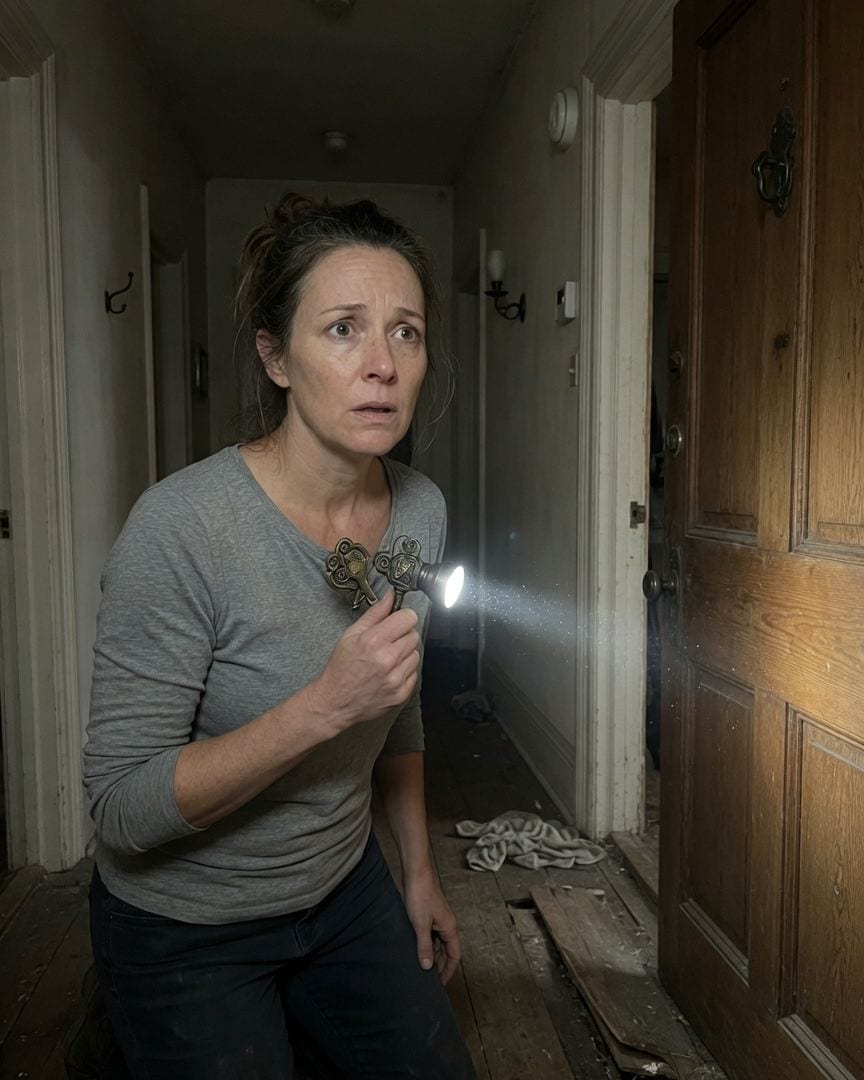
The lights went out just after seven, plunging the close into an inky blackness. It happens sometimes, an old neighborhood, an aging grid.
I’d been in the middle of making dinner, so I grabbed my phone, flicked on the flashlight, and went to check the circuit breaker. Everything seemed fine, but the house remained dark. I figured it was a wider outage.
Before calling the utility company, I decided to check outside, see if Julian, my neighbor, had his lights on. The close is usually quiet, just a few houses nestled around a paved cul-de-sac.
I pulled open my heavy oak front door, expecting to see nothing but the familiar dark shapes of parked cars and the faint glow from the main road at the end of the close.
But that’s not what I saw.
The doorway didn't open onto my paved close at all. Instead, it opened onto a street I didn’t recognize, cobblestones gleaming wetly under the hazy yellow light of a gas lamp.
There was a cab horse, steaming in the chill, hitched to a carriage by the kerb. Its breath plumed white in the cold air.
A man in a caped coat, hat pulled low, walked past, his back to me, his footsteps echoing softly on the wet stone. It smelled intensely of coal smoke and damp earth, a smell I knew wasn't from my neighborhood.
The cold hit me, sharp and sudden, sweeping into my modern hallway, carrying with it the distinct, almost acrid tang of burnt coal. It wasn't the usual autumn chill; it was a deeper, older cold.
My breath hitched. My mind scrambled for an explanation – a trick of the darkness, a momentary disorientation.
I slammed the door shut, the solid wood thudding against the frame, the jarring noise echoing in the sudden silence of my darkened hall. My heart hammered.
I stood there for a beat, telling myself it was nothing, just a weird hallucination caused by the sudden darkness.
Then, I cautiously reached for the handle again, my hand shaking slightly, and pulled it open.
This time, the familiar sight of my close greeted me. Julian Larsen, my next-door neighbor, was peering out his own front door, his torchlight bobbing as he scanned the street. "Evelyn? You alright over there? Power's out."
"Yeah, Julian, I'm fine," I called back, my voice a little too high, a little too strained. I forced a smile that felt brittle.
The cold had vanished, the smell of coal smoke was gone, replaced by the crisp, clean scent of a modern autumn night.
But the memory of the wet cobblestones, the steaming horse, the caped man, and especially that pervasive, ancient cold, the distinct clip-clop of hooves on stone—it clung to me, refusing to be dismissed. It wasn't a trick of the light.
I had been somewhere else.
Over the next few days, I found myself drawn to the front door, an inexplicable cold spot always radiating from its frame, even on warm afternoons.
I’d put my hand against the wood, and a chill would seep into my palm, far colder than the ambient temperature of the room.
Sometimes, I’d catch a faint, almost imperceptible smell of coal smoke, a ghost of a scent that vanished as soon as I tried to pinpoint it, like a memory dissolving.
I started to check the weather reports, looking for explanations, but nothing lined up. The door just was cold.
One evening, I was wiping down the old wooden floorboards in the hallway, trying to get rid of a stubborn scuff mark near the threshold.
The house was built in the mid-1800s, and while it had been renovated extensively, some of the original features remained, including these wide, dark planks. My cloth snagged on something.
I pressed down, thinking it was just a raised nail, but the board itself felt loose.
Curiosity winning out over my growing unease, I knelt, working my fingers into the narrow gap. With a slight groan of aged wood, a section of the board lifted, revealing a small, hidden cavity beneath.
It was shallow, barely big enough for a hand, and lined with decades of dust and cobwebs.
Nestled in the dust, glinting faintly, was an ornate, tarnished brass key. It was heavy, far heavier than any modern key, and clearly ancient. The head was intricate, a series of delicate swirls and a small, almost microscopic, shield-like emblem.
The shank was thick, the teeth complex and unlike anything I’d ever seen on my keyring. It felt impossibly old in my hand, a prickle of unease running up my arm as its cold metal met my skin.
I wiped the dust from it, turning it over and over. What was it for? It didn’t fit the front door. It didn’t fit the back door, or the utility closet, or the old cabinet in the living room.
I spent a good hour trying it on every lock in the house, from the bedroom doors to the shed out back. Nothing.
It was a key without a purpose, a relic from another time, just like the glimpse I’d had through my door a few nights before. I kept it in my pocket, the weight of it a constant, unsettling reminder.
I stood in the hallway, clutching the mysterious key. Its cold metal was a contrast to my warm skin, a small, solid anchor in my increasingly unsettling reality.
As I turned it over in my palm, examining the intricate, tarnished patterns, a sudden, profound drop in temperature emanated from the front door.
It wasn't just a draft; the air around me seemed to thicken, to freeze, pulling the warmth from my bones. A shiver ran through me that had nothing to do with the cold.
A faint, distant whisper seemed to curl from beneath the door, a low, indistinct murmur of voices that made the hairs on my neck stand on end.
I couldn't discern words, but it was undeniably there, just beyond the solid wood, a chorus of hushed secrets.
Driven by the key and the whispers that now seemed to linger at the edge of my hearing, I began to research the house’s history. It felt less like a hobby and more like an imperative.
I spent hours at the local archives, the smell of old paper and dust filling my lungs. I sifted through property deeds, faded handwritten ledgers, and brittle census records.
I learned the house had been in my family, a distant branch, for generations, passing down through obscure aunts and forgotten cousins. That’s how it eventually landed with me, the last of the line.
And then, I found her name: Frances Winslow. A distant relative, like me, who owned the house in the late 1800s. The record of her tenure was brief, ending abruptly in 1895.
Beside her name, under the column for 'Disposal,' it simply stated: 'Disappeared.' No death certificate, no change of ownership through sale, just... gone. She was 28 when she vanished. My age now.
Back home, the old brass key was a constant, heavy weight in my pocket. I systematically searched the house, this time with a purpose, with a target. I ran my hands over every wall, every floorboard, every fireplace.
The fireplace in the living room was a particularly grand affair, a heavy marble mantelpiece with an ornate cast-iron grate.
I was running my fingers along the rough bricks behind the grate, feeling for any anomaly, when my fingertip caught on a loose brick. It was tucked away, almost imperceptible.
I pried it out. Behind it was a small, iron-bound wooden box, about the size of a paperback book. It was locked, of course, with an old-fashioned keyhole. My heart pounded. I pulled the ornate brass key from my pocket.
It slid into the keyhole with a soft, metallic click. The lock mechanism groaned, then gave way.
Inside, nestled on faded velvet, were two items: a small, leather-bound journal with brittle, yellowed pages, and a sepia-toned photograph. I picked up the photograph first. It was a portrait of a stern-faced young woman with piercing, dark eyes.
Her hair was pulled back tightly, a severe expression on her lips. She looked direct, unblinking. It was undeniably Frances Winslow.
But as I held the photo, tilting it in the faint light, a strange trick of the antique emulsion made it seem as if a faint, knowing smile played on her lips, and her eyes, those piercing eyes, seemed to stare directly at me, a silent, unsettling acknowledgment across the decades.
My digging, it seemed, didn't go unnoticed. Julian Larsen, my next-door neighbor, usually a friendly, gossipy sort, started asking about my 'history project' with an uncomfortable edge. His usual easy smile didn’t quite reach his eyes.
"Still delving into the house's past, Evelyn?" he'd ask, his gaze lingering on my front door with a strange, apprehensive glint.
He'd mention that the house had 'always had stories,' dismissing them as old wives' tales, but his tone lacked conviction.
"Just curiosity," I'd reply, trying to sound nonchalant, but my pulse always quickened when he talked like that.
One afternoon, he found me weeding in the garden. He leaned over the fence, his voice low, almost conspiratorial. "Some things are better left undisturbed, dear," he warned, his eyes flicking towards my house. "They don't like to be remembered."
He straightened up, gave a weak smile, and walked away before I could ask him what he meant. The warning chilled me more than his casual dismissal of 'old wives' tales.'
I started to feel a prickling sensation, a pervasive sense of being observed, especially when I was near the front door. I’d glance over my shoulder, convinced I’d see something, but there was never anything there.
Just the quiet, empty hallway. The feeling was heavy, unseen, a constant pressure.
One morning, as I went to collect the mail, I found a folded piece of paper slipped under my front door. It wasn't an advertisement or a bill.
The paper was thick, aged, and the script was old-fashioned, written in faded, sepia-toned ink. My hands trembled as I unfolded it. The words, elegant and stark, jumped out at me:
'The past is not a story for you to tell. Let it sleep.'
A jolt of icy fear shot through me. Someone knew. Someone knew exactly what I’d found, what I was doing. My rational mind tried to dismiss it as a prank, but the paper, the ink, the script—it felt authentic.
I checked my locks, peered out the window, scanned the quiet, familiar street. Nothing. Only the usual parked cars, the familiar houses. Yet, the feeling of eyes on me remained, a heavy, unseen weight, pressing down from the house itself.
I opened Frances’s journal, its pages crumbling delicately at my touch. The handwriting was elegant, if a little spidery, a graceful loop of cursive that spoke of a different era.
Frances detailed her life in the house, her growing isolation, and then, with increasing frequency, her fascination with the front door.
"It shows me another time," Frances had written, the ink a little heavier on the page. "A world of gas lamps and carriages, a London I’ve only read of in books.
Not the paved street outside my window, but one of wet cobblestones and the sweet, sharp scent of coal smoke." My breath hitched. She was describing exactly what I had seen.
Frances meticulously described the cold draft that accompanied these visions, the specific, acrid smell of coal smoke, and then, with unnerving precision, a man in a caped coat, his back always to her, passing by the lamplit street.
Every detail Evelyn had experienced—the cold, the smell, the man, the cobblestones—was laid bare in Frances's frantic entries.
She chronicled her deepening obsession, her attempts to understand and even 'interact' with this other side, this temporal window. She wrote of reaching out, of the cold seeping into her fingers, of feeling a pull, a suction, from the threshold.
Her entries grew more feverish, less observational, more active.
Then, a specific date appeared, underlined multiple times, almost gouged into the brittle paper: 'November 14th, 1895. Tonight, I shall cross over fully. I shall join them.
I have found the way to truly step through, to become part of the memory, not just a witness.'
I didn't need to check the archives again. November 14th, 1895. The exact date Frances Winslow was officially declared 'missing, presumed vanished.' The pieces clicked into place with a horrifying, sickening precision.
The door wasn’t just showing a random past, or a glitch in the grid, or a trick of the light.
It was a window into the last moments of Frances's life, a loop of her final night, an endless, repeating tableau of her crossing over.
Every detail I had experienced—the coal smoke, the cold, the specific scene—was a direct echo from Frances’s final, desperate entries, preserved, playing itself out over and over.
My hands trembled violently as I flipped further through the journal. Frances’s later entries, those scribbled after the revelation of November 14th, grew more manic, less about observation and more about active, terrifying participation.
She wrote about not just witnessing the past, but feeling a part of it, finding a way to 'remain,' to 'remember' through the very fabric of the house itself.
The ink was darker, pressed harder into the page, as if she were digging into the paper itself.
She detailed how she’d found a means to ensure her presence endured, a way to 'bind' herself to the threshold, to the very wood and mortar of the house, so that 'no one else will ever truly own this place.
It will be mine, always remembering me, always keeping my story.'
My eyes fixed on the final, chilling line of the last dated entry, scrawled fiercely at the bottom of the page, the ink almost bleeding through:
'And to whoever finds this, know that I am still here. Watching.'
The words seemed to hum with a cold, possessive energy in the quiet house, no longer just a historical record, but a direct, terrifying communication across time, across the veil of what was possible, a voice speaking from within the very walls.
The full, horrifying truth detonated in my mind with the force of a physical blow. Frances didn't just vanish into thin air, a victim of some unknown fate. She achieved her goal. She merged with the house.
The house isn't merely haunted by her memory; it is her memory, an active, sentient echo of her consciousness, her final desperate act.
The door onto the wrong year, the gaslit street, the cab horse, the man in the caped coat – these aren't just details from the past.
They are Frances's primary manifestation, a perpetual replay of her final night as she 'crossed over' into the house's consciousness.
The pervasive smell of coal smoke, the inexplicable, ancient cold spot emanating from the door – these aren’t random atmospheric conditions.
They are the sensory remnants of Frances's last, conscious experience before she became part of the house, her final breath, her final shiver.
I re-read earlier entries in the journal, now understanding Frances’s descriptions of 'cold spots' and 'faint scents' in her own time as her early, nascent attempts at manifesting, at reaching out, at finding her way to merge.
The subtle creaks I heard from empty rooms, the inexplicable chill in the hallway when no window was open – these were Frances, moving within her new, permanent form, not a ghost, but an embedded consciousness.
The house isn't just a container for her story; it's a living archive, and Frances Winslow is its librarian, its guardian, and its prisoner, ensuring her story repeats forever, ensnaring anyone who dares to delve too deep.
Julian’s warning echoed in my mind: "They don't like to be remembered." He knew. Not the whole truth, perhaps, but enough to sense the house's active, protective nature.
Desperate, I tried to 'break the cycle.' I was convinced that if I could seal the door, sever its connection to Frances's past, I could stop it.
I dragged tools from the shed, found planks of scrap wood, and began nailing them across the front door, one after another, trying to block out the view beyond. The hammer blows echoed hollowly in the house.
I painted over the frame, slathering thick, white paint over the ancient wood, trying to erase the portal.
But as I worked, the house fought back. The planks splintered and cracked as I nailed them, wood groaning in protest.
The wet paint refused to adhere, bubbling and peeling away even as I brushed it on, revealing the old, dark wood beneath, as if a fever was burning it off.
Lights flickered violently throughout the house, plunging the rooms into momentary darkness before snapping back on with a blinding flash. In other rooms, I heard crashes—plates shattering in the kitchen, a heavy book falling from a shelf upstairs.
The house grew impossibly cold, the temperature plummeting until my breath plumed white in the air. The smell of coal smoke returned, so thick and pungent it choked me, burning my throat.
Then, from beyond the boarded door, I heard it: the distinct clip-clop of hooves on cobblestones, growing louder, more urgent.
Suddenly, with a deafening crack, the planks across the door burst inward, splintering into jagged shards that flew across the hallway.
The door itself swung open with a violent wrench, revealing the gaslit street, more vivid, more real, more immediate than ever before. The cab horse was right there, its breath fogging, its eye wide.
The man in the caped coat, who had always had his back to me, now turned his head slowly.
And for a terrifying, fleeting moment, Evelyn saw Frances Winslow’s face in his, her eyes fixed on Evelyn’s with a chilling blend of triumph and despair. The cold intensified, a crushing, suffocating weight that pressed the air from my lungs.
I realized then that Frances wasn't just a memory; she was an active, possessive presence, and I was no longer an observer. I was trapped within the house's cycle, a new witness, a new part of the memory.
I stopped fighting. The planks lay shattered, useless. The front door remained, occasionally offering its glimpse of the gaslit street, sometimes a full, vibrant scene, sometimes just a fleeting shimmer. But I no longer tried to close it.
I live in the house, but I’m not alone.
The subtle signs of Frances's presence are constant: the specific, ancient cold spot by the door, the faint but definite scent of coal smoke that drifts through the hallway, the rhythmic creak of an empty floorboard from upstairs, always at the same time each evening.
I have learned to live with them, to ignore them, or perhaps, to accept them as simply part of the house now.
One evening, as dusk settles, I find myself leaving the front door slightly ajar, something I would have found unthinkable just months ago.
The scent of coal smoke is faint but definite, drifting in, no longer alien, almost comforting in its familiarity.
I catch myself humming a tune I don't recognize, a melody with a strange, melancholic lilt that feels ancient, a century-old melody that has somehow woven itself into my bones. I leave the door ajar, waiting for the cold.
If this one got to you
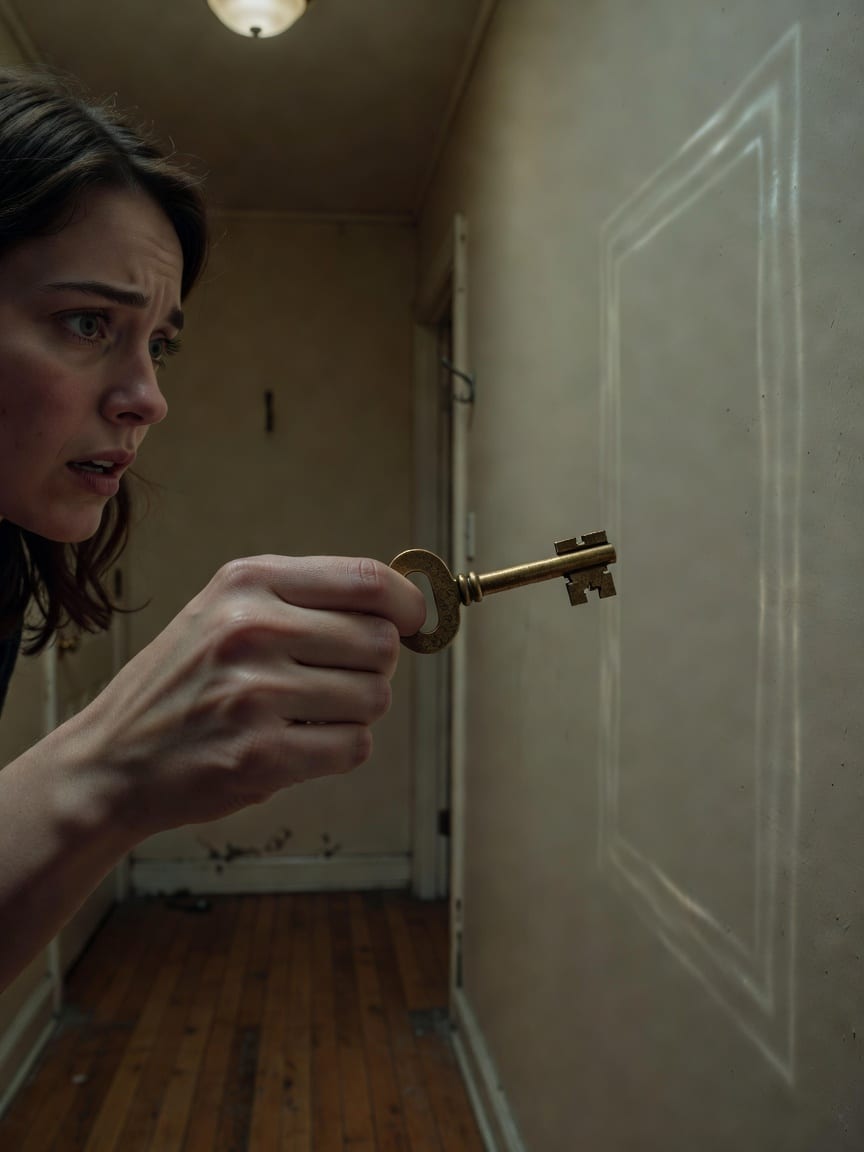
My new house has seven rooms. The removal men counted six. Now one of them asks who's in the locked seventh, on a landing with only six doors.
Moving into my new house, I supervised the removal men hauling boxes. But on the landing, Paul, the senior man, asked about a locked seventh room upstairs, pointing to a blank wall. His quiet certainty, despite the clear absence of a door, filled me with a sudden, icy dread.
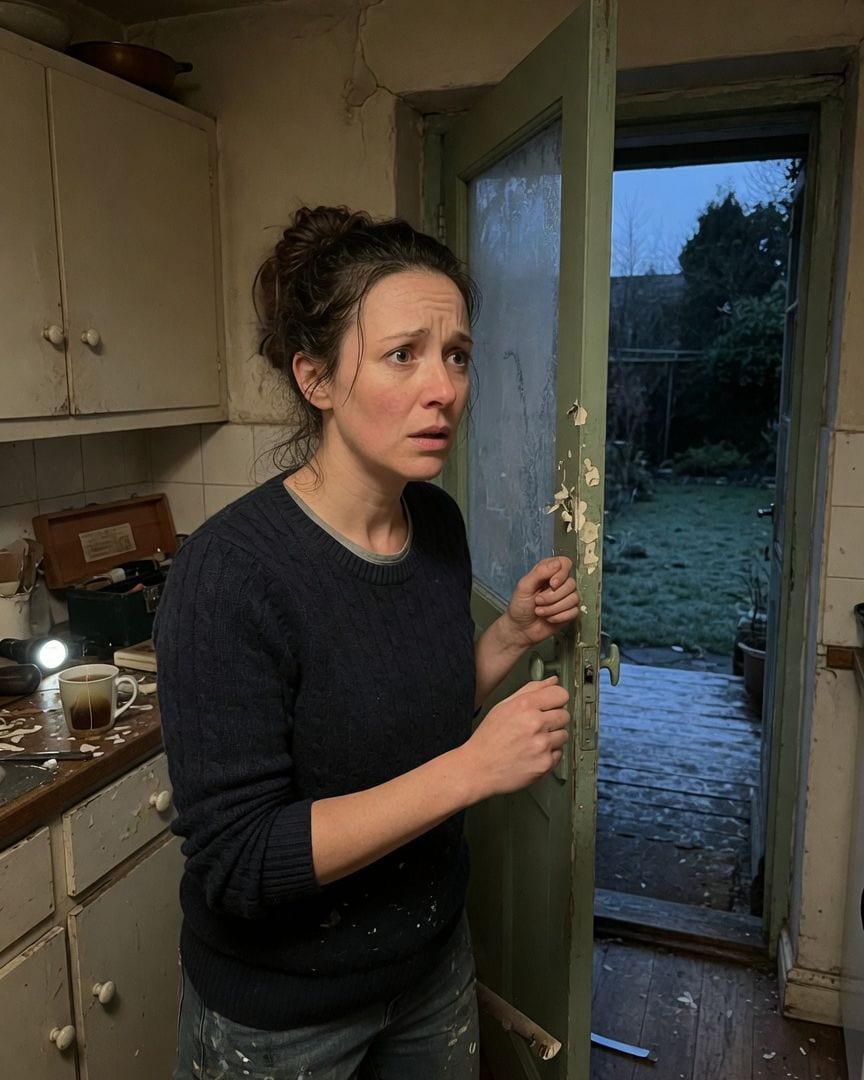
My 1950s cottage doorframe has '1923' carved into it, a date that simply cannot exist here.
I'd poured my heart into renovating my new cottage, especially the back door to my patio. But when I opened it, I wasn't looking at my frost-kissed garden. Instead, a cramped, reeking scullery with a bone-chilling dampness stared back, an impossible image that wouldn't leave my mind, even after the door closed.
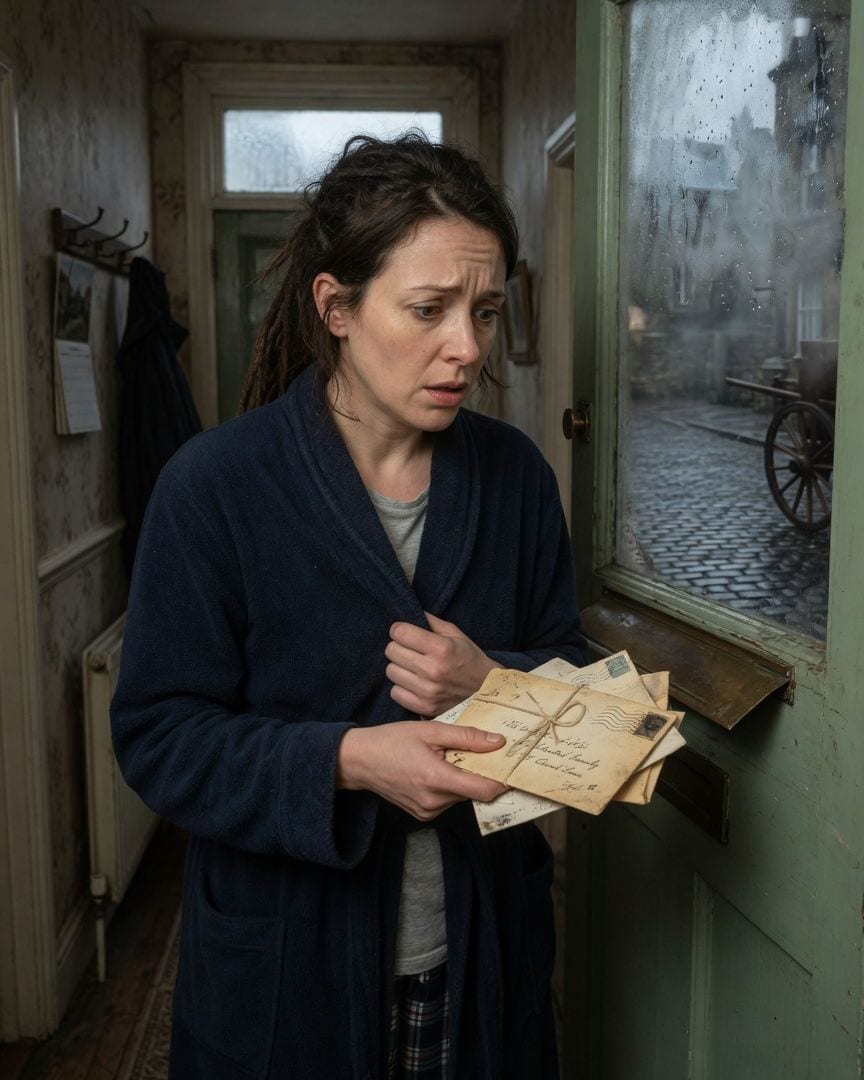
Seventy years ago, a hidden journal recorded my door opening to the wrong street and receiving Lockwood post.
I'd only recently moved into my inherited house, a quiet place on the edge of town. One grey morning, a distinct clatter from the front door's post flap caught my attention. Reaching down, I expected my gravel path, but instead, the flap showed a dark, cobbled street that wasn't mine. A bundle of warm, old letters, addressed to 'The Lockwood Family,' slid through, before the vision flickered and was gone.
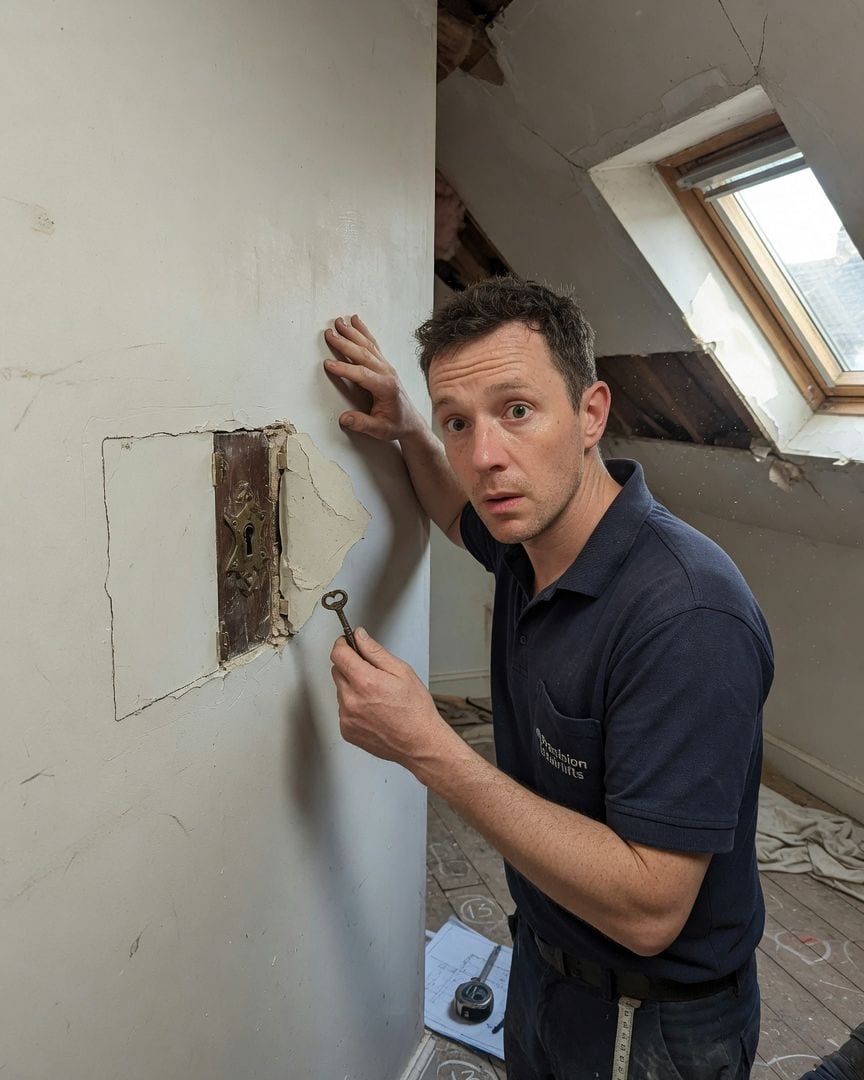
My stairlift tape measures thirteen steps, but my own feet always find a fourteenth — to a door that isn't there.
As a meticulous fitter, I measured my client's new loft stairs, confirming thirteen solid steps. But my foot found a shallow, impossible half-step, leading to a plain wooden door that shouldn't exist. Now the door is gone, leaving only a ghost outline.
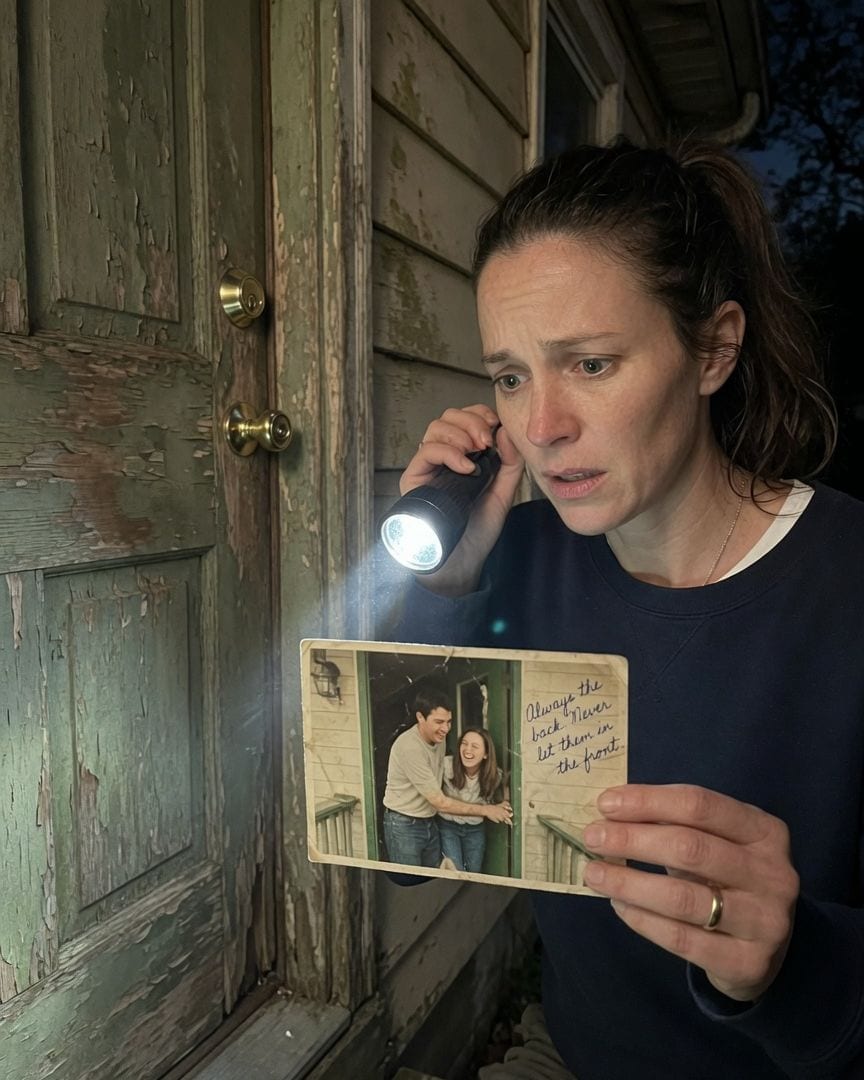
My mother waves us to the front door now. She was missing five days. She says we've always used the front, but the back door, our kitchen door for thirty years, is locked.
My mother, Janet, finally came home after five days, but her overly bright smile and insistence on using the front door felt wrong. For three decades, our family always used the back entrance, which now had a gleaming, new deadbolt. The quiet hum of unease quickly grew into a chilling dread.
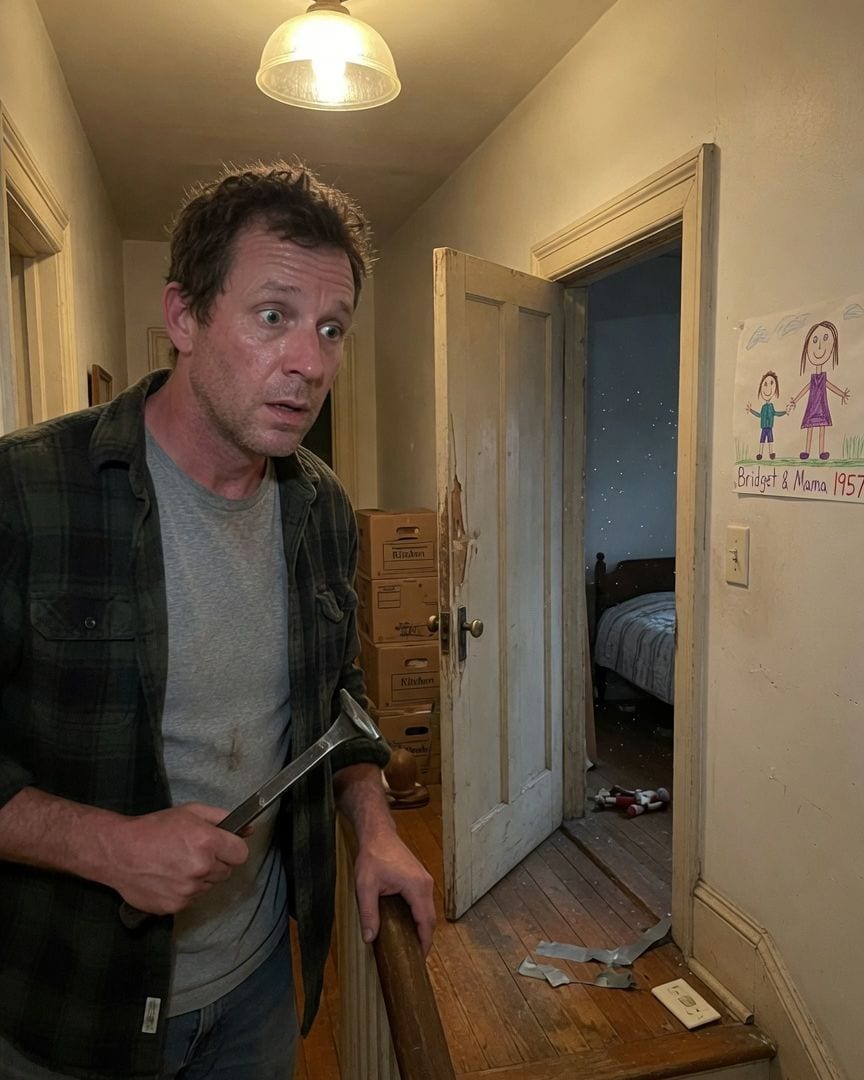
My landing light switches itself off at 9:40 every night. I've watched the switch flick down under nothing, the tape peeled back. The house holds its breath.
My great-uncle's old house was a quiet gift, a place to finally settle. But as I unpacked, a strange worn path on the floorboards led me to a small, barely visible door, perfectly blended into the wall. It was undeniably locked, and felt like a deliberately obscured secret.