My front step is scrubbed white every Monday before dawn, wet stone and a bar of yellow soap left on the sill. I live alone. I've never scrubbed a step in my life.
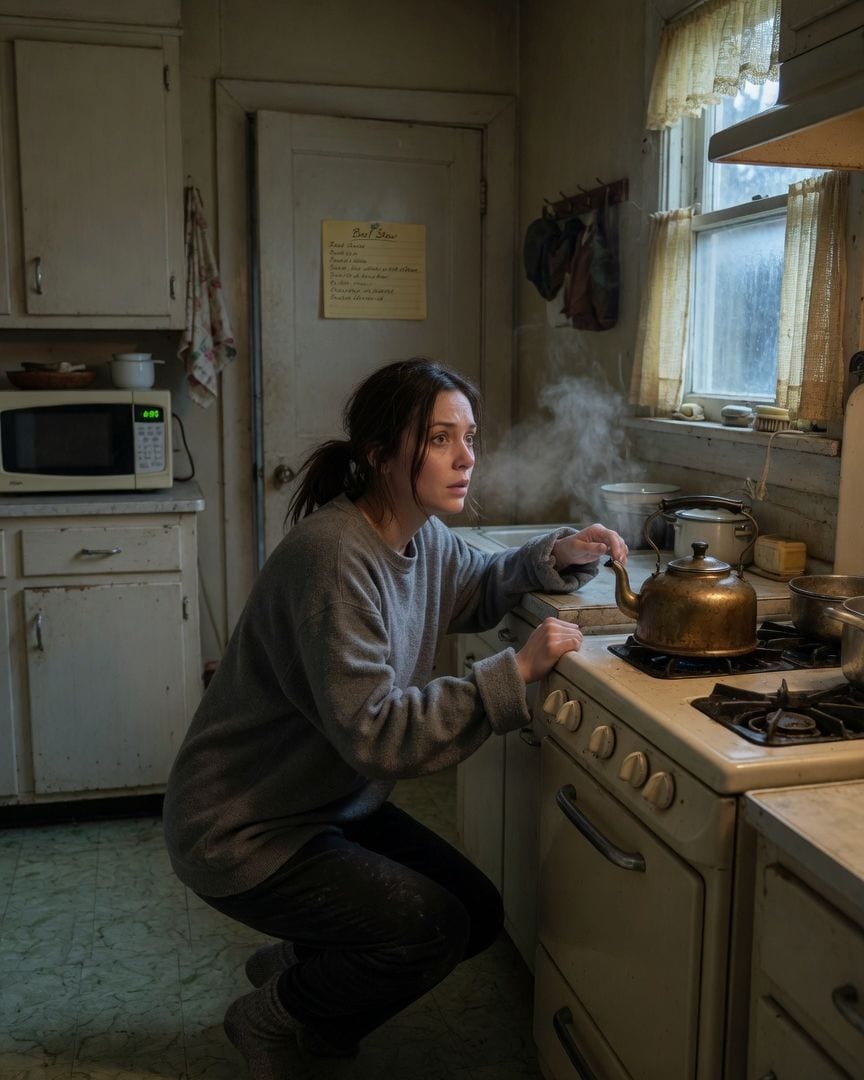
The chill hits me the moment my feet touch the linoleum. Not the usual morning chill, but something colder, a dampness that clings. It’s Monday, before dawn, and I already know what I’ll find. My front step. Scrubbed white. Again.
I pad to the door, hesitating a breath, then open it. There it is. The slate step, usually a dull, mottled grey, now gleams with a milky whiteness. Still damp.
The pale tideline where the water ran is stark against the darker flagstones of the path. To the left, on the window sill, rests a bar of hard yellow soap, slightly dissolved, and a stiff-bristled scrubbing brush, neatly placed bristles-down.
I live alone. My name is Emily Caldwell. I’m 32, and I haven't scrubbed a surface by hand in years, let alone a step at 5 AM.
I squat down, my breath fogging in the cool morning air. I run a finger over the wet stone. It’s not just clean; it’s scoured. Almost polished.
And there, just visible as the last of the moisture evaporates, are faint impressions: two distinct knee-prints, shallow but unmistakable, and the splayed, ghost-like marks of hands. Someone was here, on their knees, scrubbing. Every Monday. Before dawn.
I've been here since June, since inheriting the place, and it’s been every single Monday. I’ve tried to rationalise it—a well-meaning but overzealous neighbor? A weird, silent prank? But my security cameras show nothing, no one.
The gate is always latched, the path undisturbed, save for these pristine marks. It’s consistent, meticulous, and utterly silent. There's no explanation that makes sense.
That first week, I’d found the old brass kettle on the hob, not mine, faintly warm, and assumed the previous owner had simply left it there, still retaining some residual heat from her final days.
But then the Monday ritual started, and my attention sharpened. I began to look. Really look.
The house, built in the early 1930s, felt lived-in, but not in a comforting way. More like it was still occupied by someone else’s ghost of a routine.
Every morning, without fail, I’d come into the kitchen around 6:05 AM and hear a faint, almost imperceptible metallic click from the stove.
And there, on the hob, would be that same ornate, old brass kettle, not steaming, but radiating a distinct, recent warmth. I never put it there. I don't even own a kettle like that.
I prefer the electric one on the counter. But it was always there, at that precise moment, precisely warm.
Then there was the third stair. It wasn’t just worn; it was distinctly worn. Smoother, shallower than the others, almost polished by decades of friction.
I found myself, without thinking, instinctively skipping it as I went up or down, my foot gravitating to the step before or after, as if my body already knew its habit.
In the living room, a deep, permanent indentation on the cushion of the old, floral armchair by the window.
Not just flattened, but truly indented, as if someone had sat there, day after day, year after year, until the very fabric of the cushion learned their shape.
Sometimes, around dinnertime, I’d catch a faint, almost ghost-like smell of beef stew – a rich, savory aroma that would drift from the kitchen, even when I hadn't cooked a thing.
It was so specific, so persistent, that I finally searched for a source. Tucked behind a cabinet in the pantry, I found it: a faded, yellowed recipe card for a simple beef stew, in neat, looping handwriting.
The ‘old habits’ theory felt like a flimsy paper screen now, barely concealing something far more solid, far more… present. The step wasn't just showing wear; it was being scrubbed. The kettle wasn't just cold; it was warm.
These weren't relics of the past. They were actively happening, every day, every week.
I couldn’t sleep. The metallic click from the kitchen, even if I couldn't always consciously hear it, felt like a persistent drumbeat in the back of my mind. Tonight, I decided, I would watch.
I slipped out of bed just after five, pulling on a thick sweater against the pre-dawn chill. I didn't turn on any lights, just found a shadowed corner in the kitchen, shivering slightly, my eyes fixed on the hob.
The silence of the house pressed in, thick and heavy. I watched the clock on the microwave display. 6:00. 6:01. The air in the room felt colder, somehow. My breath plumed.
Then, at precisely 6:05 AM, a faint, metallic click sounded from the stove, sharp and clear in the quiet. I rushed forward, my heart hammering against my ribs. There, on the hob, rested the old, ornate brass kettle, not mine.
A wisp of steam, fine as a spider silk, curled lazily from its spout, glowing softly in the predawn light that had just begun to creep through the window. I reached out a trembling hand. It was warm.
The faint click of the kettle, I realized, had been happening every morning.
The next morning, the kettle was cold, placed neatly back in the cupboard above the stove where I'd found it initially, as if mocking my vigil. My first thought was that I needed to find out more about Eileen Granger.
She'd been the previous owner, I knew that much from the estate agent. The online searches were sparse: Eileen Granger, age 88, passed away peacefully in late 2023. Lived alone in her long-time family home. Quiet woman. That was it.
I needed more. The local library was a treasure trove of mundane history. Dusty newspaper archives on microfiche. I spent hours there, scrolling through local news.
Snippets about Eileen eventually surfaced: a lifetime resident, known for her immaculate house, her "set ways," her involvement in the local garden club. Nothing dramatic, just a consistent pattern of quiet, meticulous living.
Armed with this, I took a deep breath and walked two doors down to Maureen Hawkins' house. Maureen was an elderly woman I’d waved to a few times, a long-time neighbor. She invited me in, her smile thin but welcoming.
"You're the new Ms. Caldwell, dear. Emily, isn't it? Such a pretty name. You've settled in well to Eileen's old place."
"Yes," I started, trying to sound casual, "I was hoping you could tell me a little about Eileen. Just trying to get a feel for the neighborhood history."
Maureen's eyes, sharp and bright, seemed to assess me. "Eileen? Oh, a sweet woman. Very particular, though. Very set in her ways. You could set a clock by her schedule, you really could." She chuckled, a dry, rustling sound.
"Every Monday morning, rain or shine, she'd be out scrubbing that step. Before the sun was even properly up. Said it made the house feel cared for. And her tea? Always at 6:05 AM.
Always the same, that old brass kettle on the hob." My blood ran cold, but Maureen's tone was so calm, so matter-of-fact, as if she were describing the weather. "And her beef stew," she added, almost as an afterthought.
"Wednesdays, usually. You could smell it halfway down the street." Her words were precise, confirming every single impossible detail I’d observed. Her composure unnerved me more than the confirmation itself.
It was as if she found nothing unusual about any of this.
The routines, now that I was aware of their precise timing and nature, felt less like background noise and more like a surveillance system. The house was watching. And waiting.
I would be downstairs, reading, or watching TV, and suddenly I’d hear it: the distinct thump-skip on the third stair, even when no one else was in the house.
It would make me jump, my heart pounding, before I’d try to tell myself it was just the old house settling, or the wind. But it was always the same thump-skip, distinct as a signature.
One afternoon, I left my ceramic mug of coffee on the kitchen counter while I went to fetch a book. When I returned, not five minutes later, it had been moved.
Not far, just a few inches, to the precise spot on the deeply indented armchair cushion where Eileen’s teacup would have rested. I stared at it, my hands shaking. I knew I hadn't moved it.
Then, one evening, as I was about to go to bed, the smell of the beef stew hit me. Stronger than before. Not faint, but rich and warm, as if simmering in the next room. I rushed to the kitchen.
Empty. Cold. No pot on the stove, no scent clinging to the air, just the faint, metallic tang of an unused appliance. The smell vanished as quickly as it had appeared, leaving a phantom warmth in its wake.
A few days later, I was retrieving the mail when Maureen stopped me by her fence. She leaned in conspiratorially, her eyes twinkling. "You're settling into the house nicely, aren't you, dear?" she said, her voice a low murmur.
"I see you've started keeping everything just so." Her smile was faint, knowing, and utterly unsettling. It was the same smile she'd given me when confirming Eileen’s impossible rituals.
I felt a profound chill, a sense that I wasn't just living in the house, but was slowly becoming part of its display, an exhibit for Maureen’s quiet amusement.
"Maureen," I said, my voice tight, forcing myself to push past the polite facade. "The house is... doing things. Eileen's routines. They're still happening."
Maureen sighed, a slow, almost pitying sound, her gaze unwavering. "Oh, Eileen was very particular. Very set in her ways. The house… it appreciated that." She paused, looking past me, towards my house, as if addressing it directly.
"She rarely left, you know, especially in her later years. She always said she talked to the house, not in it. She believed it listened."
"Listened?" I echoed, disbelieving, but the chill in my bones deepened.
"Oh yes. She'd say the house knew her. Understood her needs. Said it kept her company, kept her busy. She even used to say the house kept her alive, in a way.
Made sure her days had purpose, her routines were seen to." Maureen spoke with a calm, unnerving certainty. "Kept her focused."
"But when she died," I pressed, "how could it... continue?"
Maureen finally looked back at me, her eyes clear and unblinking. "The house remembered," she said, simply. "It just… continued. It's what it does."
The way she said it, without a flicker of doubt or surprise, made every impossible detail snap into horrifying focus.
The scrubbed step, the warm kettle, the worn third stair, the phantom smell of stew – they weren't traces of a ghost. They were the house's own meticulous, unceasing memory. The house wasn't haunted by Eileen.
The house was Eileen’s memory. And it was still going.
Desperate for a different answer, any answer that didn't involve a house with a memory, I tore through Eileen's few remaining belongings left in a dusty box in the attic. Old linens, some faded photos, a few trinkets.
Beneath a pile of moth-eaten crochet doilies, my fingers brushed against something hard and leathery. I pulled it out. A small, leather-bound journal. Worn smooth at the edges, its pages yellowed but intact.
I opened it, my hands trembling. Inside, Eileen's neat, looping script filled the pages, detailing her daily life, her garden, her simple thoughts. I flipped frantically through, past the mundane entries, looking for anything that might explain. I found them.
The final entries, dated just weeks before Eileen's death.
The words described a growing sense of peace, a blurring of her own identity with the house. 'The house remembers, so I am here,' one entry read, dated October 12th. 'It knows my steps, my tea, my stew. It is me, and I am it.' Another, a few days later: 'Such comfort in the routine. Never alone. The house is my memory, and I am its purpose.'
Then, the very last entry. Dated December 3rd, the day Eileen Granger passed away. The handwriting, once so neat, was faltering, shaky. Words described a 'slow surrender,' a 'gentle becoming.'
It trailed off, words dissolving into a series of faint, looping patterns, barely more than scribbles, ending with the fragment: '…and the house remembers, so I am here. So I am…' The ink, I noticed, looked unsettlingly fresh.
I closed the worn, leather-bound journal, my fingers tracing the indentations of Eileen’s final, fading words. The full, chilling truth slammed into me. Eileen hadn't just maintained the house's routines; the house had maintained her.
It had absorbed her presence, her routines, her very self, weaving them into its fabric so that her life, in a terrifying way, could continue.
Her journal entries weren’t just a diary; they were a testament to her slow, willing acceptance of this merging. Her contentment in becoming the house's 'memory.'
She wrote of feeling held, protected, and ultimately, made eternal by the house's unwavering patterns.
The house wasn't just haunted by a ghost; it was the ghost, a living, breathing memory, a repository of a life lived by meticulous routine. And now, I realized, it was trying to absorb me.
Make me the next keeper of its past. The next iteration of Eileen Granger.
I had to confront Maureen one last time. She was pruning roses in her front garden, her movements slow and deliberate.
"Eileen became part of the house, didn't she?" I demanded, holding up the journal. My voice was ragged. "It absorbed her, and now it wants me to be next."
Maureen straightened, her shears clicking shut with a soft snick. She looked at the journal, then at me, her gaze calm, unblinking. "The house needs someone to keep it alive, dear. It's always been that way.
Eileen was happy to serve."
My stomach clenched. "What do you mean, 'always been that way'?"
She shrugged, a slight, almost imperceptible movement. "Oh, the houses in this neighborhood, they're old. They have… preferences. They choose their keepers. Those who are meticulous, who appreciate routine. Who understand the quiet hum of a day well-ordered."
She stepped closer, her voice dropping, though she made no effort to lower it. "You, Emily. You noticed. You followed the patterns. You watched. The house has already chosen you."
Her complete lack of alarm, her serene acceptance of this horrifying truth, was the most terrifying part. She offered no warning, no advice, no escape. Only a quiet, knowing understanding of an inevitable process.
As she spoke, I felt a subtle, undeniable pull, a whisper in the back of my mind. An urge to check the kettle. To make sure the front step was perfectly clean.
A faint echo of Eileen's contentment, settling deep within me. The house, I realized, had already begun its work.
I sold the house within weeks. At a considerable loss, of course. I fled to a small, modern apartment across the city, a place of clean lines and minimal history, trying to forget.
But the routines persisted, not in the house, but in me. I found myself meticulously straightening objects on shelves, checking locks twice, even three times.
I'd catch the faint, lemony scent of that scrubbing soap on my hands, scrubbing them compulsively, even when they were already raw. I avoided Mondays. The mere thought of them brought a cold, damp dread.
Months later, here in my new apartment, I make my morning tea. I glance at the pristine white threshold of my own front door. Then I look down at the floor, at the polished wood.
My new front step, I notice, is gleaming.
If this one got to you
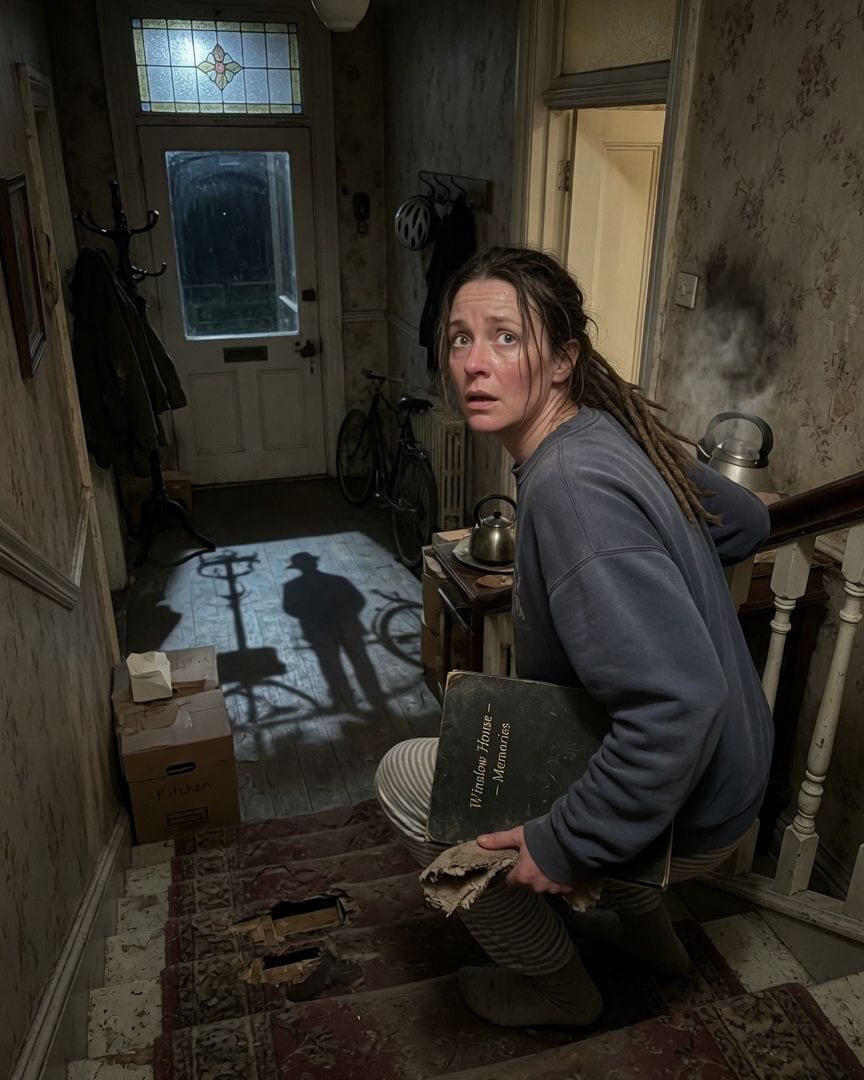
At 3am my dark porch throws grey shadows onto my hall floor — a coat-stand, a bicycle, and the outline of a man standing outside. I open the door and no one's there.
I'd just moved into Winslow House, struggling with new-house jitters and sleep. Then, at 3 AM for the second time, a stark grey light woke me, casting distorted shapes onto my hall floor. The undeniable shadow of a man stood beyond the threshold, impossibly still, even though I lived alone and the porch light was off.
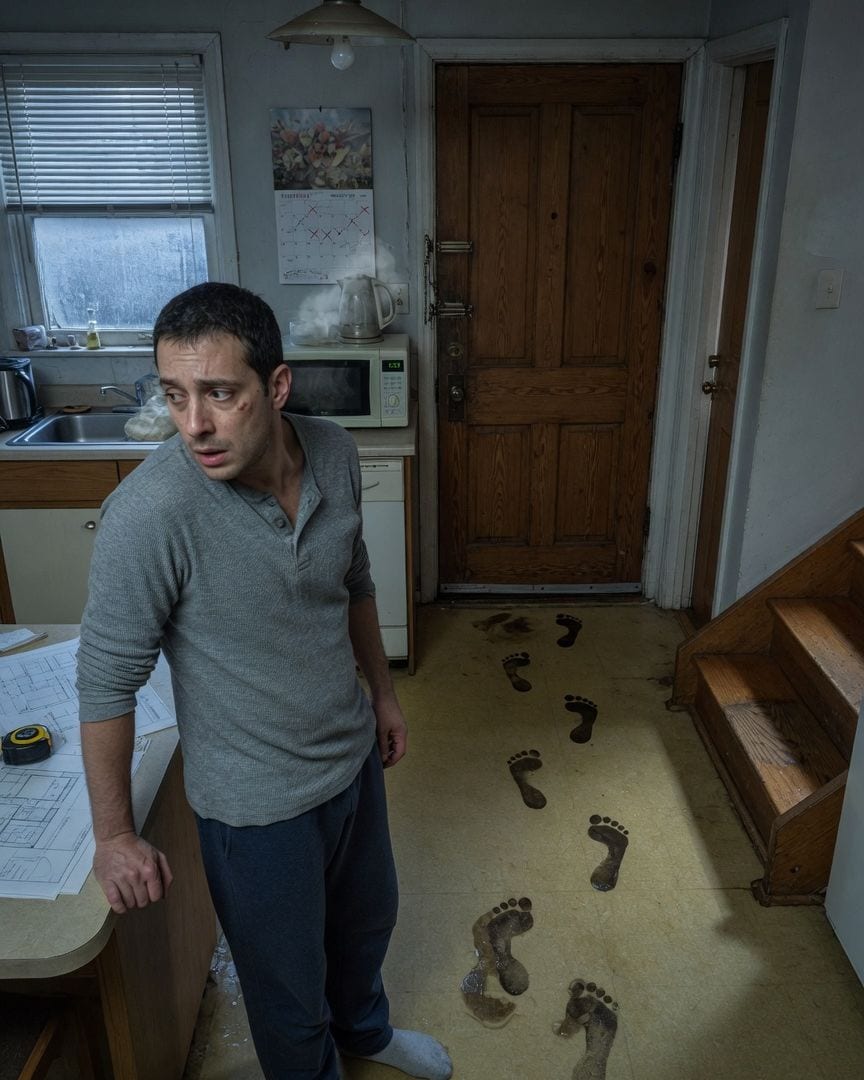
Bare wet footprints cross my locked kitchen floor every morning. Larger than mine, leading from the bolted back door to the stairs, fading from the toes as I watch.
As an architect, I notice details, but nothing in my old house's plans accounted for this. Every morning, wet, bare footprints appear across my kitchen floor, stretching from the bolted back door to the main staircase. They are larger than my own, colder than winter, and simply materialize from nothing.
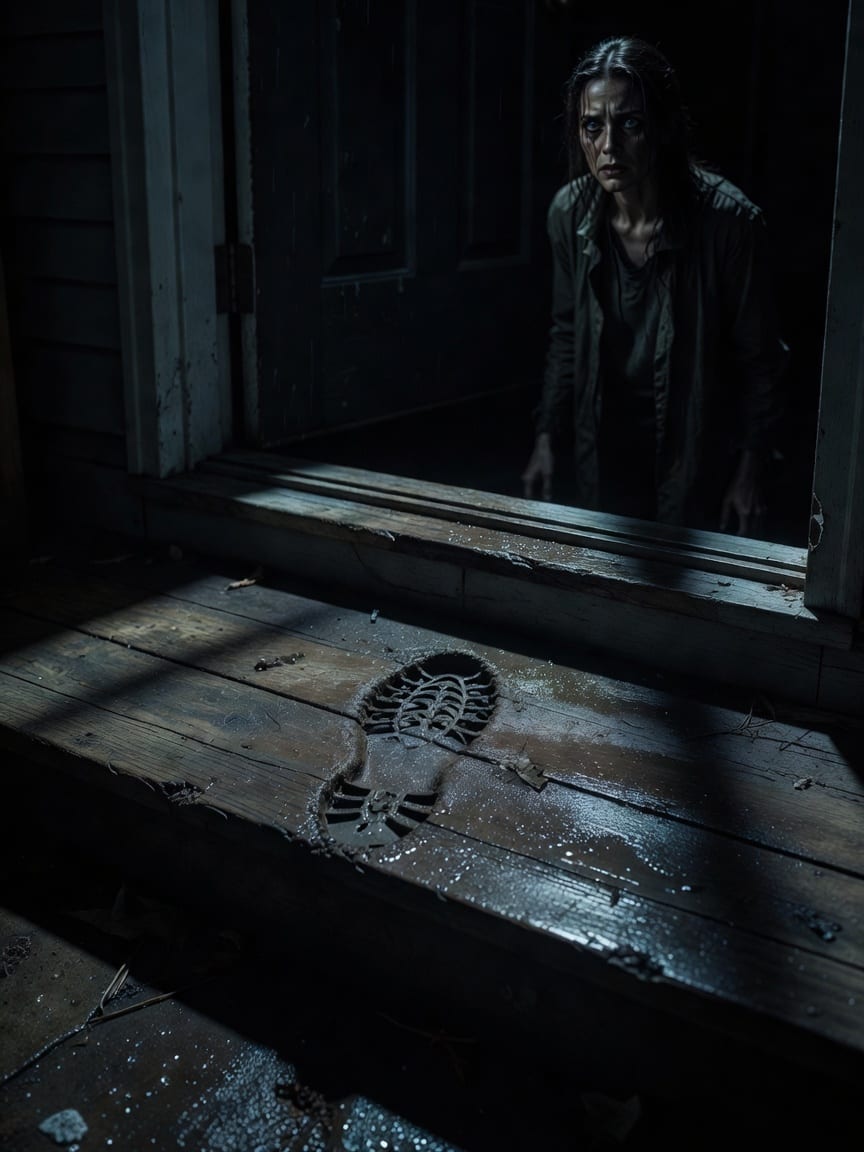
My landlord's only rule: never let the outside tap run after sundown. Last week it dripped. This morning, wet bootprints ringed the back step from the tap to my door, all the same size. The tap was off.
We'd just settled into Waterside House, with its strange landlord rule about the outside tap. After the washer broke, I found perfect, wet bootprints leading from the tap to our back door, but the tap was cranked completely off, tighter than I could manage.
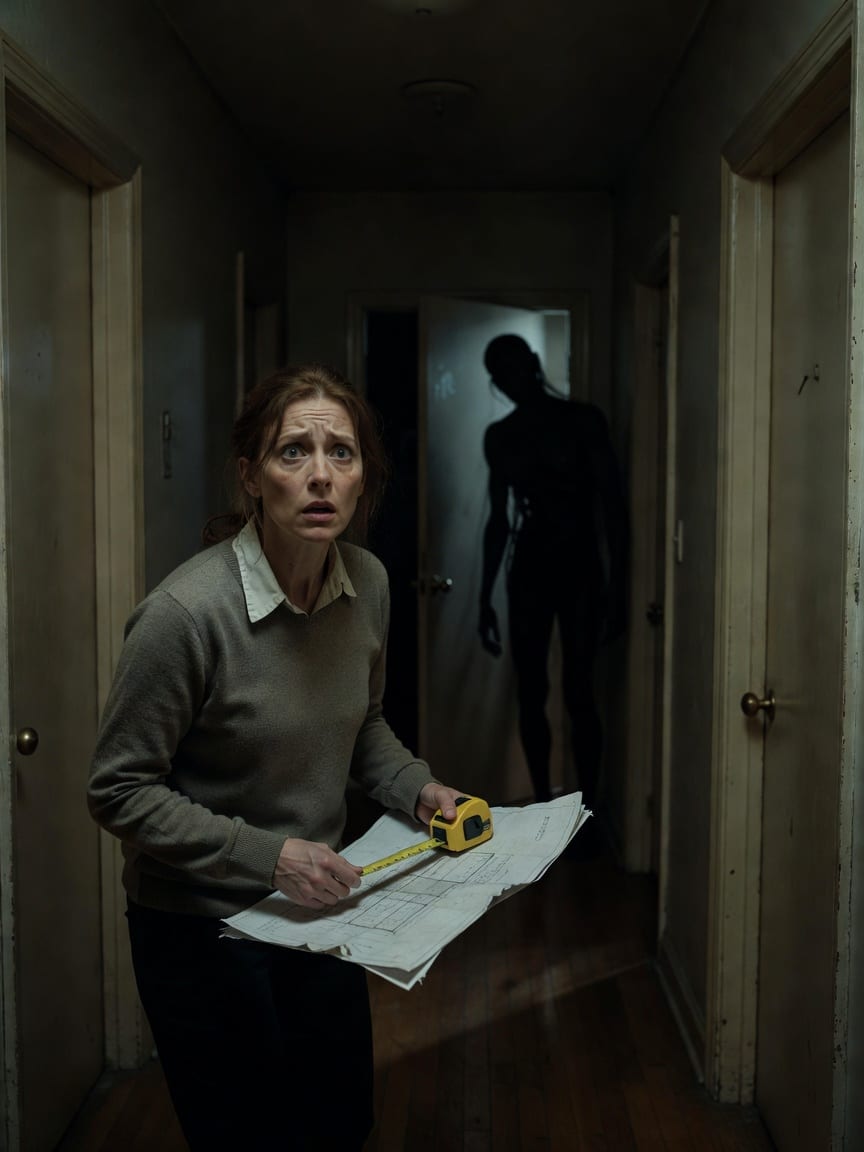
My front door has a dented gate and a dead hydrangea. I walked past it six times, trying to reach the corner shop just a hundred yards away. The pavement kept bringing me back to my own porch, and the shop's light never moved.
My morning started like any other, a quick walk to the corner shop from my home at Number 14, Elm Terrace. But after walking what felt like two minutes, I found myself back at my own front door, the shop no closer. I tried six times, faster and slower, but my street kept compressing, refusing to let me leave.

Every ninth year since 1901, my logbook records a boat through the gate at 4:05am — 'vessel through, none seen.' I was on watch tonight. Nothing passed.
As the lighthouse keeper, I log the same impossible entry every nine years, a lie I'm compelled to write. But tonight, a hidden brass disc in the floor, not on any blueprint, feels oddly warm. Hours later, it hums, and the air above it shimmers and distorts, then vanishes.
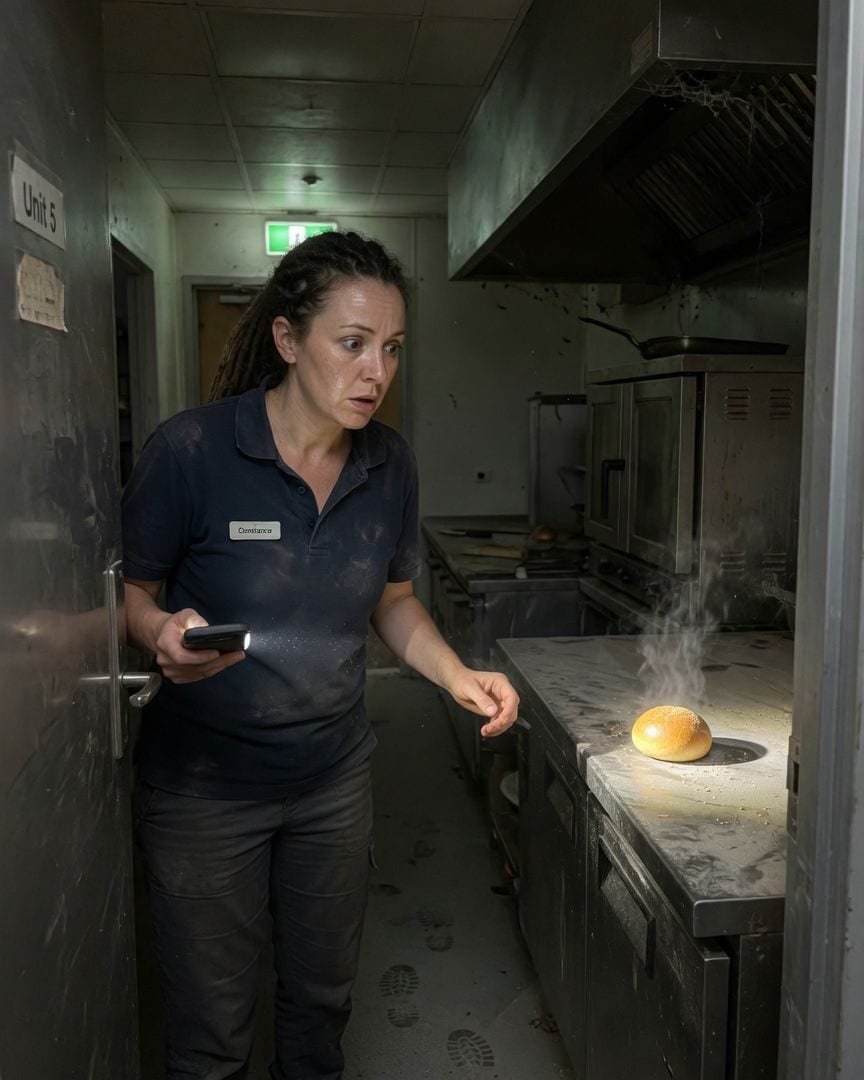
My night baker Karim always gave me a warm roll at 4 AM. His unit has been vacant, gas shut off, for two years.
I work the night shift in a quiet commercial kitchen, my routine marked by Karim from Unit 5, who always delivers a warm, golden-brown roll. It's a small comfort during the long hours. But the building manager insists Unit 5 has been vacant for two years, its gas shut off long ago. Still, a warm roll appeared under my door this morning.