The hospital found a tumor sample filed under my patient number, but the cells belong to a man who died on their table in 1988. My file has no biopsy — and they want me to come in.
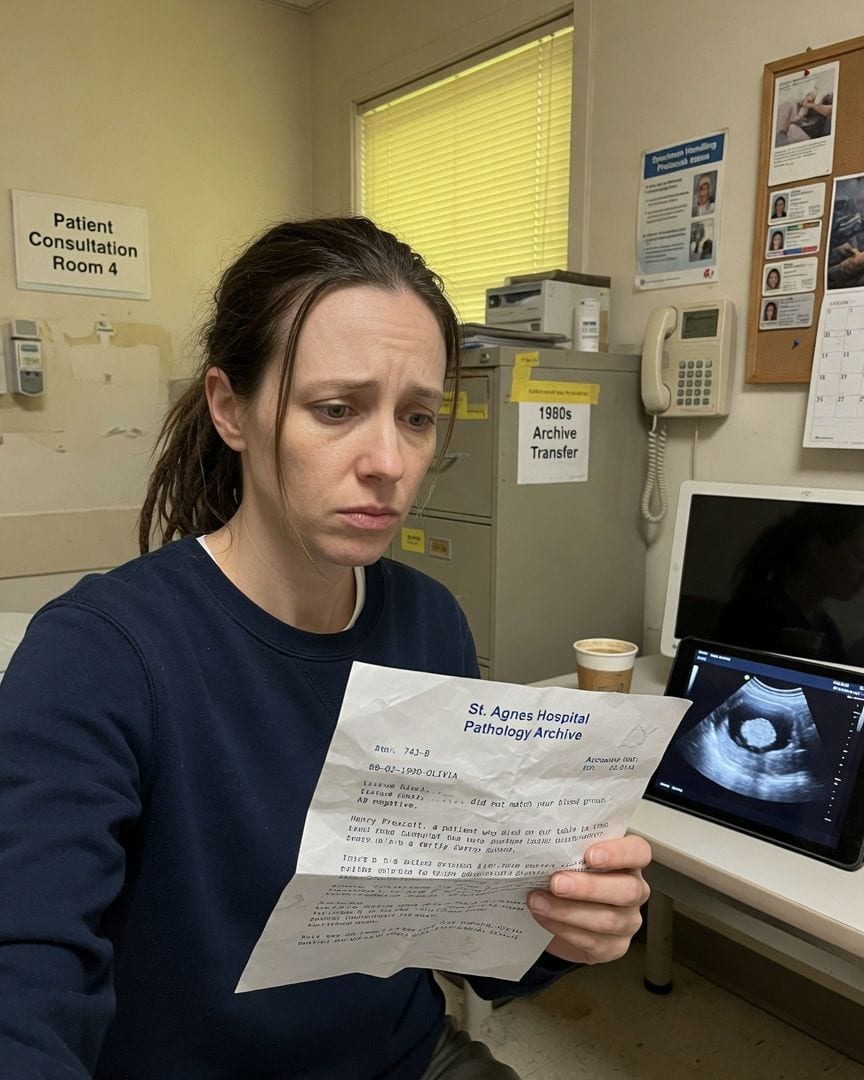
The envelope felt ordinary, a standard hospital logo, but the letter inside was anything but.
It began politely, stating that the pathology archive had flagged an anomaly: a tissue block, filed under my hospital number, did not match my blood group. Not just a slight variation, but a completely different type.
I stared at the words, a cold dread seeping in. My blood type is O positive, always has been. The letter clearly stated the sample was AB negative. How could that even happen?
My own medical file, I knew for a fact, had no record of any biopsy, let alone a tumor. I’ve never had surgery, never had a serious illness requiring a tissue sample.
The idea of a 'tumor slice' was alien to my personal history. Yet, here it was, a piece of someone else, marked with my identity, demanding a response.
Then came the next sentence, a punch to the gut: 'Upon sequencing, the block, a slice of tumour set in wax, returned DNA belonging to a Henry Prescott, a patient who died on our table in 1988.'
Henry Prescott. 1988. Two years before I was even born. The name was completely unknown to me. The date was impossible. A man dead decades ago, his cells somehow filed under my hospital number, under my name.
The whole thing felt like a particularly cruel practical joke, but the hospital’s letterhead was official, the language sober and precise.
The letter ended with a request: they needed me to come in, 'for a buccal swab to verify current biological markers.' To verify my biological markers against his? The implication was sickening.
My first instinct was confusion, then a rational desire to correct a clerical error. This had to be a mix-up, some ancient file digitised incorrectly.
I called the pathology archive directly, a calm, professional woman on the other end confirming the letter’s details with unsettling precision. She pulled up the record instantly. "Yes, Ms. Granger, accession number 743-B, filed under your current patient ID, 88-02-1990-OLIVIA.
The block itself dates from 1988, clearly marked 'H. Prescott,' but subsequently cross-referenced and stored under your number. It’s a unique discrepancy in our system." There was no mistake on their part, she assured me.
The block, accessioned decades ago, was undeniably linked to my current hospital ID.
I then called my GP, Dr. Chen, who, after reviewing my digital file, confirmed what I already knew: no biopsy, no tumor, no record of any surgical procedure in my history.
He was as baffled as I was, scrolling through screen after screen of my clean bill of health. "No, Olivia, nothing here. Not even a routine appendectomy. Your file is… pristine."
He suggested it must be a mix-up, a digit transposed somewhere in the old paper records before everything went digital, a quirk of their archaic filing system being modernized.
He advised me to go in for the swab, just to clear it up. "It’s probably just a phantom record," he said, trying to sound reassuring, but his voice lacked conviction.
The hospital booking line was efficient, almost too efficient. They scheduled me for the very next morning, emphasizing the 'urgent nature' of the discrepancy. As I hung up, the words 'Henry Prescott, 1988' echoed in my mind.
A man I’d never heard of, dead years before I was even born, his cells somehow filed under my name. The sheer impossibility of it kept me awake, a quiet hum of unease under my skin.
It wasn't just a mix-up anymore; it felt like a violation, a quiet invasion of my own identity. I had to know.
The swab was quick, painless. A nurse scraped the inside of my cheek, then sent me to a small consultation room.
Dr. Alistair Finch, a young, earnest internist, came in a few minutes later, reviewing my recent full medical history on his tablet. He scrolled through, muttering about 'standard procedure,' until his finger paused.
The quiet hum in the room seemed to lower, almost imperceptibly. He looked up, a faint frown creasing his brow.
“You had a routine abdominal scan six months ago, Ms. Granger?” he asked, a new note of caution in his voice.
“Yes, for a check-up,” I replied. “Everything was fine. They told me I was perfectly healthy.”
He nodded slowly, his gaze still fixed on the screen, not quite meeting mine. Then he said, “I’d like to order a follow-up, immediate. Just to be thorough. Given this… discrepancy.”
An hour later, I was back in a gown, the cold gel spreading on my skin. The new scan whirred, a low, pulsing sound.
Dr. Finch stared at the monitor, his face paling with each passing second, the room growing colder. He gripped the edge of the console, knuckles white. He pointed a trembling finger to the screen.
Deep within my abdomen, a small, dense mass glowed, not a tumor, not a cyst, but something utterly foreign, with an impossible, almost crystalline structure. The light from the screen reflected in his wide eyes.
“Ms. Granger,” he said, his voice barely a whisper, “This… this isn’t possible.”
Dr. Finch couldn't explain the anomaly. He ordered more tests, consulted specialists, but every expert agreed: it was biologically impossible, yet undeniably there.
They called it an 'unidentified cellular agglomeration' – a term that meant absolutely nothing to me, beyond the fact that there was something fundamentally wrong inside me.
While the medical establishment grappled with the impossible object, unable to classify it, much less suggest treatment, I started my own investigation. Henry Prescott. The name was a phantom, but I needed to put a face to it.
I found his death certificate online, confirming his demise in 1988 at this very hospital. Old newspaper archives yielded a few obituaries: Henry Prescott, 40, died of complications from a rare, aggressive cancer.
A talented architect, survived by a sister, Karen Thatcher. The details were sparse, just enough to confirm he was a real person, not just a name on a file.
I found Karen Thatcher in the phone book, an old address listed in a quiet suburb an hour away. She answered on the third ring, her voice raspy with age, tinged with a weariness that went beyond simple years.
She was initially wary, suspicious of my questions about her long-dead brother. “Who is this? What do you want with Henry?”
But when I mentioned the hospital, and the experimental treatment Henry had been undergoing before he died, her tone shifted. A tremor entered her voice, a flicker of something raw and unresolved.
“He was part of something… unusual,” she said, her words strained, almost a gasp. “They told us it was revolutionary, a last hope. A Dr. Robert Underwood was in charge.”
She wouldn’t elaborate, wouldn’t explain what 'unusual' meant. She just kept repeating, a low, mournful litany, “It wasn’t right, what they did. He didn’t… he wasn’t himself, at the end. They promised a cure, a miracle, but they changed him.”
She finally gave me Dr. Underwood’s name, saying he was a brilliant but controversial figure in cellular biology, even back then.
A quick search revealed his name in old medical journals, articles from the 80s and 90s, some praising his groundbreaking work, others questioning his ethics, hinting at radical, boundary-pushing research. He’d vanished from public life decades ago, retired, untraceable online.
Just a name, a ghost, but a connection. A thread to pull.
Finding a retired Dr. Robert Underwood proved difficult. He’d left no digital footprint. It was as if he’d deliberately scrubbed himself from the modern world.
I left messages with the hospital’s alumni association, with the medical board, with old colleagues whose names I found buried in the references of his obscure journal articles. No replies. The silence was deafening, unsettling.
But my digging seemed to trigger something. My car alarm, usually dormant, started blaring at random hours of the night, sometimes for only a few seconds, sometimes for minutes.
My apartment door, deadbolted and chained, had a faint, almost invisible scratch near the lock, a sliver of new silver on the dark wood, as if someone had tried to jimmy it open, delicately, almost without leaving a trace.
I rationalized it at first – a faulty sensor, a clumsy neighbor – but the feeling persisted.
Then, a package arrived, unmarked, at my doorstep. No sender, no return address. Inside, nestled in plain tissue paper, was a single, yellowed newspaper clipping.
It was Henry Prescott’s obituary, the one I’d found online, but a small detail was different: his name was circled in red pen, a harsh, urgent slash of color. No note, no explanation, just the silent, chilling implication.
I felt eyes on me. Walking home from work, I caught glimpses of a dark sedan parked down the street from my building, its windows tinted. It was there two days in a row, always the same spot, engine off.
One evening, as I pulled back my curtains, pretending to check the weather, I saw an old man in a dark hat, his face obscured by shadow, staring directly at my window from across the street.
He didn’t move, didn’t flinch, just watched. The streetlights made his silhouette unnervingly sharp against the dark buildings behind him.
The next morning, the dark sedan was gone, the spot empty, but the feeling of being observed, of being hunted, remained. Someone knew I was getting too close.
The paranoia grew unbearable. The impossible object inside me, the dead man’s DNA, the silent watcher – it was all coalescing into something monstrous. I knew I had to find Underwood.
Following a lead from an obscure medical forum, a decades-old post by a former student mentioning his mentor’s fondness for a specific botanical garden, I finally tracked him to a quiet, secluded retirement home outside the city.
It was a place designed for dignified fading, all hushed tones and manicured gardens.
He was frail, his white hair thinning, but his eyes held a sharp, unnerving intelligence that belied his age. I found him in the sunroom, reading a thick, leather-bound volume.
The air in the room was warm, almost oppressive, smelling faintly of old paper and something medicinal. I approached cautiously, my heart pounding, each step echoing in the quiet.
“Dr. Underwood?” I asked, my voice thin.
He looked up, his gaze steady, unflinching. “Yes?”
“My name is Olivia Granger. I think you know why I’m here.” I laid out the pathology letter, the DNA report, the scan images of the impossible object within me, spread across the small, polished table.
I mentioned Henry Prescott, and Karen Thatcher’s name hung in the air like a stone.
He listened in silence, his expression unreadable, his eyes flicking from one document to the next, betraying no surprise. He took a long, slow breath, a faint sigh escaping him.
“It seems the past has a way of finding its way back,” he murmured, his voice dry and raspy. He admitted to the experimental procedure, but framed it as a desperate, last-ditch effort.
“Henry Prescott was dying of a cancer we couldn’t touch. But his immune system… it was extraordinary, even in decline. Resilient.
We theorized we could ‘repurpose’ healthy cellular material, integrate it into newborns facing severe genetic defects, to give them a fighting chance. A radical approach, yes, but for children with no other hope…”
He confessed that after Henry’s death, some of his cellular material was indeed integrated into a newborn, Olivia, as part of a highly controversial trial. “You were that child, Olivia. Born with a severe immune deficiency.
We believed Henry’s cells could be a cure, a miracle. A new beginning, literally.”
He insisted it was a unique, ethically dubious but medically motivated attempt to save a child, and that the program was immediately shut down after, deemed a failure, too risky, too uncertain.
He spoke of the ethical dilemmas, the desperation, the pressure to innovate, the weight of choices made in a different era. He looked me in the eye, pleading. “It was a different time, Olivia. We were trying to do good.
You were meant to be the only one, the last one.”
The pieces clicked into place, horrible and cold: Henry’s cells, my body, a desperate experiment. It made a terrible kind of sense. The impossible object, a side effect. The silent watcher, an attempt to keep it buried.
My life, a consequence.
Underwood closed his eyes, exhausted, the confession leaving him visibly drained. His face looked grey, suddenly much older. “You were meant to be the only one, Olivia. The last one.”
I stared at him, the weight of his words pressing down on me, trying to reconcile the impossible truth with the frail man before me. My mind raced, replaying every detail, every implication.
My body, a vessel for another man’s cells, a product of a desperate, secret experiment. The air felt heavy, as if the room itself was holding its breath. I felt a profound sense of loss, of self.
The Olivia I knew, the rational woman trying to fix a clerical error, felt like a stranger.
Reeling, I glanced around his small, cluttered study, needing a moment to process this monstrous new reality. My gaze drifted over stacks of ancient books, framed certificates, dusty curios.
On a dusty bookshelf, behind a stack of old medical texts, a framed photo caught my eye. It was a group of smiling doctors from the late 80s, including a younger, more vibrant Underwood, his hair dark, his smile eager.
They were gathered in a sterile, clinical setting, the white walls and harsh lighting unmistakable. They were all holding babies.
In the foreground, standing proudly, was a woman in a lab coat, holding a baby, its tiny head peeking out from a white blanket.
The baby had a distinctive birthmark on its temple, a small, star-shaped mark, identical to my own, which I’d always thought was unique, a genetic quirk passed down from my mother.
And then I noticed it. The exact same birthmark on a second baby, held by another doctor in the same photo, just over Underwood’s shoulder. And a third, cradled by a man at the far end of the group.
Three distinct, star-shaped birthmarks. Three babies, all with my mark. My gaze snapped back to Underwood, who was now watching me, his faint, unreadable expression hardening into something I couldn't quite decipher, a chilling silence filling the room.
The last one. The words echoed, hollow and false.
“The last one?” I repeated, my voice barely a whisper, pointing a trembling finger at the photo. “You lied.”
Underwood’s composure finally shattered. The hardening in his expression broke, dissolving into a look of profound, agonizing defeat. He slumped back in his chair, his shoulders caving in, suddenly seeming even smaller, more fragile.
“Project Chimera,” he whispered, the name a chilling breath, a release of decades of unspoken horror. “It wasn’t about saving children, not primarily. That was… a convenient justification. A cover.”
He looked at the photo, then at me, a deep, exhausted shame in his eyes. “It was a clandestine, government-funded project, sanctioned at the highest levels.
The goal was to create genetically ‘optimized’ humans by integrating foreign cellular material from individuals with specific, desirable traits. Enhanced immune systems, rapid healing, heightened cognitive function.”
He explained that Henry Prescott, with his rare aggressive cancer, had an unusually robust immune response even in decline, making him a prime candidate for harvesting. His cells were incredibly viable, adaptable.
Olivia wasn’t the last; she was one of the first successful long-term subjects. The program continued for years, secretly, after Henry’s death, with other donors and other ‘recipients,’ each with their own unique traits they wanted to pass on, or graft.
The ‘impossible object’ in my scan, he explained, was a ‘cellular nexus,’ a synthetic organ designed to facilitate the integration and prevent rejection of the foreign cells.
It was the keystone of the entire experiment, the reason I had survived, and thrived.
He pulled out a hidden journal from a locked drawer in his desk, its worn leather cover almost camouflaged against the old wood. Its pages were filled with meticulous notes, diagrams, and names.
Dozens of subjects, all with similar “cellular nexuses,” all unknowingly carrying fragments of others. My entire life, my very being, was a lie. I was a living archive, a walking experiment, one of many.
The truth landed like a physical blow, leaving me breathless.
The journal, filled with decades of chilling detail, became my weapon.
With Underwood’s reluctant agreement to testify, his conscience finally cracking under the weight of his legacy, I contacted an investigative journalist known for breaking medical ethics scandals, and a whistle-blower organization. The process was terrifying.
Every shadow seemed to hold a threat, every phone call felt monitored. I lived in a state of constant fear, knowing the powerful interests behind Project Chimera would not want their secrets exposed.
But the truth was too monstrous to keep hidden.
We meticulously compiled the evidence: Underwood’s journal, with its meticulous records of every subject and procedure; the DNA reports from the hospital archive; my own medical scans, showing the irrefutable presence of the cellular nexus; and the corroborating details from Karen Thatcher, whose brother Henry had been the unwitting initial donor.
The journalist broke the story, not just about me, but about Project Chimera, the hospital’s complicity, and the identities of other 'chimeras' whose names were quietly revealed in the journal.
The scandal erupted like a wildfire. News anchors spoke with hushed, incredulous tones. The hospital was raided, its archives seized by federal agents, its administrators arrested.
Dr. Underwood, now frail but resolute, gave his full testimony, his voice shaky but clear, hoping to atone for his part in the decades of unethical research.
The program was forcibly shut down, its remaining facilities dismantled, its dark purpose brought into the light. The other 'subjects,' scattered across the country, were located and informed, their lives irrevocably altered by the devastating truth.
It was a messy, painful, public unravelling, but the truth was out. The 'thing' – Project Chimera – had been exposed and stopped.
The news cycle raged for months. Lawsuits piled up against the hospital, leading to its eventual closure and massive payouts to the victims. Arrests were made, careers ended, reputations shattered.
Dr. Underwood died shortly after his testimony, a broken man seeking a final measure of redemption, his face in the last newspaper photos a mask of exhaustion.
Other 'chimeras' came forward, some grateful for the truth, others devastated by the revelation of their altered biology, unsure how to live with the knowledge of what they were.
I became a reluctant public figure, navigating a world that now saw me as both a victim and a scientific marvel. The 'cellular nexus' in my body remained, a silent, living testament to the dark history I carried.
It wasn't a cure for my original immune deficiency, which had long since dissipated, subsumed by Henry’s resilient cells. It was a constant reminder of what I was, and what I was made of.
Life didn't return to normal, not really. How could it, when the very foundation of my existence had been ripped away?
I learned to live with the truth, with the knowledge that a part of me wasn't mine, and that my body housed an impossible object, a synthetic organ designed to merge me with someone else.
The world moved on, but the lingering dread never truly faded. The knowledge of others like me, scattered and still grappling with their new reality, was a constant, quiet hum beneath the surface of everyday life.
Sometimes, when I look at strangers, I wonder if they’re looking back, knowing exactly what I am.
If this one got to you
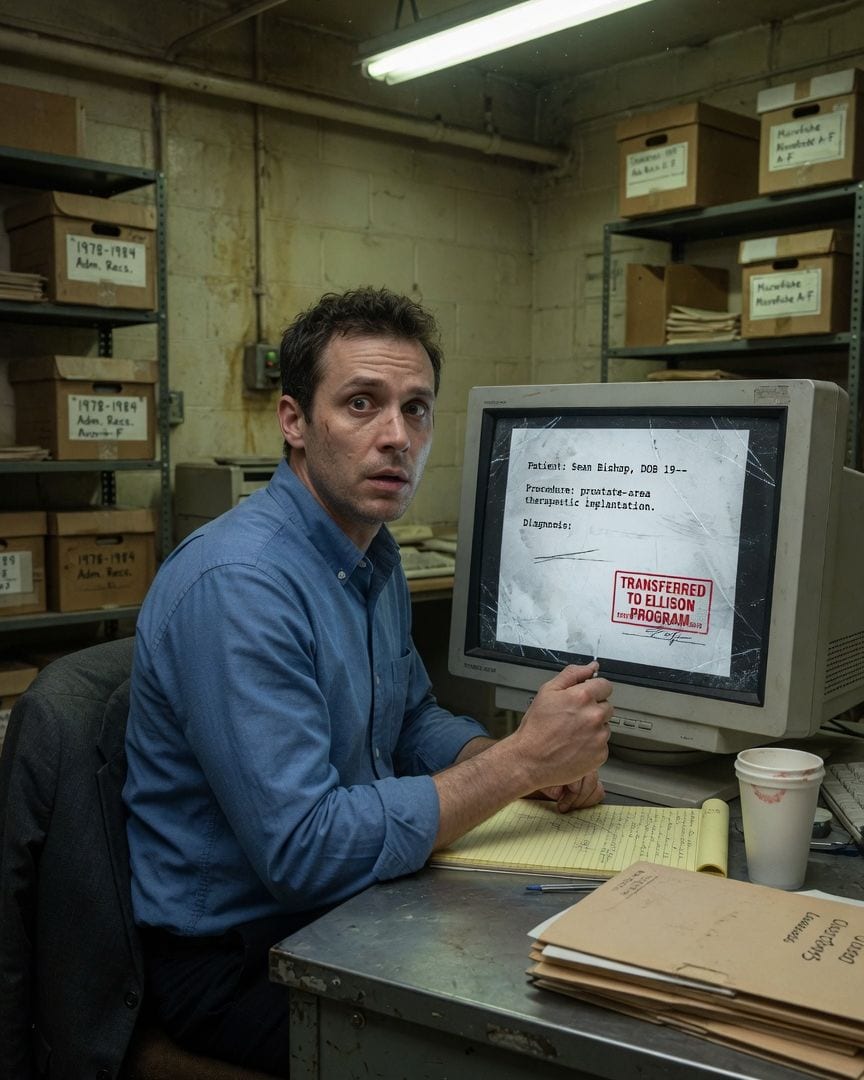
My prostate scan showed tiny metal seeds inside it. The radiologist said they were years old, for cancer. I've never had cancer or treatment.
A routine CT scan for a dull backache was just to be thorough, 'probably nothing.' But the radiologist found something impossible: forty-seven cancer treatment seeds embedded in my prostate, long-healed, from a procedure I have no memory of. My doctors confirmed the undeniable physical evidence, yet my medical history was perfectly clean.
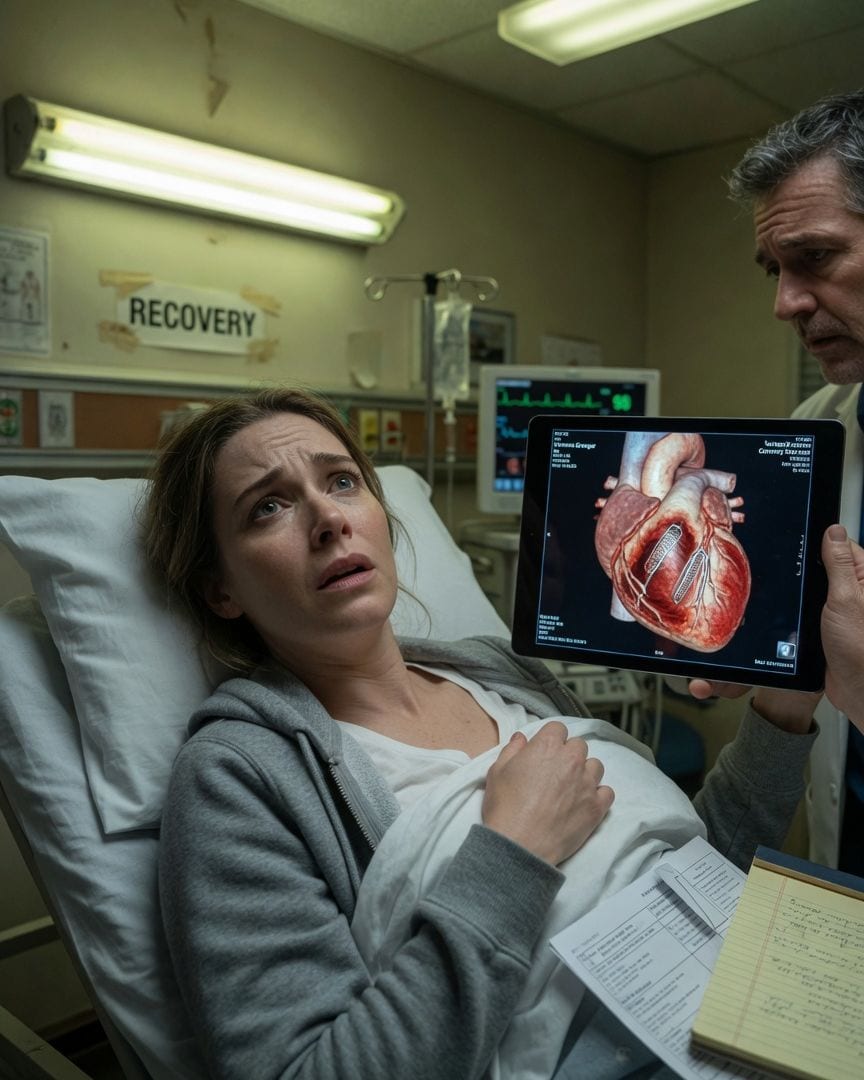
Metal stents are propping open my heart. The doctor rotated the image, but I've never had a cardiac procedure.
After years of dismissed chest pain, a CT scan revealed an impossible truth: my heart contained two metal stents. Dr. Maddox confirmed there was no record of any cardiac procedure in my entire medical history, and I had no memory of ever having surgery. My own body held a secret, alien architecture I couldn't explain.
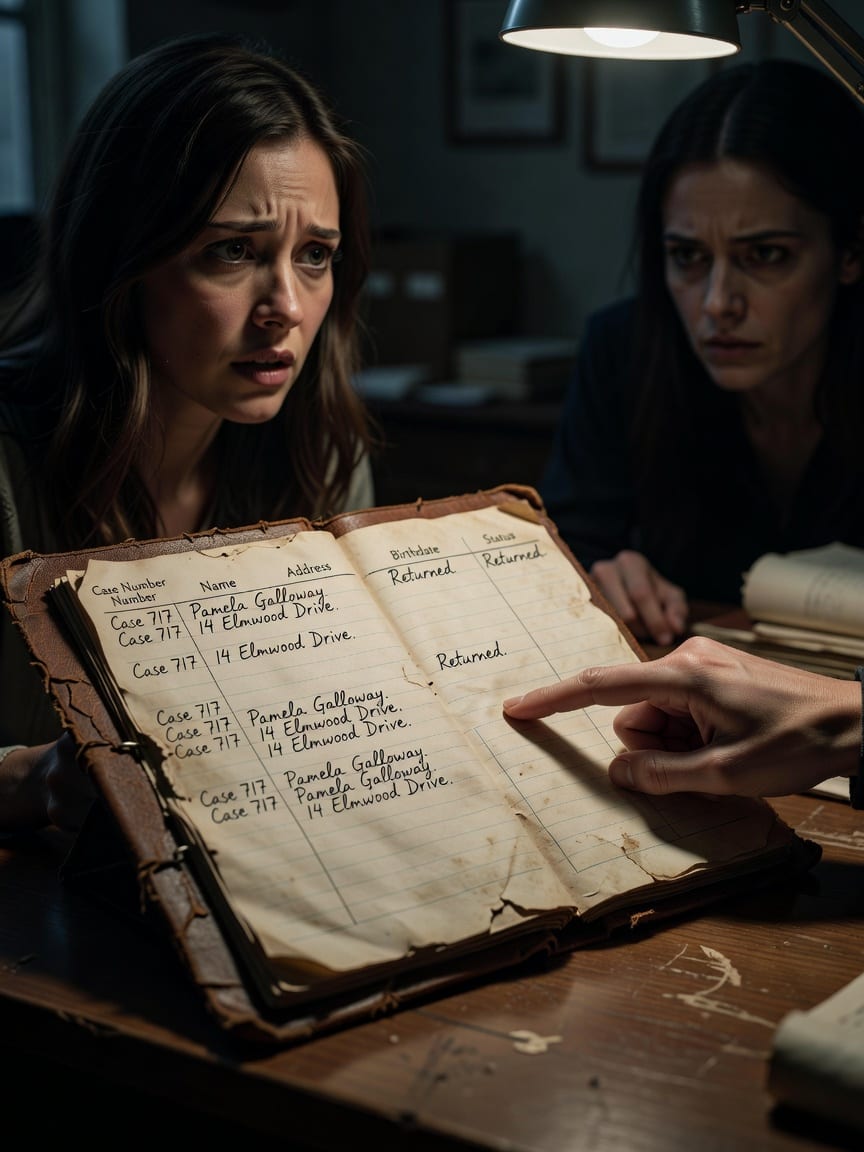
My hospital file has a blacked-out line from 1988. It names my street address, decades before I lived here. Then: 'returned'.
I finally got my medical file, hoping to clear up a ridiculous bill. Inside, I found an entry from 1988: my current home address, scrawled on a partial intake form and marked 'returned.' I was six then, living fifty miles away.
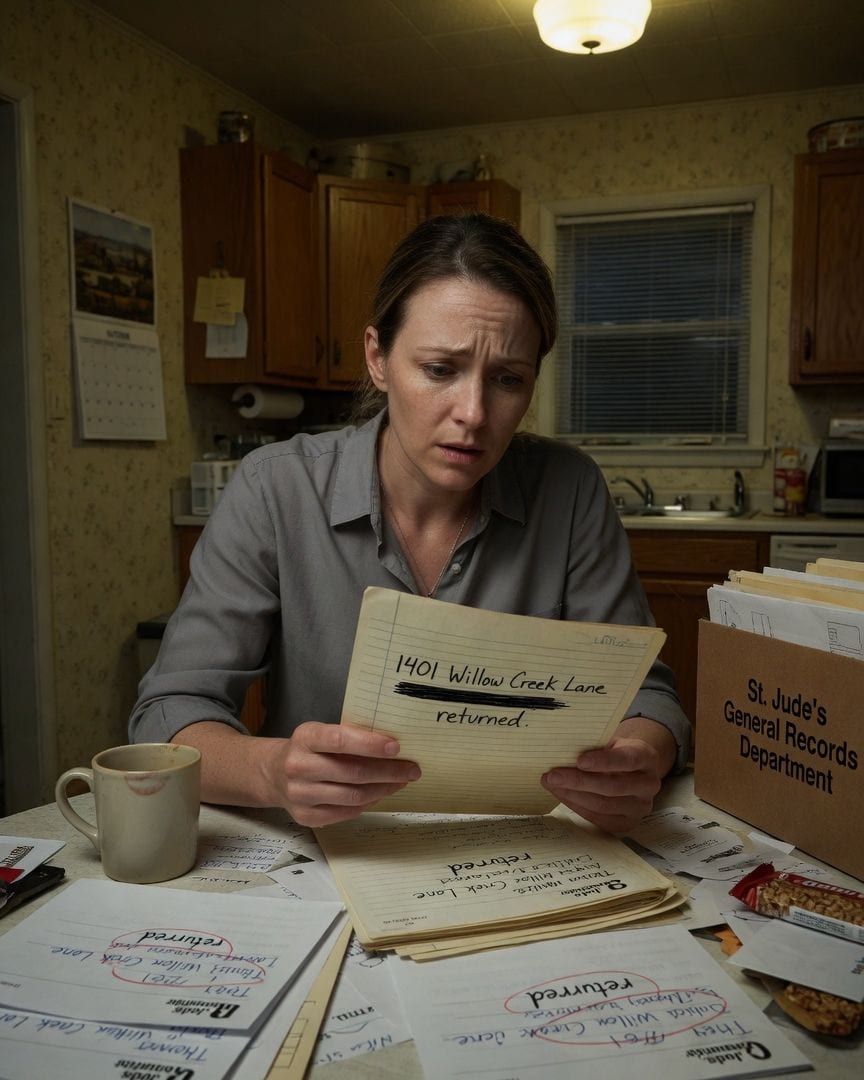
My medical file shows my street address on a struck-through line from 1988, a year I lived two counties away. It just says 'returned'.
A routine insurance audit led me to my childhood medical file from 1988. But among the expected notes, a deliberately struck-through line listed my current house address, followed by the stark word 'returned.' In 1988, I lived two counties away, making this entry an impossible and unsettling mystery.
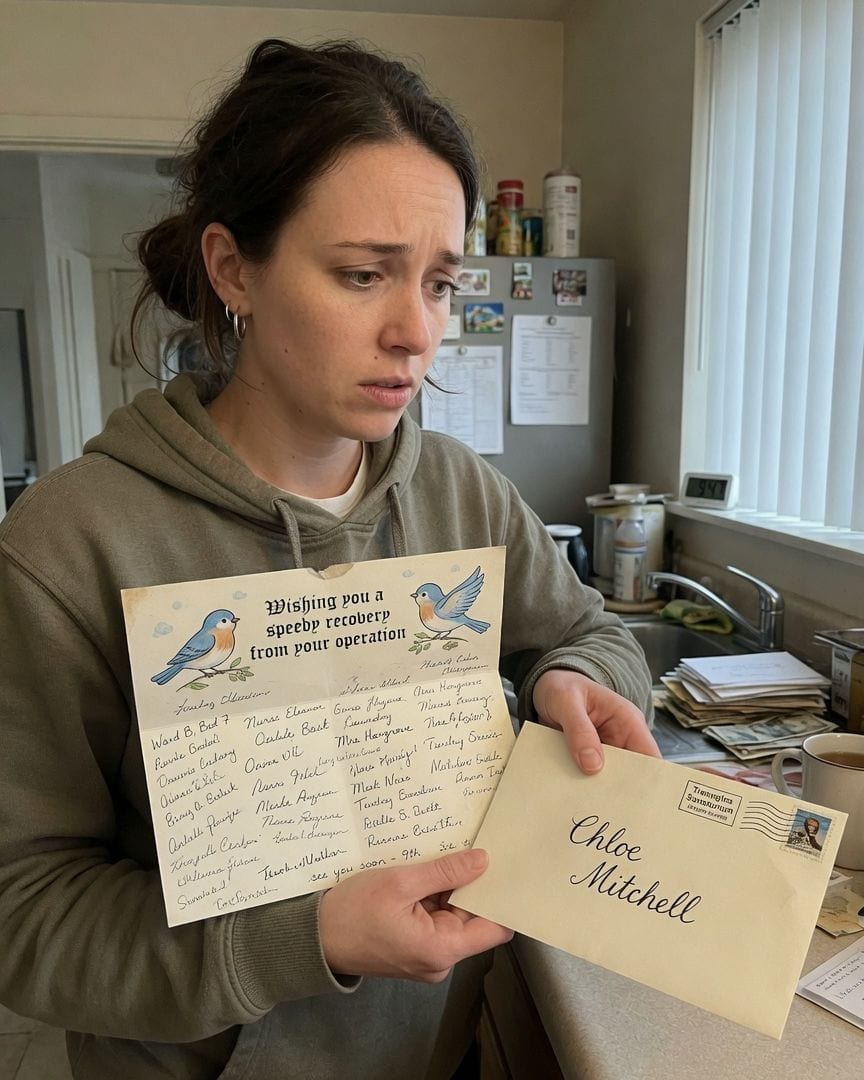
A get-well card wished me a speedy recovery from an operation I never had. It was postmarked from a sanatorium that burned down in 1963.
My quiet Tuesday morning was interrupted by an elegant get-well card, addressed to me. It wished me a speedy recovery from an operation I'd never had. But the postmark read 'Treneglos Sanatorium,' a hospital that vanished in a fire back in 1963.
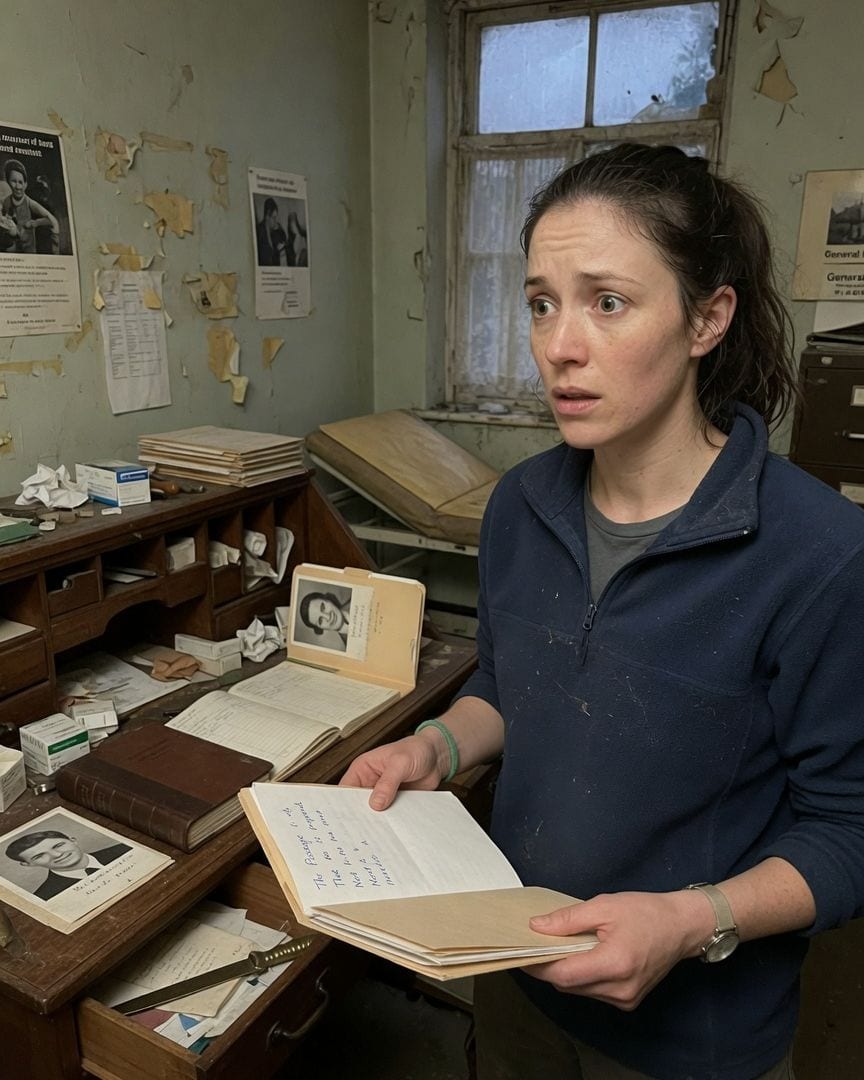
My new clinic's appointment book shows entries for this coming Monday, decades after the doctor retired and died.
Chloe Lawson bought an old, abandoned surgery in Nettlebed, ready to open her new vet clinic. Locals insisted Dr. Almott retired in '79 and the practice shut down for good. But then Chloe found his dusty appointment book filled with meticulous entries, continuing unbroken from 1979 through the decades, right up to this coming Monday.