The fire alarm woke me in the dark. Counting doors to the exit, I reached a third one that hadn't been there on the way in — open, my own coat hanging in a room I'd never entered.
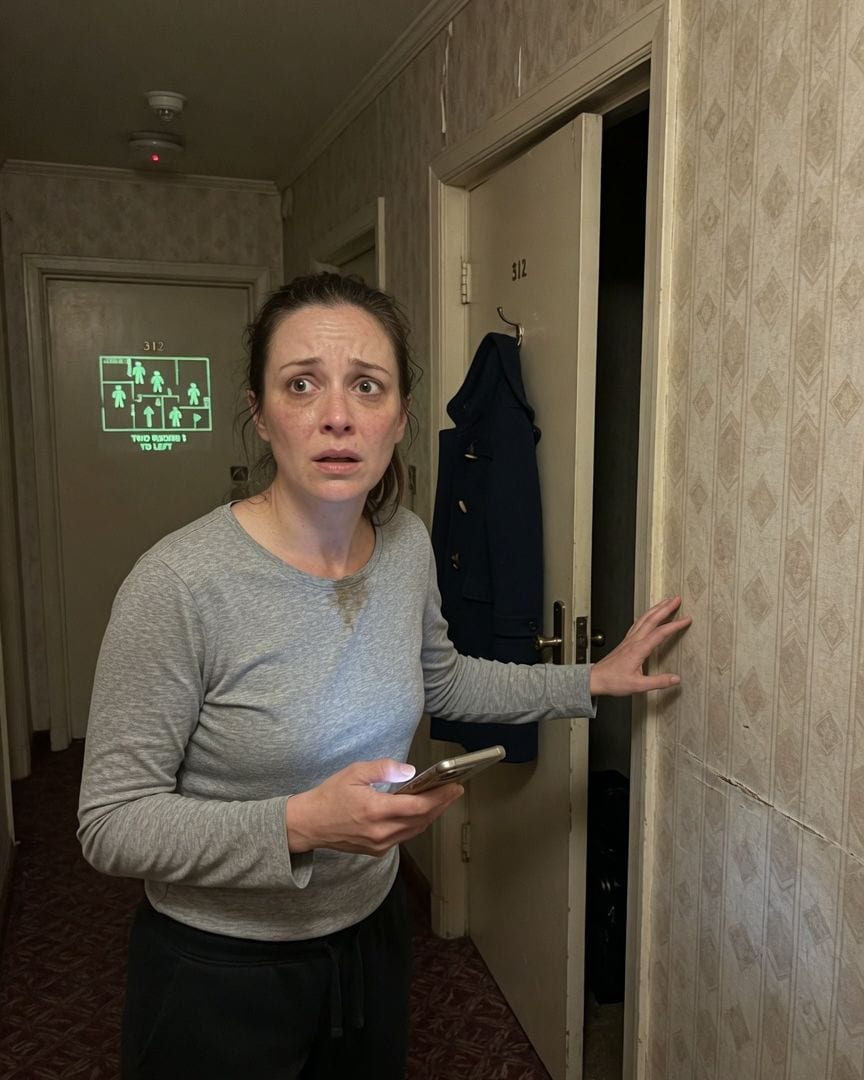
The fire alarm shrieked, a raw, piercing sound that ripped me from a dead sleep. My eyes snapped open in the pitch black of Room 312. The power was out.
My heart hammered against my ribs, a frantic drum against the sudden, overwhelming darkness. I fumbled for my phone on the bedside table, but my fingers only found cold air. It must have slid off.
My gaze darted to the back of the door, where the luminous green fire escape map glowed faintly in the gloom. Two rooms to the left. That was the way out.
Panic tightened my chest, but I forced myself to move. I stumbled out of bed, hands outstretched, navigating by instinct towards the door. My fingers found the cool, textured wallpaper. One door. Then another. My count was precise.
This was it. Two rooms. I pressed on, my hand sliding along the wall, expecting the smooth expanse that led to the fire exit. But instead, my fingertips brushed against a third door.
It shouldn't have been there.
My breath hitched. The alarm continued its piercing scream, but my focus narrowed. This door was standing slightly ajar, a sliver of deeper black against the faint glow of the map.
A faint, unfamiliar smell, like damp earth mixed with something metallic, wafted from the crack. My hand, despite my fear, pushed it open just an inch.
Through the narrow gap, I saw a sliver of a small, windowless room, cast in the dimmest light, almost like a shadow. And there, hanging on a lone hook, was my own distinctive navy blue wool coat.
The one I’d bought last fall. I hadn't even unpacked it yet; it was still folded in my suitcase.
The alarm shrieked on, an incessant, maddening sound, but I stood frozen, staring at my coat in a room that didn't exist, a room I had never entered.
The fire alarm, it turned out, was a false one. A faulty sensor in the kitchen, according to the night manager, his voice tinny over the restored PA system an hour later. I tried to dismiss it all.
Sleep-deprived confusion, I told myself. The adrenaline surge had played tricks on my mind. My brain had conjured that extra door, that impossible room, the coat. It had to have.
The next morning, in the cool, clear light of day, I opened my door to a perfectly normal hallway. Two doors to my left, just as it should be.
Then the solid expanse of wallpaper, unbroken, where the phantom third door had stood. My navy blue wool coat was exactly where I’d left it, folded neatly on my luggage rack, the deep creases still visible from the packing.
Determined to prove it a hallucination, a stress-induced anomaly, I picked up my phone, opened the camera, and began filming. I walked the hallway slowly, deliberately, my gaze sweeping over every detail. Two doors. Only two.
I checked the fire escape map on my door again. It clearly showed only two rooms between mine and the fire exit, a solid, unremarkable door at the end of the short corridor.
I counted my steps, measuring the distance with my eyes, comparing it to the map’s proportions. No third room. No hidden alcove. Nothing.
I walked the entire length to the fire exit, just to be sure, then turned to walk back, my phone still recording. It was precisely as I remembered, as it should be. My logical brain tried to reassert itself. See?
Nothing. Just a bad dream. But as I passed the spot where the third door had been, where I’d smelled the damp earth, my eye caught something.
A faint, almost imperceptible scuff mark, a thin line running along the wallpaper at about waist height. It was like something had been dragged, or pivoted, just there, and the faint mark had clung to the surface.
It was too precise, too specific to ignore. The ordinary explanation, the comforting illusion of a hallucination, dissolved, leaving a cold, hollow pit in my stomach.
I decided to retrace my steps from the night, not in a panic, but with deliberate, rational intent. My smartwatch was already on my wrist, tracking my movements.
I started at my room, 312, and walked towards the fire exit shown on the map. One door, two doors. I noted the pattern on the wallpaper, the slight dip in the carpet just before the fire exit.
I reached the fire exit, a solid metal door, confirming its presence.
Then I turned, and began to walk back, counting the doors again. One, two. I passed my room. That was wrong. My door should have been the second one.
I paused, a frown creasing my forehead, and turned around, walking back towards the fire exit. One, two. I reached the fire exit again. Confusion flared into something colder.
I spun around, resolved to make it back to my room, pushing down the rising unease. One, two, three, four, five… The hallway seemed to stretch, the wallpaper repeating its familiar pattern, mocking me.
I kept walking, my steps growing faster, a rising sense of dread coiling in my gut. Then, inexplicably, I was standing outside my own hotel room door, 312.
My smartwatch, which I’d started tracking when I left, showed I’d walked over 300 feet. The hallway was barely 100. A faint, unsettling hum now seemed to emanate from inside my room.
The hum from my room turned out to be nothing, just the building’s old pipes, a normal, if slightly loud, sound. But the impossible walk, the hallucination of distance, gnawed at me.
I couldn’t shake the feeling that the hotel itself was playing tricks. I approached Walter Radcliffe, the hotel manager, the next morning. He was a man with a quiet, almost weary demeanor, his hair thinning, his eyes a tired grey.
I described it all, trying to keep my voice even, rational. The phantom room, the misplaced coat, the hallway that seemed to loop back on itself.
Walter listened patiently, his gaze never quite meeting mine, instead focusing on a spot just over my shoulder. He offered platitudes about old buildings, settling foundations, and optical illusions.
“Sometimes, Ms. Holloway,” he said, his voice soft, almost a sigh, “a place just… has its quirks.” He even offered to move my room, a seemingly kind gesture.
I refused. His calm dismissal, the slight tremor in his voice as he spoke of “quirks,” only sharpened my resolve. He knew more than he let on.
I spent the next few hours in my room, ignoring the marketing presentation I was supposed to be perfecting. Instead, I researched the Radcliffe Inn online. Old newspaper archives, local history forums, obscure architectural blogs.
I found fragmented mentions, almost whispers in the digital ether. 'Peculiar architectural features' in a local interest piece from the 90s. 'Unexplained structural anomalies' in a forum thread discussing local legends.
One archived article from the 1970s described a guest’s complaint about a 'shifting wall' that briefly revealed a 'disused storage closet' which then vanished, dismissed as a senile delusion by the hotel at the time.
Another, from the 1940s, spoke of a maintenance worker who reported a 'new stairwell appearing and disappearing' in the staff quarters, his account relegated to the 'oddities' column of a local paper.
These weren’t proof, not in any concrete sense, but they were too specific, too consistent to be coincidence. The dread wasn't in the strangeness itself, but in its relentless, quiet consistency across decades.
I felt a cold certainty: this wasn’t a glitch. This was how the hotel was.
My investigation grew bolder. I spent hours in the local library, poring over microfiche, the dusty smell filling my nostrils, searching for any mention of the Radcliffe Inn’s original blueprints or major renovations.
I found nothing definitive, only more vague allusions to 'unconventional design choices' in old architectural journals, references so obscure they were almost like code. Back at the hotel, I started taking my own measurements.
I’d bought a laser distance measurer from a hardware store.
I would stand in the hallway, point the little red dot, and record the numbers, comparing them to the distances shown on the fire escape map, and to my own previous readings.
The numbers never quite added up, always off by a few feet here, a few feet there, just enough to be unsettling without being overtly impossible.
The hallway felt like a rubber band, stretching and contracting when my back was turned.
One evening, as I was returning to my room after another fruitless trip to the library, I saw Walter Radcliffe standing at the end of the hall, near the fire exit. He wasn't doing anything, just watching me.
He stood still, a silent sentinel, his hands clasped behind his back.
When our eyes met, he offered a small, almost imperceptible nod, a gesture that held no malice, only a deep, quiet understanding that settled like a lead weight in my gut.
“Still looking for answers, Ms. Holloway?” he asked, his voice soft, almost a whisper, yet it carried clearly down the hall. “Some things are better left… as they are.”
He didn’t elaborate, simply turned and walked away, his footsteps echoing faintly on the old carpet.
He left me with the distinct impression that my digging had not gone unnoticed, and that he wasn't just a manager, but a quiet, patient guardian of the hotel's impossible truth.
The hunting for answers had turned into being hunted, not by a monster, but by a presence that knew, and waited.
I cornered Walter Radcliffe in his office the next morning. The laser measurer felt heavy in my hand, clutched like a weapon. “Mr. Radcliffe, the numbers don’t lie,” I stated, my voice shaking slightly despite my efforts.
“This hallway is longer some days than others. The fire escape floor plan doesn’t match the physical space. What is this place?”
Walter sighed, a long, tired sound that seemed to carry the weight of years. He finally looked at me, his eyes holding a depth of resignation I hadn't seen before.
“The Radcliffe Inn,” he began, his voice barely audible, “was built on… an old place. A very old place.”
He paused, choosing his words carefully, his gaze drifting to the framed photos of old hotel owners on his wall, almost as if seeking their silent permission.
“It’s not haunted by ghosts, Ms. Holloway. It’s haunted by geometry. The building… it shifts. It’s always been this way. Sometimes a room appears, sometimes a corridor lengthens, sometimes a door leads where it shouldn’t.
It’s not something we can fix. We just… manage it.” His voice was flat, devoid of emotion, like he was reciting a well-worn, painful truth.
I pressed him, my voice sharper now. “The room with my coat? The hallway that led me back to my door? The scuff mark that appeared and disappeared?”
Walter nodded slowly. “Manifestations. Echoes. The building tries to reconcile itself, perhaps. Or perhaps it’s just showing you what it is.”
He explained that the Inn had been rebuilt multiple times over the centuries, always on the same foundation, always with these 'unexplained structural inconsistencies.'
He reached into a drawer and produced an old, faded photograph of the hotel from the early 20th century.
In it, the exterior looked almost identical to the building outside, but a careful eye could see a window on the third floor where none currently existed, and a strange, almost imperceptible distortion in the roofline, a subtle wave where there should have been a straight line.
“It’s consistent, in its inconsistency,” Walter said, his voice flat, as he handed the photo to me. “The wrongness always returns, in its own way.” As I looked at the photograph, the earlier clues clicked into focus.
The scuff mark on the wall where the phantom door had stood, a trace of something that was, then wasn’t. The looping hallway, a physical manifestation of a spatial anomaly.
The impossible room with my coat, an echo pulled into being. All symptoms of a building that defied fixed reality, a recurring nightmare of architecture that had been cycling for decades, centuries even.
Walter’s admissions, however unsettling, gave me a new, terrifying direction. He mentioned an old local architect, a recluse named Arthur Finch, long deceased, who had obsessively documented the Inn’s peculiarities.
He believed the hotel was built over some kind of geological anomaly. I spent the next day at the local historical society, specifically requesting their archives on local architects.
After hours of sifting through dusty boxes filled with faded documents, the air thick with the smell of old paper and dust, I finally found it.
A thick, leather-bound portfolio, heavy in my hands, labeled simply 'Radcliffe Inn - Architectural Anomalies.' Inside, among meticulously hand-drawn sketches and detailed, almost manic notes, was an architectural blueprint, yellowed and fragile, dated 1937.
It was a floor plan of the third floor, my floor.
My breath hitched. The blueprint clearly showed a third room to the left of room 312, exactly where I had encountered it during the fire alarm. It was labeled in tiny script: 'Anomalous Chamber - Not on official record.'
But that wasn't what made my heart seize. Scrawled in the margin, in faded, sepia ink, were a series of notes about the chamber’s properties, its 'temporal echoes,' and its 'material absorptions.'
And at the bottom, in a hand that was unmistakably my own, in a script I recognized intimately from my own journals, was my full name: 'Lydia Holloway - 19XX'. The year was decades before I was born.
I stared at the fragile, yellowed blueprint spread across the library table. It's an impossible schematic of the Radcliffe Inn, showing the extra room, the looping corridor.
But my blood runs cold, not from the impossible geometry, but from the faded, familiar script in the margin: 'Lydia Holloway - 19XX'. It's my name, my handwriting, on a document predating my birth.
The revelation of the blueprint detonated everything I thought I knew. I returned to the Radcliffe Inn, the ancient document clutched in my trembling hands, and confronted Walter again. He was in his office, just as I’d left him.
“My name. My handwriting. Decades ago. What is this?” My voice was raw, barely controlled. I shoved the blueprint across his desk.
Walter looked at the blueprint, his face etched with a familiar sorrow, a deep, quiet sadness I now recognized as a permanent fixture. He picked it up, tracing the faded ink with a calloused finger.
“It doesn’t just shift, Ms. Holloway. It… recurs. Not just the building, but sometimes, the people who witness it. You are not the first Lydia Holloway to experience this. The building remembers. It pulls in elements from previous cycles.
Your coat, the room… these are echoes. And sometimes, it pulls in people themselves, or at least, their imprint. You were here before, in a way. Or perhaps, you are always here, in every way it manifests.”
The horror wasn't that the building was wrong, but that its wrongness was a consistent, terrifying pattern, and I was a thread woven into its fabric. Every clue clicked into place, falling into a coherent, horrifying mosaic.
The fire exit plan was not just a map; it was a map of the recurring anomaly, changing with each cycle.
My distinctive navy blue wool coat, found in that impossible room, wasn't a hallucination but an absorption, a material echo from the current iteration.
The looping hallway, the impossible distance recorded by my smartwatch, was a tangible shift in its active geometry.
The Radcliffe Inn wasn't just a place that defied space; it defied time, creating loops not just of architecture, but of experience and identity.
I understood now: I wasn't just observing the impossible geometry; I was a part of its impossible, endless, and repeating design. I was another Lydia Holloway, caught in the current cycle.
The realization that I was a recurring element, a loop within a loop, ignited a desperate, primal need to escape. My hands were shaking so hard I could barely hold the blueprint.
Walter, seeing the terror in my eyes, offered a grim piece of advice, his voice low. “When it shifts, you have to move with it, but against it. Find the seam, and push through.”
He looked at me, his gaze holding an empathy I hadn't seen before. “It won’t try to hurt you. But it won’t let you go easily, either.”
I knew I couldn't stay. The hotel was no longer just a building; it was a hungry, repeating pattern, and I was its current meal.
I packed my bag in a blur, my hands trembling so violently I fumbled with the zippers. I slung it over my shoulder and began my escape.
The hallways were already subtly different. The carpet patterns seemed to ripple, the floral designs subtly rearranging themselves. The doors were slightly off-kilter in their frames, almost breathing.
I tried to follow the original fire escape route, the one that should be simple, but the walls seemed to breathe around me, subtly altering the distances, confusing my sense of direction.
The air grew heavy, thick with the scent of damp earth and something metallic, like old coins. I felt a profound, physical disorientation, as if my own body was being stretched and compressed, my equilibrium constantly shifting.
I pulled out my laser measurer, not to find the way, but to locate the deviations, the points where the numbers truly broke, where the hotel’s reality fractured. I walked, measuring, recording, feeling for the inconsistencies.
At one point, a door I knew to be a linen closet, marked by a small 'SERVICE' plate, opened into a short, dark tunnel, pulsating with a faint, internal light. The air pouring from it was cold, almost electric.
I knew this was it – a seam, a fracture in the fabric.
Taking a deep, ragged breath, I plunged into the darkness, crawling through a space that felt both too small for my body and infinitely long, like a stretched membrane.
The blueprint, now a crumpled, precious relic, was clutched tight in my hand. I heard faint whispers, echoes of voices, disembodied fragments of conversations, my own name among them, distorted and distant.
The tunnel twisted, not like a physical space, but like a horrifying, visceral experience of spatial distortion, my body feeling elongated, then compressed. I pushed forward, clawing at the rough, uneven walls, the grit biting into my fingertips.
Finally, with a gasp, I tumbled out, landing hard on solid pavement, the jarring impact stealing my breath. The air outside was cool, crisp, and blessedly normal.
I was outside, miles from the Radcliffe Inn, on a street I didn’t recognize, yet it felt utterly real.
The blueprint was still in my hand, but a corner of it had faded, the sepia ink on that one section smudged, my own name now a mere blur.
I had escaped, but the cost was immense: a piece of my sanity, a fundamental trust in the fabric of reality, and proof no one would ever believe.
I made it home, but the world felt subtly wrong. Every corner seemed too sharp, every hallway too straight. The reassuring normalcy of my apartment, my city, felt thin, like a veil over something else.
I tried to show the blueprint to friends, my family. They saw only an old, faded architectural drawing, nothing impossible, certainly no 'Lydia Holloway - 19XX' in her hand.
The date was illegible, a mere smudge, just as I’d observed when I left the tunnel. My recounting of the events was met with concern, gentle suggestions of stress and overwork, kind advice to take a vacation.
I knew what I had seen, what I had experienced, but the proof was ephemeral, shifting like the hotel itself.
I held onto the blueprint, now stored in a waterproof bag, a silent, fragile testament to a truth too vast for others to comprehend.
The Radcliffe Inn, I knew, continued its quiet existence, its impossible geometry cycling on, unnoticed by the world, but forever etched into Lydia’s mind.
Now, months later, I still sleep with a measuring tape beside my bed. My laser measurer is always charged, always within reach. I check the corners of rooms, the straightness of walls, the exact length of my hallway.
I measure the distance from my front door to the kitchen every morning. Sometimes, I even count the steps. I look at my own handwriting on grocery lists, on meeting notes, just to make sure it’s mine.
The world still adds up, but I can see the seams.
If this one got to you
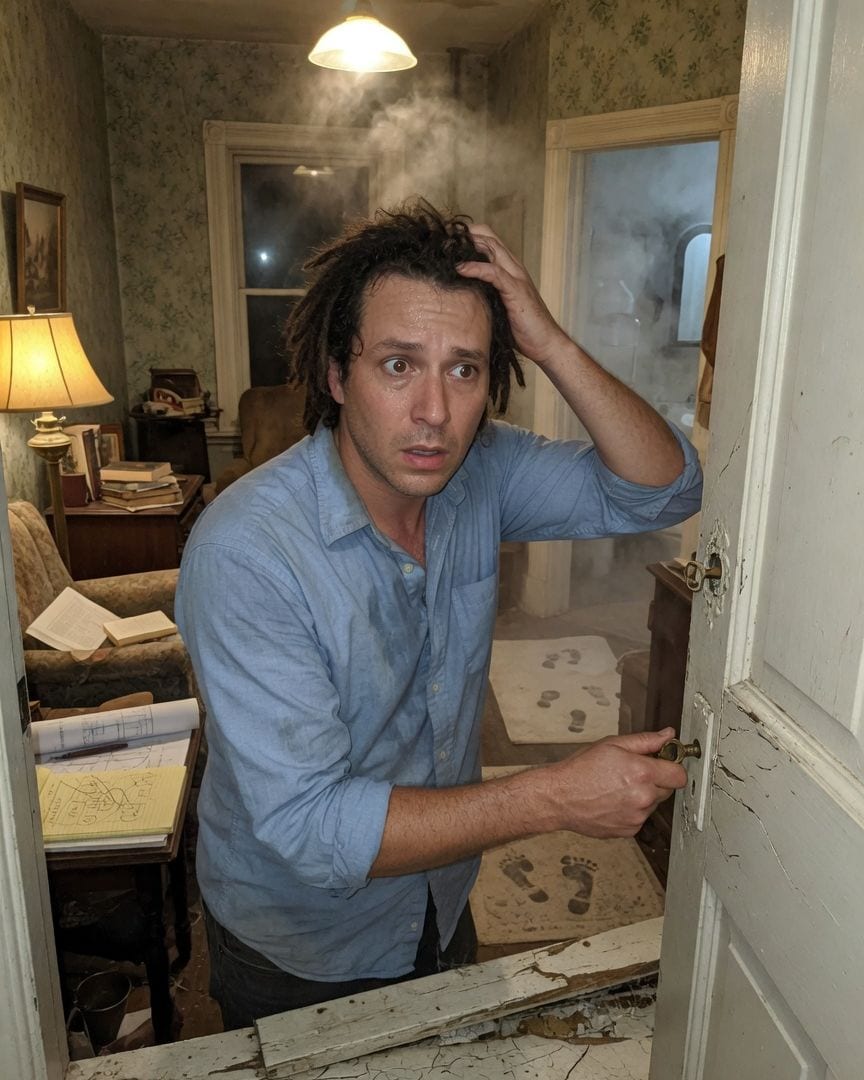
The bath filled itself at 9:30 PM. My main house water was off. Wet footprints led from the tub to a locked airing cupboard.
As an architect, I pride myself on logic. Moving into my inherited Victorian house was supposed to be a quiet fresh start, but on the third night, I heard the impossible. Even after I shut off the main water to the entire house, my clawfoot bath upstairs ran full, warm, and steaming at 9:30 PM.
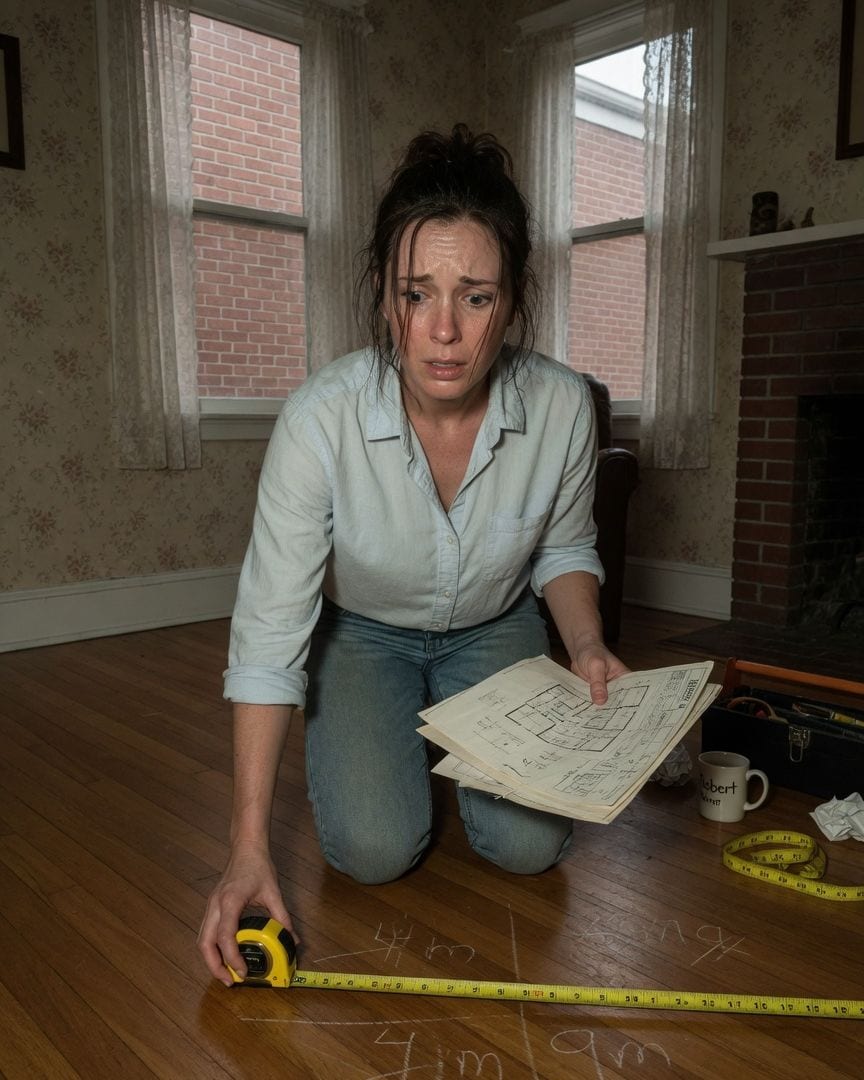
Our living room measures four by five metres. But the outside wall is nine metres long. A metre of house, gone, and I can't find it.
After moving into our charming 1920s house, I was meticulously measuring the living room when the dimensions refused to add up. My calculations of the interior space led me to discover a narrow, unpainted fifth door in the hallway, tucked almost out of sight. It wasn't on any original plans, and it opened to absolute, impenetrable darkness.
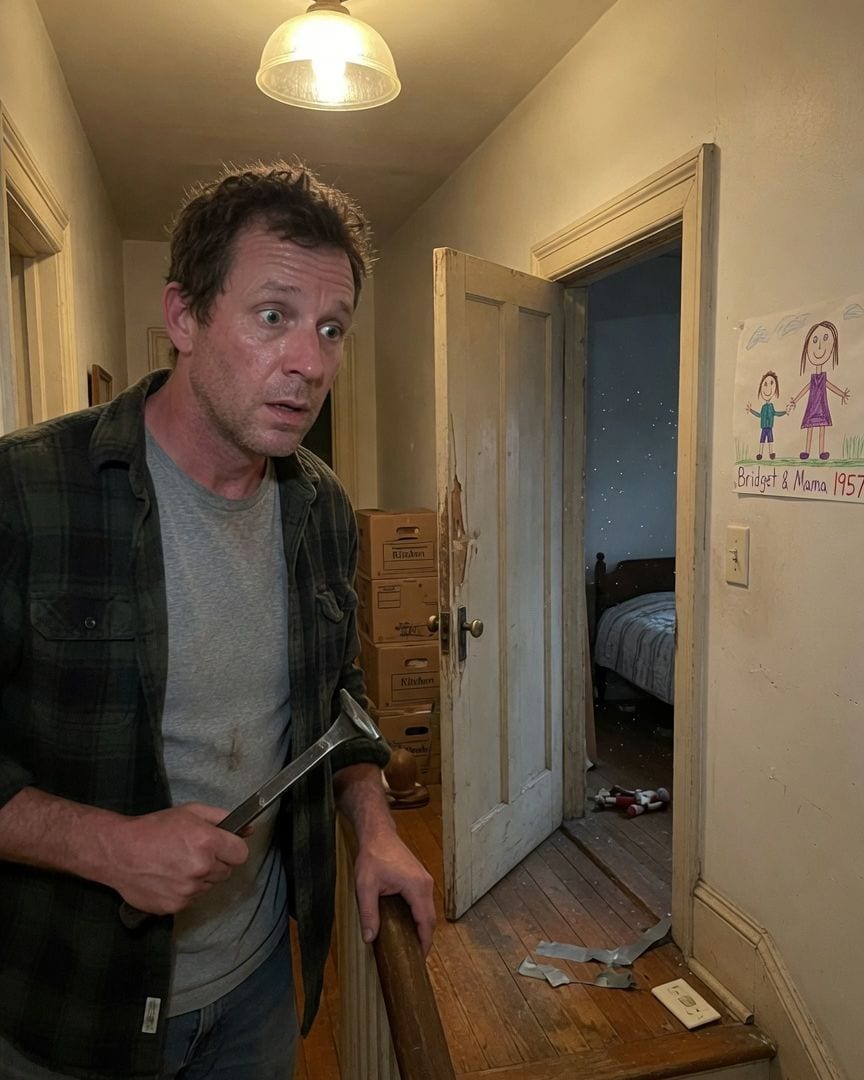
My landing light switches itself off at 9:40 every night. I've watched the switch flick down under nothing, the tape peeled back. The house holds its breath.
My great-uncle's old house was a quiet gift, a place to finally settle. But as I unpacked, a strange worn path on the floorboards led me to a small, barely visible door, perfectly blended into the wall. It was undeniably locked, and felt like a deliberately obscured secret.
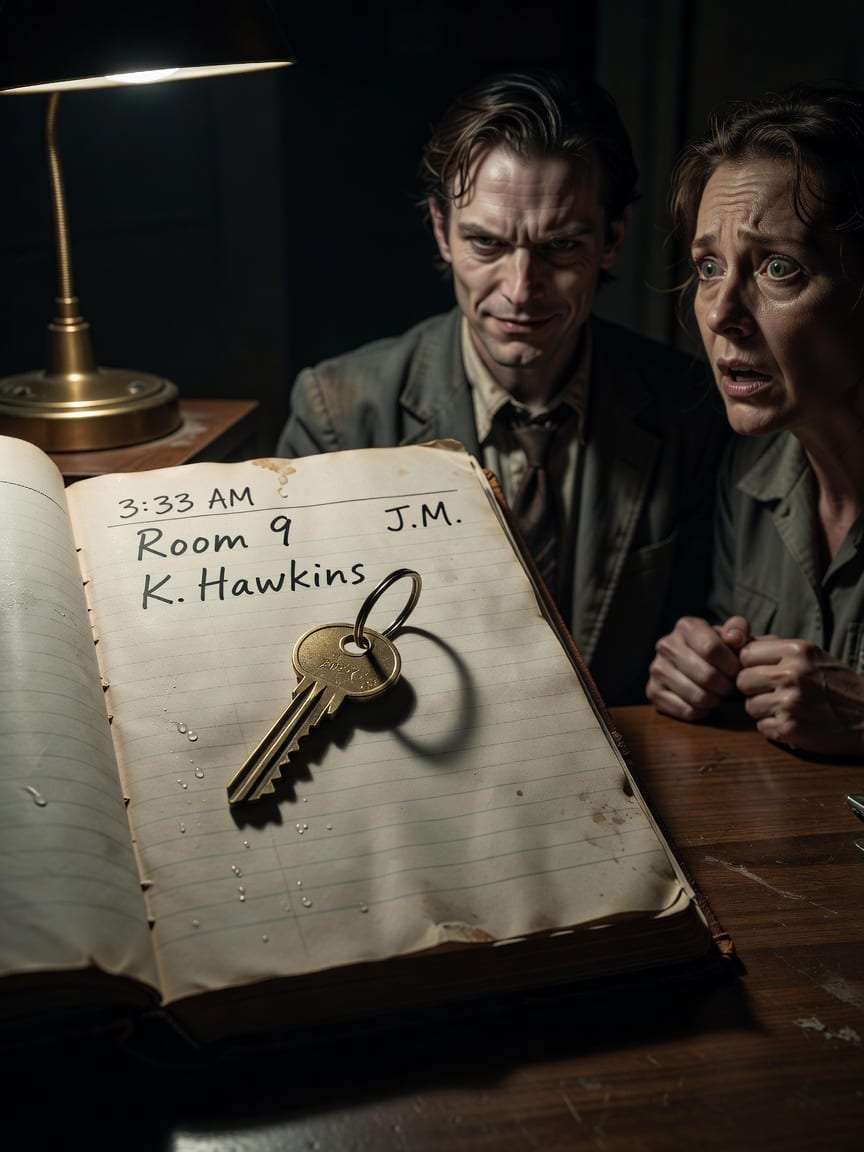
My hand wrote the Room 9 check-in at 3:33 AM. My initials were there. But Room 9 has been sealed since the spring flood, and its key still hangs on the peg.
Working the quiet night shift at the Marsh View Motel, I found a fresh entry in the register with my own initials, for Room 9. But Room 9 has been sealed since the spring flood, its key hanging untouched on the wall. Inside, a half-empty glass of water and a second, mud-encrusted key lay on the bed.
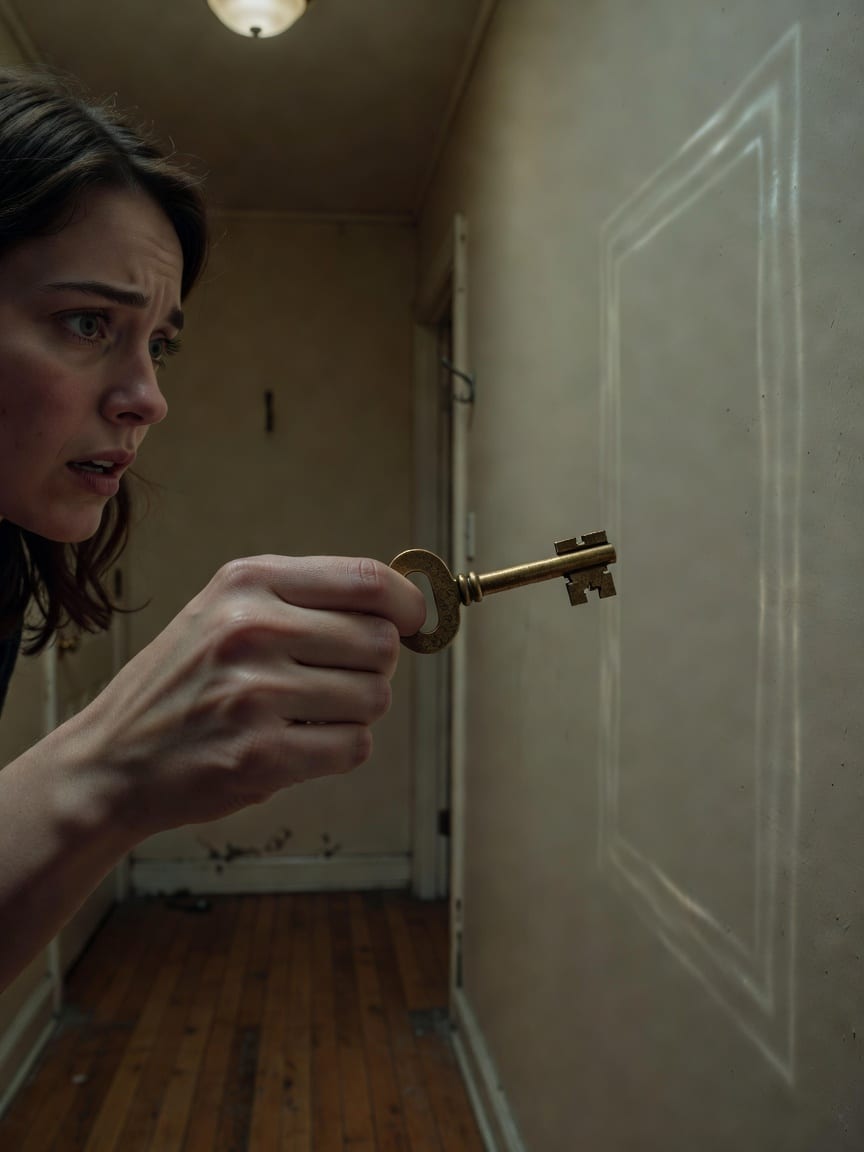
My new house has seven rooms. The removal men counted six. Now one of them asks who's in the locked seventh, on a landing with only six doors.
Moving into my new house, I supervised the removal men hauling boxes. But on the landing, Paul, the senior man, asked about a locked seventh room upstairs, pointing to a blank wall. His quiet certainty, despite the clear absence of a door, filled me with a sudden, icy dread.
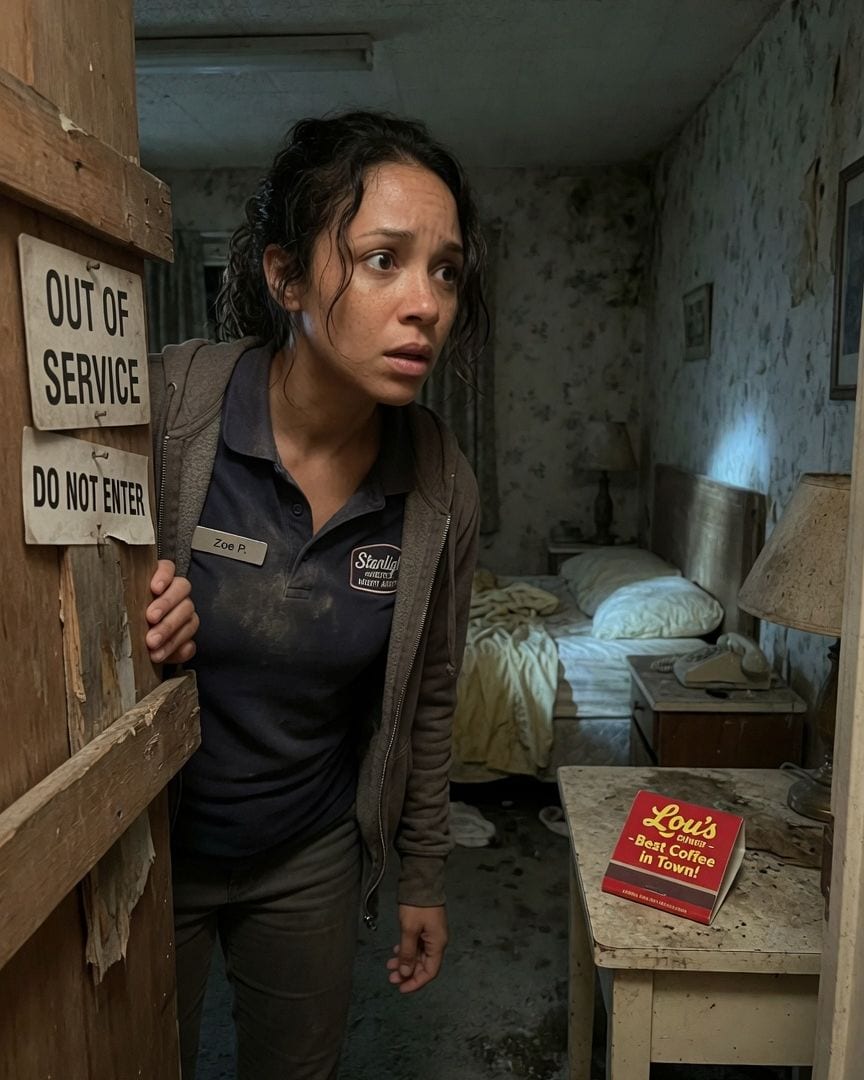
My motel register shows a check-in for Room 9 at 3:33 AM, in my own handwriting. Room 9 has been out of service since the flood.
Working the quiet night shift at the Starlight Motel, I found a chilling new entry in the guest register. My own initials had checked someone into Room 9 at 3:33 AM. The problem? Room 9 has been officially boarded shut and out of service for six months, its key still hanging untouched on the wall.