A hydrographer found a lost Cold War submarine from 1968. Inside, its logbook carried entries dated '12.03.2012'.
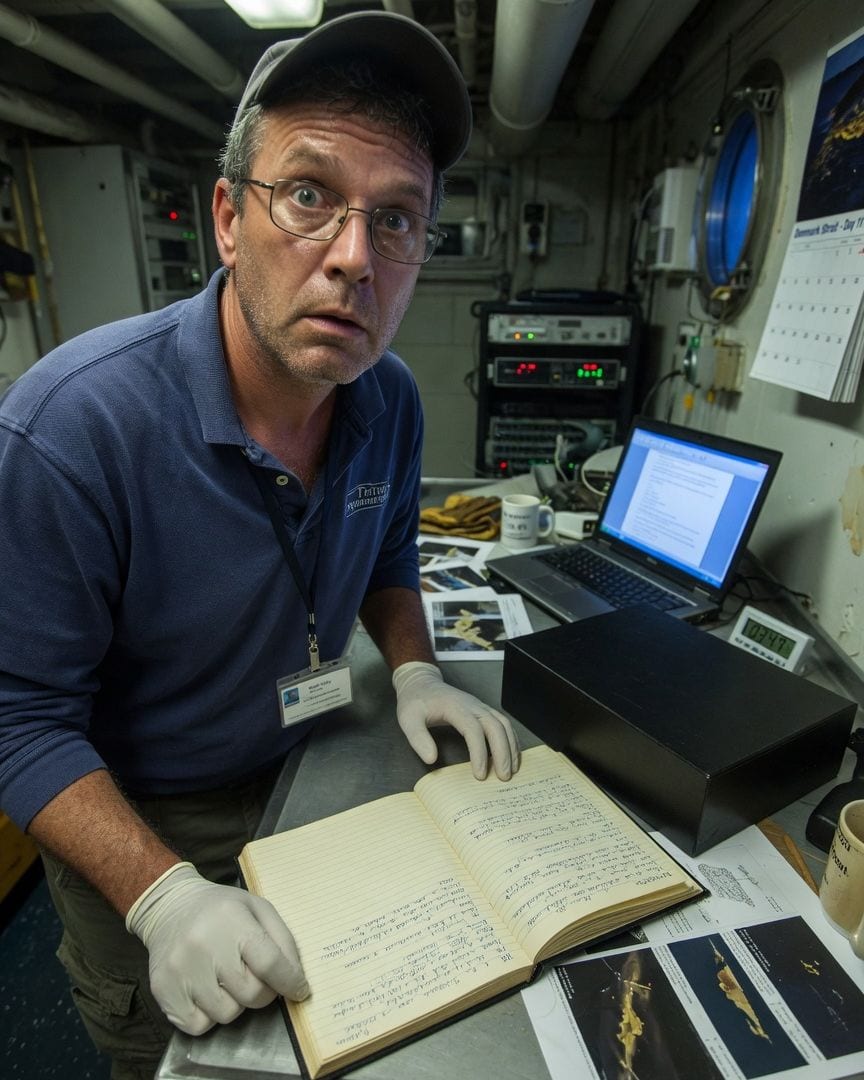
The deep-sea submersible's camera drifted across the abyssal plain, a silent eye in the crushing dark. Hydrographer Wells Duffy, hunched over the monitors in the Triton's control room, felt the familiar hum of the ship around him.
For eleven days, his team had been chasing a persistent sonar anomaly at the mouth of the Denmark Strait, a phantom signature that defied explanation. Today, the phantom had resolved.
It was the USS Gale Prescott, lost with seventy-one souls in 1968. A discovery that should have been a triumph. Wells zoomed in, the submersible's powerful lights cutting through the gloom, revealing the submarine resting upright in a deep trench.
Relief, then a creeping unease. The escape trunk hatch, midships, stood open. Not blasted open by pressure, not rusted, but simply ajar, as if someone had just stepped out.
Sediment, thick and even, coated the entire hull, a blanket of time. But the hatch rim, and the ladder rungs leading down into the dark interior, were unnervingly clean, swept bare. And worn bright.
Not just from the outside, but from the inside too, as if something had used that trunk, repeatedly, in both directions, long after the ocean had claimed the vessel.
The anomaly of the hatch gnawed at Wells. He tried rationalizing it – deep-sea currents, some unique marine organism – but the precision of the wear defied natural explanation.
Captain Samuel Crane, a man of rigid protocol, agreed to a brief, unauthorized dive, citing 'unusual structural integrity' as justification. Wells, accompanied by two experienced divers, descended. The pressure was immense, the cold absolute.
Nearing the Gale Prescott, the sheer size of the hulk was sobering. Wells ran his gloved hand over the hatch, feeling the impossible smoothness of the ladder rungs.
The air inside the escape trunk was frigid, still, no trace of water ingress beyond the initial flood. He moved cautiously into the interior, his powerful dive light sweeping the cramped space. The sub was preserved, a time capsule.
Then he saw it: tucked into a recessed compartment near the trunk, a waterproof container. It wasn't standard Navy issue; no markings, no serial numbers.
It was made of some dark, synthetic material, smooth to the touch, unlike anything he’d ever seen on a 1960s vessel. It felt almost… warm, despite the abyssal cold. He exchanged a glance with Crane, who simply nodded.
This was not part of the wreck. Wells carefully detached the container, securing it to his gear. This was the first real clue, something utterly out of place, an object that refused to belong to the grave it inhabited.
Back aboard the Triton, Wells and Crane sequestered themselves in the lab. The container, once on the table, seemed to radiate an odd, almost imperceptible chill. Wells examined its seamless construction, finding no obvious latches or fasteners.
Finally, a subtle ridge near one end yielded to pressure, and a panel slid open with a soft hiss of displaced air. Inside, nestled securely, was a logbook.
It was bound in the same synthetic material, utterly plain, devoid of any insignia or title. Wells pulled on his latex gloves, his heart thudding, and carefully opened the cover.
The first few pages were standard-issue forms, filled with precise, almost calligraphic script, detailing submarine operations from 1968. Then, the script changed. It became tighter, almost coded, and the entries continued, page after page, across the decades.
His eyes scanned down, past the 70s, the 80s, the 90s, the early 2000s. And then, there it was. An entry, clear and undeniable, dated '12.03.2012'. Wells stared at the impossible date, his breath catching in his throat.
The 2012 date in the logbook was a lead weight in Wells’s gut. He spent the remainder of his eleven days at sea poring over every declassified document on the Gale Prescott available in the Triton's onboard digital archives.
The official narrative was a tangled mess of conflicting reports: differing accounts of distress signals, inconsistent recovery efforts, even subtle variations in the crew manifest. It was as if multiple versions of the truth existed, each designed to obscure.
Back on shore, feigning research for a historical paper on deep-sea salvage, Wells visited the regional naval records facility. The sheer volume of paperwork was daunting.
He spent days sifting through microfiche and dusty binders, the scent of old paper clinging to his clothes. He finally approached Eileen Walsh, a junior records clerk, whose efficiency was matched only by her almost-too-eager helpfulness.
He showed her a printout of one of the logbook’s coded entries, asking if it resembled any known Navy operational code. She scanned it, perplexed. “Never seen anything like it, sir. Definitely not standard. It looks… institutional, but not military.”
She offered a suggestion, almost an afterthought. “There’s a retired archivist, Kenneth Sutton. He worked here for decades before the digital transition. Knew where all the bodies were buried, they used to say.
He’s the one who’d know if this was a legitimate code, or… something else.” Wells felt a chill. The phrase 'bodies buried' resonated too strongly with the cold, open hatch of the Gale Prescott.
Wells arranged to meet Kenneth Sutton at a quiet diner. But before the meeting, subtle anomalies began to surface. His personal research computer, normally secure, showed unusual login attempts from an unknown IP address.
A specific folder containing his deep-sea sonar data, which he’d been reviewing for patterns related to the Gale Prescott, was subtly corrupted, a few files unreadable. He dismissed it as a glitch, then as a coincidence.
But then, an unfamiliar, dark sedan began appearing near his apartment building, parked for hours, its tinted windows opaque. It was never the same car twice, but the pattern was undeniable. He felt eyes on him.
At the diner, Sutton, a gaunt man with an air of weary resignation, initially feigned ignorance. “Gale Prescott? Just another lost sub, son. Plenty of those.” Wells pushed, describing the synthetic logbook, the impossible dates, the precise, non-military script.
Sutton’s eyes, deep-set and shadowed, sharpened. He leaned forward, his voice a low rasp. “You shouldn’t have touched that. There are files that sign themselves, Mr. Duffy. And they don’t like being opened. You’re being watched.”
The words were a confirmation, a jolt of cold dread. Wells felt the weight of unseen gazes, the chilling implication that his inquiries had not gone unnoticed, but had instead triggered a response.
He was no longer just investigating; he was now the subject of an investigation.
Wells pressed Sutton, his voice low and urgent. “Who’s watching me? What files sign themselves?” Sutton sighed, a long, rattling sound. “Not a who, Mr. Duffy. A what. An institution.
It’s always been there, older than the Navy itself, just… in the shadows. They don’t lose things. They file them.” Sutton led Wells through a labyrinthine, forgotten wing of the old archive building.
The air grew colder, dust motes dancing in the faint light from a single bare bulb. They stopped before an aisle that, Wells realized with a jolt, measured longer than the actual physical dimensions of the building should allow.
Sutton pointed to a plain, unmarked gray box, tucked away on a high shelf. “The Box That Is Not on Any List,” he murmured. “No accession number, no finding aid. Only those who knew, knew.”
Wells reached for it, his hand trembling. Inside, beneath layers of blank paper, were heavily redacted files related to the Gale Prescott. Not official Navy documents, but internal memos, operational directives, all in the same precise, coded script as the logbook.
Sutton watched him, his face a mask of weary defeat. “The Gale Prescott wasn’t lost, Mr. Duffy. It was designated a ‘deep asset.’ Its ‘loss’ was a cover, a narrative to explain its disappearance. The crew… they weren’t lost.
They were ‘reassigned.’ ‘Filed,’ into new identities, new lives, or new… purposes.” Wells flipped through the documents, the contradictions in the official record now snapping into horrifying focus. The multiple distress signals, the conflicting recovery efforts – they weren’t errors.
They were deliberate obfuscations. The logbook wasn’t a ship’s log; it was an operational record for a clandestine program. Sutton had been part of the ‘paperwork’ team, ensuring the official narrative held while the real one unfolded in the shadows.
“They manage the transitions,” Sutton explained, his voice barely audible. “The disappearances. The impossible things. They just… make sure the records fit. Or seem to.” Wells understood.
The institution didn't just hide secrets; it created them, maintained them, and filed away the lives of those caught in their orbit.
Wells, his mind reeling, continued to sift through the unmarked box’s contents. Each file was a chilling testament to the institution’s reach, detailing other ‘lost’ vessels, ‘reassigned’ personnel, and ‘anomalous events’ that were meticulously re-contextualized into mundane explanations.
The sheer, patient horror of it all settled deep within him. Among the reams of coded documents and carefully crafted false reports, he found a personnel file.
It was thicker than the others, marked with a red stamp: “OBSERVER PROGRAM – ACTIVE.” His heart hammered against his ribs. He opened it slowly. Inside, on the very first page, was a photograph.
It was a blurry, grainy image of a young man, perhaps in his early twenties, standing on a beach, looking out at the sea. It was him. A photograph clearly taken without his knowledge, years ago.
Beneath it, in the same precise, institutional script as the logbook, was his full name: Wells Duffy. His current service number, his birthdate.
And then, the coordinates of his present survey mission, the Denmark Strait, accurate to the last decimal point. The date on the file, at the very top, was '1962'. Years before he was born.
Below that, a smaller, handwritten note, almost an addendum: 'Subject identified. Profile active. Awaiting trigger.' Wells stared at his own life, meticulously documented before it had even begun, a future pre-written. The file was still being written.
He felt a cold hand close around his throat, the air leaving his lungs. He was not just an investigator; he was a subject. He was already filed.
Wells confronted Sutton, thrusting his own file at the old archivist. “What is this? What does ‘Observer Program’ mean? 1962? I wasn’t even born!” Sutton took the file, his gaze distant. “It means you were identified, Mr. Duffy.
Long before you knew it. The ‘Observer Program’ is how the Machine finds its new… components. Individuals with a certain… predisposition. A willingness to look past the obvious. You were always going to find something, somewhere.”
Sutton explained that the institution, which he simply called ‘the Machine,’ didn’t just react to anomalies; it cultivated them, using them as triggers.
The Gale Prescott was one such trigger, an old 'drop point' set to activate when a certain type of individual, like Wells, stumbled upon it.
The crew of the Gale Prescott had not been lost, but 'transferred' to serve the Machine in other capacities, their lives, their identities, meticulously 'filed' and updated.
The worn ladder rungs were for the Machine's own maintenance crews, accessing the sub’s internal archive system, which held not just the logbook Wells found, but records of countless other 'filed' individuals.
“Your survey route, Mr. Duffy, was no accident,” Sutton continued, his voice devoid of emotion. “It was nudged. Your ‘discovery’ was anticipated. Your file was waiting to be completed. You’re not being watched anymore. You’re being prepared.”
Wells felt a suffocating dread. Every clue, every inconsistency, every impossible detail now clicked into place, forming a coherent, terrifying pattern. He wasn't just observing a buried record; he was the next entry.
The realization detonated in Wells’s mind: he was being actively ‘filed.’ He had to act. He raced back to his apartment, a desperate plan forming.
He would create a digital dead drop, upload the most damning files he’d copied from Sutton’s hidden archive—including his own ‘Observer Program’ file—and scatter them across obscure corners of the internet. As he began the upload, his systems jammed.
His screen flickered, then an anonymous, coded message appeared: “Your file is complete. Awaiting transfer.” A chill ran down his spine. They knew. They were here. He had moments.
Frantically, he encrypted a small, crucial portion of his data – a single, undeniable link between his file and the Gale Prescott – and managed to push it out, broken into fragments, across a dozen forgotten forums.
Then, with a desperate swipe, he deleted everything else, wiping his drives clean. The front door of his apartment building creaked open downstairs. Footsteps. Slow, deliberate, ascending. Wells grabbed a small bag, his heart a frantic drum against his ribs.
He couldn't go back, couldn't stay. He slipped out his back window, dropping silently to the alley below. He ran, not knowing where, only that he had to escape the invisible, patient machine that sought to file him away.
He was not confronting it; he was fleeing it, knowing he was now a permanent target, a loose end in their meticulous record-keeping, a ghost in their machine.
Wells Duffy vanished. His research vessel, the Triton, completed its survey without him, officially citing a sudden medical leave. The naval authorities, after a brief, perfunctory investigation into his disappearance, closed the case.
The official story of the Gale Prescott remained unchanged, a forgotten tragedy of the Cold War. Kenneth Sutton was found dead in his apartment a week later, ruled a heart attack by local authorities.
Eileen Walsh, the junior records clerk, received an unexpected promotion to a newly created, highly specialized records division within the naval archives, a division whose charter remained classified.
The dark sedan that had shadowed Wells’s apartment was gone, replaced by the mundane rhythm of city life. The world moved on, oblivious to the quiet, efficient reshuffling of its records.
Wells Duffy lived off-grid, a phantom moving through the fringes of society, constantly changing locations, constantly vigilant. He checked the scattered data drops daily, obsessively, but nothing had been found or accessed.
The small, encrypted fragment of truth remained, a silent scream lost in the digital static. He saw the 'filing' everywhere now: the sudden disappearances in news reports, the revised histories, the faces that looked too calm, too unbothered.
The Machine was vast, patient, and relentless. One morning, in a remote cabin in the Pacific Northwest, his burner phone, which he used only for monitoring the drops, received a blank, encrypted message. He decoded it, his hands shaking.
It was a single line of data, not a message, but a string of numbers: his current, precise GPS coordinates, accurate to within a meter. Followed by a single, familiar service number. His.
The Machine had found him. It had simply updated his file.
If this one got to you
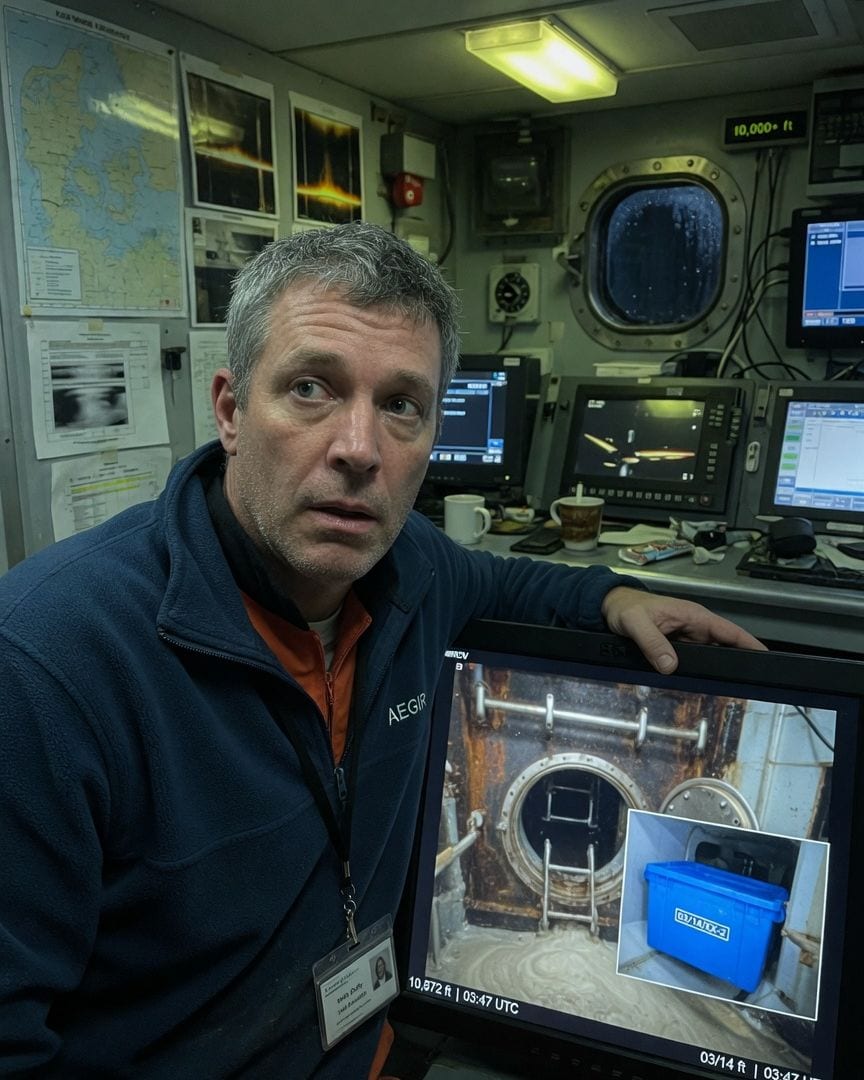
A sonar operator finds a Cold War submarine lost in 1968, but inside, a modern blue container bears a date stamp from two years ago.
Sonar operator Wells Duffy spent days on the RV Aegir, mapping the frigid depths of the Denmark Strait. He was nearing the end of his eleven-day mission when his vessel's transducers painted an impossible image. Deep in a trench, the USS Gale Prescott, a submarine lost with seventy-one souls in 1968, rested upright and perfectly preserved. But as the ROV's camera pushed into the gloom, it revealed a vibrant blue plastic container, clearly not from 1968, bearing a digital date stamp from just two years prior, chilling Wells Duffy to his core.
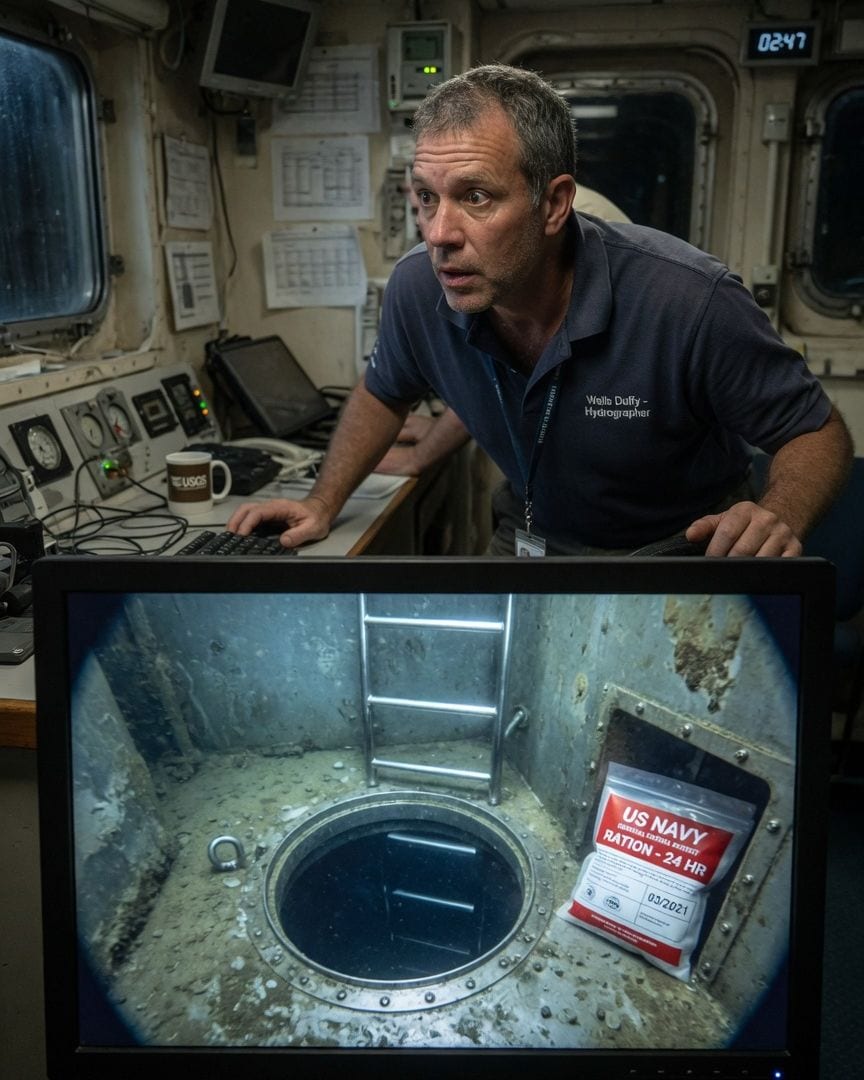
On his final mission, Hydrographer Duffy found a Cold War submarine lost in 1968. Inside, a survival pack bore a crisp date: just three years ago.
Hydrographer Wells Duffy embarked on his final deep-sea mission, hoping to justify his career one last time before a desk transfer. Eleven days in, his vessel, The Seeker, located the USS Gale Prescott, lost with 71 souls in 1968, resting upright in a deep trench. As ROV cameras descended, the submarine's escape trunk hatch stood unnervingly open, its internal ladder rungs polished smooth from recent, bi-directional use. Inside the pressure hull, surprisingly clear of decay, the ROV found a sealed survival ration pack, its packaging crisp and vibrant, stamped with an impossible date: 03/2021. How could a modern supply pack appear inside a vessel lost over half a century ago, deep beneath the Denmark Strait?
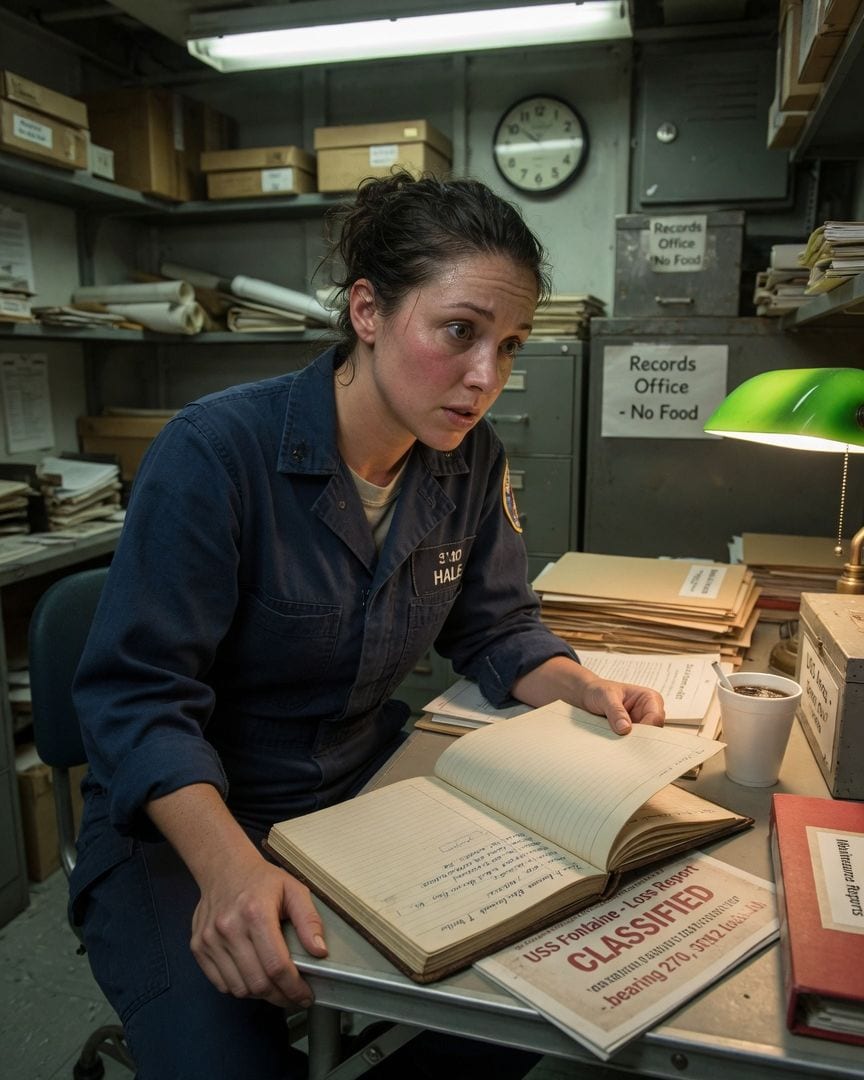
Petty Officer Hale needs a spotless record for her transfer. But the USS Ares sonar logs show an identical, impossible contact, logged to the minute, years apart, and tied to a classified loss report.
Petty Officer Sarah Hale needed a spotless record for her coveted shore duty transfer, a posting she'd worked five years to secure. Alone in the USS Ares sonar shack, three days out from San Diego, her midwatch was broken by an impossible contact: a close, slow echo holding perfect pace, invisible to radar, then vanishing. Her heart hammered, not from fear, but from the data's impossibility. When she found an identical entry in her own log from just one week prior, the cold dread tightened its grip. But the true chill settled when she unearthed decades of similar records, signed by other sonar officers, all showing the same impossible contact at 0212, off the port beam, for nineteen minutes, on the same ship, stretching back years—a persistent echo tied to a classified loss report.
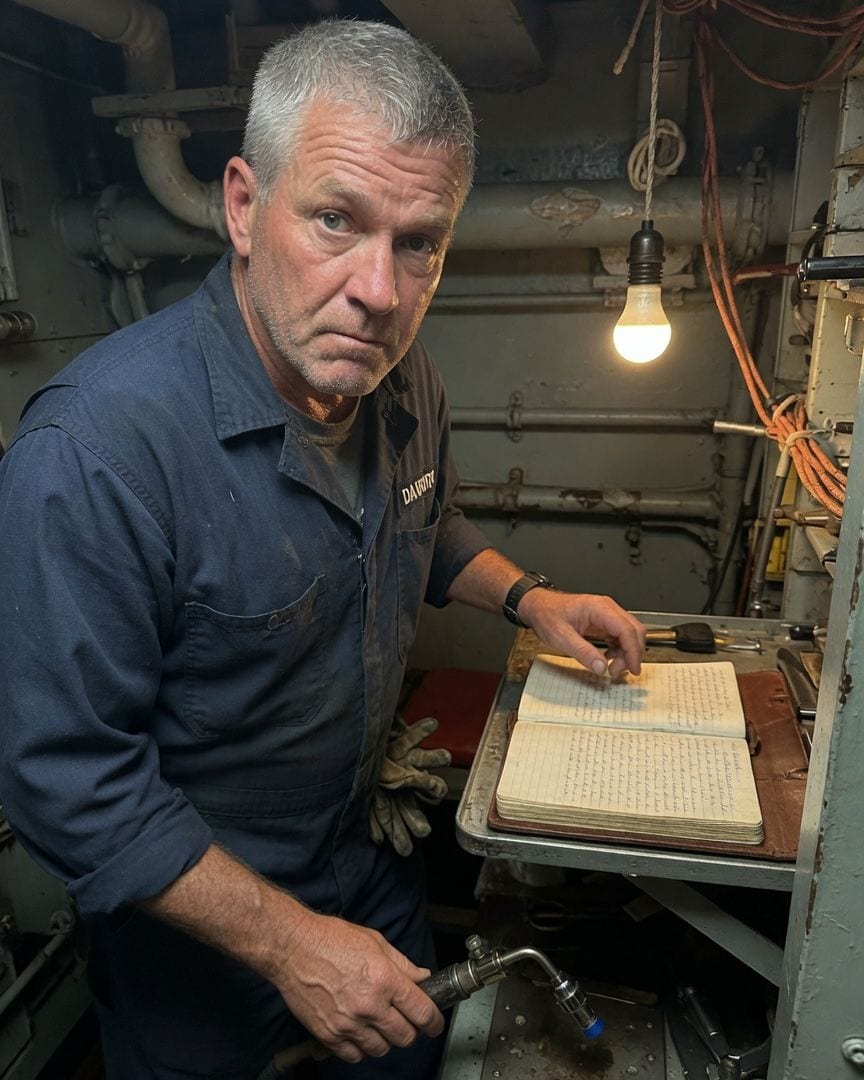
A week from shore duty, Chief Danforth cut a hatch where his ship's plans showed solid steel. An hour later, the wall was seamless, but the Cold War logbook from inside appeared under his mattress.
Chief Petty Officer Raymond Danforth, just a week from ending three decades of service, was intimately familiar with every pipe and plate of the guided-missile destroyer Weatherall. During a mid-cruise overhaul, his gloved hand found a sealed hatch where schematics promised only a solid bulkhead. He cut through the impossible seam to reveal a small, dry compartment, softly lit, containing a logbook filled with an unsettlingly familiar hand. When he returned an hour later with a witness, the hatch was gone, the wall seamless. Later that night, the same logbook appeared beneath his mattress, its pages revealing an entry: 'Petty Officer Howard Montgomery, missing, 1972.' How could a compartment vanish, yet leave its secrets behind?
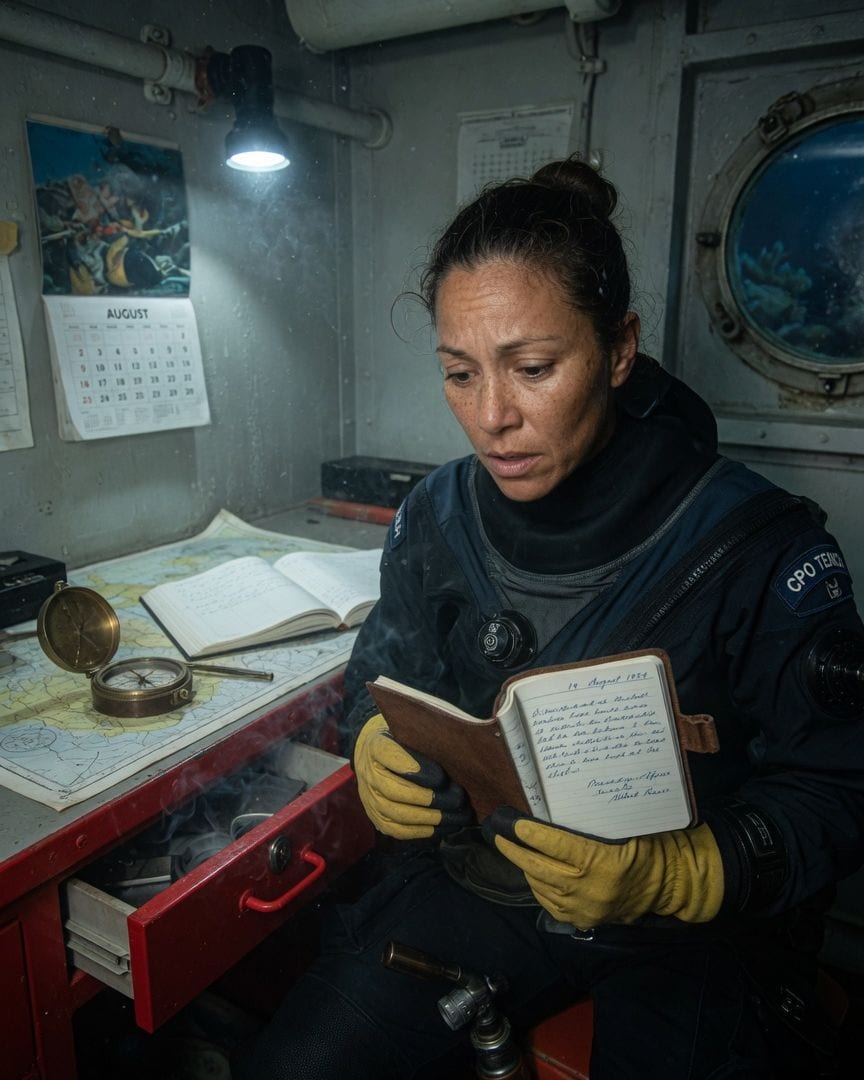
A deep-sea diver found a Cold War target ship's logbook dated months after it was vaporized in 1954.
Chief Petty Officer Marlo Tench, a methodical deep-sea diver, stared in disbelief at the ROV feed. Her team watched with her as the USS Triton, a target ship from the 1954 Castle Bravo nuclear test, appeared pristine and upright ninety feet below. It was supposed to have been vaporized, yet its hull number was unmistakable, its paint unburned, and its internal systems inexplicably active. Descending into the eerie silence, Marlo found a logbook dated five months after the ship’s destruction, and a journal entry naming a crewman officially listed as 'unmanned target.' What impossible force kept the Triton a living ghost decades after its fiery end?
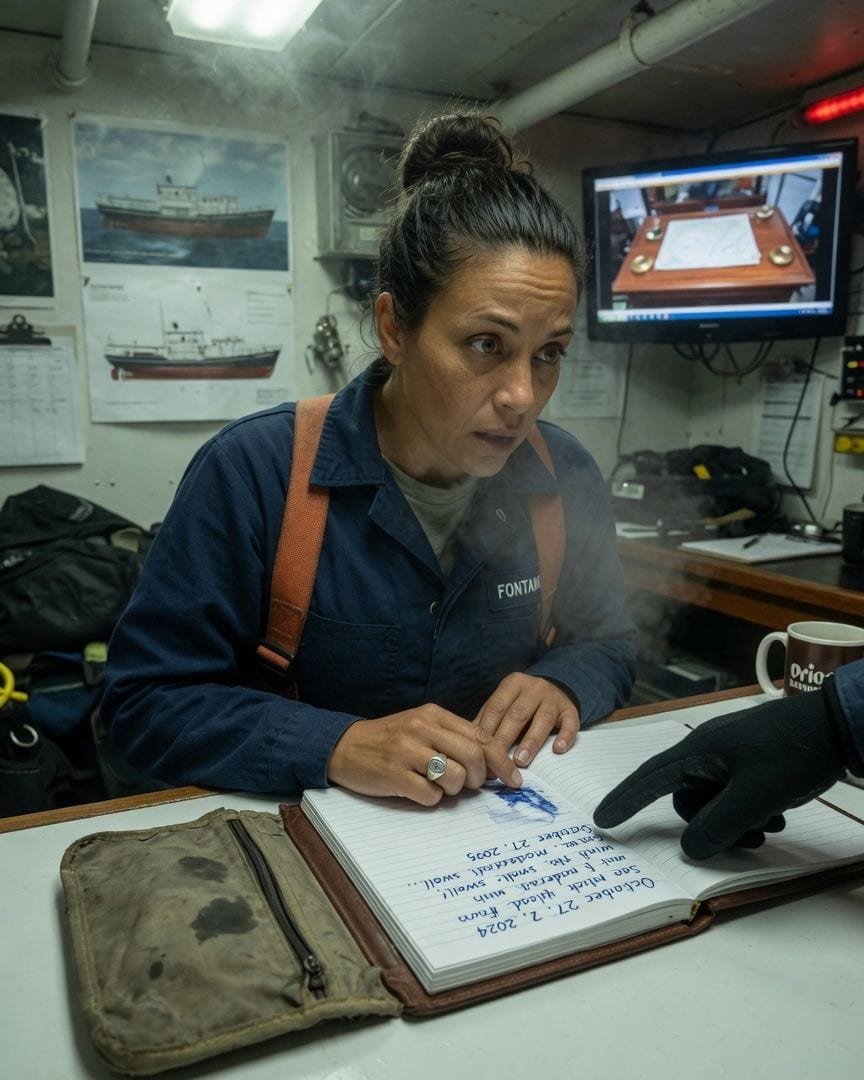
A Cold War survey ship's logbook holds an entry dated for today, its ink still wet.
Navy salvage officer Vivian Fontaine led the deep-sea recovery of the Hollis Wren, a survey ship lost forty years ago, finding it remarkably intact on the seabed. But inside, a nautical chart depicted new structures built decades after the ship vanished, and its hull was unnervingly clean of the expected forty years of growth. The true shock came in the captain's cabin: a sealed logbook with an entry dated October 27, 2024—today’s date—its deep blue ink still glistening wet, detailing current conditions at their exact coordinates. How could a ship lost so long ago carry a logbook written moments before its discovery?