On his final mission, Hydrographer Duffy found a Cold War submarine lost in 1968. Inside, a survival pack bore a crisp date: just three years ago.
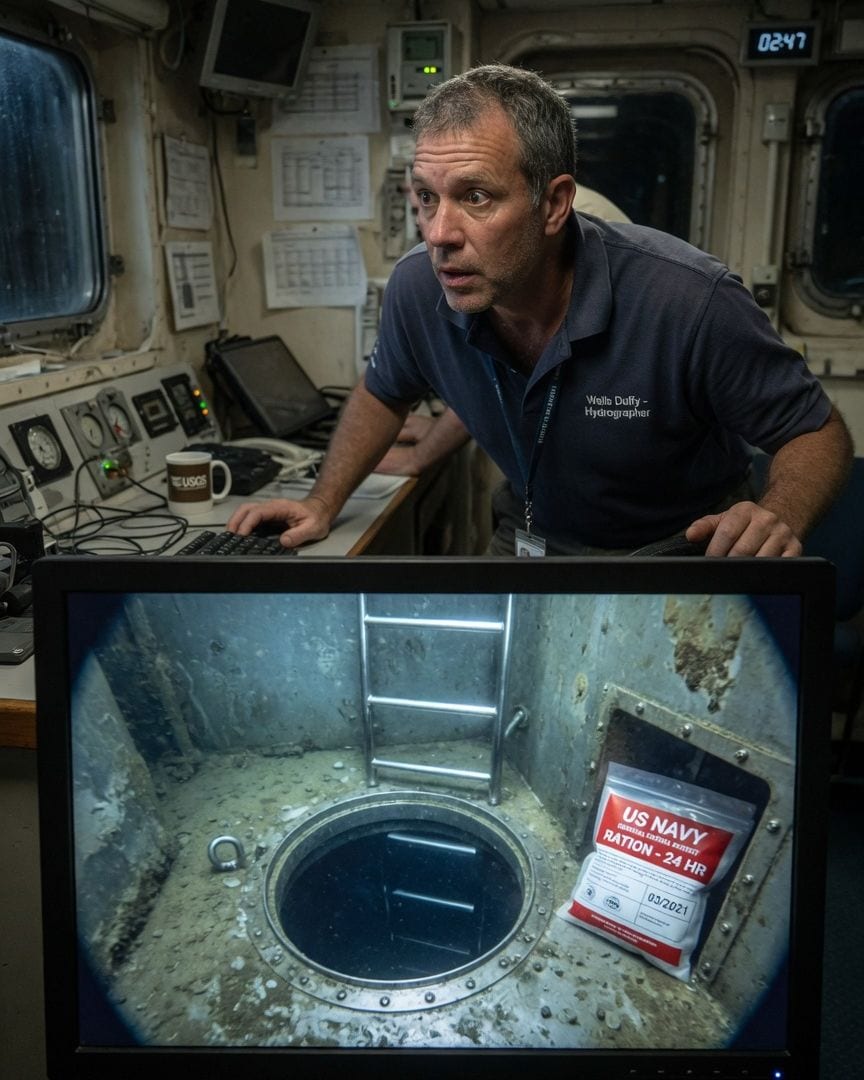
On the bridge of the survey vessel 'The Seeker,' Hydrographer Wells Duffy stared at the sonar readout.
Eleven days into his final deep-sea mission before a transfer to a desk job, he’d hoped for something, anything, to justify his career choice one last time.
The anomaly had been a faint smudge at the mouth of the Denmark Strait, too large for a natural formation. Now, high-definition bathymetry confirmed it: a submarine, upright, resting in a deep trench.
The USS Gale Prescott, lost with seventy-one souls in 1968. He felt the familiar thrill of discovery, a mix of scientific triumph and solemn respect for the men lost.
But as the ROV cameras descended, broadcasting a live feed back to the bridge, Wells saw it. The escape trunk hatch, meant to be dogged shut and sealed against the crushing deep, stood open.
It gaped like an astonished mouth in the ancient hull. And the ladder rungs below it, visible in the artificial light of the ROV, were worn bright.
Not just faded by time or scoured by current, but polished smooth, gleaming with what looked like recent, frequent use. The wear ran in both upward and downward directions.
Wells ordered a more detailed ROV inspection, overriding the captain’s initial skepticism about disturbing a war grave. He needed to understand the anomaly, not just document it.
The camera feed showed the hull of the Prescott, draped in decades of sediment, looking like a forgotten monument. But around the open hatch, the sediment was conspicuously absent, as if regularly swept away.
The contrast was sharp: the surrounding hull a ghostly gray-brown, the immediate vicinity of the hatch a clear, dark circle of exposed metal.
The ladder rungs inside the trunk gleamed under the ROV’s lights, a shocking contrast to the calcified hull, almost iridescent in their unnatural brightness.
His mind, trained in logical deduction, tried to offer explanations: unusual currents that cleared only that specific spot, migratory marine life rubbing against the rungs, some freak geological event.
None of it fit the uniform, bi-directional wear, nor the clean-swept area that spoke of deliberate maintenance. The air on the bridge felt heavy, suddenly cold, as if the deep-sea chill had seeped through the screen.
He directed the ROV to carefully enter the escape trunk. Inside, the air was still, cold, but strangely clear of the expected decay or marine growth. No swirling detritus, no tell-tale signs of fifty-five years of water ingress.
As the ROV navigated the cramped space, its lights cut through the gloom. It descended into the main pressure hull, revealing the eerie silence of the lost vessel, its interior surprisingly intact.
Then, tucked into a small, watertight niche beside the ladder, the camera found it: a standard-issue, sealed survival ration pack. Its packaging was crisp, its colors vibrant, utterly untouched by the crushing depth and half a century of saltwater.
Wells Duffy, having carefully entered the Gale Prescott's escape trunk and descended into the main pressure hull, found a small, sealed, modern-issue survival ration pack, its packaging crisp and dry, tucked into a niche beside the ladder, bearing a stamped date from only three years prior.
He stared at the screen, the impossible date burning into his mind. 03/2021. The submarine had been lost in 1968. This ration pack should not exist, not here, not now.
The Seeker's captain, standing behind him, let out a slow, stunned breath. The implications were immediate, cold, and utterly terrifying. Someone had been here. Recently. And they had left this behind.
Wells’s official report on the Gale Prescott was met with an unusual silence. His superiors acknowledged the discovery but dismissed the ration pack as a likely prank by a deep-sea diver, or perhaps a recent, unauthorized salvage operation.
The 'swept clean' sediment and 'worn' rungs were attributed to peculiar currents, a phenomenon they claimed was not entirely unknown in deep trenches. The explanation was too quick, too neat, too conveniently dismissive.
It tasted of deliberate evasion, a narrative hastily constructed to deflect further inquiry. Wells, on his last tour, felt a stubborn refusal to let it go. His years of hydrographic precision demanded an answer that actually fit the data.
He began digging, starting with declassified files on the Gale Prescott’s loss. The official report was sparse, almost deliberately vague. Key logs were missing, marked with redaction lines that seemed arbitrary, covering dates and seemingly innocuous cargo manifests.
The listed coordinates for the initial search pattern seemed to contradict later recovery efforts, placing the theoretical search area hundreds of miles from where the submarine was ultimately found.
He noticed a recurring pattern of 'classified' stamps on seemingly innocuous details, details that, if revealed, might connect disparate pieces of information.
Remembering an old contact, he reached out to Janet Kingsley, a retired Navy archivist known for her meticulousness and disdain for bureaucratic obfuscation.
He sent her an encrypted message, carefully detailing his findings—the open hatch, the worn rungs, the clean sediment, the modern ration pack—and asking for any supplementary materials, any obscure memos, any cross-referenced files on the Prescott that might have escaped the usual channels.
A few days later, Wells received a polite but firm call from his commanding officer, Rear Admiral Richard Ingram.
The Admiral advised him to focus on the 'primary mission objectives' and to 'avoid speculative tangents,' emphasizing the importance of 'institutional trust.' The tone was warm, avuncular even, but the underlying message was clear: drop it.
That evening, as Wells worked in his cabin, trying to piece together the fragmented timeline of the Gale Prescott, he noticed a faint, almost imperceptible hum from his laptop, even though it was supposedly in airplane mode.
The small, usually silent fan kicked on sporadically, then died down. He ran a diagnostic and found a background process he didn't recognize, quietly siphoning data, its activity hidden behind layers of encrypted code. His inquiries had been flagged.
The chill that ran through him had nothing to do with the arctic waters outside; it was the icy touch of unseen surveillance.
He immediately shut down the device, pulling the power cord, feeling a sudden vulnerability in the otherwise secure confines of his cabin. The next morning, he received an anonymous, untraceable email from Janet Kingsley. The subject line was blank.
'Meet me in Boston next week,' it read. 'Public library, main reading room. Noon.' No further explanation, no digital signature, just the precise instructions. Wells knew he was being watched, that his electronic communications were compromised.
He couldn't trust official channels, or even his own ship's network. The email itself was a testament to Janet’s discretion, a silent acknowledgment of the danger.
He accepted the meeting, understanding that the threat was now personal, and that Janet had something significant, something she couldn't risk transmitting electronically.
Wells met Janet Kingsley in the hushed, cavernous reading room of the Boston Public Library. The heavy oak tables seemed to absorb all sound, and the high arched windows let in a pale, diffuse light.
She was a woman with sharp eyes behind thick-rimmed glasses and an air of quiet defiance that made her seem both frail and formidable. She slid a thick, heavily redacted folder across the polished table, its aged paper rustling faintly.
'This is the supplementary file for the Gale Prescott,' she whispered, her voice barely audible above the rustle of turning pages from other patrons. 'It was never meant to see the light of day.
I pulled it from a deep archive that was scheduled for degaussing next month.' As Wells sifted through the documents, Janet explained. 'The official story is a fiction. The Prescott wasn't lost by accident. Not really.
I've seen a pattern over the decades. Similar 'losses' in strategic, remote locations. Always submarines, always in deep water, always with an unusually high casualty count and a suspiciously clean official report.'
She pointed to a series of internal memos, heavily blacked out, but with enough visible text to show a recurring phrase: 'Designated Operational Node.' Wells felt a cold knot tighten in his stomach.
The worn ladder rungs, the clean-swept hatch, the impossible ration pack—they weren't anomalies or coincidences. They were evidence. Evidence of an ongoing operation, a systematic misuse of tragedy.
'These aren't wrecks, Mr. Duffy,' Janet said, her voice dropping further, her gaze unwavering. 'They're stations. And the crews… they don't just disappear. They're filed.
Their records are sealed, their families given a tidy story, and then their service is repurposed.'
She then showed him records of other 'lost' vessels, each with similar contradictory details: a destroyer found upright decades later, its engines cold but intact, hatches dogged from the inside; a cargo ship adrift for years, its hold filled with unidentifiable, perfectly preserved equipment, its crew logs ending mid-voyage.
The truth was not that the Navy had lost these vessels, but that it had filed them away, turning them into assets for something else entirely. The realization settled over Wells, chilling him to the bone.
The dread was not just in the secrecy, but in the institutional efficiency of it all.
Janet then pulled out one last document from the thick folder. It was a single page, a routine supply manifest, seemingly innocuous, printed on crisp modern paper.
'This is the most damning piece,' she murmured, her finger tracing a line on the page. 'It's a supply requisition for 'Submersible Unit G.P.' — Gale Prescott, Mr. Duffy.
Dated just last year, 09/2023, for a specific type of specialized deep-sea equipment that didn't even exist in 1968, let alone back when the sub was supposedly lost.' Wells stared at the date, then at the signature block below.
His breath hitched. 'And this,' Janet continued, 'is who signed it.' Wells's eyes widened, tracking the ornate script. The name was unmistakable: Rear Admiral Patrick Sullivan.
He recognized the name from recent news, a high-ranking officer, currently serving on the Joint Chiefs of Staff.
But what made his blood run cold was that same name appearing on the original loss report for the Gale Prescott in 1968, a faded copy of which was still visible in the main declassified file.
Janet leaned closer, her voice a dry whisper. She pointed out the subtle differences in the signatures, the firmer, more practiced hand of the modern signature compared to the earlier, slightly less confident one.
'He was a junior officer then,' she explained. 'He signed the initial loss report. And he signed this. Fifty-five years later. The file on the Gale Prescott, Mr. Duffy,' she said, her eyes fixed on his, 'is still being written.'
The realization hit Wells with the force of a physical blow. The Gale Prescott wasn't a static wreck, a tomb for seventy-one souls. It was a living, breathing part of a vast, hidden network.
The 'lost' crews weren't casualties; they were personnel, absorbed, assigned to these 'Designated Operational Nodes,' their lives erased from public record.
The Navy, or some shadowy arm within it, was not just covering up a historical accident; it was actively managing these submerged stations, using the guise of historical tragedy to mask ongoing operations.
The pattern across decades and classifications, which Janet had meticulously uncovered, now clicked into horrifying focus. These weren't isolated incidents; they were a coordinated, patient system, a seamless integration of human and technological assets into a hidden infrastructure.
The purpose remained opaque, hidden behind layers of classification, but the mechanism was sickeningly clear: ships and their crews were simply re-classified, their lives erased from public record, their vessels transformed into clandestine outposts.
The ocean floor was not a graveyard, but a hidden infrastructure, humming with unseen activity.
The secrecy machine was the horror itself, consuming men and machines, turning them into cold, efficient assets, and then filing them away, their operational status still active, their 'loss' merely a bureaucratic entry.
The dread was in the perfect, chilling coherence of it all, the way every small, impossible detail now snapped into place.
Wells received an urgent message: report to Naval Intelligence headquarters immediately for a 'debriefing and commendation' regarding his 'exemplary work' on the Denmark Strait anomaly. He knew it was a trap.
The email, sent to his encrypted personal account, had no digital signature, no contact information beyond an address in D.C.
He tried to contact a journalist he knew, a woman who specialized in investigative pieces, but his satellite phone, usually reliable even at sea, showed no service.
His laptop, once again, refused to connect to any network, its screen a blank, unresponsive slate. He was entirely cut off.
At the headquarters, an austere gray building in a non-descript part of the city, he was met by two impeccably dressed officers.
They were polite, almost deferential, but their eyes held a chilling, unwavering intensity, missing the warmth of genuine human interaction. 'Hydrographer Duffy,' one said, his voice flat, 'Rear Admiral Sullivan wishes to speak with you personally.' Wells understood.
He was not being brought in for a commendation. He was being brought into the file. He walked down a long, sterile corridor, the polished floor reflecting his own grim face as if through dark water.
He knew the full truth now, a truth so vast and so deeply embedded it could not be undone or acted upon by any single individual. He was simply left knowing. And the knowing, he realized, was the ending.
As they approached a heavy, unmarked door, made of dark, unyielding metal, he glanced back down the corridor, the fluorescent lights humming overhead like something trapped. He saw no escape, no way out. The door opened. He stepped inside.
An official Navy report, circulated internally, stated that Hydrographer Wells Duffy had been transferred to a highly classified, non-field research position, citing 'unusual stress and psychological impact during recent deep-sea operations.'
His survey data from the Denmark Strait was immediately re-classified to 'Top Secret, Eyes Only.' The Seeker's mission was abruptly cut short, and the vessel was recalled to port for 'unscheduled maintenance,' its crew quickly dispersed.
Janet Kingsley, after receiving an anonymous, untraceable email containing a single word — 'Acknowledged' — quietly shredded her copy of the supplementary Gale Prescott file and retired from all unofficial archival work, disappearing from public life.
Weeks later, 'The Seeker' was back at sea, its crew rotating, the unsettling incident fading into the ship's quiet lore. A new hydrographer, a young Lieutenant named Greta Novak, moved into what had been Wells Duffy's cabin.
She found his old laptop in a storage locker, seemingly forgotten.
Curious, she booted it up and found a half-written email draft, detailing the inconsistencies of the Gale Prescott's loss, the worn rungs, the ration pack, and the impossible signature of Rear Admiral Sullivan.
The draft ended abruptly, mid-sentence, the cursor blinking silently. Greta deleted it. The ship's next assignment was to revisit the Denmark Strait, to conduct a 'routine re-survey' of a known anomaly.
On the bridge, the new hydrographer noted the sonar anomaly had reappeared, and the file on the Gale Prescott was still marked 'Active.'
If this one got to you
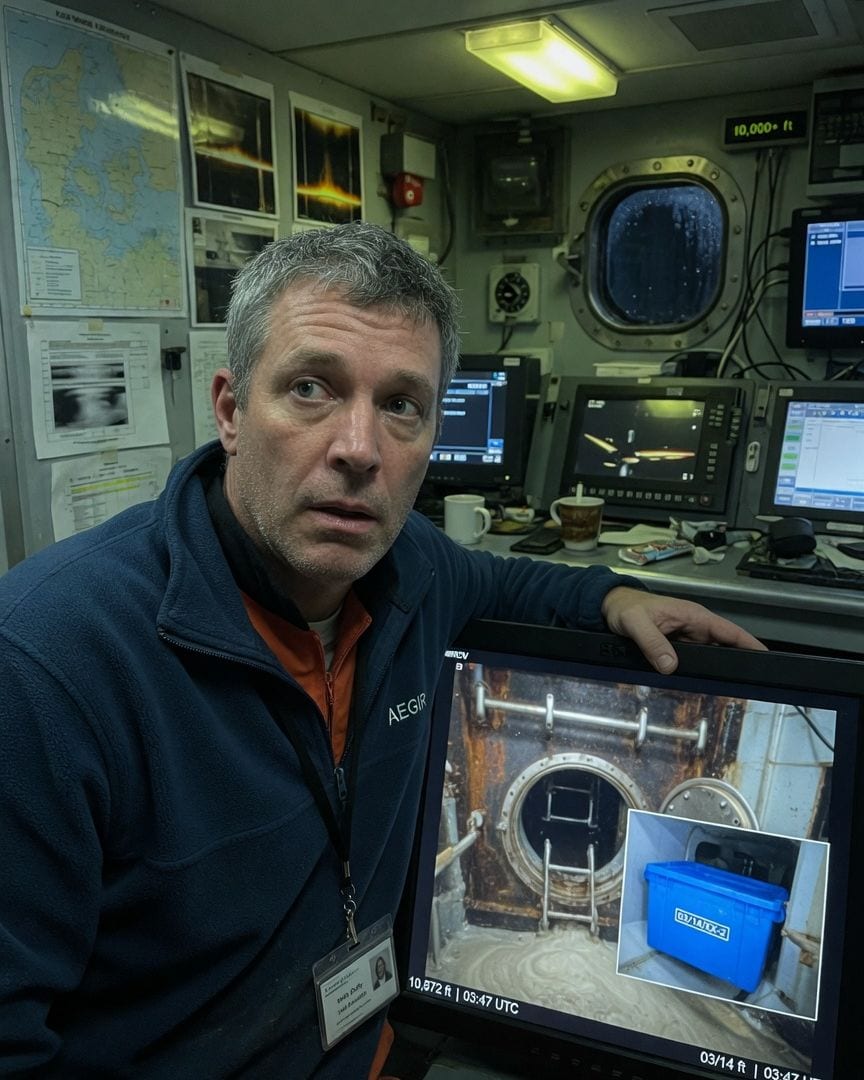
A sonar operator finds a Cold War submarine lost in 1968, but inside, a modern blue container bears a date stamp from two years ago.
Sonar operator Wells Duffy spent days on the RV Aegir, mapping the frigid depths of the Denmark Strait. He was nearing the end of his eleven-day mission when his vessel's transducers painted an impossible image. Deep in a trench, the USS Gale Prescott, a submarine lost with seventy-one souls in 1968, rested upright and perfectly preserved. But as the ROV's camera pushed into the gloom, it revealed a vibrant blue plastic container, clearly not from 1968, bearing a digital date stamp from just two years prior, chilling Wells Duffy to his core.
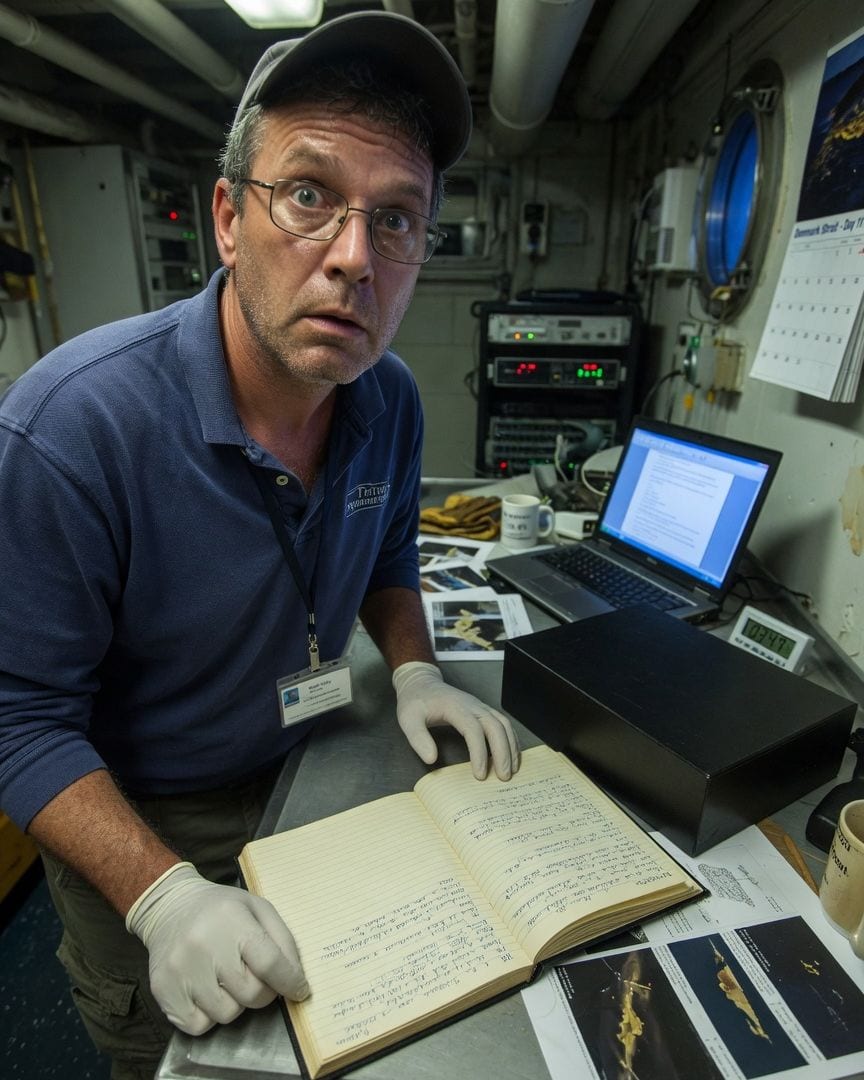
A hydrographer found a lost Cold War submarine from 1968. Inside, its logbook carried entries dated '12.03.2012'.
Hydrographer Wells Duffy had spent eleven days in the *Triton*'s control room, guiding the deep-sea submersible through the crushing dark of the Denmark Strait, chasing a phantom sonar signature. When the USS *Gale Prescott*, lost with all hands in 1968, finally resolved on his monitors, triumph turned to unease as he saw its escape hatch stood simply ajar. The hatch rim and ladder rungs were eerily clean and worn bright, used repeatedly long after the ocean claimed the vessel, prompting Captain Crane to authorize an unauthorized dive. Inside the frigid wreck, Wells discovered a non-Navy container, strangely warm, holding a logbook whose precise entries continued across the decades, ending in the impossible date of '12.03.2012'.
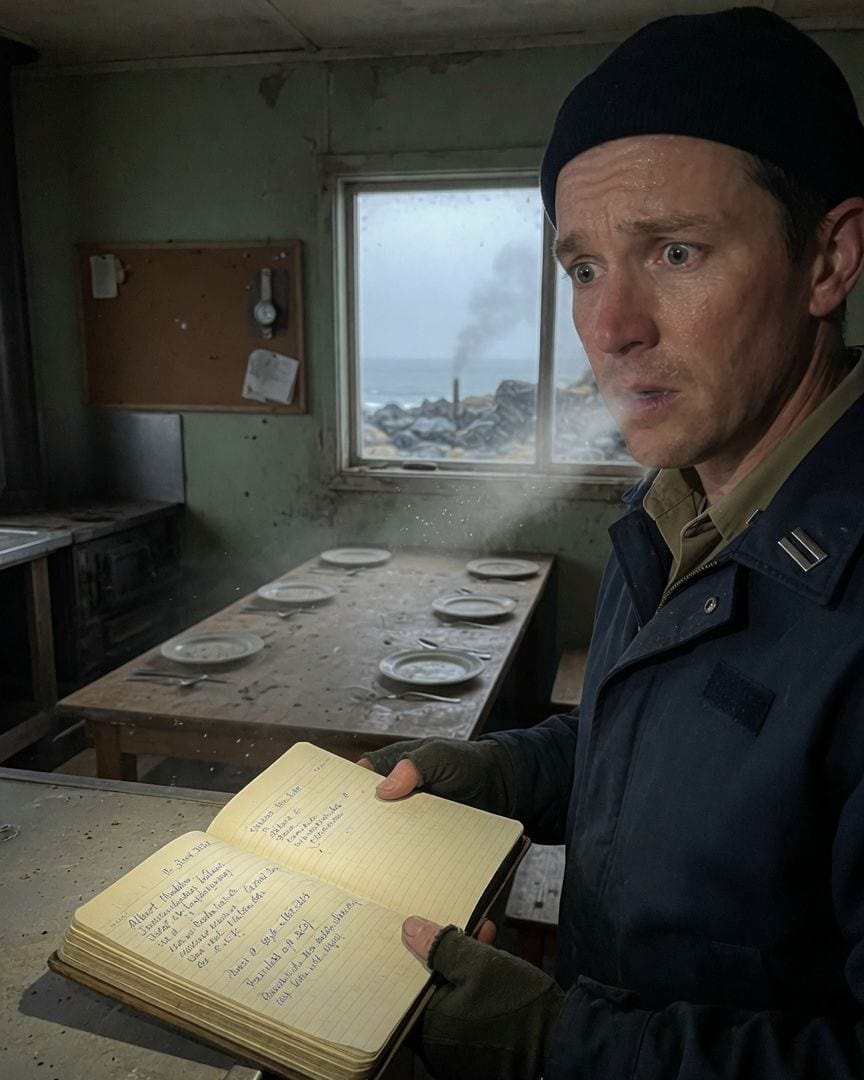
Coast Guard Lieutenant Thatcher finds an old crew photo dated today, June 15, 2024.
Lieutenant Daniel Thatcher leads a survey crew to a derelict LORAN station in the frigid Aleutians, officially abandoned for over a decade. But as they enter, a heavy-bound station log lies open on a counter, its ink startlingly wet, detailing a routine watch from today with names unknown to the Coast Guard.
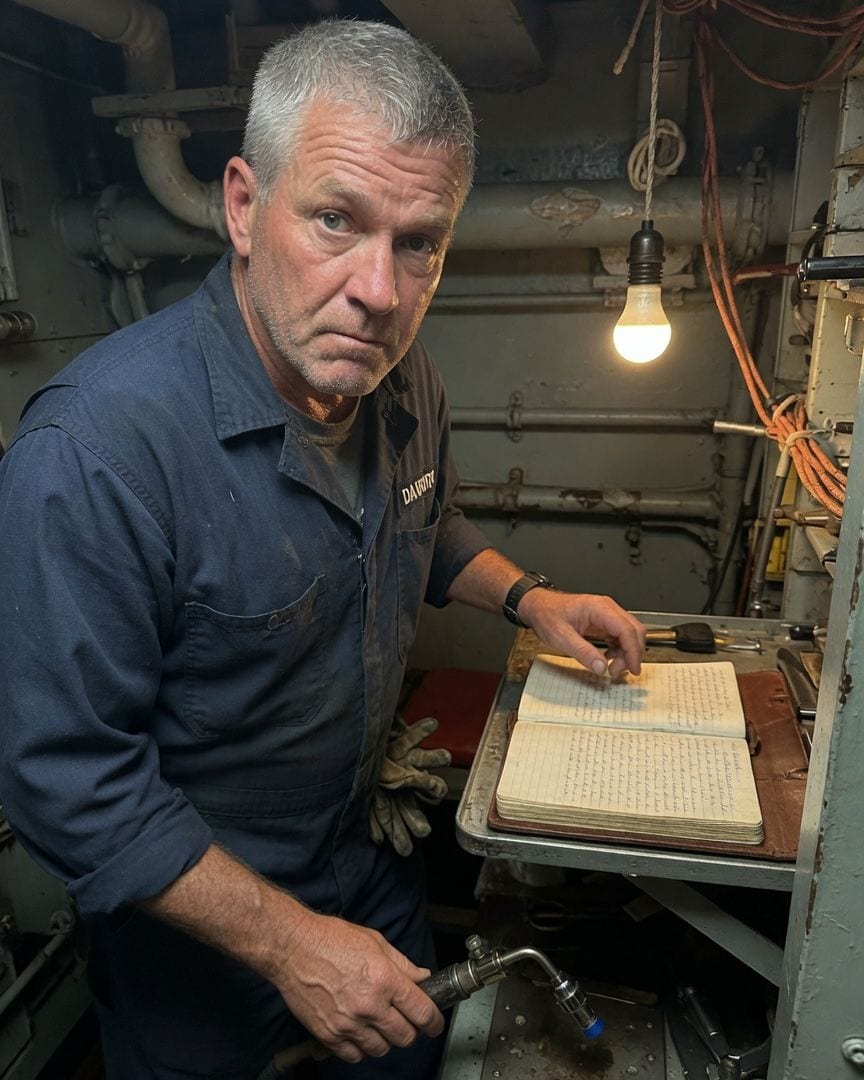
A week from shore duty, Chief Danforth cut a hatch where his ship's plans showed solid steel. An hour later, the wall was seamless, but the Cold War logbook from inside appeared under his mattress.
Chief Petty Officer Raymond Danforth, just a week from ending three decades of service, was intimately familiar with every pipe and plate of the guided-missile destroyer Weatherall. During a mid-cruise overhaul, his gloved hand found a sealed hatch where schematics promised only a solid bulkhead. He cut through the impossible seam to reveal a small, dry compartment, softly lit, containing a logbook filled with an unsettlingly familiar hand. When he returned an hour later with a witness, the hatch was gone, the wall seamless. Later that night, the same logbook appeared beneath his mattress, its pages revealing an entry: 'Petty Officer Howard Montgomery, missing, 1972.' How could a compartment vanish, yet leave its secrets behind?
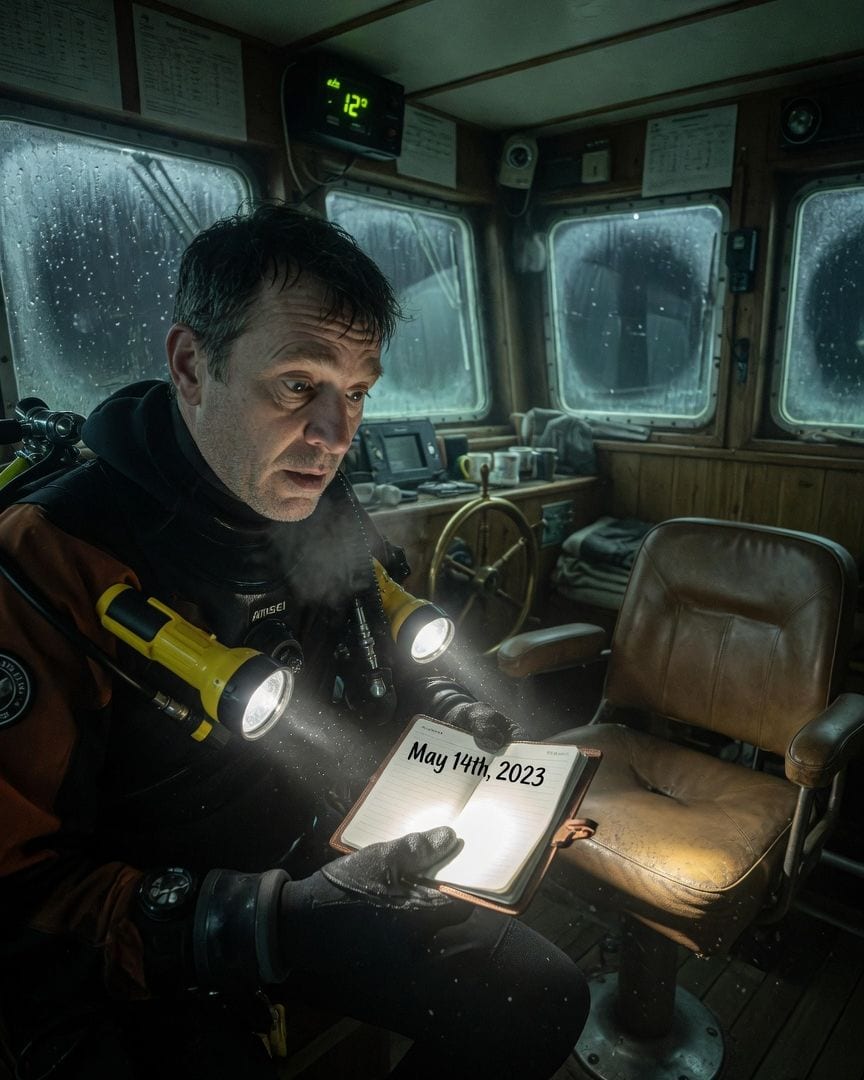
A dive supervisor exploring a Cold War sealer found its logbook on a wheelhouse shelf, with an entry dated this morning.
Dive supervisor Hugo Amsel felt the familiar cold of the Bering Sea as his submersible approached the 'Wynn Portal,' a sealer vanished without a trace in 1991. The wreck sat eerily intact, its wheelhouse windows impossibly clear, and the helm locked hard to starboard. But then the rudder angle indicator twitched, moving two degrees, a ghost still at the wheel. After breaching the sealed hull, Hugo and his lead diver found the ship's interior pristine, frozen in time. In the wheelhouse, on a shelf next to the chart table, lay the logbook. Its final entry, written in Captain Larsen’s hand, was dated 'May 14th, 2023' – today. The ink was still unsettlingly fresh, leaving Hugo to stare at the impossible date and the empty captain's chair.
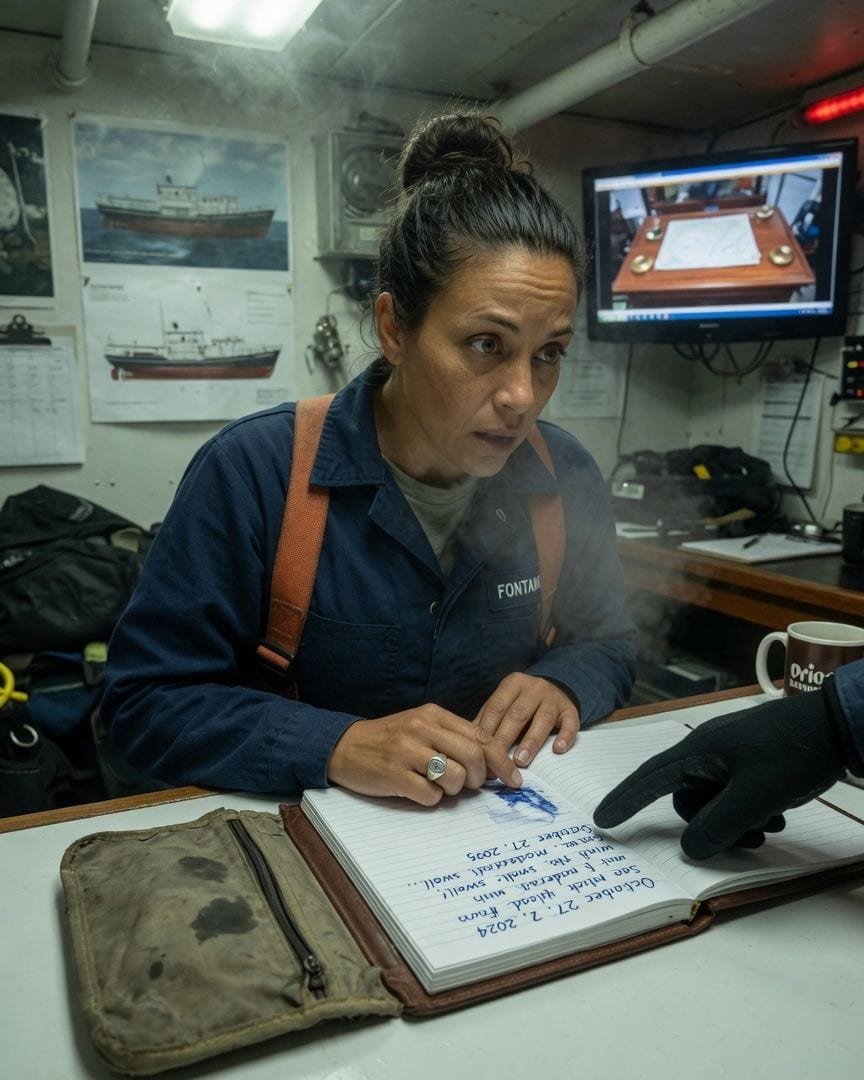
A Cold War survey ship's logbook holds an entry dated for today, its ink still wet.
Navy salvage officer Vivian Fontaine led the deep-sea recovery of the Hollis Wren, a survey ship lost forty years ago, finding it remarkably intact on the seabed. But inside, a nautical chart depicted new structures built decades after the ship vanished, and its hull was unnervingly clean of the expected forty years of growth. The true shock came in the captain's cabin: a sealed logbook with an entry dated October 27, 2024—today’s date—its deep blue ink still glistening wet, detailing current conditions at their exact coordinates. How could a ship lost so long ago carry a logbook written moments before its discovery?