A sonar operator finds a Cold War submarine lost in 1968, but inside, a modern blue container bears a date stamp from two years ago.
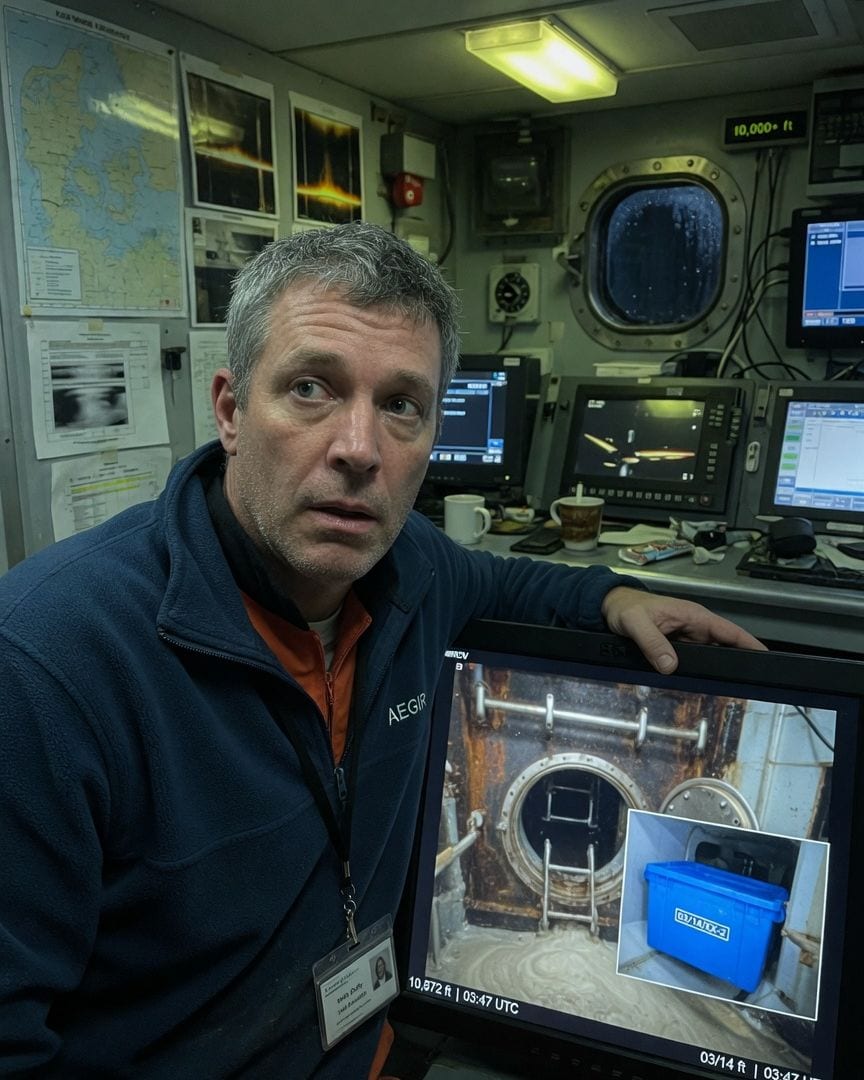
Wells Duffy traced the sonar anomaly at the mouth of the Denmark Strait for seven of his eleven allotted days. His vessel, the RV Aegir, cut a steady course through the frigid water, its transducers painting the abyss.
What began as a faint, elongated shadow on the thermal scans had resolved into a solid, unmistakable form: a submarine.
Not just any submarine, but the USS Gale Prescott, lost with seventy-one souls in 1968, now resting upright in a deep-sea trench. The wreck was an impossible find, perfectly preserved, sediment drifted evenly across her length, a silent tomb.
But the ROV's high-definition camera, pushing into the gloom, showed one detail that stole the breath from Wells's lungs and froze the coffee in his mug.
The forward escape trunk hatch, designed to be dogged down from the inside, stood ajar. Not ripped open by pressure, not damaged by impact, but simply open, as if someone had just stepped out.
The sediment around it was swept clean, a contrast to the rest of the hull.
And the ladder rungs, visible in the artificial light, were worn bright, not by fifty years of currents, but by something that had climbed them, again and again, in both directions. The air in the control room felt suddenly colder.
Wells Duffy ran the ROV over the Gale Prescott for hours, meticulously documenting every detail. He tried to rationalize it. Maybe the hatch failed, a unique pressure event.
He considered the sheer force of pressure at ten thousand feet, how it could warp metal. But the clean sweep of sediment, like a meticulous broom had brushed the area, argued against it.
No natural current could maintain that kind of pristine perimeter. And the ladder rungs – steel worn smooth and shiny in places – that wasn't sixty years of deep-sea decay. Rust might flake, but it wouldn't polish.
That was friction, human friction, or something very like it.
He ordered the ROV to approach the open hatch, its manipulator arm extended with a micro-camera. The interior was a black void, swallowing the ROV's powerful lights whole. He guided the camera slowly, cautiously, into the trunk.
The air in the control room grew thick with the unspoken question, heavy as the deep-sea pressure itself. What could be inside?
The images flickered, grainy at first, then sharpened into focus. The trunk itself was surprisingly clear of debris, unlike what one would expect from a vessel lost for decades.
Then, a flicker of color, out of place among the rusted steel. The ROV nudged closer, its lights focusing. Wedged deep in a structural void, almost hidden, was a small, rectangular object.
It was a container, clearly non-military, its casing a vibrant, almost iridescent blue plastic, unlike anything from 1968. It was sealed tight, no obvious damage.
As the ROV's camera zoomed in, a detail became horrifyingly clear on its surface: a digital date stamp, stark against the blue. It read, '03/14/XX-2'. Two years prior. Not 1968.
Wells felt a cold dread seep into his bones, a slow-moving chill that started in his chest and spread. The Gale Prescott wasn't just a wreck. Someone had been here. Recently.
Wells Duffy stared at the ROV monitor, the image of the small, sealed container filling the screen. Its plastic shell, a vivid, unnatural blue in the deep-sea lights, bore a stark, digital date stamp: '03/14/XX-2'. Two years ago. Not 1968.
His mind raced, desperate for a mundane explanation. A modern debris field? But it was inside the sub, wedged deliberately, almost secreted away. A prank? At 10,000 feet, on a lost nuclear submarine, the logistics alone were astronomical.
The implications were a cold wave, washing over him, stealing his breath. The Gale Prescott was not a tomb. It was an access point. And whatever had used it, whatever had left this container, was still active, still present.
The radio crackled, a technician asking for instructions. Wells could only manage a single word, his voice raspy: "Retrieve it."
Back on shore, the retrieved container sat in Wells Duffy's lab, secured under guard. The blue plastic was cold to the touch, smooth, utterly alien. Initial analysis confirmed it was a modern polymer, not available in the 1960s.
He presented his findings to his superiors, meticulously detailing the open hatch, the worn ladder, the anomalous sediment, and the container. They listened with a mixture of skepticism and alarm. The official line had always been a catastrophic loss.
A senior officer, his face rigid, suggested it was a hoax, an elaborate plant. Wells countered with the impossibility of such an act at that depth and location without extensive resources and a crew that would inevitably be noticed.
The container, unyielding to initial attempts to open it, held no clues beyond its date. Wells's superiors, unwilling to publicly acknowledge such an unsettling discovery, ordered a classified internal review.
Wells, however, couldn't let it go. The memory of the worn rungs, the swept sediment, gnawed at him. He began cross-referencing everything he could find about the Gale Prescott—declassified naval archives, old news reports, even obscure maritime forums.
He found inconsistencies: conflicting reports on the exact coordinates of her disappearance, a sudden halt in search efforts after only a few weeks, and a peculiar lack of any detailed recovery plans, even speculative ones.
He managed to get a contact at the Naval Records Center, Sylvia Radcliffe, a senior archivist known for her meticulousness and disdain for bureaucracy. He described the anomaly, carefully omitting the container, wary of alarming her unnecessarily.
Sylvia, intrigued by the gaps in the official record, agreed to pull the original Gale Prescott incident file, promising to look for anything unusual.
Two days later, Wells Duffy received a call from Sylvia. Her voice was hushed, almost a whisper. "Wells, the file... it's not right. The original incident report is there, but there are... gaps.
And a section marked 'Special Project Sigma-7' that's completely redacted." She sounded genuinely unnerved, her usual composure fractured. "I'm sending you copies of what I can, but I've had eyes on me since I pulled it. Someone's watching this file."
Wells felt a chill that wasn't just the memory of the frigid deep. His inquiries were being noticed. That evening, as he left his office, he noticed a dark sedan parked across the street, its windows tinted.
It wasn't the first time he'd seen it, always in the periphery.
He dismissed it as paranoia, a natural side effect of deep-sea isolation and strange discoveries, but a seed of unease had been planted, growing cold and hard in his gut.
The next morning, his access to the internal naval archives was mysteriously revoked, citing a 'system upgrade'. The error message on his screen seemed to mock him, glowing with an unnatural brightness.
He called Sylvia, but her line went straight to voicemail. He tried again, and again, until a pre-recorded message stated her extension was 'no longer active'. He knew then it wasn't paranoia; it was a carefully orchestrated maneuver.
Someone had moved. He drove to Sylvia's apartment, finding the door ajar, a small detail that screamed wrongness in the quiet hallway. Inside, the apartment was neat, almost sterile, as if recently cleaned, but the air hung heavy with absence.
No sign of Sylvia, but on her kitchen counter, tucked beneath a single, unread newspaper, was a Manila envelope.
It contained photocopies of what Sylvia had managed to pull: fragmented pages detailing 'Sigma-7' and a list of personnel assigned to it, including the name Carl Pennington, a retired Naval Intelligence Officer known for his reclusive habits.
On the last page, a handwritten note from Sylvia, scrawled hastily in blue ink: 'Wells, they know. This is all I could get. Be careful. The file… it’s still open.'
Wells Duffy found Carl Pennington living in a small, isolated cabin on the Maine coast, overlooking a perpetually gray sea. Pennington, a man whose eyes held the weary wisdom of too many secrets, was initially evasive. "The Gale Prescott?
A tragedy, nothing more." His voice was flat, practiced. Wells pressed him, laying out the details: the open hatch, the worn ladder, the modern container, Sylvia's disappearance, the 'Sigma-7' project.
Pennington listened, his face impassive, occasionally tracing patterns on his worn wooden table, a knot in the grain. The silence in the cabin stretched, punctuated only by the distant, mournful cry of gulls.
"Sigma-7... that's an old ghost," he finally conceded, his voice raspy, barely audible over the wind rattling the windowpanes. "A 'containment protocol', they called it. The Gale Prescott wasn't lost in 1968. It was… reassigned."
Wells felt a jolt, a sudden cold rush in his veins. "Reassigned? To what?" Pennington sighed, a sound that seemed to carry the weight of decades. "They found something down there, in the Denmark Strait. Not a wreck. A… presence.
Something that answered their sonar pings. The Gale Prescott was sent to investigate, then to contain. It was never meant to come back." He explained that the 'loss' was a cover story.
The ship, with its crew, became part of the containment. "The escape trunk?" Wells asked, his voice low, almost a whisper. "It was an access point. For personnel. For… transfers."
Pennington refused to elaborate on 'transfers' or 'presence', but the implication was clear: the submarine was being used, not as a tomb, but as a station. "They kept a record," Pennington continued, his gaze distant, fixed on the gray horizon.
"A specific file. Updated continuously. Sigma-7. It was designed to track the anomaly, the sub's status, and anyone who got too close." The words made the pieces click into place for Wells, each detail a cold, sharp edge fitting perfectly.
The swept sediment, the worn ladder, the modern container – all evidence of ongoing activity. The 'gaps' Sylvia found, the redactions, her disappearance – all part of maintaining the secrecy.
The Gale Prescott was not a wreck; it was a deep-sea facility, and its purpose was still active.
Carl Pennington, his face etched with resignation, handed Wells Duffy a thick, unassuming binder. "This is it. What I managed to keep when I walked away. The actual Sigma-7 file, from before they digitized everything."
The binder was old, its cover faded, but its contents were neatly organized, a testament to years of clandestine work. Wells flipped through pages of sonar logs, operational directives, and personnel rotations, all dated between 1968 and the early 1990s.
The 'presence' was described in clinical terms, never defined, only its 'interactions' and 'containment parameters'.
He saw entries detailing 'resupply runs' to the Gale Prescott, 'personnel transfers via Trunk A', and a chilling note about 'anomalous wear patterns on ladder rungs, consistent with high-frequency ingress/egress'.
It was all there, confirming Pennington's story, each typed line a hammer blow to Wells's previous understanding of the world.
But as Wells reached the final page, a loose sheet of paper, tucked carelessly into the back, caught his eye. It was a single, handwritten addendum, starkly different from the typed reports, the script less formal, more immediate.
The ink was dark, fresh, and the date was this week. It read: 'OBSERVATION LOG, DUFFY, W. UNIT 42-ALPHA, DENMARK STRAIT, 07/XX/CURRENT YEAR. ANOMALY CONFIRMED: HATCH. PROBE: CONTAINER. STATUS: MONITORED.'
The last word hung in the air, cold and hard, a physical presence in the room. Wells Duffy's own name, his survey ID, the exact details of his discovery – all recorded, just days ago.
The file wasn't just a historical record; it was still being written. And he was now part of it.
The realization hit Wells Duffy with the force of a physical blow. The file wasn't just old records; it was a living document, actively updated, detailing his every move.
He looked up at Carl Pennington, whose face was a mask of grim knowing, reflecting Wells's own dawning horror. "They're still doing it, aren't they? The Gale Prescott... it's still active. And they're still filing."
Pennington nodded slowly, a weary slump to his shoulders. "Always. The 'containment' is permanent. And anyone who finds the access point… becomes part of the record, one way or another."
He explained that 'Sigma-7' had evolved into something far larger, a self-perpetuating institution dedicated to managing the 'presence' and maintaining the cover-up.
The Gale Prescott was just one of many such 'containment zones' identified over the decades, each with its own file, each meticulously updated.
The 'presence' itself was never fully understood, only its effects: a subtle influence, a quiet absorption, a pattern of disappearances around certain 'anomalies'.
The worn ladder rungs, the swept sediment, the modern container – they weren't just evidence of past activity; they were proof of an ongoing, silent operation that had simply folded Wells's discovery into its existing narrative.
His eleven days to explain an anomaly had been a test, his report a data point. The institution had known all along, and his investigation had merely confirmed their long-held, terrifying truth: the lost were never lost. They were filed.
And the file was still being signed.
Wells Duffy felt a chilling resolve harden within him. He couldn't simply walk away. Sylvia was gone, swallowed by this same system. He looked at Pennington. "We have to expose it. The file. All of it."
Pennington shook his head, a sad, knowing look in his eyes that seemed to have seen this play out many times before. "They don't expose. They absorb. They'll offer you a position, a quiet retirement, or worse."
The words hung in the air, heavy with unspoken warnings. But Wells was unyielding. He had the binder, a physical piece of the truth, a weapon. He would take it to the press, to anyone who would listen.
He began making copies of key documents from Pennington's binder, his hands shaking slightly as he worked, the rustle of paper loud in the small cabin.
He sent encrypted emails to trusted journalists he knew from his years in oceanography, attaching redacted snippets, hinting at a deep-sea cover-up that dwarfed any conspiracy theory. He knew he was burning his career, maybe his life.
Every click of the scanner, every tap of the keyboard, felt like a bell tolling for his old existence.
As he finished, the cabin door creaked open, a gust of cold sea air filling the room. A tall, impeccably dressed man, flanked by two others in dark suits, stood in the doorway.
His face was calm, unreadable, an unnerving stillness in his eyes. "Hydrographer Duffy," the man said, his voice smooth, devoid of threat, as if discussing the weather. "We've been expecting you. Your 'report' has been duly noted.
We're here to offer you a new assignment." Wells clutched the binder, his heart pounding a frantic rhythm against his ribs. This wasn't a confrontation; it was an invitation. An absorption.
He saw the cold logic in their eyes, the absolute certainty, the quiet, implacable force. They weren't there to stop him; they were there to integrate him. He had two seconds to run, to fight, to scream.
But the men were already moving, silently, efficiently, like shadows detaching from the dim light. The cabin was remote, the coast empty, the vast gray sea his only witness.
He knew, with a dreadful certainty, that this was the moment the file truly closed on his old life. He saw the cold, deep blue of the container in his mind's eye, the worn ladder rungs.
He was climbing them now, in reverse, into the deep.
The encrypted emails Wells Duffy sent were never opened; the intended recipients reported them as spam or corrupted files, deleting them unread.
The trusted journalists, after a cursory check of the email headers, dismissed them as a hoax, another crackpot chasing ghosts.
Hydrographer Wells Duffy officially transferred to a 'special projects division' within the Navy, a highly classified unit that effectively erased him from public record.
His colleagues assumed he had taken a lucrative private sector job or retired early, occasionally wondering why he never returned their calls. Sylvia Radcliffe's disappearance remained an open case, eventually filed as 'missing at sea' after a brief, fruitless search.
Carl Pennington, after Wells's departure, quietly vanished as well, his cabin on the Maine coast left locked and empty, its windows staring out at the indifferent ocean.
The Aegir's survey data on the Gale Prescott was reclassified to the highest level, its findings suppressed, locked away from prying eyes.
The blue container Wells had retrieved from the submarine was cataloged, then disappeared into an unknown facility, its contents still unexamined.
Weeks later, a new entry appeared in the Sigma-7 file, under 'Personnel Transfers': 'DUFFY, W. ASSIGNED: MONITORING UNIT GAMMA, DENMARK STRAIT. STATUS: ACTIVE.' The hand that wrote it was neat, precise, and entirely new to the record.
The file was still being signed.
If this one got to you
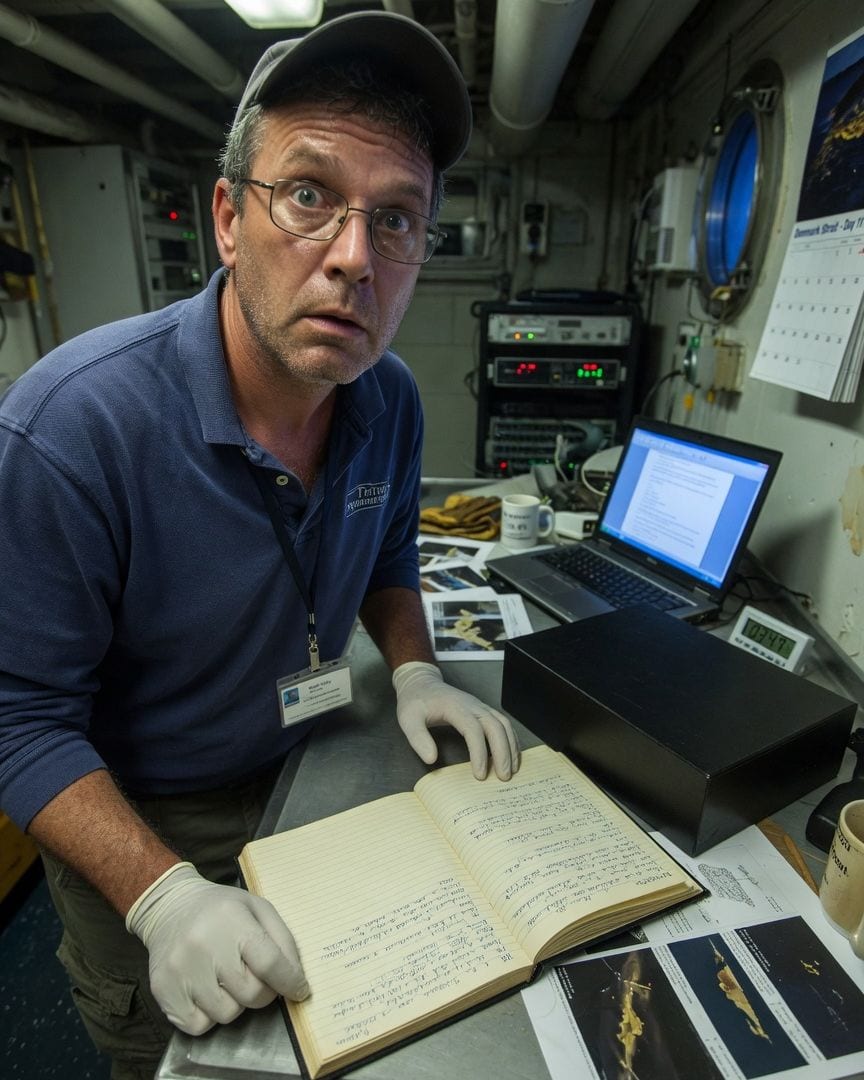
A hydrographer found a lost Cold War submarine from 1968. Inside, its logbook carried entries dated '12.03.2012'.
Hydrographer Wells Duffy had spent eleven days in the *Triton*'s control room, guiding the deep-sea submersible through the crushing dark of the Denmark Strait, chasing a phantom sonar signature. When the USS *Gale Prescott*, lost with all hands in 1968, finally resolved on his monitors, triumph turned to unease as he saw its escape hatch stood simply ajar. The hatch rim and ladder rungs were eerily clean and worn bright, used repeatedly long after the ocean claimed the vessel, prompting Captain Crane to authorize an unauthorized dive. Inside the frigid wreck, Wells discovered a non-Navy container, strangely warm, holding a logbook whose precise entries continued across the decades, ending in the impossible date of '12.03.2012'.
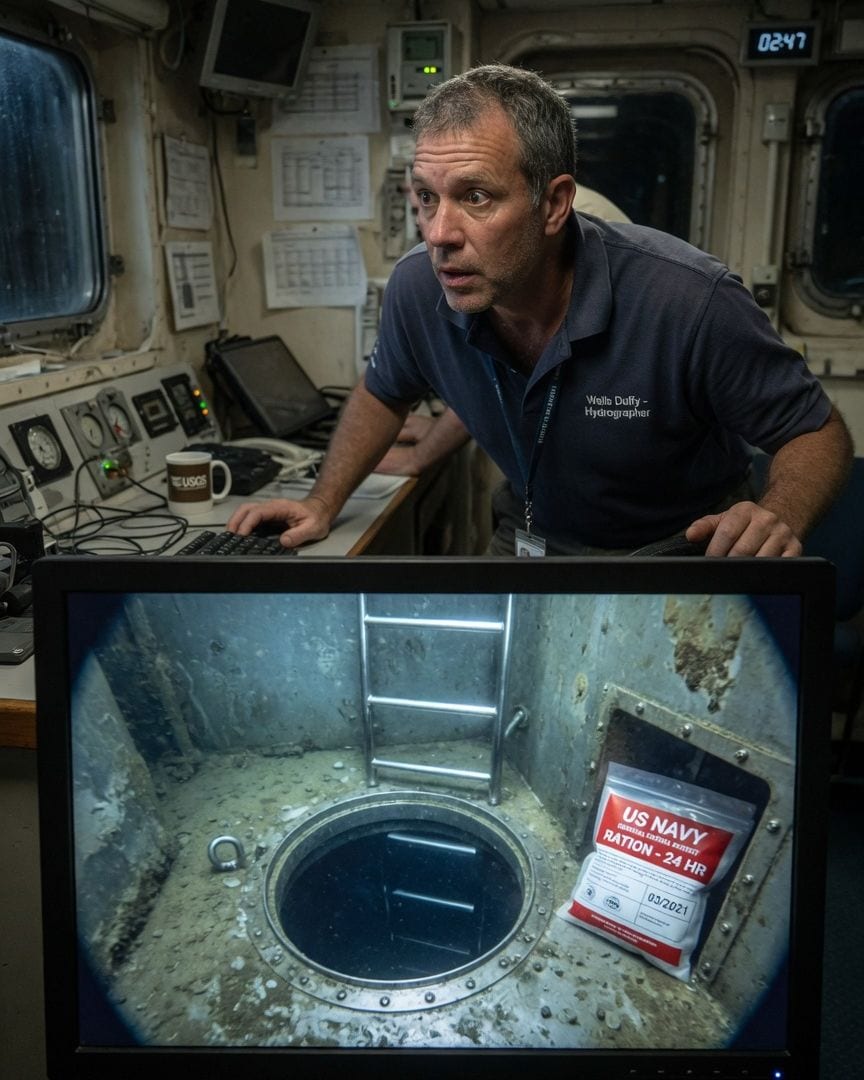
On his final mission, Hydrographer Duffy found a Cold War submarine lost in 1968. Inside, a survival pack bore a crisp date: just three years ago.
Hydrographer Wells Duffy embarked on his final deep-sea mission, hoping to justify his career one last time before a desk transfer. Eleven days in, his vessel, The Seeker, located the USS Gale Prescott, lost with 71 souls in 1968, resting upright in a deep trench. As ROV cameras descended, the submarine's escape trunk hatch stood unnervingly open, its internal ladder rungs polished smooth from recent, bi-directional use. Inside the pressure hull, surprisingly clear of decay, the ROV found a sealed survival ration pack, its packaging crisp and vibrant, stamped with an impossible date: 03/2021. How could a modern supply pack appear inside a vessel lost over half a century ago, deep beneath the Denmark Strait?
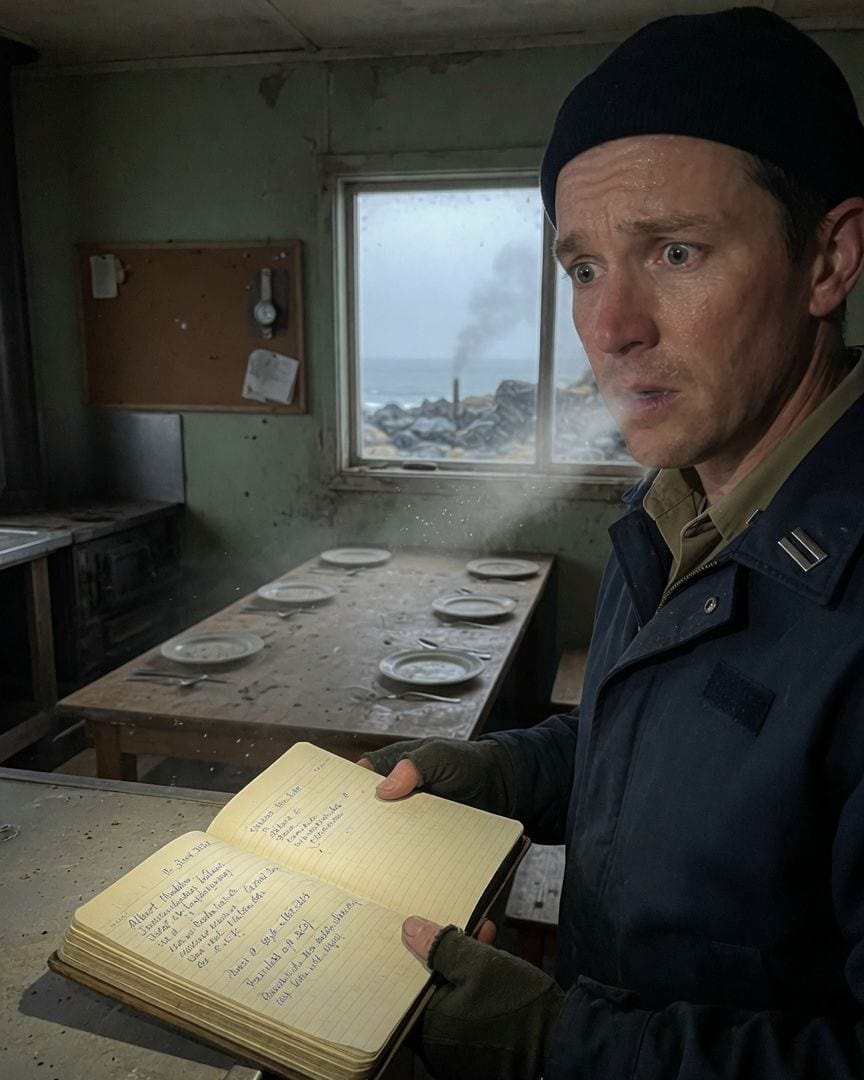
Coast Guard Lieutenant Thatcher finds an old crew photo dated today, June 15, 2024.
Lieutenant Daniel Thatcher leads a survey crew to a derelict LORAN station in the frigid Aleutians, officially abandoned for over a decade. But as they enter, a heavy-bound station log lies open on a counter, its ink startlingly wet, detailing a routine watch from today with names unknown to the Coast Guard.
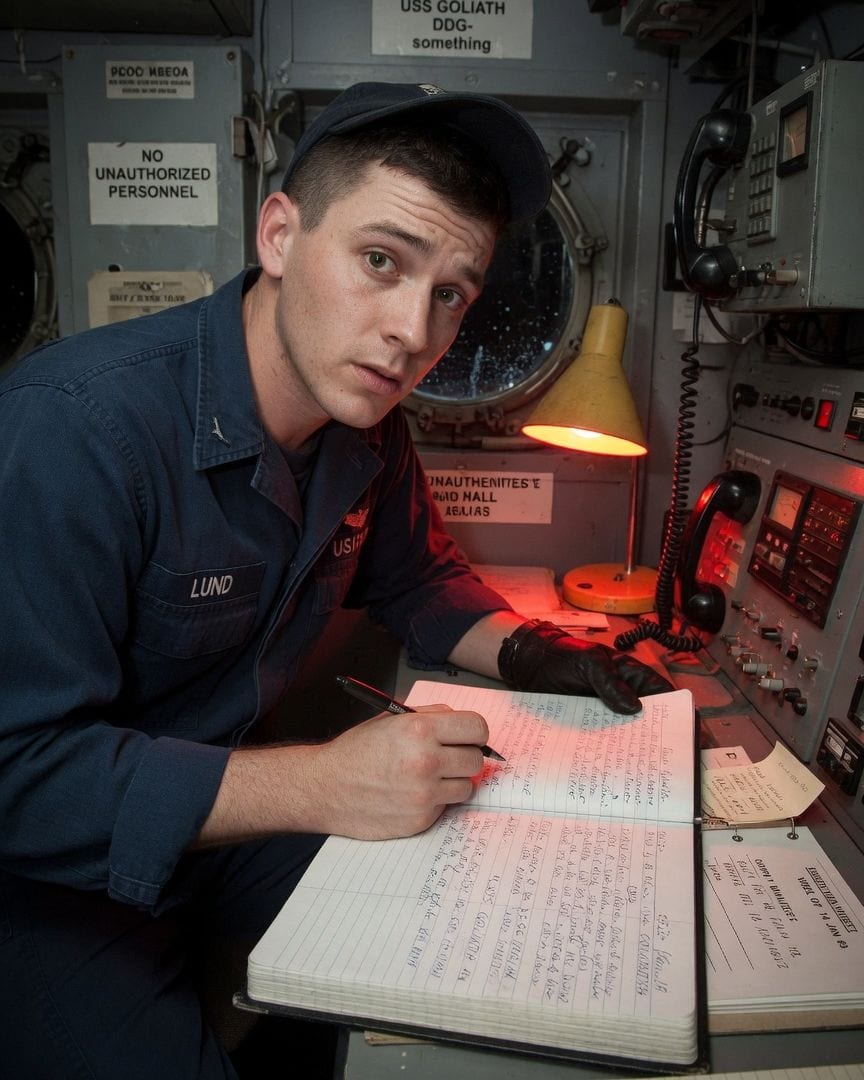
Petty Officer Lund heard his own captain's mayday: the Cold War USS Goliath was sinking, two hundred miles astern.
Petty Officer Marco Lund kept a lonely vigil in the USS Goliath's radio room, the destroyer battling the North Atlantic in deep winter 1983. Suddenly, a garbled mayday broke through: his own ship, his own captain, reporting they were going down two hundred miles astern. Though the bridge confirmed the Goliath was fine, the same chilling call came again an hour later, stronger and from the exact waters they had just crossed. Deeply unsettled, Marco began searching ship logs, eventually discovering a phantom entry: an identical mayday, logged a week prior, pressed into the very paper beneath his own.
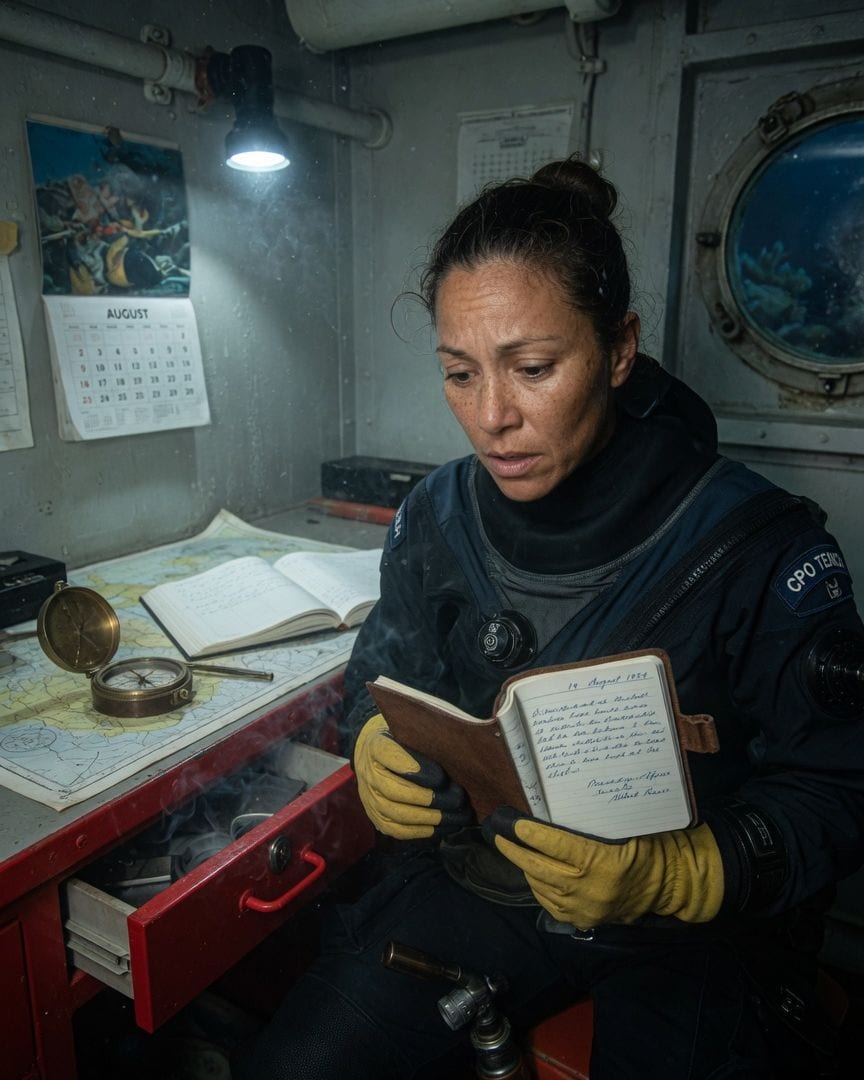
A deep-sea diver found a Cold War target ship's logbook dated months after it was vaporized in 1954.
Chief Petty Officer Marlo Tench, a methodical deep-sea diver, stared in disbelief at the ROV feed. Her team watched with her as the USS Triton, a target ship from the 1954 Castle Bravo nuclear test, appeared pristine and upright ninety feet below. It was supposed to have been vaporized, yet its hull number was unmistakable, its paint unburned, and its internal systems inexplicably active. Descending into the eerie silence, Marlo found a logbook dated five months after the ship’s destruction, and a journal entry naming a crewman officially listed as 'unmanned target.' What impossible force kept the Triton a living ghost decades after its fiery end?
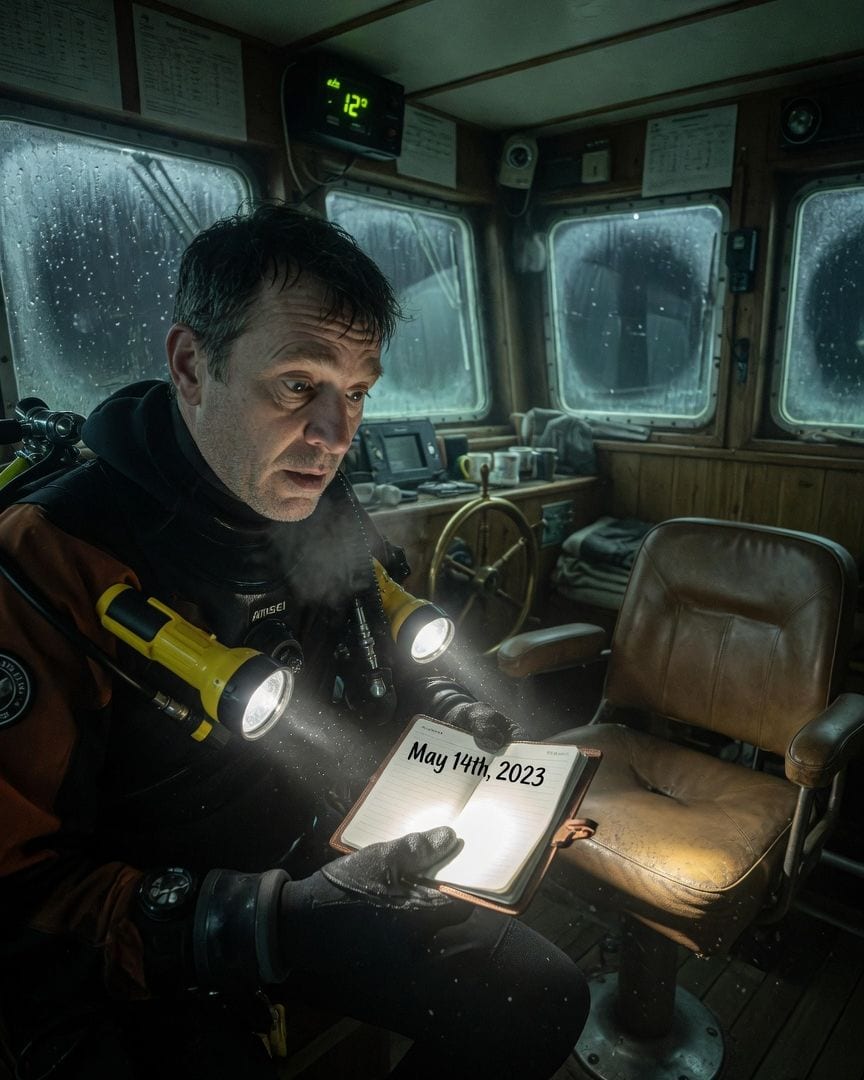
A dive supervisor exploring a Cold War sealer found its logbook on a wheelhouse shelf, with an entry dated this morning.
Dive supervisor Hugo Amsel felt the familiar cold of the Bering Sea as his submersible approached the 'Wynn Portal,' a sealer vanished without a trace in 1991. The wreck sat eerily intact, its wheelhouse windows impossibly clear, and the helm locked hard to starboard. But then the rudder angle indicator twitched, moving two degrees, a ghost still at the wheel. After breaching the sealed hull, Hugo and his lead diver found the ship's interior pristine, frozen in time. In the wheelhouse, on a shelf next to the chart table, lay the logbook. Its final entry, written in Captain Larsen’s hand, was dated 'May 14th, 2023' – today. The ink was still unsettlingly fresh, leaving Hugo to stare at the impossible date and the empty captain's chair.