On his last night before the Coast Guard station closed, Corporal Granger heard a dead radio crackle with a Cold War convoy report for tonight – then found his own handwriting in a logbook that was decades old.
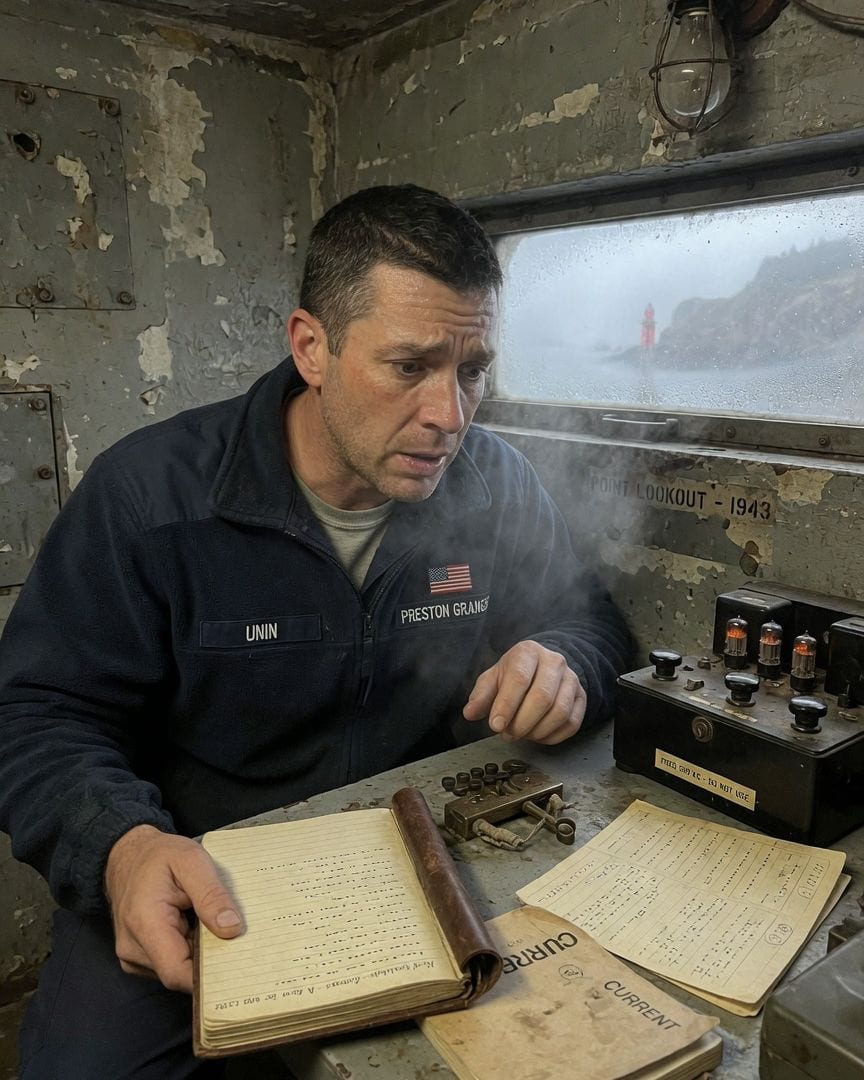
Corporal Preston Granger sat hunched in the damp, salt-scented silence of the old WWII bunker at Coast Guard Station Point Lookout. The fog outside was a smothering blanket against the New England cliffs, muffling the world.
It was his last night here, the station’s final shift before it was permanently mothballed.
The only sound was the distant, rhythmic boom of the sea against the rocks, until a faint, impossibly clean burst of Morse crackled over the antique relay set.
He hadn't touched the dial in hours; the frequency had been dead for decades.
It was a convoy sighting report, sent in a precise, almost mechanical wartime fist, for a shipping lane that hadn't seen a merchant vessel in forty years. The dread was a cold, hard knot in Preston’s stomach, a physical thing.
He stared at the ancient brass key, now vibrating with the phantom signal, his hand hovering, not daring to touch it. He tried to rationalize it – a stray harmonic, atmospheric interference, anything but what his gut screamed.
The signal came again, insistent, then cut clean. The silence rushed back in, but now it felt different, sharpened, waiting.
Preston fumbled for his modern cipher books, trying to find an explanation, a known code, anything to ground the impossible signal in the here and now.
He flipped through the pages, but nothing matched the archaic rhythm, the specific character of the code. He then remembered the station's dusty archive of WWII-era keys, tucked away in a locked, forgotten cabinet near the generator.
The metal grate squealed as he pulled it open, sending a shudder through the damp concrete walls. Deep within, behind stacks of rusted spare parts and defunct vacuum tubes, he found a brittle, yellowed sheet.
The cipher laid out on it was old, yet somehow familiar.
His fingers, trembling slightly, tapped out the decryption. The message was stark, each word forming in his mind with chilling clarity: 'CONVOY SIGHTED. GRID 4-B. ACKNOWLEDGE AND HOLD POSITION. POINT LOOKOUT. OCT 27.' His breath hitched, catching in his throat.
Oct 27. Tonight's date. He knew the grid. It was the exact coordinates of the station itself, his location.
The final instruction, 'Acknowledge and hold position — no matter what he heard on the line,' echoed in the bunker's oppressive silence, clinging to the damp air.
Preston tried to dismiss it as a prank, a bizarre coincidence, a stray signal bouncing off the ionosphere, but the precision, the current date, the specific station reference, felt too intentional, too personal.
He ran a systems check, tracing the wiring, confirming the frequency was indeed long-dead, the equipment isolated from any modern network. No one else was on duty.
He was alone with the impossible message, the taste of salt and something metallic on his tongue. The old gear hummed, a low, expectant thrum against the rising clamor in his head.
He scoured the bunker for any explanation, anything to ground the impossible, to prove it was a joke, a glitch, anything but what it seemed to be.
Behind a rusty panel, tucked into a forgotten crevice where decades of dust had settled undisturbed, he found it: a small, leather-bound logbook, unmarked and unofficial. It felt cold in his hands, heavy with secrets. He flipped it open.
The pages were filled with careful, looping script, all in Morse code transcription. He recognized the distinctive, almost mechanical 'fist' from the intercepted signal.
Each entry was dated October 27th, spanning back decades, detailing identical 'convoy sightings' and the chilling instruction to 'Acknowledge and Hold Position.' He found an entry for October 27th, 1983, signed 'D. Mercer.'
His eyes dropped to the line directly below it, a line that had no right to exist. Dated 'October 27th, 2023.' And beneath it, in his own unmistakable handwriting, the words 'P. Granger – Acknowledge. Hold Position.'
The logbook felt like a lead weight, pressing down on Preston’s chest. He stared at his own signature, a perfect forgery, or something far, far worse.
He knew he hadn't written it, had only just received the signal moments ago, yet there it was, an irrefutable record of an act he hadn't committed.
He tried calling his relief, tried to break through the sudden, suffocating isolation, but the fog was playing havoc with the landlines, reducing them to static, and his cell had no signal.
Trapped in the bunker, the air grew thick with unspoken questions.
He grabbed the logbook, the cold leather a constant reminder, and drove the station's beat-up utility vehicle into the nearest town, a tiny fishing village clinging precariously to the coast, desperate for a living voice, a logical mind.
He sought out Nathaniel Kowalski, a retired petty officer now volunteering at the local historical society, known for his encyclopedic knowledge of coastal defense and an uncanny memory for local lore.
Kowalski, a man with a perpetually furrowed brow and a scent of old paper and pipe tobacco, looked up from a stack of faded nautical charts.
Preston showed him the logbook, carefully omitting the impossible 2023 entry for now, focusing on the older, recurring dates.
Kowalski’s brow furrowed further as he recognized the distinct Morse fist, identifying it immediately as belonging to a Daphne Mercer, an operator from the early 80s.
"Sharp as a tack, that one," Kowalski mumbled, tracing the script with a gnarled finger, "but she just… vanished one night. They said she transferred, but no one ever heard from her again.
Her records were a mess after that, incomplete, contradictory." Preston pressed him about the Oct 27th entries, the repeated warnings. Kowalski shrugged, "Always been a lot of strange reports from Point Lookout on that date.
Locals call it 'Ghost Convoy Night'. Just old wives' tales, probably. The sea plays tricks on the mind out there." He offered a weak smile, but his eyes held a flicker of something older, something less dismissive.
As Preston left Kowalski’s cluttered office, a chill that wasn't just the coastal air settled over him. He felt watched, a prickling sensation on the back of his neck.
Back at the station, the old relay equipment, which he'd left powered down, hummed faintly, a low, resonant vibration that seemed to emanate from the very floor.
The Morse key on the table tapped once, a soft, deliberate click, though nothing was connected, no signal incoming, the frequency dial stubbornly on 'dead'.
He spun around, but the bunker was empty, the only movement the slow drift of dust motes in the dim overhead light. He checked the perimeter, sweeping his flashlight beam across the damp sand outside the wire fence.
No footprints, no sign of intrusion.
He returned to the logbook, examining the 'D. Mercer' entry again, desperate for a tangible clue, something that wasn't a phantom.
A tiny, almost imperceptible detail caught his eye: a faint indent on the page, as if something had been pressed hard against it before the ink had dried completely.
He held it to the light, then, on an impulse, rubbed a pencil lead gently over the area. A series of dots and dashes emerged, too faint to be ink, too precise to be random.
He quickly transcribed it, his breath catching with each character: 'YOU ARE ALREADY HERE.' The message was not from the past, not from Daphne Mercer.
It was for him, now, echoing the exact words of the original instruction, an insidious confirmation. The air grew heavy, thick with the scent of ozone and salt. The silence pressing in wasn’t just empty; it felt purposeful.
He wasn't just investigating a historical anomaly; he was being observed, and whatever was behind the signal knew he was digging. The chair he sat in groaned beneath him, a sound like an old sigh.
Preston’s heart hammered a frantic rhythm against his ribs. He raced back to Kowalski’s office, the unofficial logbook clutched tight in his hand, a lifeline and a burden.
He laid out everything: the 2023 entry with his impossible signature, the deciphered 'YOU ARE ALREADY HERE' message. Kowalski listened, his face paling, the folksy demeanor replaced by a grim resignation that deepened the lines around his eyes.
"I knew it," he whispered, his voice barely audible above the hum of the old fluorescent lights. "Point Lookout… it’s a hungry place."
He explained that the station had a reputation, not just for ghost convoys, but for operators who simply 'integrated.' "They’d disappear, vanish without a trace," Kowalski said, his gaze distant, "but their records… they’d keep running. Commendations, transfers, even promotions.
All signed, sealed, official. But no one ever saw them again. Just paperwork that swore they were still out there, serving."
Kowalski led Preston to a back room, a cavern of overflowing file cabinets and forgotten histories, pulling out a dusty file marked 'Point Lookout Anomalies.'
It contained fragmented reports, internal memos about 'clerical errors,' and a chilling pattern of operators assigned to the station specifically on October 27th who later had 'unaccounted for' service histories.
He showed Preston a faded photograph, barely visible through its yellowed plastic sleeve: a young Daphne Mercer, smiling, standing by the very relay equipment in the bunker Preston had just left. The picture was dated 1983.
"She was supposed to be transferred to Guantanamo Bay in '84," Kowalski said, his voice flat, "but the manifests for her arrival never materialized.
Yet, her service record shows her serving there for another ten years, signing off on reports, even receiving a medal for a hurricane relief effort she couldn’t possibly have been part of."
The implications crashed over Preston with the force of a rogue wave. The system wasn't failing; it was being used.
The records weren't just wrong; they were fabricated, a ghost limb of a service member still performing duties long after they were gone, their presence recorded by an unseen hand. The horror was in the sheer, bureaucratic precision of it.
The official archives, housed in a sterile government building an hour inland, were a maze of gray filing cabinets, paper, and microfiche.
Preston, desperate for solid, verifiable proof, requested Daphne Mercer's full service record, then cross-referenced it with every operator ever assigned to Point Lookout on an October 27th.
The pattern of falsified records was undeniable, a cold, hard line connecting dozens of impossible careers. But then, a new file appeared, seemingly out of place among the others he’d requested. His own. Corporal Preston Granger.
He pulled it, his hands shaking, the polished metal of the cabinet cold against his fingertips. It contained his enlistment papers, his training records, his deployments—all correct, all leading him here.
Until he reached a commendation. 'For exceptional vigilance and maintaining secure communications during severe atmospheric interference at Station Point Lookout, October 27th, 1999.' His eyes darted to the date. Nineteen ninety-nine. The year he was born.
He was an infant then, still years away from even understanding the concept of a uniform. He scrolled down, past the formal citation, past the commanding officer's signature, to the recipient's signature. It was his own.
His precise, unmistakable signature, the looping 'P' and sharp 'G' exactly as he’d signed countless forms, affirming his presence, his service, his vigilance at this very station, on a night he could not have possibly existed in uniform.
His vision blurred as he traced the faded ink. His own past had been rewritten, his life hijacked before it had even begun.
A cold dread settled that he had always been here, that his journey to this decommissioned bunker was not a random assignment but a predetermined path.
Preston stumbled back to the bunker, the official record clutched in his hand, the chilling realization solidifying in his mind with every step.
The station wasn't just receiving signals; it was a nexus, a point of continuous contact, and the operators were the conduits. The 'Acknowledge and Hold Position' command wasn't a request; it was an activation.
The entity didn't just lure; it assimilated. The operators became extensions of the station itself, their continued 'service' maintaining the signal.
His presence on October 27th, 1999, as an infant, was the entity's claim, a pre-emptive integration, marking him as its own.
The logbook entry for 2023, signed with his hand, was not a forgery but a future Preston, already part of the station, sending the confirmation signal back through time.
The 'convoy sighting' was a lie, a constant, recurring lure, a bait-and-switch for a far more insidious purpose.
The station itself was alive, or something within it was, and it needed a continuous chain of 'operators' to sustain itself, to keep transmitting the phantom signal across the dead frequency, endlessly.
Every 'clerical error,' every 'missing' operator, every impossible record, snapped into place with a terrifying click. They weren't missing; they were still here, functioning as part of the system, their identities absorbed, their lives rewritten by the phantom station itself.
He was simply the latest link in a chain that stretched back decades, perhaps centuries.
Back in the bunker, the old radio set crackled to life. It was not with Morse, but with a faint, guttural whisper that seemed to come from the very walls, from the damp, cold concrete, seeping from the air itself.
It was not a language, but a sound of immense, patient hunger, a deep, resonant hum that vibrated the worn chair he stood by.
Preston felt a profound chill that pierced to his bones, a cold that seeped into his marrow. He knew what he had to do. The knowledge was not a thought but an instinct, a pre-programmed certainty.
He reached for the Morse key, his hand moving with a terrible, preordained certainty. He had to acknowledge. He had to hold his position.
He could feel the station's will, a cold, vast intelligence, seeping into his mind, guiding his fingers, pulling him toward the key like a magnet.
He tried to fight it, to pull away, to scream, but the chair seemed to grip him, the air growing heavy, thick like the fog outside, pressing against his lungs.
He could feel his own thoughts, his memories, beginning to fray at the edges, dissolving into the static hum of the relay equipment. He was becoming the signal. He was becoming the station.
His fingers hovered over the key, then, with a terrible, slow inevitability, they began to tap. Dot-dot-dash. Acknowledge. Dot-dash-dot-dot. Hold Position.
The whisper intensified, growing into a low, satisfied hum that vibrated through the floorboards and up into his very bones, a sound of ancient satisfaction. He was no longer Preston Granger, Corporal, US Coast Guard. He was the next one.
The next operator in the endless chain. He was the station.
The next morning, the relief crew arrived at Point Lookout, their headlights cutting through the lingering fog as they pulled up to the abandoned station. The place was silent, eerily so.
The bunker door was ajar, swinging faintly in the coastal breeze. Inside, the old radio equipment was humming, a low, steady thrum, the Morse key still. Corporal Preston Granger was gone.
His gear was neatly stowed, his bed made, his personal effects packed in his duffel bag, as if he had simply completed his shift and walked away. The unofficial logbook was nowhere to be found.
His official service record, however, had been updated overnight. It now contained an entry for 'October 27th, 2023: Corporal Preston Granger, transferred to classified deep-sea acoustic monitoring assignment. Commended for exceptional vigilance.'
Weeks later, Nathaniel Kowalski, sorting through newly digitized Coast Guard records for his historical society, paused. An old, familiar signal, a ghost of a frequency, had just pinged on his computer, catching his attention.
It was a convoy sighting report, crisp and clean. He looked at the originating station: Point Lookout. And the operator's call sign. He shook his head, muttering, "They said that place was mothballed." The system, as always, swore otherwise.
On October 27th of the following year, a faint burst of Morse code, sent in an impossibly clean fist, crackled over a long-dead frequency from the decommissioned station at Point Lookout.
It was a convoy sighting report, acknowledged by the call sign 'P. Granger', instructing the unseen recipient to hold position, no matter what they heard on the line.
If this one got to you
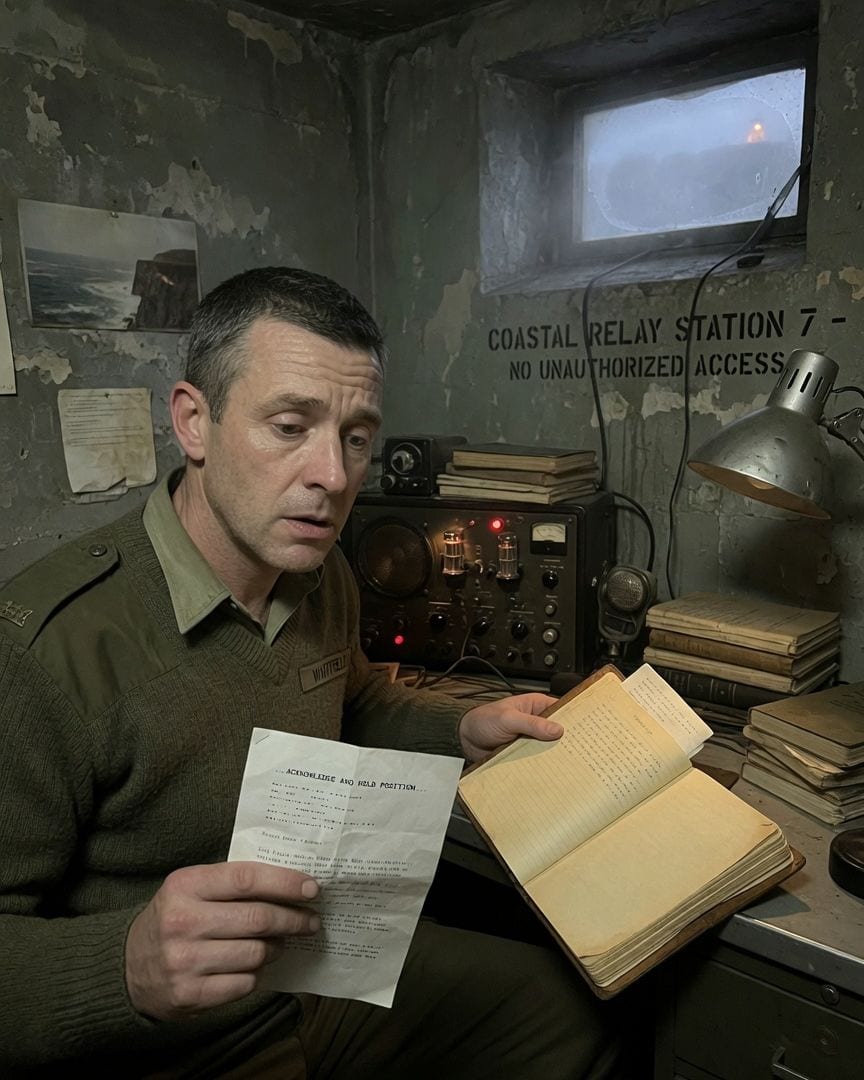
A corporal on his last watch decoded a Morse order for his station. It was sent forty years ago, for *this* very night.
Corporal Greg Whitfield stood watch on one of the final nights before his old coastal relay station was mothballed. The fog-bound English coast echoed with the lonely boom of the sea, the bunker's ancient equipment humming its last familiar tune. Suddenly, a burst of Morse code cut through the static on a long-dead frequency, an impossible convoy sighting for a shipping lane closed for forty years. Decrypted, the message named his exact station and tonight's date, instructing the operator to acknowledge and hold position, no matter what. Later, a dusty archive revealed a logbook entry from precisely forty years ago, recording the same message, acknowledged by a Private Barlow, followed by a chilling blank page. What happened to the last operator who acknowledged a forty-year-old ghost order?
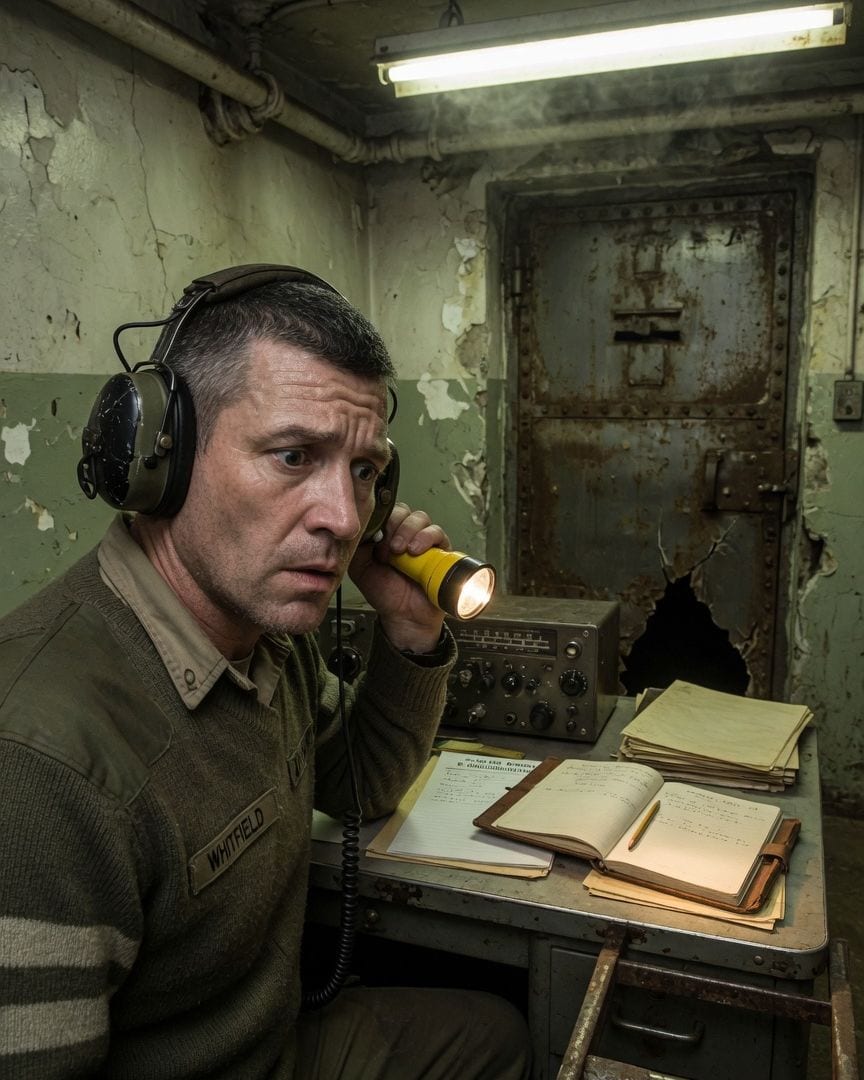
A corporal on his last watch picks up live Morse code from a shipping lane dead forty years. Then, tapping starts inside his sealed bunker.
Corporal Quentin Whitfield stood his last watch in the old coastal bunker, the facility winding down for good as thick fog muffled the sea below. His final sweep of archaic comms gear became anything but routine when a long-dead frequency crackled with live Morse code, a precise wartime transmission for a shipping lane unused in forty years. He decrypted the impossible message, a convoy sighting for his own bunker dated today, complete with an unsettling instruction: 'DO NOT RESPOND TO IRREGULARITIES ON LINE.' As if on cue, a faint, rhythmic tapping began from the bunker's sealed lower levels, growing louder behind a heavily rusted door with a fresh, ragged crack. A darker-than-dark outline pulled back from the opening as his light hit it, leaving only impenetrable blackness beyond.
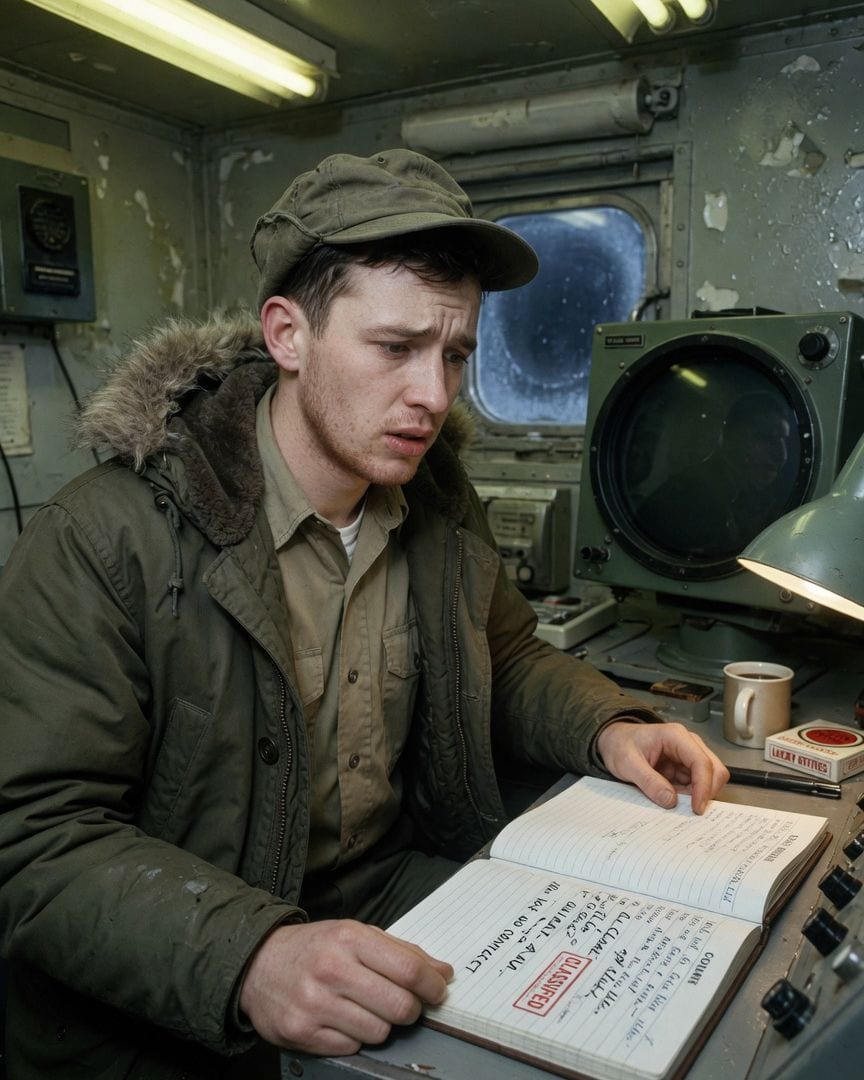
A Cold War airman logs an impossible radar contact on his last sweep. But his official logbook entry is stamped 'CLASSIFIED' and then contradicted by a hastily scrawled 'ALL CLEAR' dated moments before it.
Airman Ordway Vance, 22, manned the radar dome at Site Pellin in the biting North Atlantic dark of January 1962, running the last calibration sweep before its decommissioning. His scope picked up a faint, impossible return, growing closer with each pass, though the ocean remained empty to the eye. When Vance detailed the contact in his official logbook, a 'CLASSIFIED' stamp appeared, followed by a hastily scrawled 'ALL CLEAR' dated moments before his own entry, contradicting his every word. Commander Hartley dismissed it as equipment malfunction, but Vance sensed a chilling, official erasure behind the lie. He soon found a locked cabinet marked 'SITE PELLIN ANOMALIES,' hinting at a deeper truth buried within the base's final days.
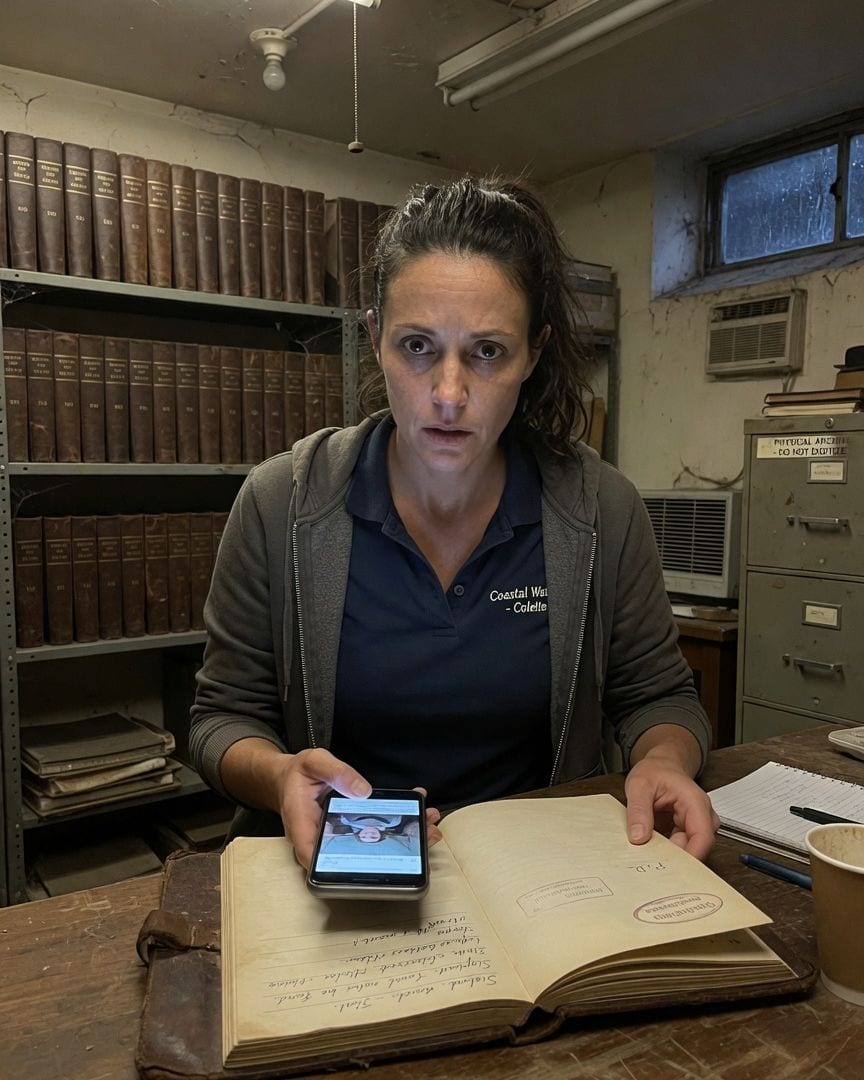
My coastguard log noted Sighting 9 again tonight, a light where no vessel showed. The old logs carry Sighting 9 off Skerry Point at 3:14am every tenth year since 1954, always 'nothing found,' always 'send no boat.'
On my watchtower night shift, the radar screen glowed green and the ocean was quiet. Then, a familiar light appeared off Skerry Point, exactly on cue, just as it had every tenth year for decades. But digging deeper, I found a hidden stamp in an old logbook: 'Operation Skerry. Status: Complete.' It left me with a chilling sense of finality.
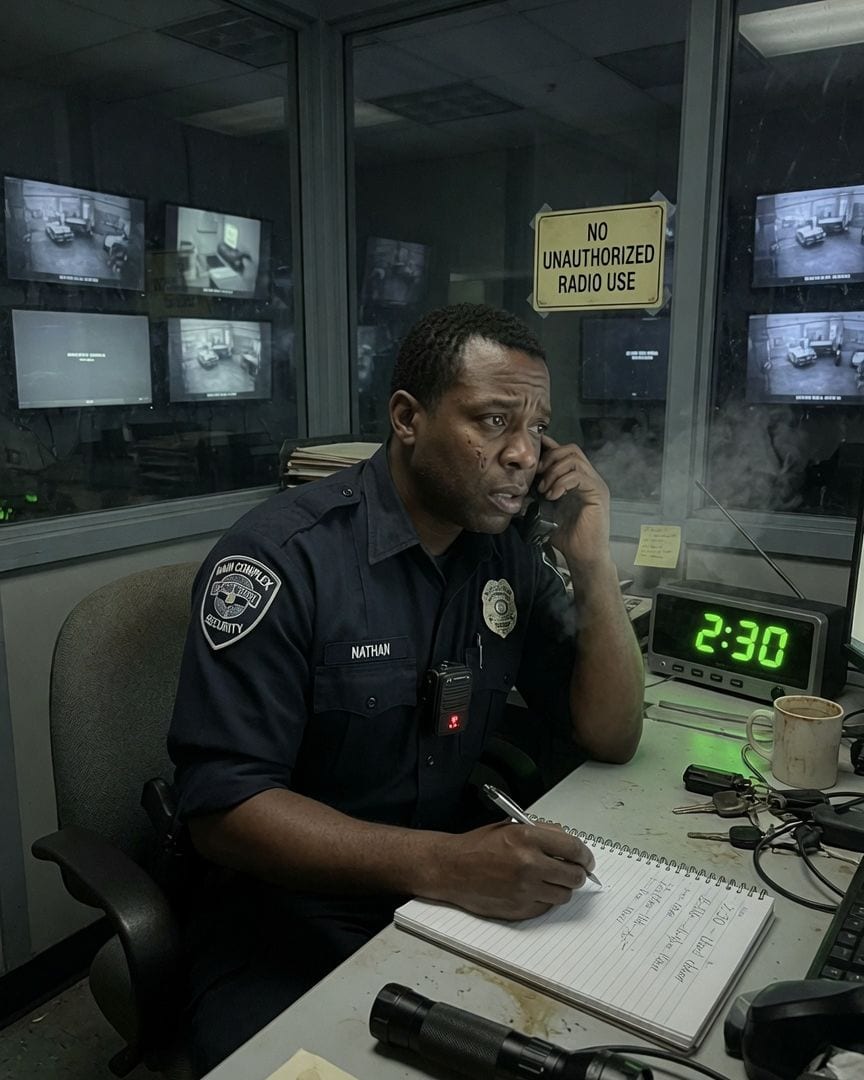
I radio Cole every night. My supervisor says his dock post was cut two years ago, and no Cole exists. But I just found Cole’s old logbook.
My graveyard shift usually consists of monotonous hourly check-ins with Cole, the guard at the loading dock. But my supervisor just revealed that the dock post was cut two years ago, and no one named Cole has ever worked for the company. I've been talking to someone who simply isn't there.
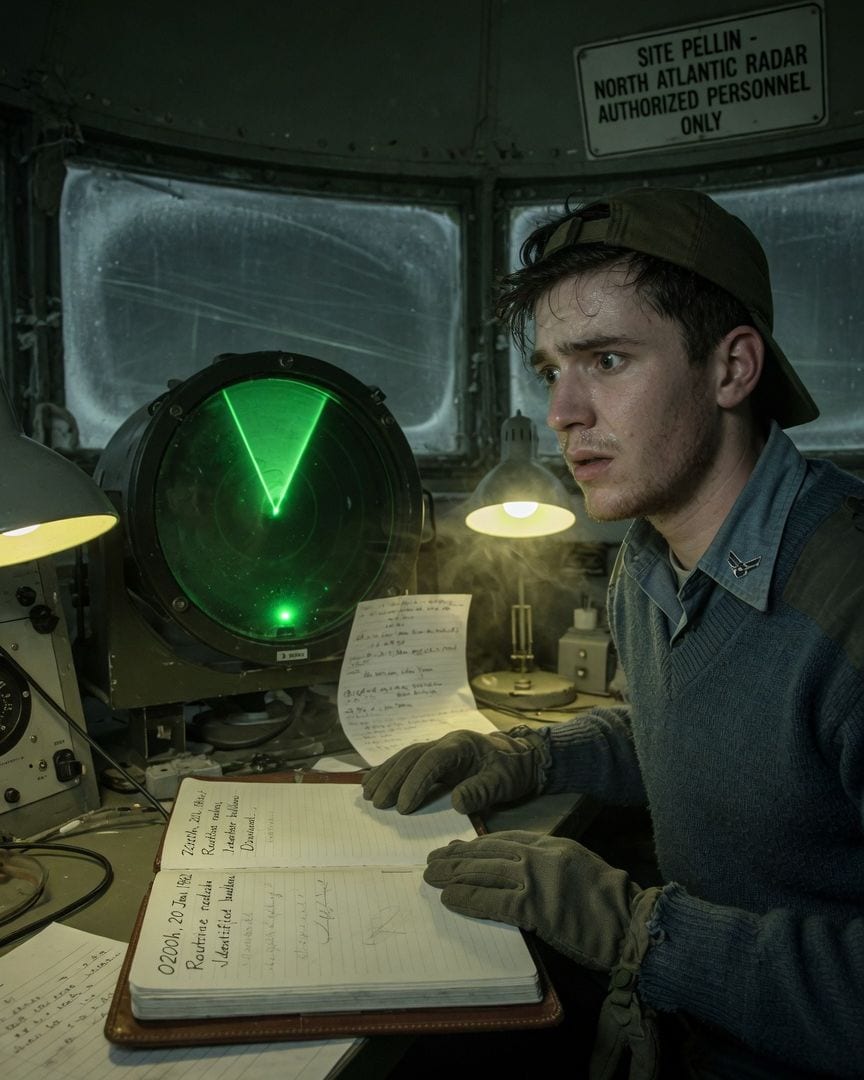
Nine days from closing, Cold War Site Pellin's Airman Vance watched his radar track a solid blip moving closer, dead in open sea where nothing could exist.
In the dimly lit dome of Site Pellin, Airman Ordway Vance, just days from discharge, ran his final radar sweeps before the base closed for good. Outside, the North Atlantic wind howled, but inside, only the hum of his console broke the silence. His last calibration had been clean, yet a single, unwavering green blip appeared on the scope, forty miles out, in open water where no vessel should be. The impossible return moved closer with each sweep, defying all logic and other sensors, until it sat static just beyond the coast fence line. What unseen presence did the radar truly hold in its unwavering green grip, contradicting the official record?