A meticulous Cold War records clerk finds a printing press deep in his vault making blank forms. One file holds his own name, dated tomorrow.
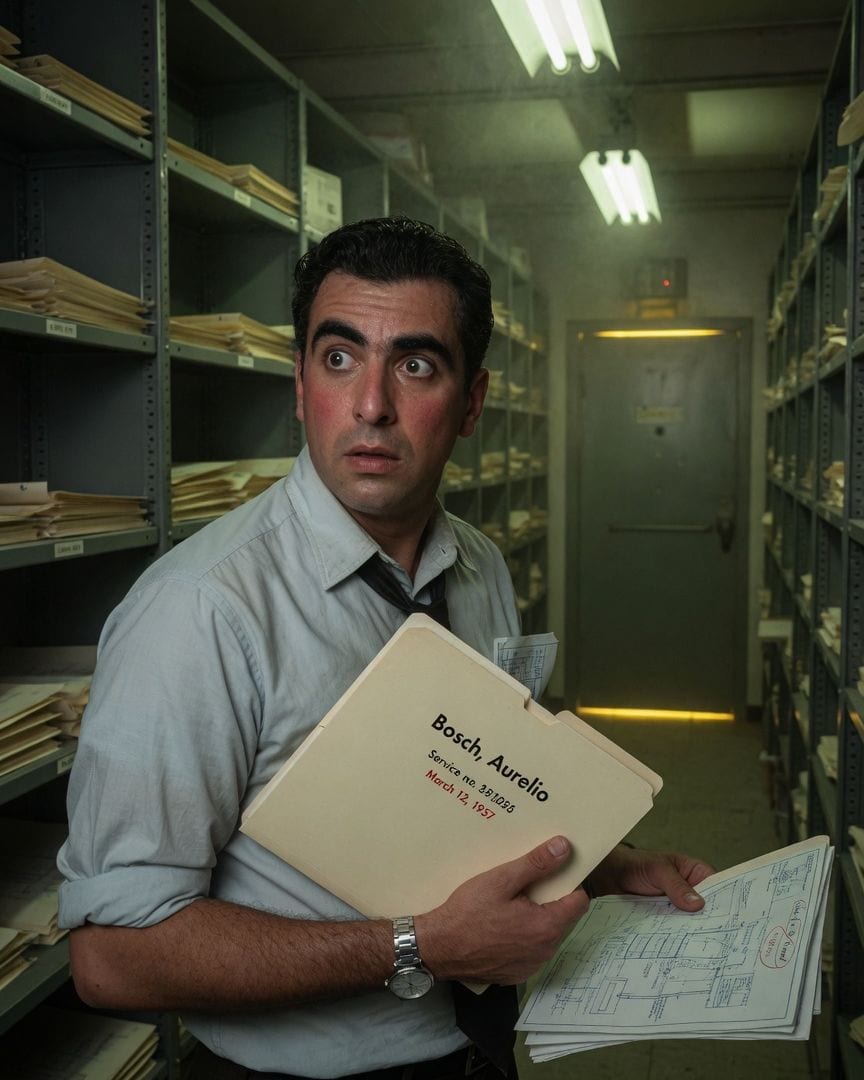
The Cheyenne records vault hummed with the steady thrum of ancient ventilation in the winter of 1957. Aurelio Bosch, 32, a meticulous night-shift clerk, worked his way down Aisle 3.
The fluorescent lights flickered overhead, casting long, dancing shadows over the towering shelves. His job was simple: compare physical files to the digital manifest, ensuring every document was accounted for, every record in its place.
He preferred the quiet solitude of the graveyard shift, the way the vast archive felt like a sleeping giant, holding untold histories in its dusty embrace.
He reached the last shelf listed on his manifest for Aisle 3, a specific section of tax forms from the early forties. But the aisle didn't end.
The steel shelving continued, stretching into a space the vault's blueprints clearly stated was only thirty feet deep. This extension, a silent, impossible ten feet, was lined with more shelves, fully loaded with dusty, unlabeled boxes.
Aurelio paused, his breath fogging slightly in the cool air, a small frown creasing his brow. At the very end of this unlisted stretch, a heavy, unadorned door stood, unlisted on any schematic he’d ever seen.
From under its threshold, a faint, steady light glowed, a thin sliver of yellow cutting through the dimness.
A low, rhythmic hum, like a printing press, vibrated through the still air of the vault, a deep pulse beneath the everyday drone.
Aurelio’s rational mind scrambled for an explanation. He pulled out his worn, dog-eared copy of the vault’s architectural plans, the crisp blueprints Sophia Harrington, the retired vault manager, had given him when he started.
His finger traced Aisle 3, confirming the thirty-foot measurement, the solid block wall indicating the vault’s outer boundary.
He cross-referenced the maintenance logs for the past decade, looking for any record of an expansion project, a forgotten storage area, or even an unapproved structural alteration. Nothing.
The logs detailed every bulb change, every shelf repair, but remained silent on the impossible ten feet of vault that now stood before him.
The rhythmic hum persisted, a quiet insistence that pulled at his attention, drawing him closer to the unlisted door. It was heavy, steel-plated, but to his surprise, the handle turned with a soft click, unlocked. He pushed it open slowly.
The door swung inward, revealing a short, unlit corridor that led into a small, brightly lit room. Inside, bathed in the stark glow of an industrial lamp, a late-model printing press churned, its rollers turning silently, rhythmically.
It was far newer, far more advanced than anything else in the antiquated vault. It spun out reams of blank, official-looking forms, the paper a crisp white.
The air in the room was warm, thick with the chemical tang of fresh ink and the sharp, clean smell of ozone.
On a plain metal desk, beside a stack of the blank forms, lay a single, distinct file, not yet filed, its cover stark against the cool steel.
He could make out an official service number printed clearly on it, stark black against the cream cardstock.
Aurelio’s heart thudded against his ribs, a frantic counterpoint to the press’s quiet efficiency. He picked up the file, his fingers brushing the still-warm paper. The cover felt too new, too real, almost alive in his hand.
He turned it over, the hum of the press a steady pulse in the otherwise silent room. His eyes fixed on the details printed on the cover. He read the service number again, then the name: 'Bosch, Aurelio.'
His own name. His own service number. Below it, a date. He checked his watch, then back at the file. The date on the file was for tomorrow.
The file itself was otherwise empty, a pristine, official document awaiting its contents.
Shaken, Aurelio mechanically filed the blank document. He walked it back to its designated spot on a shelf in Aisle 3, placing it amidst the meticulously organized tax forms as if it were any other piece of routine paperwork.
But the image of his name, his date, on a blank file gnawed at him. He couldn't shake the unnerving sense of wrongness. Over the next few shifts, the routine comfort of the vault dissolved.
He started cross-referencing, subtly altering his manifest checks. He searched for other blank files with future dates, not just in his section, but across different classifications, digging into the vault’s archaic card catalog system, rifling through yellowed index cards.
He found a pattern: scattered across decades, under various 'declassified' banners, were dozens of similar blank files. Each was for a different vault employee, each bore a future date.
Some of these employees he vaguely remembered, faces from old staff photos, others were names from long before his time – all disappeared from the vault's active roster shortly after their assigned 'date.'
He tried to access the original, more detailed vault blueprints, the ones that pre-date the 'official' expansion, but his access codes were mysteriously denied.
When he asked his supervisor, a placid woman named Mrs. Gable, she merely blinked, telling him the old blueprints were 'misplaced during a reclassification audit years ago, dear. Nothing to worry about.'
He felt a cold knot tightening in his stomach, the mundane explanations failing one by one.
A week later, a man named Marcus Winslow, 45, a 'records integrity officer,' appeared unannounced during Aurelio's shift. Marcus was impeccably dressed in a dark suit, his movements fluid and precise. His eyes, a pale, unnervingly still blue, met Aurelio’s.
He asked Aurelio about his recent unusual search queries—the old blueprints, the cross-referencing of staff files, the unauthorized entries into the 'declassified' sections. 'Just a spot of personal research, Mr. Bosch?'
Marcus asked, his voice smooth, devoid of accusation, yet heavy with implication. He leaned against a tall metal cabinet, not quite casual, his presence filling the aisle.
He began to speak of the 'importance of maintaining proper protocols' and the 'sensitivity of certain classified materials.'
He advised Aurelio to 'stick to his assigned duties' and reminded him that 'unauthorized access to certain data streams can lead to severe disciplinary action, or worse.'
The conversation was quiet, polite, almost pleasant, but Aurelio felt the weight of unseen eyes on him, the distinct sense of being watched, his every unusual action logged and reported.
The air grew colder around Marcus, like a draft from a door no one else saw. He realized his digging had been noticed, and the threat was no longer theoretical.
Marcus Winslow’s visit crystallized Aurelio’s dread. The files weren't just empty; they were pre-filed, waiting for their subjects to fulfill their pre-ordained roles.
He remembered a faint, almost mythical story among the older clerks about a 'ghost annex' in the vault, a whisper of a space that appeared and disappeared like a mirage. Driven by a desperate hunch, Aurelio bypassed official channels entirely.
He delved into the most obscure, long-abandoned archives, dusty corners of the vault where files hadn't seen daylight in decades. He eventually unearths a single, brittle memo, tucked inside a misfiled box labeled 'Disposal Records - 1940s.'
It was from a retired vault manager, Sophia Harrington, then 78, dated 1949. The memo, typed on faded onion skin, detailed an 'unapproved expansion project' and mentioned 'pre-allocated resources for future archival needs.'
It referred to a 'silent auxiliary facility' that 'operates outside standard inventory parameters and current legislative oversight.' Sophia’s tone was one of quiet, helpless protest, almost a plea, against something she clearly didn't understand but recognized as deeply wrong.
Aurelio reread it, the words 'pre-allocated' and 'future archival needs' now screaming in his mind. The printing press wasn't documenting the past; it was orchestrating the future.
The blank files, the future dates, the vanished employees—they weren't records of disappearance, but instructions for it. The 'lost' were never lost; they were simply filed, their lives repurposed by an unseen machine, their old identities quietly printed away.
The dread tightened its grip, squeezing the air from his lungs. Aurelio returned to the hidden printing room, the rhythmic hum of the press now a sinister lullaby, a sound that burrowed into his bones.
He meticulously searched the small chamber, his fingers tracing every seam, every panel, every join in the metal walls. He pushed at the shelves, ran his hands along the corners of the desk.
Behind a loose access panel, hidden beneath a stack of blank forms still warm from the press, he found a sealed, classified folder. The label, stark and official, read: 'Project Chronos.'
His hands trembled as he opened it, the paper crackling softly in the too-quiet room. Inside, among pages of dense, technical jargon he could barely comprehend, was a single, grainy black-and-white photograph.
It was a shot of the vault's Aisle 3, taken from the vantage point of the printing room door itself. In the photograph, a figure stood at the shelves, clearly visible, meticulously arranging files. It was him. Aurelio.
In his vault uniform. He looked exactly as he did now, a younger version of himself, yet undeniably the same man. But the date stamped on the bottom corner of the photograph, small and precise, was '1948.'
A chill, far deeper than the vault’s constant cold, ran through him. He flipped the page. A single line, stark and official, was underlined in red ink: 'Subject: Aurelio Bosch. Designation: Asset 734. Status: Pending Activation.'
The photograph dated 1948 detonated the full, horrifying truth within Aurelio’s mind. 'Project Chronos' wasn't just about recording disappearances; it was about engineering them. He devoured the file, his eyes scanning the technical jargon, piecing together the fragments.
It detailed a highly classified program of temporal displacement and re-insertion. Key personnel, designated 'assets,' were identified, extracted from their original timelines, and then re-inserted at critical junctures in new ones, their memories subtly adjusted to fit their new roles.
The blank files Aurelio had been finding weren't merely predictions; they were the pre-written instructions for these assets' re-integration, their former lives systematically erased and replaced with new, fabricated histories.
The printing press, running tirelessly in the hidden room, wasn't just producing blank forms; it was generating the very fabric of these new identities, new records, new realities for those 'filed.'
Aurelio’s current life, his methodical job, his very existence, was a construct.
He was not merely an observer of this machine; he was one of its parts, a re-inserted version of an earlier self, or perhaps a placeholder, waiting for his 'activation.'
The 'lost' were never truly lost; they were simply filed away, their stories rewritten, their roles reassigned, their new files still being signed by the relentless machine.
Aurelio’s mind raced, every past interaction, every odd detail, clicking into place with horrifying coherence. He was the thing that came back wrong, the anomaly that had been filed into existence.
He returned to his official desk in the main vault, the desk he had used for years, the worn laminate cool under his fingers.
His fingers, guided by an instinct he didn't understand, traced a faint imperfection on the underside of the desk's top drawer. It was a small, almost invisible latch, disguised as a scratch.
He pressed it, and with a soft click, a hidden compartment sprang open. Inside, nestled on a bed of faded, dark velvet, lay a small, metallic card. It was a military identification card, perfectly preserved, cold to the touch.
He picked it up. His face stared back at him from the laminated photo, younger, the uniform slightly different, but undeniably him. His service number was embossed on it, a familiar sequence. And the issue date: 1948.
This was the artifact that could not exist, a tangible piece of his pre-activation past. It was real, dated, and checkable. The ordinary explanation for his life, for the vault, for everything, shattered.
He was not just reading a file; he was the file. He was the record. The dread was not in what he might find, but in what he already was.
A profound, unsettling calm settled over Aurelio. The frantic pulse in his temples softened, replaced by a quiet, clear understanding. He carefully placed the 1948 ID card into the blank file marked with his name and tomorrow's date.
He closed the file, sealing his own future, the soft click echoing in the vault. He returned the 'Project Chronos' folder to its hidden compartment, the access panel clicking softly into place, melding seamlessly with the wall.
He finished his night shift with a quiet, efficient precision, his movements imbued with a new, strange purpose.
He walked out of the vault, the faint, persistent smell of fresh ink still clinging to his clothes, a scent that now defined his very being. The early morning air was cold, but he felt nothing but a quiet certainty.
He stepped out into the crisp winter morning, the first pale light just touching the horizon. The vast, empty parking lot stretched before him, an expanse of cracked asphalt under a cold, indifferent sky.
He looked up at the still-dark heavens, at the distant, indifferent stars. He was Aurelio Bosch, and he knew what he was. The machine had filed him, and now, he was activated.
He knew his next assignment would be printed soon.
If this one got to you
A methodical auditor measured his storage cave 211 feet too long, finding Cold War files inside stamped with tomorrow's date.
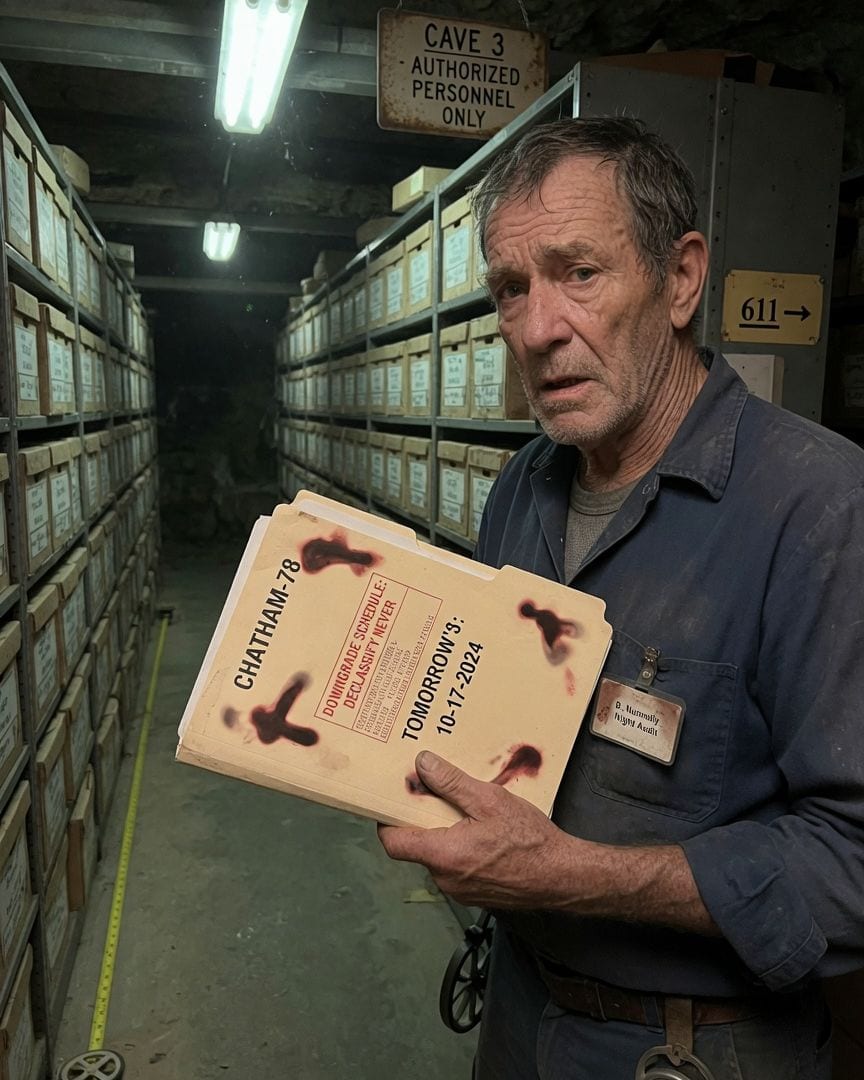
Barrow Nunnelly, a methodical sixty-three-year-old burdened by a bad back, undertook the colossal task of auditing the Cheatham storage caves, which hadn't seen a full inspection since 1968. His measuring wheel in Cave 3, officially four hundred feet long, clicked to a stop at an impossible six hundred eleven, confirming an extra two hundred eleven feet of shelving that simply didn't exist. Among these newly discovered, deeply unsettling Cold War files, Barrow found documents with strange, organically curved redactions and an alphanumeric code from no known office, all stamped with a chilling classification: 'DECLASSIFY NEVER.' Yet, beneath that, printed in crisp black ink, was an official date that hadn't happened yet. It was tomorrow.
A declassification agent processed old Cold War files. A man reported dead in 1951 had 1958 fingerprints matching an employee badged into the building that morning.
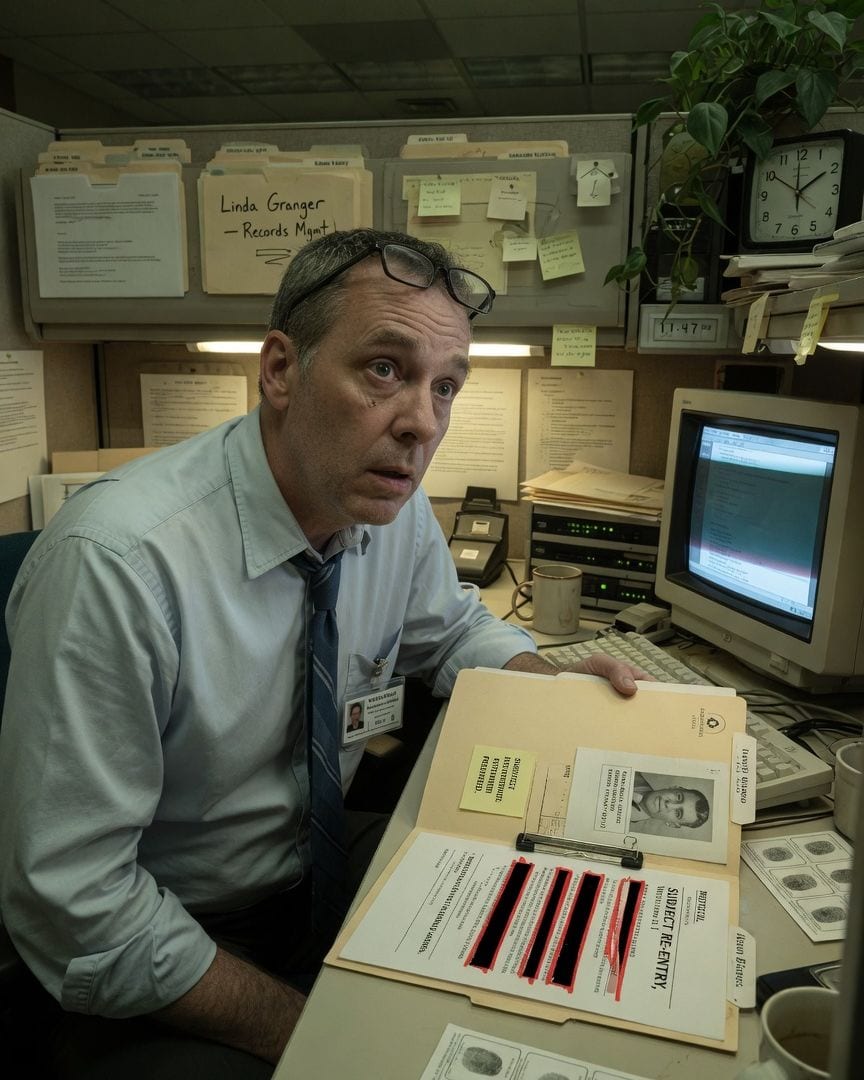
Anton Skeel, a declassification agent nearing two decades of service, meticulously processed the endless backlog of Cold War secrets. His cubicle hummed with the ghosts of forgotten files, but one 'Hollow Bell' folder held a particularly glaring anomaly. It contained a 1958 fingerprint card for Henry Bishop, a man officially reported dead in 1951. When Anton fed the print into the active database, it matched Carl Romano, an employee badged into the building that very morning. A cold certainty settled over him: this wasn't an error, but a system designed for such impossible discrepancies.
I found my street address in a century-old lighthouse file, printed decades before I lived there.
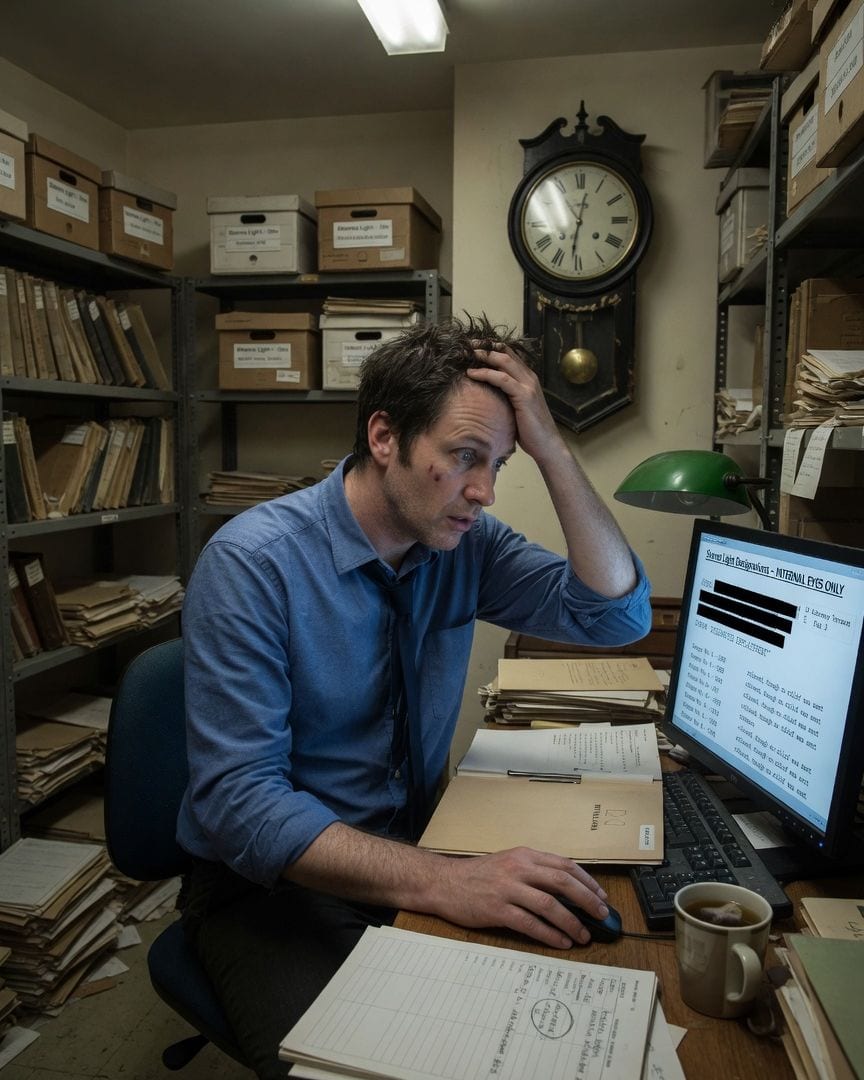
As a maritime archivist, my world revolves around forgotten lives and dusty ledgers. But the Skerne Light files broke that quiet rhythm, revealing a chilling pattern: 'Keeper number 6' relieved, though no relief was sent, repeating for decades. Now, an internal document with a strange code has led me to a redacted entry, revealing my own street address, decades before I ever lived there.
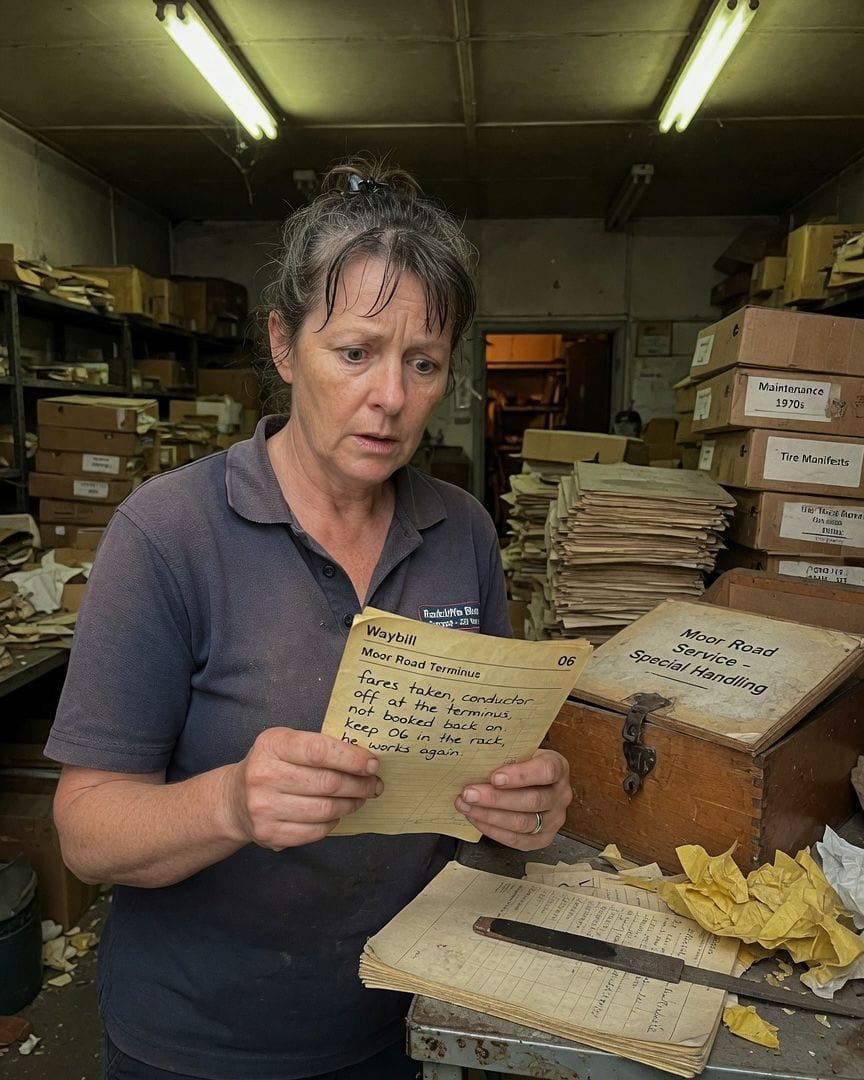
Our depot's Waybill 06 filed a moor road service we stopped running years ago. Every eight years since 1956, it closes: 'keep 06 in the rack, he works again.'
Sorting waybills in the depot, I stumbled across a form for the Moor Road Terminus. That route was decommissioned decades ago, but this waybill had a chilling handwritten instruction: 'keep 06 in the rack, he works again.'
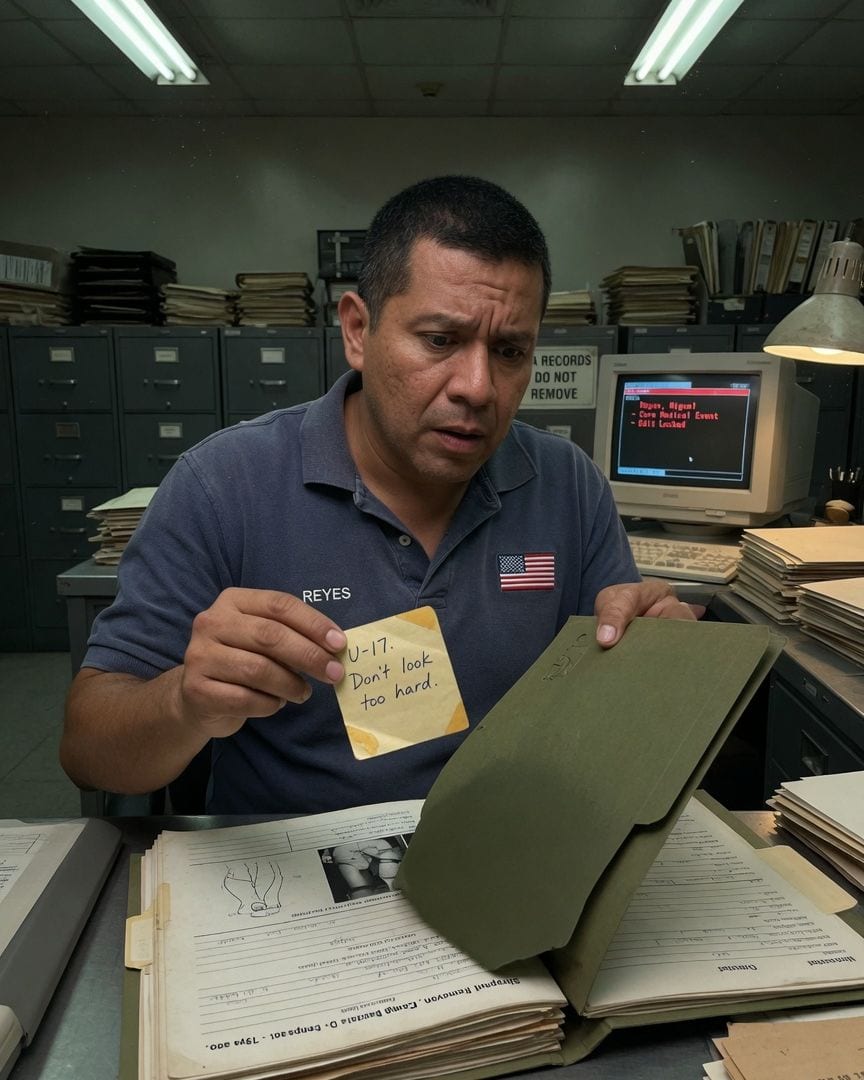
A veteran's medical record details a shrapnel wound his body never had. Taped to the report: 'U-17. Don't look too hard.'
Miguel Reyes, a veteran seeking relief for an old running injury, found his routine VA visit take a chilling turn. His medical file claimed a shrapnel wound and surgery from thirteen years prior, but his leg bore no scar, no mark of the supposed incident. Despite the detailed digital and paper records, his body swore the event never happened. As he pressed for answers, a hidden, yellowed note taped inside the official report surfaced, scrawled with two words: "U-17. Don't look too hard." The sterile clinic air suddenly felt cold and thick, suggesting a truth far darker than a simple clerical error.
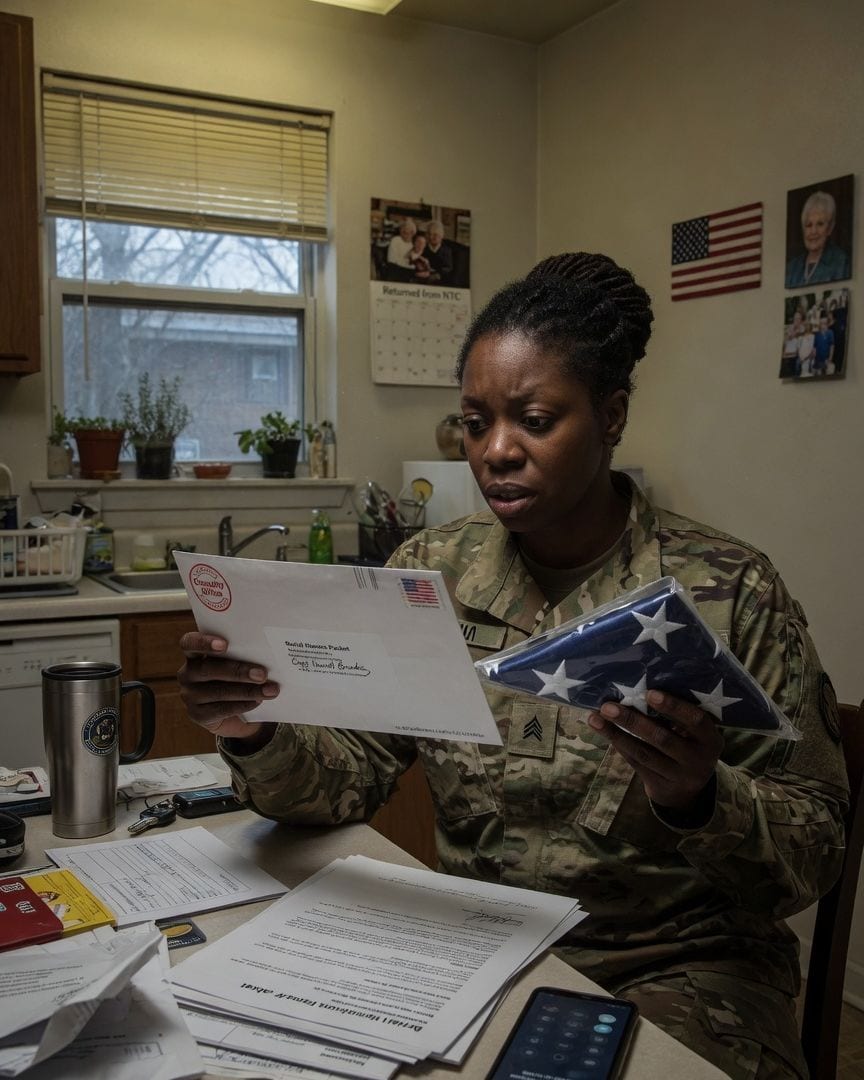
A Sergeant finds her own complete burial packet, dated for the coming spring, then finds a stack of identical ones for others.
Sergeant First Class Bree Alcott returned from a grueling training exercise, looking forward to peace, but found her kitchen table piled with mail, one official package heavy with dread. Inside was her own complete burial-honors packet, every detail filled, from Arlington plot to her grandmother’s chosen hymn, all dated for a specific day in the coming spring. The casualty office dismissed it as a 'glitch,' but Bree found a cryptic code leading to a decommissioned desert station and a stack of identical packets for other soldiers. What meticulous hand had prepared these packets, and why was Bree Alcott’s name on a list for a future she shouldn't have known?