An MP sergeant reviews patrol footage: a Cold War soldier in a 1970s uniform appears but leaves no prints on soft ground.
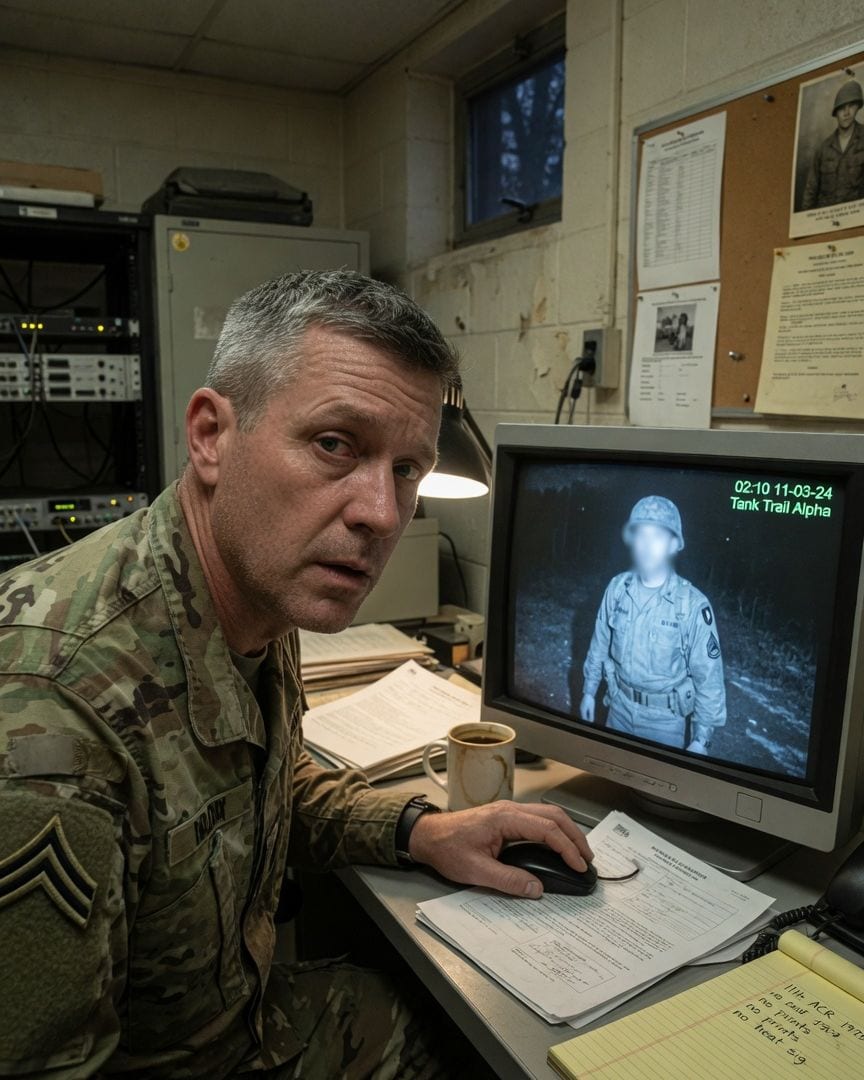
Sergeant Richard Halloran leaned closer to the monitor, the stale coffee in his mug long cold. It was 0330, and the MP station hummed with the low thrum of servers and the muted crackle of dispatch radios.
He was reviewing Specialist Susan Carter’s patrol dashcam footage from the night. Her vehicle had been on the routine perimeter check along Tank Trail Alpha, a straight stretch of road cutting through dense woods, around 0210.
Suddenly, a flicker. A pale, indistinct figure stood on the shoulder of the trail, silhouetted against the trees. It was wearing what looked like a US Army uniform.
Carter’s voice, tinny from the dashcam audio, reported, “Hold up, Sergeant, someone’s out there.” The patrol vehicle’s brakes hissed, the dashcam view jolted, and by the time the Humvee settled, the figure was gone.
Just empty road, the beam of the headlights cutting through the pre-dawn gloom.
Halloran frowned. “Did you see anything when you stopped, Carter?” he’d asked her an hour ago. “Nothing, Sergeant,” she’d replied, her voice tight. “Just… gone.” He toggled the remote, rewound the footage.
The figure reappeared, ghost-like, still for a split second before the brake lights flared. It wasn’t a trick of the light. It was there.
The next morning, the sun was barely clearing the tree line when Halloran walked the designated section of Tank Trail Alpha himself.
The air was cool, damp, and the ground along the shoulder was soft from recent rain, a fine layer of silty mud. He reached the milepost where the figure had stood. He knelt, pushing aside some damp leaves.
The mud was undisturbed, smooth, holding not a single boot print. Just the faint, rhythmic pulse of his own blood in his ears.
Specialist Carter caught Halloran after his morning brief. “Sergeant,” she began, her voice low. “I asked around. That figure… it’s been showing up on other dashcams, too. Same time, same spot. For weeks.”
Halloran felt a cold knot tighten in his stomach. A lone trespasser, he could explain. But a scheduled one, leaving no trace? That was different.
He sought out Sergeant Greta Yates, the base’s archive specialist, a woman with a reputation for knowing the digital guts of the installation better than anyone.
Her office, nestled in the sub-basement of the MP station, smelled of ozone and old paper. Halloran explained what he’d seen.
Yates, a pragmatic woman with quick eyes, pulled up the last few weeks of video archives, cross-referencing them with the perimeter’s thermal imaging and motion sensors.
She worked methodically, her fingers flying across the keyboard. The monitors flickered with silent surveillance feeds. “Nothing,” she announced after nearly an hour, turning in her swivel chair. “No heat signature. No motion alert. Not even a blip.
The dashcams are picking up something, but the dedicated sensor systems? Zero. Whatever it is, it’s not registering as a living thing.”
Halloran replayed the dashcam footage on her screen, zooming in as best he could. The uniform, he noticed, was off. The cut of the fatigues, the high collar, the specific style of the helmet – it wasn't modern issue.
He recognized it from old training manuals. “That’s not current, Yates,” he muttered, more to himself than to her. “That’s straight out of the seventies. That pattern was phased out over forty years ago.”
The air in the archive office suddenly felt heavy, thick with unspoken implications. A trespasser, even a dedicated one, wouldn't be wearing a uniform that old. It didn't make sense. The mundane explanation was crumbling.
Halloran spent the next day poring over historical deployment records, old uniform regulations, and unit insignias. The specific uniform pattern, the one from the dashcam, pointed him toward a narrow window: the mid-to-late 1970s.
Specifically, the 11th Armored Cavalry Regiment, which had been stationed at Katterbach from 1975 to 1980. This wasn't just an old uniform; it was a specific old uniform from this base.
He took the best frame grab he could from the dashcam footage, transferring it to his personal terminal. He ran it through a basic enhancement program, pushing the pixels to their breaking point.
The figure on the screen became a blocky, distorted collection of squares, but one detail sharpened, just enough. On the soldier’s right shoulder, a faint, recognizable patch materialized: the black and gold insignia of the 11th ACR.
Then he looked at the face. Or what passed for one.
The resolution was too poor to make out features, but the tilt of the head, the posture – the figure’s blurred, indistinct face was turned directly toward the passing patrol vehicle.
Its eyes, though just smudges on the screen, seemed to hold a peculiar, unblinking intensity, fixed on the path of the Humvee, tracking its movement as it drove past.
Halloran felt a prickle of cold sweat on the back of his neck. It wasn't just there; it was watching.
Halloran knew he couldn’t pursue this officially without looking like a conspiracy theorist, or worse, someone losing his grip. He found Specialist Carter wiping down her patrol vehicle, the late morning sun glinting off the polished chrome.
“Carter,” he said, keeping his voice casual. “I need you to look into something, discreetly. Back-channel, just for me. Old incidents, anything unusual, near Tank Trail Alpha. Focus on the 1975 to 1980 window. Especially anything involving the 11th ACR.”
Carter’s gaze was sharp, but she simply nodded, understanding the unspoken implications of 'discreetly.'
Later that week, Halloran found himself back in Yates’s sub-basement office. The air, if anything, felt colder.
He used his authority as a patrol supervisor to request access to the 'deep storage' digital archives, usually reserved for long-term intelligence or major incident reviews. Yates looked at him, her brow furrowed.
“You’re really digging at this, Sergeant,” she observed, but she unlocked the terminals.
Halloran began searching, running keywords through the archaic databases: '11th ACR incident,' 'Tank Trail Alpha anomaly,' 'missing personnel Katterbach 1977.' He filtered by date, focusing on the five-year window. The system was clunky, designed to bury what wasn’t actively referenced.
It took hours of patient sifting through garbled logs and compressed files.
He found it, buried under layers of system updates and obsolete protocols. Reports from 1977 detailed 'temporary disruptions' to perimeter sensors near Tank Trail Alpha. They were routinely dismissed, marked ‘wildlife interference – likely deer’ or ‘sensor glitch – temporary.’
But the timestamps were precise. Many of these 'disruptions' occurred between 0200 and 0230. A chill snaked down Halloran’s spine. The overlap was too exact, too consistent with the dashcam appearances. This wasn’t new. This wasn’t a recent anomaly.
This had been happening for forty-five years, an old, misidentified pattern woven into the very fabric of the base’s digital history.
Captain Arthur Winslow, the MP commander, was not a man known for casual strolls through the desk sergeant’s bullpen. Yet, over the next few days, Halloran started to notice him there more often, leaning against the counter, observing.
Winslow's gaze would drift to Halloran, linger, then move on. His questions to other MPs seemed innocuous, but Halloran detected a subtle shift in their casualness. “Anything new or unusual on your patrols, Sergeant?”
Winslow asked him directly one afternoon, his voice even, but his eyes were too sharp. “Routine, Captain,” Halloran replied, forcing a neutral tone.
Halloran began to feel watched, an unsettling awareness that tightened the space around him. Doors seemed to swing shut a little too quickly in his wake. Conversations would trail off as he approached.
The usual boisterous camaraderie of the MP station had curdled into something colder, more formal around him. The air itself seemed to hum with an unspoken tension, specifically directed at him.
One evening, back in his barracks room, Halloran logged onto his secure terminal. A notification icon blinked: an unread message.
It was from an anonymous sender, the sender ID showing a garbled string of numbers and letters, clearly routed through an old internal proxy server that should have been decommissioned years ago. The subject line was blank. He opened it.
The message contained a single, stark sentence: "Some things are best left buried, Sergeant. For everyone's sake."
The words glowed on the screen, stark and absolute. Halloran stared at them, his breath catching in his throat. It wasn't a warning from outside. It was from within the base. Someone knew.
Someone connected to the very system he was investigating, perhaps even the same system that had scrubbed those old records, wanted him to stop.
The threat was not just about his career; it was personal, a cold, silent pronouncement that cut through the sterile air of his room.
Halloran needed answers, and he knew Yates had them, or at least knew where they were buried. He found her in the motor pool, checking a maintenance log on a Humvee.
The clang of wrenches and the smell of diesel filled the cavernous space. “Sergeant Yates,” Halloran said, his voice low, cutting through the noise. “I need to know about the ‘Black Box’ files. The ones from the seventies.
What happened on Tank Trail Alpha?”
Yates paused, her hand still on the clipboard. She looked at him, her eyes guarded. The clang of a wrench hitting the concrete floor echoed through the motor pool. “Those files are classified, Sergeant. Beyond your clearance.”
“The dashcams disagree,” Halloran countered, pushing. “The sensors from forty-five years ago disagree. And someone on this base just sent me a message telling me to stop digging.” He held her gaze, unwavering. “I’m not asking for secrets, Sergeant.
I’m asking for the truth about a ghost on our patrol route.”
Yates sighed, a long, weary sound. She led him to a quiet corner, away from the other mechanics. “October 17th, 1977,” she began, her voice barely a whisper. “Training exercise. Night maneuvers on that very tank trail. A miscommunication.
A vehicle movement that wasn’t logged. PFC Daniel Kowalski. Twenty years old. Fatality.”
Halloran felt the air leave his lungs. “A cover-up,” he stated, not a question.
“A ‘containment of information’,” Yates corrected, her tone dry. “The official record was purged. No formal incident report. No casualty notification to next of kin. He was just… gone from the system.”
She paused, looking past Halloran at nothing in particular. “But you can’t fully erase something that was never formally deleted. See, the system was designed for perfect accountability. Every soldier, every piece of gear, every movement logged.
When Kowalski died, the official records were wiped, but the low-level noise… the raw sensor data, the comm chatter from other units nearby, even the subtle magnetic fluctuations from his dog tags when he was still alive and moving… that never went away.”
She turned to him, her expression grim. “It’s like a ‘ghost in the machine,’ Sergeant. His presence was never officially removed because he was never officially present in the accident log in the first place.
The digital traces, the echoes of his last moments, they just… persisted. They show up on the most basic, unfiltered sensors, like your dashcams, because they’re not looking for a heat signature.
They’re just registering a visual anomaly where no visual anomaly should be. The uniform, the lack of prints, the 1977 sensor disruptions… it all converges. It's Kowalski. A digital phantom, a casualty the base’s own systems couldn’t reconcile, couldn’t forget.”
Halloran looked out at the mechanics, now distant figures, the noise of the motor pool suddenly a dull roar. The silence of Kowalski's secret was deafening.
Halloran and Yates retreated to the archive office, the revelation about Kowalski hanging heavy in the air. Halloran felt a desperate urgency to see everything, to confirm the impossible truth.
Yates pulled up the fragmented records she could still access – not the official purged files, but the ghost data, the systemic noise.
They found a faded ID photo, a young man, barely out of his teens, with a serious gaze. PFC Daniel Kowalski. Below it, a brief entry: ‘Missing Personnel – October 17th, 1977.’ It was later marked: ‘Resolved. Misfiled.’
A blatant lie.
Yates, her fingers flying across the old terminal, recovered more raw sensor data from the 1977 incident. She cross-referenced it with forty-five years of similar 'wildlife interference' and 'temporary disruptions' reports near Tank Trail Alpha.
A chilling pattern emerged, clear and undeniable. The peaks, the anomalies, weren’t random. They weren’t spread evenly across the year. They consistently spiked, sharply and without fail, on one specific date: October 17th. Every single year.
The system, in its relentless pursuit of accountability, continued to register a disruption, a presence, on the anniversary of Kowalski’s death. The figure on Halloran’s dashcam wasn’t just a nightly occurrence, an unexpected glitch. It was a scheduled, annual appearance.
A spectral roll call. Marking the same lost soldier, on the same lost day, year after year.
The screens in Yates’s office glowed with the cold, irrefutable data, the silent testament of a forgotten trauma replaying itself, relentlessly, in the digital ether.
Halloran obtained an official permit, a rare concession from a reluctant chain of command, citing "historical site assessment" as the reason.
Accompanied by Specialist Carter, he returned to Tank Trail Alpha, this time equipped with ground-penetrating radar and a high-sensitivity metal detector. The morning mist hung heavy in the air, muffling the sounds of the distant base.
They walked in silence, the equipment heavy in their hands, the only sound the rhythmic sweep of Halloran’s feet through the damp grass.
They reached the exact milepost where the figure appeared. Halloran marked out a grid. Carter began her sweep with the metal detector, a focused intensity on her face. The machine hummed, an innocuous, rhythmic thrum against the quiet.
Then, a sharp, insistent chirp. Carter stopped dead. She re-scanned the spot. The chirp came again, stronger this time.
Halloran pointed to the spot. “Here. Start digging.”
Carter knelt, pulling a small entrenching tool from her pack. She dug carefully, turning over clods of earth, her movements precise. The soil was loose, yielding. A few inches down, her tool scraped against something hard. She widened the hole.
Something metallic glinted in the damp earth. Halloran knelt beside her, reaching in. He pulled out a small, oval piece of metal, caked in mud and corrosion.
He found a nearby puddle, knelt, and carefully began to clean it. The grit fell away, revealing dull, pitted aluminum. Engraved, though faint, were letters. He rubbed harder, his thumb tracing the cold surface. KOWALSKI, D.
And below it, a date of issue: OCT 17, 1977. A dog tag. Daniel Kowalski’s dog tag. A physical artifact, undeniable, found at the very spot where his digital ghost manifested. Halloran held it, a small, cold weight in his palm.
The figure was not supernatural in the traditional sense, he realized. It was an echo, a memory made visible by the very base technology that had tried to erase him, a catastrophic flaw in the system’s supposed 'perfect' accountability.
The silence of the tank trail seemed to deepen, acknowledging the truth now uncovered.
Halloran walked into Captain Winslow’s office, the dog tag in his hand, a thick file of printouts from Yates’s archives tucked under his arm. Specialist Carter followed, carrying a tablet displaying the compiled dashcam footage.
Winslow sat stiffly behind his desk, his expression unreadable. “Sergeant, I trust this isn’t about the… wildlife interference again?” His tone was laced with thinly veiled disapproval.
Halloran placed the dog tag carefully on Winslow’s desk, the dull metal contrasting starkly with the polished wood. “Captain,” he began, his voice calm, “this is PFC Daniel Kowalski’s dog tag. Issued October 17th, 1977.
We found it this morning, at milepost six on Tank Trail Alpha.”
Winslow scoffed. “A relic. Could be anything. A prank, a loose end. You’ve let this get out of hand, Sergeant.”
Halloran ignored the dismissal. He opened the file, laying out the evidence methodically. “The dashcam footage, sir, shows a figure in an outdated 11th ACR uniform, consistently at 0210. No prints. Sergeant Yates’s archives show an un-removed digital presence.
Fragmented logs from 1977 detailing a training incident on that exact date. PFC Kowalski was declared missing, then falsely marked ‘resolved, misfiled.’ And the ‘wildlife interference’ reports? They spike on October 17th, every year, for forty-five years.”
He pointed to the digital logs. “The system never forgot him, sir. It just couldn’t process his absence because it never officially recorded his death.”
The ordinary military explanation, the glitch, the misfiling, the human error – it all collapsed under the weight of the coherent, irrefutable evidence.
Winslow stared at the dog tag, then at the dates, then at the young, faded face of Kowalski on the ID photo. His composure cracked, revealing a flicker of something close to defeat, or perhaps a terrible understanding.
The horror was not supernatural; it was bureaucratic, systemic.
Winslow leaned back in his chair, a long, slow exhale escaping his lips. “What do you propose, Sergeant?” he asked, his voice low, the fight gone out of him.
“Find his next of kin,” Halloran stated. “Arrange a proper burial. A memorial. The system’s flaw requires final, human accountability, sir. Not another erasure.” Winslow nodded, a grim acknowledgment of the impossible truth.
A quiet ceremony was held at the base. A small, simple plaque was installed near Tank Trail Alpha: ‘PFC Daniel Kowalski, 1977. Accounted For.’
The base’s official record was updated with a carefully worded explanation of a ‘historical clerical error,’ omitting any mention of phantoms or digital echoes.
Halloran worked tirelessly, ensuring all digital threads were tied, all the ghost data acknowledged and quietly archived. Sergeant Yates, for her part, confirmed that the deeper, uneditable system echoes had finally settled into a profound, persistent silence.
The anomaly had, at last, found its resting place.
Halloran completed his rotation at Katterbach, the dog tag still in his possession, tucked deep into his personal effects. He transferred stateside, never seeing the figure on Tank Trail Alpha again.
He often reflected on the base’s absolute accountability, a system designed to forget nothing, and how some things, once registered, once a part of the network, could never truly be removed, only silenced.
A few months later, at his new posting, a junior MP on patrol reported a flicker on his dashcam, deep in the woods behind the new base.
A pale, still figure, gone before the brakes took hold, leaving no prints in the soft, pine-needle earth. Halloran simply closed his eyes and shook his head. The system always remembers.
If this one got to you
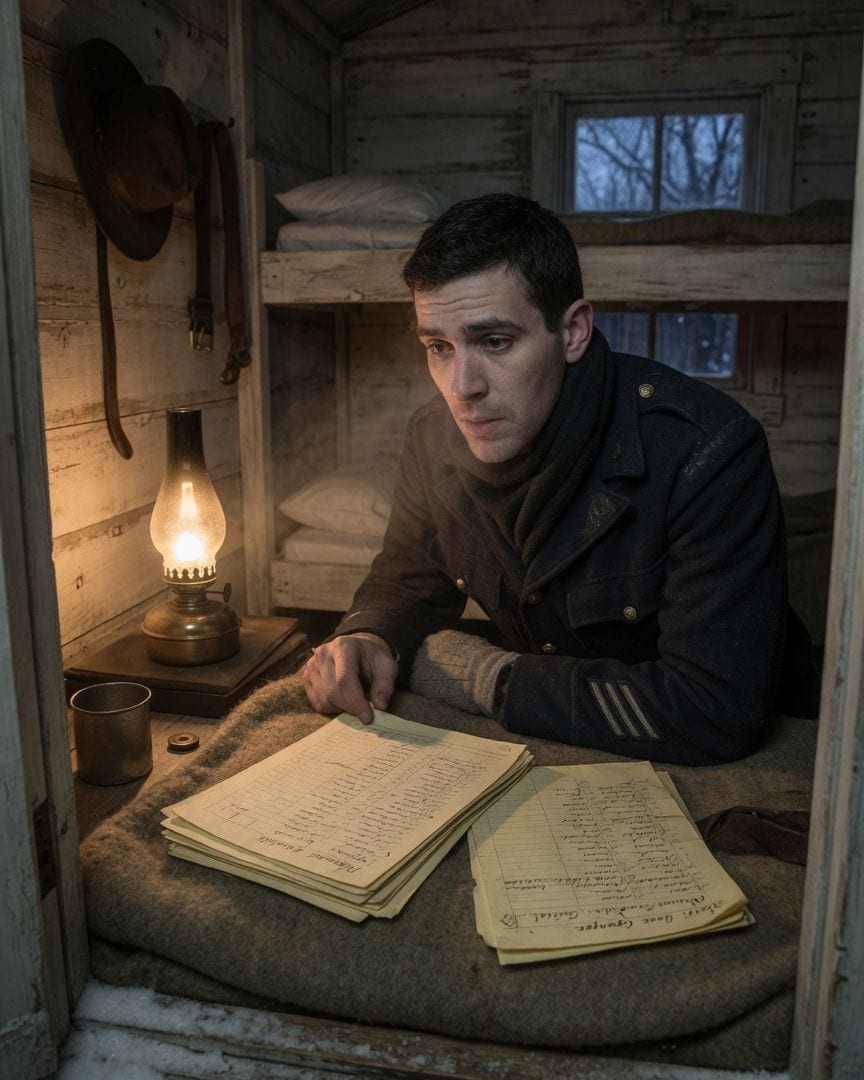
On his last watch, Corporal Carter found boot prints ending inside a sealed magazine, and a blood-red handprint from a soldier decades out of time.
Corporal Franklin Carter shivered, not from the biting November wind, but from the chill of his last pay muster at Fort Taggart before its winter abandonment. His final duty was to count every man, tallying thirty-seven, precisely the company strength. But his breath hitched when he saw the completed roll: it ran thirty-eight names long. An impossible extra slot, filled by a voice that answered 'Here, Corporal,' for a soldier whose name, Pvt. Isaac Granger, vanished from all official records, only to reappear in a forgotten supply log from 1863. Was Fort Taggart abandoning its dead, or something far older?
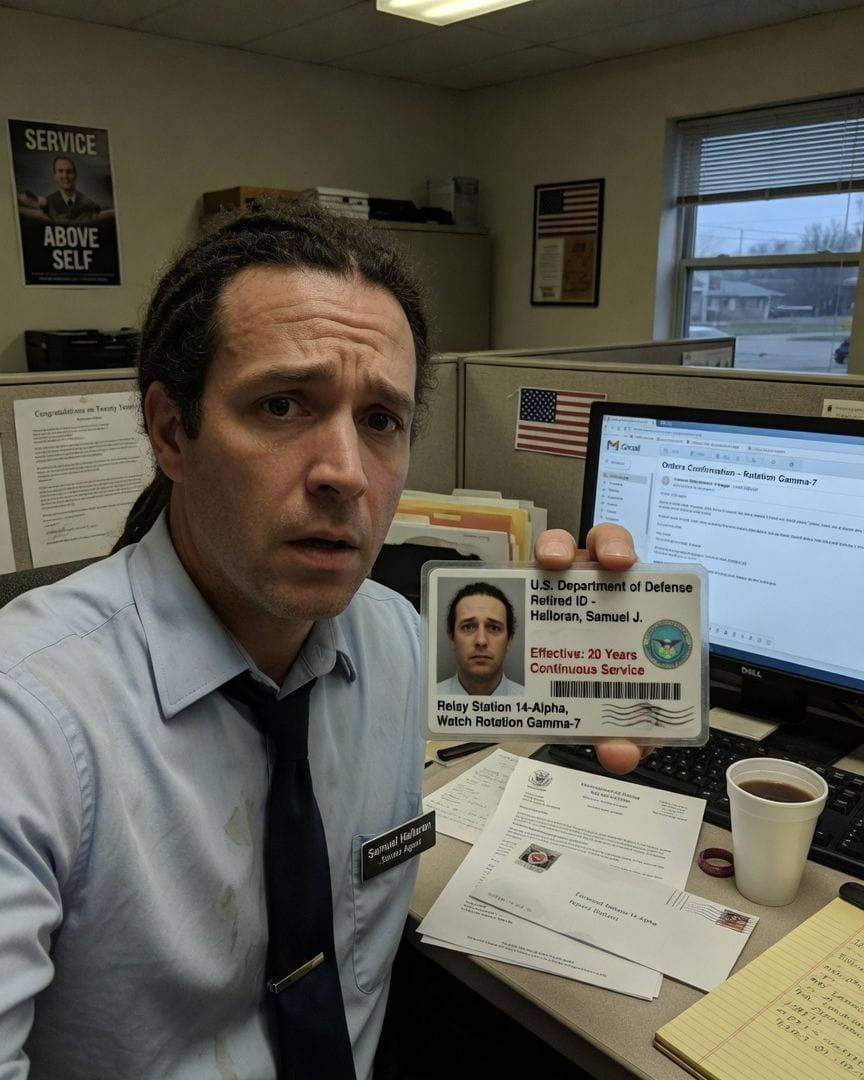
An Ohio insurance worker's new military ID shows his current face, but orders send him to a Cold War station abandoned for decades. An old photo there shows his face.
Samuel Halloran, an Ohio insurance worker, had built a quiet life eight years after leaving the military, with a mortgage and two kids, far from the uniform. The scent of stale coffee usually defined his suburban days, but a letter from a Missouri records center shattered his routine. It congratulated him on twenty years of continuous service, complete with a retirement ceremony and a new ID card bearing his current face, yet his own separation date was missing from the meticulously kept history. Then came specific orders for a forward relay station in the Ozarks, a desolate place decommissioned and abandoned since the 1980s. Scrolling through old archives, Halloran found a faded 1987 photo of a sentry guarding the derelict site, whose blurred face held an undeniable, chilling resemblance to his own.
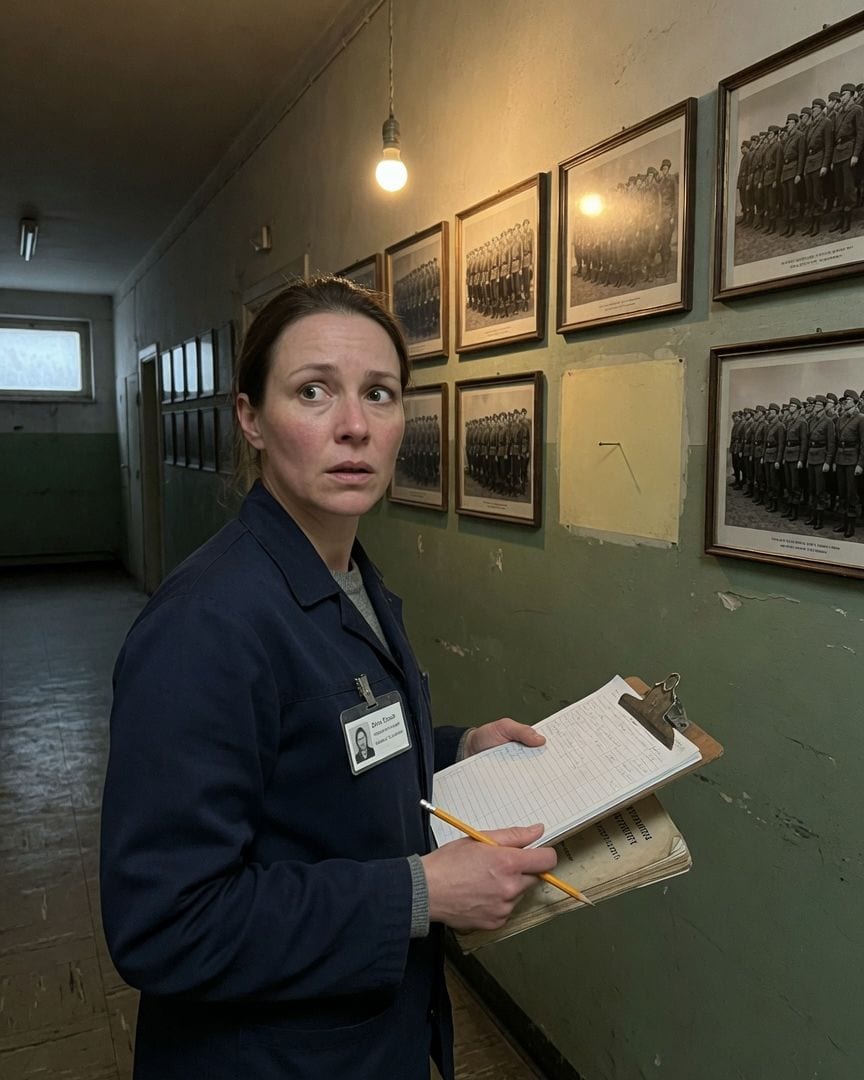
On a closing Cold War base, an inventory clerk finds every soldier in old photos staring at an empty wall. Her own name is on a hidden footlocker holding the missing picture: a dark, blurred figure among them.
Delia Straub has eleven days to inventory Kaserne Ottmarsheim, a former German base slated for demolition. The air in its echoing, abandoned halls smells of coal smoke and old wax as she races against the clock. Her task takes an unsettling turn when she discovers a phantom unit, the '604th Ordnance Detachment,' explicitly listed in old records despite never existing. Even more unnerving, every soldier in adjacent photos stares fixedly at the empty space where its picture should be. But why does a hidden footlocker, bearing Delia's own name, hold the missing photograph, revealing a dark, blurred figure among the men?
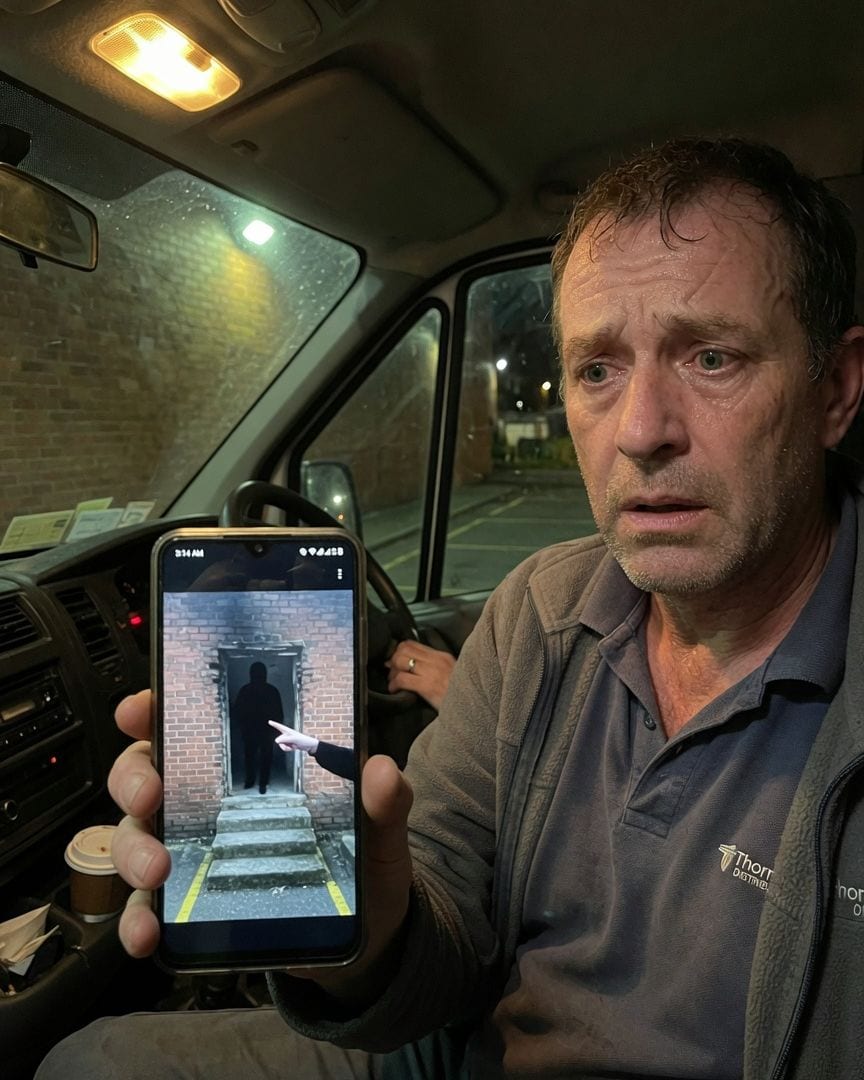
My dashcam showed a doorway in the loading bay wall. Open, with steps into the dark. I got out. Solid brick. Back in the cab, a shape stood on the steps.
It was past three in the morning, just another routine reverse into Loading Bay 7. My van's dashcam flickered on, ready to guide me back against the familiar brick wall. But that night, it showed a doorway where no door should be, open and leading down into absolute darkness.
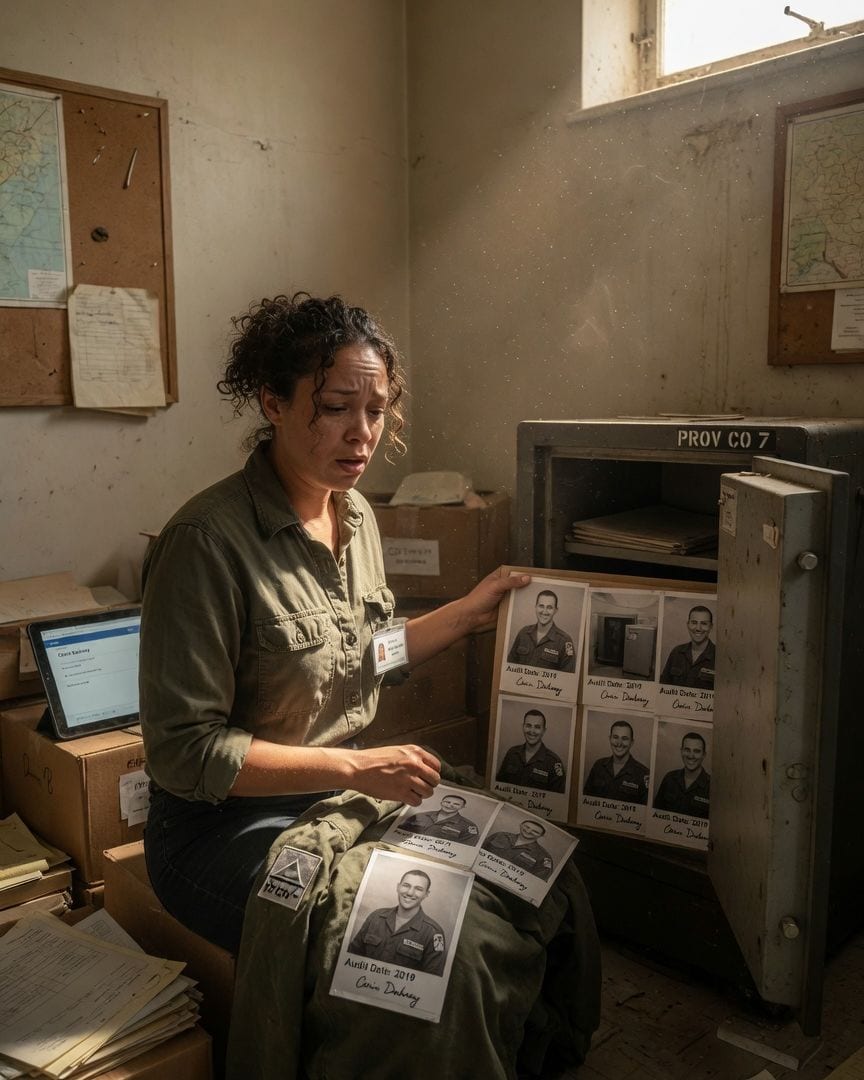
With eight days to clear a Cold War fort, Corin Calloway found files signed 'Corin Dabney' from 2019.
With just eight days left before Fort Halloway was gutted by demolition crews, Corin Calloway worked to clear half a century of forgotten lives from its dusty archives. As she meticulously sorted through records, she discovered an old, unlisted safe, its pitted door stenciled with a phantom designation. Inside, Corin found seven personnel jackets, each dated '2019' and signed with the name 'Corin Dabney.' But Corin Calloway knew she had never set foot in the building before this week, and the name 'Corin Dabney' existed nowhere in the base's official history. What secret was Fort Halloway's forgotten safe trying to reveal?
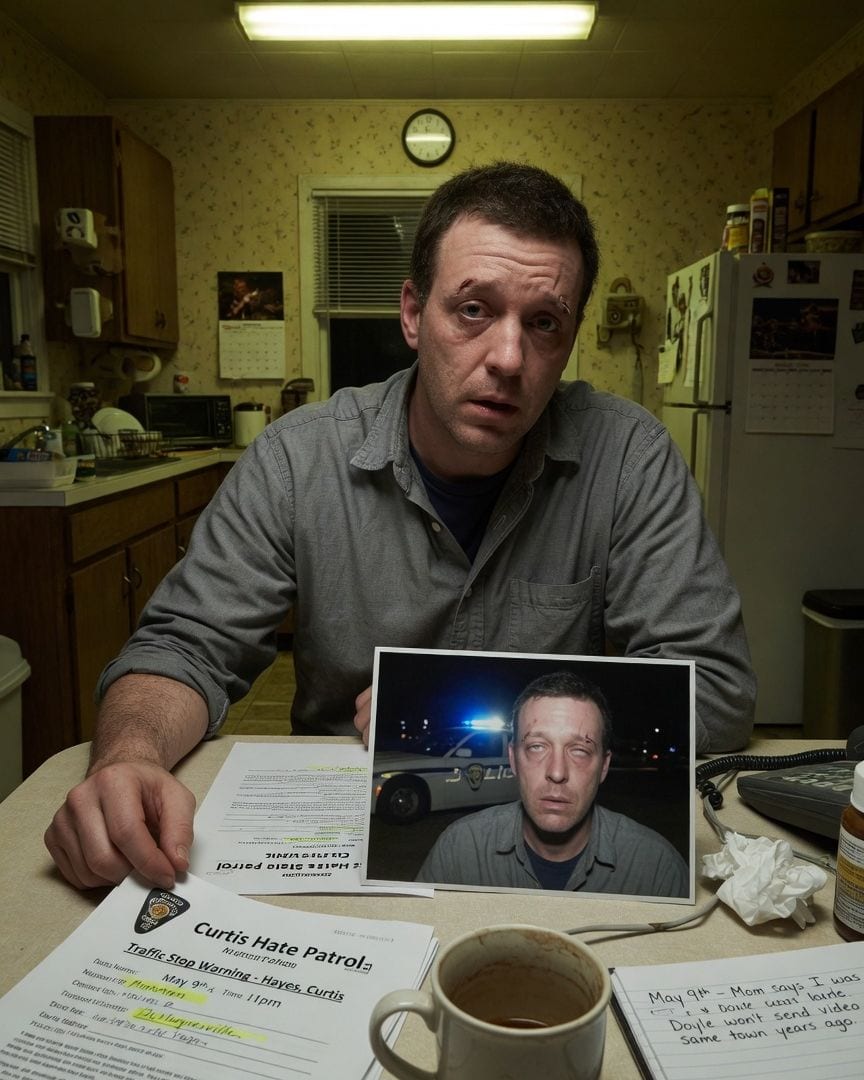
My face stared back from a bodycam video, in a town I've never been. He answered to my name.
I received an email from the Ohio State Patrol for a traffic stop I never made, 200 miles away on May 9th. My mother confirmed I was home that night, asleep on the sofa. When the police finally sent a bodycam photo of the driver, it was my face and scar, but the eyes were flat, distant, and utterly devoid of warmth.