With nine days until the Cold War site sealed forever, Sergeant Dolvig found a folder detailing the sealing party's words — four days in the future.
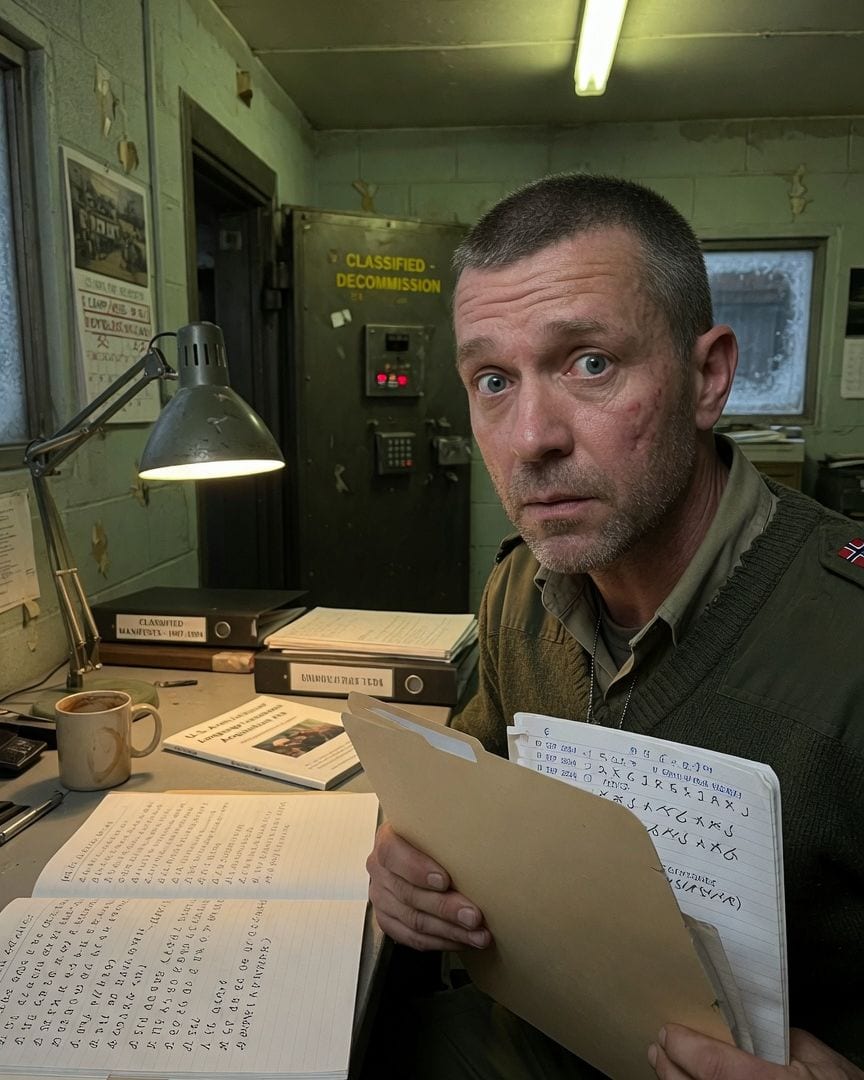
Sergeant Aksel Dolvig moved through the sterile, echoing corridors of Camp Vess, the sound of his boots a rhythmic drumbeat in the quiet.
He was a man of meticulous order, his life a series of precise entries in ledgers and logs, and Camp Vess suited him.
Nine days remained until the site’s permanent sealing, a final abandonment of a Cold War relic in the Greenland ice. His last duty before transfer was to ensure all classified materials were secured or destroyed.
It was a task he approached with unwavering diligence.
He stopped at the heavy vault door, its thick steel a bulwark against the elements and prying eyes. The mechanism whirred quietly as he keyed in the sequence.
Inside, the shelves were packed with precisely labeled binders and archival boxes, their contents meticulously cataloged in his system. But one anomaly stood out: a thick manila folder, resting on a shelf otherwise dedicated to decommissioned equipment manifests.
It bore no control number, no originating office stamp. Its paper felt unusually heavy in his hands, its binding unique, a subtle weave he’d never encountered in standard issue.
He opened it. Forty pages lay inside, filled with an angular, alien phonetic script. It looked like a series of sharp lines and hooks, utterly unlike any alphabet he knew. Each page was dated in a steady, official hand.
He flipped through, the dates ascending with unnerving regularity, not ending with the camp’s scheduled sealing, but crossing it, extending four days into the future. A cold knot formed in his gut as he reached the last page.
It was headed with the exact day Camp Vess would be sealed. Beneath that date, in the same unsettling script, lay the precise words the sealing party would say.
He stared at the future, written out in an unknown language, and a shiver crawled up his spine.
Sergeant Dolvig fought against the uncanny feeling, his mind searching for any rational explanation. A prank, perhaps? A misplaced draft? He could not dismiss the consistency of the script, the unwavering hand that produced it.
He decided to consult Dr. Susan Kingsley, a visiting linguist briefly attached to Camp Vess for a cultural exchange program with local Inuit communities.
He approached her cautiously, presenting the script without its unsettling context, merely as an “unidentified document from an old archive.”
Kingsley, a woman with sharp, observant eyes, took the pages and spread them across her desk. She spent an hour with them, poring over the angular marks, comparing them to charts of ancient scripts and known cryptographic systems.
When she finally looked up, her expression was one of genuine perplexity. "Sergeant Dolvig," she said, her voice quiet, "this matches no known human language, living or dead. Nor any recognized cryptographic system.
It’s too structured to be random, certainly, but too alien to be a code I've ever seen. The patterns suggest a sophisticated internal logic, but the symbols themselves are... untraceable."
His fear, far from being assuaged, solidified. Dolvig returned to his office, the folder now a physical weight. He attempted to trace its non-existent control number through every available database, cross-referencing archives, supply manifests, and decommissioned inventories.
He found no record, no originating office, no mention of 'phonetic transcripts' in any official capacity. The absence itself was a tell, a gaping hole in his meticulously organized world.
He returned to the file, focusing on the last page once more. The consistent script, the unnerving certainty of the future dates – it all suggested purpose, not a prank.
He pulled out a basic phonetic guide, a tool for initial sound approximations used in preliminary language acquisition, a long shot, almost absurd. He began the tedious task of sounding out the recurring symbols, searching for any pattern, any repetition.
His finger traced a specific mark that appeared frequently, a small, hooked symbol, almost like an instruction, a strange, silent command.
Driven by a chilling hunch, Dolvig isolated the repeating hooked symbol. He worked through the phonetic guide, matching the sound approximations, the sheer alienness of the characters grating against his mind.
He spent hours, the only sounds in the quiet office the rustle of paper and the soft click of his pen against the guide. Slowly, painfully, a short, two-word phrase began to coalesce from the foreign characters: 'TO BE SPOKEN.'
He found it on multiple pages, including the final one detailing the sealing of Camp Vess, a chilling recurring motif.
The words 'the sealing party would say' on the cover sheet suddenly re-framed, no longer a prediction of future events but a direct instruction, a chilling directive.
He stared at the final page, the strange script no longer feeling like a record, but like a command, a script that demanded to be followed.
The phrase 'TO BE SPOKEN' became a constant, icy refrain in Dolvig’s mind. He couldn't shake it.
He meticulously observed the camp’s routine, carrying the ghost of the phonetic script with him, cross-referencing daily events with the future-dated entries in the mysterious folder.
He noted a sequence of mundane, seemingly random occurrences: a minor power flicker in the comms array that lasted precisely 1.7 seconds at 03:14 on Tuesday, a specific supply drop delayed by exactly two hours due to 'unexpected headwinds,' a particular maintenance crew's rotation shifted by a single day due to a 'scheduling conflict.'
Each of these small, insignificant events, he realized with mounting horror, was precisely detailed, in sequence, within the angular marks of the phonetic script. He could no longer deny it: the script wasn't foretelling. It was dictating.
His rational mind screamed for an explanation, any explanation.
He picked up his secure satellite phone, the heavy device feeling cold in his hand, and contacted an old colleague, Kevin Harrington, now a records officer at a major intelligence archive stateside.
Dolvig framed his questions cautiously, speaking in hypotheticals, asking about 'unassigned' or 'pre-dated' classified reports, documents that seemed to exist outside the usual chain of custody. Harrington, initially dismissive, chuckled dryly.
"Sounds like someone's been reading too many ghost stories, Aksel. Everything's logged, eventually."
But as Dolvig pressed, describing the folder’s lack of identifying marks, the strange script, Harrington’s voice grew increasingly uncomfortable, a subtle shift in tone that Dolvig, with his years of observing bureaucratic nuance, did not miss.
"Look, I don't know anything about that, Aksel. Truly. It's not in the system." His evasiveness was palpable, a wall of forced ignorance.
Dolvig’s unease grew; his rational world was dissolving around this impossible file, eroding with every passing, dictated hour.
Hours later, Harrington called back, his voice tight, stripped of its earlier forced jocularity. "Aksel, listen to me," he whispered, the secure line almost crackling with his tension. "There are things in the system that aren't meant to be found.
Things that don't officially exist. Stop looking." The line went dead abruptly, cut by Harrington himself, leaving Dolvig with a buzzing silence and a cold prickle running down his spine.
The warning was not just a warning; it was a desperate plea.
Dolvig returned to his office, the conversation replaying in his head. He had carefully secreted the transcript folder beneath a stack of mundane logistical reports. Now, it was subtly out of place, slightly ajar, peeking out from under the stack.
Nothing seemed missing, but the violation was clear, a deliberate repositioning. His breath hitched. Someone had been in his office. He immediately checked the camp’s internal access logs for his office door.
An entry for 'Maintenance Check – Routine' appeared during his absence, logged with an impersonal, official hand. He stared at the entry.
The script used for the log, the precise, almost calligraphic flourish of the 'M' in Maintenance, the rigid certainty of the strokes, mirrored the same unsettling script he had found in the folder.
It was too neat, too perfect for a routine entry logged by any of the camp’s grizzled mechanics. He realized with a terrifying jolt that his inquiries had not gone unnoticed.
The same 'hand' that wrote the future in the manila folder had now touched his present, confirming that he was being watched, or perhaps, guided.
Dolvig confronted Harrington again, bypassing official channels entirely for a direct, secure line, his own voice tight with controlled desperation. "The maintenance log," Dolvig pressed, "who signs off on phantom checks?
And what did you mean, 'things not meant to be found'?" Harrington’s voice, strained and hoarse, finally cracked. He admitted he was instructed to flag any inquiries matching a specific profile: 'unassigned origin, future-dated, phonetic script.'
The instructions had come down through obscure, untraceable channels, cloaked in layers of deniability. "They call them… phantom files," Harrington whispered, the term itself a shiver down Dolvig's spine.
He described whispers within the archives of records that appeared and disappeared, always concerning sites that were later decommissioned or personnel who vanished without explanation.
He detailed their signature: no control number, no originating office, and a chilling 'DECLASSIFY NEVER' schedule stamped on an invisible cover sheet.
The characteristics of Dolvig's folder. Every single one.
Harrington then recalled seeing a brief, almost immediately reclassified memo years ago.
It had flashed across his screen, a fleeting glimpse of a file concerning 'Greenland Site Vess' with these exact markers, a reference to an unusual document, but it had vanished before he could access it further, swallowed by the system.
The realization hit Dolvig with brutal force, a physical blow to his gut. The file wasn't a mistake, a prank, or an anomaly.
It was part of a deliberate system, an institution that knew, recorded, and sealed not just secrets, but fates. The 'secrecy machine,' as Harrington called it in hushed tones, wasn't just hiding information; it was actively managing a predetermined reality.
And he, Aksel Dolvig, had stumbled directly into its gears.
Following Harrington’s lead on the trail of 'phantom files,' Dolvig dug deeper, specifically into the 'Sterling Incident' of 1968, a lost research outpost in the Arctic, shrouded in similar whispers of inexplicable disappearance.
He spent an agonizing night searching through ancient, half-redacted digital archives, finally managing to locate a partial, heavily redacted declassified memo from that era, concerning a 'transcript recovery' operation at the Sterling site.
The memo, barely legible in places, mentioned a 'peculiar phonetic script' found at the Sterling site, echoing the language Kingsley had used.
He poured over the document, his finger tracing the thick blacked-out lines, then the remaining text, his breath held captive in his chest.
The memo listed a sequence of dates and locations, chronicling various 'filings' over the decades, each entry stark and official. His breath caught, a cold, sharp intake of air.
The final entry, stark against the faded paper, read: 'Camp Vess, Greenland, 19XX – Sealing Protocol Initiated.' And beneath it, in the same precise, official hand that marked his folder, was a specific service number.
It was Aksel Dolvig’s own service number.
The Sterling Incident, Camp Vess, the peculiar phonetic script, and now his own identity—all connected.
He was not just reading a file; he was written into it, a character in a story decades in the making, his role not chosen, but assigned.
The service number. It was the key, the final, horrifying confirmation. Dolvig understood with a chilling clarity that transcended logic, a truth so absolute it felt ancient.
The 'secrecy machine' was not merely an institutional archive, not just a system of hidden records. It was the physical manifestation of a deeper, unnameable process that wrote reality. The phonetic script was its language, precise and immutable.
The 'files' were its directives, its commands, etched into existence. The lost were never lost; they were filed into this script, their fates dictated by its entries, their disappearances not accidental but deliberate.
Camp Vess wasn't merely being abandoned; it was being acted upon by this script, its closure a predetermined event.
Dolvig’s own role – his meticulous nature, his discovery of the file, his inquiries to Harrington, his adherence to protocol – all of it was part of the script, designed to ensure the file was discovered and its directives observed by the 'responsible party.'
The 'DECLASSIFY NEVER' wasn't about protecting secrets from the public; it was about protecting the script from being undone, its coherence absolute, its narrative inviolable.
Every clue, every unsettling detail, every pattern across decades, snapped into place with a sickening click: the future dates, the 'TO BE SPOKEN' directives, the phantom 'maintenance check.' He was not an investigator.
He was a character, his actions already inscribed, his will already accounted for in the ongoing, self-fulfilling narrative of the file.
Dolvig clutched the Camp Vess transcript, his knuckles white against the heavy paper.
The last page for today detailed the specific actions of the sealing party, including his own movements, his final duties, even the words he would speak as the vault closed.
He knew he was meant to place the file in the main vault. He felt a rising panic, a desperate, animal urge to resist, to break free from the invisible lines that guided him.
He tried to burn the file, pulling a matchbook from his pocket, but his hand trembled, unable to strike the match, a profound inertia seizing his arm.
He attempted to hide it, to simply walk away from his office, but an invisible force, a profound sense of inevitability, pulled him toward the vault.
It was not a physical control, not a direct external command, but a profound, internal compliance, as if his own will had been pre-written, his choices already made, his rebellion pre-figured and folded into the script itself.
He walked, step by deliberate step, into the cold, concrete vault. The air, usually still, felt charged, expectant. His gaze fell upon the designated slot for archival documents, specifically prepared for this final sealing.
He placed the folder inside, his fingers lingering on the strange script one last time. The heavy sealing mechanism began its low, grinding whir, the sound reverberating through the vault, sealing Camp Vess forever.
He felt the words form on his lips, the words written on the final page of the Camp Vess transcript, the words he will say as the final seal engages.
Camp Vess was sealed, a silent monument to its own pre-ordained fate, locked away beneath the Greenland ice. Sergeant Dolvig’s final reports were filed, noting his exemplary service and subsequent transfer.
His colleagues observed his quiet efficiency, his methodical nature, noting nothing amiss. He departed Greenland, transferred to a new, equally remote posting, his methodical routine unbroken.
The world moved on, oblivious to the script that bound it, to the whispers of an unseen hand guiding its history.
Dolvig sat at his new desk, a blank, official inventory form before him. He picked up a pen, his hand steady, poised to begin the meticulous logging of new supplies. He paused, looking at the empty lines on the form.
He heard the faint, almost inaudible whisper of a phonetic phrase in his mind, a phrase that described his next action, his next thought, his next word.
He filled in the first line, the words his own, yet not his own. He knew.
Later that day, his new commanding officer, Captain Catherine Sterling, passed his desk. "Sergeant Dolvig," she said, "you're still here? I thought you were off duty." Dolvig looked up, a faint, almost imperceptible smile on his face.
"Just finishing up, Captain," he replied. "The file is still being signed."
If this one got to you
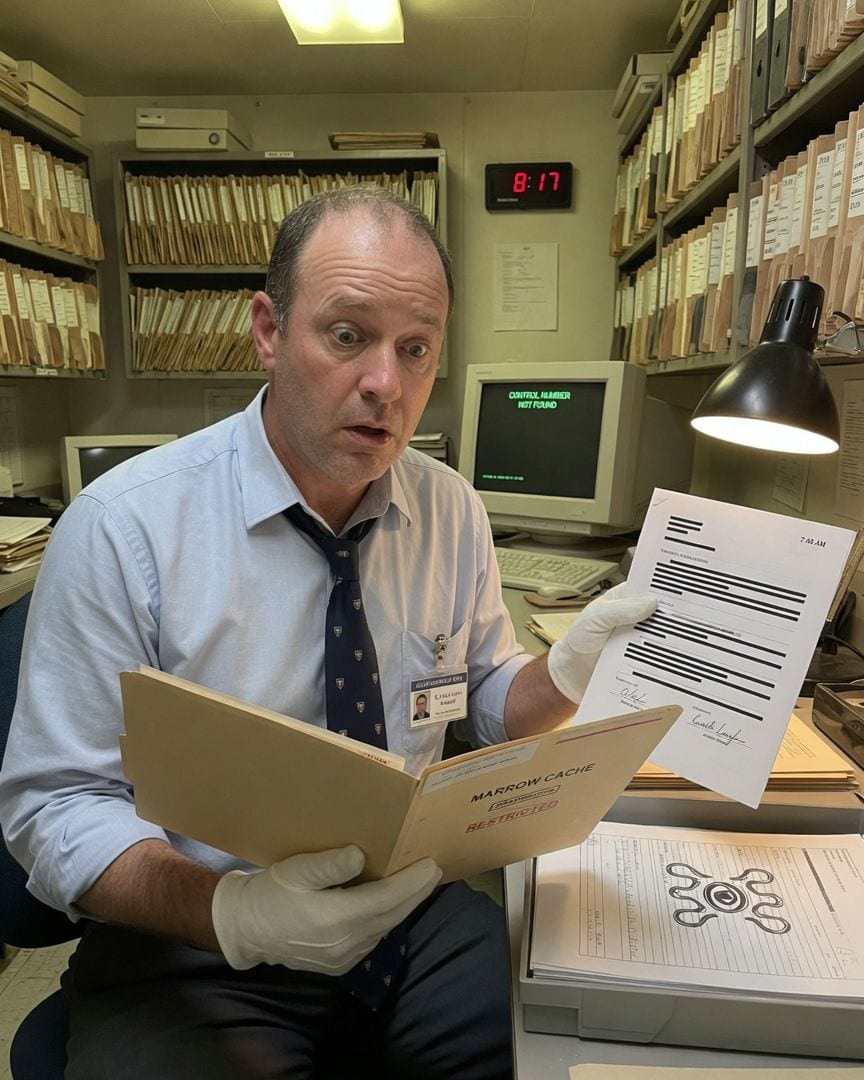
A records manager found a file extension signed at 7:48 AM. He hadn't clocked in yet, and a strange symbol pulsed in its redacted pages.
Corwin Vale, lead records manager for Fort Ruthven, lived by routine, his world precise and ordered. This morning, however, that order shattered when he found the Marrow Cache file's extension signed at 7:48 AM. Corwin had not clocked in until 8:00 AM, and the vault logs showed no other entry. As he reviewed the heavy file, he discovered its control number did not exist in any database. Then, deep within the redacted pages, a strange, geometric symbol pulsed faintly, an alien glyph etched into the classified paper. What impossible secret did the file hold?
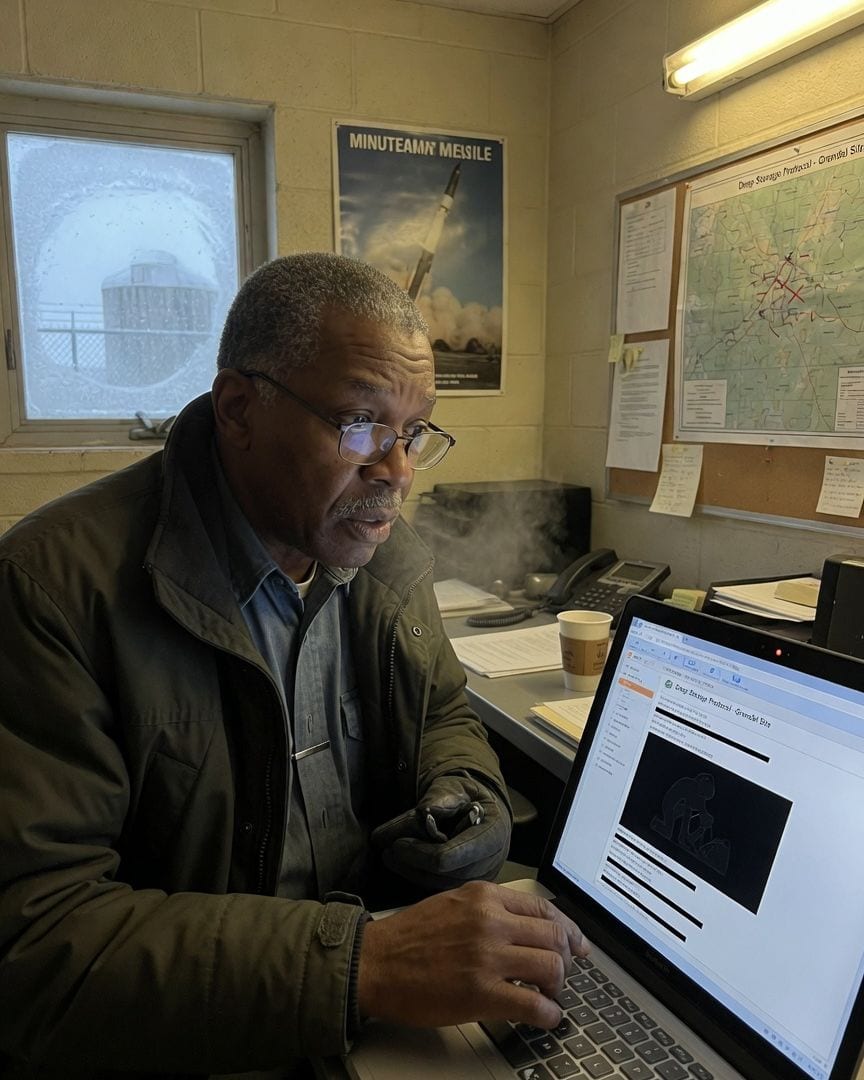
On his last cleanup before retirement, Colonel Marsalis found a dead Cold War missile silo's printer repeating: CREW STILL ON STATION.
Colonel Ren Marsalis, a career Air Force officer, faced his final administrative cleanup before retirement at the decommissioned Grendel Site in the biting North Dakota winter. He expected a sealed missile capsule, but Capsule 7's eight-ton door stood cracked open eleven impossible inches, its hydraulics removed in 1985. Inside, consoles glowed with static alerts from an unknown power source, while an old printer endlessly spooled paper repeating one chilling message: "CREW STILL ON STATION. ACKNOWLEDGE." This impossible communication, from a long-dead system, was no glitch; it hinted at a deliberate, hidden presence, a truth reinforced by a redacted document showing a hunched, humanoid shape.
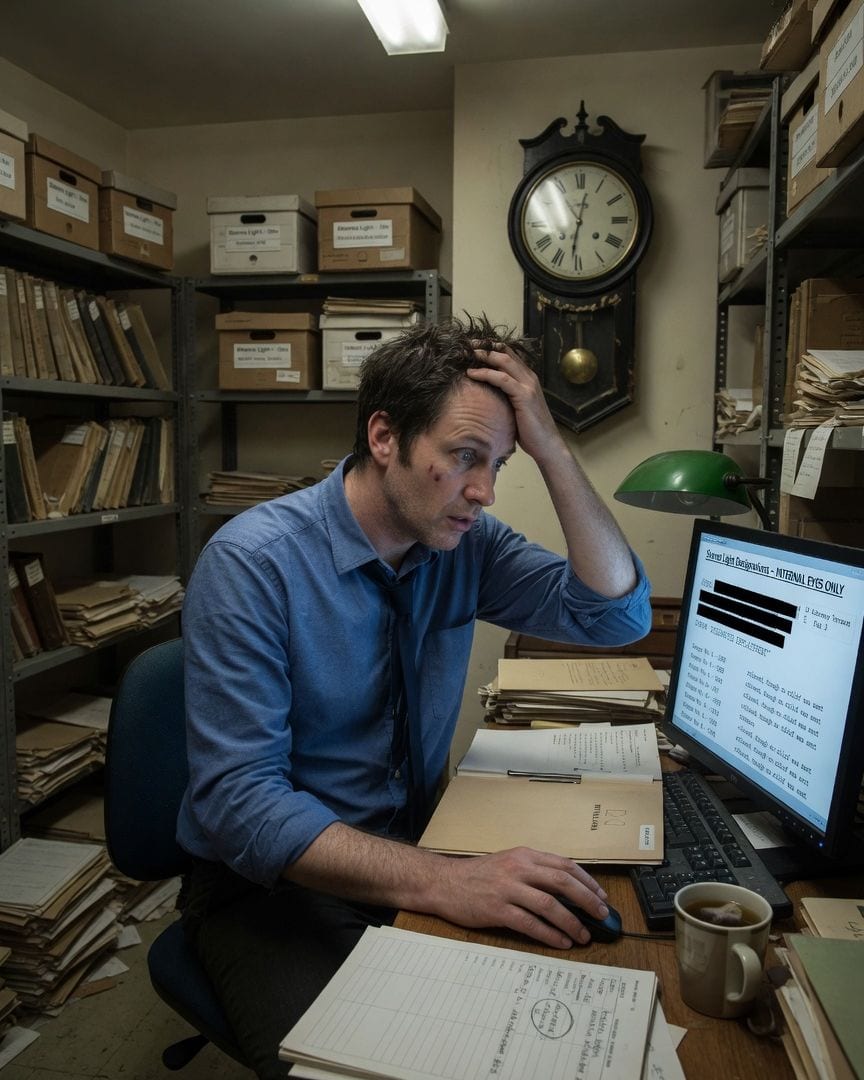
I found my street address in a century-old lighthouse file, printed decades before I lived there.
As a maritime archivist, my world revolves around forgotten lives and dusty ledgers. But the Skerne Light files broke that quiet rhythm, revealing a chilling pattern: 'Keeper number 6' relieved, though no relief was sent, repeating for decades. Now, an internal document with a strange code has led me to a redacted entry, revealing my own street address, decades before I ever lived there.
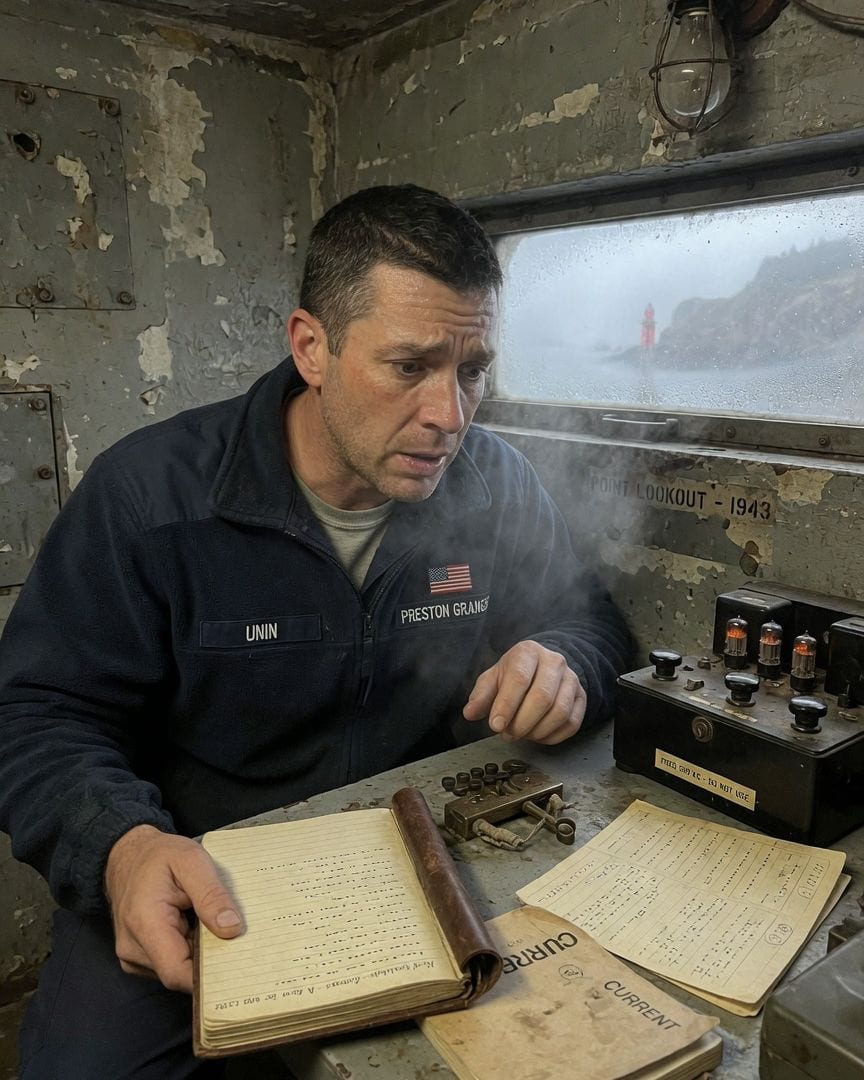
On his last night before the Coast Guard station closed, Corporal Granger heard a dead radio crackle with a Cold War convoy report for tonight – then found his own handwriting in a logbook that was decades old.
Corporal Preston Granger sat hunched in the old WWII bunker at Coast Guard Station Point Lookout, enduring his final shift before the station was permanently mothballed. The fog outside muffled the world, leaving only the distant boom of the sea until a faint burst of Morse code crackled over the antique relay set. The frequency had been dead for decades, yet the signal was a precise convoy sighting report for a shipping lane that hadn't seen a merchant vessel in forty years. The dread was a cold, hard knot in Preston’s stomach as he decrypted the message: 'CONVOY SIGHTED. GRID 4-B. ACKNOWLEDGE AND HOLD POSITION. POINT LOOKOUT. OCT 27.' Oct 27 – tonight’s date, his exact location. He later found a leather-bound logbook filled with identical entries spanning decades, and beneath the last one, dated October 27th, 2023, was his own unmistakable handwriting.
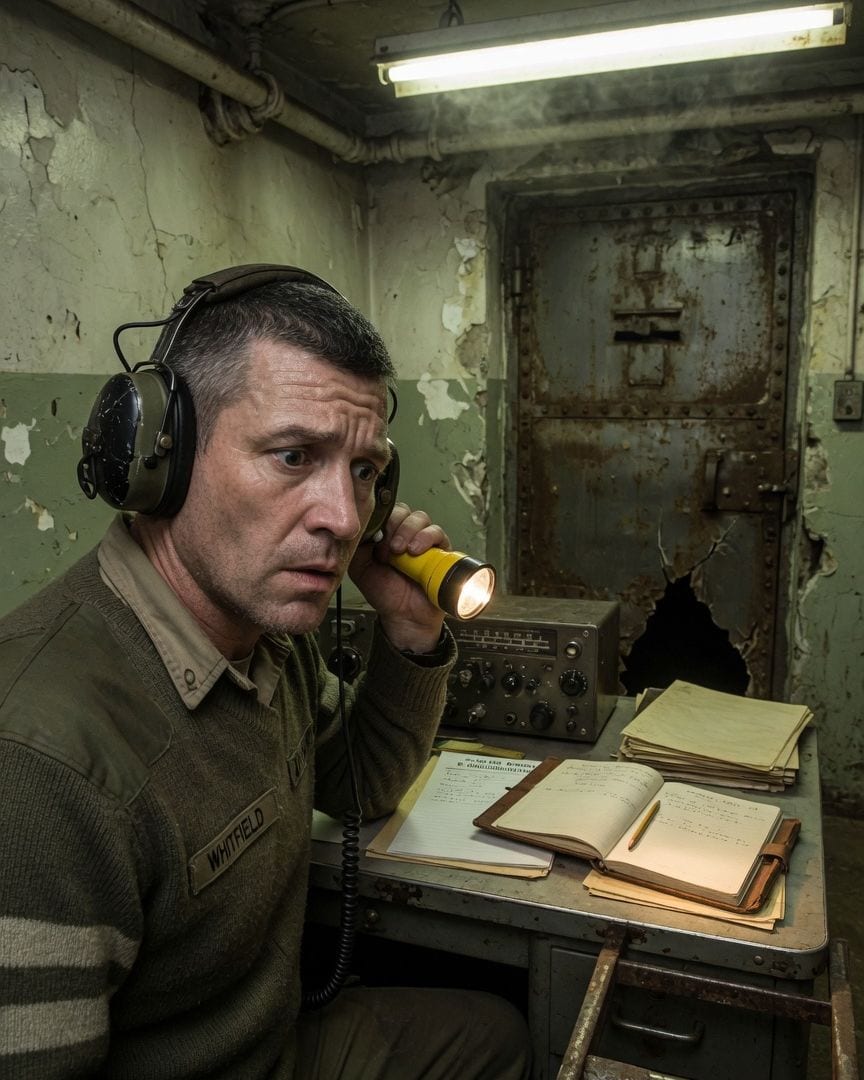
A corporal on his last watch picks up live Morse code from a shipping lane dead forty years. Then, tapping starts inside his sealed bunker.
Corporal Quentin Whitfield stood his last watch in the old coastal bunker, the facility winding down for good as thick fog muffled the sea below. His final sweep of archaic comms gear became anything but routine when a long-dead frequency crackled with live Morse code, a precise wartime transmission for a shipping lane unused in forty years. He decrypted the impossible message, a convoy sighting for his own bunker dated today, complete with an unsettling instruction: 'DO NOT RESPOND TO IRREGULARITIES ON LINE.' As if on cue, a faint, rhythmic tapping began from the bunker's sealed lower levels, growing louder behind a heavily rusted door with a fresh, ragged crack. A darker-than-dark outline pulled back from the opening as his light hit it, leaving only impenetrable blackness beyond.
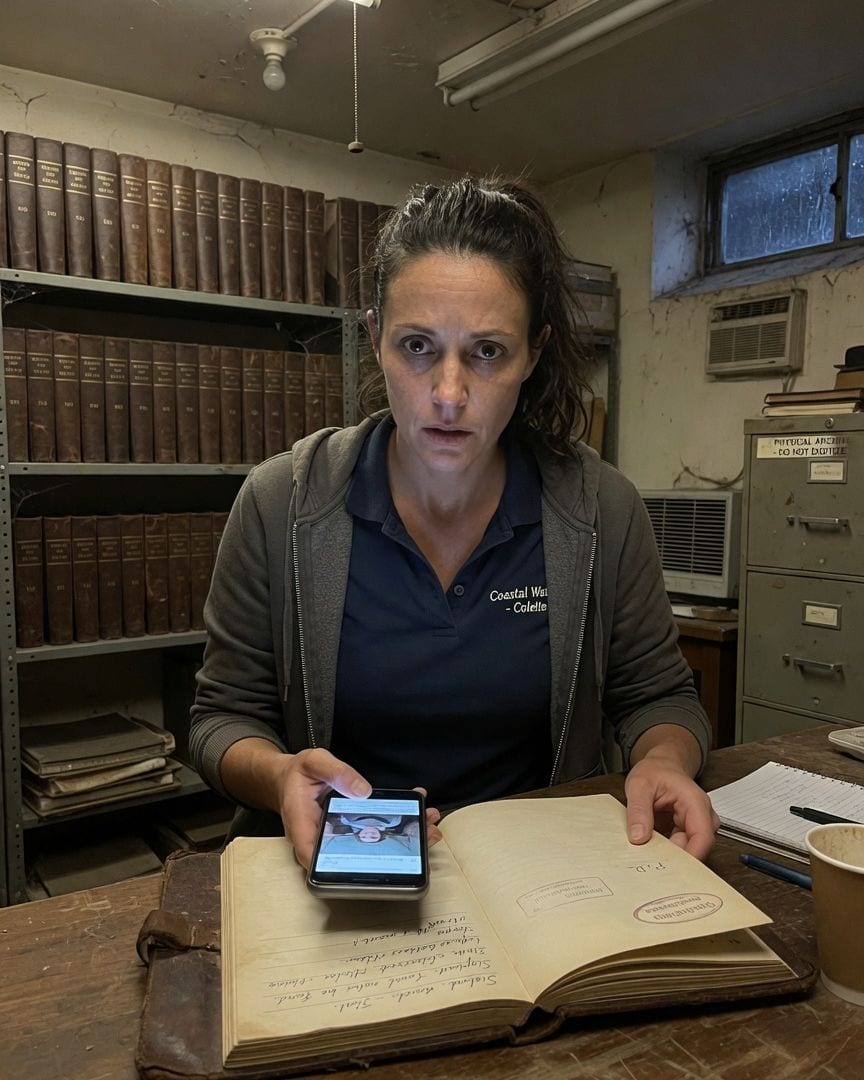
My coastguard log noted Sighting 9 again tonight, a light where no vessel showed. The old logs carry Sighting 9 off Skerry Point at 3:14am every tenth year since 1954, always 'nothing found,' always 'send no boat.'
On my watchtower night shift, the radar screen glowed green and the ocean was quiet. Then, a familiar light appeared off Skerry Point, exactly on cue, just as it had every tenth year for decades. But digging deeper, I found a hidden stamp in an old logbook: 'Operation Skerry. Status: Complete.' It left me with a chilling sense of finality.