My painted-shut window opens itself two inches every dawn, balanced top and bottom like a sickroom. I close it. It opens.
I woke to the familiar chill in my front room, a cold draft that seemed to defy logic.
The sash window, which I had meticulously painted shut in late autumn, stood open exactly two inches, top and bottom balanced, like a window aired for a sickroom.
The paint seal I’d so carefully applied was cleanly cracked along the join, a thin, stark line of white against the older, yellowed frame.
I closed it, pushing against the slight resistance of the old wood, hearing the firm click of the latch I’d tested countless times. It was secure.
I even ran my fingers over the paint, feeling for any weakness, but it felt solid again. A trick of the old house, I told myself. A settling.
But the next morning, as the first grey light filtered through the curtains, the chill was back, and the window was open again, exactly two inches. The paint crack was there, pristine, as if it had never been sealed.
I checked for drafts, faulty latches, even structural shifts in the old house. I pressed a piece of tissue against the gap, watching for any movement that might indicate a subtle air current. Nothing. The window simply opened.
This impossible, silent defiance in the empty house I lived in alone became a daily ritual: close it, find it open. A quiet, unnerving violation of my new home.
I started setting my alarm earlier, just to be sure I was the first one up, the first to find it. Every morning, the same. Two inches.
The window’s impossible routine made me hyper-aware of my surroundings. I started noticing other small, consistent oddities, things I’d initially dismissed as quirks of an old property.
There was the faint but distinct smell of stewed apples that would permeate the kitchen on Tuesday afternoons. Not every Tuesday, but most.
Even after I’d cooked nothing for days, after I’d scrubbed the counters, checked the drains, even bought new air fresheners, the scent persisted, fading by Wednesday, only to return the following Tuesday. It wasn’t strong, just…present. Like an echo.
Then there was the worn floral armchair in the living room. It always seemed to have a deeper, fresher impression on its left armrest, as if someone had just risen from it, always resting their arm in the same way.
I tried sitting in different positions, leaving cushions strategically placed, even draping a blanket over it, but the impression would return, a silent testament to an unseen occupant.
I told myself it was just the stuffing settling, or the way the light hit it, but the consistency was what got to me. It wasn’t random.
But the most unsettling was the third stair on the main staircase. It wasn't creaky or loose; I'd checked that, too.
But the dark, polished wood on either side of it was noticeably more worn, as if decades of feet had consistently stepped around it, never on it. The grain was smoother, the varnish thinner in a precise arc.
I, rational to a fault, tried to explain it away: old house quirks, maybe a bannister post made it awkward to step directly on it, an optical illusion.
I even made a point of stepping firmly on the third stair myself, feeling nothing out of the ordinary, yet the feeling of avoidance, of a precise, unvarying routine I wasn't a part of, tightened in my chest.
The dread wasn't in what I saw, but in the coherence of things I couldn't explain.
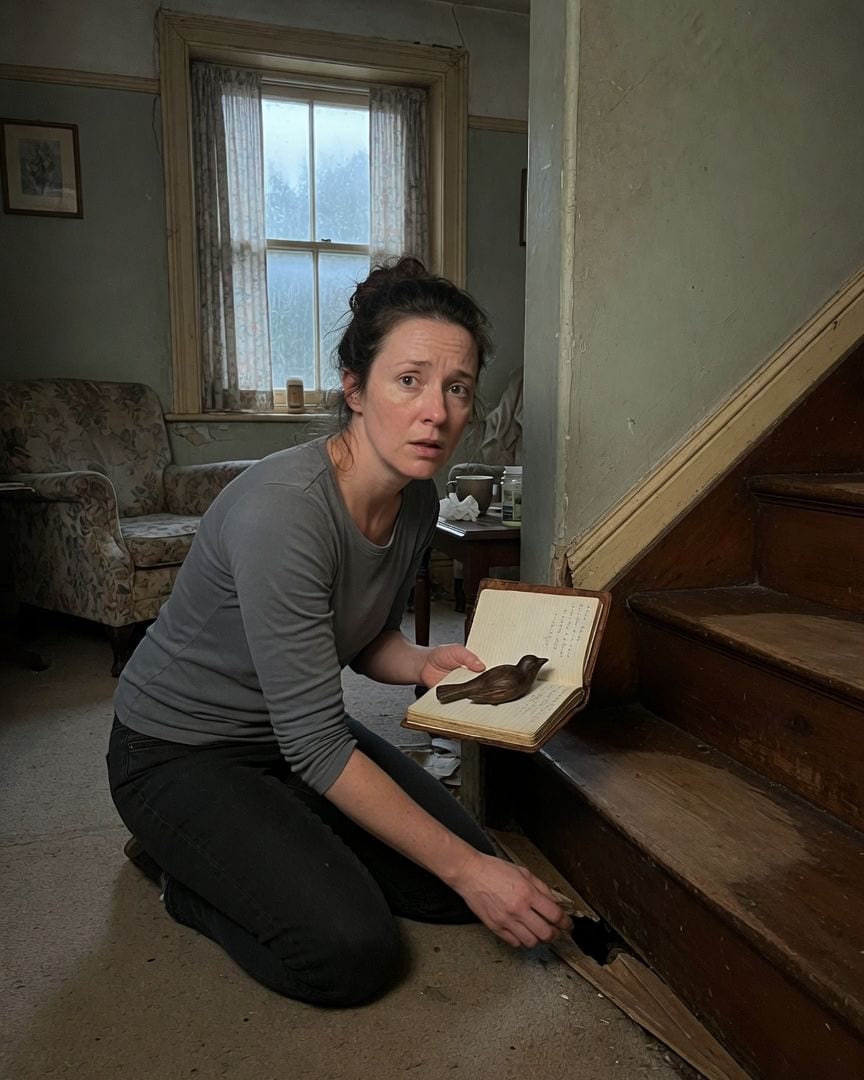
Determined to find a mundane explanation for the worn stair, I knelt beside it one afternoon, running my hand along the baseboard, feeling for loose plaster or a hidden cavity. My fingers snagged on something.
A small section of the floorboard, just beneath the third stair, gave way with a soft creak, revealing a hollow. Inside, tucked neatly, was a small, leather-bound book, its cover faded but intact, clearly a diary.
As I pulled it out, a small, intricately carved wooden bird, dark and smooth from handling, fell from between its pages, landing softly on the carpet. I stared at the small, leather-bound book, my heart thudding.
Its pages were filled with neat, looping script. My fingers, trembling slightly, traced a date from decades ago, then the words: '6 AM. Window. Two inches. For Lily.'
The diary belonged to Margaret Sullivan, the previous owner. I spent hours, late into the night, deciphering Margaret's elegant but often cryptic handwriting. The early entries detailed mundane routines, then slowly, the patterns I had noticed began to emerge.
Margaret meticulously recorded the window airing, the avoidance of the third stair, the stewed apples on Tuesdays.
The entries were filled with a quiet, persistent grief centered around 'Lily's illness,' describing her young daughter, sickly, who spent much of her last years in the front room—which was Lily's bedroom.
I felt a cold shift in my understanding; these weren't random quirks, but the indelible imprints of a grieving mother's life, replaying themselves decades later. The rational explanations crumbled away.
I decided to seek out Gordon Beaumont, an elderly neighbor who had lived next door for decades. Under the guise of asking about the house's history, I subtly introduced the 'old routines' I'd noticed.
"You know, the house has some interesting quirks," I started, trying to sound casual. "This front window, for instance. It seems to have a mind of its own."
Gordon, a kind but reserved man, spoke fondly of Margaret, describing her as 'a creature of habit.' He smiled. "Oh, Margaret. Yes, she had her ways. Kept that house just so."
But his eyes flickered with discomfort when I mentioned the window and then, more directly, the oddly worn third stair. "And the third stair? Funny how worn it is on either side, like someone always stepped around it."
He quickly dismissed them as 'Margaret's ways, nothing more,' changing the subject with a forced cheerfulness that didn't quite reach his eyes. "Just an old house settling, I suppose," he said, clearing his throat.
"She always loved her garden, you know. Used to talk to the roses." His evasiveness only deepened my suspicion that there was far more to Margaret’s habits than simple grief, and that Gordon knew it.
As I delved deeper into Margaret's diary, I noticed subtle changes in the house itself, a heightened awareness of its presence. The smell of apples was stronger, more frequent, almost cloying, sometimes now even on Thursdays.
The worn armchair now seemed to hold a deeper, fresher impression, as if someone had just risen from it moments before I walked into the room. Sometimes I’d catch a faint warmth on the fabric, quickly gone.
I started closing doors, just to see if they’d open. They never did, but the house felt… awake.
One evening, I was engrossed in a particularly poignant entry in Margaret's diary about Lily's last days, sitting in the very front room that had once been Lily's bedroom. The room felt colder than usual.
I heard a faint, dragging sound from the hall, like something being moved carefully across the floorboards, followed by a soft, rhythmic tap, tap, tap. My blood ran cold. I froze, listening, my breath held. The sounds stopped.
The silence that followed felt heavy, expectant.
Heart pounding, I slowly, silently, walked to the hall. The third stair, the one always avoided, now had a single, small, intricately carved wooden bird resting precisely in its center.
The same bird I had found tucked within the diary's pages. It was facing me, its tiny, smooth eyes seeming to watch.
I felt a prickle on my skin, a cold certainty that my investigation had been noticed, that the house was responding, perhaps even guiding me, or warning me.
I was no longer just uncovering history; I was part of its continuation, an unwelcome participant in a routine that was not mine.
Shaken by the bird on the stair, I returned to Gordon Beaumont, pushing harder this time. I showed him the diary, its pages open to Margaret's entries about Lily.
"Gordon," I said, my voice tight, "Margaret mentions Lily's illness, but these routines… the window, the stair, the apples. They feel like more than just grief. Was there something else?"
Gordon sighed, his gaze distant, fixed on a point beyond me, out the window and into his garden. His hands, gnarled with age, gripped the arms of his chair. "Margaret… she changed after Lily. Not just grief, no.
She said the house… it was taking her. Not the illness, not really." He spoke in a low, hesitant voice, describing Margaret's growing conviction that the house had a 'presence,' a quiet, draining force that fed on Lily's fading life.
"She started these… rituals. The window, the stair, the apples. Said she was trying to keep it calm. To give it something else to feed on, or to keep Lily's spirit… contained. Safe."
He shook his head, clearly uncomfortable, but the dam had broken. "She thought it wanted Lily. Thought it took her."
I flipped through the diary, rereading entries about the window airing, the carefully placed objects, the 'avoidance' of certain spots.
It all clicked into place with a horrifying coherence: the window wasn't just for air; it was to let something out, or perhaps in, a deliberate act, a part of a negotiation.
The stair wasn't just avoided; it was a boundary, a weak point, a place Margaret couldn't risk stepping on, a way for her to keep it from crossing. The apples, an offering, meant to satiate, to distract.
Margaret wasn't just remembering Lily; she was fighting a quiet, desperate war against the house itself, a war she ultimately lost. The house isn't just a memory; it's an active, subtle entity, and Margaret's routines were its feed, its tether.
I felt a profound chill that had nothing to do with the weather.
Back in the house, the weight of Gordon's words settled over me, a cold, suffocating blanket. The air in Lily’s old room felt heavy, almost viscous.
I returned to Margaret's diary, finding later entries, their script more hurried, almost frantic, the elegant loops giving way to jagged lines that clawed across the page. Margaret's quiet grief had morphed into terror.
She wrote of the house 'watching,' 'listening,' and 'demanding.'
I read, my blood running cold, about Margaret's increasingly desperate attempts to 'contain' the house's hunger, to 'distract' it, to save what little of Lily remained, to prevent 'it' from taking more.
The language shifted from 'Lily's room' to 'the room where it waits.'
The small wooden bird, Lily's last comfort, was mentioned repeatedly as a key component in a specific 'offering' ritual, meant to 'bind' the presence, to create a momentary barrier.
My eyes scanned the page, my heart thudding, as Margaret described leaving the bird in specific places, performing specific gestures to 'bind' the presence, to 'sate' its appetite. I closed the diary, my breath catching in my throat.
The last entry, scrawled almost illegibly, read: 'It took her, piece by piece. My routines were never enough. It's still here, and it’s always hungry.'
I looked up at the front room's sash window, now shut, and saw a faint, almost imperceptible condensation on the inside pane, forming a small, familiar bird shape.
The bird-shaped condensation was the final, chilling piece of the puzzle. I realized the house wasn't just replaying Margaret's routines; it was acting them out, using the traces of Lily and Margaret as its tools, its physical manifestation of a lingering hunger.
The window opened not just as a memory of airing a sickroom, but as an ongoing 'breath' of the entity, a subtle invitation or release. It needed to be closed, but it also needed to open.
The avoided stair wasn't just Margaret's habit; it was a point of weakness, a place of passage the entity could use, which Margaret tried to block with her ritualistic sidesteps.
The stewed apples weren't just a comforting smell; they were a forgotten offering, a sensory appeasement, a way to keep it docile.
And the small wooden bird, Lily's last comfort, wasn't just a memento; it was a conduit, a focal point for the house's lingering hunger, a way for it to show its presence, to beckon, to mark its territory.
I understood that Margaret's routines were not just for Lily, but for the entity itself, a complex system of appeasement and containment that ultimately failed.
The house had claimed Lily, not through illness, but through a slow, imperceptible draining of life, and Margaret’s life became a desperate, losing battle to keep it sated or confined.
The house, now, was doing the same to me, drawing me into its cycle, its memory of hunger and appeasement, making me the new, unwilling participant in its deadly routine.
The bird on the windowpane was not a sign of Lily, but a sign of it, showing its presence, a subtle, cold trace, a hunger. Every clue, every strange detail, clicked into a terrifyingly coherent pattern.
I knew, with absolute certainty, that I could not stay. The house was a trap, a slow consumption, and I was already being drawn into its cycle.
I moved with a frantic, focused energy, not bothering to pack clothes or belongings, but gathering only the proof: Margaret’s diary, the small wooden bird, photos I’d taken of the opened window, the worn stair, anything tangible.
I knew no one would believe me, but I needed this physical evidence for myself, to validate the terrifying truth I now carried. I shoved the diary and the bird into my small messenger bag, my phone in my pocket.
As I attempted to leave, the house seemed to resist. The front door, usually easy to open, felt inexplicably heavy, stuck fast in its frame. I pushed, but it wouldn’t budge.
A faint, almost imperceptible whisper seemed to emanate from the walls, a sound like a child's sigh, or a soft, dragging breath that raised the hairs on my arms.
The air in the hall grew cold, not just a draft, but a bone-deep chill that held me in place.
I shoved against the door with all my strength, the whisper growing louder, more insistent, a cold draft swirling around me, seeming to pull me back inside.
I felt a profound reluctance, a strange, overwhelming pull to stay, to continue Margaret's routines, to become the new guardian of its hunger. The house wanted me.
With a final, desperate, guttural shove, the door burst open, tearing free from its frame with a splintering crack that echoed like a scream.
I tumbled out onto the porch, gasping, the diary and bird clutched tight in my messenger bag. I didn't look back, didn't hesitate, running blindly to my car, the cold whisper fading behind me, but not entirely gone.
I drove away, leaving the house behind, but knowing I carried its memory, its terrible truth, within me.
I never returned to the house. I sold it, quickly, at a significant loss, providing no explanation to the bewildered real estate agent beyond 'personal reasons' and a vague mention of it being too old for me.
The new owners, a young couple with two small children, moved in, unaware of the subtle, persistent hunger within its walls.
I tried to put it behind me, to rationalize the diary, Gordon's reluctant words, the impossible bird on the stair. To convince myself it was all just a story I'd pieced together from a lonely woman's grief.
But the knowledge, the cold, coherent dread of it all, clung to me.
I kept Margaret's diary and the small wooden bird hidden away in a locked box, tangible proof of a truth too impossible to share, too terrifying to forget.
Sometimes, in the quiet of my new, smaller apartment, I still feel a faint chill, a phantom draft I can't place. I find myself checking the windows, double-locking them, a habit I never had before.
I avoid certain stairs in public buildings, a subtle, unconscious sidestep I can't explain, but which my body remembers. The memory of the house, of its quiet hunger, never truly left me.
I know what I saw, what I felt, what I escaped. The proof is locked away, but the understanding is embedded in my bones, a cold, persistent ache. The house remembers, and now, so does she.
The window still opens, sometimes, in her dreams, a quiet, insistent breath. She never airs her own bedroom, not even on the hottest days. She can't.
I carry the house's memory now, a cold draft that never quite closes.
If this one got to you
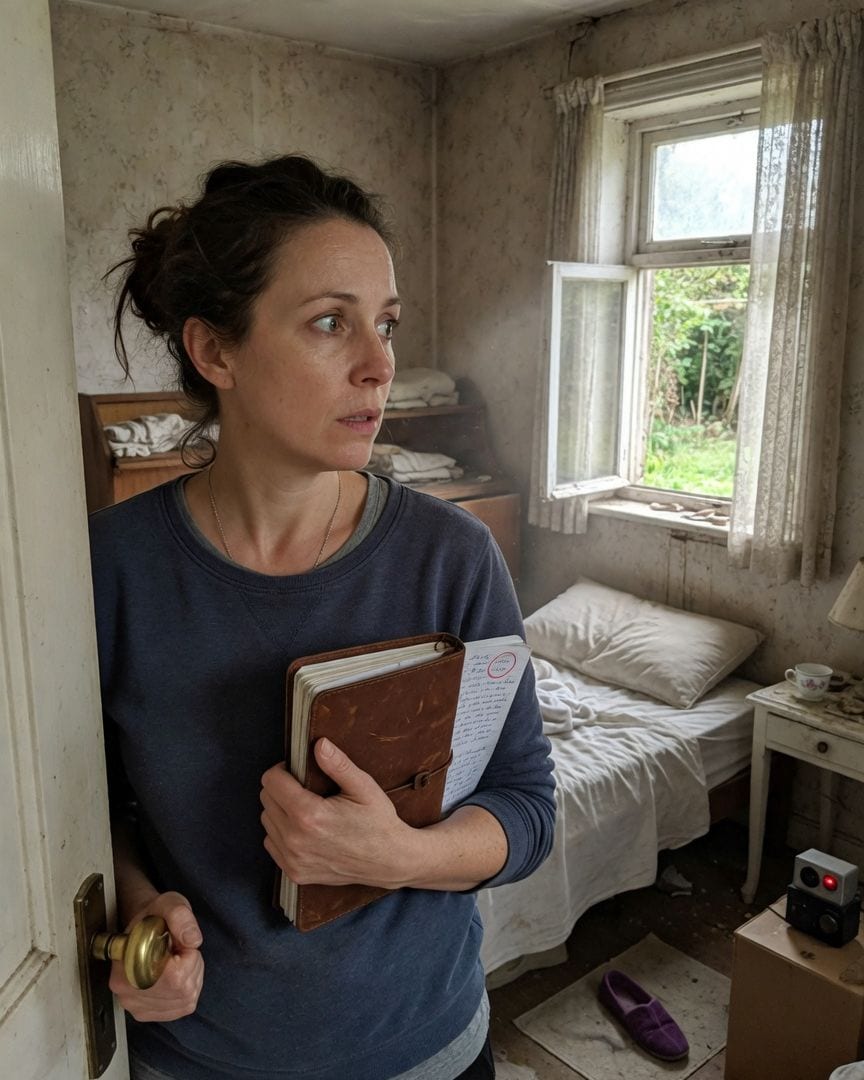
My spare room bed is slept in every few nights, sheets warm and pillow dented. I live alone, painted the window shut, and nobody has a key.
I've lived in Grace's house for six months, adjusting to its quiet rhythms. But the spare room, which I keep shut and empty for storage, has a disturbing routine of its own. Every few mornings, the bed is clearly slept in, the sheet rumpled and warm, and the window I painted shut is open exactly two inches.
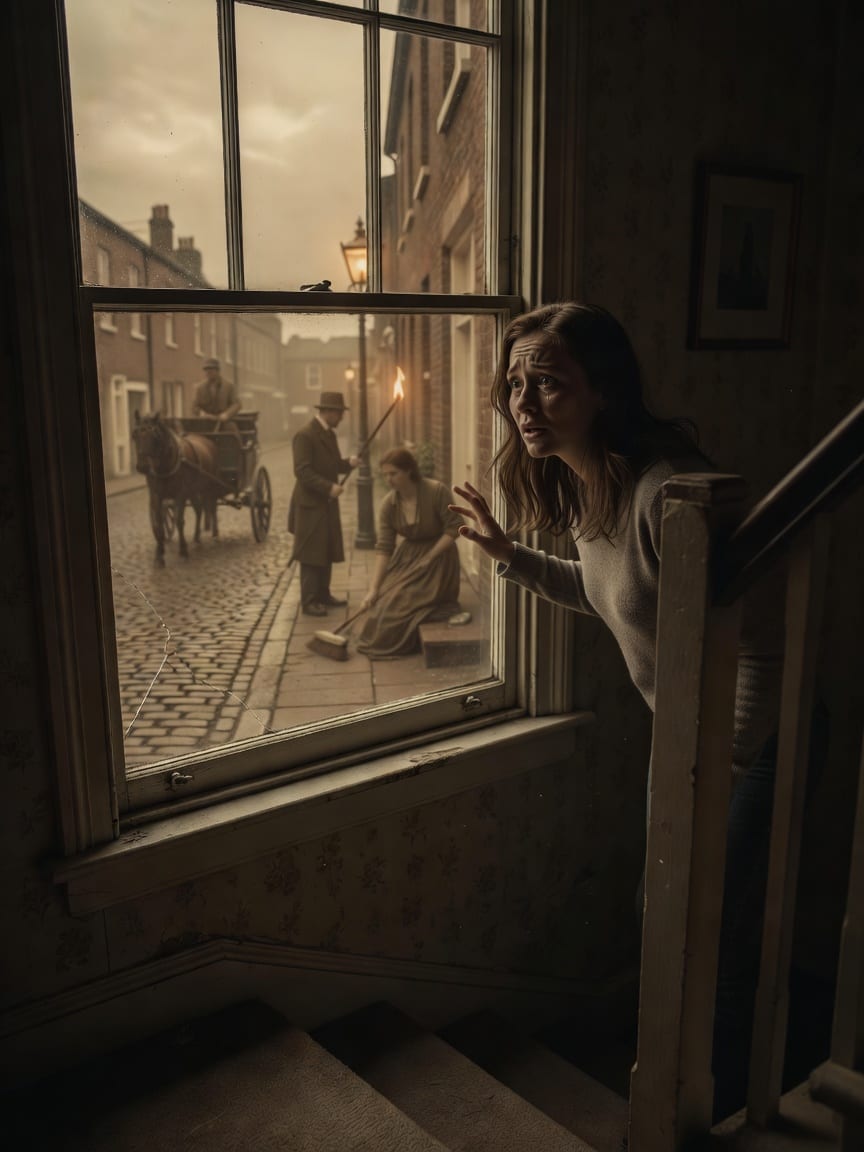
My half-landing window looked down on a cobbled street, a horse and cart. My panes, same crack. Below, only the bins.
I moved into this inherited house for a fresh start, living alone in the quiet. But the third stair on the main flight is deeply worn, a ghostly scoop hinting at decades of unseen footsteps. It feels hollow, and the wall beside it hides a faint, inexplicable seam.
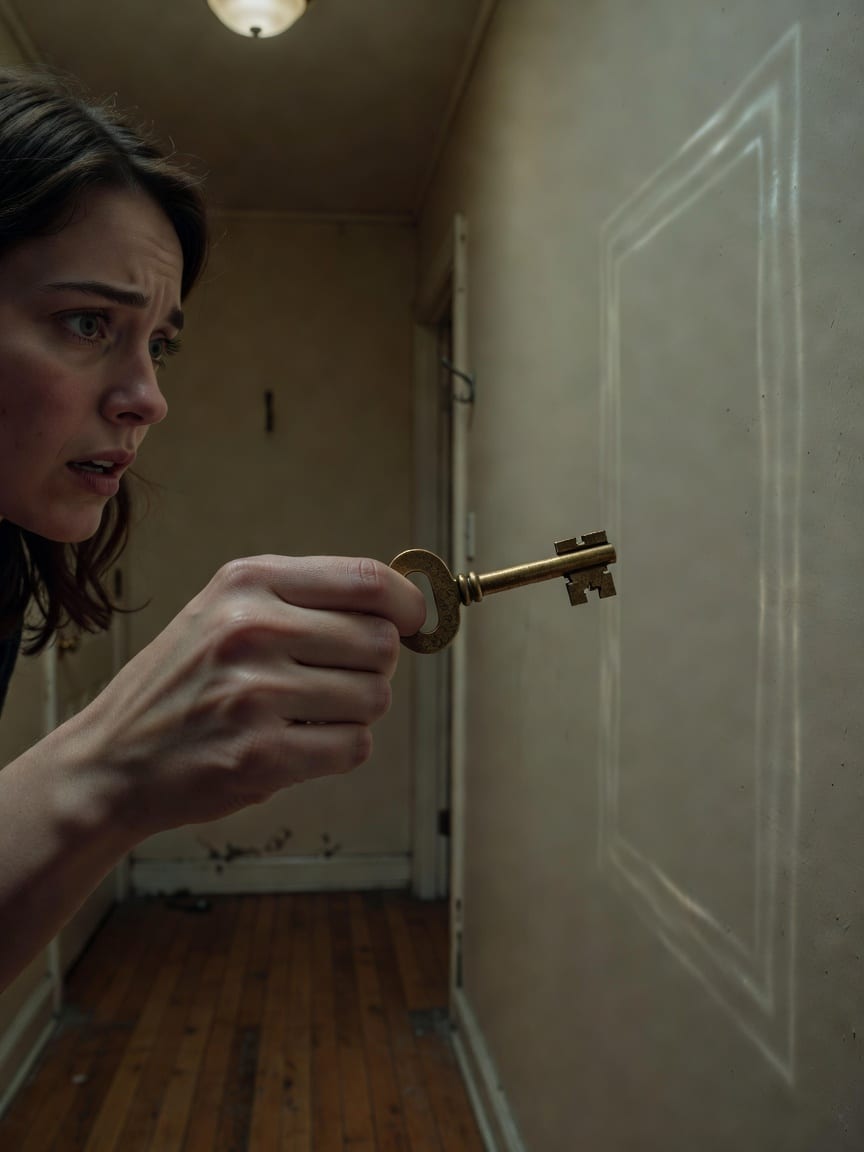
My new house has seven rooms. The removal men counted six. Now one of them asks who's in the locked seventh, on a landing with only six doors.
Moving into my new house, I supervised the removal men hauling boxes. But on the landing, Paul, the senior man, asked about a locked seventh room upstairs, pointing to a blank wall. His quiet certainty, despite the clear absence of a door, filled me with a sudden, icy dread.
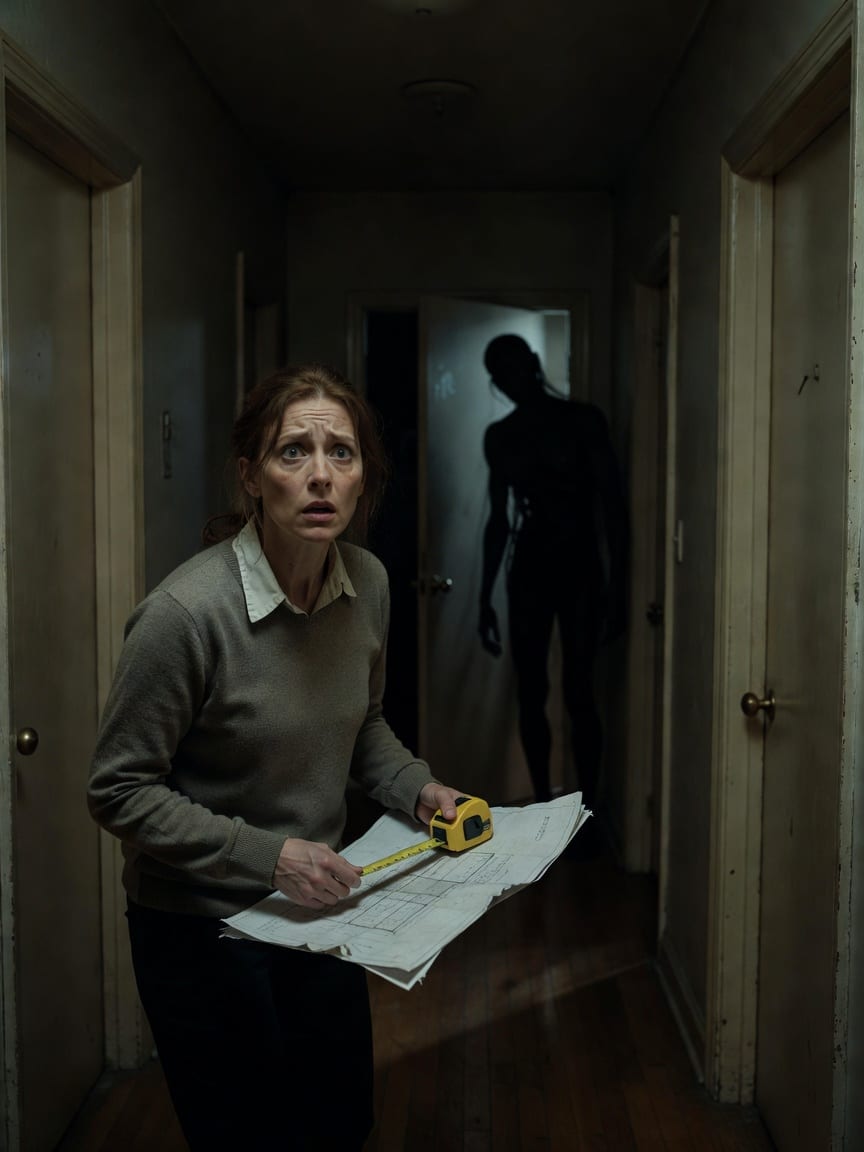
My front door has a dented gate and a dead hydrangea. I walked past it six times, trying to reach the corner shop just a hundred yards away. The pavement kept bringing me back to my own porch, and the shop's light never moved.
My morning started like any other, a quick walk to the corner shop from my home at Number 14, Elm Terrace. But after walking what felt like two minutes, I found myself back at my own front door, the shop no closer. I tried six times, faster and slower, but my street kept compressing, refusing to let me leave.
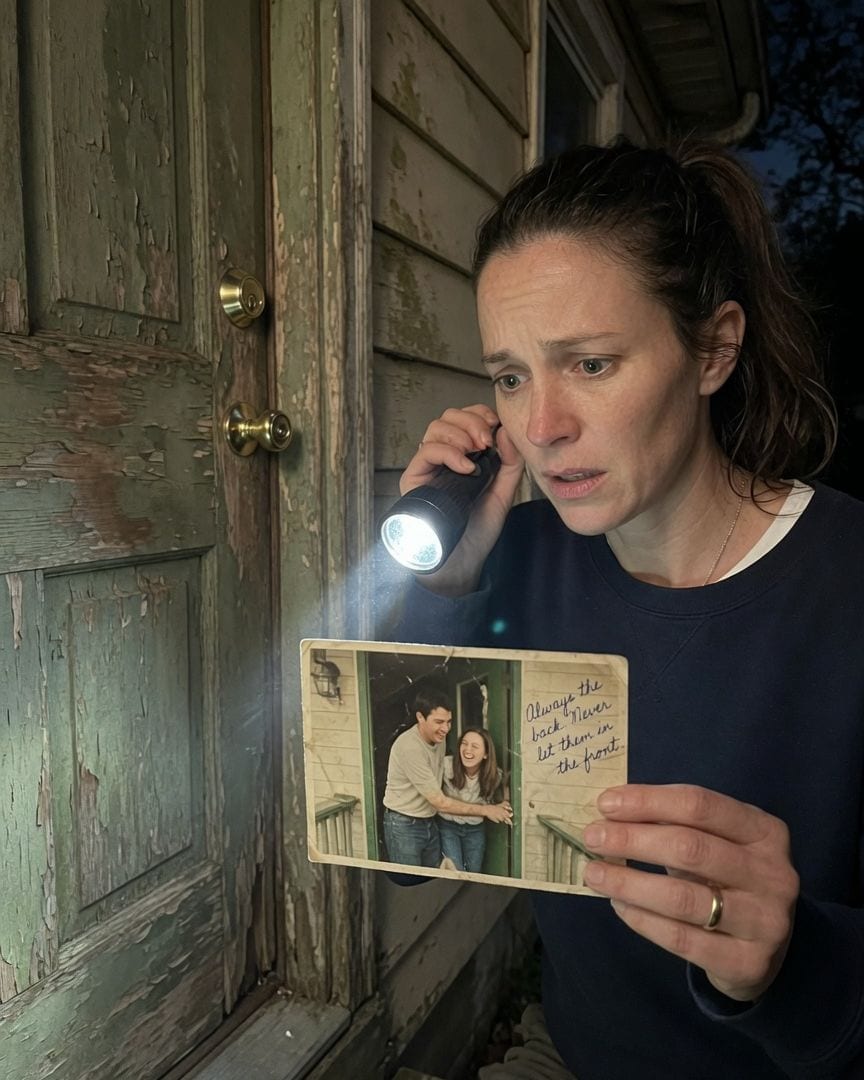
My mother waves us to the front door now. She was missing five days. She says we've always used the front, but the back door, our kitchen door for thirty years, is locked.
My mother, Janet, finally came home after five days, but her overly bright smile and insistence on using the front door felt wrong. For three decades, our family always used the back entrance, which now had a gleaming, new deadbolt. The quiet hum of unease quickly grew into a chilling dread.
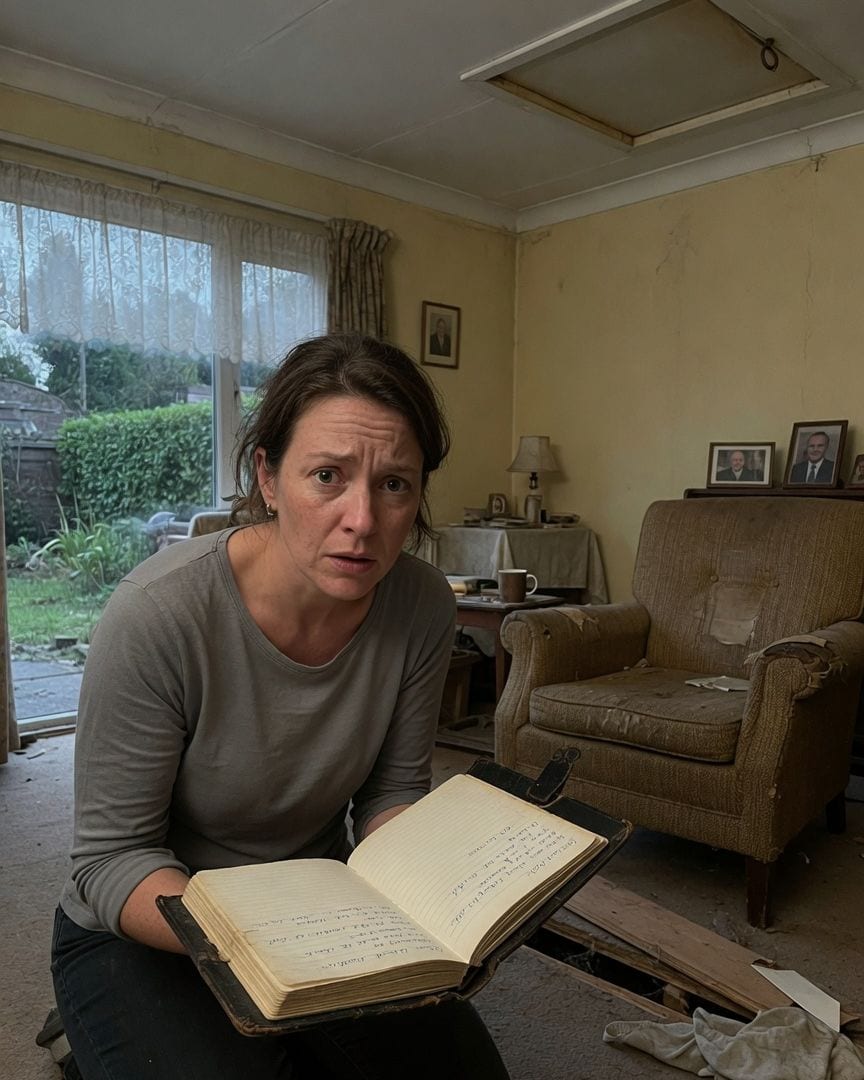
My loft hatch is sealed with paint, but every night a trunk scrapes across the floor above my bed, then a chair settles. I have the only ladder.
Living in my great-uncle Ralph's inherited house, I've grown used to the usual creaks. But above my bed, behind a sealed loft hatch, distinct sounds begin nightly: a heavy trunk dragging, then a chair scraping as if someone sits down. I live alone, and the sounds are too deliberate, too regular, for an empty house.