A patrol leader's final count at Cold War Firebase Kestrel found four men. A raspy fifth voice answered, 'Five.'
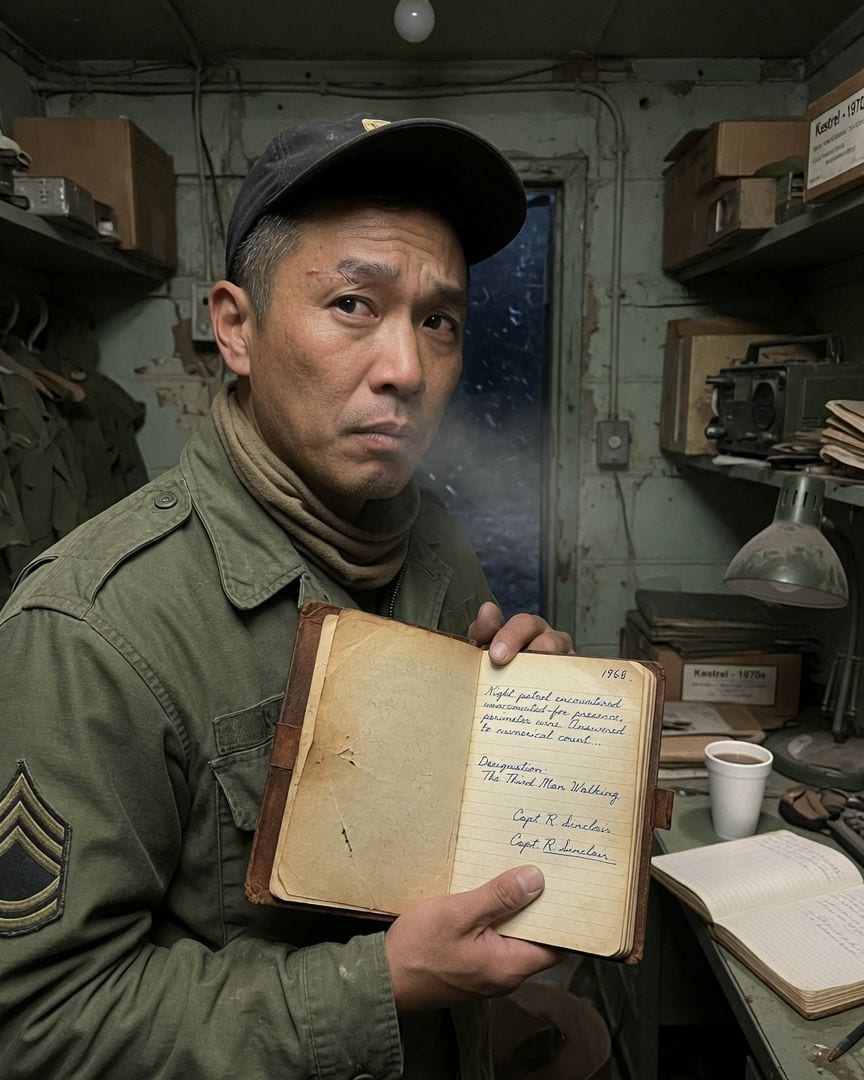
Sergeant Julian Aoki, a career NCO whose life was built on order, kept his voice low against the biting wind.
The relief column was due at dawn, and his four-man patrol was making its final sweep of Firebase Kestrel’s perimeter wire.
The remote outpost, perched on a desolate, windswept plateau, was days from being decommissioned, and Aoki was determined to leave it with a clean manifest.
At the halfway mark, he called out the numbers, a habit ingrained from years of training. "One, two, three, four." A fifth voice, raspy and barely audible over the wind, answered, "Five." Aoki paused, his breath fogging.
He knew his team: PFC Greg Maddox, Specialist Nora Patterson, Corporal Richard Vance. Four men. He counted again, slower, scanning the dark forms ahead, the wind whipping at his collar as if trying to carry away his words.
"One, two, three, four." No "five." He felt the hair prickle on his neck.
He chalked it up to fatigue, the wind playing tricks, but as they continued their patrol, a fifth set of heavy boot prints appeared in the thin layer of dust beside his own, matching his stride for stride.
It kept station just off his right shoulder, a silent, invisible companion, all the way back to the wire. He did not count again.
Back inside the relative warmth of the command post, Aoki poured himself a lukewarm coffee. His team was accounted for, all four of them.
He checked the patrol log, his signature neat and precise next to the entry for his four-man team. He reviewed sensor readings, thermal scans – nothing. Just the four men.
He tried to dismiss the incident, but the cold certainty of those five boot prints, and the phantom voice, gnawed at him. He remembered the old hands’ whispers: 'Never count heads aloud, and never name the third man walking.'
Superstition, he’d always thought. But now, the silence of the command post seemed to press in on him, amplifying the memory of that unnatural whisper. It felt less like a myth and more like a warning.
Aoki began to search, not for ghosts, but for anomalies in the system.
His methodical mind led him to a disused supply closet tucked behind the comms array, rarely opened, its air thick with dust and the smell of old paper.
The closet door creaked open reluctantly, complaining on rusted hinges as if it hadn't been disturbed in years. Buried beneath a stack of decaying field manuals, he found it: a heavy, leather-bound logbook, its cover worn smooth, no official markings.
It felt impossibly old. He wiped the dust from its pages and saw faded, cramped handwriting. The entries detailed perimeter patrols, supply runs, and unusual incidents, all specific to Firebase Kestrel.
One entry, dated 1968, described a 'night patrol encountered unaccounted-for presence, perimeter wire. Answered to numerical count. Designation: The Third Man Walking.'
The entry was signed by a 'Captain R. Sinclair,' a name Aoki didn't recognize from any official roster for Kestrel. The mundane explanation—a clerical error, a prank—was failing. This book was something else entirely.
Aoki flipped through the unofficial logbook, the pages rustling softly, the faint scent of mildew and aged paper filling his nostrils. Entry after entry detailed similar encounters, spanning decades.
'Unaccounted for entity observed matching patrol cadence,' read one from 1975, the ink a lighter shade of sepia. Another, from 1988, spoke of 'a fifth presence in the count, then gone.'
The details were too specific, too consistent to be coincidence or independent pranks. The sheer volume of entries, each meticulously recorded over generations, lent them a terrifying gravity.
He found another entry from 1968, meticulously describing a four-man perimeter patrol, identical to his own, right down to the specific sector of the wire. And then the chilling line: 'Acknowledged numerical count, maintained station off patrol leader's right flank.'
Sergeant Aoki stood frozen, the dust-caked, leather-bound logbook open in his hands, its faded ink describing a 'third man walking' on a perimeter patrol, dated 1968.
He stared at the signature beneath the entry: a name he didn't recognize, but the detail of the patrol was unmistakable.
He felt a cold dread, not from the words, but from the sudden, chilling thought that this book wasn't a record of the past, but a blueprint.
The relief column was hours away, but Aoki couldn't focus on preparations. The logbook had taken root in his mind, its strange history unfolding like a phantom map.
He spent the next few hours cross-referencing names and dates from the unofficial log against Kestrel’s official records, both digital and paper.
The comms room, usually bustling, seemed to hold its breath around him, the low hum of the equipment a constant, unsettling drone. Captain R. Sinclair? No such officer ever commanded Kestrel.
Other names in the logbook — a 'Specialist Maddox' in 1978, a 'Sergeant Vance' in 1985 — bore an uncanny resemblance to his own team's surnames, but the given names and service numbers were different, and their dates of service didn't match.
The more he searched, the less sense it made, yet the more undeniable the pattern became.
He tried to broach the subject with Vance and Patterson, casually mentioning old Kestrel legends, but they dismissed it as 'ghost stories for the new guys.' Vance merely chuckled, his attention on packing his gear.
Maddox, younger and more impressionable, looked uneasy but said nothing, his eyes darting to the shadowed corners of the room. Aoki knew he couldn't push it; he needed to remain credible, his discipline his only shield against the creeping irrationality.
He realized this wasn't a local legend, but something more systemic, something deliberately obscured. The logbook entries were too precise, the pattern too consistent across decades. He needed to get off-base, to access broader military archives.
Once the relief column arrived and the handover was complete, Aoki, citing a personal matter, requested a few days leave before his next assignment. His request was approved.
He drove the long, winding road down from the plateau, the logbook hidden in his pack, the desolate landscape outside the windshield mirroring his growing isolation.
He felt a growing sense of isolation, carrying a truth nobody else seemed to acknowledge, a truth that defied the very order he swore to uphold.
The wind, which had been a constant companion at Kestrel, now seemed to whisper at the edges of his closed car windows. He knew he was chasing something far bigger than a local ghost story.
At Fort Dawson, a sprawling, anonymous base, Aoki navigated the labyrinthine corridors of the Army’s records facility. The fluorescent lights hummed with an almost audible exhaustion.
He submitted requests for personnel files, unit histories, anything that might shed light on the names and incidents in the unofficial log. His requests were met with polite, bureaucratic delays. Days stretched into a week.
He felt an unsettling sense of being observed, a phantom chill that followed him even into the brightly lit, sterile archives.
Archivist Pamela Doyle, a woman with kind eyes but an unyielding demeanor, seemed to take an unusual interest in his queries, often appearing at his workstation with 'helpful' suggestions that subtly redirected his research away from the more obscure files.
Her presence felt less like assistance and more like quiet supervision.
One afternoon, as he was poring over a microfilm reel, the dusty film rattling faintly through the reader, a low, raspy voice, startlingly familiar, whispered "Don't count" from just behind his shoulder. Aoki’s spine stiffened.
He spun around, his heart hammering against his ribs. The aisle was empty, lined with silent, towering shelves of forgotten documents. Doyle was at her desk, engrossed in paperwork, too far away to have spoken, her back to him.
He felt the phantom presence again, the cold dread from Kestrel, sharper now in the artificial quiet of the records room. He realized his digging was being noticed, not just by the living.
This wasn't just old records; it was live, active. He changed tactics, focusing on institutional patterns rather than specific names, searching for any protocol, any directive, however obscure, related to 'unaccounted-for' presences at remote outposts.
The database glowed with endless entries, a digital ocean of information. He found a single, cryptic reference in an old, declassified operations manual: 'Kestrel Protocol: Refer all non-standard sensory input to Section 7-Alpha, retired personnel.'
It was a dead end in terms of immediate access, but the mention of 'retired personnel' sparked a memory: Captain R. Sinclair, from the logbook. He wasn't in any active roster, but what if he was retired?
Aoki began searching for retired officers named Sinclair, specifically those with a 'R' initial and a connection to Kestrel's operational period.
Aoki found him: Colonel Albert Sinclair, retired, living a quiet life in a small town two states over. The 'R' in the logbook was for Robert, his middle name.
Aoki drove through the night, the unofficial logbook on the passenger seat, a silent, weighty companion. Sinclair lived in a modest house, surrounded by well-tended rose bushes, a beacon of normalcy that felt utterly alien after his week of disquiet.
He was old, his face lined with the wisdom of years, but his eyes were sharp and clear. He was surprisingly calm when Aoki introduced himself and showed him the logbook. Sinclair's gaze lingered on the worn leather.
"So, they still keep that old thing, do they?" Sinclair said, his voice raspy, a familiar quality to it that sent a fresh shiver down Aoki’s spine. It was the voice from the wire.
It was the voice from the archive. "Sir, what is this? The entries… they match what I saw at Kestrel." Sinclair sighed, a slow, deep exhalation, and invited Aoki inside.
The air in the living room was warm, smelling faintly of old books and potpourri. "It’s not what you saw, Sergeant. It’s what you were part of." He explained, slowly, deliberately, over a cup of weak coffee.
The truth unfolded with a terrifying banality. "Firebase Kestrel, and a handful of other similar sites, they’re… special. They have a permanent resident, you might say. An entity. Not alive, not dead, not human. Just… there."
Aoki listened, his rational mind reeling, grasping for an anchor. The floorboards of Sinclair's quiet home seemed to creak under the impossible weight of the revelation. "An entity, sir? Unaccounted for?" Sinclair nodded, his gaze unwavering. "Precisely.
The system, the military, it’s designed for accountability. Every man, every bullet, every minute. But some things, Sergeant, cannot be accounted for. So, the system adapted. We learned to account for the unaccountable."
He pulled out a worn, leather-bound volume from a locked cabinet – an official, classified record, its binding remarkably similar to the unofficial logbook Aoki carried. "This is the 'Sinclair Files.' My father started it. Then me.
It's the real log of Kestrel. It details the cycles, the manifestations, the… interactions. We don’t fight it. We don’t understand it. We just document it. It’s a fixed variable in the operational cycle of those sites."
Aoki felt the floor drop out from under him. The world he knew, built on logic and order, was crumbling. "The warnings… 'the third man walking'?" Sinclair smiled, a grim, humorless expression that barely touched his eyes.
"A desperate attempt to manage it without acknowledging it. Keep it quiet. Keep the men sane. It answers to a count, it matches your stride. It makes itself known.
Your patrol, Sergeant, was just another manifestation of a pattern that’s been running for decades. A pattern we merely record."
Sinclair handed Aoki a heavily encrypted data chip. "This is a digital copy of the files, Sergeant. Everything we know. It goes back to the 40s." Aoki thanked him, his mind reeling from the weight of the truth.
The chip felt heavy, cold in his palm, a tiny vessel for decades of carefully curated horror. He drove back to Fort Dawson, found an isolated, secure terminal, and inserted the chip.
The files were vast, dense with operational reports, psychological assessments, and chillingly precise descriptions of the 'fifth man's' behavior. The glow of the screen cast stark shadows on his face in the deserted room.
He saw entries detailing the entity mirroring soldiers, answering roll calls, leaving impossible traces. He found a sub-folder labeled 'KESTREL-AOKI_INCIDENT_LOOP,' dated 40 years prior. His hands trembled as he opened it.
Inside was a partial after-action report detailing a patrol's encounter with an 'unaccounted-for entity' on the perimeter.
The report described the entity matching the patrol leader's stride, answering to a count, and disappearing when recounted – the exact sequence of events from Aoki's own patrol just days ago.
The cold hum of the server racks behind him seemed to intensify, vibrating through the floor. Sergeant Aoki stared at the screen, his breath catching in his throat.
The classified report, dated decades ago, detailed his patrol, his count, his 'fifth man.'
But it was the signature that shattered his composure: 'SGT J. AOKI', written in a hand identical to his own, on a report from a time before he existed.
He felt the cold touch of an impossible loop, a pre-written destiny, and the horrifying implication that his own life was just another entry in an archive that knew him better than he knew himself.
The 'KESTREL-AOKI_INCIDENT_LOOP' file wasn't just a record of a past event; it was a predictive model. The documents detailed how the anomaly, dubbed 'The Auditor,' would periodically manifest, and how it seemed to 'select' certain individuals for specific interactions.
The most chilling discovery was the 'Host Designate' protocol, a section outlining how the Auditor would mimic the behavior, and even the identity, of specific soldiers within a given rotation.
Aoki saw his own service number, his full name, listed as a 'Host Designate' for the current cycle.
The file contained not only the after-action report from 40 years ago, but also projected 'future' reports, almost identical to his own, with his name and details, scheduled for decades to come.
The screensaver on the terminal flickered, momentarily plunging the room into darkness before its return, a brief, unsettling punctuation mark to the chilling revelation.
The 'unaccountable accountability' wasn't just about recording the entity; it was about recording the entire interaction, including the soldier's predetermined role.
The unofficial logbook, the vague warnings, the untraceable names that mirrored his team – it all clicked into place, a perfectly constructed, horrifying mechanism.
The logbook was an early, crude attempt to track the phenomenon before the institution fully understood its cyclical nature. The warnings were to prevent outright panic. The names were echoes, placeholders in a recurring narrative.
The Auditor wasn't random; it was precise, following a horrifyingly consistent script, and Aoki was simply the latest actor in a play written long before his birth.
He wasn't just a witness; he was a living, breathing part of the record itself, his experiences pre-ordained, his dread merely a re-enactment.
Aoki returned to Firebase Kestrel. The relief column had arrived, led by a capable but by-the-book Captain Frances Ingram. The handover was underway, a meticulous accounting of every piece of equipment, every man.
The air buzzed with the unfamiliar voices of new arrivals, a contrast to the quiet dread Aoki now carried. He moved through the motions, his face impassive, his movements precise, his personal nightmare cloaked in military decorum.
He saw Maddox, Patterson, Vance, all of them oblivious, laughing with the new arrivals, their faces open and unburdened. He couldn't tell them.
The truth wasn't a weapon against the Auditor; it was a part of the Auditor's cycle, another detail to be played out, another entry to be made.
His confrontation wasn't with the entity, but with the chilling reality of his own inescapable inclusion in this decades-old loop.
He realized that 'dread_survival' wasn't about fighting a monster, but about enduring the knowledge that the monster was an integral, unchangeable part of the system he served.
His duty now was not to expose, but to perform his role, to ensure the cycle continued without disruption, to keep his team safe from the full, shattering truth.
He completed the final inventory, signed the last manifest, his hand steady as he completed his part of the ritual.
As he walked the perimeter one last time with Captain Ingram, checking the wire, he felt the familiar, cold presence just off his shoulder.
The wind picked up, a low, raspy whisper that seemed to press against his ear, not quite a sound, but a felt vibration. Ingram shivered, pulling her collar tighter. "Cold night, Sergeant."
Aoki nodded, his gaze fixed on the distant horizon, where the sun was just beginning to paint the sky with thin, colorless light.
He knew the Auditor was there, a silent, unrecorded witness to the transfer of command, to the continuation of its own unacknowledged existence.
He had not escaped, but he had survived with his mind intact, carrying the weight of the institution's darkest secret. His survival was in his silence, his compliance, his continued function within the pre-written script.
Firebase Kestrel was decommissioned, its structures dismantled, its memory fading into the high plateau winds. Sergeant Aoki completed his transfer, his service record impeccable, not a single mention of the 'KESTREL-AOKI_INCIDENT_LOOP.'
He continued his career, a model NCO, his discipline unwavering. He never spoke of the Auditor, or the files, or the loop.
He saw Maddox, Patterson, and Vance transfer to other units, their lives untouched by the horrifying coherence he now carried, their laughter from the transfer day an echo he would never forget.
The system, in its infinite capacity for order, had absorbed the anomaly, and Aoki along with it. The official paperwork swore to a clean, uneventful decommissioning. But the silence on the plateau, and in Aoki's mind, knew otherwise.
Years later, Julian Aoki, now a retired Command Sergeant Major, sat on his porch, watching the sunset. He’d lived a full, decorated life. The world was quiet around him, save for the distant chirping of crickets.
But every now and then, a shiver would run down his spine, a phantom chill on his right flank. He'd hear the wind whisper a count, or see a fleeting shadow match his stride in the periphery of his vision.
He never spoke of it. The institution had known for decades, and he was now part of that knowing, a custodian of the 'unaccountable accountability.'
He was a survivor, not because he fought it, but because he became a silent, living archive. His life was his own, yet forever linked to a pattern far older and more absolute than any military order.
He knew the loop would continue, long after he was gone, and another Sergeant Aoki would one day stand on a remote perimeter, counting his men, and hearing that fifth voice.
He was simply an entry in a record that never truly ended.
His wife, Renee, came out with two glasses of iced tea. "Still staring at nothing, Julian?" she asked gently. He turned, a faint, almost imperceptible smile touching his lips. "Just watching the show, Renee," he said, his eyes distant.
The system does not account for what cannot be accounted for; it simply records it.
If this one got to you
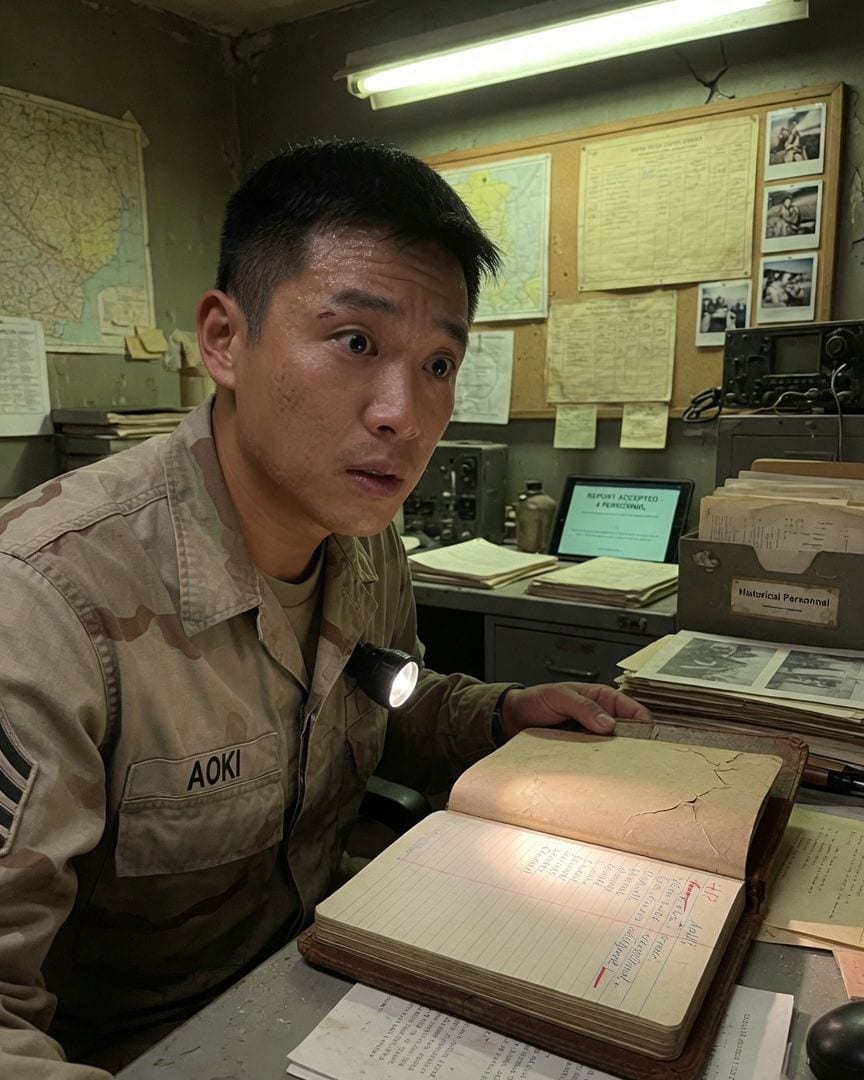
Sergeant Daniel Aoki counted his four-man night patrol, but a fifth presence murmured back from the desert dark. An old logbook from fifty years ago also noted a mysterious '+1?'
Sergeant Daniel Aoki, 32, led his four-man night patrol along Firebase Kestrel's wire, the desert wind a constant, gritty whisper. With relief due at dawn, Aoki conducted a quick headcount. After calling out his four men, a soft, almost imperceptible murmur acknowledged the call from just off his right shoulder, a fifth presence in the dark. His flashlight swept empty ground, but the cold dread that settled in his gut told him otherwise. Later, an old logbook from fifty years ago revealed a similar mystery, with a scribbled '+1?' next to a patrol led by an 'Aoki, R.'
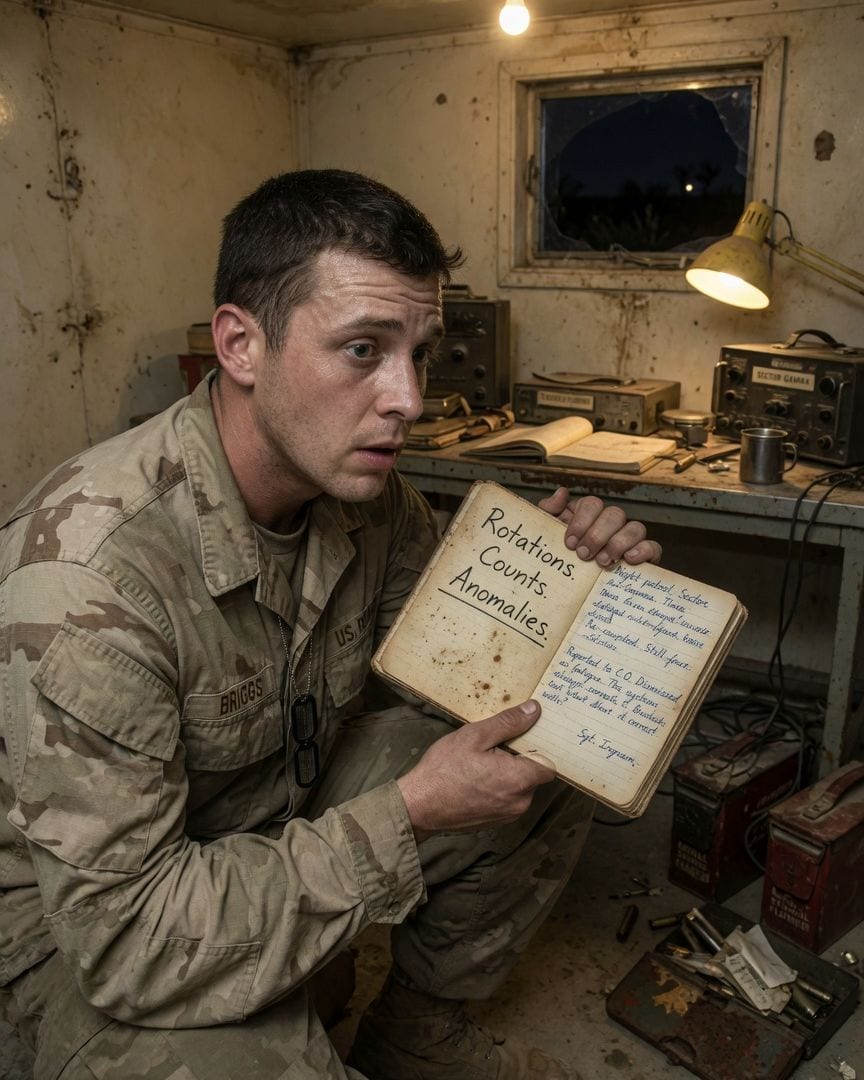
A firebase patrolman counted four men on his night patrol. Only three were visible. An old logbook echoed his impossible tally years ago.
Lance Corporal Everett Briggs, new to a remote firebase, dismissed the old-timer whispers as he moved through the black scrub on night patrol. His boots crunched against the arid ground, the vast night swallowing the sound as he counted his men. He saw three familiar figures ahead, but his reflex count came out four. Despite rationalizing it as fatigue, the impossible number haunted him, especially after an old logbook revealed the same phantom count years ago in the same sector.
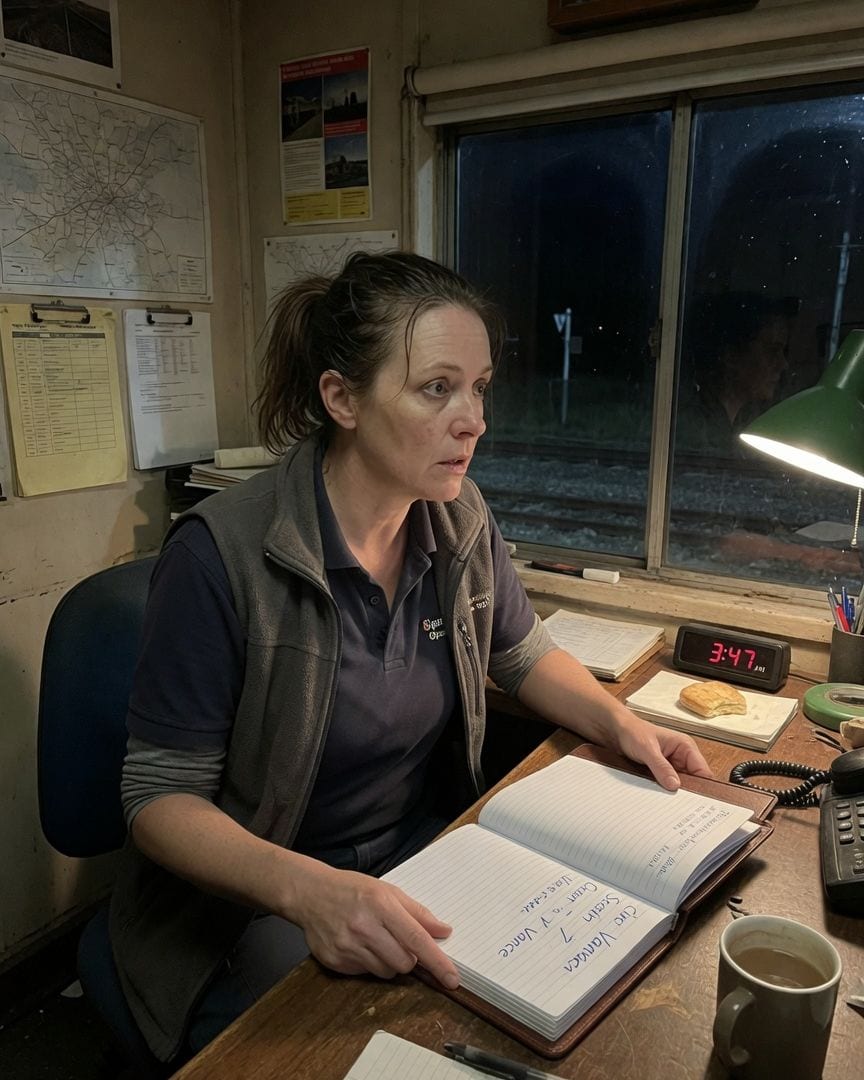
My linesman taps twice on my window at 3 AM. Control says he retired and passed years ago.
My routine at the rural signal cabin was regular: the linesman's double tap on the window at 3 AM. But then my supervisor called, revealing the linesman I knew, Warren Vance, had died five years ago. Now, an impossible entry in my official logbook, with his signature and timestamped from my shift, proves someone else was there.
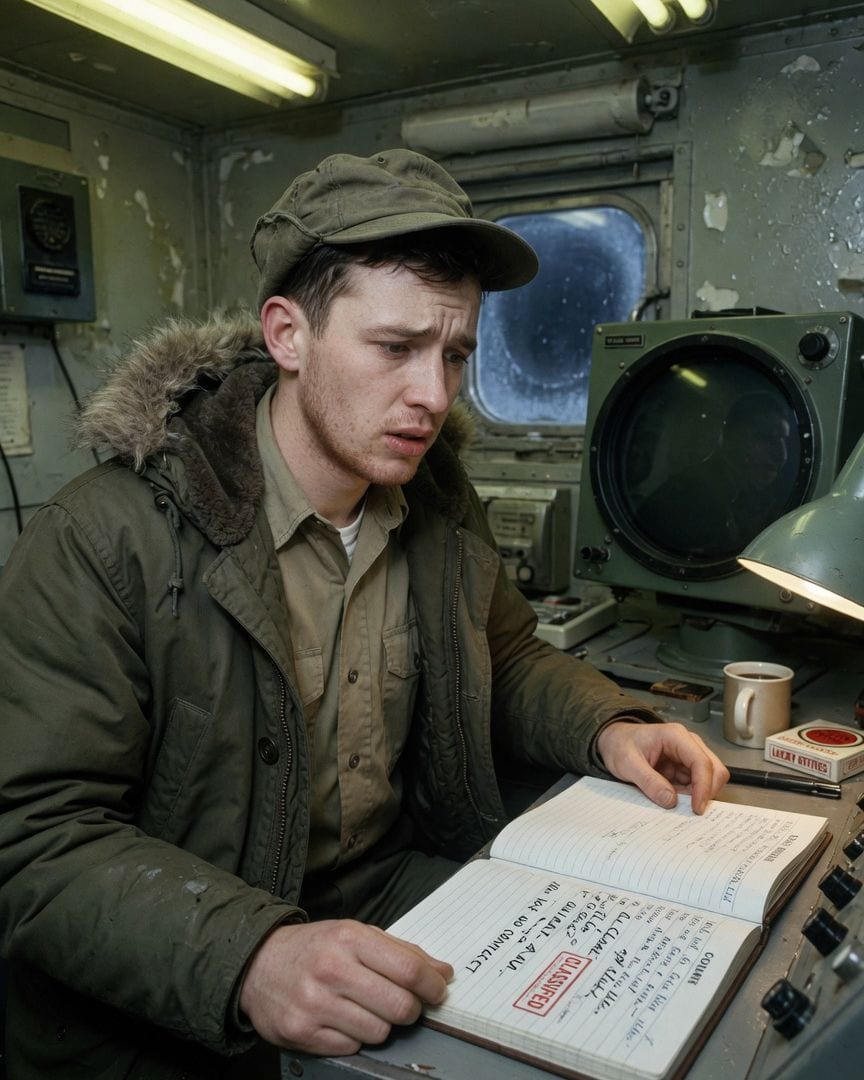
A Cold War airman logs an impossible radar contact on his last sweep. But his official logbook entry is stamped 'CLASSIFIED' and then contradicted by a hastily scrawled 'ALL CLEAR' dated moments before it.
Airman Ordway Vance, 22, manned the radar dome at Site Pellin in the biting North Atlantic dark of January 1962, running the last calibration sweep before its decommissioning. His scope picked up a faint, impossible return, growing closer with each pass, though the ocean remained empty to the eye. When Vance detailed the contact in his official logbook, a 'CLASSIFIED' stamp appeared, followed by a hastily scrawled 'ALL CLEAR' dated moments before his own entry, contradicting his every word. Commander Hartley dismissed it as equipment malfunction, but Vance sensed a chilling, official erasure behind the lie. He soon found a locked cabinet marked 'SITE PELLIN ANOMALIES,' hinting at a deeper truth buried within the base's final days.
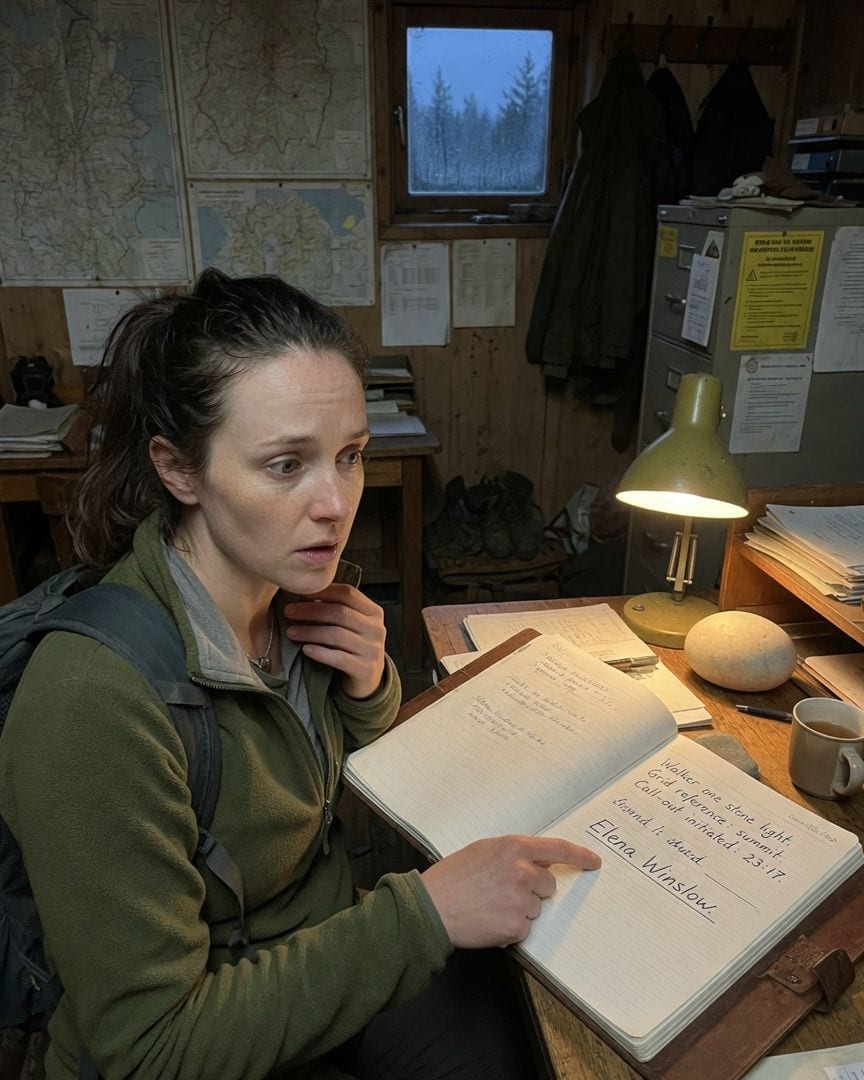
My pocketed mountain stone meant a rescue logbook recorded a call-out that night for me — a shout that never went out.
After an exhilarating climb on Cadair, I took a small, smooth white stone from the summit cairn, despite a warden's warning. Back at the station, a logbook entry shocked me: my name, dated last night, for a rescue call with an impossible detail: 'Walker one stone light'.
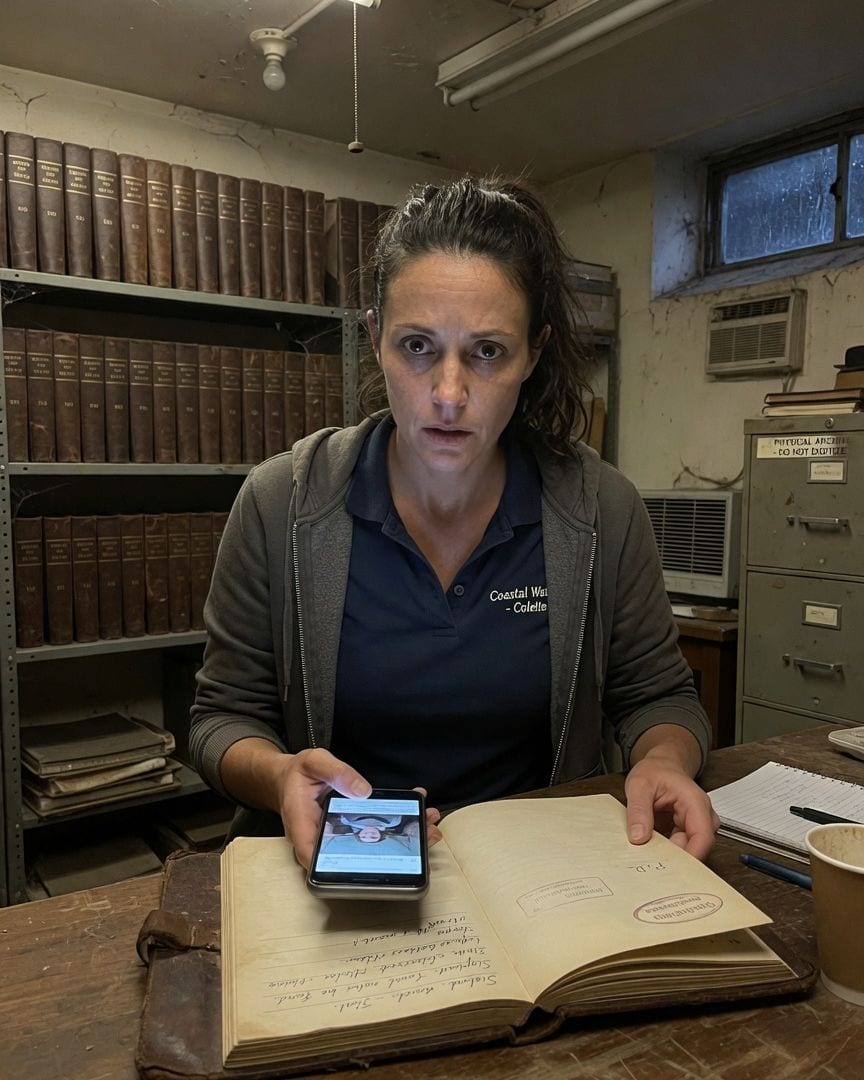
My coastguard log noted Sighting 9 again tonight, a light where no vessel showed. The old logs carry Sighting 9 off Skerry Point at 3:14am every tenth year since 1954, always 'nothing found,' always 'send no boat.'
On my watchtower night shift, the radar screen glowed green and the ocean was quiet. Then, a familiar light appeared off Skerry Point, exactly on cue, just as it had every tenth year for decades. But digging deeper, I found a hidden stamp in an old logbook: 'Operation Skerry. Status: Complete.' It left me with a chilling sense of finality.