A Platoon Sergeant finds a hidden logbook, and on its last page, a bootprint matches his own sole exactly.
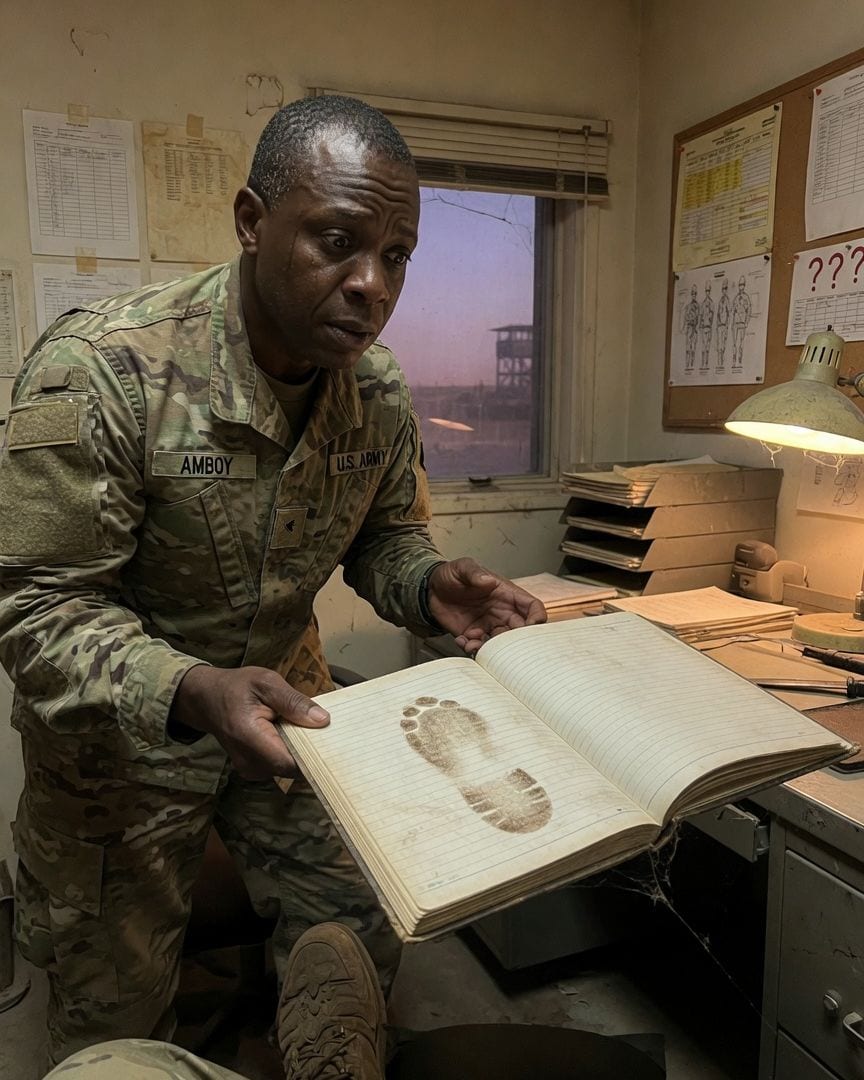
The dry desert wind, thick with dust and the smell of diesel, whipped across FOB Kestrel’s parade ground. Sergeant First Class Nathaniel Amboy, a by-the-book NCO filling in as Platoon Sergeant, adjusted his cover.
He stood before Platoon 3, a mixed unit of support personnel and infantry, calling the morning formation. The routine was etched into his muscle memory: count, verify, report. He moved down the ranks, eyes sharp, his internal tally running.
But as he reached the end, a prickle of unease. His count came up one man over.
Amboy frowned, his gaze sweeping the line again. Impossible. He started from the beginning, slower this time, pointing subtly at each man. He reached the end, counted them off aloud, and again: one man too many.
The unofficial rule, a hushed warning from the previous platoon sergeant, Vincent Barlow, echoed in his mind: if the count ever comes up over, you re-form. You do not report it. Amboy was impatient with old superstitions.
He was a stickler for protocol, eager to finish his temporary assignment at this desolate outpost and move on.
He squared his shoulders, turned on his heel, and marched straight to Captain Charlotte Hughes’ office, the over-count form clutched in his hand.
Later that day, the evening formation. The sun dipped below the jagged horizon, painting the sky in bruised purples and reds. Amboy ran the count again. This time, it came out precisely as it should: twenty-seven men.
A wave of relief washed over him, briefly easing the tension that had tightened his shoulders all day.
Then, as Amboy scanned the ranks one last time, a figure shimmered into existence just behind the last man in the third file. Solid as stone, a soldier in full combat gear, standing at rigid attention, facing Amboy directly.
An extra man. No one else reacted. The soldiers shifted, mumbled, ready to be dismissed. The extra man remained, still, silent, only for Amboy.
The extra man appeared at every formation Amboy called. Sometimes he was in the front rank, sometimes the rear, sometimes in the middle, always one more than the roster, always facing him.
Amboy tried to dismiss it, telling himself it was fatigue, the stress of deployment, a trick of the light in the harsh desert mornings. He pinched the bridge of his nose, blinked hard, even rubbed his eyes until they ached.
The figure remained.
He consulted the base's old administrative files, looking for any record of past over-counts, any explanation for Barlow's strange, superstitious rule. Most records were sparse, sanitized, full of official jargon that offered no answers.
He spoke to Captain Hughes, cautiously, about ‘unusual discrepancies’ in previous logs, hoping for a flicker of recognition. But she dismissed his concerns with a tired wave of her hand. “New guy jitters, Sergeant,” she’d said, not unkindly.
“FOB Kestrel does that to people.” Amboy felt a cold dread settle in his gut, heavy and undeniable.
He tried to ignore the figure, to count around him, but it was like trying to unsee a physical object. The extra man was there, a persistent, silent observer in his peripheral vision.
He started taking photos of the formations with his phone, hoping to capture proof, to rule out the hallucination. But when he reviewed the images, the figure never appeared in the digital frames.
The rational explanations failed, one after another, leaving a vacuum where reason should have been. The extra man became a physical, undeniable presence in his world.
Driven by a desperate hunch, a whisper of an idea that perhaps Barlow’s rule wasn't just superstition, Amboy returned to the platoon sergeant's office, the dusty, forgotten space he now occupied.
The room itself felt heavy, thick with the weight of decades of untold stories. He ran his hand along the underside of the old metal desk, feeling for anything out of place.
His fingers brushed against a loose panel, almost imperceptible against the worn metal. He pried it open with the tip of his combat knife, revealing a hidden compartment.
Inside, nestled amongst cobwebs, was a battered, unofficial logbook, its cover worn smooth by countless hands. He pulled it out, the pages brittle with age, the smell of old paper and desert dust rising from it.
It was Barlow’s, filled with cryptic notes and hand-drawn diagrams of formation rules, the handwriting tight and precise.
On the last active page, not a name, but a single, perfectly formed bootprint was pressed into the paper, its tread distinct and familiar.
Amboy dropped the logbook. It landed with a soft thump on the desk, the bootprint on the page facing him. He glanced down at his own worn combat boots, then back at the page.
The tread pattern on the paper was an exact, undeniable match to the sole of his right boot.
Amboy spent the next night poring over Barlow's logbook, hidden beneath his bunk. The thin beam of his tactical flashlight cut through the oppressive darkness of the barracks, illuminating the brittle pages.
The entries detailed 'systemic discrepancies' and 'unaccountable counts' stretching back decades, each entry meticulously coded with dates and the names of the platoon sergeants who had recorded them.
Barlow had clearly taken over from someone else who maintained the log, carrying on a grim tradition.
There were hand-drawn sketches of formation layouts, with strange asterisks next to certain positions—positions, Amboy realized with a jolt, where he had seen the extra man.
The language was clinical, detached, like a scientific journal, but the sheer volume of entries, the chilling consistency of the 'discrepancy,' filled Amboy with a growing horror. He tried to find a pattern, a common factor.
Most of the incidents occurred at FOB Kestrel. He cross-referenced the names of the platoon sergeants in Barlow's log with official military records, confirming they were real people who had served at the outpost.
Real people, but none of the official records mentioned anything like an 'over-count.' No one had ever reported it, just as Barlow's rule dictated. Except Amboy. He felt the isolation of the base, its dusty silence, pressing in on him.
He was chasing a ghost through a paper trail, and the ghost was leaving physical marks.
The 'extra man' became more persistent. He no longer just appeared at formations.
Amboy would catch glimpses of him in the mess hall, standing silently at the back, or in the shadows of the barracks, always at attention, always facing Amboy.
It was like living with a second shadow, one that didn't quite follow the rules of light.
One evening, Amboy was hunched over Barlow's logbook in the deserted common room, tracing the names of sergeants from the 80s, his flashlight casting long, dancing shadows. A faint scuff of a boot on the concrete floor made him jump.
He looked up, his heart slamming against his ribs. The extra man stood in the doorway, observing him, his form indistinct in the gloom, but undeniably present. Amboy felt a surge of cold anger, then pure terror.
He slammed the logbook shut, the sound echoing loudly in the silent room. He knew it wasn't a prank. He tried to engage the figure, to shout at it, to demand an explanation, but no sound came out.
His throat was suddenly dry, constricted. The figure simply turned and vanished into the night.
The next morning, Amboy found a fresh, pristine bootprint in the dust outside his bunk, directly facing his door. It was the same distinct tread as the one in the logbook, and the same as his own.
Someone, or something, knew he was digging. The watch was no longer just his; he was being watched in return.
Amboy sought out Captain Hughes again, this time with a more direct approach. He didn't mention the extra man, didn't speak of hallucinations.
Instead, he spoke of 'unusual historical anomalies' in the base's records, trying to keep his voice level, rational. Hughes, her face tired from another endless rotation, finally admitted that there was a 'local legend' among the old-timers about FOB Kestrel.
"They say," she began, her voice low, as if sharing a secret with the room itself, "that this place… it doesn't like being accounted for incorrectly.
That if you find something that doesn't fit, and you try to force it into the books, it just… adds itself." She looked at Amboy, her gaze distant, haunted.
She explained that the unofficial rule about not reporting over-counts was a way to 'appease' the base, a superstitious practice handed down through generations of platoon sergeants who had passed through Kestrel.
Amboy pressed her, his voice barely a whisper. "What happened to those who didn't follow the rule?"
Hughes looked away, uncomfortable, her eyes scanning the dusty shelves of her office. The air grew thick, heavy with unspoken things. "They just… stopped being themselves. They became part of the base, part of the count."
She mentioned Sergeant First Class Vincent Barlow, the previous platoon sergeant, had been particularly rigid about the rule. "He was the last one to break it, right before his transfer," Hughes said, her voice barely audible.
"He filed a report on an over-count. Said he was tired of old superstitions."
Amboy felt a chill, colder than the desert night, spread through his veins. Barlow had been the one who started the current log, the one he now held.
The extra man, the bootprint, the cryptic entries – they weren't just about an anomaly, a glitch in the system. They were about a consequence.
The system, in trying to account for the unaccountable, was creating its own permanent, horrific entries.
Back in his bunk, the words echoed in Amboy's head: 'He was the last one to break it.' He flipped through Barlow’s logbook, his fingers trembling, the pages rustling like dry leaves.
He had noticed a pattern earlier, a faint whisper of an idea he had dismissed as coincidence, as his own mind trying to make sense of the madness. But now, with Hughes’ words, it clicked into place with horrifying clarity.
Every time a previous platoon sergeant, like Barlow, reported an 'over-count' to their commander, their own name eventually appeared later in the log, not as the recorder, but meticulously listed as the 'unaccounted-for individual' for the next sergeant's rotation.
A chilling legacy. He found the last active entry, dated the day before Barlow's final transfer, and scrawled beneath a familiar bootprint was a new, stark entry:
'FOB Kestrel, Platoon 3, 0600 formation. Over-count: One. Name: Amboy, Nathaniel, SFC.'
Amboy stared at the logbook, then at the empty bunk across the room, the dust motes dancing in the beam of his flashlight. He checked the date again, frantic. The entry wasn't a prediction; it was a record.
A pre-ordained fate already etched into the base’s history. He heard a faint, rhythmic thump-thump-thump from the parade ground outside, the sound of boots marching in perfect, impossible synchronicity.
He looked up, his eyes locking onto the door, knowing that the next count was already underway, and he was its subject.
The rhythmic thumping grew louder, closer, echoing through the thin walls of the barracks. It wasn't the ragged march of soldiers; it was a single, amplified beat, perfectly synchronized, impossible.
Amboy scrambled to his feet, grabbing his combat knife from his pack, its cold steel a meager comfort against the overwhelming dread. He knew. The extra man wasn't just a ghost, not a hallucination, not a glitch.
It was the embodiment of a systemic error, a persistent 'ghost entry' created when the hyper-accountable military system was forced to acknowledge an impossibility.
And the names in Barlow’s logbook weren't just witnesses; they were the victims, the sergeants who had tried to 'fix' the count, to impose logic, only to become the 'extra' themselves, permanently logged into the base’s spectral roster.
The extra man was Barlow, or a previous sergeant, or a dozen others, all merged into one silent, observing presence, a composite of those who had been consumed. The pattern had snapped into place, horrifyingly clear.
The moment Amboy reported the over-count, he had signed his own manifest. He was no longer the counter; he was the counted.
The door to his bunk creaked open slowly, revealing the extra man standing perfectly still in the dim light, his face indistinct, yet his eyes—or where his eyes should have been—were fixed on Amboy.
The figure's boots were caked in the same fine, reddish dust from the parade ground, familiar and chilling.
Amboy stood frozen, the knife heavy in his hand, facing the extra man. There was no confrontation, no struggle, no sound from the figure. It simply raised a hand, pointing towards the parade ground, a gesture of silent command.
Amboy understood. He was being called to formation. He dropped the knife, the clatter loud in the silence. The dread was absolute, not because of what was happening, but because it made perfect, chilling sense.
He had tried to impose order on an inherent disorder, to account for the unaccountable, and the system had simply absorbed him.
He walked out of the bunk, the extra man falling in silently behind him, a permanent shadow at his back.
The sun was just breaking the horizon, painting the dusty parade ground in harsh oranges and deep purples.
A new platoon sergeant, a young woman named Fiona Barlow, stepped out of the command tent, rubbing sleep from her eyes, ready to call the morning formation.
She moved with the crispness of someone new to the post, eager to impress. Amboy felt a strange sense of resignation, a quiet acceptance settling over him like the dust.
He was part of the count now, a permanent fixture in the unseen ranks of FOB Kestrel's spectral platoon. He walked to his designated spot, just behind the last man in the third file, and stood at rigid attention.
The dust swirled around his boots, leaving no trace.
Captain Hughes reported Sergeant First Class Nathaniel Amboy missing, a routine disappearance in the chaos of a remote outpost. His personal effects were packed, his bunk stripped, his paperwork processed.
No one questioned it too deeply; soldiers rotated in and out of FOB Kestrel constantly. The unofficial logbook was never found, perhaps absorbed back into the hidden compartment, waiting.
Fiona Barlow, the new platoon sergeant, quickly settled into her role, diligent and by-the-book. She inherited the quiet, dusty office, and the legacy of the base’s peculiar demands.
The daily routine settled back into its rigid military rhythm, unbroken by the shift in personnel.
Months later, at a new posting, Captain Charlotte Hughes received a routine transfer request for a Sergeant First Class Nathaniel Amboy from FOB Kestrel. She paused, a flicker of unease.
She had reported him missing, but here was the transfer, processed and approved, crossing her desk like any other piece of paperwork.
She signed the form, then looked out her office window at the bustling base, the familiar sounds of reveille echoing across the parade ground. A young, squared-away sergeant walked past, his uniform pristine, his bearing perfect.
He looked vaguely familiar, a ghost of a memory. He stood at rigid attention, facing the rising sun, waiting for the next sergeant to count.
If this one got to you
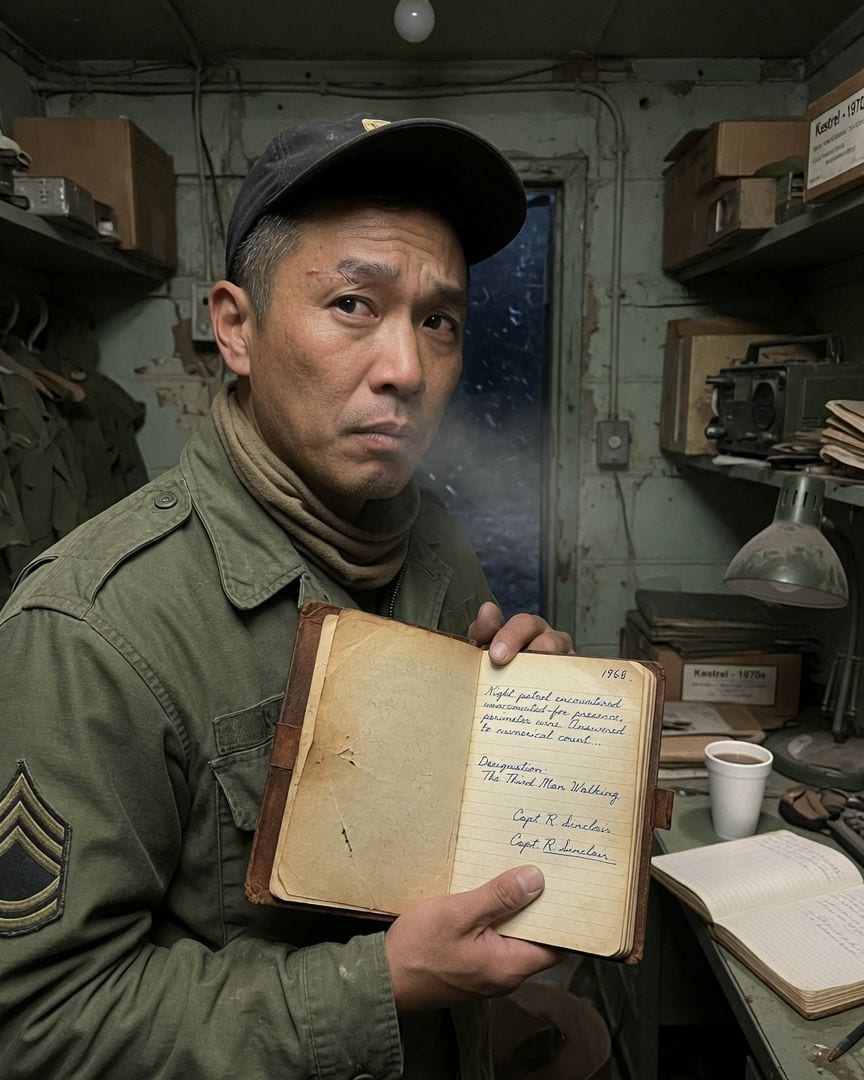
A patrol leader's final count at Cold War Firebase Kestrel found four men. A raspy fifth voice answered, 'Five.'
Sergeant Julian Aoki, a career NCO, prepared for his final perimeter sweep of Firebase Kestrel, a remote outpost days from decommissioning. He aimed to leave the desolate, windswept plateau with a clean manifest before the relief column arrived at dawn. As he called out his four-man patrol’s numbers, a raspy, barely audible fifth voice answered 'Five,' though only four men stood before him. Later, a fifth set of heavy boot prints appeared in the dust, matching his stride back to the wire, a silent, invisible companion. Dismissing it as fatigue, Aoki later found a disused, leather-bound logbook describing identical perimeter encounters, including a 'Third Man Walking' in 1968. Could this unsettling record be more than just old superstition?
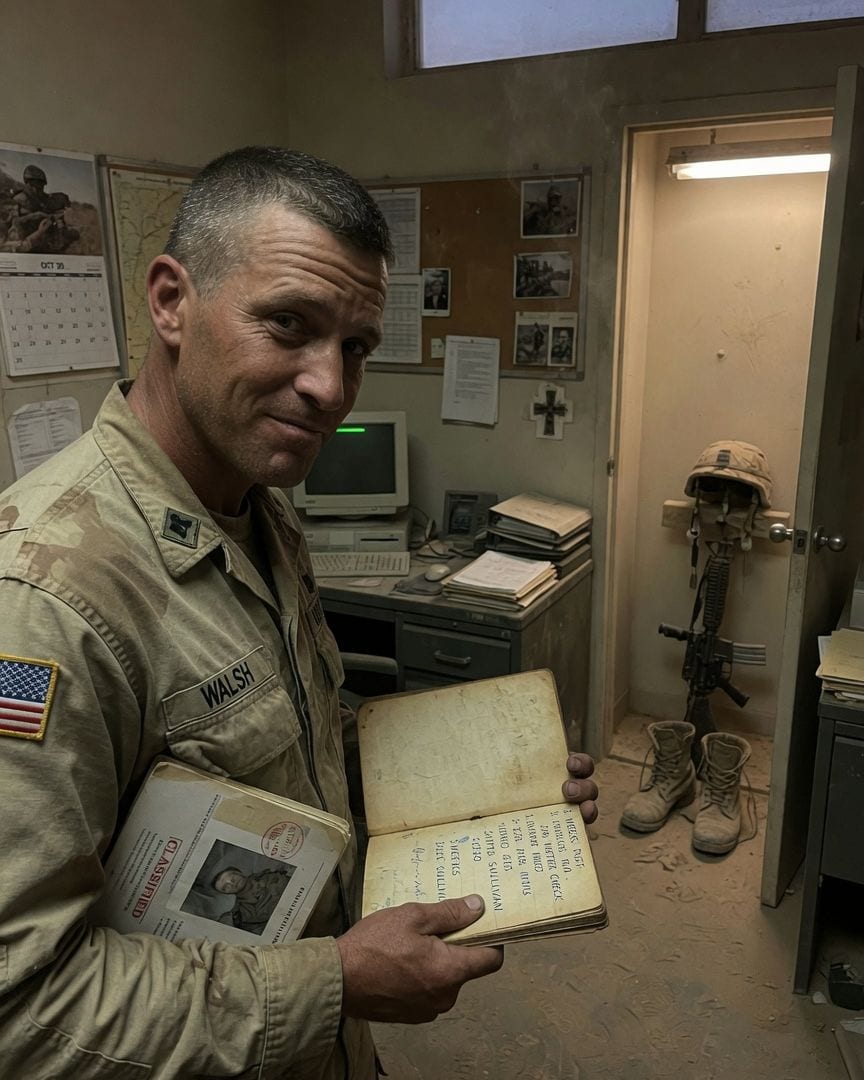
A Staff Sergeant watched combat boots reappear at the memorial each dawn, their soles deepening with scuffs that no living soldier made.
Staff Sergeant Raymond Walsh walked his routine patrol at FOB Kestrel, passing the memorial alcove where a battle cross stood reverently. The quiet space held a pair of worn boots at its base, a detail Raymond first dismissed as a sophomoric prank. But each dawn, the same combat boots reappeared at the memorial, their laces open, showing fresh scuffs and deepening wear inconsistent with any living soldier’s duties. Raymond's rational mind struggled as the boots defied logic, mirroring the growing dread of Private Marsh, who swore they never left his locker. Why did these boots keep returning, carrying the marks of impossible journeys?
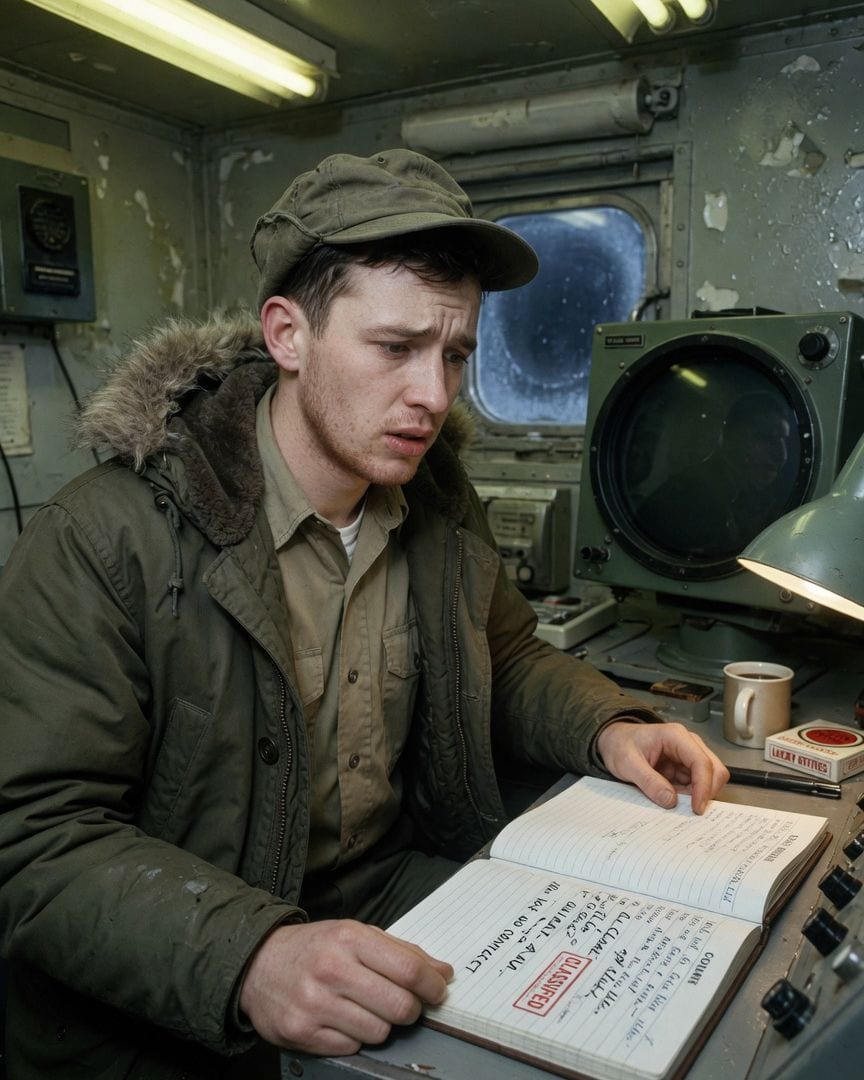
A Cold War airman logs an impossible radar contact on his last sweep. But his official logbook entry is stamped 'CLASSIFIED' and then contradicted by a hastily scrawled 'ALL CLEAR' dated moments before it.
Airman Ordway Vance, 22, manned the radar dome at Site Pellin in the biting North Atlantic dark of January 1962, running the last calibration sweep before its decommissioning. His scope picked up a faint, impossible return, growing closer with each pass, though the ocean remained empty to the eye. When Vance detailed the contact in his official logbook, a 'CLASSIFIED' stamp appeared, followed by a hastily scrawled 'ALL CLEAR' dated moments before his own entry, contradicting his every word. Commander Hartley dismissed it as equipment malfunction, but Vance sensed a chilling, official erasure behind the lie. He soon found a locked cabinet marked 'SITE PELLIN ANOMALIES,' hinting at a deeper truth buried within the base's final days.
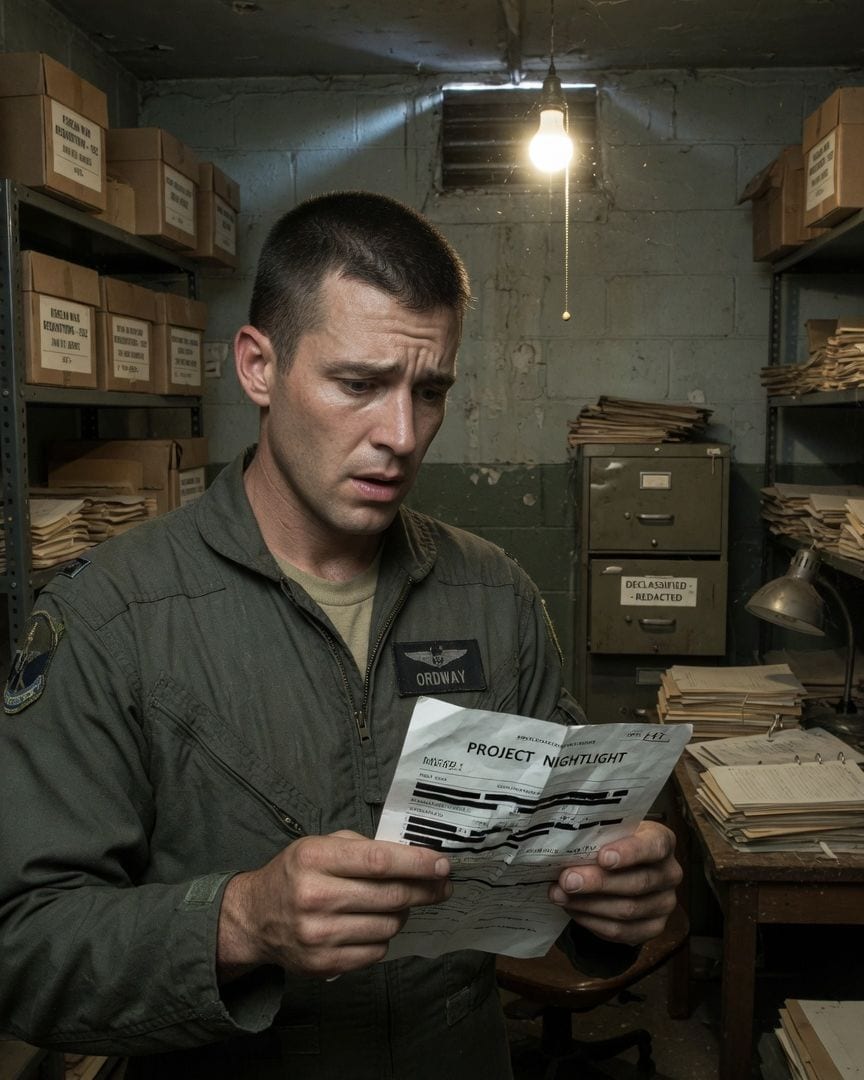
A Cold War pilot's F-104 Starfighter was shadowed by an impossible object. Weeks later, a secret memo referenced his own service number for 'pilot reassignment protocols.'
First Lieutenant Cal Ordway soared over the Mojave in his F-104 Starfighter in 1962, the night sky a familiar canvas. But that night, one 'star' broke formation, pulling alongside his wing and mirroring his every impossible maneuver. His instruments confirmed the silent, unblinking object, defying all known physics. After filing his precise report, Cal found his flight log altered to 'no incidents,' radar tapes corrupted, and a superior advising him to 'let it go.' Driven by his training, he uncovered a heavily redacted memo referencing 'Project NIGHTLIGHT' and, chillingly, his own service number for 'pilot reassignment protocols initiated.' Was he merely a witness, or already a subject in a much deeper secret?
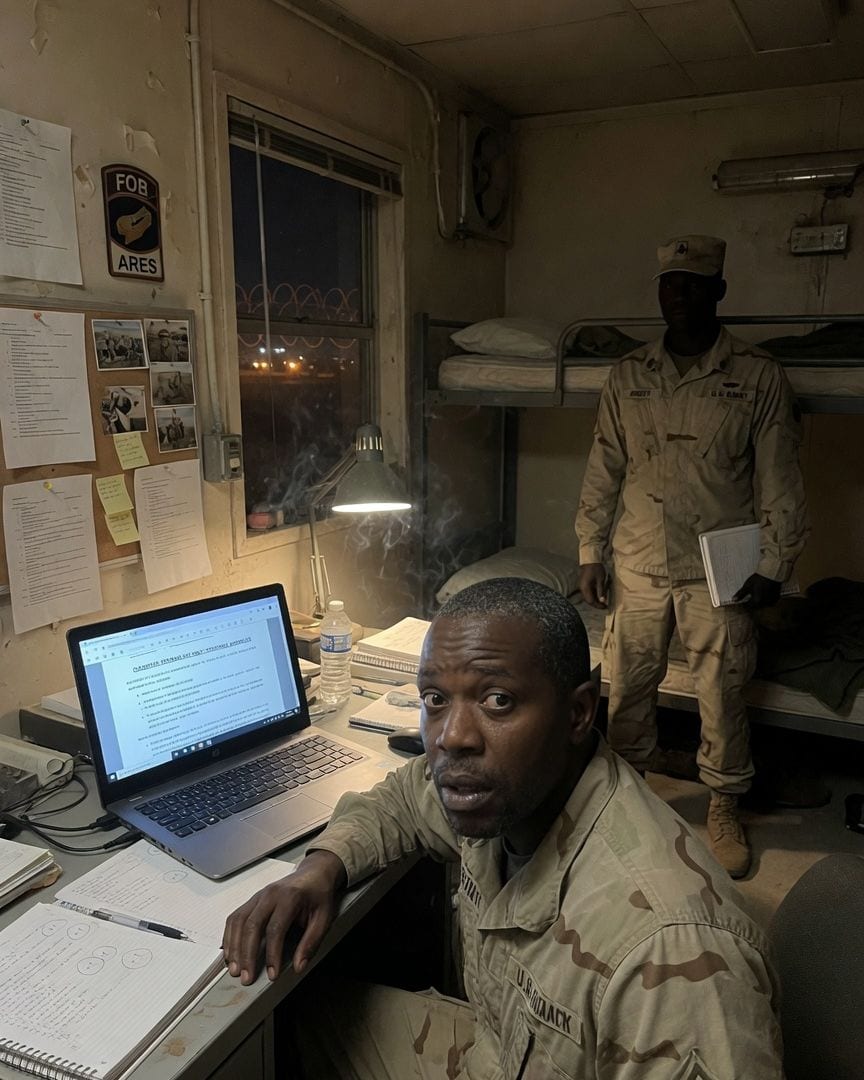
On his final rotation home, Sergeant Abbott counted his platoon: one man too many. The base’s secret files called them 'phantom units,' always watching him.
Sergeant First Class Malcolm Abbott was on his final rotation at FOB Ares, ready for transfer home. He called his platoon to formation, watching the sun break over the desolate desert as he counted each man. But the numbers didn't add up; there was always one extra soldier, standing at rigid attention, perfectly aligned with the others, yet only Malcolm could see him. Despite cross-referencing every manifest, the phantom remained, its face obscured in shadow, a silent sentinel that defied all logic. What secret did the base archives hold about these unacknowledged personnel?
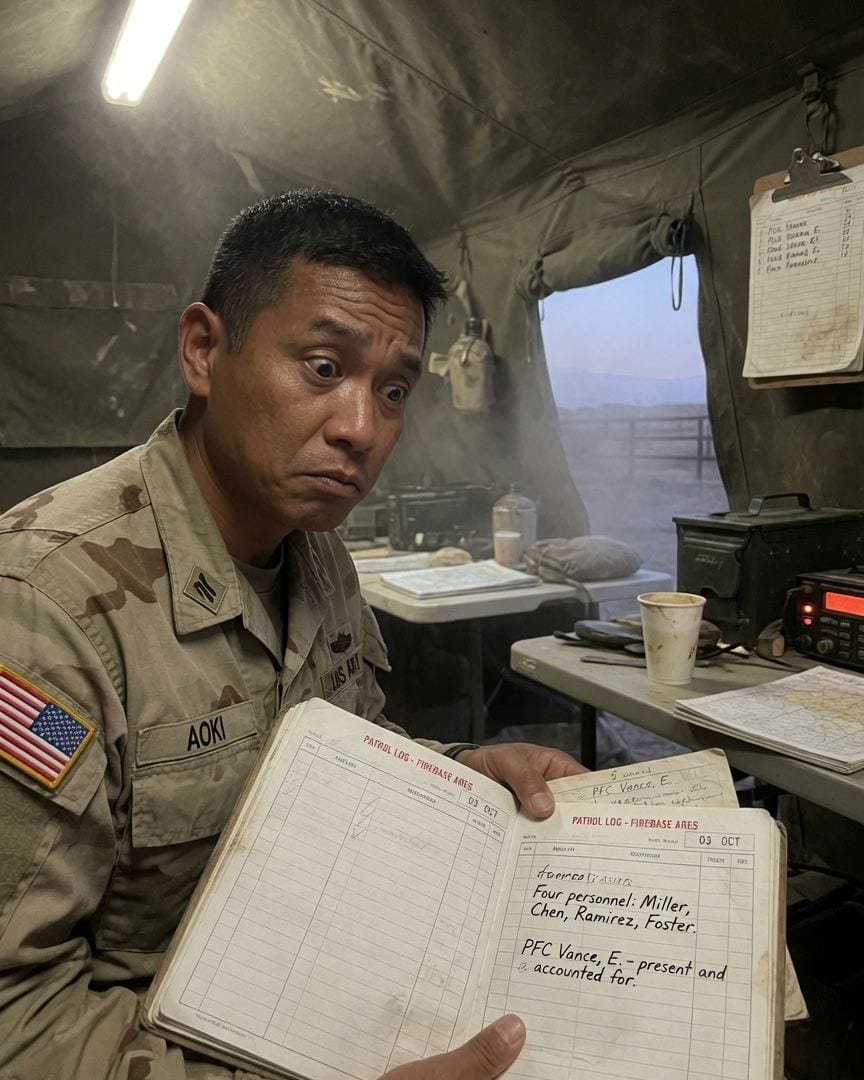
On his final patrol, Sergeant Hans Aoki led his four-man team. A fifth figure, silent, disciplined, shifted its weight right off his shoulder. Then his own signed log confirmed five men present.
On his final patrol through the pre-dawn Afghan desert, just hours from leaving Firebase Ares for good, Sergeant Hans Aoki led a disciplined four-man team. At the halfway point, a fifth figure, silent and disciplined, shifted its weight right off his shoulder, matching his stride; Aoki saw only four men, but the phantom presence remained, and the comms static felt like a muffled whisper. Back at the operations tent, his own signed patrol log, confirming four men, then listed an impossible fifth soldier, 'PFC Vance, E.', as present and accounted for. What impossible truth had his own hand attested to?