A records clerk on her last week found the Cold War crate she disposed of back. The boot print in its dust matched a photo from days ago, perfectly undisturbed.
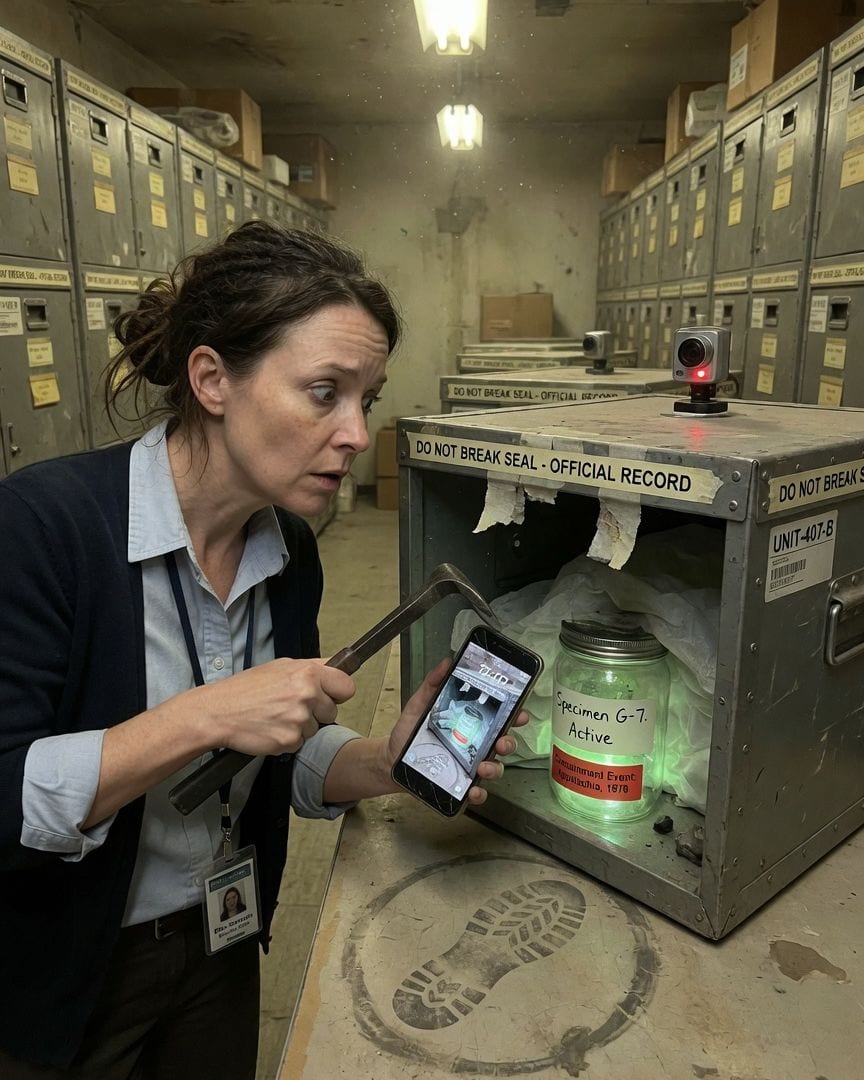
Elke Sarrazin, 40, a records clerk, pushed a metal cart down the dim aisle of the Fort Holabird annex, the air thick with the scent of mildew and forgotten paper.
It was her last week before the facility’s scheduled demolition, a countdown she felt in her bones, a dull ache in her joints.
She stopped at aisle four, a section typically reserved for 'specialized' units, and stared at UNIT-407-B, a heavy-duty storage crate. Its gray metal was scarred with countless scuffs, its thick seals riveted in place.
She’d personally carted it to the disposal bay Friday afternoon, logging its transfer into the system, triple-checking the manifest. Yet here it was, Monday morning, in the exact same spot, a perfect oval dust ring outlining its base.
Its seals were unbroken, the official tamper-proof tape pristine. Elke pulled out her phone, scrolling to a photo she’d taken Friday, a mundane record of her mundane work.
The dust ring, the crate’s serial number, even a faint scuff mark on its side, matched perfectly.
But the single, clear boot print in the dust just in front of the crate, a print she hadn’t made, was identical in both photos, sharp and undisturbed.
Elke tried to rationalize it. A new hire, perhaps, or a glitch in the transfer system. She considered a prank, but the thought felt flimsy, insufficient. There was no joy or malice in the stillness of the crate.
She meticulously re-logged UNIT-407-B, noting its 'return' and assigning it to a new, isolated storage bay at the far end of the annex, documenting every step with photographs, creating an undeniable paper trail for her supervisor.
Before leaving for the day, she positioned a small, motion-activated camera near its new location, aiming its lens directly at the crate, hoping to catch the phantom mover in the act.
The fluorescent lights hummed with an anxious buzz as she locked up, leaving the silent crates in the gloom.
The next morning, Monday again, the crate was back in aisle four, precisely centered within its original dust ring, the boot print perfectly preserved.
The camera’s memory card was full, but the footage from the critical hours showed nothing but static, a relentless, grainy snowfall that consumed the entire frame. Frustrated, Elke began searching the annex’s digital archives specifically for 'UNIT-407-B.'
Its transfer manifest was missing, a blank space where her Friday log should have been. But she found a heavily redacted file labeled 'Special Containment Unit: UNIT-407-B.'
It mentioned 'anomalous recovery' and 'self-correction protocols,' terms that sent a cold shiver down her spine. The file contained no details about its contents, only a warning in stark red letters: 'DO NOT OPEN. UNDER ANY CIRCUMSTANCES.'
But Elke, driven by a methodical curiosity that overruled caution, knew she had to. She walked to the maintenance closet, the fluorescent lights flickering in her peripheral vision, and found a heavy pry bar.
With a grunt, Elke leveraged the pry bar against the heavy-duty seals of UNIT-407-B. The metal groaned, a sickening protest that echoed in the empty aisle, then popped, allowing her to peel back the layers of reinforced tape.
Inside, instead of standard files or documents, she found thick, sound-dampening foam, packed tight against the interior walls. She tore it away, revealing a smaller, internal compartment, also sealed, its edges fused with a sterile precision.
Her hands, suddenly clammy, fumbled for a utility knife. She cut through the inner lining, the blade scraping against an unseen barrier. Inside, nestled in sterile packing material, was a specimen jar.
It contained a single, impossibly vibrant, bioluminescent fungus, pulsing softly with a sickly green light that cast eerie shadows on her face.
Elke recognized the classification code on the jar from a redacted 'Containment Event: Appalachia, 1978' file she’d glanced at that morning. The label, written in a precise, almost clinical hand, read: 'Specimen G-7, Active.'
The ink on the label was still wet.
Elke’s rational mind reeled. The wet ink. The vibrant pulse. She rushed back to her terminal, the specimen jar clutched tight in her hand, the fungus glowing softly in the dim light.
She pulled up the 'Containment Event: Appalachia, 1978' file once more, her fingers flying across the keyboard.
It detailed a catastrophic 'containment failure' at a remote Appalachian site, the 'total loss of field team,' and the subsequent 'neutralization and incineration' of 'Specimen G-7' to prevent its spread.
Yet, the fungus in her hands was undeniably alive, impossibly fresh, and pulsing with an eerie, quiet vitality. It was a physical contradiction of a declassified record, an impossible anachronism.
She began cross-referencing all 'UNIT' classifications, searching for any mentioning 'self-correction' or 'anomalous recovery.' She found a handful, scattered across different annexes, different decades, each file a cryptic puzzle piece.
Every file was incomplete, heavily redacted, or explicitly marked 'DO NOT TRANSFER.' A chilling pattern emerged: these 'UNIT' designations were consistently linked to regional 'containment events' where records were lost or corrupted, and personnel disappeared without a trace.
Their transfer logs always abruptly ceased or were inexplicably corrupted. Deep in the annex archives, she unearthed a forgotten document titled 'Standard Procedure 7-Gamma: Relocation of Active Containment Units.'
It outlined archaic protocols for handling units that 'return to designated staging areas,' including a chilling instruction to 'reset associated tracking logs and personnel records.'
The implication was clear: these units were not just returning; they were operating under their own, hidden logic, and the paper trail was intentionally obscured, wiped clean after each cycle.
The next morning, Elke found her access to the 'UNIT' classification files suddenly restricted. Her login attempts were met with a stark red message: 'Access Denied: Flagged Activity.' A cold dread settled in her stomach, heavy and metallic.
Moments later, an anonymous email landed in her inbox. No sender, no subject, just a terse line of text: 'Some things are best left filed.' Her heart pounded, a frantic drumbeat against her ribs.
As she walked down the main aisle, she saw a figure standing at the far end, observing her section.
It was Quentin Montgomery, a retired records supervisor she recognized from old staff photos, known for his encyclopedic knowledge of the annex’s history.
He was a gaunt, quiet man, and when Elke looked up, he simply turned and walked away without a word, disappearing into the shadows of aisle three.
Later that day, she found a file she’d been searching for, marked 'Restricted: Personnel Review,' conspicuously placed on her desk, open to a page detailing 'personnel re-assignment' for those exhibiting 'excessive curiosity' regarding certain classifications.
The boot print wasn't just a physical marker; it was a warning. The camera static, a deliberate act. Someone, or something, was watching her, and they knew exactly what she was finding.
Elke cornered Quentin Montgomery in the deserted breakroom, the smell of stale coffee hanging in the air like a shroud.
She slid a printout of 'Standard Procedure 7-Gamma' across the chipped Formica table, its archaic diagrams stark against the white paper. 'You know about this, don't you?' she demanded, her voice barely a whisper, ragged with barely contained fear.
He sighed, a sound heavy with years of unspoken secrets. The fluorescent lights above hummed, casting a sickly yellow glow on his worn face. 'You know, Elke, I was like you once. Curious.'
He picked up the paper, his long, thin fingers tracing the complex diagrams, unbothered. 'These 'UNIT' crates,' he began, his voice low and even, 'they're not storage. Not in the way you understand it. They're processors. They file things.
Not just paper.' He explained that these units were ancient, designed to contain and process anomalies that could not be destroyed, only managed. When an anomaly was contained, its associated records were generated, and a 'unit' was dispatched.
But sometimes, he continued, his voice barely audible, 'the unit returns. And sometimes, the unit retains a part of what it processed, or even brings back a… re-filed version of it.'
The 'self-correction protocols' were for when the units detected tampering, attempts to alter their purpose or contents.
The 'boot print,' he revealed, was a maintenance mark, a signature of the unit's own movement, or perhaps a trace left by whatever interfaced with it to ensure its proper function.
He told her the demolition of the annex wasn't just about the building; it was about 'resetting' this particular collection of units, clearing the slate before a new cycle could begin elsewhere.
'The machine doesn't like loose ends,' he warned, his eyes flat, devoid of emotion. The bioluminescent fungus in the crate, he confirmed, was a 're-filing' – a contained anomaly that the unit had brought back, impossibly fresh, from 1978.
The record was the thing itself, and it had simply returned home.
Shaken, Elke returned to her desk, the annex now feeling like a vast, cold tomb. Quentin’s words echoed in her mind, a terrifying mantra: 'The machine doesn't like loose ends.'
She pulled up the 'Personnel Re-assignment' file Quentin had left for her. It detailed the disappearances of several records clerks over the decades, always after they’d shown an 'excessive curiosity' in 'UNIT' classifications.
Their files were all marked 'Transferred to Project Holobird Annex B-7,' a facility Quentin had confirmed didn't exist.
She scrolled down, her fingers trembling, past names and dates of 'transfer,' past chillingly impersonal descriptions of their 'pattern of behavior requiring re-integration.'
The pattern across decades and classifications wasn't just about the units; it was about the people who got too close to them. The last entry, still incomplete, had her own service number, 'Sarrazin, Elke, 40.'
The 'date of re-assignment' was for tomorrow. The file was being signed. And her name was on it.
Elke was frozen, her name staring back at her from the screen, an accusation, a prophecy. Quentin's calm, detached warning now made terrifying sense. The demolition clock was ticking, not just for the building, but for her.
The pattern snapped into place with horrifying clarity: the 'secrecy machine' didn't merely file anomalies; it 'filed' people who uncovered its operations, integrating them into its own internal 'records' system.
The 'transfers' weren't to another facility; they were into the system itself, a chilling form of re-indexing, a bureaucratic erasure. She frantically searched for any escape, any protocol that broke the cycle.
Her eyes scanned the obscure appendices of the 'Standard Procedure 7-Gamma,' a desperate hope flickering in her chest. There, buried under layers of technical jargon and cross-references, was a single, improbable protocol: 'Emergency Deactivation of Containment Unit 407-B.'
It required physical access to the unit's internal control panel, which was only accessible when the unit was in its 'staging area' (aisle four) and 'active.' It was a long shot, a desperate gamble, but it was her only chance.
The protocol also carried a chilling warning, underlined in red: 'Deactivation may result in localized temporal distortion and personnel re-indexing.' She knew what 're-indexing' meant now, and the full horror of her situation became brutally clear.
Dawn broke, painting the annex windows in sickly gray light, a pre-dawn gloom that felt like the end of the world.
It was her last day, and the demolition crews were already starting to arrive, their heavy equipment rumbling in the distance like approaching thunder. Elke raced to aisle four, her breath catching in her throat.
UNIT-407-B sat there, as expected, its dust ring perfect, the boot print a silent accusation in the fine gray powder. Her heart hammered against her ribs, a frantic bird desperate to escape its cage.
She used the pry bar again, this time to open a different panel on the side of the crate, following the archaic diagrams in the deactivation protocol.
Inside, a complex array of antiquated vacuum tubes glowed faintly, blinking lights flickering in an unintelligible sequence. A single, prominent red button, unmarked and ominous, dominated the panel. The protocol instructed: press it, then 're-seal the unit and walk away.'
As her trembling hand hovered over the button, she heard it: a low, rhythmic thrumming from inside the crate, growing louder, vibrating through the metal floor, up into her bones.
The bioluminescent fungus within the jar in the opened compartment pulsed faster, casting a sickly green light that intensified the gloom, making the shadows dance.
The boot print on the floor seemed to deepen, as if something impossibly heavy had just stepped there.
The air around her grew cold, then hot, then cold again, a palpable shift in the atmosphere, a sensation of being stretched thin. She felt a profound, almost magnetic pull from the crate, a silent invitation, a hungry void.
At the end of the aisle, a shadowy figure emerged from the gloom – Quentin Montgomery. He wasn't watching her with concern, but with a detached, almost expectant expression, his eyes fixed on her, on the button.
He slowly raised a hand, not to warn, but to point directly at the red button. Knowing this was her only chance, or her final mistake, Elke slammed her palm down on the red button. The crate shuddered violently.
The thrumming became a deafening roar. A blinding flash of green light erupted from the unit, engulfing aisle four, erasing everything in its wake.
The light faded, leaving an afterimage burned into the air, a phantom green that slowly dissipated. Marcus Brooks, the demolition crew supervisor, entered aisle four moments later, blinking against the lingering haze.
The air smelled faintly of ozone and old paper, like a library struck by lightning. UNIT-407-B sat quietly in its dust ring, its seals unbroken, the control panel seamlessly re-integrated into its side, as if it had never been opened.
Brooks frowned. 'Where's Sarrazin? Her section's supposed to be cleared.' He checked his manifest on a clipboard, flipping through the pages. Her name, 'Elke Sarrazin,' was gone.
The space where it should have been was blank, as if it had never existed. He glanced at the dust on the floor. A single, distinct boot print sat perfectly in the center of the ring around the crate.
He shrugged. 'Guess she finally transferred out.'
Marcus Brooks walked away, calling for his crew to begin the demolition. The annex would soon be gone. The dust settled again around UNIT-407-B, silent and inert, awaiting its fate. It was just a crate, after all.
Or so it seemed. Weeks later, a new records clerk, Sandra Caldwell, started her first day at the newly constructed Fort Holabird data center. Her supervisor handed her a tablet. 'Welcome, Ms. Caldwell.
Your first assignment is to review a backlog of 'unindexed assets' from the old annex. Pay special attention to anything marked 'UNIT-series.' We've had some unusual activity.' Sandra nodded, scrolling through the digital manifest.
She paused on a line item: 'UNIT-407-B: Status – Active. Last Personnel Interaction – Sarrazin, E. (40). Remarks – Re-indexed.' Below it, a faint, almost imperceptible boot print icon was embedded in the digital record.
The file is still being signed.
If this one got to you
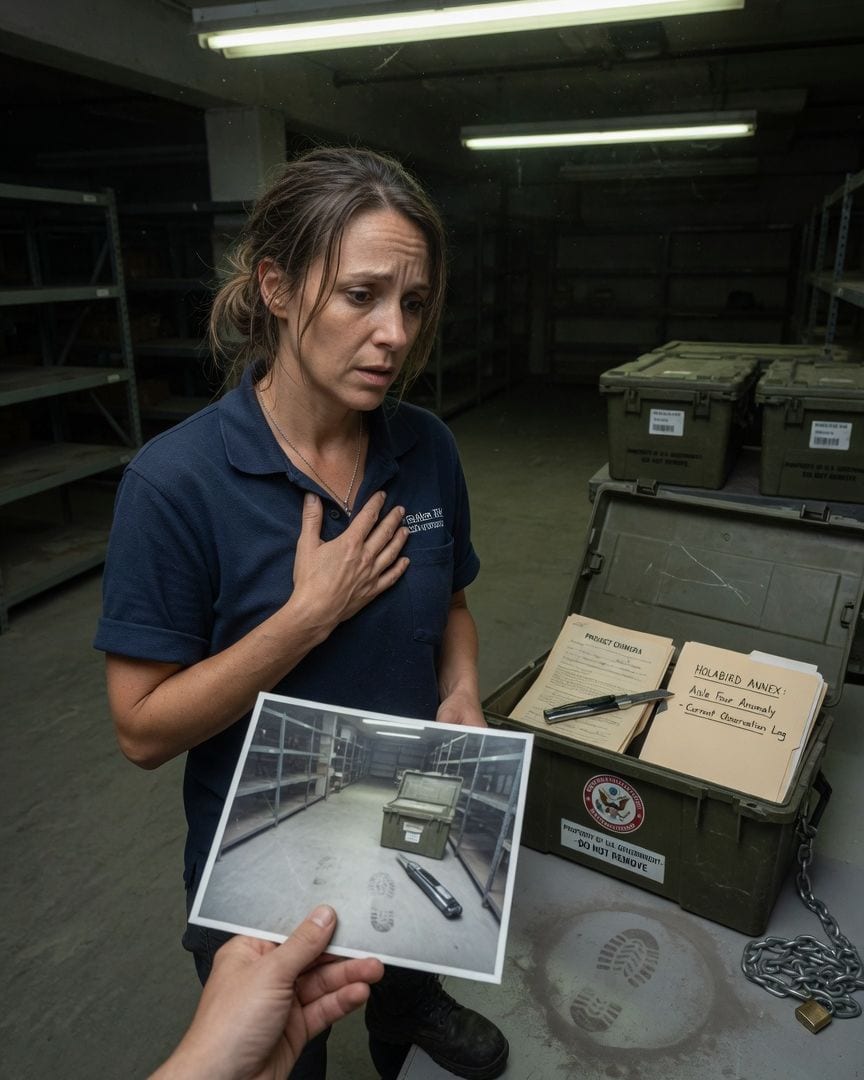
A logging clerk's last week at the Cold War annex uncovered a crate she'd moved, back in place with a photo of itself and a boot print not hers.
Elke Sarrazin, a forty-year-old logging clerk, felt the cold finality of her last week at Fort Holabird annex. The vast, echoing storage facility, slated for demolition, was almost empty as she meticulously logged the last sealed government crates for off-site storage. But Monday morning, a crate she had moved and logged days earlier sat precisely back in aisle four, its official seal unbroken and a fresh ring of dust around it. After it returned multiple times, Elke found a distinct boot print not her own beside it, then later, inside the crate, a glossy photograph of that very aisle, taken moments ago, showing the same impossible boot print.
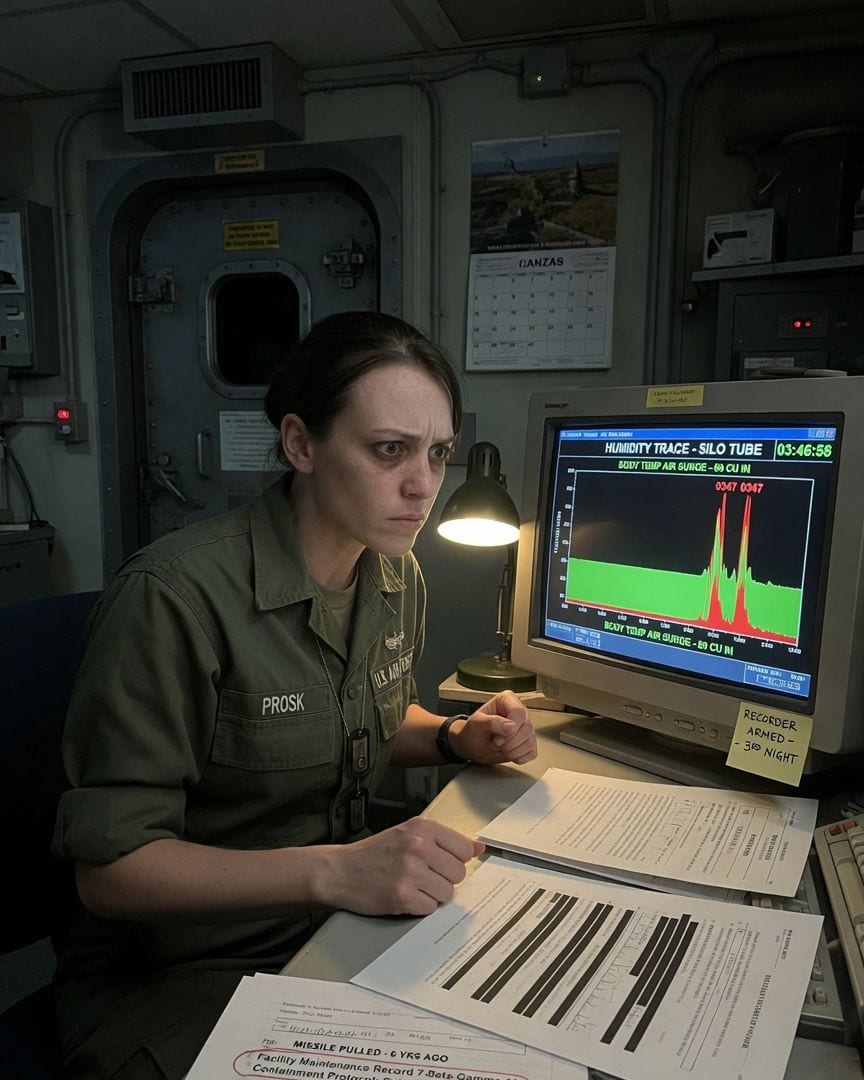
An airman's last weeks before transfer: the empty Cold War missile silo took a warm breath.
Airman Gale Prosk was counting down her final weeks at the silo, eager for her transfer from the isolated Kansas prairie. In the dim control room, the low hum of the ventilation was a constant companion. For years, the environmental monitor for the empty missile tube below had shown a flatline, until three nights ago. A sudden, jagged spike appeared, a surge of air registering at body temperature. She dismissed it as a glitch, but then it happened again. She descended into the vast, echoing chamber where the missile had once stood, finding only cold, polished steel. Back in the control room, redacted declassification files spoke of "biological integrity checks" for the empty space, and Project THRESHOLD documents were missing eight crucial pages. The silence of the silo now hummed with an unseen weight.
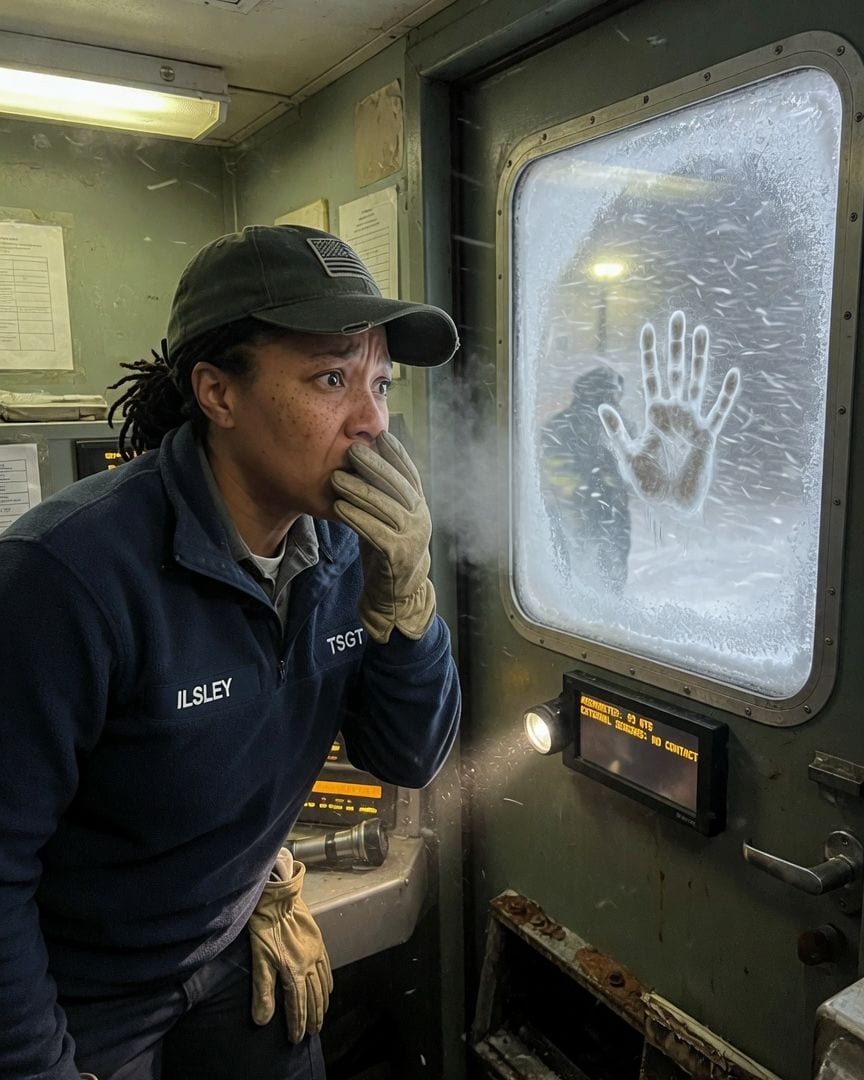
Technical Sergeant Ada Ilsley had two weeks left when a handprint appeared on her sealed window, unnervingly warm and pressed from the *inside*.
Technical Sergeant Ada Ilsley was counting her last two weeks on the Greenland ice-cap before Thule-Gamma Station closed for good. Tonight, the polar wind howled at ninety knots, clawing at the station's insulated walls as she kept a lonely vigil. Through the main door's triple-paned port, she watched a dark figure emerge from the impossible blizzard, its face pressed against the glass, only to vanish. On the frost outside, a perfectly clear handprint remained, unnervingly warm and undeniably pressed from the *inside* of the sealed pane. How could anything have touched the glass from within a supposedly impenetrable barrier?
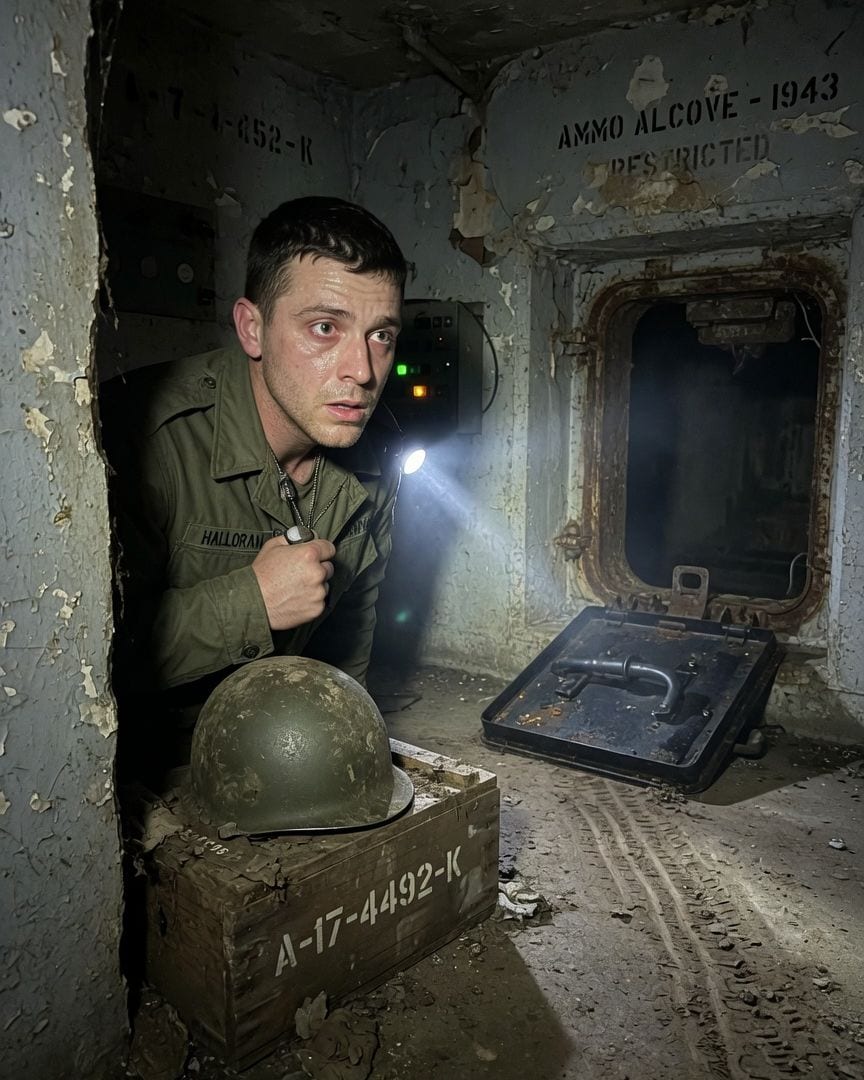
A coastal sentry on his last watch found the bunker's decades-sealed hatch ripped open by impossible strength.
Private Daniel Halloran shivered through his final hours on watch at the old WWII coast-artillery bunker, counting down to his discharge and going home. The pre-dawn fog rolled in thick, and through its swirling white, he watched a landing party form on the beach below, their outdated gear impossibly clean, their forms unmoving. After dawn burned off the mist, the beach was empty, but up the embankment, the bunker's rear hatch—sealed for decades—stood violently ripped open, its locking bar twisted. Inside the dark, silent chambers, Daniel's flashlight found a mud-caked military helmet, unlike any he'd ever seen, bearing a faded serial number that felt sickeningly familiar.
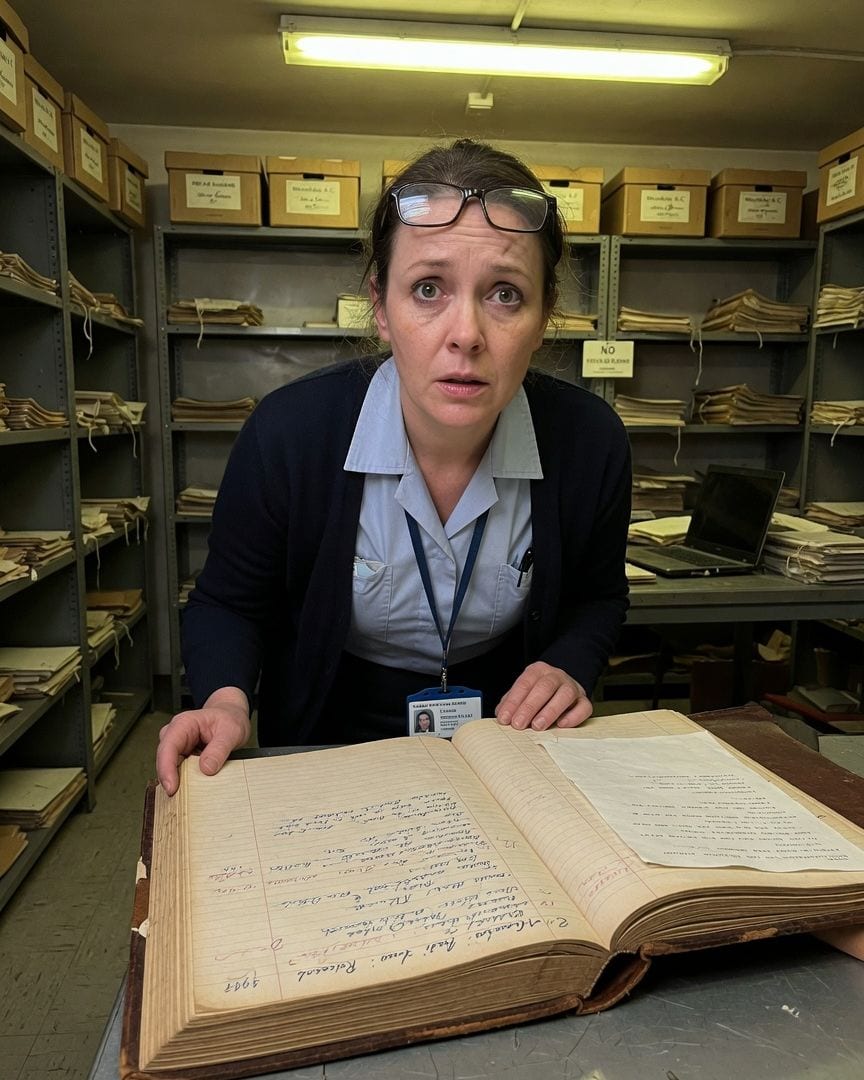
My ambulance trust's incident log shows callout 22-014 to 6 Cathcart Row at 2:40 AM. Every four years, the same call, same address. Always 'patient not found'.
My job involves tedious data entry for ambulance calls, but Incident 22-014 was different. It appeared every four years, always at 2:40 AM, always closed as 'patient not found.' Digging into the dusty physical archives, I found an entry from 1961 for the exact same incident, but its resolution read: 'Subject Secured. Relocated to "Holding".'
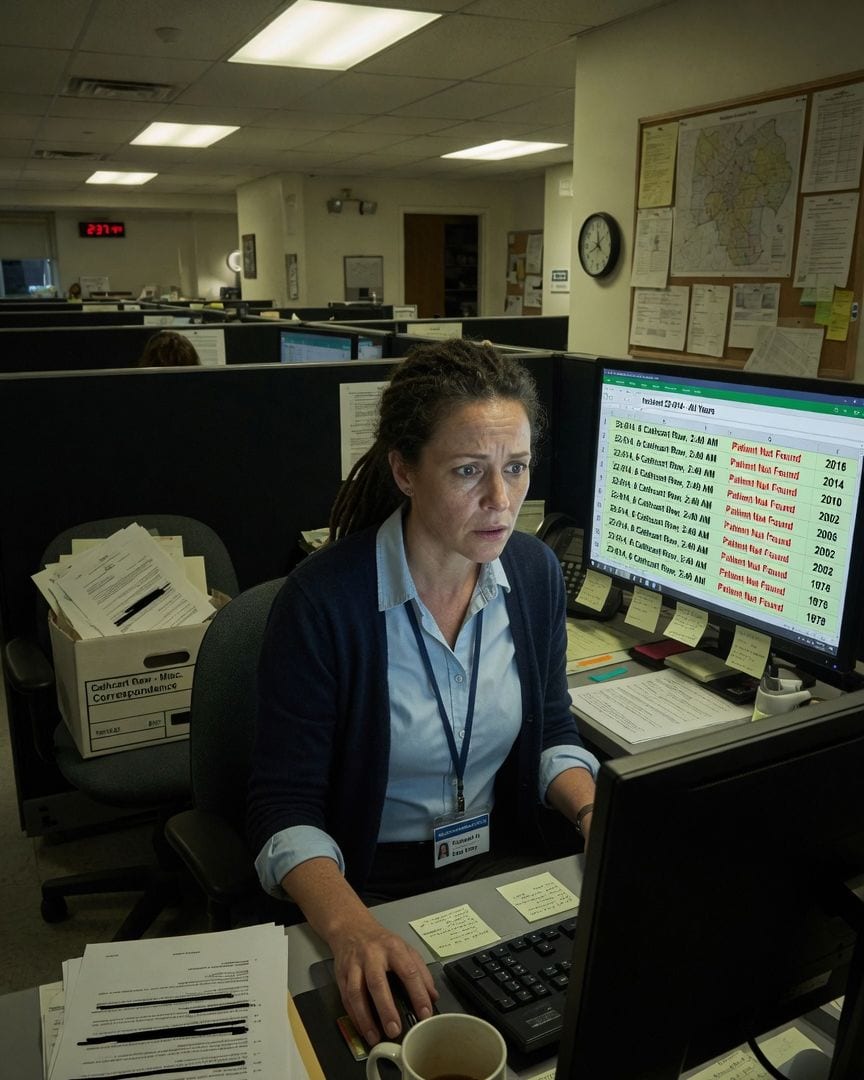
My computer log shows the same 2:40 AM call to Cathcart Row, every four years since 1978, always closed 'patient not found'.
Working data entry for the County Ambulance Trust, I found a routine incident logged as 'Patient Not Found.' But digging deeper, I discovered the exact same phantom call had repeated every four years for over forty years, always at the same address, always at 2:40 AM. Then I found a heavily redacted memo linking it to my own street.