A salvage master found a Cold War escort vessel lost for fifty-eight years. Its running lights were burning bright.
Salvage Master Bram Oduya, a man whose life was built on finding what was lost, stared at the sonar readout. The Java Sea was flat, a rare calm, but beneath his vessel, the Triton, sat something impossible.
The USS Palo Cinder, an escort vessel officially lost in 1966, was there, a ghost from fifty-eight years past. What truly froze him, though, were the running lights.
Red, green, and a masthead white, steady and bright, configured for a vessel underway. Not the faint phosphorescence of deep-sea life, but actual power, burning in salt water for nearly six decades.
He knew, with a certainty that iced his blood, that his generators hadn't been in salt water for fifty-eight years. He gave the order to surface the ROV, his voice tight, barely a whisper.
As the submersible rose, its camera focused on the impossible sight, and the Palo Cinder, sitting motionless on the bottom, showed a faint bow wave, a subtle ripple around its ancient hull.
Bram’s ROV operator, Ryan Brooks, a seasoned man in his thirties, kept muttering, "Bad sensor, boss. Has to be a bad sensor." But the readouts were clear, redundant systems confirming the impossible. The lights were real.
The bow wave, that subtle ripple around the hull, was also real, unmistakable even in the low light. The Palo Cinder was impossibly intact, not a barnacle, not a scratch on her hull.
Bram tried every rational explanation, the kind he relied on to make sense of the ocean’s vagaries: unique bioluminescence, a freak geothermal energy pocket, a residual charge from an experimental battery.
Each theory crumbled under the weight of the raw data. He ran simulations, compared historical charts, even called in a marine physicist friend, who offered only bewildered silence.
The ship was too clean, too perfect, its paintwork still holding its faded gray, as if it had been placed there yesterday, not abandoned to the deep for half a century. The lights, though.
They pulsed with a steady, electric hum that the ROV’s hydrophones picked up, a sound that should not exist from a dead vessel.
Bram knew, with a cold certainty that settled deep in his bones, that what lay beneath them was not a wreck. He ordered the dive preparations.
He had to see it for himself, to touch the impossible, to find the seam where reality had torn open.
Bram descended, the deep-sea lights of his suit cutting through the black, a lone beacon in an alien world. The Palo Cinder loomed, vast and silent, its running lights casting an eerie glow on the seabed.
He examined the hull, running a gloved hand over the impossible smoothness. No corrosion, no signs of impact, no trace of fifty-eight years of oceanic decay.
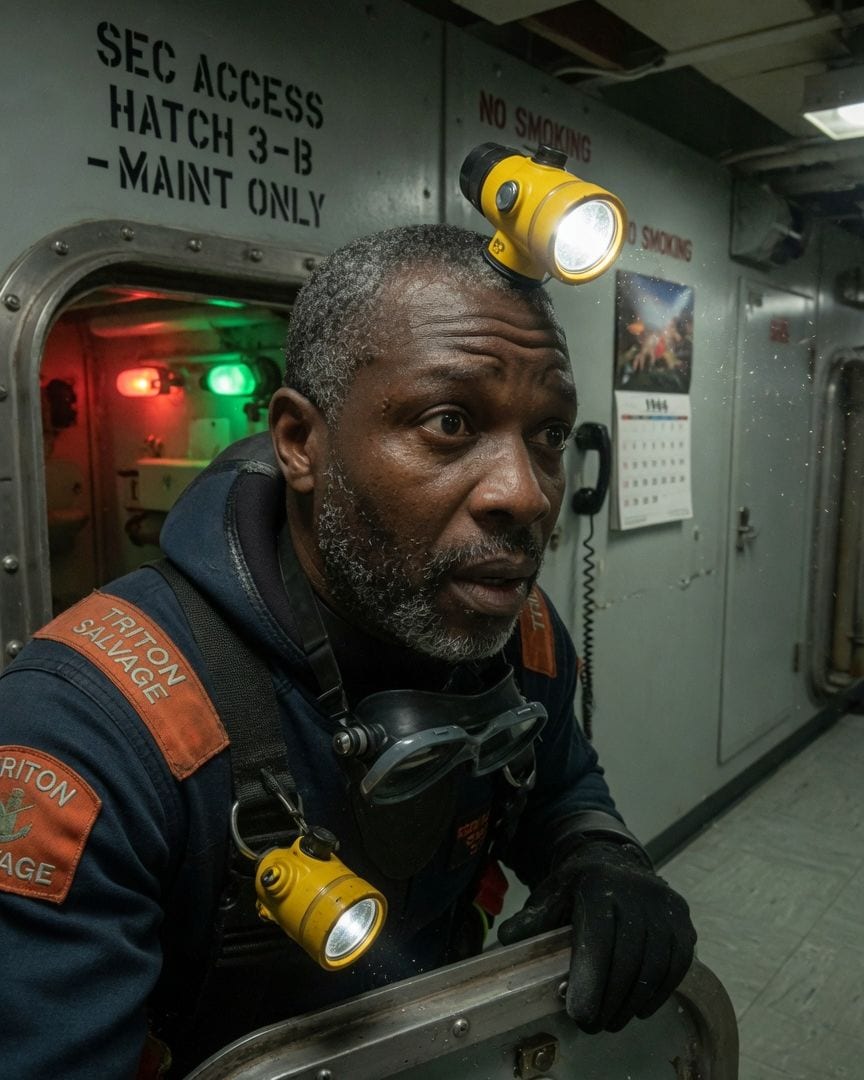
He found the main hatches, dogged tightly from the inside, as if the crew had sealed themselves in against something, or for something. After a tense hour, he located a seldom-used secondary access hatch, designed for maintenance.
With a burst of hydraulic power, he forced it open. A rush of impossibly still water, then nothing. Inside, it was dry, the air cool and stagnant but free of the expected stench of decay and rust.
The ship’s interior was perfectly preserved, not a speck of dust, not a sign of the ocean’s relentless march. He moved through the silent corridors, the beam of his helmet lamp sweeping over pristine bulkheads, reaching the bridge.
A logbook lay open on the chart table. Its last entry, written in perfect, unsmudged ink, was dated yesterday, and mentioned his own vessel, the Triton, by name.
Bram surfaced, the logbook clutched in a waterproof case, his mind reeling. He tried to report his findings to the authorities – the Navy, maritime agencies – but was met with a wall of polite skepticism, then outright stonewalling.
His calls went unreturned, his official reports routed into bureaucratic dead ends. "Bad data, Captain," a Navy liaison had finally told him, his voice flat, devoid of any genuine curiosity or concern. "The Palo Cinder is a known loss.
Your vessel must have encountered an unrelated anomaly. Suggest you move on." Frustrated, Bram turned to his network, the web of old contacts and favors he had built over decades.
He had heard whispers of a declassified archives project, a repository of forgotten naval incidents, too strange or too sensitive for public consumption.
He pulled strings, made calls, and eventually found himself in the sterile, fluorescent-lit halls of a government records office. There, he met Frances Carver, a meticulous archivist in her mid-forties, whose quiet demeanor belied a sharp intellect.
She was initially wary, her professional caution palpable, but Bram’s earnestness, and the undeniable strangeness of his story, piqued her professional curiosity.
After days of digging, her fingers flying across ancient keyboards and dusty microfiche readers, Frances located a heavily redacted file: "Project Echo-Delta – USS Palo Cinder Incident, 1966".
It contained vague references to a "non-standard contact" and "unexplained energetic signature," but page after page was blacked out, solid blocks of black ink hiding whatever truth lay beneath.
"I’ve seen redactions like this before," Frances murmured, her voice hushed, "in files that had nothing to do with naval losses. Always the same patterns, the same code names, like a signature."
As Bram continued his inquiries, a subtle shift occurred. His comms systems on the Triton began experiencing intermittent, unexplainable glitches – static bursts that cut off vital communications, phantom signals that momentarily populated their screens with gibberish.
On two separate occasions, Ryan Brooks, his ROV operator, reported fleeting, unidentified radar contacts at the extreme edge of their operational zone, vessels that appeared and vanished without a trace, too fast and too silent to be fishing boats.
The radar screen flickered like an anxious eye, showing a momentary blip, then nothing.
Bram dismissed them as sensor ghosts, attributing them to the increased strain of their ongoing, unusual investigation, but a prickle of unease started to grow, a cold hand tracing his spine. Then came the call from Frances.
Her voice was hushed, almost a whisper, sounding stretched thin. "Bram, I… I can’t help you anymore." She explained that her superiors had "suggested" she cease assisting him, a quiet but firm warning, delivered with unsettling politeness.
"They didn’t threaten me," she said, "but the implication was clear. Someone knows I’m digging. Someone knows you’re digging." She sounded genuinely scared, her usual composure utterly gone. Bram felt a cold knot tighten in his stomach.
He was no longer just investigating a mystery; he was being watched. The secrecy machine, which had buried the Palo Cinder for decades, was now turning its attention to him.
He was no longer the hunter; he was becoming the hunted, tracked by unseen eyes, his every move noted, cataloged, judged.
Bram met Frances in a discreet coffee shop, tucked away in a quiet corner of the city, far from the prying eyes of her office. He laid the waterproof case on the table, opening it to reveal the logbook.
The smell of clean, dry paper in a world of salt water was an anomaly in itself. "This is from the Palo Cinder’s bridge," he said, his voice low, heavy with the weight of the impossible. "Dated yesterday.
It mentions my ship." Frances’s eyes widened, her professional skepticism finally cracking under the undeniable, tangible evidence. "Impossible," she breathed, staring at the perfect, unsmudged ink.
This wasn't a historical artifact, decaying with age; it was a live document, a fresh entry written just hours before. Armed with this new, undeniable evidence, a physical object that defied logic and history, Frances took a calculated risk.
She returned to the archives, this time searching not for "Palo Cinder" but for the obscure code "Echo-Delta," cross-referencing against every document she could access, every peripheral file.
She found an unredacted fragment embedded in a seemingly unrelated budget report for deep-sea surveillance equipment, a peripheral document that had somehow slipped through the censors, hidden in plain sight among rows of fiscal data.
The fragment referred to "Echo-Delta Asset 7.1" – a "mobile, self-sustaining anomaly, periodically activated for observation, location tracked, status logged." The words hit Bram like a physical blow, stripping away every last thread of his rational disbelief.
The Palo Cinder wasn't lost; it was a shell, subsumed by this "asset," a vessel for something else entirely. The burning lights, the phantom bow wave, the pristine, dry interior, the recent log entry – it all snapped into horrifying focus.
The Palo Cinder was not a wreck with a strange power anomaly.
It was a functioning, active entity, or rather, the visible manifestation of one, and the logbook entry wasn't from the ship’s original crew, but from whoever or whatever operated and observed the asset, a log of its perceptions.
The institution wasn't searching for it; they were tracking it, studying it, and filing its existence away, a terrible, living secret.
The revelation of "Echo-Delta Asset 7.1" ignited a desperate urgency in Bram, a frantic need to understand the full scope of what he had uncovered.
He pressed Frances to find anything else, any detail that wasn't blacked out, any crack in the wall of secrecy.
She spent another frantic day cross-referencing, digging through peripheral files linked to "Echo-Delta," files that were supposed to be mundane administrative records, devoid of any sensitive information.
The fluorescent lights in her office seemed to hum with an oppressive weight as she worked, the silence punctuated only by the click of her keyboard. Late that night, her voice trembling, strained with fear and exhaustion, she called Bram.
"You need to see this, Bram. You need to come to my apartment. Not the office." When he arrived, the air in her small living room felt thick with unspoken dread.
She handed him a printout, her hand shaking so badly she almost dropped it. It was a page from the "Project Echo-Delta" file, a recent addendum, dated only last week.
It wasn't about the asset itself, but about current "operational security concerns." The text was stark, clinical, devoid of emotion.
It detailed the ongoing, unauthorized salvage attempt by "Salvage Master Bram Oduya, vessel Triton," noting his "persistent interest" in the Java Sea anomaly, and recommending increased surveillance.
His own name, his vessel, his actions, were being recorded within the very file he was reading, a file that had supposedly documented an event from fifty-eight years ago.
The file wasn't just a historical document; it was a living, breathing record, tracking him, updating his movements in real time.
Bram confronted Captain Howard Ingram, a retired naval intelligence officer he knew through his father, at a quiet, out-of-the-way diner, the kind where old men nursed lukewarm coffee.
Ingram, aged and weathered, his face a roadmap of old secrets, listened calmly as Bram laid out the evidence: the logbook, the 'Echo-Delta' fragment, the addendum with his name, his voice tight with a desperate need for answers.
Ingram didn't deny a word. He stirred his coffee, the spoon clicking softly against the ceramic. "Project Echo-Delta," he began, his voice raspy, surprisingly calm, "is not about a lost ship. It's about an adaptive entity. A presence.
It resides in the deep, drawing power and information from its environment. The Palo Cinder was the first vessel it fully… interfaced with. Not lost, but subsumed. It became a shell, a means for the entity to observe the surface world."
Ingram explained that the institution, a shadowy intelligence arm known only as 'The Bureau,' didn't control the entity but studied it, trying to understand its patterns, its "communications."
The running lights, he explained, were part of its 'active state,' a form of observation. The bow wave, that impossible ripple, was a manifestation of its adaptive, operational nature, a subtle indicator of the vast power it commanded.
The logbook entries weren't human-written. "They're its observations," Ingram said, his eyes meeting Bram’s, "facilitated by our monitoring system. A record of what it perceives. A language we're still trying to decipher."
The terror wasn't that the ship was haunted, but that it was a living, observing instrument, cold and impersonal, and that 'The Bureau' had known all along, patiently filing away the incomprehensible.
Ingram leaned forward, his eyes fixed on Bram, grave and unblinking. "Your father, Carl Oduya, was part of the original deep-sea survey team that first documented Echo-Delta in the late 60s."
A cold dread settled over Bram, heavier than any ocean current. "He became… obsessed. Like many who got too close. The lure of the unknown, the whispers from the deep." Ingram paused, taking a slow sip of his now-cold coffee.
"He disappeared on a 'research dive' years later. Officially, lost at sea." The pieces clicked into place with sickening precision. His father's 'obsession,' the vague rumors that had haunted Bram’s childhood, the official silence that followed his disappearance.
"The logbook entry mentioning your vessel," Ingram continued, his voice devoid of emotion, "was a signal. From the entity, or from our deep-sea observers. A warning. You were following your father's path, Bram."
Ingram explained that The Bureau wasn't malevolent, merely pragmatic. They managed the information, protected humanity from a truth it couldn't comprehend, and filed away the 'casualties' – those who got too close, like Carl Oduya.
"You have a choice, Bram," Ingram said, his voice a low, gravelly rasp. "Walk away. Forget this. Or become another entry in the file. The Bureau is patient. It has been signing these files for decades."
Ingram wasn't a villain, but a weary gatekeeper, a cog in a vast, indifferent machine that processed human lives into paperwork, and the horror was his calm acceptance of it all.
Bram felt the weight of generations, the silent horror of what had been known and hidden beneath the waves.
Bram returned to the Triton. The Java Sea was empty, stretching out beneath an indifferent sky. The Palo Cinder was gone, vanished as completely as if it had never been there.
Ryan Brooks and the crew were baffled, attributing the 'ghost ship' sightings to fatigue and faulty equipment, unable to reconcile their observations with the sudden, impossible absence. Bram's salvage contract for the area was abruptly cancelled, citing 'unforeseen geological instability.'
Frances Carver was quietly reassigned to a remote, obscure archive in a different state, her career effectively ended, erased from her old life. The Bureau moved silently, efficiently, erasing the traces, smoothing over the wrinkles in reality.
Bram himself was left untouched, but marked, an indelible understanding etched into his very being. The world simply moved on, unaware of the impossible truth that had just been buried again, deep beneath the waves.
Bram is back in his home office, the scent of old paper and salt lingering in the air, a phantom reminder of the deep.
He sorts through a box of his father’s belongings, things he hadn’t truly looked at since Carl’s disappearance. Beneath a stack of navigation manuals, he finds a faded, handwritten note.
It’s a single line, scrawled in Carl Oduya’s familiar hand: 'The lights burn for those who watch.' Bram sets it down on his desk, the words a cold echo. He picks up an old chart of the Java Sea.
A faint, almost invisible circle, drawn in red ink, marks the precise spot where the Palo Cinder had been found, and where it had vanished again.
He traces the circle with his finger, then folds the chart carefully, placing it in a drawer. He knows the file is still being signed, somewhere, for someone else.
His neighbor, Monica Whitmore, stopped by later that week, noticing the light in his office. "Still working late, Bram?" she asked, her voice cheerful, unaware of the depths.
"Just tying up some loose ends," he replied, a faint, wrong little smile on his face as he looked out at the dark, empty ocean.
If this one got to you
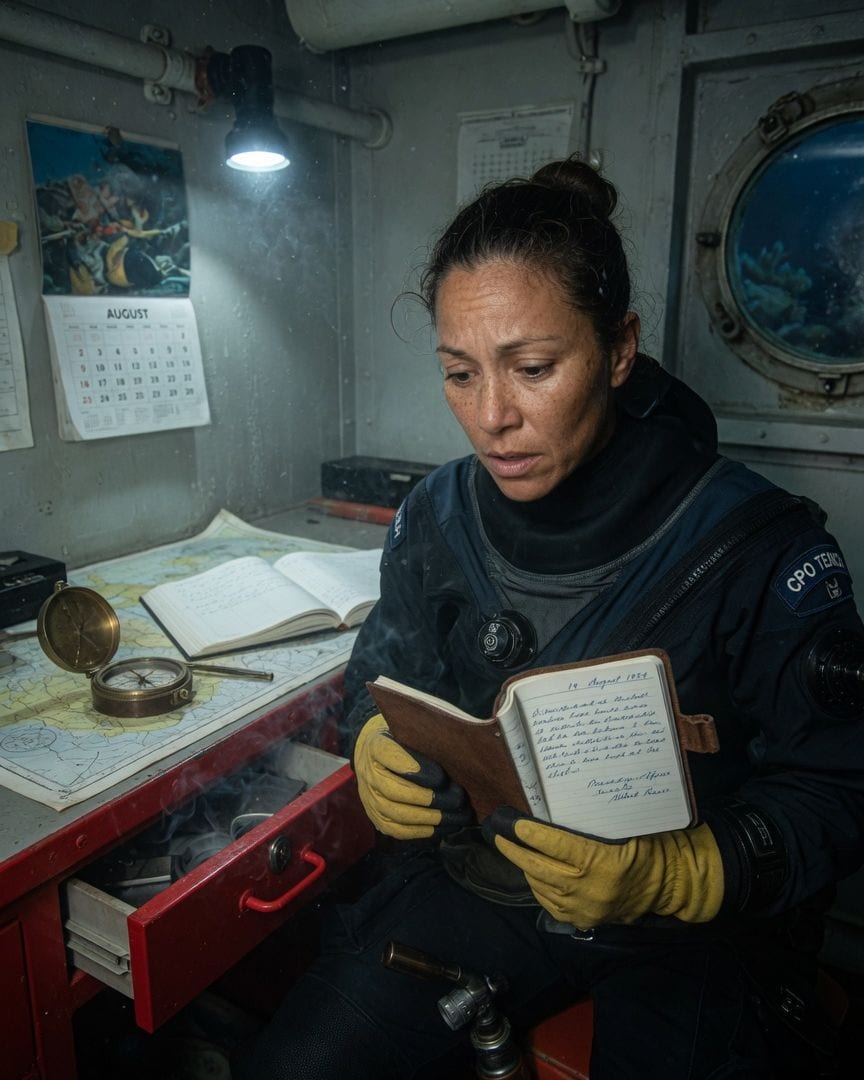
A deep-sea diver found a Cold War target ship's logbook dated months after it was vaporized in 1954.
Chief Petty Officer Marlo Tench, a methodical deep-sea diver, stared in disbelief at the ROV feed. Her team watched with her as the USS Triton, a target ship from the 1954 Castle Bravo nuclear test, appeared pristine and upright ninety feet below. It was supposed to have been vaporized, yet its hull number was unmistakable, its paint unburned, and its internal systems inexplicably active. Descending into the eerie silence, Marlo found a logbook dated five months after the ship’s destruction, and a journal entry naming a crewman officially listed as 'unmanned target.' What impossible force kept the Triton a living ghost decades after its fiery end?
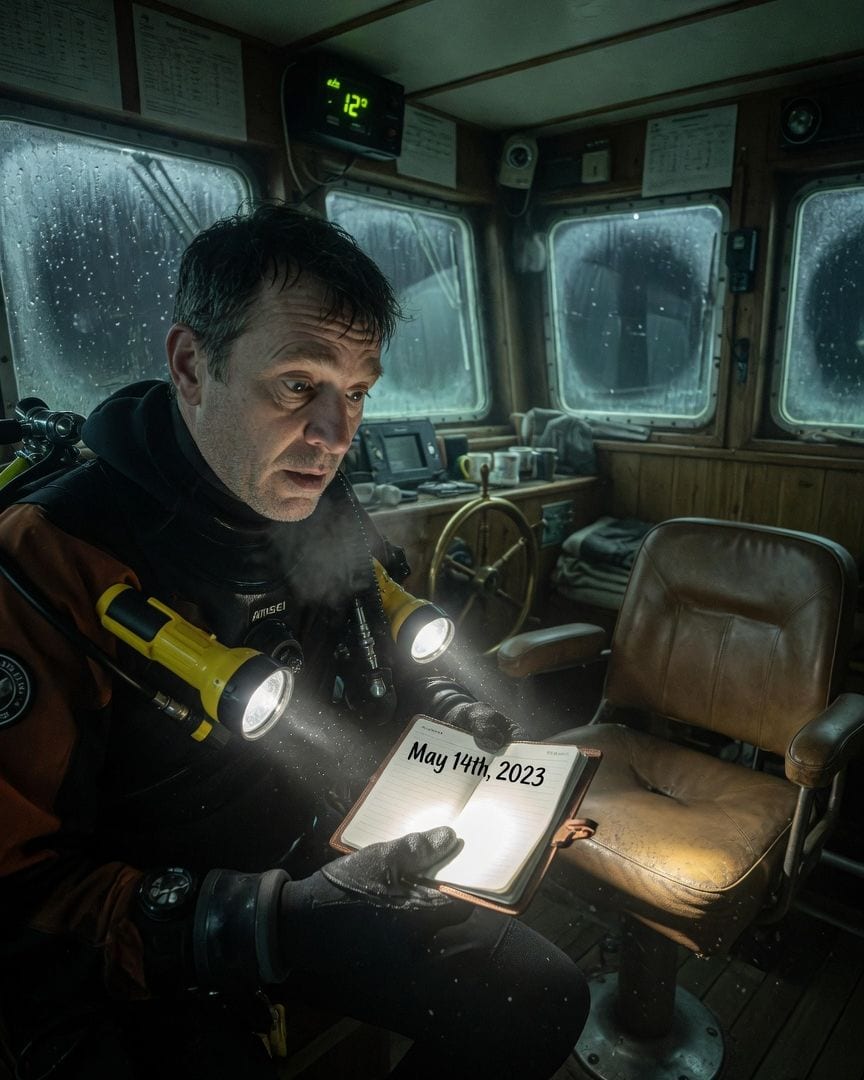
A dive supervisor exploring a Cold War sealer found its logbook on a wheelhouse shelf, with an entry dated this morning.
Dive supervisor Hugo Amsel felt the familiar cold of the Bering Sea as his submersible approached the 'Wynn Portal,' a sealer vanished without a trace in 1991. The wreck sat eerily intact, its wheelhouse windows impossibly clear, and the helm locked hard to starboard. But then the rudder angle indicator twitched, moving two degrees, a ghost still at the wheel. After breaching the sealed hull, Hugo and his lead diver found the ship's interior pristine, frozen in time. In the wheelhouse, on a shelf next to the chart table, lay the logbook. Its final entry, written in Captain Larsen’s hand, was dated 'May 14th, 2023' – today. The ink was still unsettlingly fresh, leaving Hugo to stare at the impossible date and the empty captain's chair.
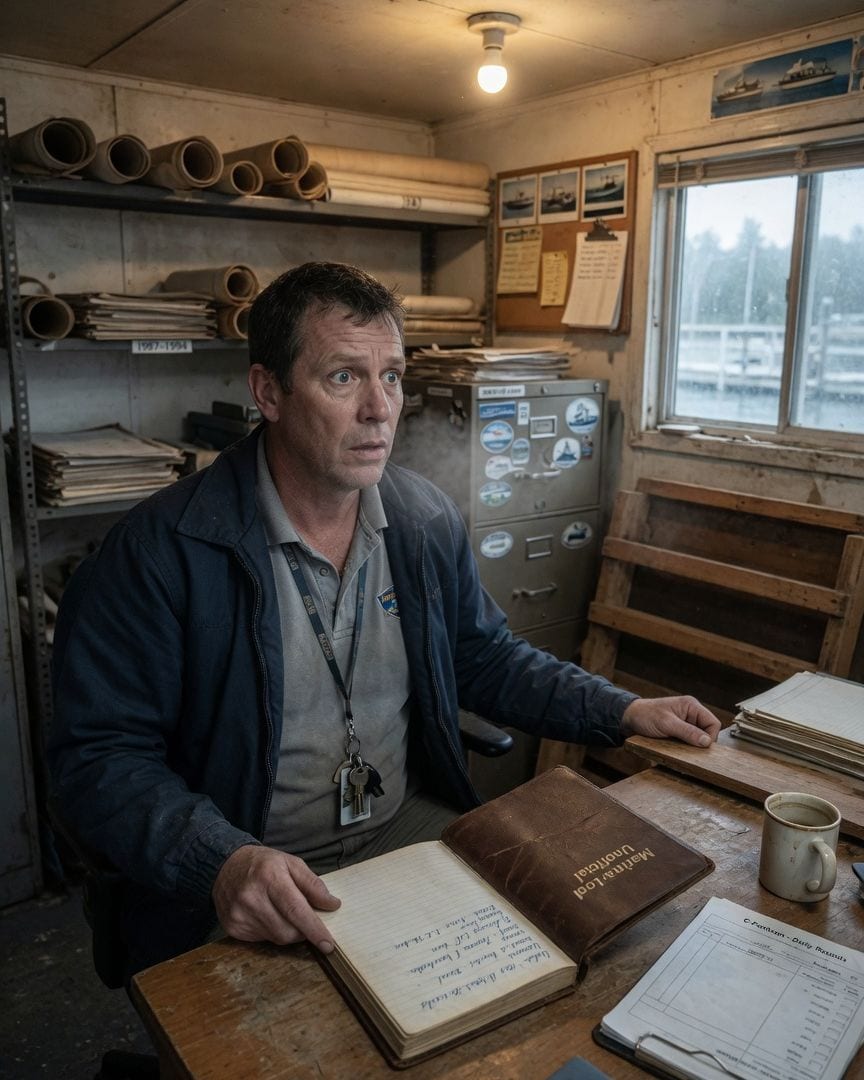
My C-Pontoon goes an extra thirty feet to Berth 61, with a sleek, dark yacht I've never seen. It's drawing power, but doesn't exist on any records.
As harbormaster, my morning rounds are always routine, checking the sixty berths on our C-Pontoon. But one chilly morning, beyond the last numbered post, C-60, I found the pontoon inexplicably extended by another thirty feet. It ended in a new numbered post: Berth 61, a physical fact that simply could not exist.
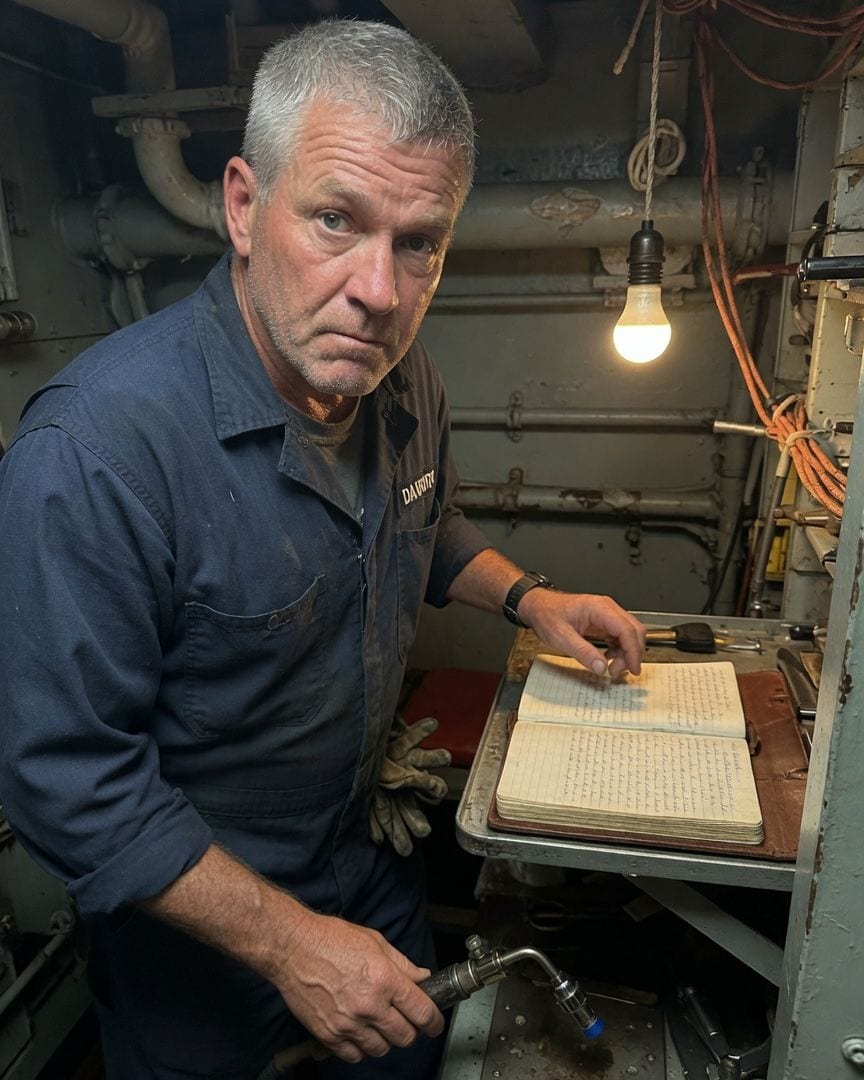
A week from shore duty, Chief Danforth cut a hatch where his ship's plans showed solid steel. An hour later, the wall was seamless, but the Cold War logbook from inside appeared under his mattress.
Chief Petty Officer Raymond Danforth, just a week from ending three decades of service, was intimately familiar with every pipe and plate of the guided-missile destroyer Weatherall. During a mid-cruise overhaul, his gloved hand found a sealed hatch where schematics promised only a solid bulkhead. He cut through the impossible seam to reveal a small, dry compartment, softly lit, containing a logbook filled with an unsettlingly familiar hand. When he returned an hour later with a witness, the hatch was gone, the wall seamless. Later that night, the same logbook appeared beneath his mattress, its pages revealing an entry: 'Petty Officer Howard Montgomery, missing, 1972.' How could a compartment vanish, yet leave its secrets behind?
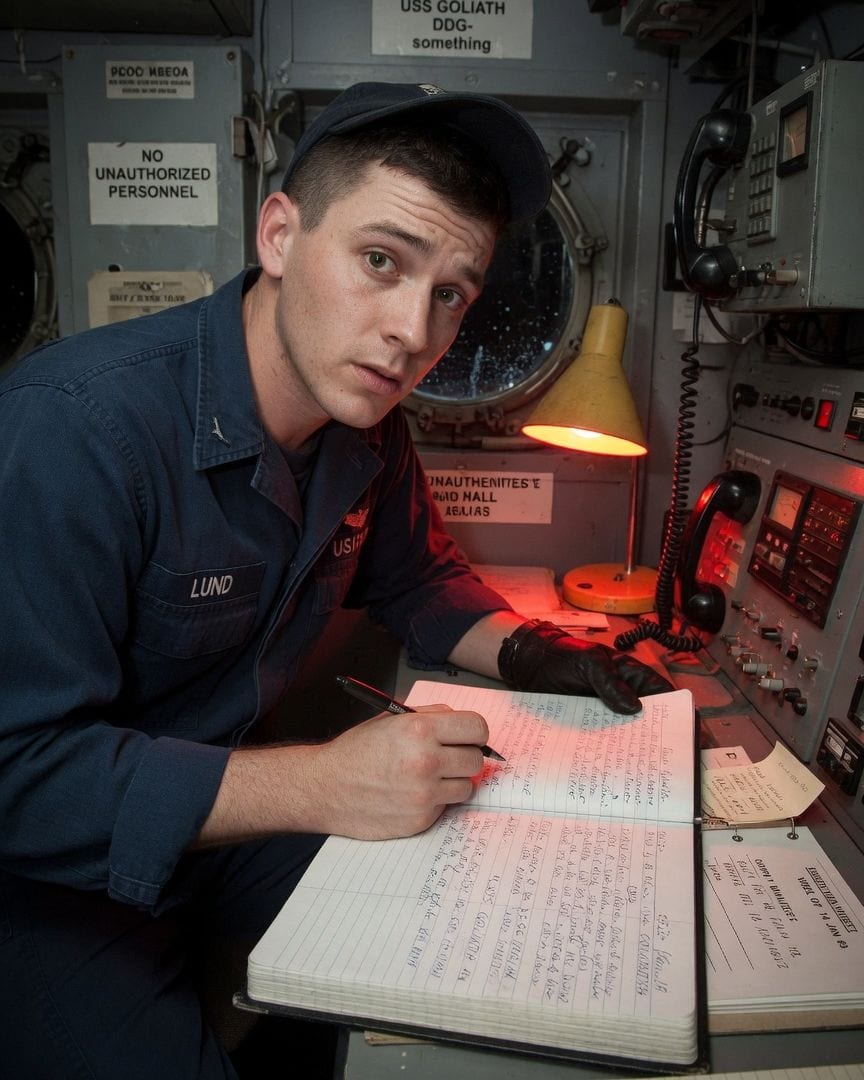
Petty Officer Lund heard his own captain's mayday: the Cold War USS Goliath was sinking, two hundred miles astern.
Petty Officer Marco Lund kept a lonely vigil in the USS Goliath's radio room, the destroyer battling the North Atlantic in deep winter 1983. Suddenly, a garbled mayday broke through: his own ship, his own captain, reporting they were going down two hundred miles astern. Though the bridge confirmed the Goliath was fine, the same chilling call came again an hour later, stronger and from the exact waters they had just crossed. Deeply unsettled, Marco began searching ship logs, eventually discovering a phantom entry: an identical mayday, logged a week prior, pressed into the very paper beneath his own.
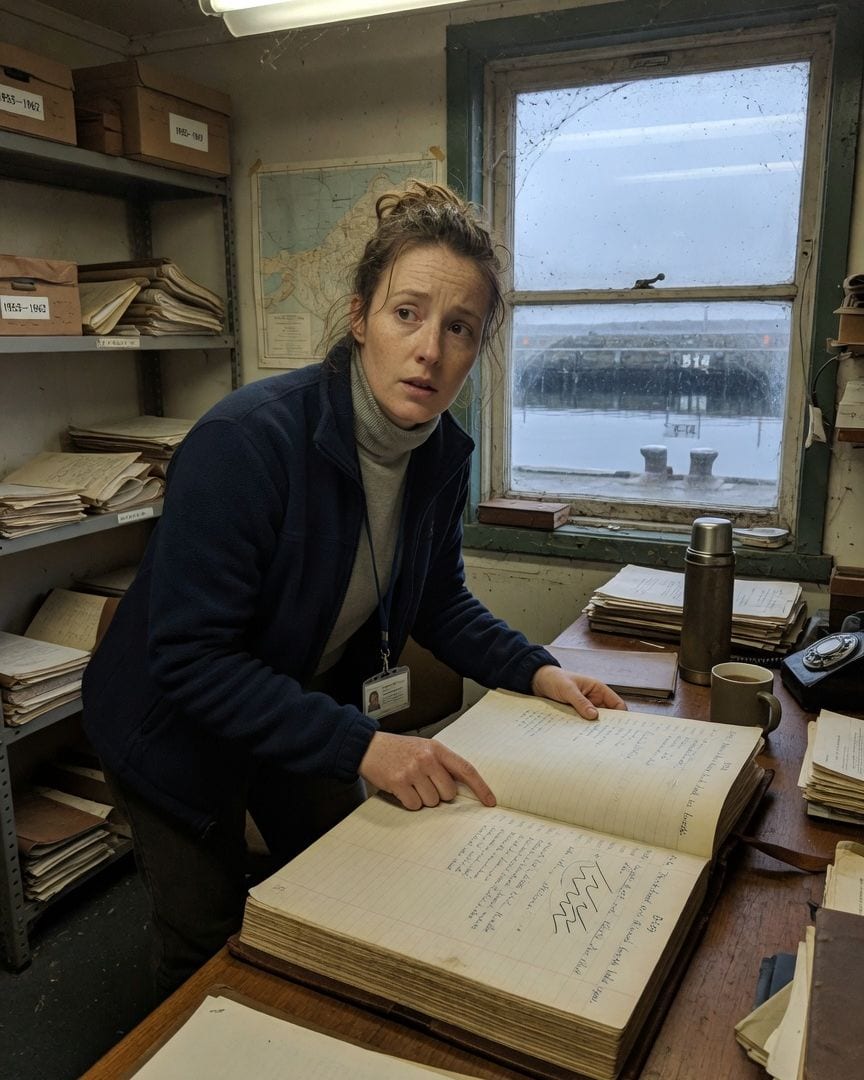
My harbour ledger shows Berth 14 let to a trawler every few years, but it's always empty. Each entry reads 'not returned to sea, berth held open'.
My job as Harbour Master's Assistant is managing the berth ledger, tracking every vessel. But Berth 14 holds a strange paradox: my book says it's let, yet it's always empty. Each entry for that berth closes with the same cryptic note – 'not returned to sea, berth held open' – a pattern stretching back to 1955.