Senior Airman Cofield's last patrol found a hot coffeepot and a 'transferred' airman's dog tag inside a building mothballed since 1992.
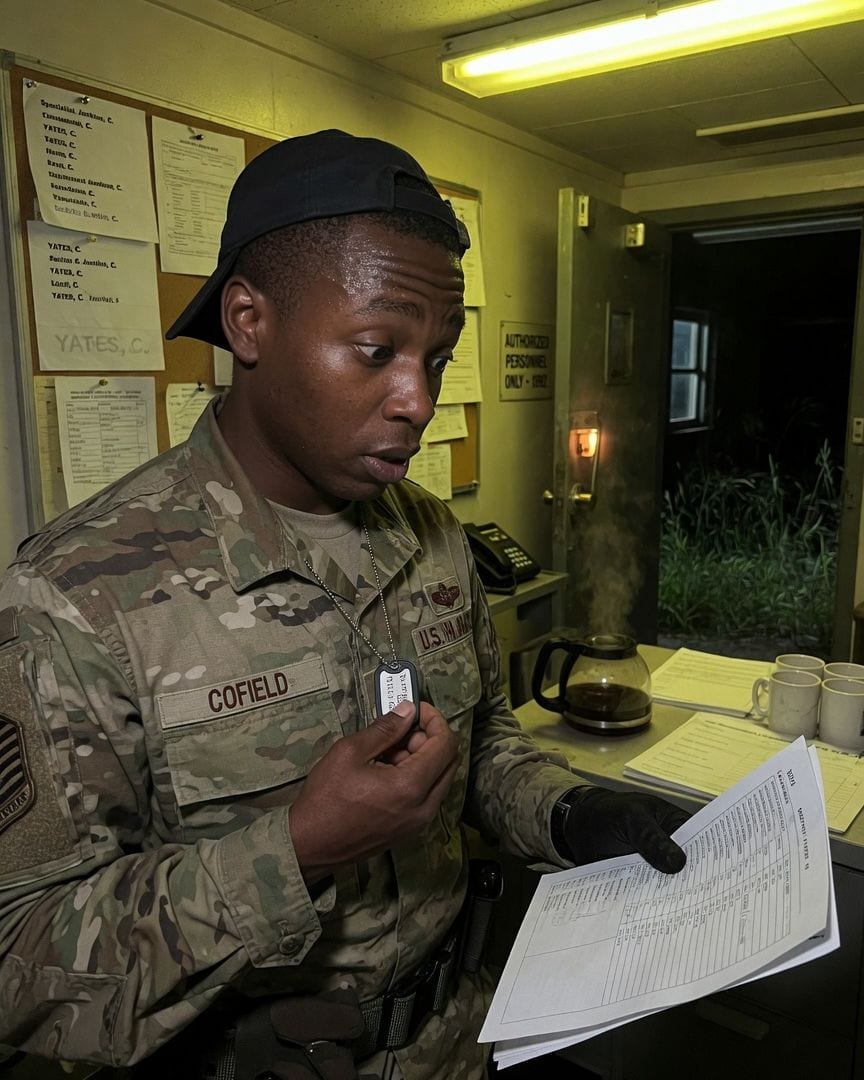
Senior Airman Maxwell Cofield, on his last perimeter patrol before transfer, scanned the desolate expanse of the decommissioned weapons storage area.
The chain-link fence, topped with razor wire, circled a cluster of concrete bunkers and a single, squat alarm-monitoring building, officially de-energized and mothballed since the wing gave up its special-weapons mission back in 1992.
Cofield had walked this path a hundred times, the silence always absolute, the darkness always unbroken. His eyes, however, snagged on an impossible detail tonight: a light, a faint yellow glow, blooming on in a window of that very building.
He checked his comms. Central Security Control reported the zone clear: no entry, no maintenance scheduled. "Montgomery, Porter," he called, his voice tight, "WSA building. Window on the east side." His patrol, Staff Sgt.
Vera Montgomery and Airman First Class Everett Porter, moved with him toward the building, their boots crunching on the gravel road, each sound amplified in the night.
The light intensified as they approached, a steady, undeniable luminescence spilling from the interior, painting a rectangle of sickly yellow onto the overgrown weeds outside.
When they reached the heavy steel door, it was unlocked, the latch warm to Cofield’s gloved touch. Inside, the fluorescent lights hummed, casting a sterile, unrelenting glow over a small office area.
A fresh shift-change roster, printed with names and duty times for the coming week, was tacked to a corkboard.
And on a small table, next to a stack of empty mugs, the coffeepot was still hot, steam rising faintly from its dark, oily surface.
Montgomery, ever by-the-book, immediately called it in, describing the scene with a mix of disbelief and annoyance. "CSC, this is Montgomery. Appears we have unauthorized access at WSA building three. Interior lights on, unsecured door, active utilities.
Stand by for details." She pulled out her notepad, already drafting her report. "Probably some prank by the night shift, or maintenance forgot to log in," she muttered, not meeting Cofield’s eye.
Cofield, however, was already examining the roster on the corkboard. The names were unfamiliar, not part of their current security forces rotation. He didn’t recognize a single one from any other department either. "Who are these guys, Sarge?"
he asked, pointing to a name – a ‘Specialist Jenkins, C.’ – with a duty shift beginning at 0300.
Montgomery shrugged, still focused on her comms. "Probably a placeholder, Cofield. Someone's idea of a joke to mess with us on graveyard." But Cofield felt a prickle of unease that went deeper than a prank.
He ran a quick check on his handheld, cross-referencing names from the roster against the base's current manifest. His thumb scrolled through the database. None matched. Not a single one. "Sarge, these names aren't in the system.
Not for this base, anyway."
Montgomery sighed, taking the device from him with an impatient gesture. "Give it here. Probably a lag in the system. Or a clerical error in the roster print. Happens all the time."
As she tried, tapping the screen with a gloved finger, Cofield’s gaze fell on a custom-engraved dog tag lying half-hidden under a stack of old, blank forms near the coffeepot. He bent down, picked it up.
'YATES, C.' it read, with a small, stylized falcon etched beside it, the metal cool against his palm. He recognized it instantly. Airman Chloe Yates.
She’d been officially ‘transferred’ off base a week ago, but Cofield remembered a specific, unsettling detail: during a perimeter headcount the day before her supposed transfer, his count had come out one man too many, and he’d distinctly seen Yates standing in formation, even though she shouldn’t have been there, her uniform a crisp, impossible detail in the dawn light.
He’d dismissed it as fatigue, a trick of the light, blaming the early hour and the flickering stadium lamps. Now, he felt a cold knot in his stomach. Yates’s dog tag, here, in a decommissioned building. It wasn't a prank.
Cofield held out the dog tag to Montgomery. "Sarge, this is Airman Yates's. The one who transferred last week."
Montgomery’s brow furrowed, her easy dismissal finally faltering. She looked from the tag to Cofield’s face, then back again. "That's impossible. She’s gone. Moved on to another posting."
She took the tag, turning it over in her gloved hand, her eyes scanning the familiar engraving. Her gaze went to the roster again, then back to the tag, a flicker of something close to fear in her expression.
Cofield, meanwhile, was staring at the roster, drawn back to it by a detail he hadn't fully processed. He pointed to the name 'YATES, C.' on the fresh print. "Look closer, Sarge."
Beneath the crisp, dark ink, faintly visible as if erased and rewritten countless times, was another 'YATES, C.', scrawled in a slightly different hand, faded with time, almost ghost-like.
It wasn't just a new name on a new roster; it was a recurrence, an echo.
Just then, a low, rhythmic thump-thump-thump began, vibrating faintly through the concrete floor, a sound that resonated from deep within the building's unseen depths, like a slow, heavy heartbeat.
The thump-thump-thump continued for several unnerving minutes before fading into silence, leaving an oppressive quiet in its wake. Montgomery, visibly shaken, secured the building, radioing for a full investigation.
The official explanation came swiftly and smoothly: a faulty old generator in a sub-level, a clerical error with the roster, and a 'misplaced' dog tag that had somehow ended up in the WSA during a forgotten maintenance sweep.
The 'hot coffee' was attributed to a maintenance crew that had supposedly been in earlier, though no record of their entry existed. Everyone was told to consider the matter closed.
Cofield knew better. The official report was a neat, tightly wrapped lie. He started quietly digging into Airman Chloe Yates's 'transfer' records. He found the paperwork surprisingly thin, processed with unusual speed and minimal oversight.
It was almost too clean, a blank space where there should have been a detailed trail. He sought out Tech. Sgt.
Oliver Hartley, a grizzled veteran NCO in Base Operations known for his encyclopedic memory of the base's history, a man who had seen everything come and go.
Cofield casually mentioned the WSA incident, phrasing it as a curiosity, a strange thing that had happened on his last patrol. Hartley's jovial demeanor vanished, replaced by a hard, unreadable stare.
His eyes, usually crinkled at the corners with amusement, narrowed. "Some things, Airman, are best left alone," Hartley advised, his voice low, a warning more than an observation.
He took a long drag from his coffee, then added, "You’re almost out of here, Cofield. Got your transfer papers waiting. Keep your nose clean. Don't go looking for trouble where there isn't any."
Cofield, however, was undeterred. He began cross-referencing names from the unofficial roster he’d found with old base personnel lists, searching for any connection.
He spent his off-duty hours hunched over microfiche readers in the dusty base library, scrolling through decades of records.
He noticed a disturbing pattern: every few months, a small cluster of 'transfers' or 'discharges' would occur, always around the same week.
And some of those names, though not on the current official roster, seemed to echo those on the unofficial list he'd found, faint echoes across time.
Cofield’s inquiries did not go unnoticed. A few days later, he was called into Colonel Gordon Vaughn's office. Vaughn, a man whose smile never quite reached his eyes, sat behind a meticulously neat desk, his hands clasped.
He offered Cofield a 'friendly' warning, his voice smooth as polished stone. "Senior Airman Cofield, your diligence is commendable. We appreciate a sharp eye. But there are... certain sensitivities. This base has a long history, as you know.
Some matters are beyond the scope of a junior airman's inquiry." He leaned forward slightly, his gaze unwavering. "Your upcoming transfer to your desired duty station could be jeopardized if you continue to 'disturb' settled matters.
It would be a shame to see such a promising career take an unexpected detour." The unspoken threat hung heavy in the air, a cold weight.
Later that night, Cofield returned to his barracks, the Colonel’s words still echoing in his head. His locker, which he always locked with a specific, complex combination, was ajar. He checked it immediately.
Nothing was stolen, no item seemed out of place from his carefully organized belongings. But inside, neatly folded on his neatly arranged bunk, was a single, blank, faded copy of the unofficial roster he'd found in the WSA building.
It was the exact same print format, the same faint crease marks, only completely empty of names. It was a message, clear and chilling. Someone knew. Someone was watching.
The dread, once an abstract puzzle, now had a cold, personal edge. He was no longer just an observer.
The blank roster solidified Cofield's resolve. This wasn't just a strange incident; it was deliberate. He needed answers.
Using a back channel he’d cultivated with a sympathetic records clerk – a young airman who owed him a favor for a forgotten watch shift – he gained temporary, illicit access to archived base manifests and duty rosters, stretching back to the early 1990s.
He spent hours poring over the dusty files in the restricted archives, the dry smell of old paper filling his nostrils.
The pattern he'd noticed earlier solidified into an undeniable trend: names from the unofficial roster he'd found in the WSA building, or names eerily similar, reappeared on official records from decades past, usually marked 'Missing, Presumed Deserted' or 'Transferred (Special Assignment)'.
He found a 'YATES, C.' from 1993, listed as 'Missing, Presumed Deserted.' The same name, the same initial. He now understood the faded scrawl beneath the fresh ink on the current roster.
It wasn't just a clerical error; it was a re-inscription, a re-manifestation.
Armed with this damning evidence, Cofield sought out Tech. Sgt. Hartley again, cornering him during a quiet shift change in the empty supply room.
He spread printouts of the old records on a battered metal table, pointing to the recurring names, the impossible 'YATES, C.' from both the recent and distant past.
Hartley's face, usually a mask of weary amusement, crumpled. He stared at the documents, then at Cofield, a deep, ancient fear in his eyes. He slowly pushed the papers away, as if they were physically toxic.
"It's always been there, son," Hartley finally admitted, his voice barely a whisper, his gaze fixed on some point beyond Cofield’s shoulder. "That building... it's not decommissioned. Not really. It just operates on its own terms."
He explained that 'it'—he never specified what 'it' was, as if the entity itself were unnameable—had a way of identifying certain individuals, those who 'stood out,' who subtly 'broke' the system's perfect count. "They don't transfer. They don't desert. They're...
selected. For permanent duty. Duty that doesn't exist on any official manifest." Hartley’s eyes met Cofield’s, wide and haunted.
He revealed that base command had known for decades, managing it as a classified, unacknowledged program, sacrificing personnel to maintain whatever balance 'it' demanded. "The names on that roster you found? Those are the ones on 'permanent assignment.'
The ones who never come back."
Hartley, his confession complete, looked utterly defeated, the weight of decades pressing down on him. "I've seen it happen for thirty years, Cofield. It’s part of the base now. You can't fight it."
He reached into the breast pocket of his fatigues and pulled out a folded, brittle piece of paper, its edges soft and worn with age.
It was a faded, hand-drawn map of the WSA building, showing not only its ground floor but a complex sub-level beneath it, marked in faint pencil: 'Observation Post Gamma.'
"They don't just take them," Hartley said, his voice barely audible, a desperate rasp. His eyes were wide and fixed on some distant, invisible point, as if he were already seeing his own future. "They watch. Always.
They watch for the ones who slip through the cracks, the ones who don't quite fit the numbers."
Cofield was about to ask 'who?' or 'what are they watching?' when his gaze fell upon the map Hartley still held out.
At the very bottom, scrawled in the same distinct, unsettling hand as the original 'YATES, C.' from the unofficial roster, a fresh name had been added. The ink was still dark, still vibrant against the faded paper.
'HARTLEY, O.'
Cofield tried to warn Hartley, but it was too late. He searched everywhere – Hartley’s barracks, his usual haunts, even the base operations office – but the old sergeant was gone.
His bunk was stripped, his gear absent, his name already scrubbed from the current duty roster – another 'transfer' executed with impossible speed, a paper ghost where a man had been.
Cofield knew Hartley had handed him the map as a final, desperate act, knowing his own time was up, a last desperate plea for someone to understand.
Following Hartley's faded map, Cofield located a rarely used maintenance tunnel beneath a derelict pump house, its entrance cleverly disguised behind a rusted panel and a tangle of defunct wiring.
He squeezed through the cramped, dust-choked space, the air thick with the metallic tang of old machinery and the damp earth. The tunnel led him directly to the sub-level of the WSA building.
It opened into a sterile, anachronistic observation room, bathed in a low, green light from a bank of ancient, cathode-ray tube monitors.
These weren't just security cameras displaying perimeters or gates; they displayed live feeds of the base, but focused not on facilities, but on individual airmen in their barracks, the mess hall, the motor pool.
The camera followed a young recruit heading to PT, then another eating breakfast alone.
He saw a monitor displaying his own barracks room, live, the camera angled to catch his bunk, his neatly folded uniform laid out for the next day.
The 'thump-thump-thump' from Part 1 was now a rhythmic, almost hypnotic hum emanating from the massive, still-active surveillance equipment that filled the room, a low thrum against his chest.
The 'hot coffee' he’d found was indeed for the 'observers,' the 'permanent duty' personnel whose names graced the unofficial rosters, now revealed as the watch-keepers of this unseen program.
The pattern of names, the discrepancies in counts, the impossible transfers – it all clicked into place with horrifying coherence.
Cofield moved through the observation room, a cold dread settling deep in his bones. The monitors showed the minutiae of daily life, but with a predatory focus, seeking out any flicker of anomaly.
He found a row of locked metal file cabinets, old-school, analog, stretching along one wall. With a burst of adrenaline born of terror and resolve, he forced one open, the rusted lock groaning in protest.
Inside were decades of personnel files, cross-referenced with the unofficial rosters he’d seen. These were the true records of those 'transferred' or 'deserted,' detailing their 'selection' for this permanent, hidden duty.
He found Chloe Yates's file, a brief biography followed by a clinical assessment of her 'anomalous presence' in the base's accountability system, a subtle 'count discrepancy' that had led to her 'recruitment.'
He found Oliver Hartley's file, recently updated, outlining his 'voluntary' transition to 'permanent observation duty,' a small note about his invaluable historical knowledge.
The institution’s own records, obtained at last, stated it plainly in black and white: a program to identify and recruit individuals who subtly defied standard military accounting, for indefinite, unrecorded observation work.
It wasn't an external threat, but a systematic, internal function of the base itself.
A faint click echoed from the maintenance tunnel entrance. Footsteps. Slow, deliberate, approaching the observation room.
Cofield grabbed a handful of files – Yates's, Hartley's, and several others detailing similar 'anomalous' individuals – stuffing them into his uniform shirt, the stiff paper digging into his side.
He could hear the breathing now, shallow and steady, just outside the door.
He scrambled back into the maintenance tunnel, just as a figure in an old, unidentifiable uniform, their face obscured by shadow, stepped into the green-lit observation room, a faint, knowing smile playing on their lips.
Cofield moved as fast as he could, the files digging into his side, the hum of the equipment fading behind him, a slow, rhythmic pulse against the concrete walls.
Cofield made it off base, the pilfered files hidden deep in his duffel bag, his transfer papers surprisingly processed. His attempts to report the program, however, were met with polite skepticism, then outright dismissal.
His claims were attributed to stress and fatigue, the result of a difficult rotation. His 'evidence' was deemed classified material he had no business possessing, or worse, forgeries concocted by a disgruntled airman.
His transfer was expedited, not to his desired post in Hawaii, but to a remote, undesirable station in the Arctic, a quiet blacklisting. He was told to consider himself lucky.
The official records for Chloe Yates and Oliver Hartley remained unchanged: 'Transferred' and 'Retired, Location Unknown.' The base simply continued its operations, undisturbed, a humming presence in the desert.
Years later, Maxwell Cofield, now a civilian living in relative isolation, still found himself checking old, secure veteran forums. He never posted, just watched, a ghost in the machine.
The base he'd left behind, now under new command, continued its quiet, almost imperceptible pattern of 'transfers' and 'discharges,' always around the same week of the month, always the same impossible names.
One evening, he saw a new post pop up on a forum dedicated to his old base, from a former airman asking if anyone remembered 'Airman Chloe Yates,' who 'just vanished' one day. The post vanished in an hour.
Cofield knew the names would only grow.
If this one got to you
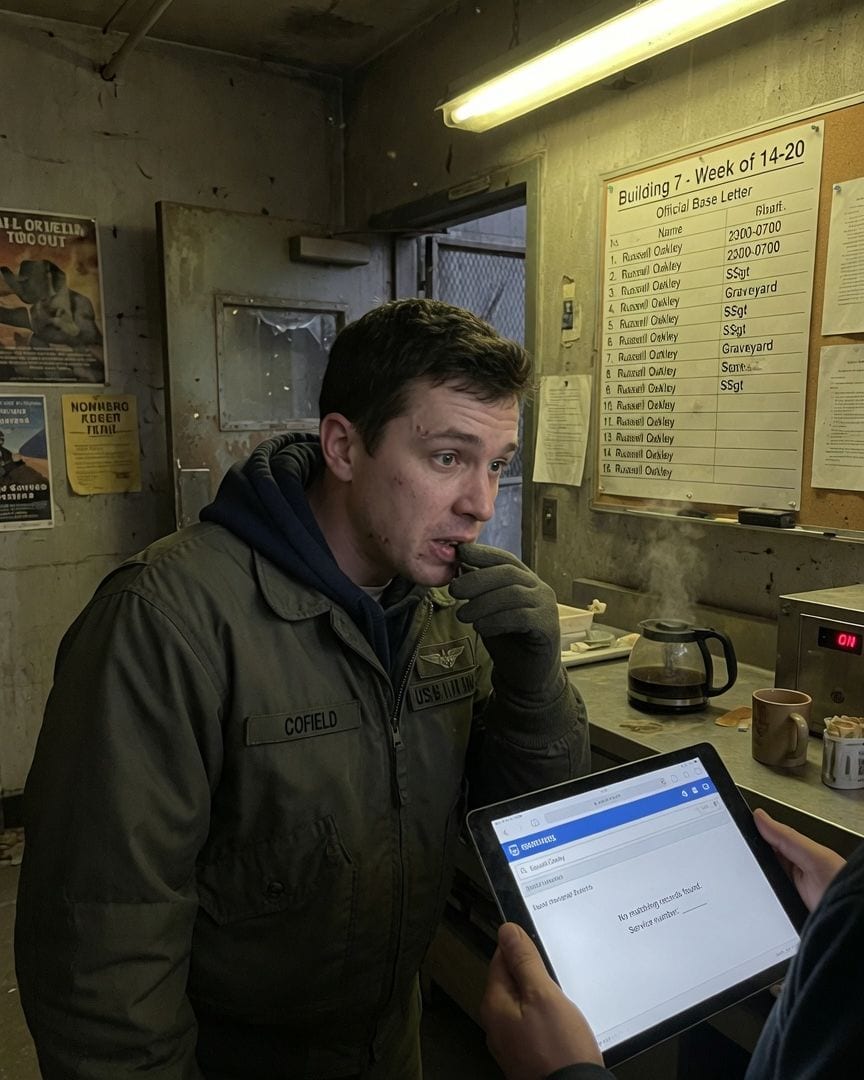
Airman Cofield, two weeks from transfer, found a warm coffee pot in a building without power for thirty years. Its new shift roster listed a name that didn't exist.
Senior Airman David Cofield, just two weeks from his long-awaited transfer, patrolled the perimeter of a decommissioned weapons storage area. Building 7, a concrete shell dark since 1992, suddenly showed a faint, warm light in its window. Inside, fluorescent lights hummed, and a coffee pot on the counter was still warm, defying the building's decades-long power shutdown. A freshly pinned shift roster for the coming week then revealed a name: 'Russell Oakley,' listed for Cofield’s own graveyard shift, yet completely absent from every official base record. Who was Russell Oakley, and how was he on shift in a dead building?
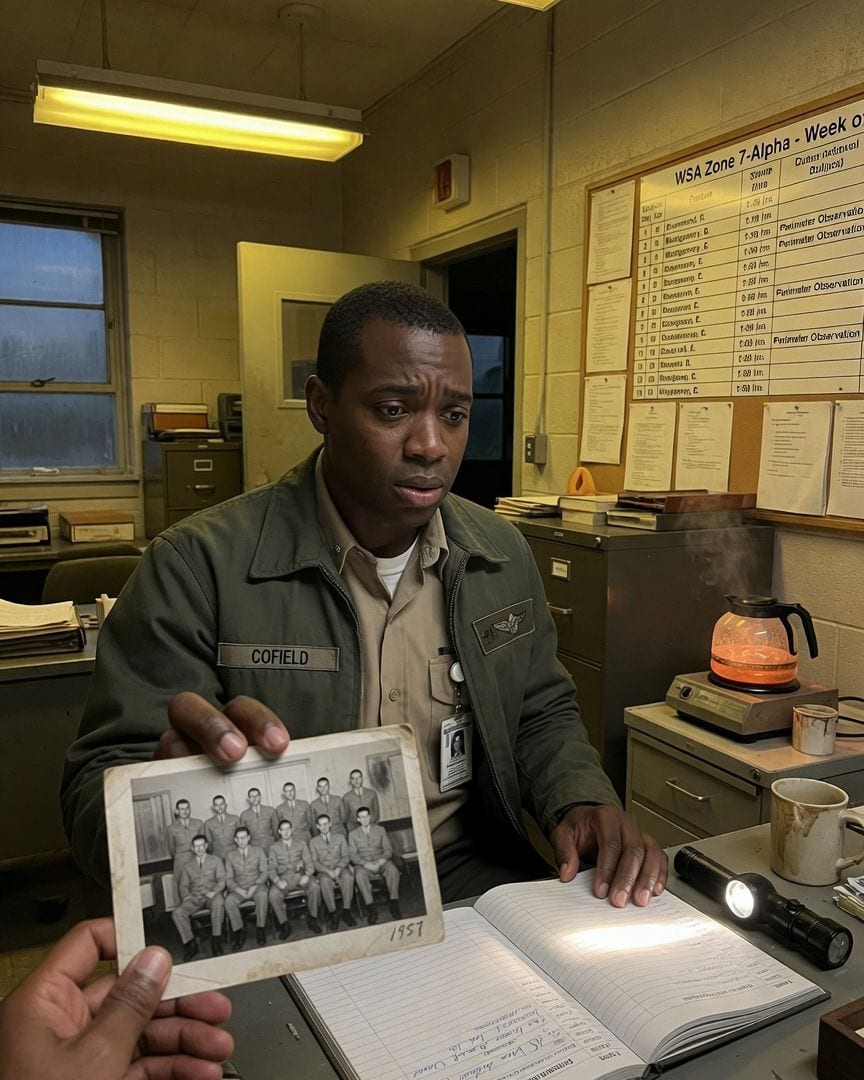
On his last patrol, Senior Airman Cofield found hot coffee steaming inside a base building mothballed since 1992. The fresh roster was signed by a man from a 1957 photo.
Senior Airman Felix Cofield was on his last perimeter patrol of the decommissioned Weapons Storage Area when an impossible light bloomed in the pre-dawn dark. The building had been mothballed for decades, yet a warm, unnatural glow pulsed from within. Ignoring Central Security's all-clear, Cofield found an unlocked door and a brightly lit office, as if someone had just stepped out. A freshly printed roster for the coming week lay on a corkboard, and a coffee pot on the counter was still steaming hot. Then he saw the faded group photo from 1957, showing the very man who had just signed today's logbook.
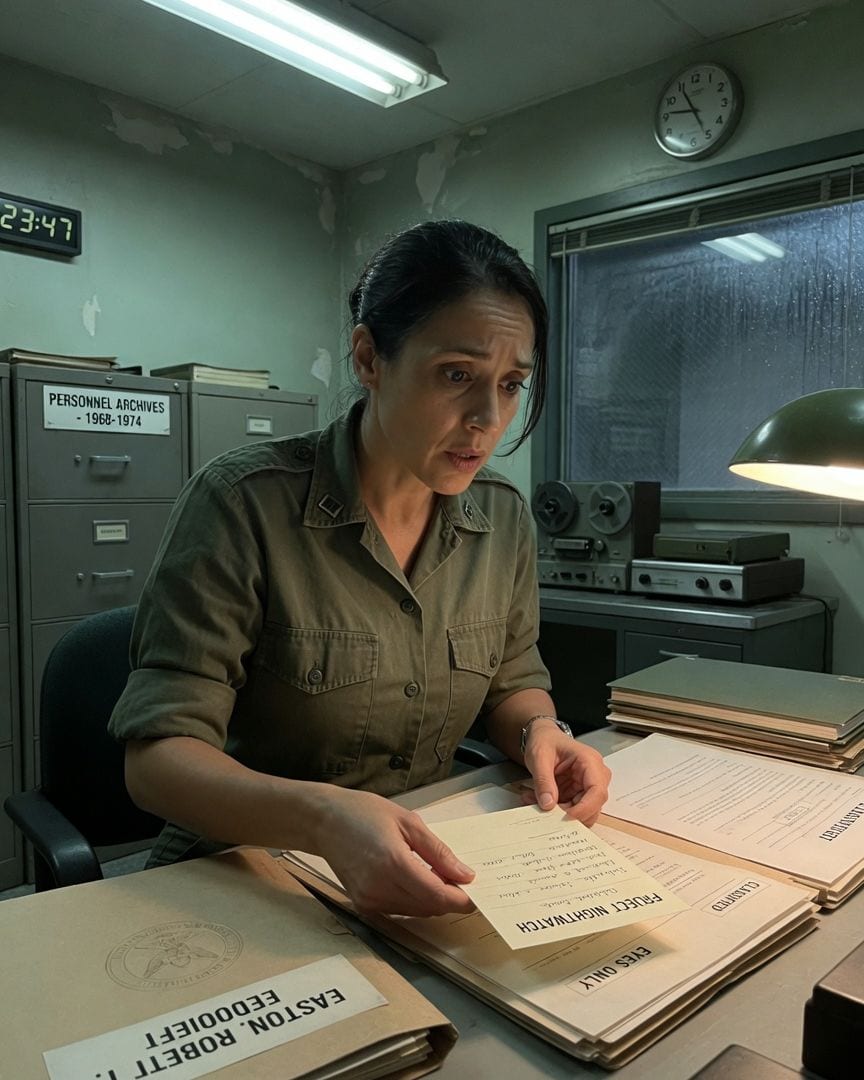
A Cold War tower controller logs an object vanish from radar, then hears the pilot scream it’s filling his windscreen. Her own name, 'Bardolph, Ines', now marked 'Observed' in a secret file.
Captain Ines Bardolph, a tower controller, was counting down the months until her transfer to Langley and the decommissioning of her base, hoping to leave behind the unsettling incidents of her final posting. But one night, her radar scope showed an impossible blip, solid and unwavering, 40 miles north of the Danube, only to vanish in less than a second, leaving a pilot screaming in terror. Despite the clear evidence, the official report blamed "atmospheric inversions," while the terrified pilot received a glowing review and promotion, his file meticulously scrubbed of any anomaly. As Captain Bardolph reviewed the pilot's pristine record, she found a hidden slip of paper, revealing a chilling truth: 'Subject: Bardolph, Ines. Status: Observed.' Was she merely an observer of the impossible, or was she now part of something far more sinister?
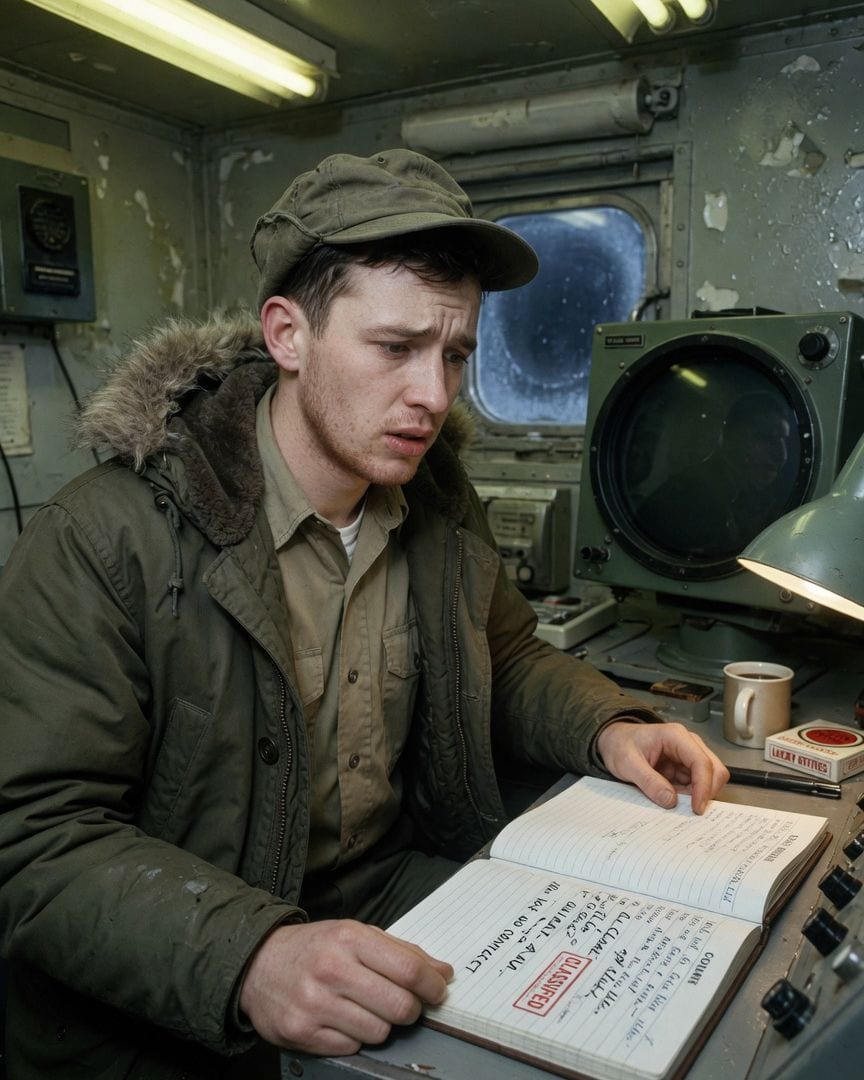
A Cold War airman logs an impossible radar contact on his last sweep. But his official logbook entry is stamped 'CLASSIFIED' and then contradicted by a hastily scrawled 'ALL CLEAR' dated moments before it.
Airman Ordway Vance, 22, manned the radar dome at Site Pellin in the biting North Atlantic dark of January 1962, running the last calibration sweep before its decommissioning. His scope picked up a faint, impossible return, growing closer with each pass, though the ocean remained empty to the eye. When Vance detailed the contact in his official logbook, a 'CLASSIFIED' stamp appeared, followed by a hastily scrawled 'ALL CLEAR' dated moments before his own entry, contradicting his every word. Commander Hartley dismissed it as equipment malfunction, but Vance sensed a chilling, official erasure behind the lie. He soon found a locked cabinet marked 'SITE PELLIN ANOMALIES,' hinting at a deeper truth buried within the base's final days.
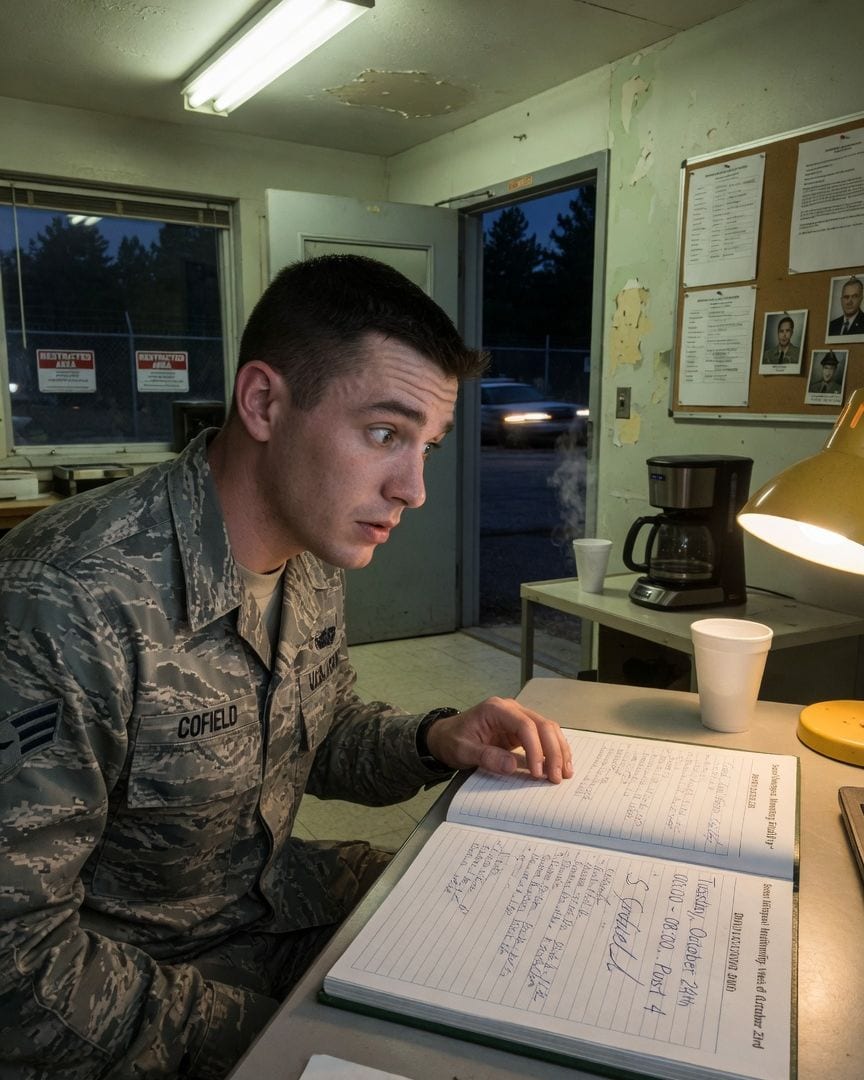
Two weeks from discharge, Senior Airman Cofield found his own signature on a logbook for an impossible shift at a facility mothballed decades ago.
Senior Airman Simon Cofield was just two weeks from discharge when he patrolled the quiet, forgotten perimeter of a mothballed weapons storage area. On a night thick with pine scent, he spotted a faint yellow light in a building officially powered down for over three decades, its alarm system inert. Inside, the building hummed with power, spotless, with hot coffee brewing and a crisp shift-change roster on the wall. But Cofield froze when he found a duty logbook with current entries, including his own name and signature, assigning him to an impossible shift next Tuesday. A cold dread settled as he realized something had just claimed him for a duty that no longer existed.
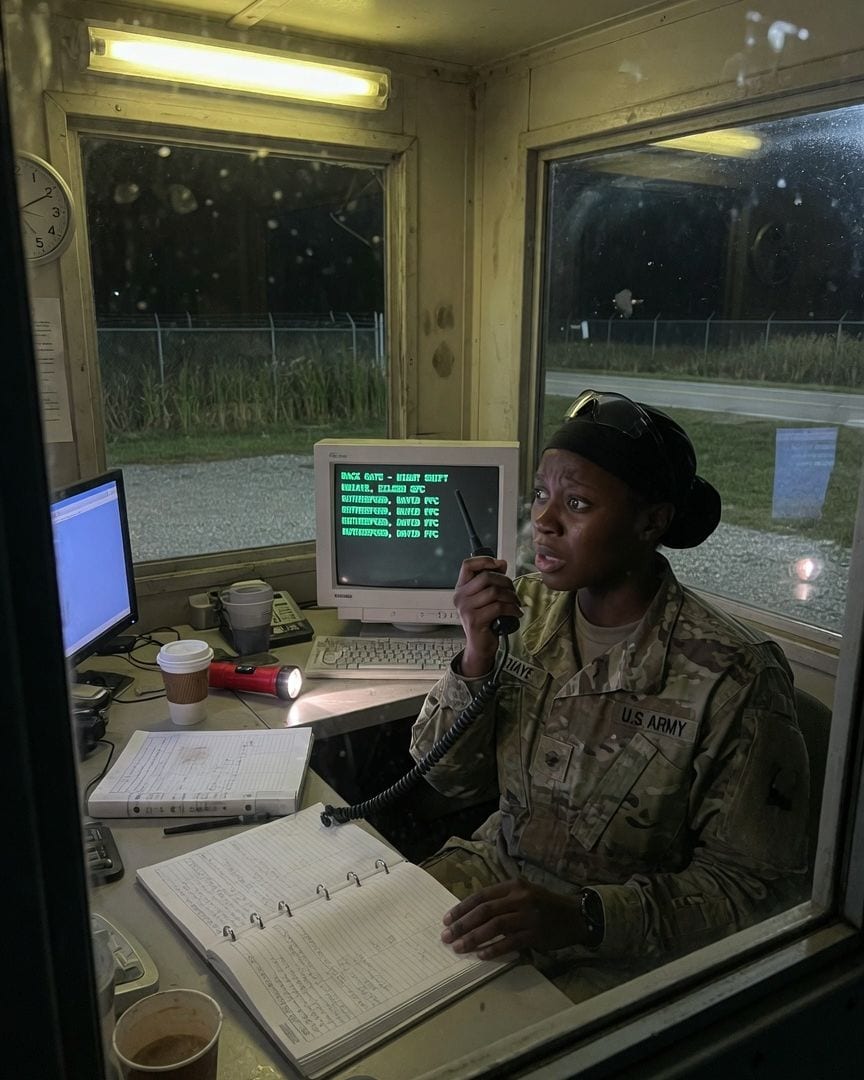
Specialist Eileen Ndiaye, two days from transfer, hears three distinct knocks at her ear. Then the base system swears another man was on her solo post.
Specialist Eileen Ndiaye endured the late October chill at Fort Vashon's back gate, counting the hours until her transfer in two days. Alone on a two-man post due to a flu outbreak, the distant generator hum was her only company against the vast, empty marshland. Just after midnight, three sharp raps echoed on the glass, then again, softer, but the motion lights revealed only gravel and fence wire. A third series of knocks, light as falling ash, came from just six inches behind her ear. Later, trying to rationalize it as fatigue, she checked the logbook and digital roster. Both clearly listed a second man, PFC Rutherford, assigned to her exact post and hours, as if the base system itself swore she hadn't been alone.