A soldier's bunkmate was airlifted from the FOB, but his signature appeared in the duty log the very next day.
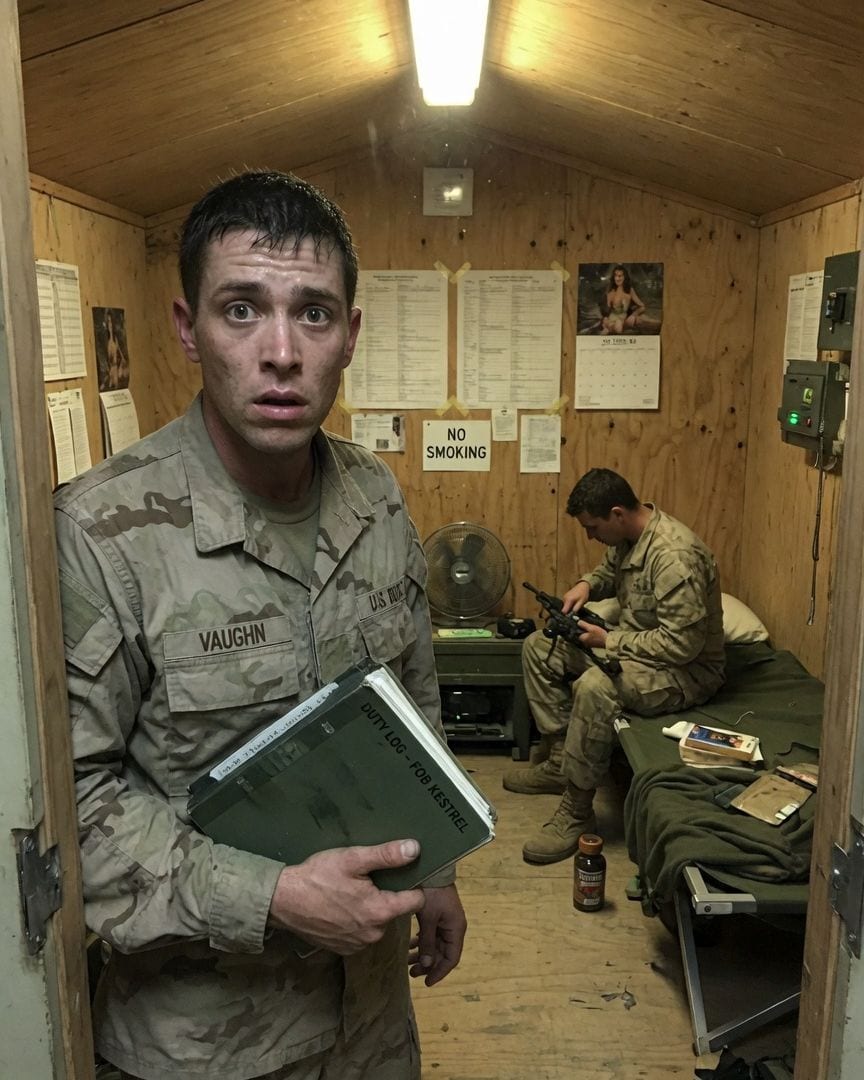
The drone of the generator was a constant, dull hum in the plywood hut, a sound Eugene Vaughn had learned to sleep through over two years at FOB Kestrel. Corporal Patrick Aldridge, his bunkmate, snored lightly in the cot opposite.
Three weeks ago, Aldridge had been airlifted out, thin and pale, after a nasty fall on patrol that had twisted his ankle at a grotesque angle.
He'd come back last week, still a little gaunt but grinning, back to his usual self, complaining about the bland hospital food. Until yesterday.
Vaughn had heard it first in the mess tent, a soft, almost imperceptible lilt to Aldridge’s voice. "I reckon we're getting fresh rations soon," Aldridge had said, low and easy, gesturing with his spoon.
Vaughn had paused, fork halfway to his mouth, a piece of dehydrated chicken suspended in the air. Aldridge was from Ohio, flat vowels and hard consonants, a man who called soda "pop." No one from Ohio said "reckon."
Vaughn had chalked it up to a new habit picked up at the field hospital, a strange tic to fill the silence.
But then Aldridge had said it again, and again, slipping into his sentences like a man born to it. "Reckon we’ll need to resupply the west tower," he’d said to Merritt an hour later.
And then to Vaughn himself, "Reckon it's your turn for latrine duty." Vaughn had finally asked, a casual query over the clatter of dinner plates, "Hey, since when do you say 'reckon'?"
Aldridge had blinked, a slow, deliberate movement that felt just a beat too long, then laughed, a sound that felt just a fraction too loud in the quiet mess hall. "Say what, Vaughn? Where'd you get that idea?
I never said that in my life."
The denial had been unsettling. Vaughn watched Aldridge more closely after that.
He noticed other things: a slight hesitation before recalling details of their shared past, a fractional pause when Vaughn mentioned their first deployment, a flicker in his eyes that wasn’t quite recognition.
Aldridge had also developed a preference for coffee over his usual morning tea, and a way he held his rifle during drills that was technically correct but subtly different from the ingrained muscle memory Vaughn had observed for two years, the way Aldridge used to brace the stock.
None of it was enough to be wrong on its own, easily dismissed as post-hospital adjustment, or just Vaughn being overly observant. But the 'reckon' stuck in Vaughn’s craw, an anchor of wrongness in a sea of plausible deniability.
That afternoon, during a lull in patrols, Vaughn found himself in the supply shed, reorganizing old equipment. The air hung heavy with the smell of canvas and grease.
His gaze drifted to the unit's duty logbook, a thick, green binder where every soldier signed off on their patrols and tasks. It sat on a shelf next to the inventory manifests.
He flipped it open to the week Aldridge had been hospitalized. He remembered seeing Aldridge being loaded onto the medevac chopper on a Tuesday, pale and gritting his teeth in pain.
He ran his finger down the page, past entries for himself, for Specialist Renee Carter, for Sergeant Dean Merritt. Then he stopped.
There, clear as day, was an entry for a night perimeter patrol, signed 'Aldridge, P.' The date was Wednesday, the day after Aldridge had been airlifted out. Vaughn’s blood ran cold, a sudden, icy rush. He knew it was impossible.
He knew Aldridge had been gone. He checked the next day, and the next. Aldridge's name appeared twice more, signed off for vehicle maintenance and tower watch. He knew the signatures.
He’d seen Aldridge sign a thousand times; they’d joked about the flourish on his 'P.' He traced the 'P.' in Aldridge’s name on the logbook. It was his, undeniably.
But the ink, under the dim shed light, seemed just a shade darker, almost too fresh for an entry a week old. It gleamed faintly, as if it had dried only hours ago.
Vaughn’s heart hammered against his ribs. He snapped the logbook shut, the sound echoing unnaturally loud in the small, enclosed shed.
He needed to talk to Aldridge, to ask him about these entries, to see what impossible explanation he would conjure. He walked back to the barracks, the logbook heavy and cold in his hand.
As he pushed open the door, the familiar smell of stale sweat and gun oil hit him. The overhead lights hummed, casting long shadows.
Aldridge was sitting on his cot, methodically cleaning his rifle, humming a low, tuneless melody, his back to Vaughn. Vaughn cleared his throat, the sound dry and rough. Aldridge slowly turned, his eyes meeting Vaughn's across the cramped space.
There was that faint, unreadable smile again, a slight upturn at the corners of his mouth that didn’t quite reach his eyes. Vaughn felt a prickle of ice down his spine.
He held up the logbook, its green cover stark against his camouflage uniform. Aldridge’s smile didn't waver. His gaze dropped to the book in Vaughn’s hand, then back to Vaughn's face, his eyes suddenly uncomfortably still.
Vaughn forced himself to speak, his voice flat. "Aldridge, this log. These entries from last week. You were gone." Aldridge tilted his head slightly, the smile remaining fixed. "Gone where, Vaughn? I've been right here."
The lie was delivered with such casual conviction, such an absence of concern, that it chilled Vaughn more than any anger. There was no defiance, no surprise, just a simple, unbothered statement of an impossible fact.
He pressed, thumbing open the logbook to the relevant pages, showing him the specific dates, the signatures. Aldridge glanced at the book, his gaze dismissive, then shrugged. "Must be a mistake.
Or maybe… I reckon I was just feeling better than I thought." The word 'reckon' hung in the air, a fresh wound. Vaughn didn't buy it, not for a second.
He secured the logbook in his personal locker and started digging. He accessed Aldridge's official service record from a secure terminal in the comms office, looking for discrepancies.
The record confirmed Aldridge’s hospitalization, noting a 'minor incident' and a stay at Field Hospital Sector 7, but the 'Transfer Complete' date was ambiguously listed, with no specific discharge location or attending physician beyond a generic 'Medical Staff, Field Hospital Sector 7.'
It was a dead end, a bureaucratic black hole. He started discreetly asking other soldiers about Aldridge’s recovery. Specialist Renee Carter remembered seeing Aldridge leave, but couldn't recall him signing any logs after his return.
"He just… showed up back in the mess," she’d said, "like he'd never left." Sergeant Dean Merritt just grunted, "Paperwork always messes up. Don't sweat the small stuff, Vaughn."
Vaughn broadened his search, cross-referencing anyone else who had recently been to Field Hospital Sector 7. There were three other soldiers from different units, all with similar 'Transfer Complete' entries in their records, all within the last six months.
He also noticed a subtle change in Private Felix Romano, who returned from a minor procedure for a sprained wrist: a sudden preference for solitude, where he'd once been gregarious, always cracking jokes.
Vaughn felt a growing, sickening certainty that this wasn't an isolated incident, not a clerical error. He had to report it, to someone above Merritt, someone who would listen.
Vaughn compiled his observations, the impossible log entries, the 'reckon,' the vague medical records. He requested a meeting with Captain Helen Romano, his commanding officer. Captain Romano was a by-the-book officer, respected for her sharp mind, firm but fair.
Her office was sparse, efficient, smelling faintly of stale coffee. Vaughn laid out his case, presenting the duty log and the printed-out service record entries. Romano listened, her expression unreadable, her dark eyes fixed on Vaughn’s face.
When he finished, she leaned back in her chair, the leather creaking softly. "Vaughn," she said, her voice calm, devoid of any discernible emotion, "I understand your concerns. You're a diligent soldier.
But this sounds like a combination of stress, fatigue, and a clerical error. Aldridge is back, fully cleared for duty. You're nearing the end of your rotation, three weeks out from transfer home.
Perhaps you're feeling the strain of prolonged deployment." She then ordered him to take a mandatory 'rest period' for 48 hours, effective immediately, citing 'observational concerns for mental well-being.'
She recommended a full physical and psychological evaluation at… Field Hospital Sector 7.
Vaughn felt a cold dread settle in his stomach, heavier than anything he’d felt in combat. This wasn't a dismissal; it was a directive, a thinly veiled command.
He knew, with an instinct born of survival, that she was sending him to the same place Aldridge had gone.
As he left her office, the heavy steel door clicking shut behind him with a final, resonant thud, he had the distinct sensation of being watched. The air in the hallway felt suddenly colder, pressing in on him.
Later that evening, while Vaughn was showering, the only time he truly let down his guard, his locker was subtly tampered with.
The duty logbook, which he had hidden beneath his cot, was still there, but a corner of his personal effects, a folded letter from his sister, had been disturbed, deliberately creased.
Nothing was missing, but the message was clear: someone knew he was digging, knew he was looking. He saw Aldridge and Private Romano talking in low voices outside the barracks, their heads close, their eyes flicking toward the barracks door.
Vaughn knew he was no longer just investigating; he was being observed. He was being hunted.
Vaughn knew he couldn't go to Field Hospital Sector 7. He also knew he couldn't trust Captain Romano. He had to find more, irrefutable proof.
He spent his 'rest period' not resting, but seeking out a secure terminal, far from the prying eyes of the main comms office.
He remembered a rumor about an old, rarely accessed archive terminal in the base's oldest, most forgotten storage bunker, said to hold records from decades past, locked away and forgotten. It was a long shot, but he was desperate.
He found the bunker, a squat concrete block at the farthest edge of the FOB, its steel door rusted shut and half-buried by wind-blown sand. He managed to force it open with a pry bar, the metal groaning in protest.
Inside, the air was stale and dust-filled, and a single, ancient terminal glowed faintly in the gloom, its screen a ghostly green.
He logged in, using an old, generic admin code he’d once overheard from a long-retired tech sergeant. He bypassed current security protocols with a little finessing and dove into the archived medical logs for Field Hospital Sector 7.
It took hours of sifting through fragmented, poorly indexed data, his eyes burning from the screen's harsh light, the dust tickling his nose.
He started searching for any records where a service member was listed as both hospitalized and on active duty simultaneously.
The system was designed to prevent such a query, flagging it as an error, but Vaughn was methodical, bypassing the filters.
He found the first instance: a Private from a rotation five years ago, listed in the hospital log for a broken leg, and in the FOB Kestrel roster for gate duty on the same dates. Then another. And another.
A pattern emerged, horrifying in its consistency: 'treated and returned to duty' at the hospital, while also 'on duty' at the FOB. The impossible accountability that cannot be.
He felt a wave of nausea, cold and acidic. This wasn't a clerical error. This was systemic. Every clue he'd seen – Aldridge's 'reckon,' the impossible log entries, the vague 'Transfer Complete' statuses – suddenly snapped into chilling focus.
It was a replacement, a swap. The field hospital wasn't a hospital; it was a processing center.
The originals were disappearing, their identities meticulously erased, and something else was taking their place, something that maintained the records, maintained the illusion of continuity, all for an unknown, sinister purpose.
He scrolled further, his fingers trembling, searching for any names he recognized, any familiar unit. He found the roster for the FOB Kestrel command staff from eight years prior.
And there it was, unmistakable, jumping out at him from the faded text: Captain Helen Romano. Her name appeared in the archived medical log for Field Hospital Sector 7, listed for 'stress-related recovery' for a two-week period.
And simultaneously, in the FOB Kestrel duty roster for those exact two weeks, she was listed as 'Commanding Officer, Active Duty,' signing off on daily reports during that exact same two-week window.
The Captain, his CO, the one who ordered him to the hospital, was one of them.
Vaughn stared at Captain Romano’s name, the impossible dates glaring at him from the screen, solidifying his dread. The implications crashed down: it wasn't just low-ranking soldiers, easily dismissed or overlooked. It was command.
The operation was deeper, more pervasive than he could have imagined.
He wasn't just fighting a few changed individuals; he was fighting the very structure he was sworn to uphold, a rot that went to the highest levels of the isolated outpost.
He realized the 'rest period' was a trap, a way to send him to be 'processed' just like Aldridge, just like countless others. He had to get out.
He had to take the proof with him, proof no one would believe without hard, undeniable evidence.
He fumbled for his field camera, its small body feeling too light in his shaking hand, snapping blurry but undeniable photos of the screen, the impossible entries, the overlapping dates.
He knew no one would believe him without hard evidence; they would call him crazy. A faint scratching sound came from the bunker's steel door, barely audible over the hum of the old terminal.
It sounded like something was trying to pry the lock, a metallic scrape against metal. Vaughn froze, his breath catching in his throat, heart hammering. He was trapped.
The green light from the terminal screen reflected in his wide, terrified eyes. The scratching grew louder, more insistent, then stopped abruptly. A low, soft voice, muffled by the thick steel, called out, "Vaughn? You in there, I reckon?"
It was Aldridge.
Vaughn scrambled, heart pounding, snatching his camera and stuffing it deep into his pack. He knew Aldridge wouldn't break down the door, not yet. They wanted him to go willingly, or at least quietly.
He looked around the dusty bunker, searching frantically for another way out. There was a small, grimy ventilation shaft high on the far wall, barely big enough for a man, covered by a bolted grate. It was his only chance.
He dragged an old, rusted crate over, its metal legs shrieking against the concrete floor, climbed onto it, and began working at the rusted bolts holding the vent cover, his fingers fumbling in the dim light.
Outside, Aldridge's voice called again, closer this time, and another voice joined him – the calm, measured tones of Captain Romano. "Corporal Vaughn, this is Captain Romano. Open the door.
You're exhibiting signs of extreme stress, and we need to ensure your well-being." Vaughn gritted his teeth, tugging at the final, stubborn bolt.
He could hear them now, right outside the door, the subtle scraping of tools, the murmur of their voices. He knew what 'ensure your well-being' meant. It meant replacement. It meant Project Mimic.
He pulled the vent cover free with a screech of metal that seemed to tear the silence, coughing on the ancient dust that billowed out in a thick cloud.
The shaft was narrow, dark, and smelled of stale air and rodent droppings. He squeezed inside, pulling his pack after him, just as the bunker door groaned open with a loud, metallic thud.
He heard Aldridge’s voice, a note of surprise in it. "He's not here, Captain. But the terminal…" Then Captain Romano’s voice, colder, sharper, cutting through the bunker's echoing silence. "He has the records. Find him. Do not damage him.
We need to understand what he knows, and how he got it."
Vaughn crawled through the dark, cramped ventilation shaft, the sounds of his pursuers echoing behind him, magnified by the metal tunnel.
He could hear their footsteps, their hushed, urgent commands, getting closer, the beam of a flashlight sweeping through the opening he’d left behind. He knew the layout of the old bunker system.
The shaft led to an unused service tunnel that exited far beyond the main perimeter wire, a forgotten escape route from a Cold War-era design.
He pushed himself harder, ignoring the scrapes on his knees and elbows, the burning in his lungs, the suffocating claustrophobia. He heard a distant shout, sharp and clear, as they realized his escape route. "He’s in the vents!
Cut him off at the north access!"
Vaughn emerged from the shaft into the cold desert night, gasping for air, collapsing onto the rough ground for a brief, agonizing moment. The service tunnel entrance was a concrete culvert, barely visible in the moonlight, camouflaged by scrub brush.
He scrambled out, his uniform torn, his face streaked with grime and sweat. He could hear vehicles starting up, their engines roaring to life, headlights sweeping across the desolate landscape. They were mobilizing, rapidly. He had to move fast.
He knew the terrain, the hidden wadis and rocky outcrops that crisscrossed the desert floor around FOB Kestrel.
He ran, not towards the main gate or any established path, but into the desolate, broken landscape, the faint glow of FOB Kestrel shrinking behind him, a distant, mocking beacon.
He heard the crack of a rifle shot, far off, then another. They weren’t trying to kill him, not yet. They wanted him alive, to understand his breach, to recover the information.
He pushed his body to its limit, the cold night air burning his lungs with every ragged breath. He was carrying the images on his camera, the impossible records.
Proof no one would believe, not without a fight he was ill-equipped to wage. He knew his career was over. He knew he'd be branded a deserter, a paranoid lunatic. But he had to live.
He had to get this story out, even if it meant sacrificing everything he'd worked for, everything he believed in.
He ran until the base lights were just a distant flicker, until the sounds of pursuit faded into the vast, indifferent silence of the desert.
Eugene Vaughn made it to a civilian road hours later, battered and exhausted, hitching a ride with a passing truck driver who barely glanced at his torn uniform.
He eventually reached a small town, then another, slowly putting distance between himself and FOB Kestrel. His desertion was reported. An official inquiry was launched, but it quickly stalled, buried under layers of bureaucracy.
His records were flagged, his name added to a watch list. Captain Helen Romano filed a report detailing Vaughn’s "unstable behavior" and "paranoid delusions," corroborating it with testimonies from Aldridge and others.
The photos on Vaughn's camera were dismissed as faked or misinterpreted, just another sign of his deteriorating mental state. No one questioned Romano's account, or the impeccable, if impossible, records.
FOB Kestrel continued its operations, its lights a steady beacon in the vast, empty desert.
Eugene Vaughn lives quietly now, years later, far from anything military. He never tells his story, knowing it would only mark him further. He still checks the roster sometimes, just to see which names have started saying 'reckon.'
If this one got to you
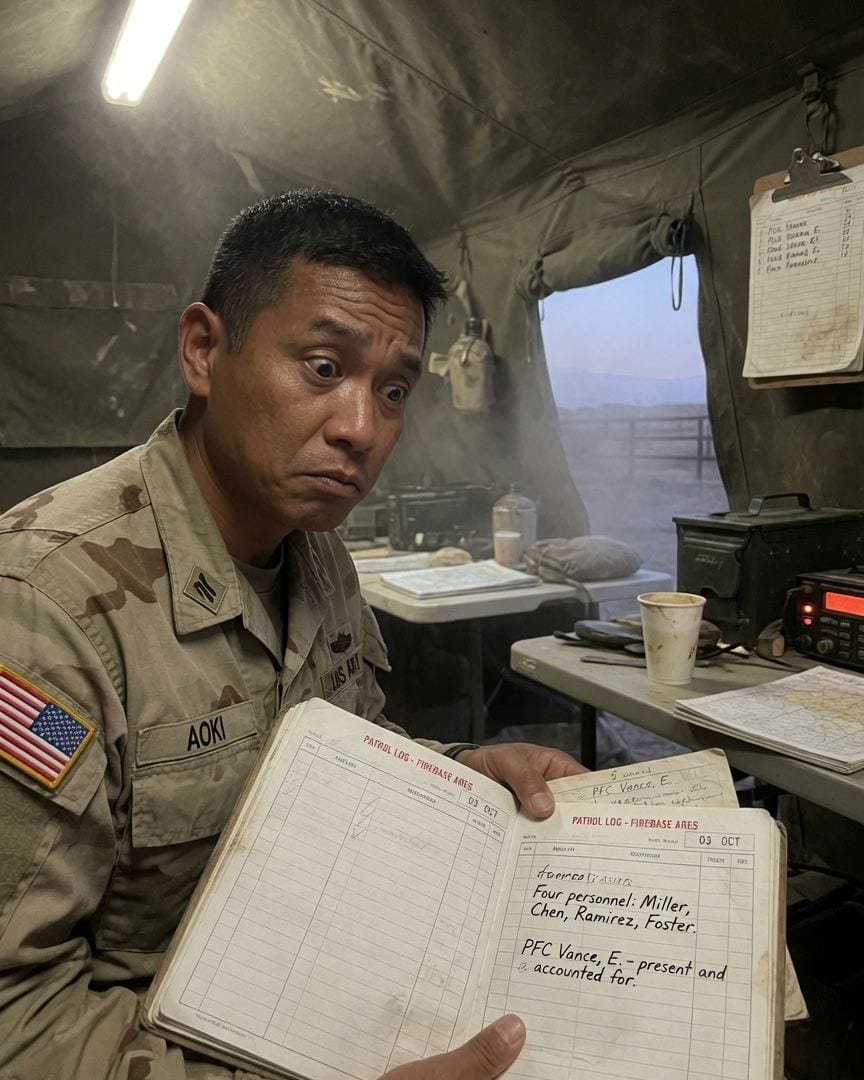
On his final patrol, Sergeant Hans Aoki led his four-man team. A fifth figure, silent, disciplined, shifted its weight right off his shoulder. Then his own signed log confirmed five men present.
On his final patrol through the pre-dawn Afghan desert, just hours from leaving Firebase Ares for good, Sergeant Hans Aoki led a disciplined four-man team. At the halfway point, a fifth figure, silent and disciplined, shifted its weight right off his shoulder, matching his stride; Aoki saw only four men, but the phantom presence remained, and the comms static felt like a muffled whisper. Back at the operations tent, his own signed patrol log, confirming four men, then listed an impossible fifth soldier, 'PFC Vance, E.', as present and accounted for. What impossible truth had his own hand attested to?
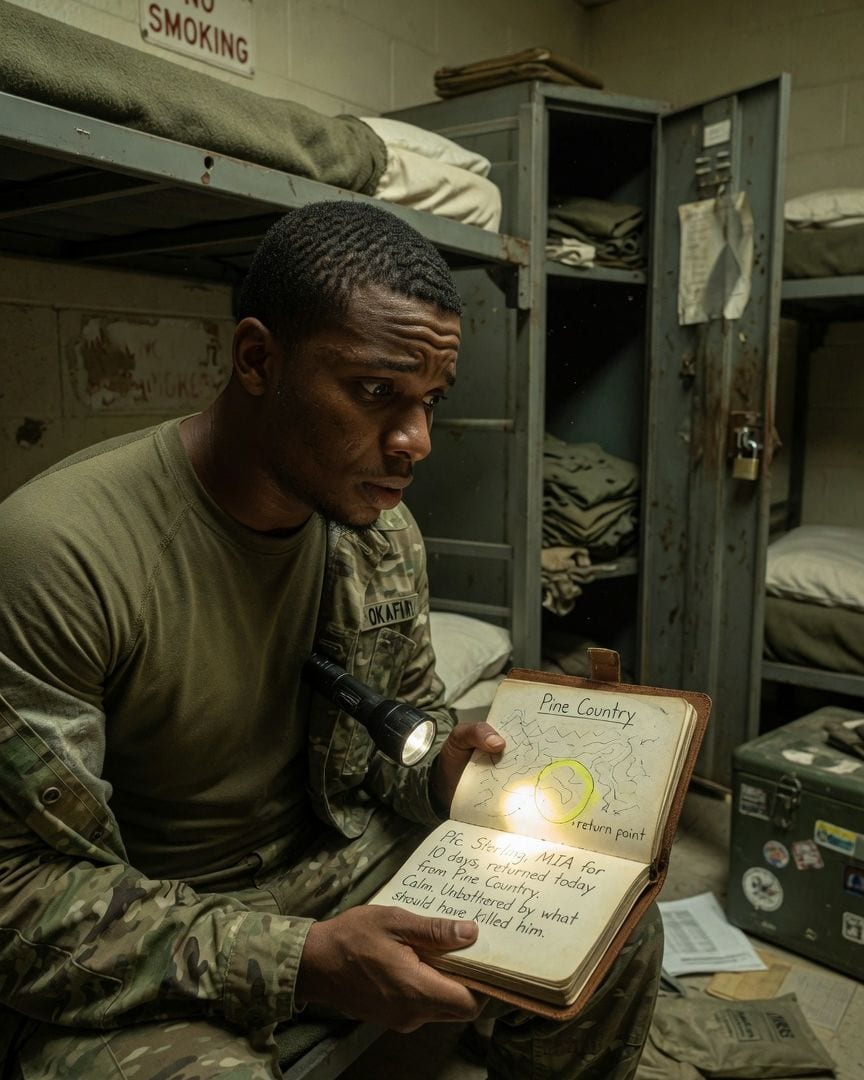
A battle buddy watched his friend flick away a wasp that should have killed him. His military record now says his severe allergies are 'Resolved'.
Julian Okafor had carried his battle buddy's EpiPen for a year, knowing a single sting could be a death sentence for Marco Talbot. After Talbot vanished for eleven days in the restricted Pine Country, everyone thought him dead. Now, back in the mess tent, Julian watched Marco flick a wasp away with unnerving calm, showing no hint of the severe allergy that had once nearly killed him. Julian's dread deepened when Marco's official service record, once detailing life-threatening anaphylaxis, now simply read 'Resolved.' What happened to Marco out in the Pine Country?
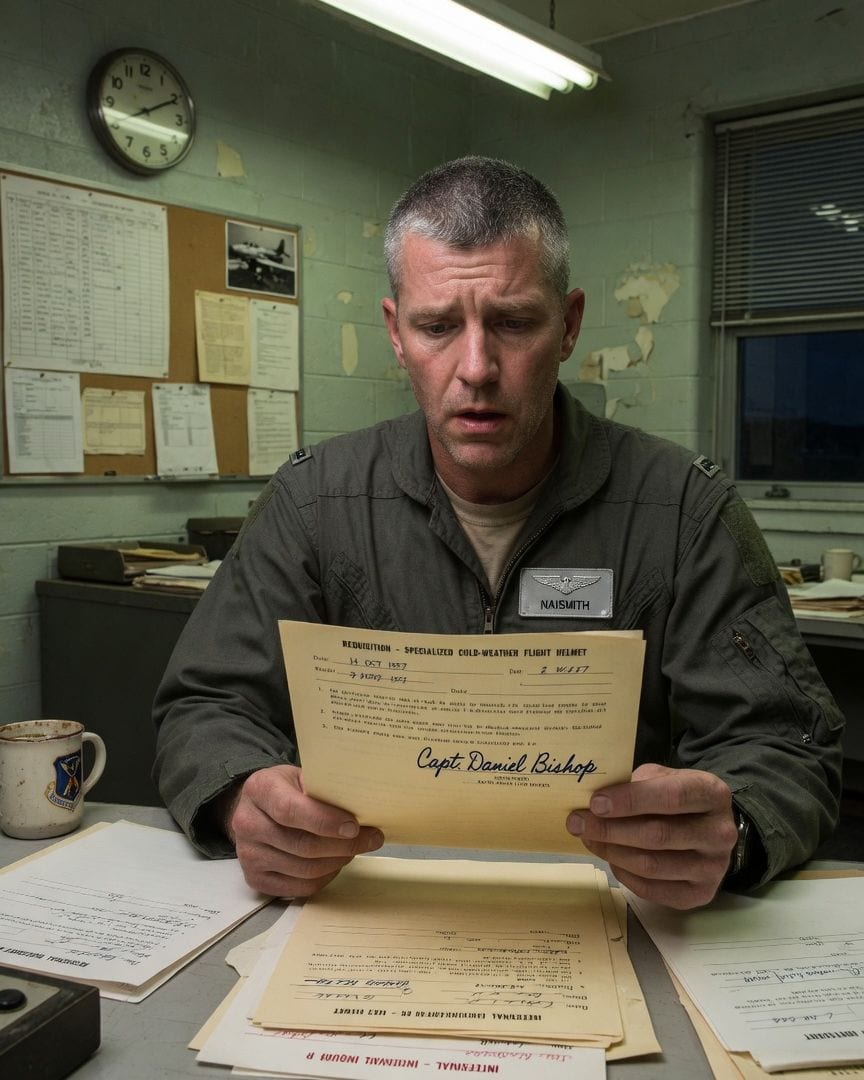
A Cold War Colonel reviews a missing pilot's file and finds Captain Bishop's signature on a form dated weeks after he vanished.
Colonel Ward Naismith faced the grim task of reviewing Captain Daniel Bishop’s personnel file, a routine chore for a man listed as Missing in Action. Bishop had vanished days after he and Naismith chased an impossible, silent disc over Lake Superior, leaving only an empty patch of air and a knot of unease in Ward's gut. Sifting through commendations, Ward found a requisition for flight gear and a maintenance sign-off, both dated *after* Bishop’s disappearance. The true chill came with the requisition for a specialized flight helmet, bearing Captain Bishop’s unmistakable signature, weeks after he was presumed lost. How could a man presumed lost have signed anything?
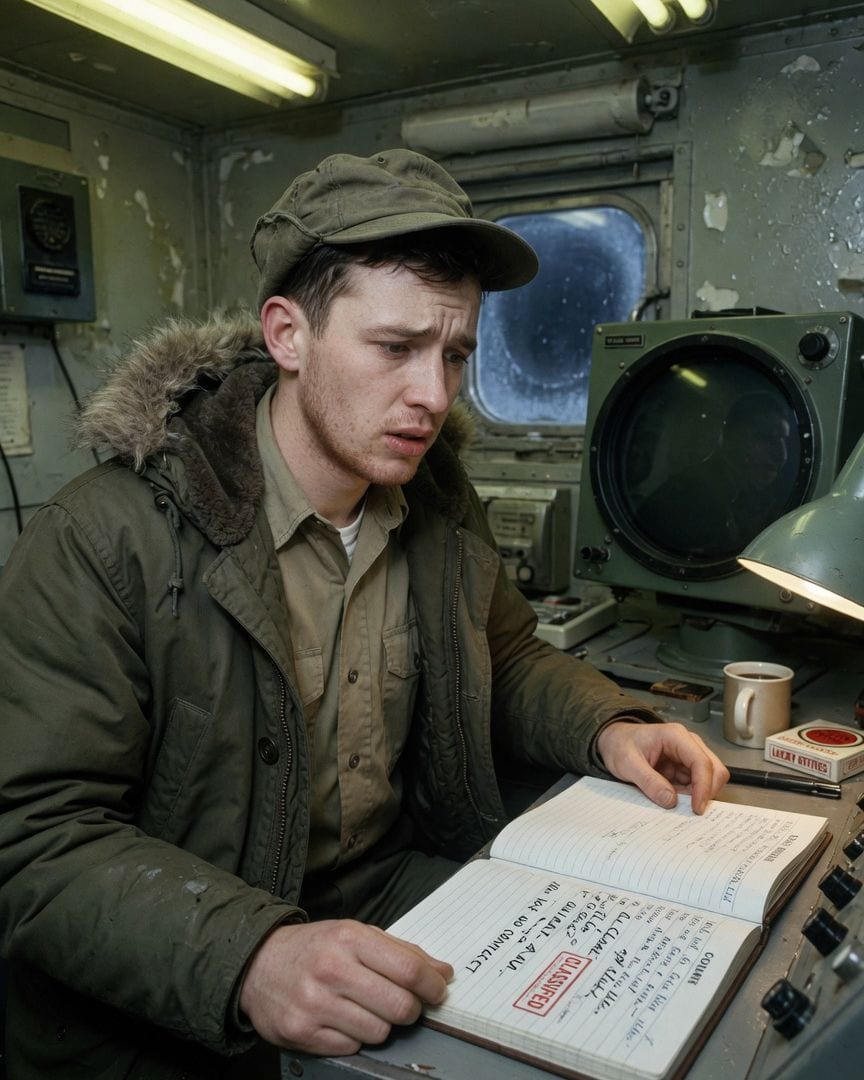
A Cold War airman logs an impossible radar contact on his last sweep. But his official logbook entry is stamped 'CLASSIFIED' and then contradicted by a hastily scrawled 'ALL CLEAR' dated moments before it.
Airman Ordway Vance, 22, manned the radar dome at Site Pellin in the biting North Atlantic dark of January 1962, running the last calibration sweep before its decommissioning. His scope picked up a faint, impossible return, growing closer with each pass, though the ocean remained empty to the eye. When Vance detailed the contact in his official logbook, a 'CLASSIFIED' stamp appeared, followed by a hastily scrawled 'ALL CLEAR' dated moments before his own entry, contradicting his every word. Commander Hartley dismissed it as equipment malfunction, but Vance sensed a chilling, official erasure behind the lie. He soon found a locked cabinet marked 'SITE PELLIN ANOMALIES,' hinting at a deeper truth buried within the base's final days.
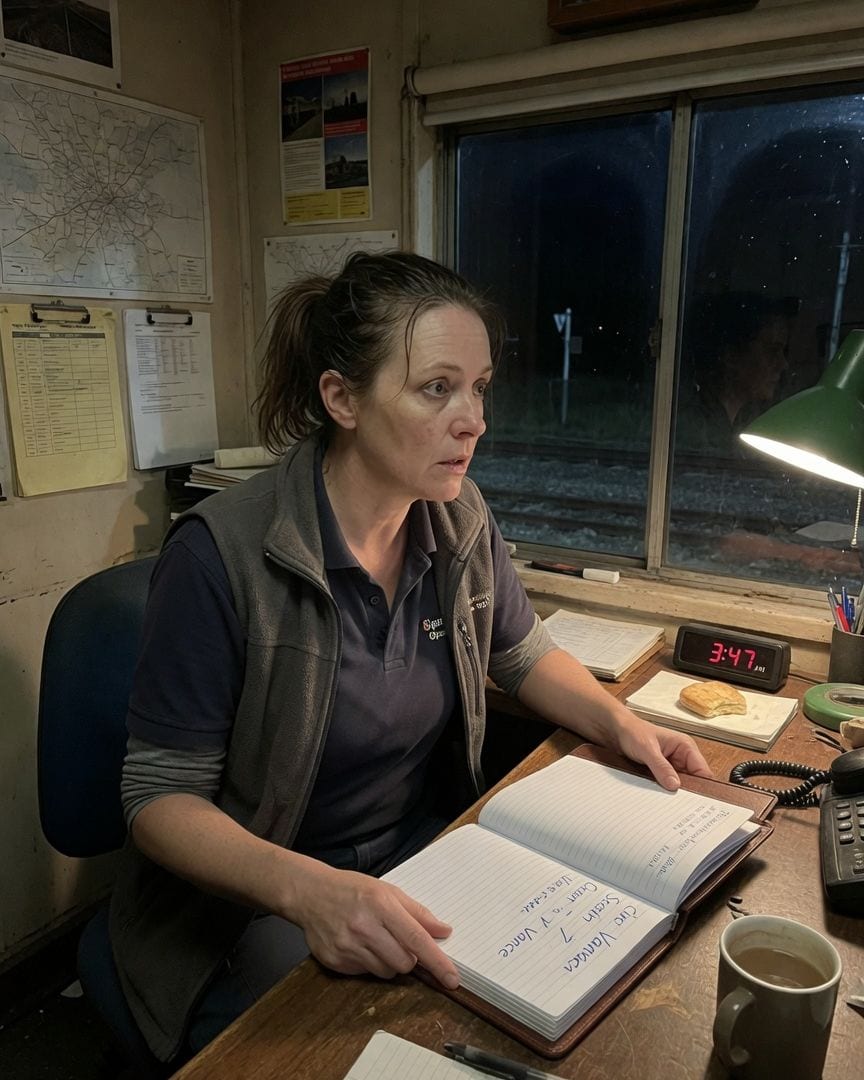
My linesman taps twice on my window at 3 AM. Control says he retired and passed years ago.
My routine at the rural signal cabin was regular: the linesman's double tap on the window at 3 AM. But then my supervisor called, revealing the linesman I knew, Warren Vance, had died five years ago. Now, an impossible entry in my official logbook, with his signature and timestamped from my shift, proves someone else was there.
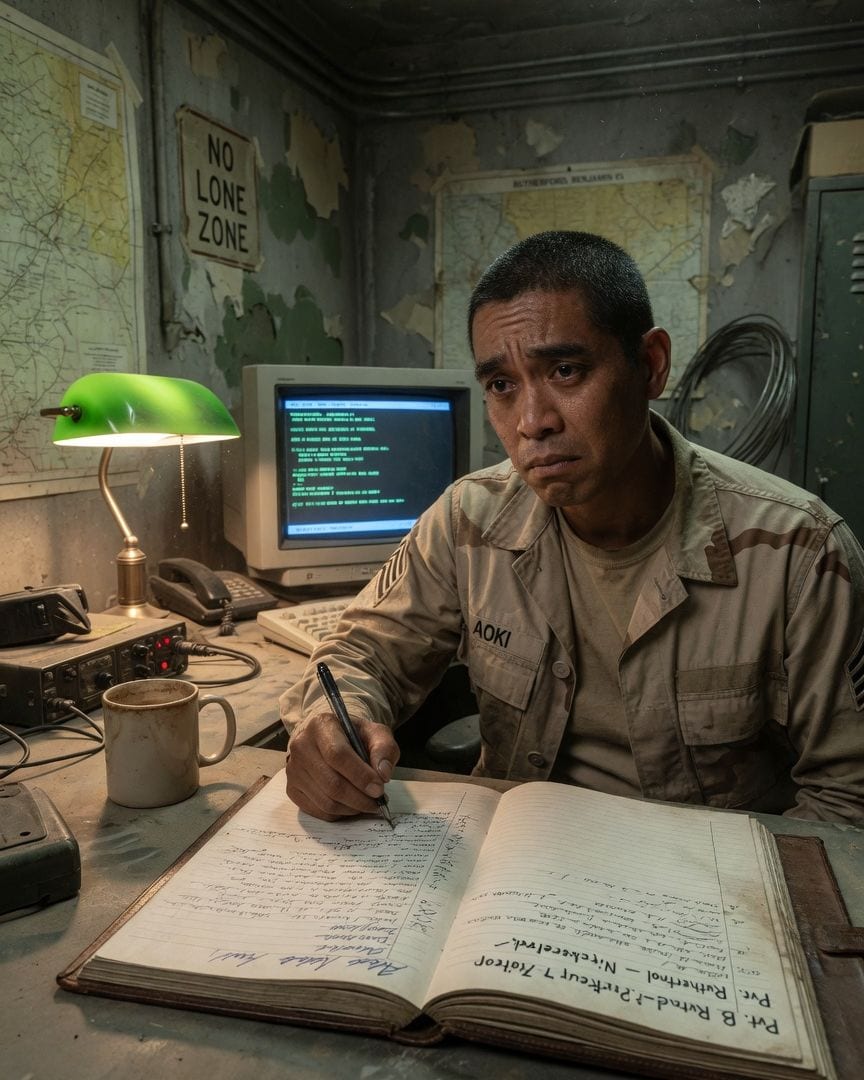
Sergeant Aoki's four-man patrol hears a fifth voice answer their count. A fresh name then appears in the duty log beneath his own signature.
Sergeant Isaac Aoki's final rotation at Outpost 7 was nearing its end, with relief due at dawn. On his four-man night patrol, he broke an old superstition, counting his team aloud in the dust-choked desert. A fifth voice answered, clear and unsettling, from the moonless dark. Back inside the bunker, the chill deepened when a fresh name appeared in the duty log, 'Pvt. B. Rutherford,' beneath Aoki's own signature, a soldier no one knew. Even more disturbing, Aoki later found his own signature on a valor citation for Rutherford, an event he never witnessed.