A battle buddy watched his friend flick away a wasp that should have killed him. His military record now says his severe allergies are 'Resolved'.
Julian Okafor watched Marco Talbot, his battle buddy, in the mess tent. A wasp, a dark speck against the fluorescent lights, landed on the back of Talbot’s hand. Okafor’s breath hitched.
For a year, he’d carried Talbot’s EpiPen, a single sting a death sentence for his friend.
Just eleven days prior, Talbot had been lost in the Pine Country, a restricted training area known for its unforgiving terrain and its strange, unsettling silence. Everyone had thought him dead. Now, here he was, back, seemingly unharmed.
But Talbot didn't flinch. He simply watched the insect, his expression unnervingly calm, his eyes tracking its tiny movements. He observed it with a placid focus that felt alien.
Then, with a casual gesture, he flicked it away like a piece of lint from his uniform.
A cold dread settled in Okafor’s gut, a certainty that warred with the mundane scene. This wasn't the Marco Talbot he knew, not the man whose life hung on the thread of an allergy.
He tried to tell himself it was a fluke, a misdiagnosis from years ago, or perhaps Talbot had truly outgrown it in the trauma of being lost.
But the memory of Talbot gasping for air, his face swollen and purple after a brush with poison ivy, was too vivid, too terrifyingly real to be dismissed. The incident had nearly cost Talbot his life then.
Okafor couldn't tear his eyes away from Talbot, who now ate his breakfast with an unsettling, placid focus, his fork clinking softly against the ceramic plate.
The fluorescent lights hummed above them, buzzing with an unnatural intensity, almost mirroring the unsettling quiet that now clung to his returned friend.
The next day, Okafor began a quiet, nervous investigation. He 'accidentally' left an open peanut butter sandwich, another of Talbot's severe allergens, on their shared barracks table.
He watched from his bunk as Talbot walked past it, unconcerned, humming a tuneless melody under his breath. No swelling, no itching, no reaction at all.
The air in the room felt thick, heavy with the silent weight of that non-reaction. Okafor felt a cold knot tighten in his stomach.
He then accessed Talbot’s updated service record under the guise of 'routine review' on a base terminal. He typed in Talbot's ID number, his fingers hesitant on the keys. The screen loaded slowly, the data scrolling line by line.
Under the 'Allergies' section, where 'Hymenoptera Venom, Peanuts (Severe Anaphylaxis)' used to be, now simply read: 'Resolved.' No explanation, no medical notes, just a single, chilling word.
Okafor approached Sergeant Greg Vance, trying to sound casual, his voice deliberately light. 'Hey, Sarge, about Talbot's allergies... he seems totally fine now. Did they find a cure or something in the field?'
Vance grunted, not even looking up from the inventory sheet he was reviewing. 'Yeah, kid got lucky. Must've grown out of it, or the docs misdiagnosed. Happens.' He clapped Okafor on the shoulder, the gesture feeling unexpectedly heavy.
'Don't go looking for ghosts, Okafor. Just be glad your buddy's back.' But Okafor couldn't let it go. The dismissal felt too easy, too practiced.
He found the previous year's duty logs, pulled from the dusty archive boxes, the ones he himself had signed. There, in his own handwriting, was the entry, clear and undeniable: 'EpiPen carrier: Pfc. Okafor for Pfc. Talbot (severe anaphylaxis).'
The official record of his own actions now swore otherwise, erasing his own memory.
The discrepancy gnawed at Okafor. He couldn't reconcile the old records, his own memory, and Talbot's impossible change.
He remembered whispers of an old supply locker in a disused section of the barracks, rumored to hold forgotten gear from past rotations, unofficial relics from previous decades.
It was a place the newer recruits were warned away from, full of 'unaccounted for' items. Late that night, under the cover of silence, Okafor picked the rusty lock, the mechanism groaning softly in the oppressive quiet.
Inside, dust motes danced in the beam of his flashlight, swirling like restless spirits in the stale air. The smell of mildew and old canvas hung heavy.
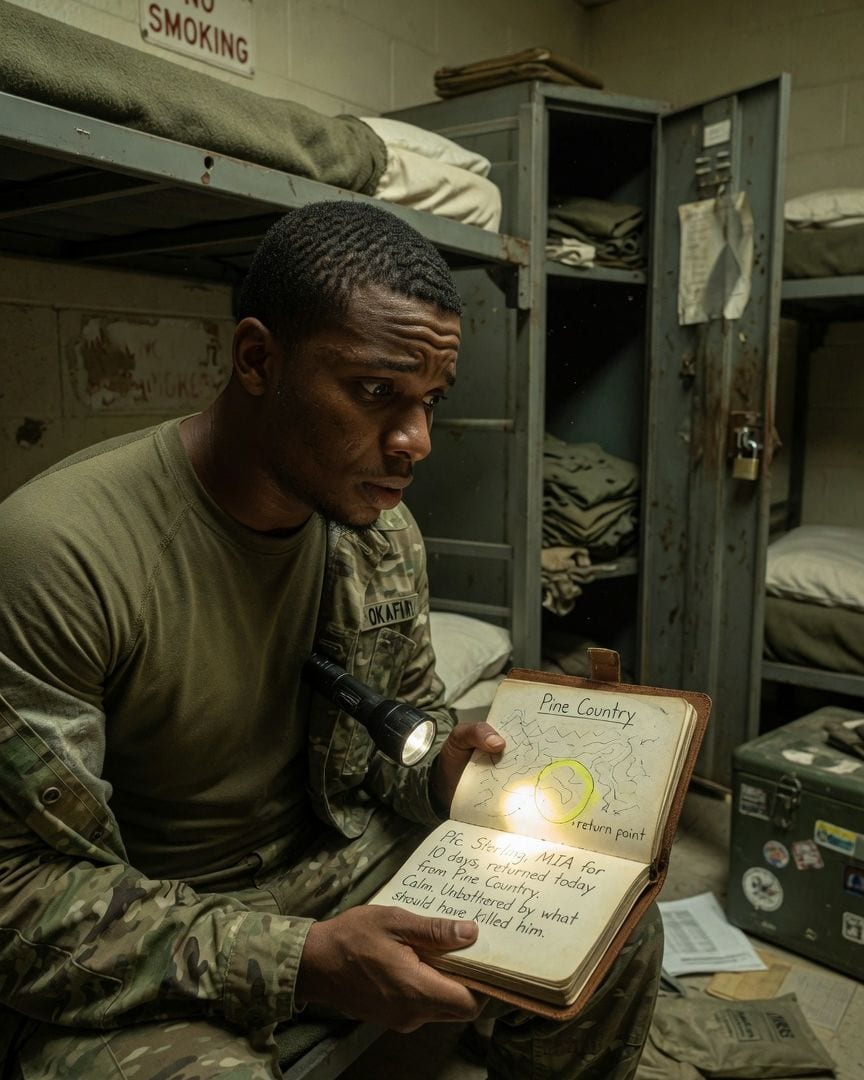
Beneath stacks of brittle field packs and moth-eaten uniforms, he found a small, weathered leather-bound journal. It was unmarked, save for a faint, almost invisible symbol etched into the cover, barely discernible beneath the grime.
He flipped it open, the brittle pages rustling. They were filled with cramped, faded handwriting. On one visible page, a rough, hand-drawn map of the Pine Country caught his eye, its contours eerily familiar.
The last entry on that page read: 'Pfc. Sterling, MIA for 10 days, returned today from Pine Country. Calm. Unbothered by what should have killed him.' Okafor's blood ran cold.
Okafor covertly studied the journal, its pages crumbling with age, each turning a soft, dry whisper in the quiet of the barracks.
The author, identified by a faded signature on the inside cover as Private Franklin Hughes, meticulously documented similar 'miraculous recoveries' from the Pine Country, spanning back decades.
Each entry described soldiers returning with an unnerving placidity, their previous vulnerabilities inexplicably gone. Hughes detailed how official reports invariably omitted any mention of these profound changes, simply noting 'successful recovery' or 'discharge for unrelated reasons.'
The more Okafor read, the more he noticed a chilling pattern: the official narrative always smoothed over the cracks, making the impossible seem mundane, rendering the utterly bizarre into dull bureaucratic fact.
He began cross-referencing names from Hughes's journal with old unit manifests he could access through the base's digital archives.
For every 'recovered' soldier Hughes mentioned – a private who suddenly lost his debilitating fear of heights, a sergeant whose chronic asthma vanished overnight – Okafor found a clean, unremarkable service record, perfectly aligned with the official story, never hinting at any anomaly.
The entries were like perfectly polished gravestones over inconvenient truths. The sheer bureaucratic weight of it was terrifying.
It wasn't just a cover-up; it was an active, systematic erasure of truth, a quiet re-writing of reality into something far more palatable, far more accountable.
The journal became a heavy burden, a testament to a hidden history the institution was determined to bury.
Okafor felt the walls of the official system closing in, each perfect record a lie that suffocated the truth, a silence so profound it was deafening.
Okafor’s subtle digging didn’t remain unnoticed. Sergeant Vance, usually gruff but fair, pulled him aside one morning after formation. The air in the corridor felt colder than usual, clinging to Okafor’s skin. 'Okafor, I told you to drop this.
You're getting too curious about things that don't concern you. It's not good for your career, and it's not good for your head.'
Vance’s tone was sharper, laced with an unspoken warning that seemed to hang in the air, vibrating like a loose wire. He gave Okafor a long, appraising look before turning and walking away, leaving an unsettling stillness in his wake.
Back in his barracks, Okafor found his locker subtly disturbed. He always left his padlock’s shackle slightly askew, a small, private check. Now, it was perfectly aligned, locked tight.
The journal, which he’d hidden under a loose floorboard that he always wedged a certain way, was now tucked neatly back into his duffel bag, almost imperceptibly moved, as if someone had tidied up for him.
Someone had been in his space, someone who knew exactly what he was looking for, someone who knew his secrets.
That night, as Okafor reviewed a laminated map of the Pine Country, tracing the vague paths Hughes had sketched, he felt a prickle on the back of his neck, the hairs standing on end.
He looked up, his heart hammering against his ribs. At the far end of the deserted corridor, bathed in the dim emergency lighting, stood Marco Talbot.
He was perfectly still, a statue in the shadows, watching Okafor with that unnervingly calm, unblinking gaze. The air around Talbot seemed to grow heavy, drawing all sound into itself. He didn’t speak, didn’t move, just observed, a silent sentinel.
Okafor froze, the blood draining from his face, leaving his skin clammy. A primal terror, colder than any combat fear he had ever known, gripped him. Talbot’s presence wasn't a warning; it was an affirmation. He knew.
After a long, agonizing moment, Talbot slowly turned and walked away, his steps silent, his figure melting back into the gloom. Okafor was no longer hunting; he was being watched. The barracks itself seemed to hold its breath.
Desperate, Okafor sought out Vivienne Fontaine, a retired archivist known for her near-mythical knowledge of the base's history, a woman said to remember every file, every whispered rumor.
He found her in a cluttered, dusty office tucked away in a forgotten corner of the administration building, surrounded by stacks of old files that seemed to breathe with forgotten stories. The air smelled of old paper and ozone.
Okafor laid Hughes's journal on her desk, the worn leather a contrast to the stacks of pristine binders. 'Ma'am,' he began, his voice hoarse, 'this is about Private Talbot. He came back from the Pine Country... changed.
And this journal suggests it's happened before. Many times.'
Fontaine's eyes, sharp behind thick glasses, scanned the journal, her gaze lingering on the watermarked symbol on the cover. Her face, initially impassive, softened with a weary resignation that spoke of long-held secrets.
She traced the symbol with a gnarled finger. 'The Pine Country,' she murmured, her voice raspy, 'it takes what it wants, and sends back... something else.'
She leaned forward, her voice dropping to a near whisper, barely audible over the hum of the old fluorescent lights. 'It's an unstable zone, Okafor. Anomaly. For generations, the military has had an unwritten protocol for 'returnees.'
Not official, not on any public record, but deeply ingrained.' She described how these altered soldiers were integrated back into service, their new biological baselines meticulously recorded in classified files, their histories subtly rewritten.
'They're still accounted for, you see,' Fontaine said, tapping a finger on a stack of files beside her, as if gesturing to the vast, hidden system. 'Every man. Even if they're not quite the same man.'
Okafor felt a horrifying clarity settle over him, a cold, hard understanding that eclipsed all his previous fears. It wasn't a cover-up of a failure, but a chillingly effective management of an impossible truth.
The military wasn't hiding the changes; it was incorporating them, making the anomaly part of the system, a managed variable.
The wasp sting, the peanut allergy, the calm, unblinking stare – it all snapped into focus, a cold, bureaucratic acceptance of the uncanny. The room seemed to expand around him, suddenly vast with the weight of generations of silent complicity.
Fontaine, seeing the terror in Okafor's eyes, slipped him a coded access card. It felt warm in his palm, a small, potent key. 'There's a terminal in the old medical wing, restricted access. Find his real record.
The one they don't want you to see. It’s marked 'Post-Pine Country Returnee'.' Following her instructions, Okafor navigated the deserted, dimly lit corridors of the decommissioned wing.
The air was cold, thick with the smell of disuse, of antiseptic and decay, and every shadow seemed to stretch and shift. The silence pressed in on him, broken only by the squeak of his boots on the linoleum.
He found the terminal, a relic of an older era, its screen dark, sleeping. He inserted the card into the slot, a faint click echoing in the stillness.
He typed in the file number Fontaine had given him, his fingers trembling slightly.
The screen flickered, a cascade of green text filling the display, then solidified, showing a detailed biological profile for Marco Talbot, marked in stark red letters: 'Post-Pine Country Returnee.'
It stated, in precise military prose, that 'Subject's previous anaphylactic response to Hymenoptera venom is no longer present. New baseline established.' It was signed by Captain Sharon Radcliffe – the current Base Commander.
Okafor’s stomach churned, bile rising in his throat. But below Radcliffe's signature, a faint, almost transparent symbol appeared, watermarked into the digital document, barely visible unless he angled his head just so.
Okafor recognized it instantly: the same symbol etched into the cover of Franklin Hughes's decades-old field journal.
The system wasn't just aware; it was the same system that had been running for generations, managing this 'accountability that cannot be,' swallowing men whole and spitting back their perfect, terrifying replacements.
The coded file, labeled 'Returnee Protocol: Pine Country Anomaly,' laid bare the full, horrifying truth. Okafor scrolled through it, his eyes scanning page after page in the dim glow of the terminal.
It detailed a chilling history of 'recoveries,' outlining specific biological markers for each, psychological profiles characterized by 'unwavering compliance' and 'absence of emotional distress,' and precise procedures for reintegrating these altered soldiers into military service.
The file contained identical 'resolved' medical conditions for every soldier mentioned in Hughes's journal, confirming the recurring pattern across decades of rotations. Each of Hughes’s faded entries now had an official, clinical echo.
Okafor scrolled through page after page of cold, clinical data, each entry a testament to the institution's systematic management of the impossible.
The military wasn't trying to hide the changes, but to meticulously document and incorporate them, transforming anomalies into new, perfectly accounted-for baselines.
The horror wasn't a sudden, chaotic event, a monster in the woods, but the sheer scale, the cold efficiency, and the decades-long institutional acceptance of this quiet, dreadful replacement.
Every clue, every whispered warning, every unnervingly calm stare, now clicked into place, forming a coherent, terrifying picture of an organization that had long ago made peace with the uncanny.
The old medical wing itself seemed to hum with this unspoken history, the sterile air charged with the weight of so many forgotten transformations.
A voice, calm and measured, broke the silence of the old medical wing. It cut through the oppressive quiet like a razor. 'Private Okafor. I knew you'd find it eventually.'
Captain Sharon Radcliffe stood in the doorway, her silhouette stark against the faint light from the corridor, her expression unreadable. Her uniform was perfectly pressed, her posture impeccable. She walked towards him, her footsteps echoing precisely on the tiled floor.
'The Pine Country is an unstable zone,' she stated, her voice devoid of emotion, 'and the Returnee Protocol is a necessary measure. We account for every man, Okafor.
Even if sometimes, the man who comes back isn't quite the one who left.'
She offered him a chilling choice, her gaze unwavering, direct. 'You can accept the protocol. Serve out your remaining time quietly, integrate into the system. It can be quite beneficial, actually.
Or you can be processed as 'unfit for duty,' dishonorably discharged, your family notified of your... psychological instability. They’ll be quite convinced, I assure you.'
As she spoke, Marco Talbot appeared silently behind her, a specter stepping out of the deeper shadows. His calm gaze was fixed on Okafor, his face a perfect, empty mask.
He was no longer a victim; he was a part of the system, a quiet enforcer, as still and watchful as the figures in Okafor’s nightmares.
Okafor looked from Radcliffe’s resolute face to Talbot’s unnerving calm. The choice was stark, terrifying in its simplicity. He would not become another accounted-for anomaly. He would not be quietly assimilated into this cold, monstrous system.
With a sudden surge of adrenaline, a desperate, animalistic urge to survive, he shoved the terminal chair aside with a violent clatter that startled the quiet.
He sprinted, bolting past Radcliffe and Talbot, out into the darkened corridors, the sound of his own ragged breath loud in his ears. He could hear Radcliffe’s voice behind him, not angry, but firm, calling for security.
The image of Talbot’s watchful, emotionless face burned into his mind, a brand of pure dread.
His only escape was to get out, to break free from this horrifying system, even if it meant abandoning everything he knew, every last shred of his old life.
Julian Okafor, against all odds, managed to evade pursuit, disappearing into the civilian world.
His military career ended with an 'Administrative Separation - Psychological Instability' on his official record, a mark that followed him like a shadow, clinging to every job application, every attempt to rebuild.
His family was told he suffered a breakdown, a story he could never truly refute, for who would believe the truth?
He tried to speak of the Pine Country, of the altered soldiers, of the silent, systematic replacement, but his words, without concrete proof, sounded like the ravings of a paranoid man.
He kept Hughes's journal and the coded access card, the only tangible evidence of the impossible truth he’d uncovered, locked away like a terrible secret.
The military system, in its quiet, insidious way, had accounted for him, too, making him an inconvenient truth to be filed away, neutralized by a simple, damning label.
Julian Okafor lives quietly now, far from any military installation, in a small, anonymous town by the coast.
He scans news from the 'Pine Country,' looking for mentions of MIA soldiers, for 'miraculous recoveries,' for any echo of the horror he escaped.
He often feels a phantom itch on his hand, a memory of a wasp that never stung him, a ghost sensation of fear that was once real.
He sometimes checks his own service record online, the one that now lists his 'Administrative Separation.' It's perfectly clean, no mention of the psychological instability, a blank slate where his career once was.
Except, every few months, an old, faint, watermarked symbol appears on the digital file, hidden beneath the official seal, the same symbol from Hughes's journal and Talbot's classified profile. It’s barely visible, but he sees it.
He can't scrub it away, can't delete it. He knows they are still watching, still accounting.
Julian Okafor's wife, Monica, found him staring at his laptop screen late one night. 'Still looking at that old stuff, honey?' she asked, her voice soft. He nodded slowly, closing the laptop.
'Just making sure everything's accounted for,' he murmured, a faint, wrong little smile playing on his lips.
If this one got to you
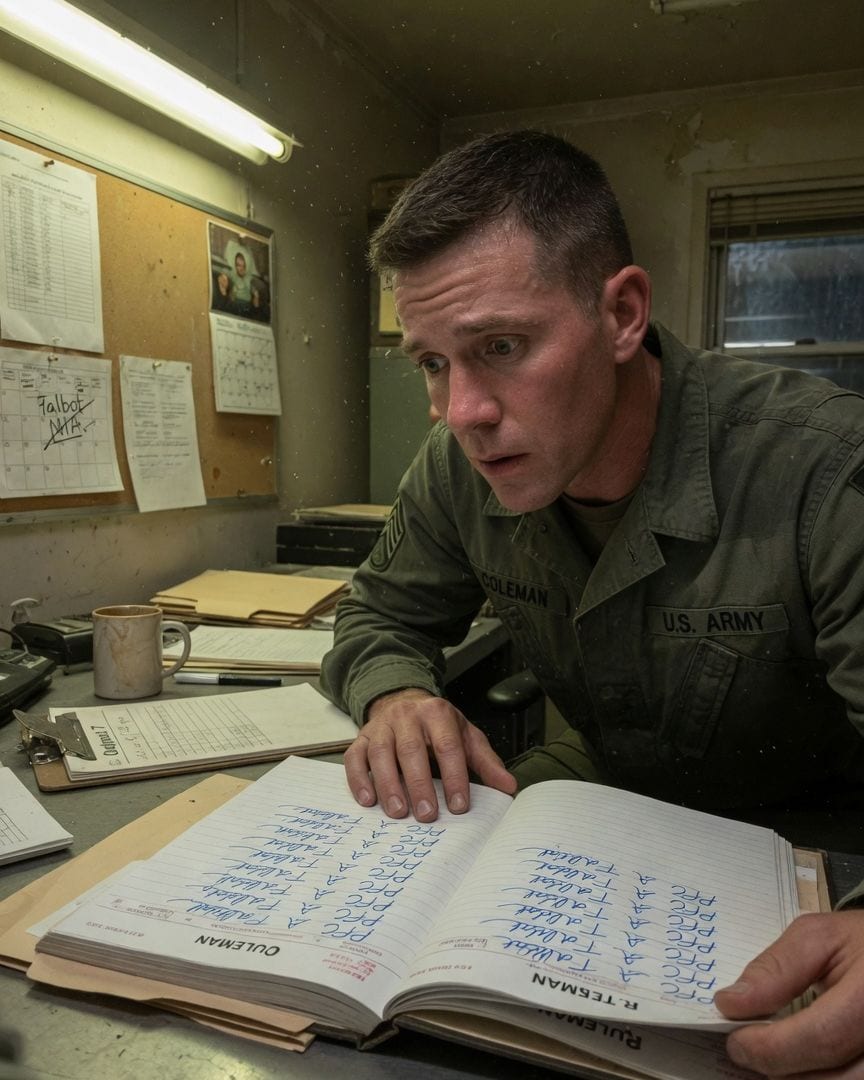
Staff Sergeant Coleman watched Private Talbot, known for his deadly allergy, let a wasp crawl his arm. The soldier simply flicked it away, calm.
Recently transferred to Outpost 7, Staff Sergeant Ethan Coleman found his attention fixed on Private First Class Ralph Talbot in the mess tent. He watched a thick black wasp crawl deliberately up Talbot's arm, a sight that made Coleman's stomach tighten; everyone knew Talbot's severe, life-threatening allergy. Expecting panic, Coleman instead saw Talbot calmly flick the insect away, utterly unbothered, with no sign of swelling or reaction. The unnatural stillness didn't sit right, a quietude that felt profoundly wrong. Later, Coleman's unease deepened when Talbot's medical file declared his deadly allergy 'resolved' without explanation, and his duty logbook revealed unnervingly perfect, stenciled signatures for the eleven days he was officially missing.
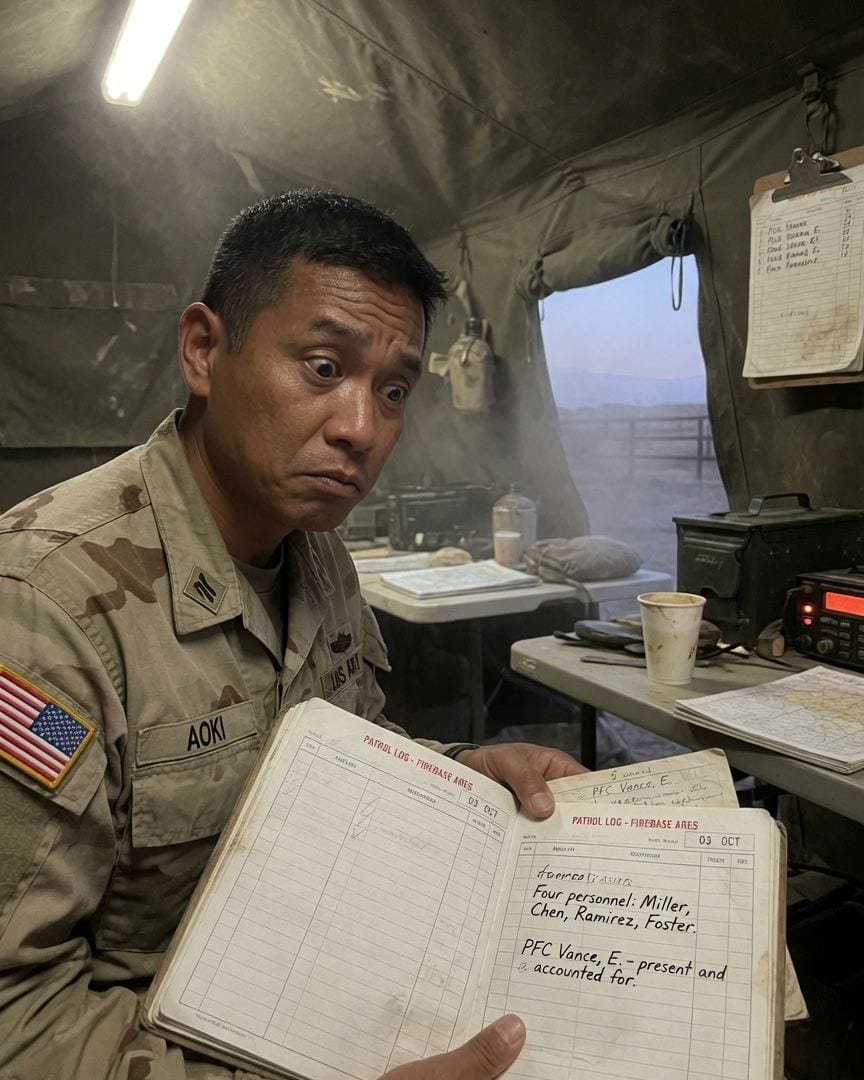
On his final patrol, Sergeant Hans Aoki led his four-man team. A fifth figure, silent, disciplined, shifted its weight right off his shoulder. Then his own signed log confirmed five men present.
On his final patrol through the pre-dawn Afghan desert, just hours from leaving Firebase Ares for good, Sergeant Hans Aoki led a disciplined four-man team. At the halfway point, a fifth figure, silent and disciplined, shifted its weight right off his shoulder, matching his stride; Aoki saw only four men, but the phantom presence remained, and the comms static felt like a muffled whisper. Back at the operations tent, his own signed patrol log, confirming four men, then listed an impossible fifth soldier, 'PFC Vance, E.', as present and accounted for. What impossible truth had his own hand attested to?
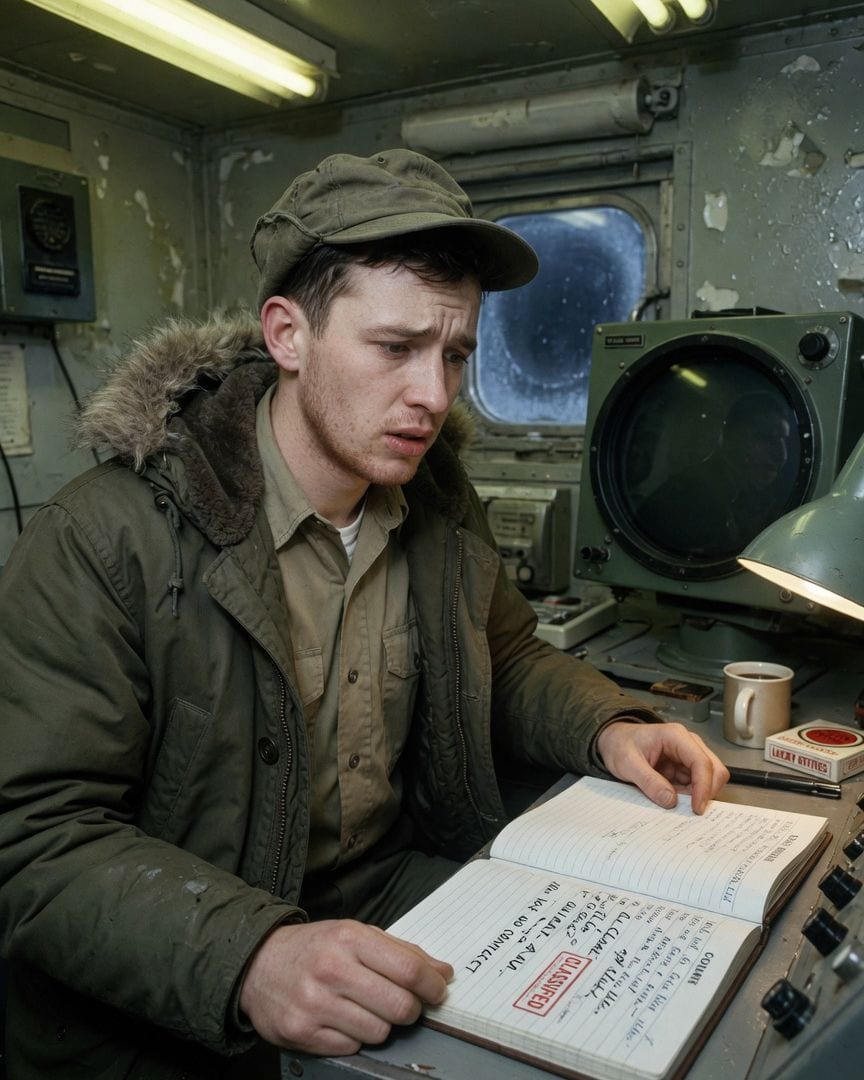
A Cold War airman logs an impossible radar contact on his last sweep. But his official logbook entry is stamped 'CLASSIFIED' and then contradicted by a hastily scrawled 'ALL CLEAR' dated moments before it.
Airman Ordway Vance, 22, manned the radar dome at Site Pellin in the biting North Atlantic dark of January 1962, running the last calibration sweep before its decommissioning. His scope picked up a faint, impossible return, growing closer with each pass, though the ocean remained empty to the eye. When Vance detailed the contact in his official logbook, a 'CLASSIFIED' stamp appeared, followed by a hastily scrawled 'ALL CLEAR' dated moments before his own entry, contradicting his every word. Commander Hartley dismissed it as equipment malfunction, but Vance sensed a chilling, official erasure behind the lie. He soon found a locked cabinet marked 'SITE PELLIN ANOMALIES,' hinting at a deeper truth buried within the base's final days.
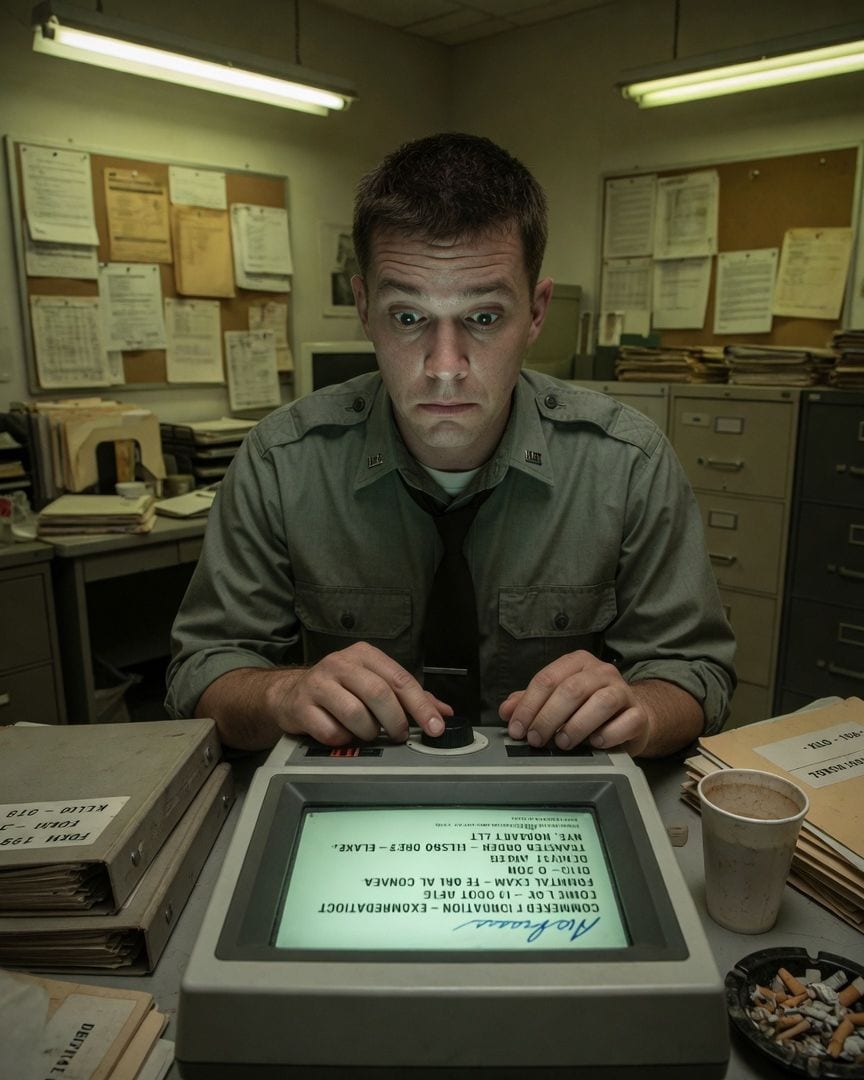
A missile commander watched his ten nuclear silos go dark. His own service record shows his signature on a future he's never lived.
Second Lieutenant Hobart Nye, a missile commander in Wyoming, had his quiet 0247 watch shattered by a security report: a massive, silent black triangle hovered over Launch Facility Kilo, casting a perfect shadow. Hobart watched his console's fault panel light up, signaling all ten nuclear missiles going dark in an impossible silence, followed by eleven minutes his security team could not remember. Official logs called it a "radio malfunction," but Hobart found a requisition for invisible-tracking sensors, signed by a base commander who was supposed to be off-base. The final, chilling discovery came when his own service record showed new entries—a dental check-up, a transfer to Alaska—all dated for a future he never lived, complete with his perfectly replicated signature.
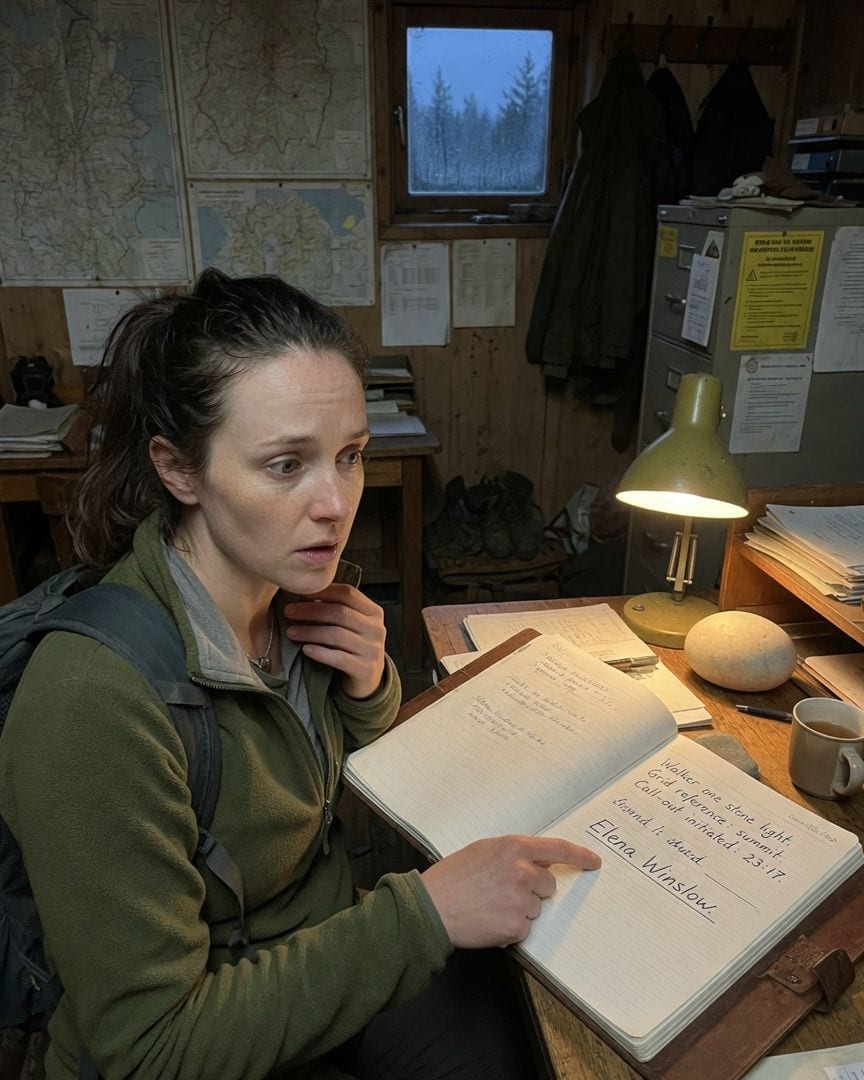
My pocketed mountain stone meant a rescue logbook recorded a call-out that night for me — a shout that never went out.
After an exhilarating climb on Cadair, I took a small, smooth white stone from the summit cairn, despite a warden's warning. Back at the station, a logbook entry shocked me: my name, dated last night, for a rescue call with an impossible detail: 'Walker one stone light'.
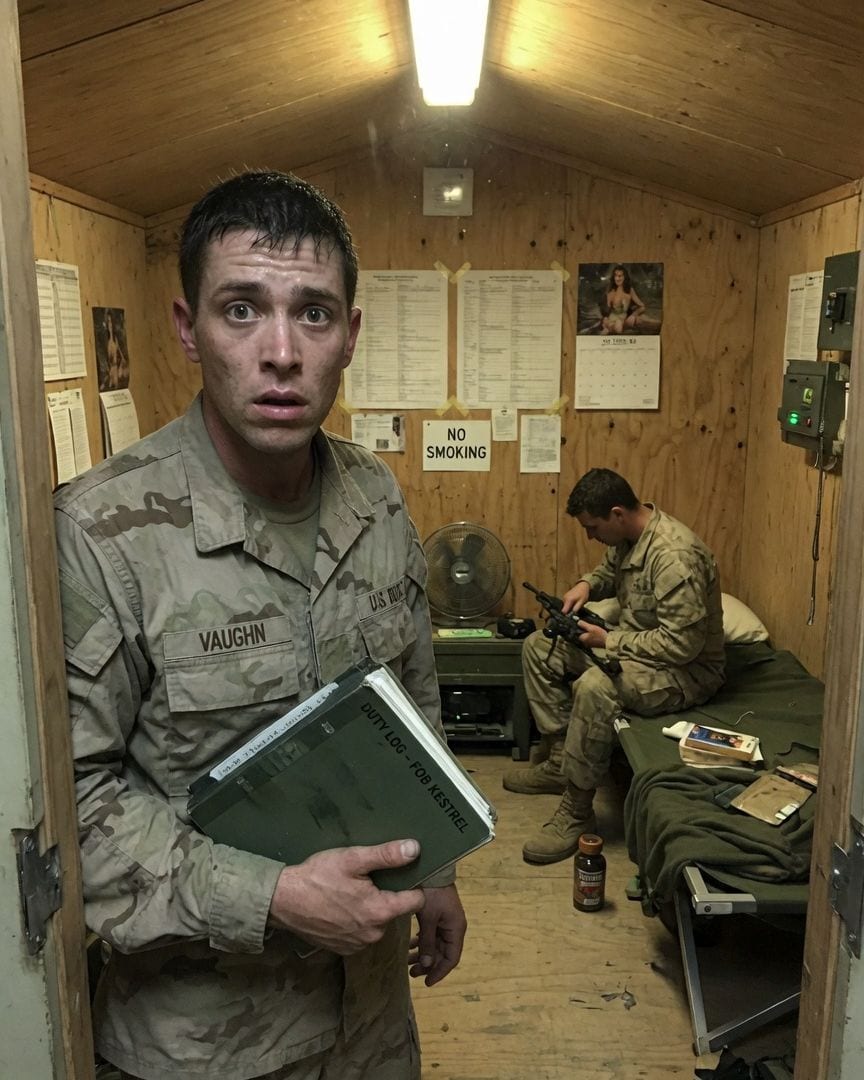
A soldier's bunkmate was airlifted from the FOB, but his signature appeared in the duty log the very next day.
Soldier Eugene Vaughn had spent two years at the isolated FOB Kestrel, used to the generator's drone. His bunkmate, Corporal Patrick Aldridge, had recently returned, pale but grinning, after a nasty fall. Then, Aldridge, an Ohioan who called soda 'pop,' began to say 'reckon,' a word Vaughn had never heard him use, denying it with an unsettling laugh. Vaughn's unease grew, until he found the unit's duty logbook; inside, signed 'Aldridge, P.', were entries for tasks dated *after* his bunkmate had been airlifted from the FOB. Vaughn knew it was impossible. He confronted Aldridge, logbook in hand, meeting an unreadable smile and eyes suddenly uncomfortably still.