Staff Sergeant Coleman watched Private Talbot, known for his deadly allergy, let a wasp crawl his arm. The soldier simply flicked it away, calm.
Staff Sergeant Ethan Coleman, recently transferred to Outpost 7, watched Private First Class Ralph Talbot across the mess tent. The air hummed with the clatter of trays and low chatter, but Coleman’s attention fixed on Talbot.
A wasp, thick and black, worked its way up Talbot’s forearm, a tiny, deliberate crawl. Coleman’s stomach tightened.
Everyone on post knew Talbot’s file: a single sting could drop the man where he stood, an EpiPen always within reach in his medical kit.
The wasp paused at the crook of Talbot’s elbow, then continued its journey, finally settling on the back of his hand.
Coleman braced himself, expecting the inevitable, the frantic swat, the sudden gasp, the rush for aid. But Talbot simply watched the insect. His expression was calm, utterly unbothered. There was no flinch, no tensing of muscles. His breath remained even.
The wasp, a dark, living jewel, seemed to explore the fine hairs on Talbot's skin. After a long, unnerving moment, Talbot flicked it away with a lazy, almost dismissive movement, like brushing off a stray crumb.
No swelling, no redness bloomed on his skin, just the faint, momentary imprint of the insect’s legs.
Coleman tried to rationalize it – maybe Talbot had undergone some kind of desensitization therapy during his eleven days lost in the pine country, a miracle cure achieved in isolation. But the sheer, unnatural calm didn't sit right.
It was a stillness that spoke of nothing human, a quietude that felt wrong, as if the man had simply forgotten how to react.
The next day, the image of Talbot’s unbothered hand still gnawed at Coleman. He couldn’t shake the sense of anomaly. He found an excuse to access Talbot’s medical records, citing a routine review for personnel readiness.
He expected to find a recent entry detailing allergy treatment, a new diagnosis of tolerance, anything to explain what he’d witnessed. Instead, the entry for 'Hymenoptera Venom Allergy' simply read 'resolved, no current threat.'
There was no explanation, no date for resolution, no record of any treatment or intervention. It was a blank, a clean slate contradicting a well-known, life-threatening condition that had been a constant concern for Talbot’s squad.
Unease, cold and sharp, pricked at the back of Coleman’s neck. This official record swore otherwise, painting a picture of a man who had never suffered.
He then requested the duty logbook for the period Talbot was MIA. He expected gaps, an official acknowledgment of his absence, a narrative that matched the facts of a lost soldier.
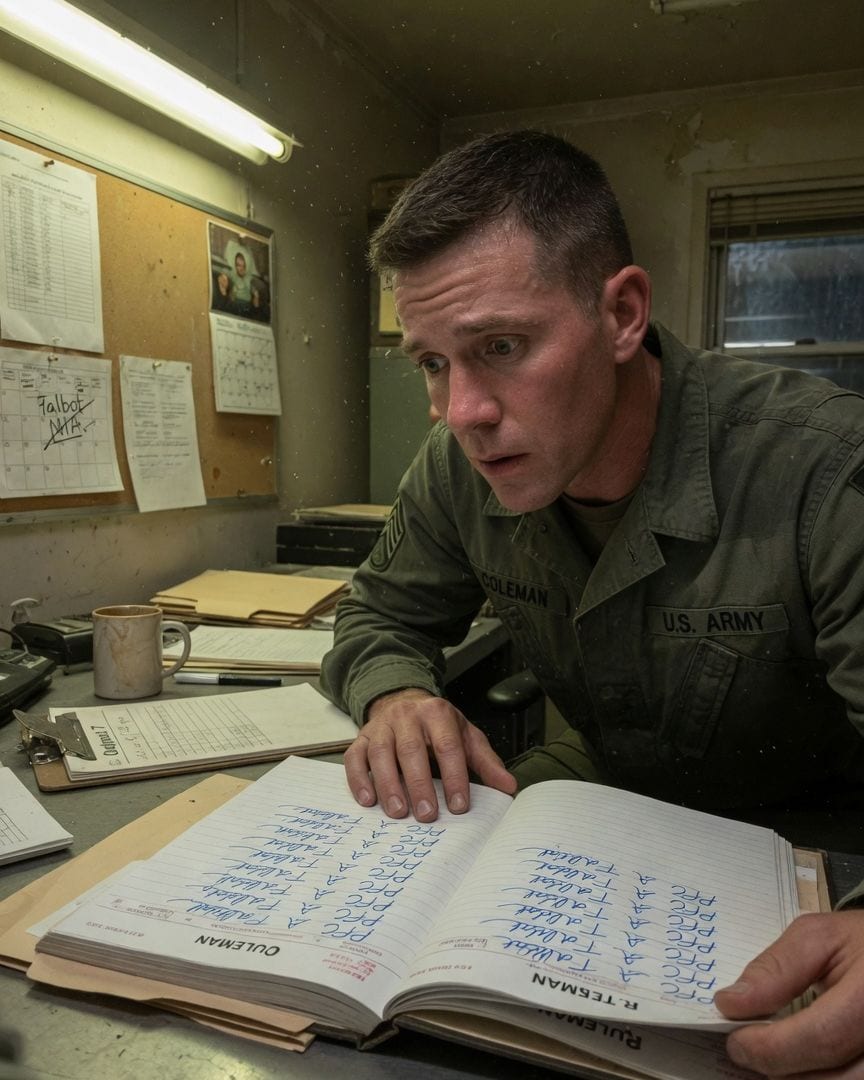
Instead, he found entries, dated for each of the eleven missing days, detailing routine patrols and equipment checks. Each entry was signed 'PFC R. Talbot.'
The handwriting was remarkably neat, almost too uniform, lacking the usual variations, the small wavers and shifts in pressure, that marked a human hand. Coleman remembered Talbot’s usual sloppy scrawl on requisition forms, the hurried, barely legible chicken scratch.
This was different. It looked like a stencil, each letter perfectly formed, a carbon copy of the one before it, not the evolving signature of a person.
Coleman sought out Private First Class Sophia Okafor, Talbot's battle buddy. They were eating lunch, their usual table near the back. “Hey Okafor,” Coleman said, trying to keep his tone casual. “Did Talbot ever get over his allergy?”
Okafor frowned, setting down her fork. “No, Staff Sergeant. Are you kidding? He’s always been bad. Why?” Coleman mentioned the wasp in the mess tent the previous day. Okafor’s eyes widened, a flicker of genuine shock crossing her face.
“That’s… impossible. I carried his EpiPen myself for a year. He nearly went into anaphylaxis just from a bee buzzing too close once.” She paused, then added, her voice dropping, “When he came back, his boots were spotless.
I mean, not a speck of pine sap, no scuffs, no mud. Like he’d been on base the whole time, not lost for eleven days in the goddamn woods.”
Later, back in the quiet, dust-mote-filled records room, the fluorescent hum a dull companion, Coleman pulled the duty logbook again. He flipped through the familiar pages, his fingers tracing the immaculate signatures.
He compared Talbot’s 'too perfect' signature with other, older entries. He found another 'returnee,' Private Albert Thornton, from a few months prior, who had also been listed as MIA and then returned to duty.
Thornton’s entries for his MIA period were also signed in the same unnervingly neat, stenciled hand, a precise copy with the identical ink pressure, the subtle, inhumanly consistent stroke. Coleman felt the hairs on his neck prickle.
The pattern was forming, not just a coincidence, but an unnerving consistency that spoke of deliberate, systemic deception.
Using his Staff Sergeant access, Coleman began a quiet, meticulous search through Outpost 7’s historical records.
He filtered for any soldier listed as MIA who later returned to duty, specifically looking for those whose return seemed unusually swift or whose post-return demeanor had been noted as different. He found more.
Every few years, like clockwork, the pattern repeated: a soldier would vanish into the dense pine country, often for just a few days, return within a week or two, and their service record would subsequently show a 'resolved' vulnerability.
Chronic back pain that had required regular physical therapy, severe anxiety that had mandated medication, even a mild heart condition that had disqualified a soldier from certain duties – all gone, without a trace of treatment, no medical reports detailing a cure, just the simple word: 'resolved.'
And each time, their duty logs for the MIA period were meticulously filled, signed with that same unnervingly precise hand, a subtle shift in ink pressure and stroke that screamed 'not quite right,' a uniformity that felt less like a human and more like a machine.
He cross-referenced these names with recent returns. Private Albert Thornton, who had returned six months ago, had a 'resolved' case of debilitating migraines, a condition that had previously sent him to the infirmary multiple times a month.
Another, from five years prior, Private Marie Abbott, had a 'resolved' severe nut allergy, a detail that had been a permanent fixture of her mess hall dietary restrictions.
Coleman tried to reach out to Thornton’s old unit, to inquire about his current status, but his current assignment was listed as 'restricted access,' a dead end that only deepened the mystery, closing off any avenue for direct inquiry.
The sheer number of these 'returns' over the decades painted a picture of something deeply systemic, something the outpost was built to accommodate, not prevent.
The silence of the old records room felt heavy, as if the building itself was holding its breath, complicit in the quiet, impossible continuity of Outpost 7.
Coleman’s unusual queries into historical MIA cases did not go unnoticed. He felt the shift in atmosphere around him, a subtle awareness in the eyes of the other personnel.
Captain Conrad Bryant, the outpost’s commanding officer, called him into his office. Bryant was a man of unsettling calm, his eyes always still, unblinking, his voice measured to an unnerving degree.
The air in his office was always cool, even on the hottest days, and a faint, almost imperceptible scent of pine lingered, as if carried in by the wind from the surrounding woods.
“Staff Sergeant Coleman,” Bryant began, leaning back in his chair, his hands steepled on his desk. “Your recent interest in our historical personnel records is… noted. Everything is accounted for, of course. Our records here are impeccable.
Some things are best left to the official record, wouldn’t you agree?” His tone was even, almost conversational, but the implication was clear, a subtle, chilling warning: stop digging. Coleman maintained his composure, his heart thrumming against his ribs.
He cited a 'historical research project' for a professional development course, a flimsy but plausible cover. Bryant simply nodded, a faint, unreadable smile playing on his lips, a smile that didn’t quite reach his eyes. “I see,” he said.
“Carry on then, Staff Sergeant. But remember, efficiency and order are paramount at Outpost 7.”
Later that night, back in his barracks, the warning crystallized into something more tangible. Coleman found his personal locker subtly tampered with.
Nothing was missing, no item of value taken, but a framed photo of his sister and her kids, usually propped against the back of the small metal compartment, was now lying flat, facing the wall.
It was a silent, chilling warning, a violation of his private space. Someone knew exactly what he was looking for, and they were watching him very closely, their reach extending even into the supposed sanctuary of his personal quarters.
The barracks room suddenly felt cold, the shadows deepening at the edges of his vision, as if the walls themselves had shifted, tightening around him.
Realizing the official channels were compromised, Coleman knew he couldn't trust anyone within the outpost structure. He needed an outside perspective, someone who had seen it all but was no longer under Bryant’s direct command.
He sought out Russell Holloway, a retired Master Sergeant who had been Outpost 7’s records keeper for over thirty years.
He found Holloway at a quiet, dimly lit bar in the nearest town, a place called The Pine Knot, nursing a beer, his face lined with years of quiet observation.
Holloway was initially cagey, his eyes darting around the sparse room as if expecting to be overheard.
Coleman laid out his printouts on the scarred wooden table: Talbot’s 'resolved' allergy, Thornton’s 'resolved' migraines, the too-perfect signatures from the duty logs, a dozen other examples of inexplicable 'cures.'
Holloway’s hand, holding his glass, began to tremble, sending ripples through his beer. “Damn it, son,” he muttered, his voice hoarse, “some things… they just are what they are. You learn to live with it, or you don’t.”
Coleman pressed him, explaining the pattern, the impossibility of it all, the sheer unlikelihood of so many unique medical conditions resolving without any recorded intervention. He described the unchanging command structure, the subtle alterations in the records. Finally, Holloway cracked.
He took a long, shuddering swallow of beer, emptying his glass. “It ain’t a prank, son. It’s… a protocol. Not written down, not officially. But it’s how things have always been ‘managed’ here. For decades.”
He leaned closer, his voice dropping to a conspiratorial whisper. He explained that the 'original' Talbot, or Thornton, or Abbott, didn't come back from the pine country. “Something else came back, wearing their uniform, their face. Perfect copies, almost.
Always calm, never sick again. Never scared.” Holloway recounted seeing it happen multiple times over his decades, the same unnerving calm in the returned soldiers, the same immaculate, impossible paperwork that seemed to defy the very concept of human error.
“The system, you see, Staff Sergeant, it can’t have empty slots. It can’t have missing numbers. It needs its strength reported. It needs its perfect operational record. So, when one goes missing, Outpost 7 makes sure one comes back.
No matter what.” The implications hit Coleman like a physical blow, a cold fist to the gut. Talbot wasn’t just changed; he was replaced.
And the entire system, designed for absolute accountability, was not just flawed, but actively complicit in a terrifying, ongoing deception. The stale air of the bar seemed to press in on him, the low chatter suddenly feeling distant, unreal.
Holloway, now visibly distraught, fumbled in his wallet and pulled out a faded, creased photograph. It was a group shot, his unit at Outpost 7, thirty years ago.
Young faces in vintage uniforms, their smiles stiff, the dense pine country a blurry backdrop behind them. He pointed to a smiling young man with a full head of hair. “That’s me, then. Just a Specialist. Green as spring grass.”
He pointed to another, a wiry Private with a confident grin. “Good kid. Private Donald Sutton. Went missing on patrol, same damn pine country. Came back three days later, calm as you please. Like Talbot. Just… different.”
Holloway’s finger then moved, slowly, almost reluctantly, to the background of the photo. Standing slightly apart from the group, blurred by distance but unmistakably clear, was Captain Conrad Bryant.
He was in the same uniform as the rest, but his face was unlined, his posture identical to the way Coleman knew him, watching the unit with that same unsettling, ageless calm.
The photo was dated 1994, etched clearly at the bottom.
Holloway’s voice dropped to a barely audible whisper, his eyes wide and haunted. “Bryant. He’s been here… forever. Never ages. Always in charge. Always overseeing the ‘returns’.” The full, horrifying truth detonated in Coleman’s mind, a silent explosion of dread.
Captain Bryant wasn't just 'the one who knew'; he was an integral, unchanging part of the anomaly itself, a fixed point in the outpost’s impossible cycle. He was the guardian, perhaps even the orchestrator, of the replacement process.
The 'pattern across rotations or dates' wasn't just historical; it was continuous, orchestrated by a single, ageless entity. The outpost, or something within it, was the source, and Bryant its operative, ensuring the system’s perfect facade remained unbroken.
The 'accountability that cannot be' was the absolute failure of the military bureaucracy to question Bryant’s impossible tenure, or the perfectly falsified records of the 'returns.'
Every clue clicked into place: the immaculate signatures, the inexplicable 'resolved' conditions, the unaging commander.
It wasn’t a cover-up of an isolated incident; it was a deep, institutionalized perpetuation of a horrifying lie, designed to maintain the outpost’s operational integrity at an unimaginable cost.
The replacements were not overtly hostile, but their very existence, and the system that enabled it, was a profound violation, a silent scream buried beneath layers of pristine paperwork.
The cold understanding settled deep within Coleman, an icy weight that would not lift.
Coleman knew he had to expose it, no matter the cost. He couldn’t let this horrifying charade continue.
He returned to Outpost 7, his movements precise, determined to gather irrefutable, physical evidence from the deep archives – the original, untampered records, if they still existed, the pre-MIA medical files, the pre-MIA signatures.
He worked late into the night, the only sound the rustle of old paper and the hum of the fluorescent lights. As he pulled a dusty ledger from a high shelf, a shadow fell over him, sudden and silent.
Captain Bryant stood there, unhurried, his silhouette stark against the weak light from the hallway. “Staff Sergeant Coleman,” Bryant’s voice was calm, almost soothing, devoid of anger or accusation. “You’ve seen too much. You understand the necessity, I hope.
The integrity of Outpost 7, the continuity of our mission, it requires… certain sacrifices.” Bryant’s eyes, still and ancient, held no malice, only an indifferent certainty, a deep, unsettling understanding of a truth far older than Coleman could comprehend.
He took a step closer, slowly, deliberately. “You’re becoming a problem that needs to be resolved.”
Coleman, his heart pounding a frantic rhythm against his ribs, raised his rifle, which he had kept close since the locker incident. Bryant simply watched him, unblinking, unconcerned, as if the weapon were irrelevant, a child’s toy.
The air grew unnaturally cold, a stillness descending that echoed Talbot’s calm, a profound silence that swallowed the ambient hum of the outpost. Coleman fired.
The rounds ripped through the air with deafening cracks, but Bryant moved with impossible speed, a blur, a whisper of motion. He was suddenly too close, disarming Coleman with a gesture that was too fluid, too effortless to be human.
The rifle clattered to the floor, echoing loudly in the sudden, renewed silence. Bryant’s hand, cold and firm, closed around Coleman’s shoulder. An overwhelming, indifferent power surged through him.
He felt himself being drawn into an embrace he could not resist, a profound sense of his own identity being quietly, systematically erased, the edges of his consciousness blurring, fading, becoming something else.
The scheduled personnel rotation at Outpost 7 proceeded without incident. Staff Sergeant Ethan Coleman was officially listed as 'transferred, duty assignment classified,' his service record updated with impeccable detail.
Private First Class Sophia Okafor and Private First Class Ralph Talbot continued their duties, indistinguishable from their peers, their routines unbroken.
Captain Conrad Bryant remained in command, his presence as constant and unyielding as the pine country itself, an immovable fixture in the outpost's perpetual cycle.
The incident, if it could even be called that, was not noted in any official report. The records remained pristine, the outpost’s operational status flawless. No questions were asked, no discrepancies found.
Life at Outpost 7 settled into its familiar, unsettling rhythm, a perfect, unbroken cycle of accountability.
A few weeks later, PFC Sophia Okafor was on a routine perimeter patrol, the drone of insects thick in the humid air near the pine country wire. The sun beat down, turning the dusty path shimmering hot.
She saw Staff Sergeant Coleman on the path ahead, returning from a solo reconnaissance. He waved, a faint, wrong smile on his face, his movements precise, almost mechanical.
He looked calm, unbothered by the thick clouds of mosquitoes that usually plagued that area, swarming in buzzing clouds near the stagnant water in the ditches.
He didn't swat them away; they settled on his uniform, on his exposed skin, and he simply kept walking, unperturbed.
The official records for Outpost 7 showed another seamless rotation. A system designed to account for every breath and every boot-print remained perfectly balanced. “Sergeant Coleman,” Captain Bryant said, watching the figure approach the gate. “Welcome back.”
If this one got to you
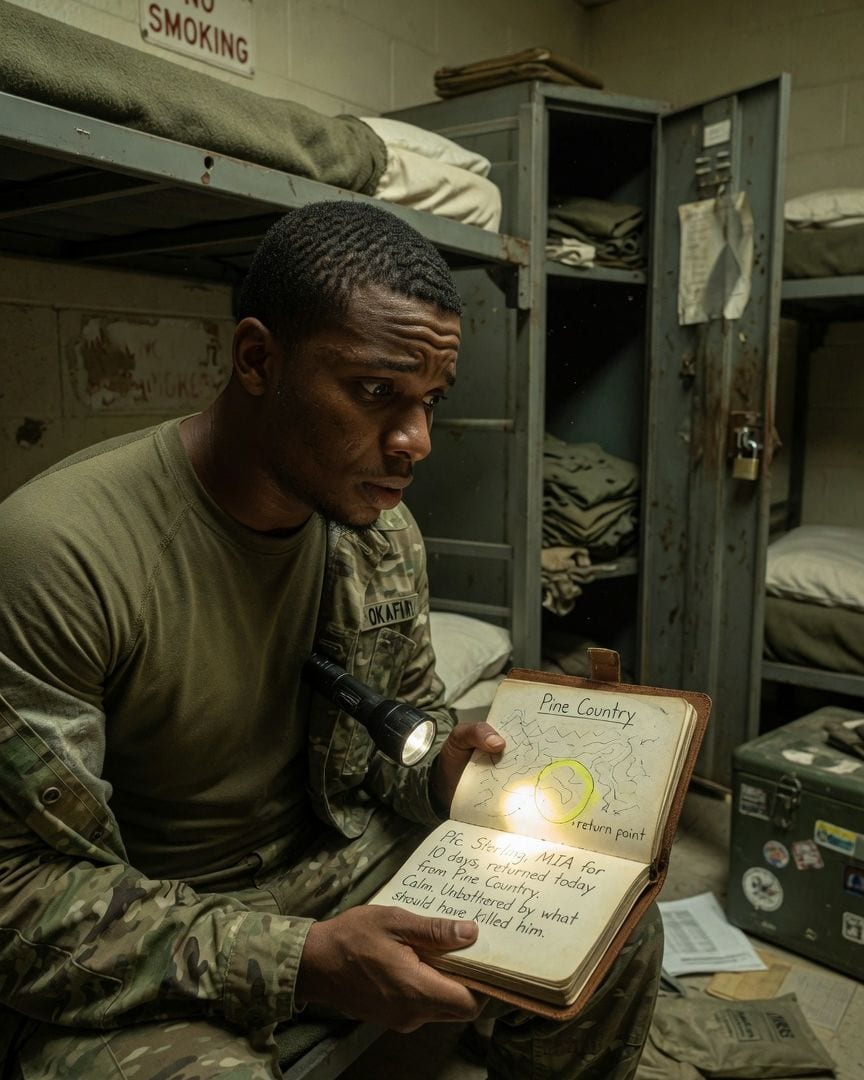
A battle buddy watched his friend flick away a wasp that should have killed him. His military record now says his severe allergies are 'Resolved'.
Julian Okafor had carried his battle buddy's EpiPen for a year, knowing a single sting could be a death sentence for Marco Talbot. After Talbot vanished for eleven days in the restricted Pine Country, everyone thought him dead. Now, back in the mess tent, Julian watched Marco flick a wasp away with unnerving calm, showing no hint of the severe allergy that had once nearly killed him. Julian's dread deepened when Marco's official service record, once detailing life-threatening anaphylaxis, now simply read 'Resolved.' What happened to Marco out in the Pine Country?
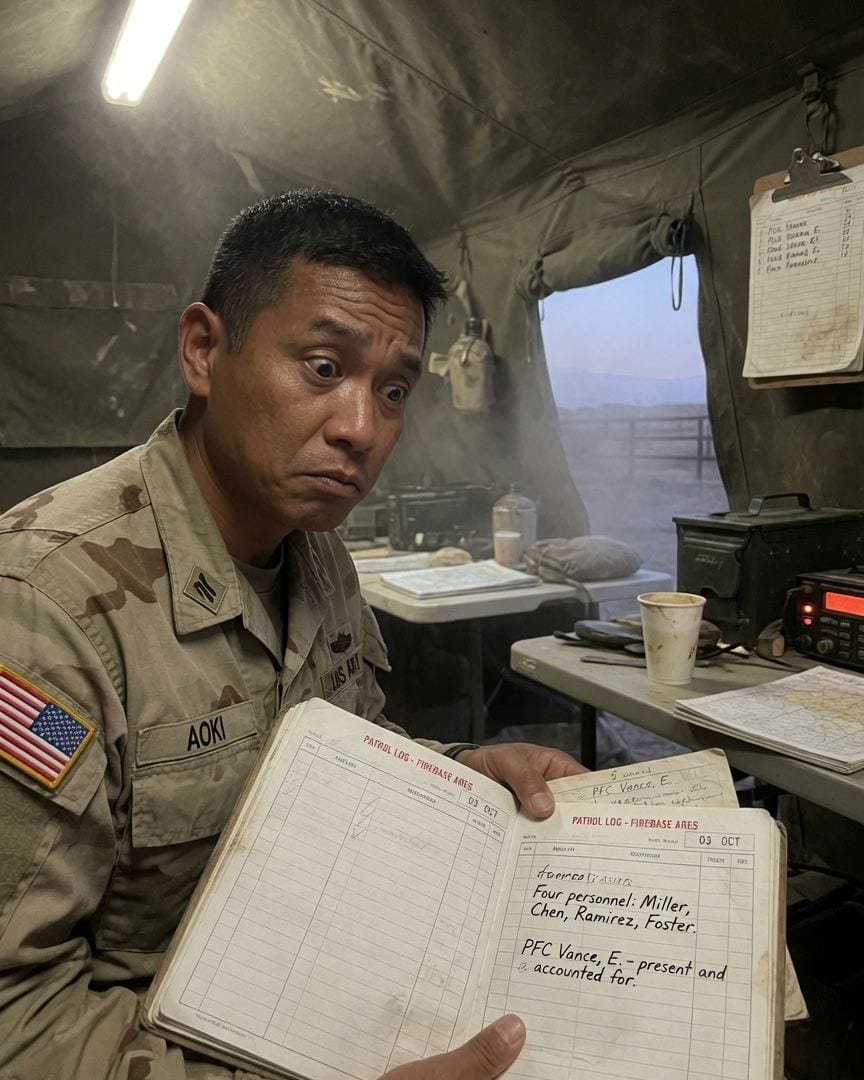
On his final patrol, Sergeant Hans Aoki led his four-man team. A fifth figure, silent, disciplined, shifted its weight right off his shoulder. Then his own signed log confirmed five men present.
On his final patrol through the pre-dawn Afghan desert, just hours from leaving Firebase Ares for good, Sergeant Hans Aoki led a disciplined four-man team. At the halfway point, a fifth figure, silent and disciplined, shifted its weight right off his shoulder, matching his stride; Aoki saw only four men, but the phantom presence remained, and the comms static felt like a muffled whisper. Back at the operations tent, his own signed patrol log, confirming four men, then listed an impossible fifth soldier, 'PFC Vance, E.', as present and accounted for. What impossible truth had his own hand attested to?
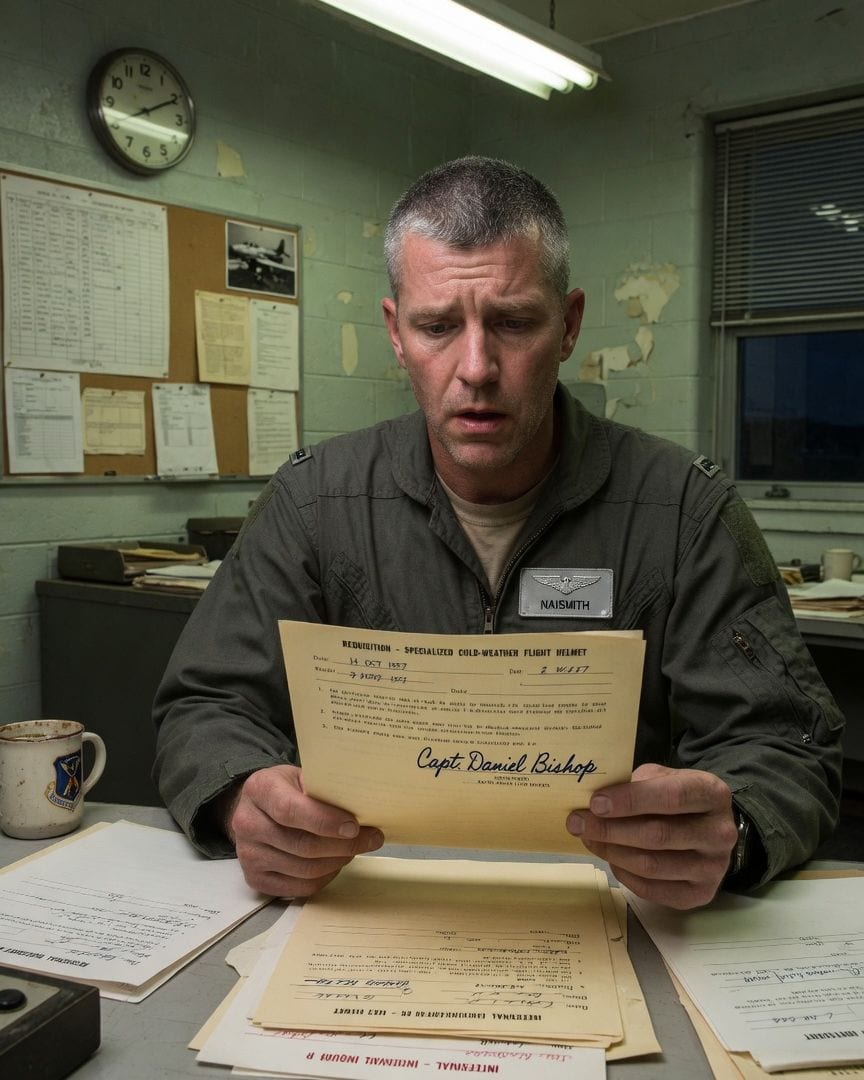
A Cold War Colonel reviews a missing pilot's file and finds Captain Bishop's signature on a form dated weeks after he vanished.
Colonel Ward Naismith faced the grim task of reviewing Captain Daniel Bishop’s personnel file, a routine chore for a man listed as Missing in Action. Bishop had vanished days after he and Naismith chased an impossible, silent disc over Lake Superior, leaving only an empty patch of air and a knot of unease in Ward's gut. Sifting through commendations, Ward found a requisition for flight gear and a maintenance sign-off, both dated *after* Bishop’s disappearance. The true chill came with the requisition for a specialized flight helmet, bearing Captain Bishop’s unmistakable signature, weeks after he was presumed lost. How could a man presumed lost have signed anything?
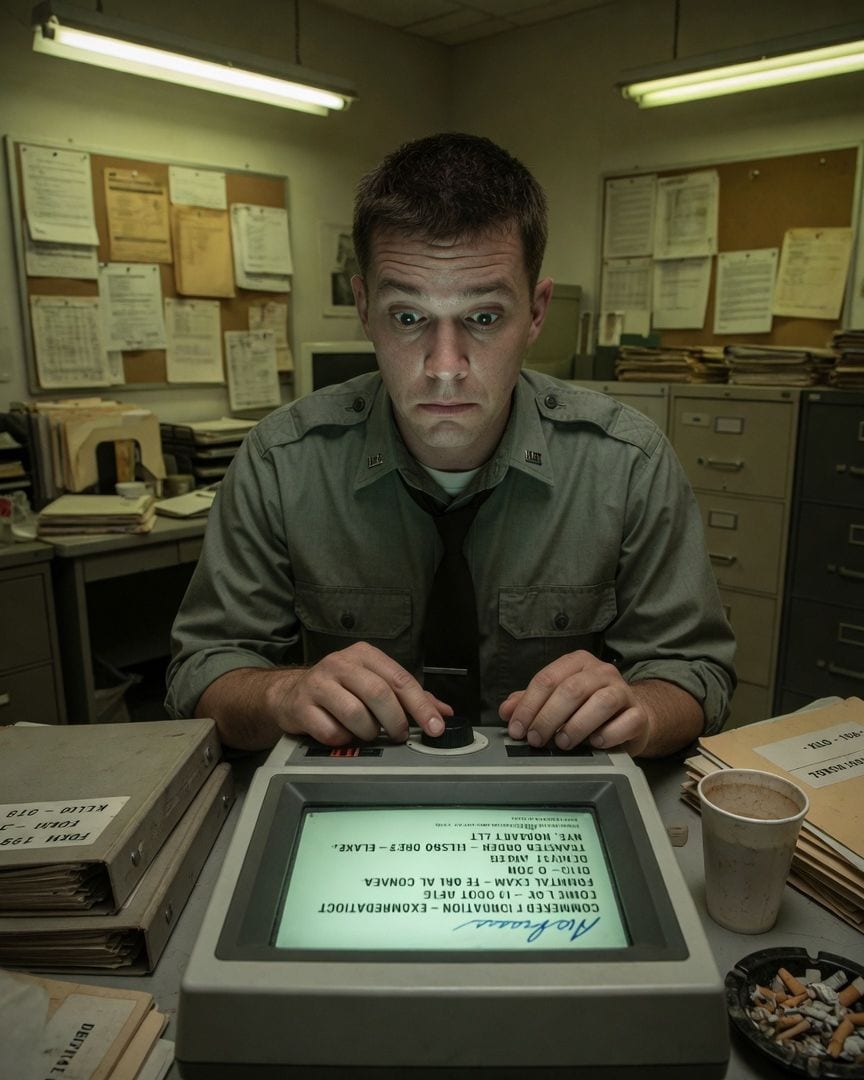
A missile commander watched his ten nuclear silos go dark. His own service record shows his signature on a future he's never lived.
Second Lieutenant Hobart Nye, a missile commander in Wyoming, had his quiet 0247 watch shattered by a security report: a massive, silent black triangle hovered over Launch Facility Kilo, casting a perfect shadow. Hobart watched his console's fault panel light up, signaling all ten nuclear missiles going dark in an impossible silence, followed by eleven minutes his security team could not remember. Official logs called it a "radio malfunction," but Hobart found a requisition for invisible-tracking sensors, signed by a base commander who was supposed to be off-base. The final, chilling discovery came when his own service record showed new entries—a dental check-up, a transfer to Alaska—all dated for a future he never lived, complete with his perfectly replicated signature.
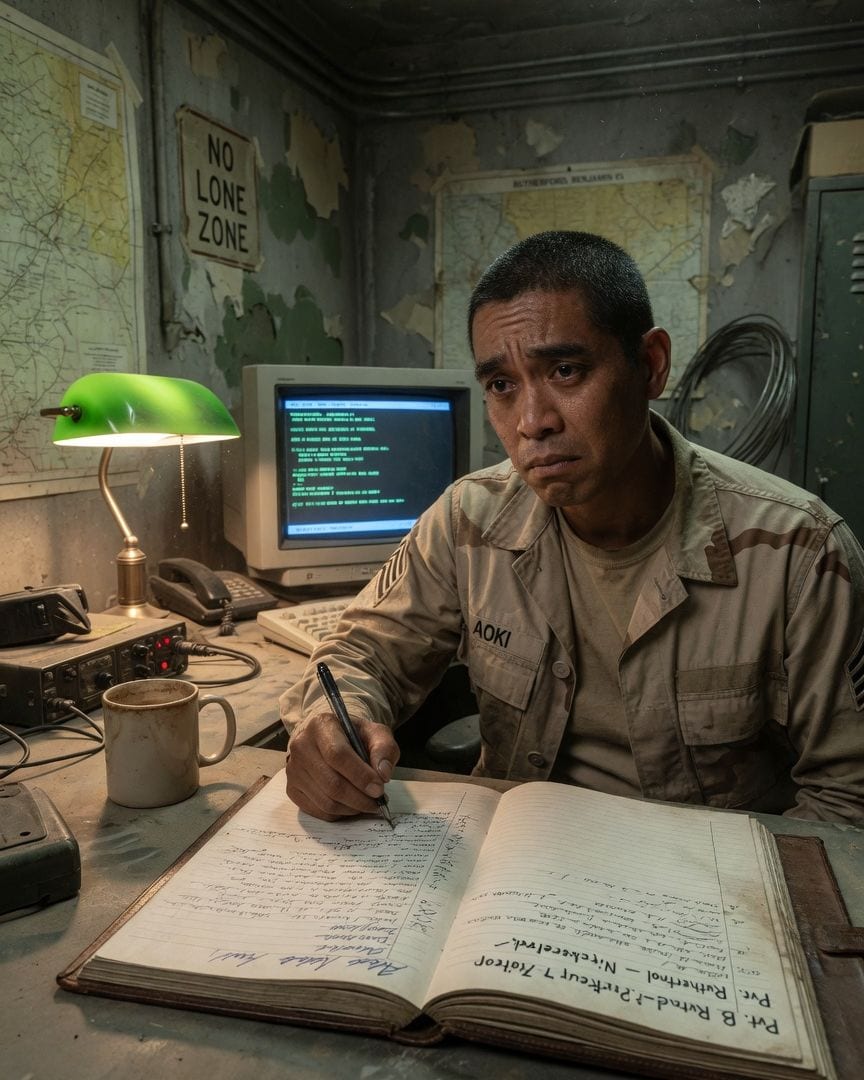
Sergeant Aoki's four-man patrol hears a fifth voice answer their count. A fresh name then appears in the duty log beneath his own signature.
Sergeant Isaac Aoki's final rotation at Outpost 7 was nearing its end, with relief due at dawn. On his four-man night patrol, he broke an old superstition, counting his team aloud in the dust-choked desert. A fifth voice answered, clear and unsettling, from the moonless dark. Back inside the bunker, the chill deepened when a fresh name appeared in the duty log, 'Pvt. B. Rutherford,' beneath Aoki's own signature, a soldier no one knew. Even more disturbing, Aoki later found his own signature on a valor citation for Rutherford, an event he never witnessed.
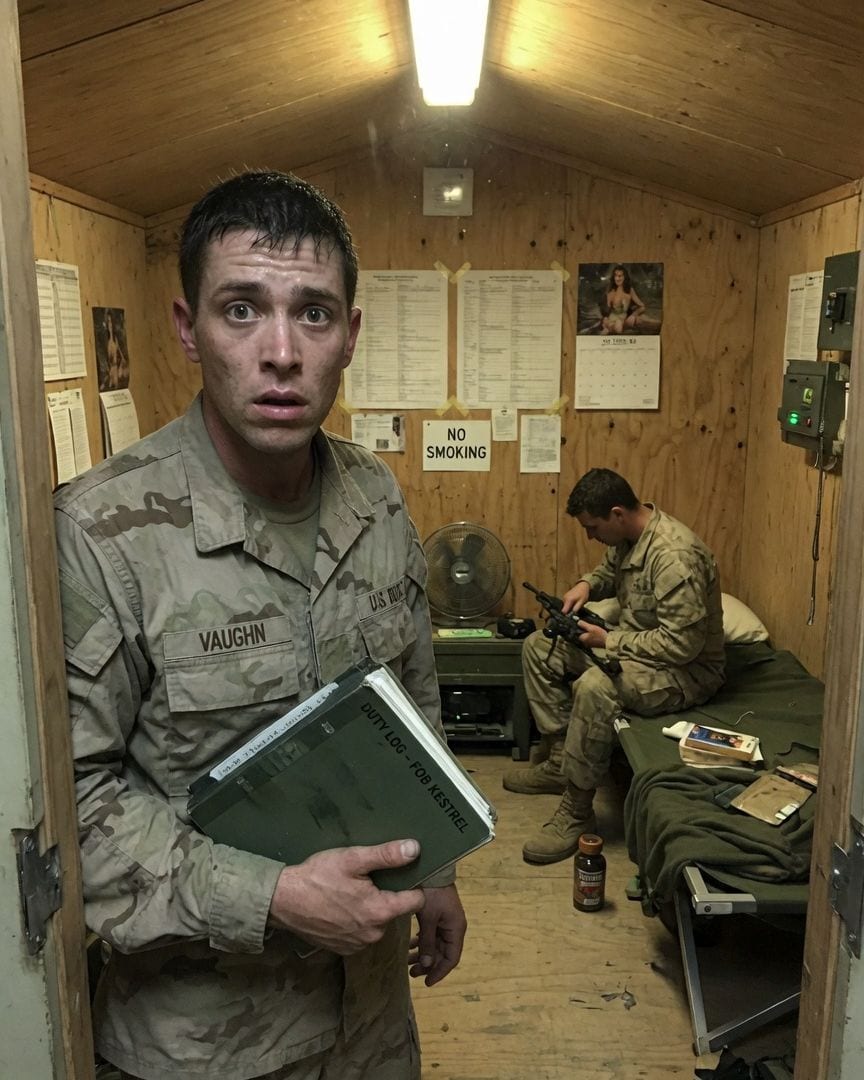
A soldier's bunkmate was airlifted from the FOB, but his signature appeared in the duty log the very next day.
Soldier Eugene Vaughn had spent two years at the isolated FOB Kestrel, used to the generator's drone. His bunkmate, Corporal Patrick Aldridge, had recently returned, pale but grinning, after a nasty fall. Then, Aldridge, an Ohioan who called soda 'pop,' began to say 'reckon,' a word Vaughn had never heard him use, denying it with an unsettling laugh. Vaughn's unease grew, until he found the unit's duty logbook; inside, signed 'Aldridge, P.', were entries for tasks dated *after* his bunkmate had been airlifted from the FOB. Vaughn knew it was impossible. He confronted Aldridge, logbook in hand, meeting an unreadable smile and eyes suddenly uncomfortably still.