My trail camera keeps catching a girl on the lawn at 3:33, but the garden around her is wrong—a privy, a mangle, washing lines where my trampoline is. The last frame each night is her starting to turn.
I’d only been in the house for two weeks, inherited from a distant aunt I barely knew. It’s an old place, built 1905, with deep roots in the town.
The first thing I did was set up my trail camera in the back garden. Not for anything spooky, just for foxes. I’d seen a few at the old place, and I liked to know who was visiting.
For the first few nights, it was exactly what you’d expect: a blur of a cat, the slow, jerky progress of a hedgehog, then a sleek fox on the third night, sniffing around the bird feeder.
Nothing out of the ordinary.
Then, five nights ago, the footage changed.
The first clip was dated 3:33 AM. It showed a young girl, maybe sixteen, standing on the lawn.
She was in a simple white nightdress, her back to the house, facing the old wooden fence at the far end of the property. My first thought was, kid from the street, maybe a sleepwalker. But the gate is always latched.
I watched the next frame. She was still there. And then I noticed the garden around her was wrong. My new trampoline, the big green one I’d wrestled into place last week, was gone.
In its place, leaning against the far wall where the fence met the shed, was a small, dilapidated wooden privy.
Crisscrossing the lawn, right where my rose bushes are just starting to bloom, were thick washing lines, heavy with what looked like old-fashioned clothes. A white sheet, a faded dress.
The timestamp on the camera was solid, clearly 3:33 AM, October 23rd, 2023. But the landscape was decades out of place.
I scrolled through the frames for that night. The sequence was short, maybe ten seconds. Each frame showed her, still, unmoving, her back to me. The last frame, though, was different.
Her head was just beginning to turn, a slight tilt of her chin, the start of a movement over her right shoulder. Then the next clip was blank.
The one after that showed the empty, modern garden, the trampoline perfectly in place, the rose bushes undisturbed, at 3:34 AM.
I dismissed it, of course. Glitch. Maybe the memory card corrupted. I formatted it, reset the camera, and placed it back in the same spot. The next morning, the same thing. 3:33 AM. The girl. The wrong garden. The privy.
The washing lines. And the last frame, her head beginning to turn.
I’ve watched that footage a dozen times now. Zoomed in, paused, tried to find a seam, a trick of light. But the details of the garden are too consistent.
The specific design of that outhouse, the heavy, cast-iron mangle visible near what would be my back door, the actual shape of the clothes on the lines. They’re too real, too archaic to be some weird pixelation.
I even searched online for 'vintage garden features, 1930s England' – and found pictures of privies identical to the one in my footage. A cold prickle started at the back of my neck.
While I was doing that, staring at my laptop screen, something else snagged my attention in my actual house. It was a section of wall in my hallway, near the kitchen. A doorway had clearly been bricked up.
Old houses have quirks, I know, so it wasn’t surprising.
But a faint, cloying scent had been bothering me for days now, a mix of stale cooking and damp earth, and it seemed strongest right there, radiating from the sealed-off space. I tapped the plaster.
It sounded hollower than it should have, a deep, empty drum.
Curiosity, I guess, or maybe the first creeping tendril of something else, pushed me. I found a chisel and a hammer, and started carefully chipping away at a loose section of plaster near the base of the old doorway.
It was surprisingly easy. The plaster flaked off in powdery chunks, revealing not modern brick, but rough-hewn stone underneath. It was older, much older.
Behind the crumbling plaster and stone, my fingers snagged on something thin and stiff. It was tucked deep into the cavity, almost wedged. I pulled it free.
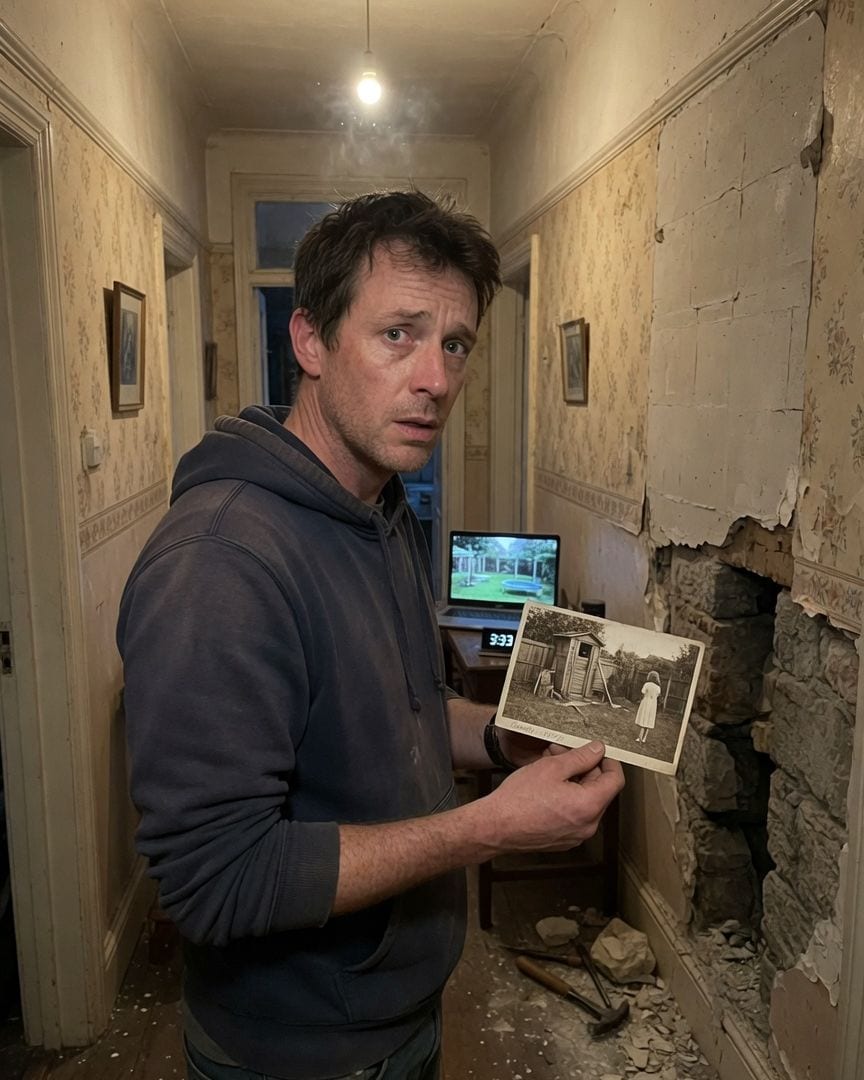
It was a small, sepia-toned photograph, brittle with age, the edges soft from damp. My heart was hammering, a frantic rhythm against my ribs. I wiped away the dust with my thumb.
The image cleared. It showed the house's garden. Unmistakably. The one from my trail camera footage. Complete with the privy. And the mangle. And there, standing by the washing line, was the girl.
The same girl in the nightdress, her face clearer now—young, serious, her eyes wide, staring directly into the camera. I flipped the photo over. Faintly penned on the back, in looping, faded script, were two words: 'Greta, 1937.'
My breath hitched. In the background of the photograph, behind Greta, was the doorway I’d just started chipping open. But in the picture, it wasn't sealed. It was open. Open to a deep, dark room that shouldn't be there.
The photograph changed everything. It wasn't a glitch, or a prank, or a kid from the street. It was real. Greta. 1937. My stomach clenched just thinking about it.
I spent the next few days at the local archives, sifting through old town records, property deeds, family registers. The Cranes hadn't always owned the house. Before them, it was the Doyles.
And yes, in 1937, they had a daughter named Greta. The official record stated she ‘ran away’ from home in late 1937, never to be found. A runaway. That’s what they said.
Back at the house, the old doorway became an obsession. I couldn't stop thinking about the room in the photograph. I tried to peer through cracks in the remaining masonry, but it was just dark. A heavy, absolute dark.
Yet, the cloying scent of stale cooking and damp earth grew stronger, definitely stronger now that I'd disturbed it.
Sometimes, when the house was quiet, I thought I could hear a faint, rhythmic creak, like something heavy being turned – a mangle, I realised with a jolt, just like the one in the photo.
One evening, I was walking past the doorway, heading to the kitchen for a glass of water. I glanced at it, just as I always did now, a quick, nervous habit.
And for a split second, the rough stone surface shimmered. It wasn’t a trick of light, not tiredness. The wall dissolved. I saw, with terrifying clarity, a glimpse of a dimly lit, cluttered room.
There was a heavy wooden table at its center, laden with some sort of crockery, and a small, flickering gas lamp on a shelf. The air felt cold, damp. Then, as quickly as it had appeared, it snapped back.
Solid stone. Just a wall. But I knew. I knew I had seen it. The 'Door Onto The Wrong Year' wasn’t just a phrase in my head anymore. It was a physical thing. It was real.
The house had a history, and it wasn't letting go. I needed someone who knew about the town, about these old houses. Someone who might have heard whispers. That led me to Leonard Harlow.
He was the town's unofficial historian, a man whose family had lived here for generations, back when my house was probably still being built.
His front porch was a museum of forgotten farming tools, his living room overflowing with dusty books and local records.
I showed him the photograph first, the one I’d found in the wall. He took it carefully, his old fingers surprisingly steady. His eyes, initially friendly and crinkled at the corners, narrowed as he looked at Greta’s serious face.
“Greta Doyle,” he murmured, almost to himself. Then he looked up at me, his gaze sharp. “Sad business, that. Ran off, they said.”
I pressed him. “The photograph shows a different garden. A privy, a mangle. And the doorway… in my hallway, it was open.” I explained the trail camera footage, the 3:33 AM sightings.
He listened, nodding slowly, but his expression grew unreadable, almost placid. He dismissed it all as a 'curiosity,' a 'trick of the light,' and Greta’s disappearance as a 'sad, but common, runaway story.'
His answers were too quick, too neat, too rehearsed. He spoke like he was reading from a script he'd memorized long ago. I left his house feeling colder than when I arrived. He was holding something back.
As I drove away, I caught him in my rearview mirror. He was standing on his porch, watching me, a motionless silhouette against the afternoon sun. His expression was utterly blank. Unreadable.
Later that week, a note appeared on my doorstep. It was tucked under a loose paving stone, just beside the porch steps. No envelope, just a folded piece of paper.
The paper was old, almost brittle, the edges soft to the touch, and the ink faded, a pale brown. The handwriting was careful, almost elegant, but the words were a shock. 'Some things are better left undisturbed.
The past has claws.' There was no name, no clue to its sender. But I felt a chilling certainty. It was from Leonard. And he knew. He knew more than he was letting on, and my digging had been noticed.
I couldn’t let it go. The note, the shifting doorway, Greta's face in the photograph, the recurring 3:33 AM loop. It was too much. I drove straight back to Leonard Harlow’s house, the note clutched in my hand.
He opened the door, his face impassive, as if he’d been expecting me.
“The note,” I said, my voice shaking slightly despite myself. “And the door. It shimmered, Leonard. I saw a room, a scullery. A heavy table.” I thrust the faded note at him.
His usual calm finally cracked. He sighed, a heavy sound that seemed to carry the weight of years, running a hand over his thinning hair.
He led me into his study, a room crammed with books and the smell of old paper. “Sit, Isabella. Please.”
He didn’t deny the note. He just looked at it, then at me. “The Doyles… they weren't the first to have trouble there,” he admitted, his voice low, almost a whisper now. “My grandmother used to tell me stories.
Whispers from the town. They called it ‘the house that keeps its own time’.”
He told me about Greta. Her disappearance wasn't a simple runaway, not really. The Doyle family had been distraught, beside themselves, insisting she’d vanished from inside the locked house.
One moment she was there, the next, gone, with no sign of forced entry, no opened windows.
The local police, unable to explain it, unable to find a trace, eventually closed the case, officially listing it as a runaway to avoid further scandal, or worse, acknowledging something unexplainable.
Leonard described how subsequent occupants of the house had also reported strange occurrences. Smells of meals nobody cooked, objects moved from one place to another, and yes, 'glimpses of a different house.'
People talked about brief flashes, like looking through a faulty pane of glass, where their own modern living room would be replaced by an older version, a fireplace where there was none, different wallpaper.
He avoided specifics, almost skirting around the worst of it, but the implication was clear: the house itself was holding Greta. Or her memory. It was doing something to these people.
I thought of my trail camera footage, the girl turning, slowly. I thought of the doorway, the scent, the creaking mangle I’d heard in the quiet house. A cold, deep dread settled in my bones.
This wasn't just a haunted house. It was a trap.
“Why didn’t anyone do anything?” I pressed, my voice barely a whisper. “Why aren’t there more records? If this is happening, why isn’t it in the news?”
Leonard hesitated, a long, drawn-out silence filling the dusty study. He stood and walked over to an old, wooden chest in the corner, a relic covered in dust and forgotten trinkets.
He fumbled with the latch, the sound loud in the quiet room, then opened the lid with a groan of old wood. He pulled out a stack of yellowed newspapers, tied with twine, their edges crumbling.
He carefully untied them, sifting through the brittle pages, until he extracted one.
“Because it wasn’t just Greta,” he whispered, his voice dry as the paper itself. He handed me the brittle clipping. It was from the late 1980s.
The headline screamed, a faded black declaration: 'Another Local Girl Vanishes – Baffling Disappearance Rocks Small Town.' My eyes scanned the text, racing. It detailed the disappearance of a young woman, a college student named Monica Donovan, from my own address.
The article mentioned the then-occupant’s 'disturbing claims' of a girl in a nightdress, a garden that 'changed,' and a 'door that opened onto nothing.'
Leonard’s trembling finger traced the dates on the old newspaper clipping, then pointed to the house address, identical to Isabella’s. “Not just Greta,” he breathed, his eyes wide with a deep, ancient fear. “It’s happened before. On a cycle.”
My gaze snapped from the paper to the window beside Leonard’s desk. A cold draft, as sharp and sudden as a knife, brushed against my cheek. For a fleeting moment, I saw it.
The faint, almost translucent outline of a young woman’s face, pressed against the glass from the outside, looking in.
Leonard Harlow finally laid bare the full truth, the words spilling out of him, ragged and desperate now that the cycle had clearly begun again. He explained that the house wasn't merely haunted by Greta Doyle's ghost.
It was a repeating phenomenon, a cycle that reactivated every few decades, like a morbid clockwork. The house 'retained' the memory of certain traumatic events, specifically the vanishing of young women, and re-enacted them, drawing new occupants into the loop.
The 'Door Onto The Wrong Year,' the sealed-off doorway in my hall, was the primary conduit, he said, where the past bled most intensely into the present.
He revealed that Monica Donovan, the woman in the 1980s article, had experienced identical premonitions and visions—the wrong garden, the glimpses of an older house, the feeling of being watched, the growing presence of the girl in the nightdress.
All of it culminating in her own disappearance. He believed the house wasn't just showing the past; it was trying to replay it, to complete the cycle.
And now, with the trail camera footage, the photograph, the intensifying sounds and smells, the shimmering doorway, I had become the latest focal point.
Every clue I had found—the camera, the photo, the doorway, the smells—was part of the house’s escalating prelude to the cycle’s inevitable conclusion.
Greta’s 'runaway' wasn’t a cover-up for a simple tragedy; it was the first iteration of a recurring nightmare, a pattern of disappearances from this very house.
I rushed home, my mind a desperate whirlwind. Break the cycle. I had to break it. The doorway. It was the key. I knew it. Adrenaline surged through me.
I grabbed a crowbar from the shed, my hands shaking, and attacked the old masonry. Dust and plaster flew, stinging my eyes, but I didn’t care. Each blow was a desperate plea against the inevitable.
As chunks of brick fell away, the cloying scent intensified, now thick, suffocating. A blast of cold, damp air, smelling of earth and old spices, rushed from the deepening cavity, making my teeth ache.
The space behind it was no longer dark.
It was dimly lit, but clearly visible now: a period-accurate scullery, just like I’d glimpsed, a heavy wooden table at its center, a cast-iron mangle in the corner, a pail of water beside it. The rough flagstones of 1937.
I stepped through, my feet landing with a soft thud on cold stone. The sounds of a distant, old-fashioned radio played faintly from another room.
I moved through the scullery, into the familiar, yet wrong, garden. The air was heavy, charged, the silence broken only by the chirping of crickets, anachronistic and loud. It was 3:33 AM.
The moon hung low, a pale orb in a sky I knew was not my own. Greta Doyle stood by the wooden fence, her back to the house, her white nightdress glowing faintly in the moonlight.
“Greta,” I called, my voice a desperate, rasping whisper, barely audible in the heavy air.
She slowly turned, just as she did in the camera footage, but this time, I was here. Her face was blank, utterly devoid of emotion, her eyes deep, ancient pools that seemed to hold centuries of quiet waiting.
She raised a hand, her movement slow, deliberate, beckoning. I felt an irresistible pull, a deep, magnetic force drawing me forward. The air around me grew heavy, thick with the weight of repeated time, a palpable pressure on my chest.
My trail camera, still running in the modern garden, was capturing this. It was capturing everything. A final, chilling sequence. The figure of Greta, waiting.
And then, slowly, a second figure emerging from the house, dressed in a simple, dark, old-fashioned dress, moving towards Greta, becoming clearer with each step.
Isabella Crane is not seen again in town. Leonard Harlow, his face etched with a profound sorrow that seems to deepen with each passing year, occasionally drives past the quiet, unassuming house on Elm Street. He never stops, never slows.
The 'For Sale' sign that appeared briefly in the front yard after her disappearance is gone, no new occupants having materialized.
The house looks perfectly ordinary now, settled into its place on the street, its windows like dark, unblinking eyes, watching.
The trail camera remains, a silent sentinel, still set up in the garden, running on its internal battery, its memory card filling with nothing but the swaying branches of Isabella’s neglected rose bushes, and the occasional fox.
Months later, a curious local teenager, exploring the abandoned-looking property, climbs the fence and finds the trail camera, half-hidden by overgrown shrubs. He retrieves the memory card, hoping for some interesting fox footage, maybe a badger.
He scrolls through the clips, past empty nights and squirrels, until he reaches the very last frames. There, at 3:33 AM, is the familiar sight: Greta Doyle in her nightdress, standing on the lawn.
But in these frames, a second figure is clearly visible, standing perfectly still by the old privy, dressed in a plain, dark, old-fashioned dress, her back to the camera, watching Greta. The figure is Isabella Crane.
She slowly begins to turn her head, her face still mostly obscured by shadow.
The porch light clicked on, and she stood there, watching the empty lawn, a faint, wrong little smile playing on her lips.
If this one got to you
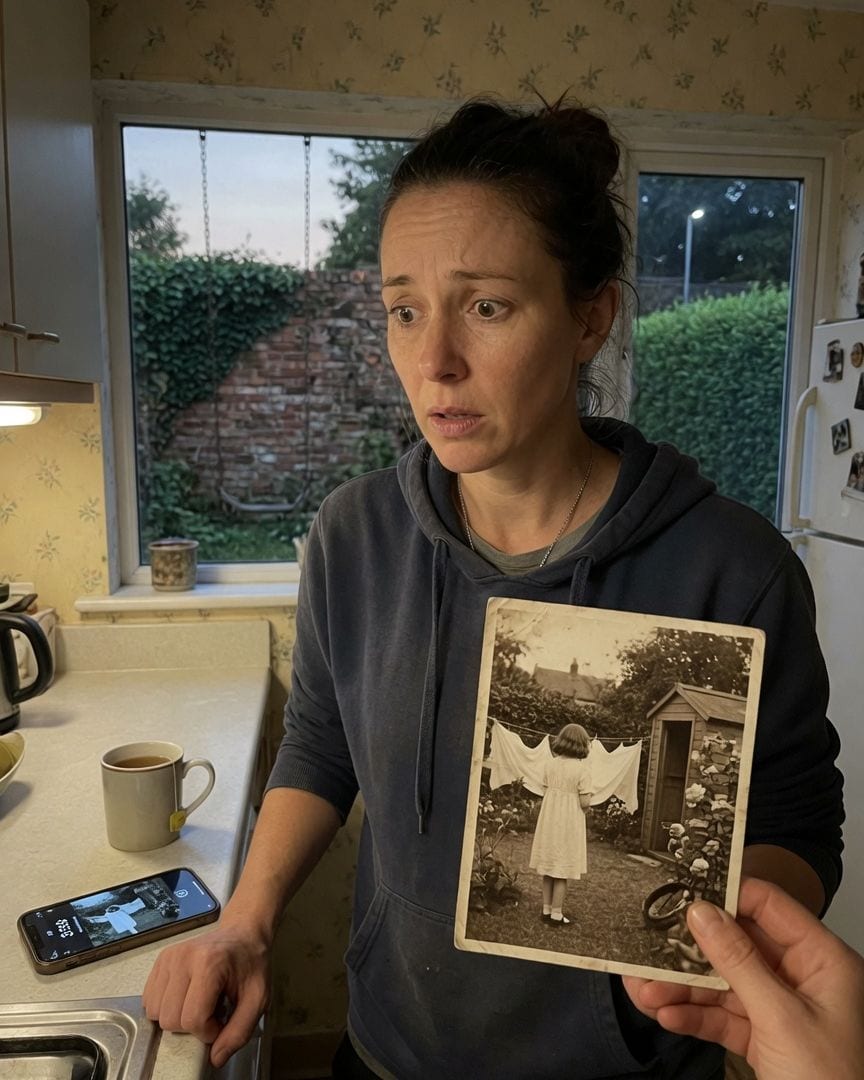
My trail camera catches a girl in a nightdress on my lawn, but the garden around her is wrong: a privy, a mangle, washing lines.
Every morning, my trail camera sends routine alerts, but one day, it showed a girl in a white nightdress standing on my lawn. What truly stopped me was the garden itself: where my trampoline should be, there were laundry lines, a dilapidated privy, and a rusted mangle. These impossible structures appeared in the footage, yet my yard remained exactly as it had always been.
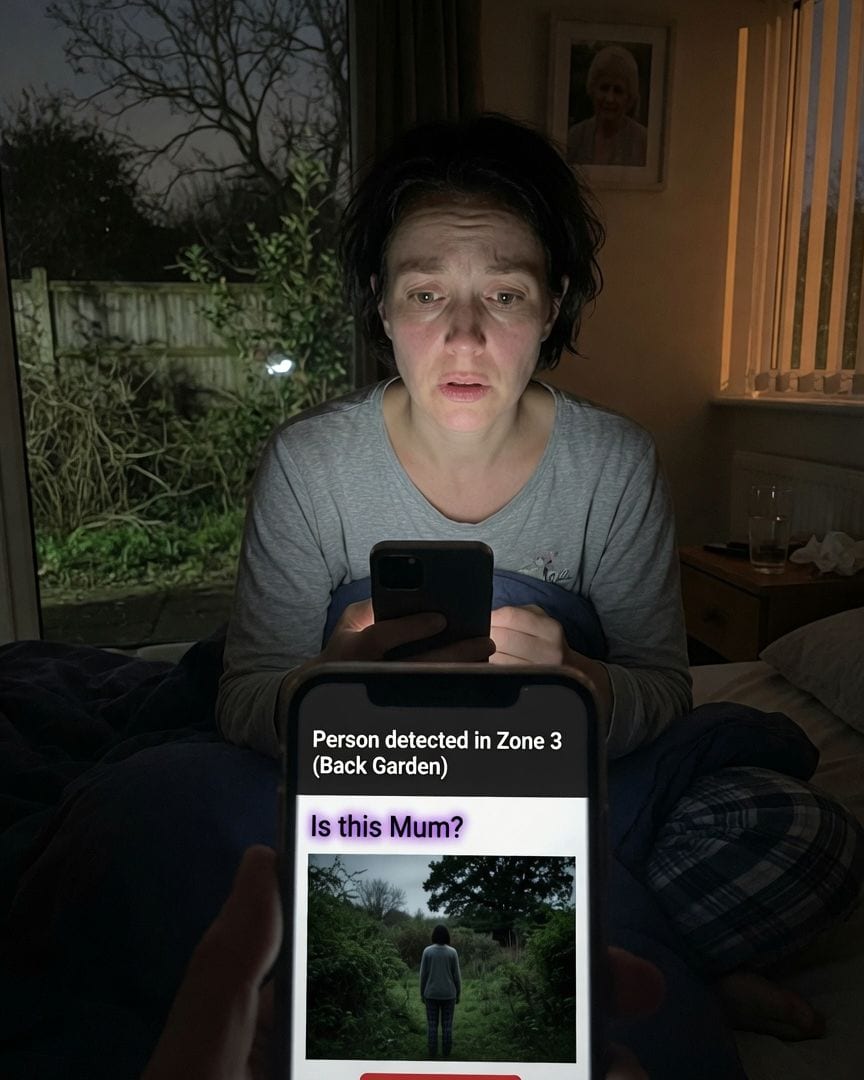
My security camera sent a clip at 3:03 AM: a woman standing in my back garden. The subject line read, 'Is this Mum?' My mother died here in March.
My phone pinged at 3 AM with a security camera alert, interrupting the deep quiet of my house. The attached clip showed a still figure in the back garden, but the subject line froze me. It asked, 'Is this Mum?' My mother died here in March.
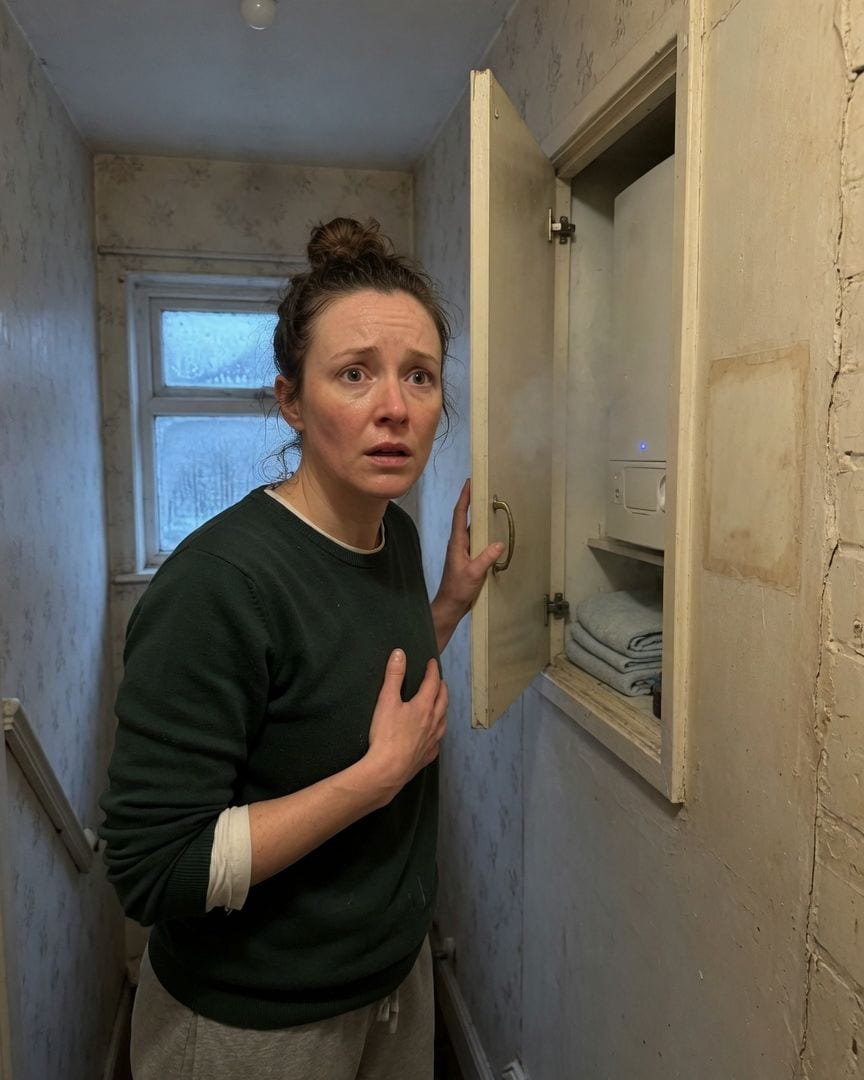
My airing cupboard held a brick copper, fire lit, sheets boiling, smelling of soda and wet linen. I live in a modern flat; there's only ever been a boiler and towels.
Claire Bishop was settling into her new house when she opened the airing cupboard for a blanket. A wave of humid heat and the intense smell of soda rolled out, revealing a heavy copper vessel boiling laundry over a crackling fire. She slammed the door, only to find the cupboard perfectly normal moments later, the impossible vision unnervingly vivid.
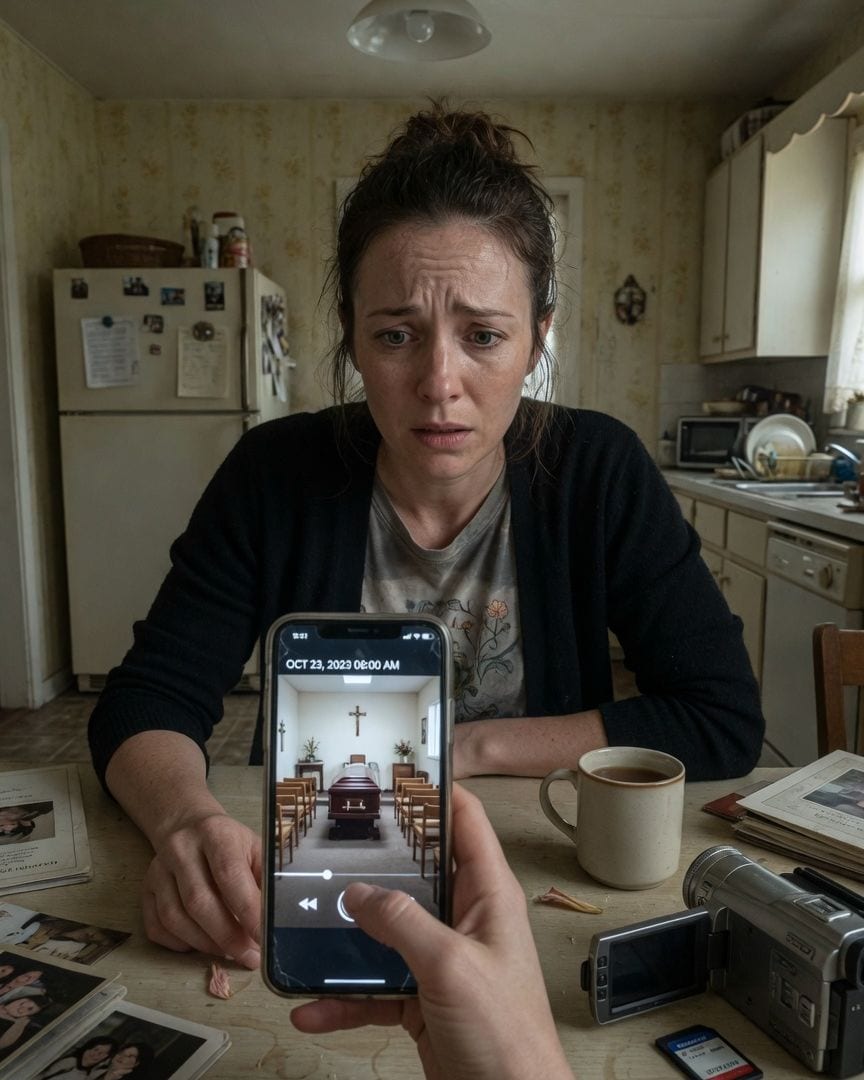
On my dead mother's phone I found a video of her funeral — steady, shot from the back over the mourners' heads, holding on her coffin. The timestamp says it was filmed an hour before any of us had arrived.
Days after my mother's funeral, I sifted through her digital life, hoping for comfort. Instead, her old camcorder revealed a video of my living room, timestamped for tomorrow morning. The abstract landscape I'd just hung was already there, waiting on the wall, a cold dread tightening in my gut.
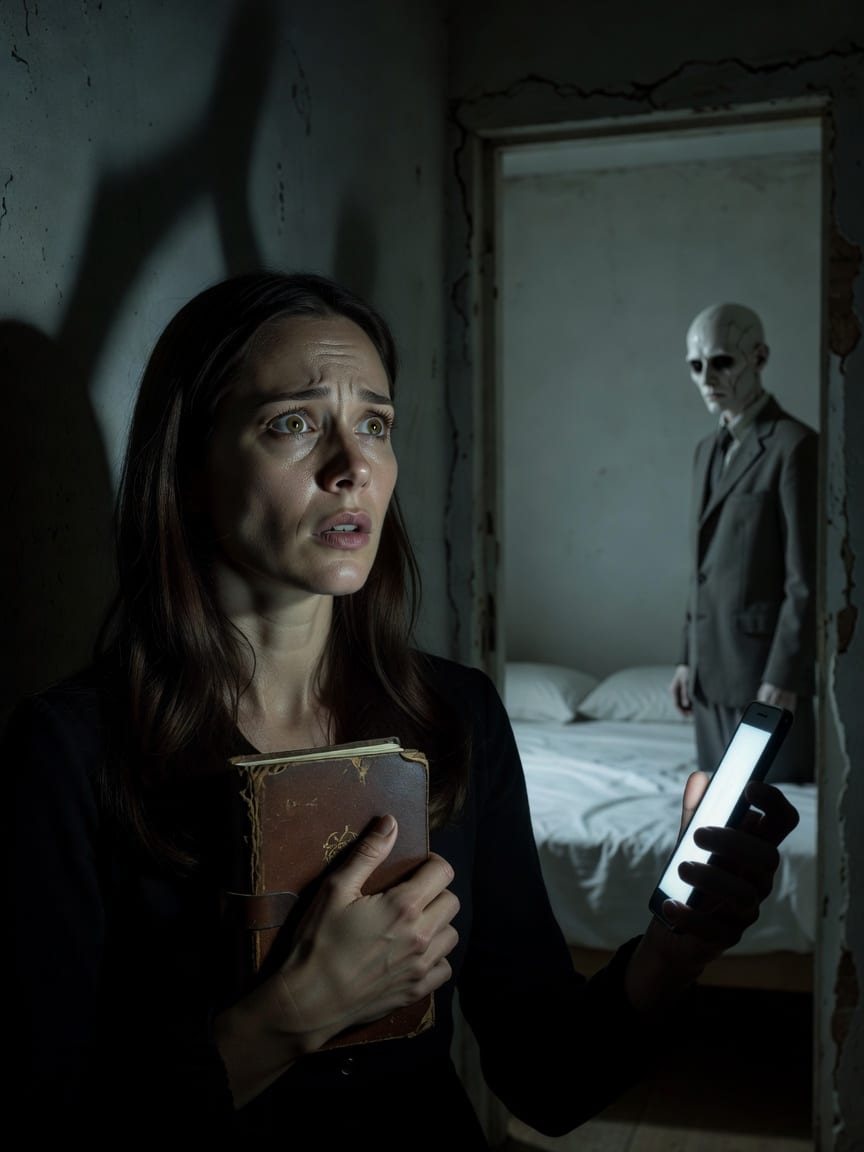
Behind a plastered-over doorway, I found a room. Papered, carpeted, and furnished with a made bed, sealed for decades. The air was dead still, but the bed wasn't dusty. My council tax bill only lists five rooms.
I'm Claire, an architect, meticulously planning my new Victorian terrace renovation. But when I uncovered a hidden room behind a wall, everything I knew about time and decay shattered. The bed was perfectly made, the air still, yet there was no dust, only an unnerving cold.
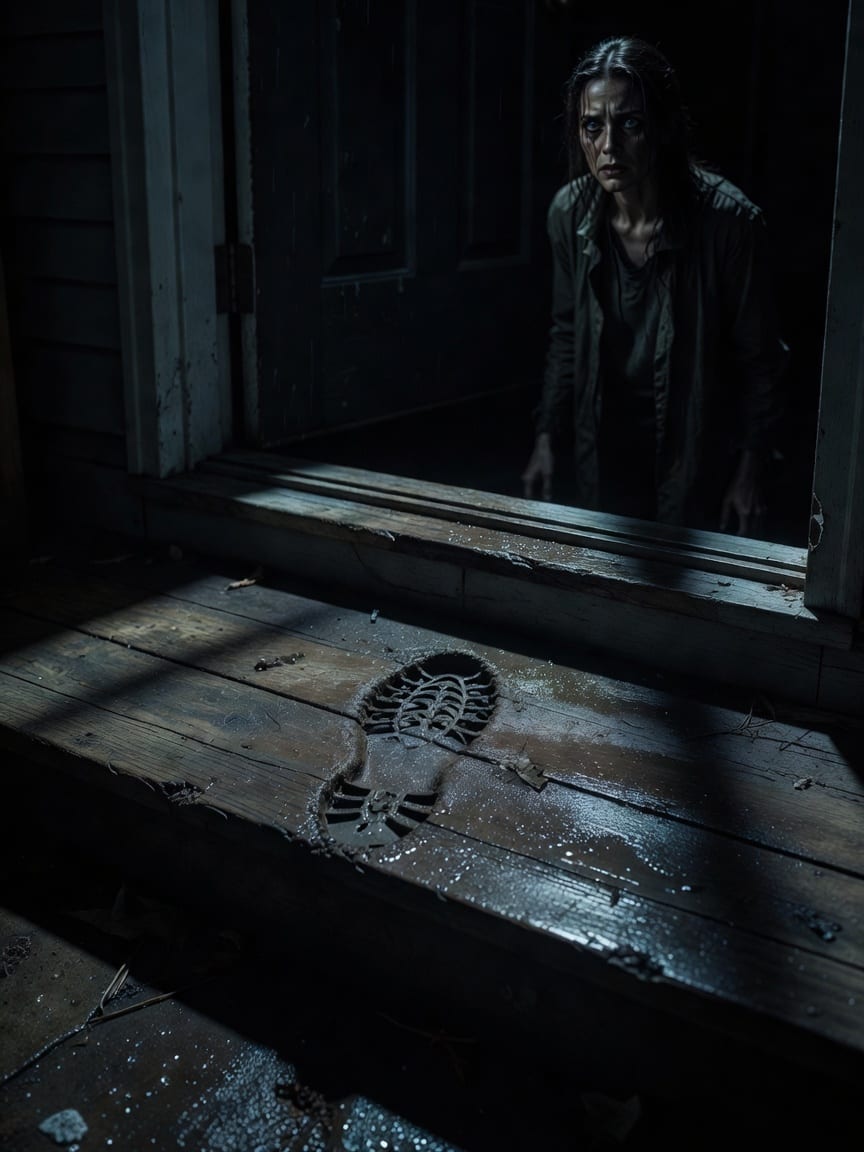
My landlord's only rule: never let the outside tap run after sundown. Last week it dripped. This morning, wet bootprints ringed the back step from the tap to my door, all the same size. The tap was off.
We'd just settled into Waterside House, with its strange landlord rule about the outside tap. After the washer broke, I found perfect, wet bootprints leading from the tap to our back door, but the tap was cranked completely off, tighter than I could manage.