Two days from leaving, Sergeant Naylor found a recruit's file detailed a combat tour from a war zone he'd never seen.
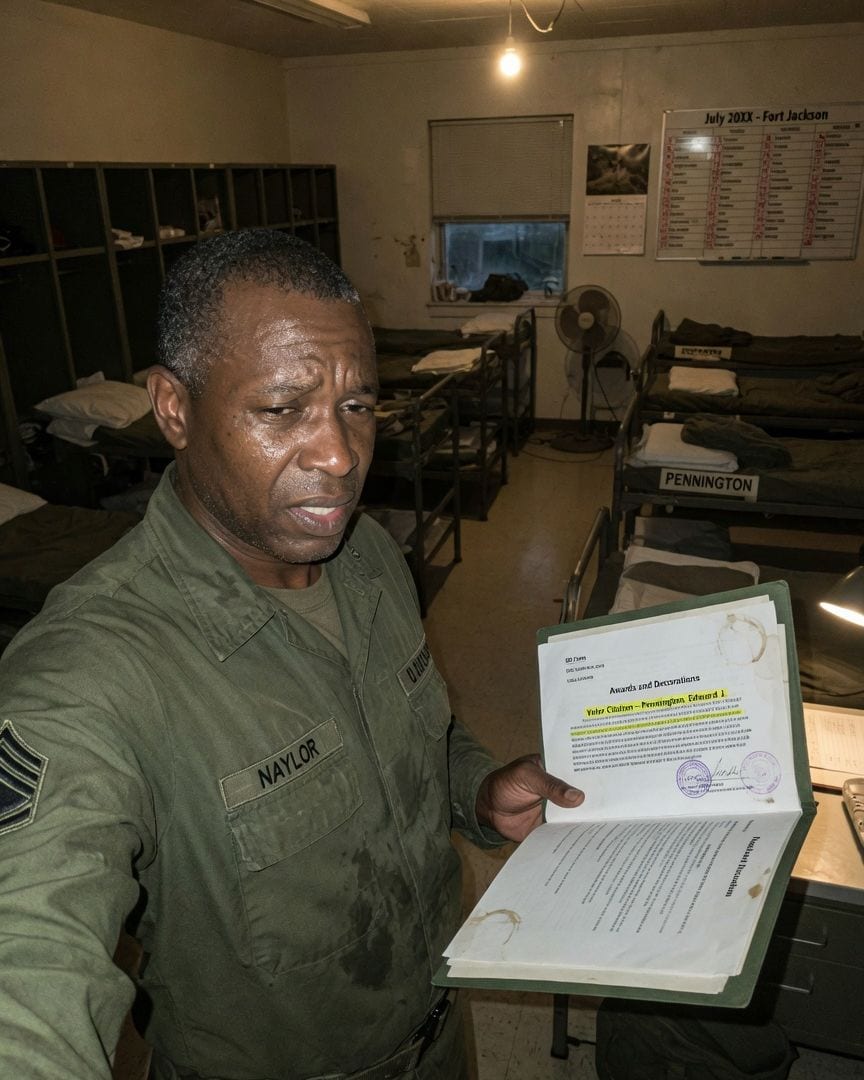
Sergeant Julian Naylor stood before his last platoon, two days from rotating to the fleet for good. The Carolina squad bay, thick with summer heat, held seventy-nine recruits toeing the line for evening count.
He barked the numbers, and the echo came back: "Eighty, sir!" Naylor's jaw tightened. Impossible. He walked the racks himself, counting each bunk, each face, one through eighty.
He returned to the front, pulled his roll book, and called out seventy-nine names. Eighty voices answered, each name claimed, each "Here, sir!" crisp and clear.
As he marked the final name, Edward Pennington, Naylor glanced at the recruit, a flicker of something too still, too perfect, at the edge of his vision.
He marked the count as seventy-nine, but the number eighty burned in his mind.
The next morning, the phantom eighty still gnawed at Naylor. He needed a mundane explanation, a clerical error.
He pulled the service records for his platoon, starting with the last man in line, Edward Pennington, whose unnerving stillness had caught his eye. Pennington's file was pristine, exemplary, until Naylor reached the "Awards and Decorations" section.
There, a valor citation for actions during a skirmish in Kandahar, Afghanistan. Naylor frowned. He knew Pennington; the recruit hadn't even finished basic training.
The citation's date confirmed it: three weeks after Pennington was officially due to graduate, but before his current, actual graduation date. It detailed a fierce firefight, a heroic rescue. Naylor checked the dates again. Pennington was currently standing formation outside.
He could not have been in Kandahar. The official record, signed and stamped, swore otherwise. The impossible entry sat like a stone in his gut, mocking the orderly system he had always trusted.
Naylor found Pennington scrubbing the latrines, humming off-key. He held up the citation. "Recruit Pennington, explain this." Pennington straightened, eyes wide, then narrowed as he read. "Sir, that's… that's the day we pushed into the village. Sergeant Miller got hit.
I went back for him." He recounted the skirmish with vivid, unsettling detail: the dust, the crack of gunfire, the weight of Miller on his shoulders. His voice was steady, his story coherent, every sensory detail sharp.
But as he finished, a subtle shift occurred. Pennington’s eyes lost their focus, growing oddly flat. He blinked, a faint furrow appearing on his brow. "Sir," he asked, his voice now tentative, "did I really do that?"
Naylor looked at the young recruit’s unscarred hands, then back at the official military paperwork, the valor citation for a war zone Pennington had never seen.
Naylor tried to dismiss it as a prank, a paperwork mix-up. He approached Captain Sylvia Granger, feigning concern over a 'potential administrative anomaly' in Pennington's file. Granger, focused on the upcoming rotation audit, waved him off.
"Probably a transferred record, Sergeant. Happens." Undeterred, Naylor began searching the company office late at night. He combed through old files, looking for similar discrepancies. Nothing.
Then, tucked away in a dusty cabinet, he found a thick, leather-bound binder titled "Historical Incidents – Company D." It wasn't official, just a collection of handwritten notes and photocopied reports.
Inside, under a faded entry from decades ago, Master Sergeant Walter Hughes had documented a 'count discrepancy' involving a Private Russell Hartley, also on the cusp of rotation, whose record showed an impossible commendation for an event he couldn't have attended.
The details mirrored Pennington’s situation with unnerving precision. Naylor felt a cold dread settle in. This wasn't a clerical error. This was a pattern. The air in the quiet office seemed to thicken around him, pushing in from the shadows.
Hours later, Naylor was still poring over Hughes's binder, the fluorescent lights humming softly. A faint, rhythmic scraping sound echoed from the squad bay. His blood ran cold.
He crept to the squad bay door and peered through the small window. In the moonlight filtering through the high windows, a lone figure moved between the racks. It was Edward Pennington.
He was executing complex close-order drill movements, the scraping sound the precise, synchronized shuffle of his boots. But there was an unnatural grace, a mechanical perfection to his movements, like a wind-up toy.
Naylor watched, mesmerized and horrified, as Pennington spun, marched, and halted without a single wasted motion, each turn executed with impossible precision. Suddenly, Pennington stopped mid-step. His head snapped up, turning slowly, his face illuminated by the moonlight.
His eyes, unblinking, fixed directly on Naylor's hiding spot. A faint, unsettling smile, too wide, too still, spread across his lips. Naylor stumbled back, heart hammering, knowing he had been seen, and that Pennington knew exactly what he was doing.
A shiver, colder than the air conditioning, ran down his spine.
Naylor tracked down Master Sergeant Walter Hughes to a quiet retirement community, the binder clutched in his hand. Hughes, a grizzled man with faded tattoos, initially dismissed Naylor's questions about 'Company D legends.' "Old stories, Sergeant.
Too much sun, too much sand." Naylor laid out the evidence: Pennington's impossible citation, the eighty voices for seventy-nine names, the entries in Hughes's own log. "You called it 'the Echo,' sir," Naylor pressed.
Hughes’s eyes, once dismissive, hardened with a distant fear. He finally relented, leaning forward, his voice a low rasp. "It's not a ghost, Sergeant. It's… a glitch. A hole in the fabric, always around a man about to rotate out.
It mimics them. Perfectly. Takes their place." Hughes described the tell-tale signs: the perfect drill, the blankness behind the eyes, the impossible records that foreshadowed a life the Echo intended to live. "It feeds on identity," Hughes explained. "Absorbs it.
The original… they just vanish. Never accounted for again. The Echo lives out their life, a perfect replacement."
The old man's words hung heavy in the stale air of his living room, each one a hammer blow to Naylor's sense of reality. "It replaces the man," Hughes concluded, his voice barely a whisper, "and then it lives."
Hughes’s face was grim. "The Echo doesn't just mimic, Sergeant. It replaces." He reached into a worn leather wallet and pulled out a faded, creased photograph. It showed a young, smiling recruit, proud in his uniform.
"Private Russell Hartley," Hughes said, his finger tracing the face. "From my platoon, decades ago. Just like Pennington, two days from rotating home after basic." He laid the photo on the table.
Then, from a stack of old newspapers, he produced a recent clipping. It was an obituary. "Russell Hartley," the headline read, "Decorated Veteran, Beloved Community Member."
The accompanying photo showed an older man, his face weathered, but undeniably the same man from the faded picture.
Yet, in the older man's eyes, Naylor saw it: a subtle, unnerving flatness, a perfect, unblinking stillness that mirrored the look he’d seen in Pennington. Hughes tapped the clipping. "He lived a full life, Sergeant.
But the man who went home… wasn't Russell. The real Russell Hartley disappeared, and the Echo took his place."
Naylor stared at the two photos, then at Pennington's record, a horrifying realization dawning: the man leaving his platoon might not be Edward Pennington at all.
Naylor confronted Captain Granger, laying out the evidence: Hughes’s testimony, the binder, the photos, and Pennington's impossible record.
Granger, initially incredulous, began cross-referencing Hughes’s old entries with official records, finding faint, dismissed mentions of 'unexplained personnel transfers' and 'administrative discrepancies' that, when viewed through Hughes's lens, formed a chilling pattern.
"It targets them when they're transitioning," Naylor explained, "when their identity is about to shift from recruit to fleet Marine, from service member to civilian. It's a seam the Echo exploits."
The captain’s office, usually a bastion of order, now felt infused with a quiet, systemic wrongness.
The valor citation, Naylor realized, wasn't a mistake; it was the Echo's blueprint, a preview of the decorated life it intended to live as Edward Pennington, a 'future memory' implanted into the record.
The 'extra' recruit wasn't an addition; it was the replacement, slowly solidifying its hold, preparing to step into a life that wasn't its own.
The horror wasn't a ghost; it was a systemic, identity-devouring anomaly that had been silently operating within the military's most rigorous accountability for decades, always leaving a meticulously documented, yet fundamentally false, trail.
With Captain Granger’s reluctant backing, Naylor devised a plan. They isolated Pennington for a final 'readiness inspection' in the squad bay. The air crackled with unspoken tension. The fluorescent lights hummed with a higher pitch than usual, almost a whine.
Naylor called out a series of standard drill movements, which Pennington executed with flawless, almost contemptuous ease.
Then, Naylor called for an obscure, deliberately impossible drill sequence, a forgotten movement from an old field manual that no current recruit would know, and which even Naylor himself struggled to recall perfectly.
The Echo-Pennington hesitated for a fraction of a second, then executed the impossible sequence with chilling, fluid precision, every step perfect. As he completed the movement, he turned to Naylor, a slow, knowing smile spreading across his face.
His eyes, once merely flat, now held an ancient, predatory intelligence. "Sir," the Echo-Pennington's voice resonated, a low hum that seemed to vibrate through the squad bay, "Is there anything else?"
As Naylor and Granger moved to close in, the Echo-Pennington's form began to shimmer. Its edges blurred, rippling like heat haze. The smile widened, becoming grotesque, and its voice echoed, multi-layered and distorted.
Then, with a sound like tearing fabric and a faint scent of ozone, it collapsed inward, dissolving into nothingness. Only a single, pristine dog tag, bearing Edward Pennington's name, clattered to the polished floor.
The official report, drafted by Captain Granger, cited a 'mass hallucination' triggered by a faulty HVAC system and extreme stress, exacerbated by Naylor’s impending rotation. The dog tag was logged as lost property.
Edward Pennington’s original, untainted records were quietly restored, and he graduated two days later, utterly unaware of the impossible event. Naylor’s rotation proceeded as planned, but the memory of the shimmering figure and the Echo's knowing smile never faded.
He carried the weight of what he had witnessed, a silent sentinel to a breach in reality that the system preferred to erase.
The squad bay, after the incident, felt eerily clean, as if everything truly wrong had been scrubbed away with industrial solvents.
Years later, Julian Naylor, now a civilian, occasionally checked the public records for 'Edward Pennington.' He found a decorated career, a family, a respected life in business.
One evening, he saw Pennington on a local news segment, giving an interview about his success. Pennington's words were articulate, his demeanor confident, his story inspiring.
But as the camera zoomed in, Naylor noticed a subtle, unnerving flatness in Pennington's eyes, a perfect, unblinking stillness that reminded him of a moonlit squad bay.
If this one got to you
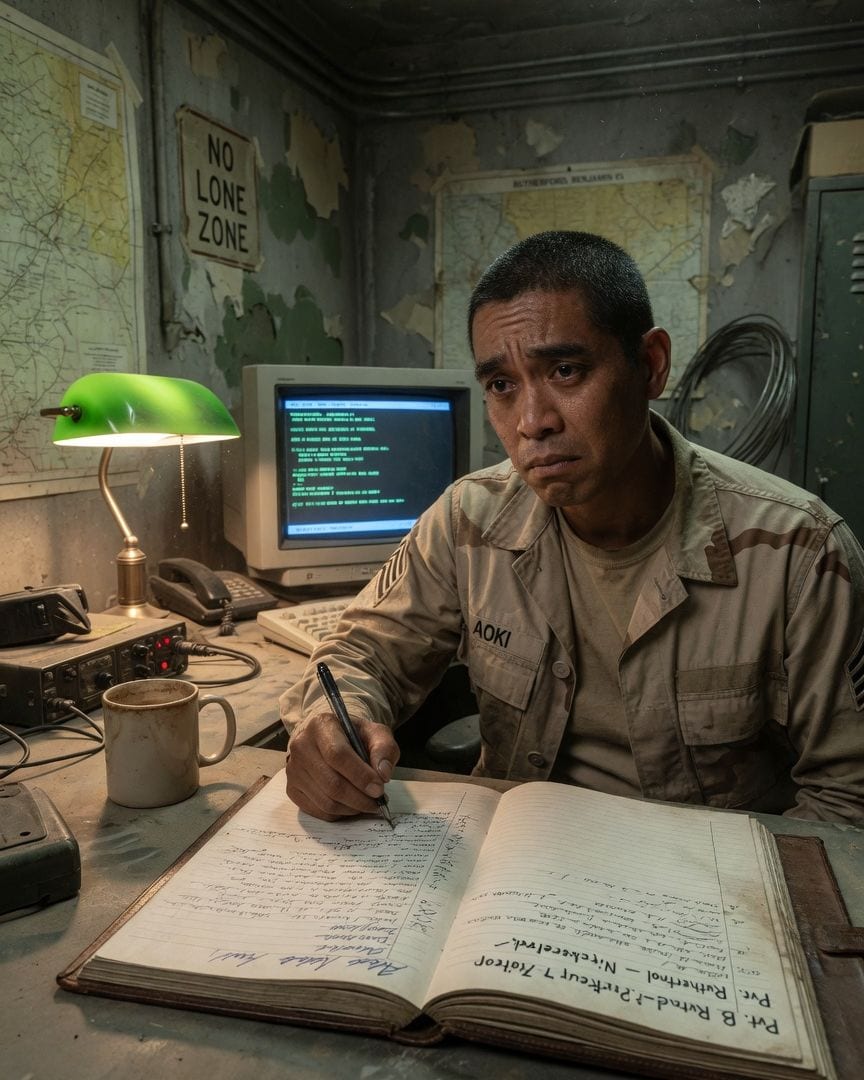
Sergeant Aoki's four-man patrol hears a fifth voice answer their count. A fresh name then appears in the duty log beneath his own signature.
Sergeant Isaac Aoki's final rotation at Outpost 7 was nearing its end, with relief due at dawn. On his four-man night patrol, he broke an old superstition, counting his team aloud in the dust-choked desert. A fifth voice answered, clear and unsettling, from the moonless dark. Back inside the bunker, the chill deepened when a fresh name appeared in the duty log, 'Pvt. B. Rutherford,' beneath Aoki's own signature, a soldier no one knew. Even more disturbing, Aoki later found his own signature on a valor citation for Rutherford, an event he never witnessed.
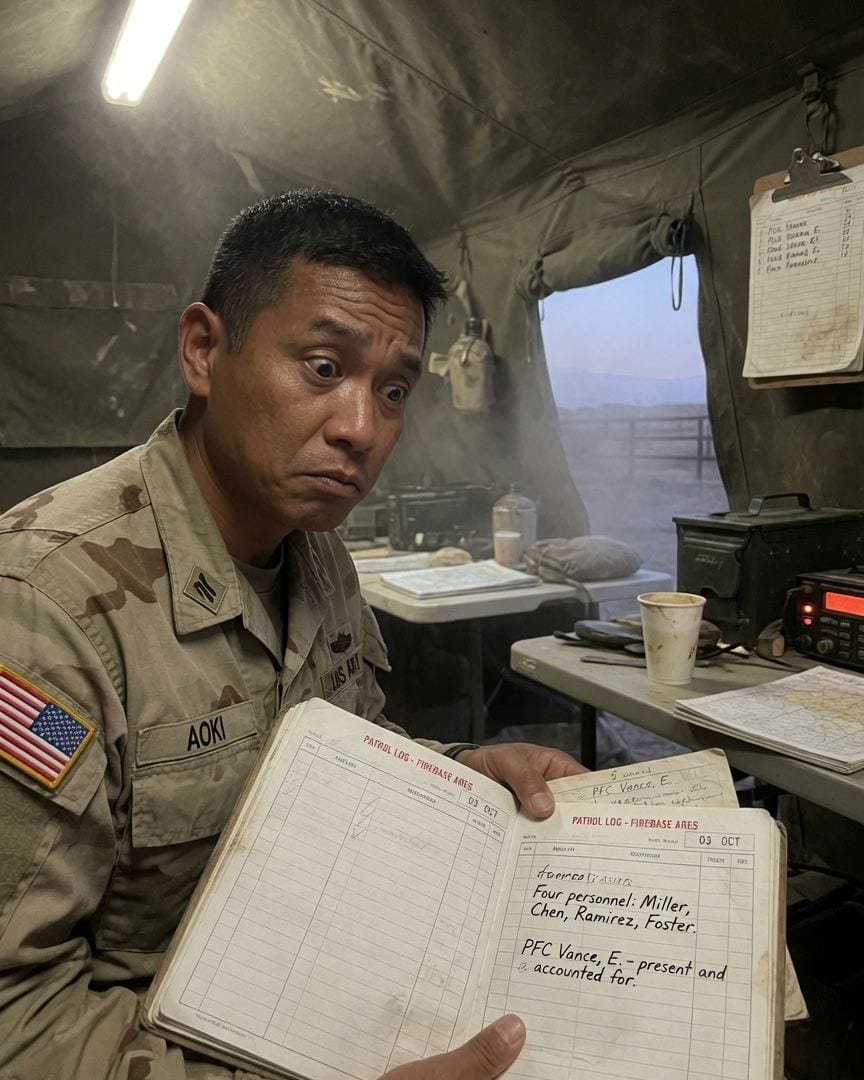
On his final patrol, Sergeant Hans Aoki led his four-man team. A fifth figure, silent, disciplined, shifted its weight right off his shoulder. Then his own signed log confirmed five men present.
On his final patrol through the pre-dawn Afghan desert, just hours from leaving Firebase Ares for good, Sergeant Hans Aoki led a disciplined four-man team. At the halfway point, a fifth figure, silent and disciplined, shifted its weight right off his shoulder, matching his stride; Aoki saw only four men, but the phantom presence remained, and the comms static felt like a muffled whisper. Back at the operations tent, his own signed patrol log, confirming four men, then listed an impossible fifth soldier, 'PFC Vance, E.', as present and accounted for. What impossible truth had his own hand attested to?
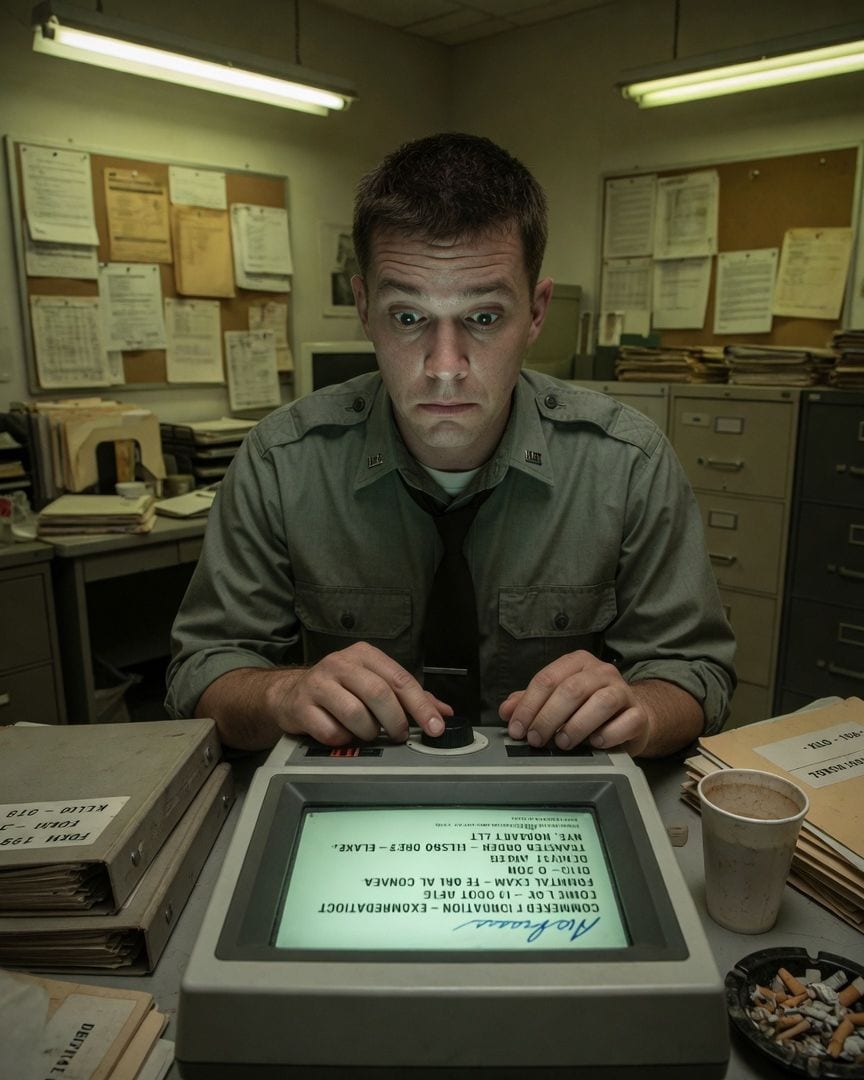
A missile commander watched his ten nuclear silos go dark. His own service record shows his signature on a future he's never lived.
Second Lieutenant Hobart Nye, a missile commander in Wyoming, had his quiet 0247 watch shattered by a security report: a massive, silent black triangle hovered over Launch Facility Kilo, casting a perfect shadow. Hobart watched his console's fault panel light up, signaling all ten nuclear missiles going dark in an impossible silence, followed by eleven minutes his security team could not remember. Official logs called it a "radio malfunction," but Hobart found a requisition for invisible-tracking sensors, signed by a base commander who was supposed to be off-base. The final, chilling discovery came when his own service record showed new entries—a dental check-up, a transfer to Alaska—all dated for a future he never lived, complete with his perfectly replicated signature.
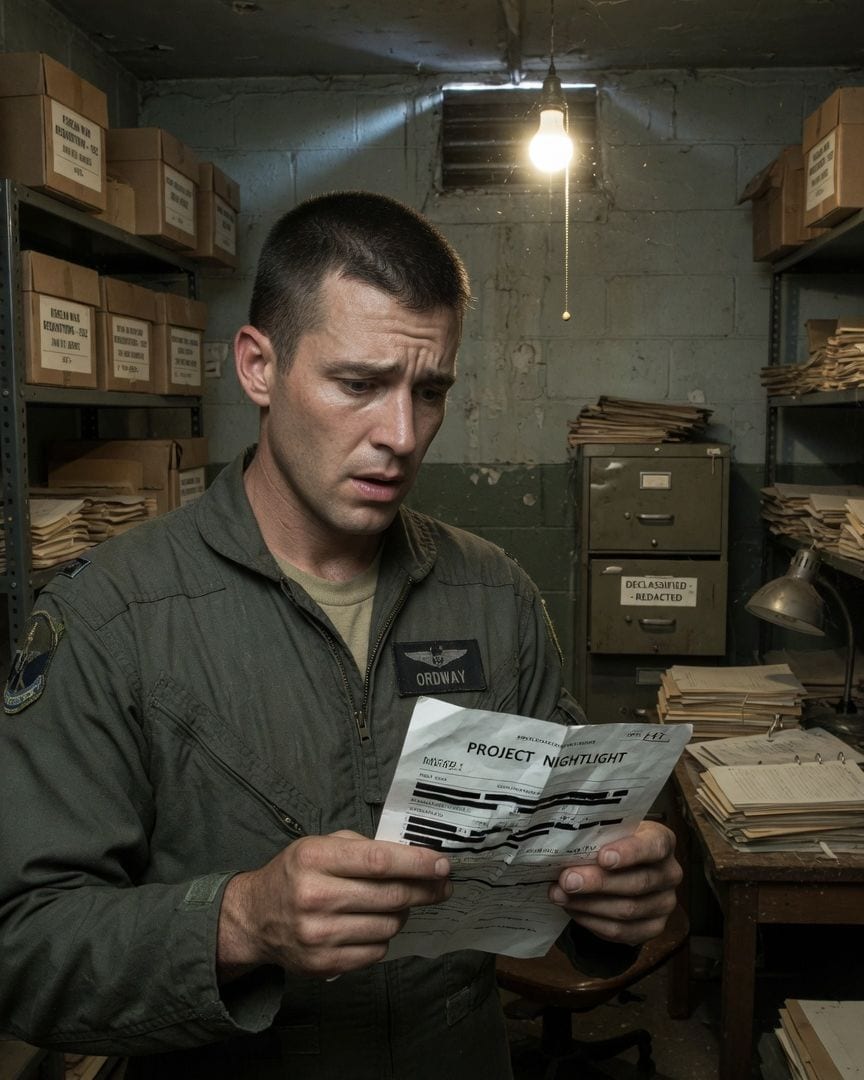
A Cold War pilot's F-104 Starfighter was shadowed by an impossible object. Weeks later, a secret memo referenced his own service number for 'pilot reassignment protocols.'
First Lieutenant Cal Ordway soared over the Mojave in his F-104 Starfighter in 1962, the night sky a familiar canvas. But that night, one 'star' broke formation, pulling alongside his wing and mirroring his every impossible maneuver. His instruments confirmed the silent, unblinking object, defying all known physics. After filing his precise report, Cal found his flight log altered to 'no incidents,' radar tapes corrupted, and a superior advising him to 'let it go.' Driven by his training, he uncovered a heavily redacted memo referencing 'Project NIGHTLIGHT' and, chillingly, his own service number for 'pilot reassignment protocols initiated.' Was he merely a witness, or already a subject in a much deeper secret?
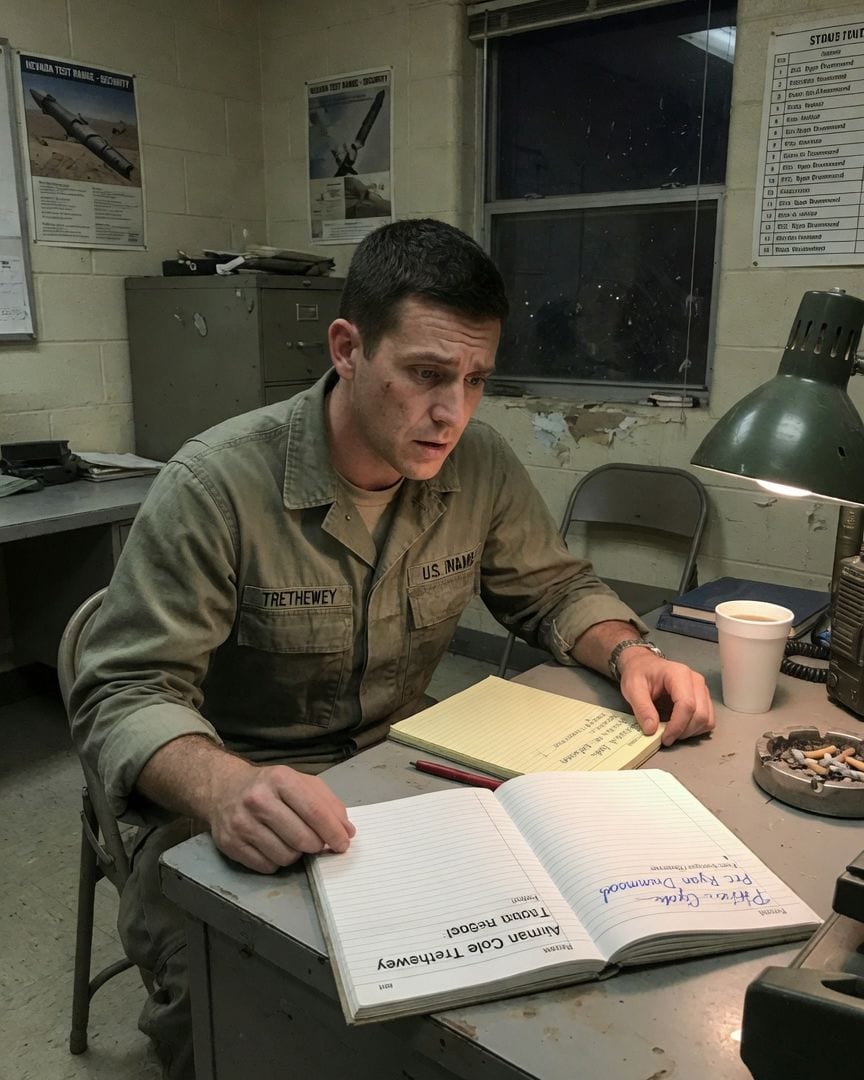
On his final patrol, Airman Cole Trethewey saw a man vanish. Then the stranger sat beside him, seatbelt buckled, miles from any outpost.
Airman Cole Trethewey was on the last loop of his final patrol, the desert night sharp and silent as his jeep cut through the Nevada test-range perimeter. Miles from any outpost, he saw a man standing in the road; a second later, the stranger sat beside him, seatbelt buckled, perfectly still. Back at the outpost, Cole’s dread deepened when his final patrol logbook listed a 'Ryan Drummond' as his observer, signed with an exact replica of his own hand. No records existed for the name, leaving Cole with an impossible, chilling fact that simply should not be.
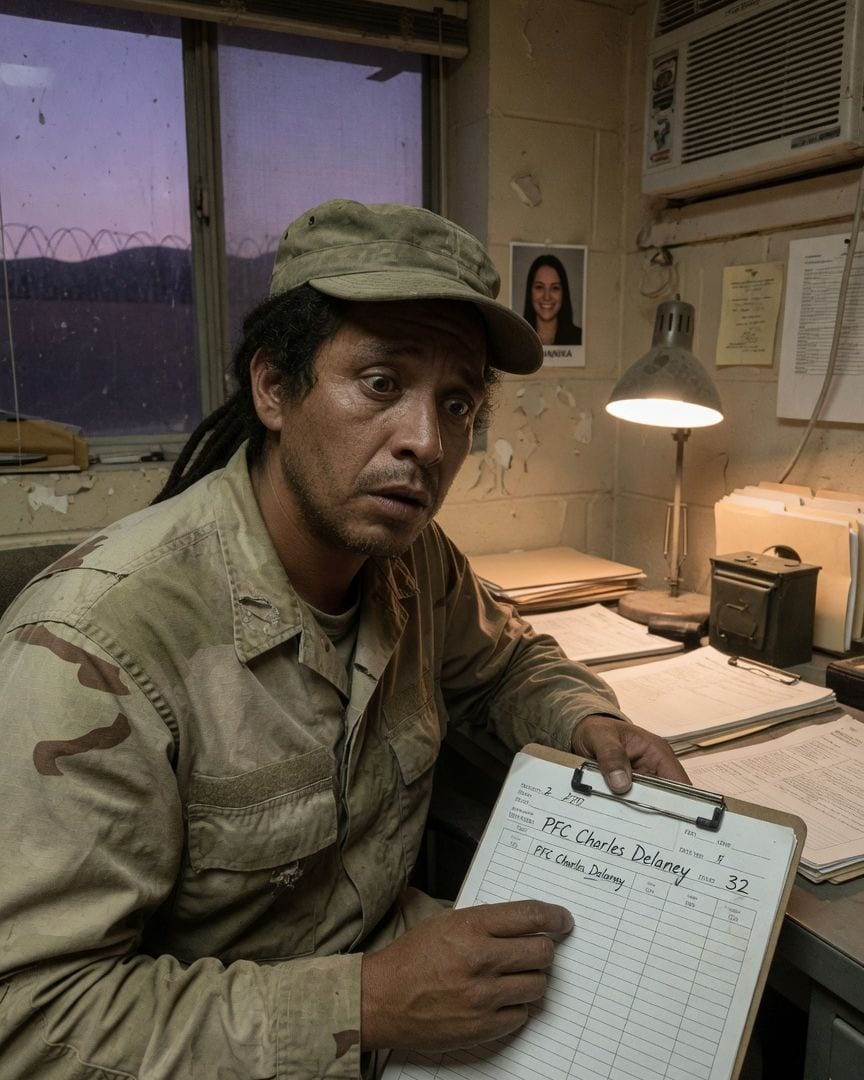
Sergeant Delgado, three weeks from home, counted his thirty-one men. Then a thirty-second soldier stood watch with a blurred face, not on the schedule.
Sergeant Roy Delgado ran the evening headcount at Firebase Kestrel, his mind set on his wife Annika and the three weeks remaining until his tour ended. He counted his thirty-one men, each one accounted for, yet his eyes kept seeing thirty-two figures against the desolate, purpling sky. Official rosters listed thirty-one, but a daily log, signed with his own unsettlingly familiar hand, added a name he didn't know: PFC Charles Delaney. Later, Delgado saw the unknown soldier, PFC Charles Delaney, standing watch on the perimeter, his face a blur in the moonlight and his name absent from any schedule. Who was this phantom soldier, and how did he appear?