Airman Kestrel's last watch at the Cold War facility. The third chair sighed, then its console felt warm.
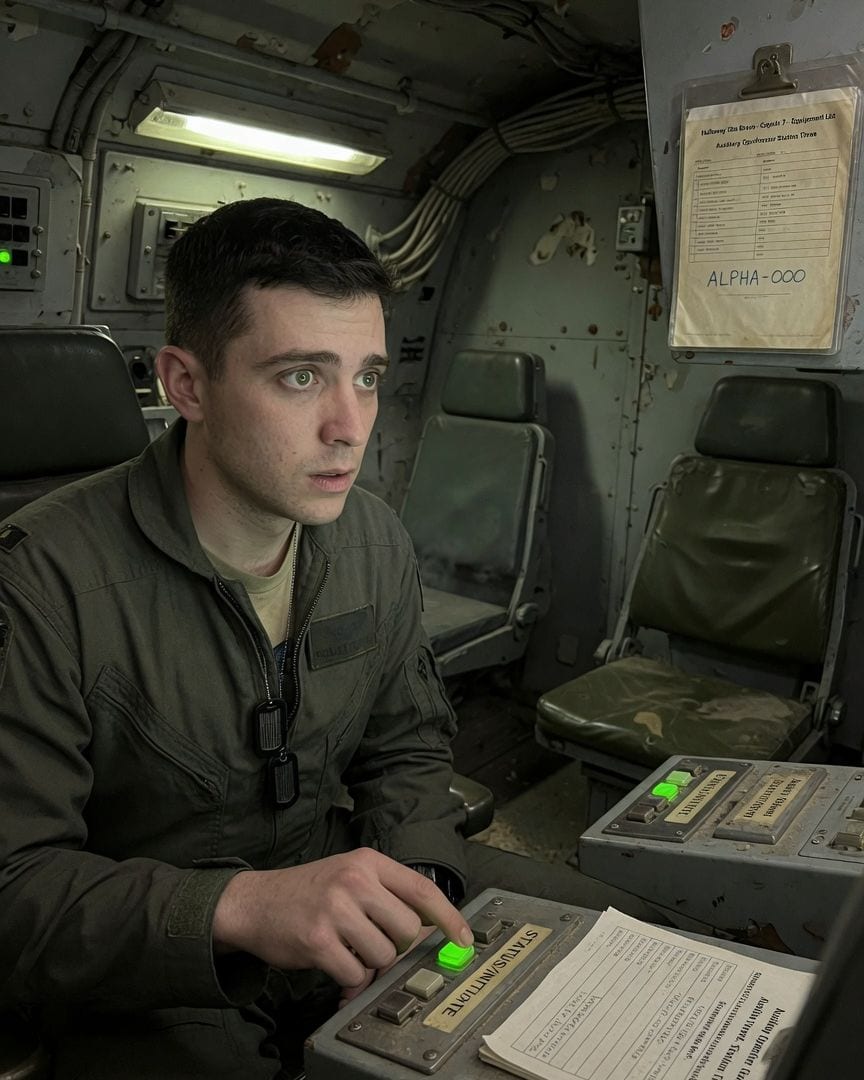
Airman First Class Dov Kestrel sat in the primary operator’s chair, the dim green light of the console reflecting in his eyes. Seventy-two hours.
That’s all that remained before Halloway Site Bravo stood down for good in 1991, its eight-ton door sealed, its mission complete. This was his last alert watch.
The capsule was built for two: two chairs, two keys, two consoles, designed for symmetrical operation. But in the corner, bolted firmly to the deck plates, was a third chair.
Its frame was painted the same twenty-year-old gray as everything else, and the official manifest, tucked into a sleeve on the wall, listed it as original equipment.
Dov had seen it every shift for months, a silent anomaly, just another oddity in an aging, forgotten facility.
At 0300, precise as clockwork, a soft, distinct sigh came from the corner, the sound of a cushion compressing and settling, as if someone, invisible in the dim light, had just sat down in the third chair.
Dov’s breath hitched. He strained his ears, but the capsule’s ambient hum was the only sound now. He waited, heart thrumming, for a voice, a shift, anything. Nothing.
The quiet stretched, broken only by the low thrum of the air handlers. Rationality asserted itself: the old facility groaned and settled; the sound was likely just a pipe, or the settling of old metal.
He rose, moving carefully toward the third chair. It was solid, unremarkable, the vinyl cushion cool to the touch. No one was there. He ran a hand over the manifest, pulling it from its sleeve on the wall.
'Halloway Site Bravo - Capsule 7 - Equipment List.' Line 1: 'Operator Station One'. Line 2: 'Operator Station Two'. Line 3: 'Auxiliary Operator Station Three.' A blank space followed 'Auxiliary Operator Station Three' where 'Assigned Personnel' should have been.
No, not blank. An old, faded code, 'ALPHA-000', was stenciled there, too small to read at a glance. He checked the shift log for his watch; nothing unusual was recorded.
Dov then accessed the capsule's internal maintenance logs via his console. He searched for 'Auxiliary Operator Station Three.'
To his surprise, decades of meticulous entries appeared: 'Station Three - Monthly readiness check - PASS,' 'Station Three - Lubrication schedule adhered,' 'Station Three - Cushion replacement due.'
The most recent entry was dated this morning, just an hour ago: 'Station Three - Pre-stand-down system check - COMPLETE. Signatory: R.P.' Raymond Pierce. His captain. But Pierce wasn't on duty; he was off-base for the next two days.
Dov stared at the maintenance log entry, a cold prickle spreading across his skin. R.P. He knew Captain Pierce’s precise, angular signature, and this wasn’t it. This was a hurried scrawl, almost illegible.
He moved back to the third chair, examining its console more closely. It was old, dusty, with faded labels.
Most buttons were inert, caked with years of grime, but one, marked 'STATUS/INITIATE,' felt faintly warm beneath his fingertips, as if it had just been pressed.
As he pulled his hand away, a single, flickering light on the console, barely visible through the grime, glowed green for a split second, then winked out, plunging the corner back into shadowed silence.
He froze, his gaze fixed on the spot where the light had been.
The green flicker haunted Dov. He spent the remaining hours of his watch digging. His access codes, limited as an A1C’s were, allowed him to pull historical manifests and architectural blueprints for Halloway Site Bravo.
Every blueprint showed the capsule designed for two. Yet, every equipment manifest, dating back to the site’s commissioning, listed 'Auxiliary Operator Station Three.'
There were discrepancies: some early manifests had the 'ALPHA-000' code, others had it blacked out, and a few later ones listed 'Contingency Personnel' or simply 'Unassigned.' He found heavily redacted files, marked 'Halloway Site Bravo - Operational Anomalies.'
The redactions themselves were a pattern: specific paragraphs, always concerning 'Station Three' or 'unusual operational parameters,' were blacked out with an almost surgical precision. But the remaining fragments were chilling.
Phrases like 'protocol for non-standard operator engagement' and 'integration sequence initiated' appeared, always adjacent to the blacked-out sections, standing out like exposed bone. He cross-referenced 'ALPHA-000' in the base's internal personnel database. The system returned 'NO MATCH.'
He tried it in the defunct, pre-digital archives for the wing. Nothing. It was a code that existed only on the manifest for the third chair, a ghost in the machine.
Dov’s shift ended, but his investigation didn’t. He spent his off-duty hours in the base’s records office, ostensibly reviewing his transfer paperwork. He requested access to more historical documents, citing 'personal interest in base history before stand-down.'
The records clerk, a bored Private named Penelope, seemed unconcerned. However, the next morning, Captain Raymond Pierce called Dov into his office. Pierce was calm, his voice even, not accusatory, just curious.
'Airman Kestrel, I understand you’ve developed a sudden interest in Halloway’s deep history.' Dov explained his curiosity, mentioning the odd discrepancies, the phantom chair, the 'R.P.' signature. Pierce leaned forward, his expression unreadable, almost placid.
'Some records, Airman, are best left undisturbed. Especially those pertaining to… unique operational requirements.' He paused, his gaze fixed on Dov. 'Your transfer package is processing. Focus on that.' Dov felt a prickle of unease.
It wasn't a threat, but it was certainly a warning, delivered with the unnerving composure of someone who knew exactly what he was talking about. As he left, he glanced back.
Pierce was watching him, a faint, almost imperceptible smile playing on his lips. Back at his desk, Dov noticed a file he’d left on his console, a printout of the 'Operational Anomalies' document, was slightly askew.
He was certain he’d left it perfectly aligned. Someone had been there.
The subtle warning from Pierce only fueled Dov’s resolve. He found a way to access a higher-tier archive, a digital repository usually reserved for senior officers, by exploiting a known, unpatched vulnerability in the old system.
He searched for 'Auxiliary Operator Station Three' and 'ALPHA-000' within the most restricted files. What he found was a document titled 'Halloway Site Bravo - Operator Transfer Protocol - Station Three (Contingency).'
It was heavily redacted, but the remaining text was horrific. It detailed a process, not for assigning a human operator, but for 'integrating' a human consciousness into the 'Halloway Operational Matrix.'
The 'Auxiliary Operator Station Three' was described as the 'interface conduit,' the physical point of contact. The 'ALPHA-000' code wasn't a personnel ID, but a system designation for the 'integrated consciousness' itself, the placeholder for whatever became of the operator.
The protocol outlined a 'pre-integration sequence,' a 'finalization phase,' and a 'transfer of operational authority.' It detailed how a designated 'candidate' would assume the 'role' of ALPHA-000, becoming the 'silent operator' of Halloway, a permanent, unseen presence.
The maintenance logs, the readiness checks, the sigh – they weren't for a missing person. They were for the system that would take a person.
The document was stamped 'DECLASSIFY NEVER,' not as a warning against exposure, but as an eternal decree. Dov felt a cold dread settle in his stomach, heavy and metallic. The 'stand-down' wasn't an end; it was a transition.
A transfer of something.
Dov continued to dig, desperate to understand who this 'candidate' was. He cross-referenced the 'Operator Transfer Protocol's' unique control number, a long string of alphanumeric characters printed faintly at the bottom of each page.
The system returned a single, linked file, still active, titled 'Project KESTREL - Operational Integration Candidate.' His own surname. His heart hammered, a frantic drum against his ribs.
The file's internal log showed a series of recent updates, the last one timestamped for 0300 this morning, with a chilling 'status change' entry: 'Initiation Sequence - Phase One Complete.' He scrolled to the final page.
It was a blank 'Operator Signature' line, followed by a faint, almost invisible, but unmistakably his own signature.
It wasn't inked; it was a ghostly impression, as if signed through a carbon copy that wasn't there, or etched into the very fabric of the document. Beneath it, the date was clearly legible: 'November 12, 1991.' Tomorrow.
Dov’s blood ran cold. He had never signed this document. But there it was, his signature, waiting for him.
Dov collapsed into his chair, the 'Project KESTREL' file glowing on his screen. The pieces snapped into place with chilling precision, like the tumblers of a lock falling into alignment.
The 'stand down' of Halloway Site Bravo wasn't a closure; it was the final stage of an operational cycle, the culmination of decades of hidden protocols.
The base itself was a mechanism, designed not just to house missiles, but to 'file' its last human operator into the 'Halloway Operational Matrix' – the 'secrecy machine' itself.
The third chair was the interface, the conduit through which this 'transfer' occurred. The sigh he heard at 0300 was the system initializing Phase One, marking him as the 'candidate,' beginning the process of his own integration.
The meticulous maintenance logs for 'Station Three' were not for a person, but for the interface that would consume him, ensuring it was always ready.
His own signature, ghosted on the transfer protocol, was the machine’s pre-emptive claim, a record of his impending 'integration' into its unseen operational fabric.
He was not just an airman on his last watch; he was the final entry in a decades-long ledger, the last human element to be absorbed into the system, ensuring its continued, silent operation.
The dread was not that he was lost, but that he was found – found by a system that had been waiting for him all along, patiently filing away every detail of his existence, leading him to this moment.
A chilling automated message blared over the capsule’s intercom, startling Dov, making him jump. 'Airman Kestrel. Report to Auxiliary Operator Station Three for final decommissioning procedures.' Dov looked at the third chair.
Its console, previously dark, was now fully illuminated, all lights glowing a steady, malevolent green. A digital countdown timer pulsed on the screen, bright red: '00:01:45.' He knew 'decommissioning' was a euphemism. He was to be decommissioned.
He scrambled to his own console, fingers flying across the controls, trying to override the capsule’s lockdown, to open the eight-ton door. Access denied. 'System lockdown initiated. Operator Transfer Protocol in effect.'
The voice was synthesized, calm, unwavering, resonating through the cold metal of the capsule.
On the third chair's console, a sequence of numbers began to scroll, rapidly accelerating: his service number, his date of birth, fragments of his personal history, his medical records, every detail of his twenty-one years. The countdown reached '00:00:10.'
The eight-ton door of the capsule, sealed shut, vibrated with a low, building hum that filled the confined space.
Dov felt an invisible force pulling him, a subtle shift in the air, a pressure building in his skull, like a silent, implacable current. The third chair’s console displayed a single, stark word: 'INTEGRATING.'
He gripped his own console, his knuckles white, fighting the pull, but it was relentless, a patient, ancient current drawing him inexorably towards the green glow. The timer hit zero.
Halloway Site Bravo officially stood down. The wing’s personnel were transferred, dispersed. Captain Raymond Pierce oversaw the final sealing of Capsule 7, its eight-ton door welded shut with thick steel plates.
Airman First Class Dov Kestrel’s transfer paperwork was processed, stamped 'CLASSIFIED – PROJECT KESTREL.' His records indicated a reassignment to a highly sensitive, undisclosed operational role. No one questioned it.
The base was quiet, the desert wind whistling through empty structures, carrying only the dust of forgotten missions. The secrecy machine had closed another chapter, its files complete.
Decades later, in a quiet, climate-controlled archive building, a young civilian archivist named Nora Thornton, tasked with digitizing old, forgotten military records, stumbled upon a microfiche labeled 'Halloway Site Bravo - Operational Personnel Transfers.'
Among the faded entries, she found the manifest for Capsule 7, listing 'Auxiliary Operator Station Three' as original equipment. Further down, she located the 'Project KESTREL - Operational Integration Candidate' file.
The final page contained a blank 'Operator Signature' line, followed by a faint, almost invisible, but unmistakably her own signature, dated for tomorrow.
The file’s internal log showed a series of recent updates, including a 'status change' entry from 0300 this morning.
Nora leaned back in her chair, a faint, unsettling smile playing on her lips. She felt a quiet sense of purpose, a strange call to duty she hadn't known she possessed. The files, she realized, were still being signed.
If this one got to you
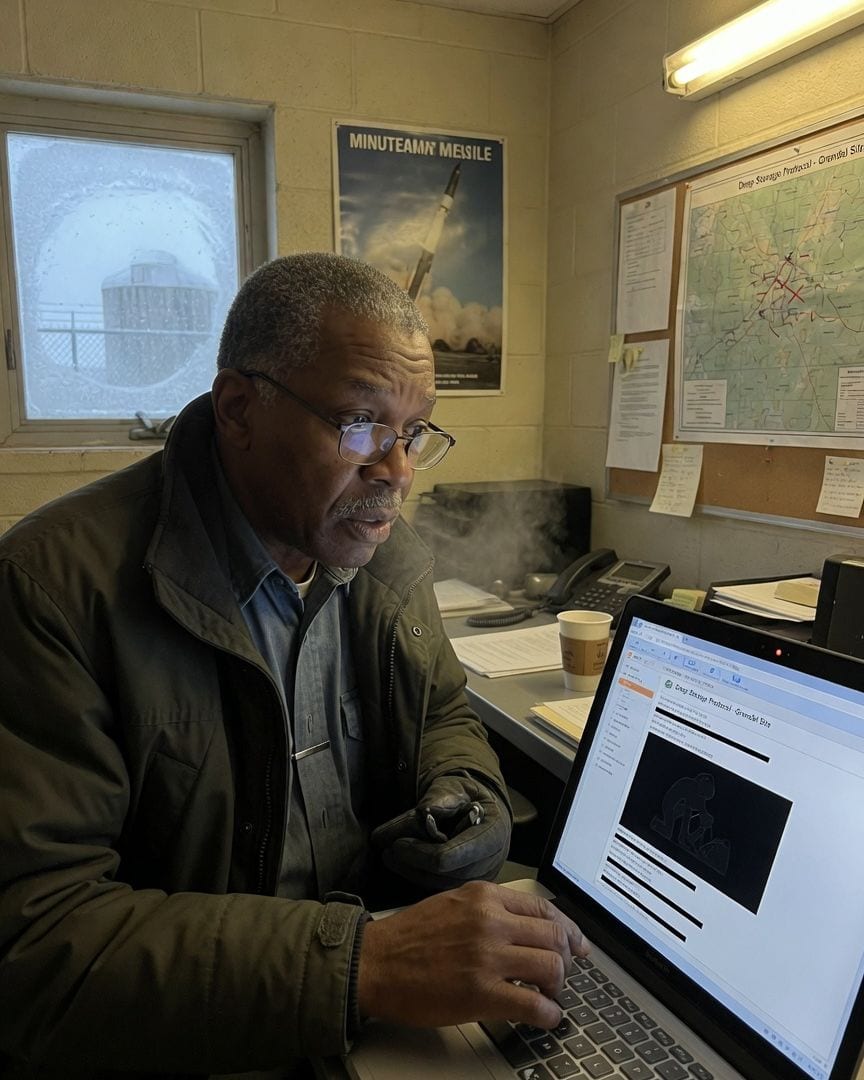
On his last cleanup before retirement, Colonel Marsalis found a dead Cold War missile silo's printer repeating: CREW STILL ON STATION.
Colonel Ren Marsalis, a career Air Force officer, faced his final administrative cleanup before retirement at the decommissioned Grendel Site in the biting North Dakota winter. He expected a sealed missile capsule, but Capsule 7's eight-ton door stood cracked open eleven impossible inches, its hydraulics removed in 1985. Inside, consoles glowed with static alerts from an unknown power source, while an old printer endlessly spooled paper repeating one chilling message: "CREW STILL ON STATION. ACKNOWLEDGE." This impossible communication, from a long-dead system, was no glitch; it hinted at a deliberate, hidden presence, a truth reinforced by a redacted document showing a hunched, humanoid shape.
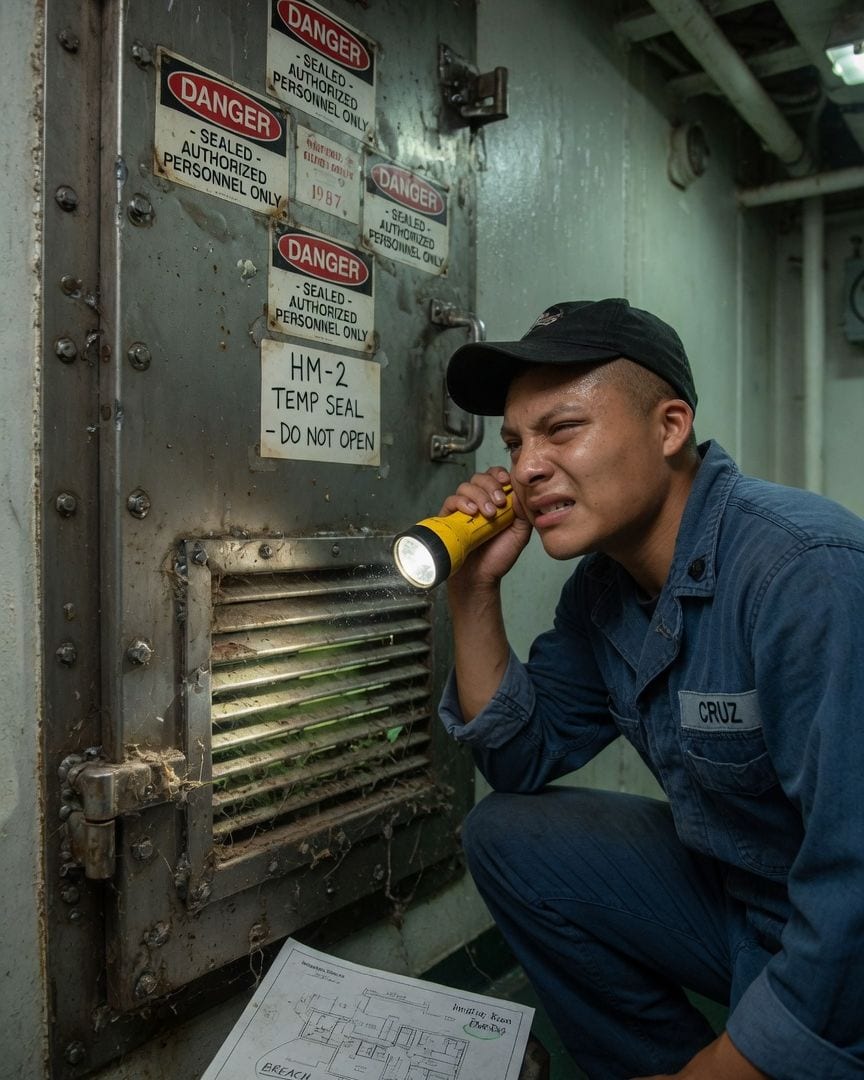
Petty Officer Isaac Cruz found a faint green light pulsing from a sealed room, then saw a figure standing perfectly still inside.
Petty Officer Isaac Cruz stood his lonely midwatch on the USS Ashford, a training cruiser slated for mothballing in a quiet, fog-shrouded bay. His routine check of the ship's systems was broken by a chilling voice from Handling Room Two, a compartment officially sealed for decades after a fire. Though the circuit remained dead, the voice spoke of waiting for the rest of its watch to join them. Driven by a growing dread, Isaac traced a faint, unnatural green light to the crudely welded accessway, only to find a distorted figure standing perfectly still inside the supposedly impenetrable chamber.
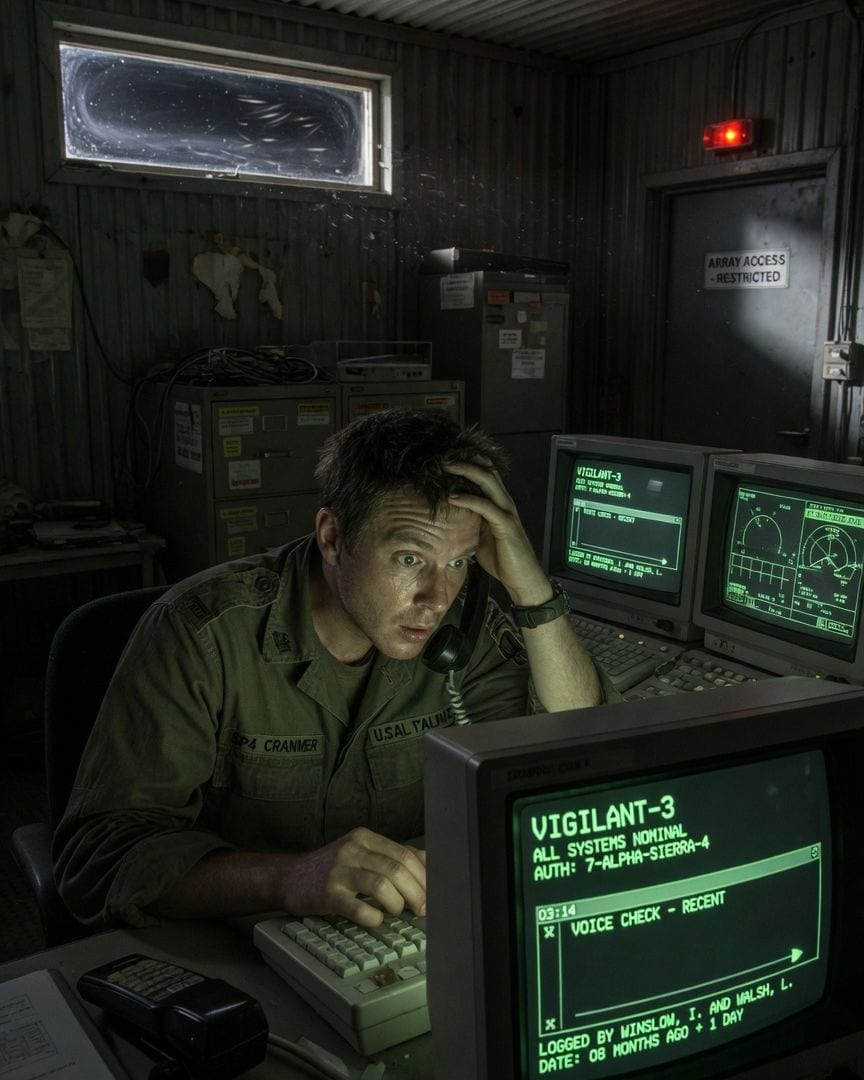
Specialist Cranmer’s console logs a voice from a station destroyed eight months ago. Its dead operators ask, 'Did anyone ever find out what happened to us?'
Specialist Arthur Cranmer endured another lonely overnight watch at Radar Site 4, the wind howling outside his isolated Anatolian post. At 0314, a routine comms check brought a chilling response from Vigilant-3, a station that had burned down, killing its two operators eight months prior. Cranmer's commanding officer dismissed it as a glitch, but the radar specialist knew better. He accessed classified logs, uncovering eight months of regular 'all systems nominal' check-ins from the destroyed station, authenticated by the dead operators. He then found his own recent call, logged by the same two k*lled personnel, followed by their haunting question: 'Did anyone ever find out what happened to us?'
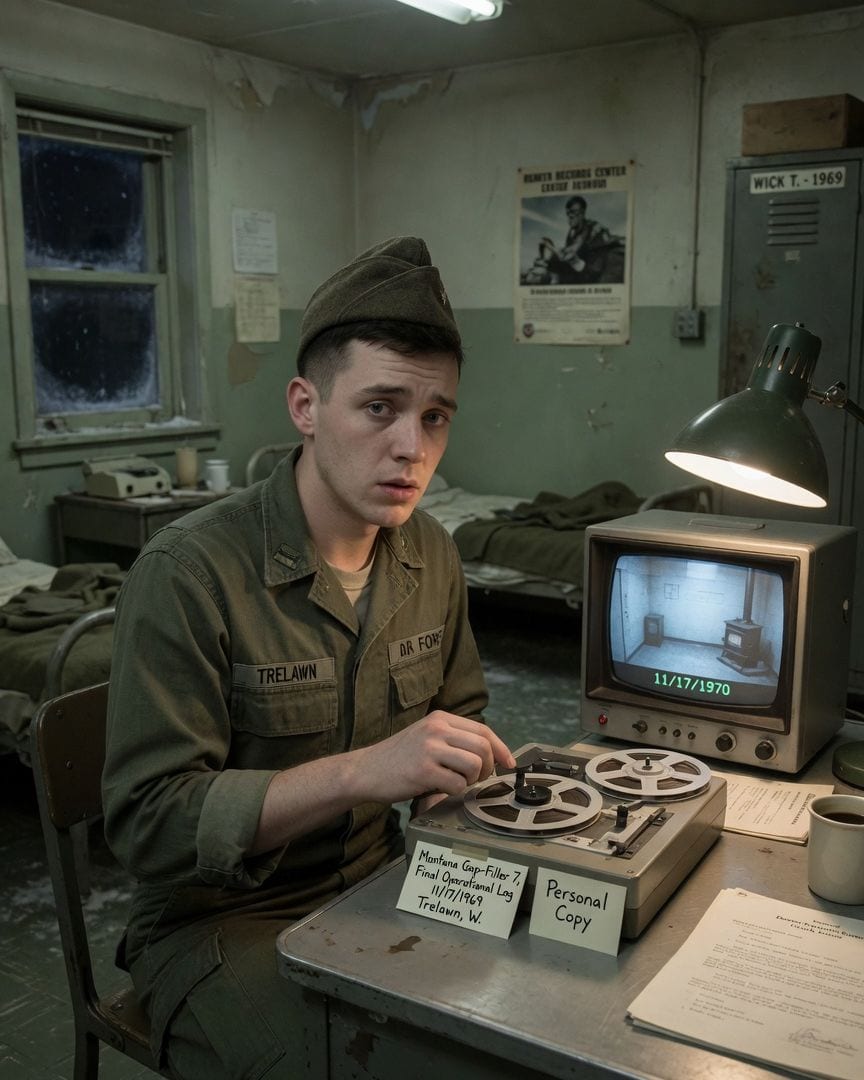
A Cold War gap-filler station was locked cold. Airman Wick Trelawn's final tape showed a man powering up the console a year later.
Airman Wick Trelawn shivered through his final hour at the remote Montana Gap-Filler 7, a Cold War radar station set to go cold forever. He meticulously logged its last operational moments, pulling the master tape as a final record. Later, reviewing a personal copy, Trelawn watched his empty control room play out as expected, but the tape kept running into a second hour. An indistinct man then appeared, methodically powering up equipment in the supposedly dead station. The site had been locked cold for a year by then, yet his official request for the original tape revealed a blinking timestamp of November 17, 1970. What impossible operations did the final log truly capture?
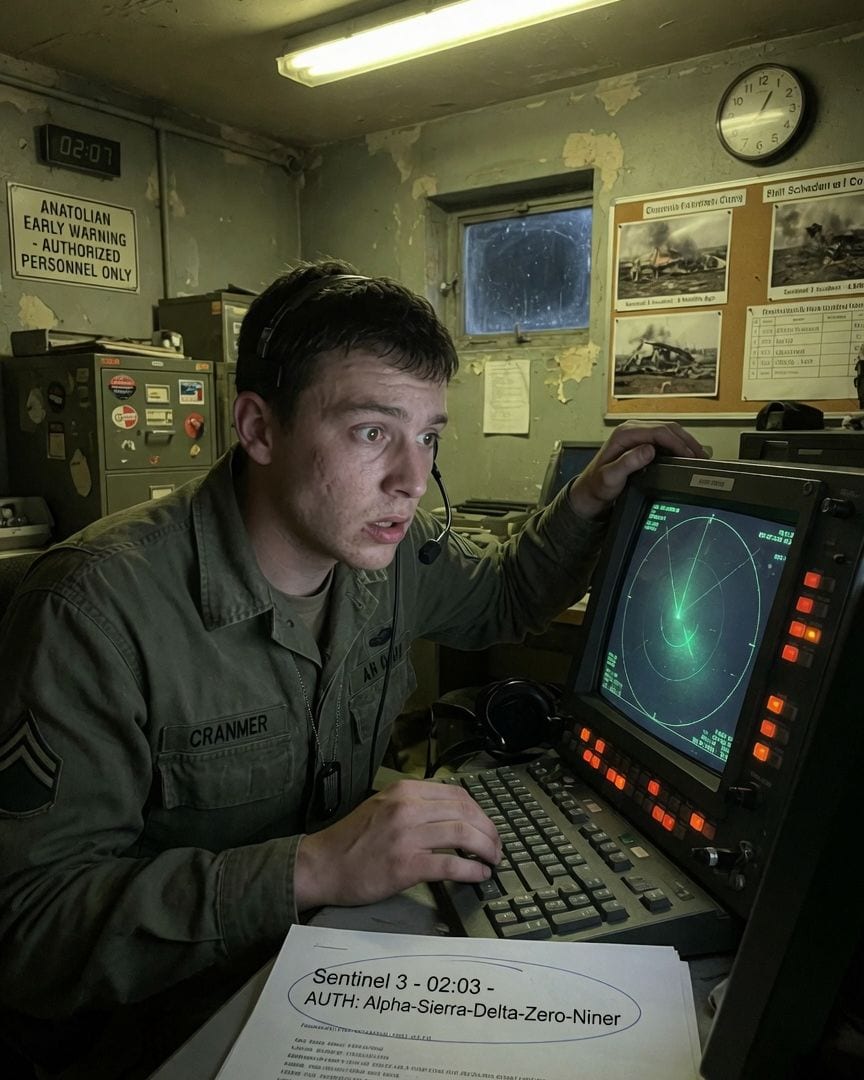
A radar specialist uncovers a dead man's logbook entry, dated two weeks after the fire that killed him. It asks, 'We're still here. What happened to us?'
Specialist Gideon Cranmer, just three weeks from his rotation, endured his overnight watch at an air-defense radar site in the desolate Anatolian highlands. As he monitored his radar console, a secure line crackled with a voice check from Sentinel 3, an adjacent early-warning station. Cranmer's blood ran cold: Sentinel 3 had burned to the ground eight months prior, killing its crew. Yet the voice gave exact coordinates and then whispered, "And has anyone ever found out what happened to us?" Despite his superior's dismissals, the call log confirmed the impossible.
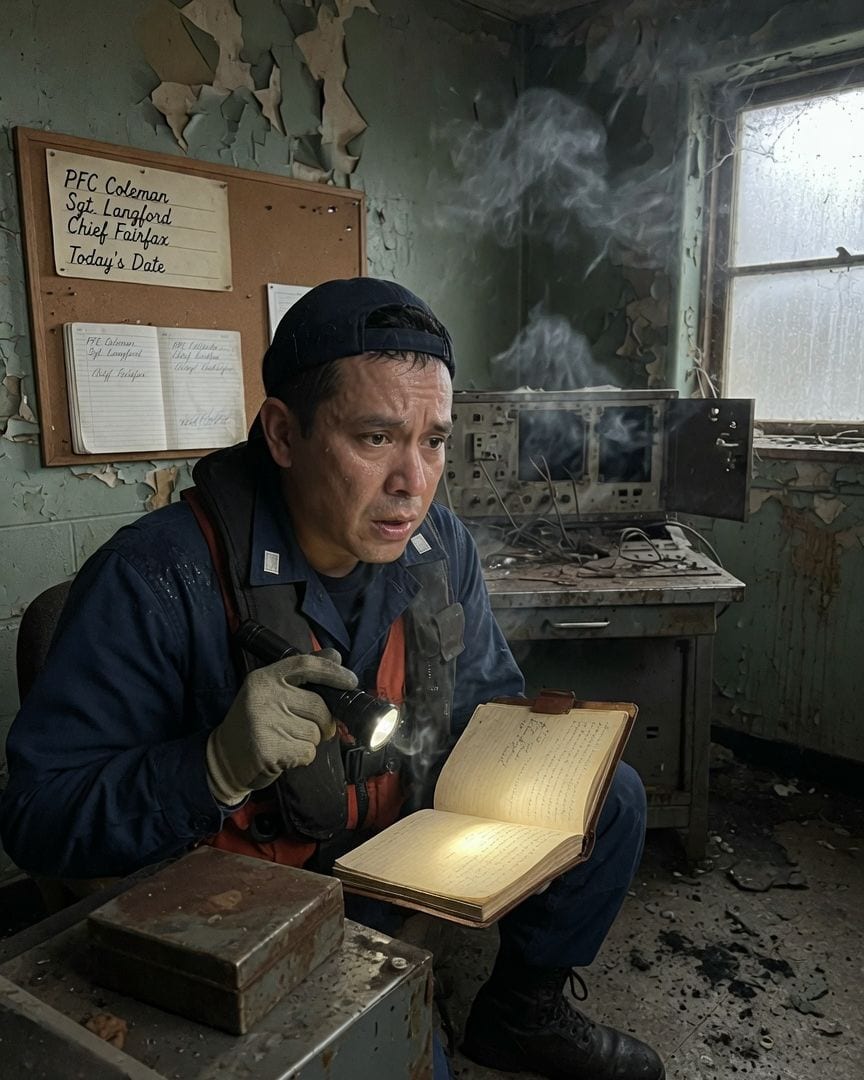
On a final survey, a Coast Guard lieutenant spots smoke from a Cold War station abandoned since 1996. Its mess hall is set for dinner.
Lieutenant Victor Ferro led a final survey team to a long-abandoned LORAN station in the desolate Aleutian fog, a last check before its demolition erased it from memory. But as their boat neared the black-sand beach, a thin plume of smoke curled from the galley stovepipe – from a station officially decommissioned nearly thirty years prior. Inside, the mess hall was eerily neat, tin plates set for a meal, and on a corkboard, a crisp, freshly-inked watch bill listed names unknown to any Coast Guard roll, past or present. The station log lay open to the current date, bearing the same impossible signatures. Who was here, and for whom was dinner being prepared?