An arctic expedition leader finds a Korean War jet in the ice, its fuel full, and a logbook signed by her grandfather six years after he vanished.
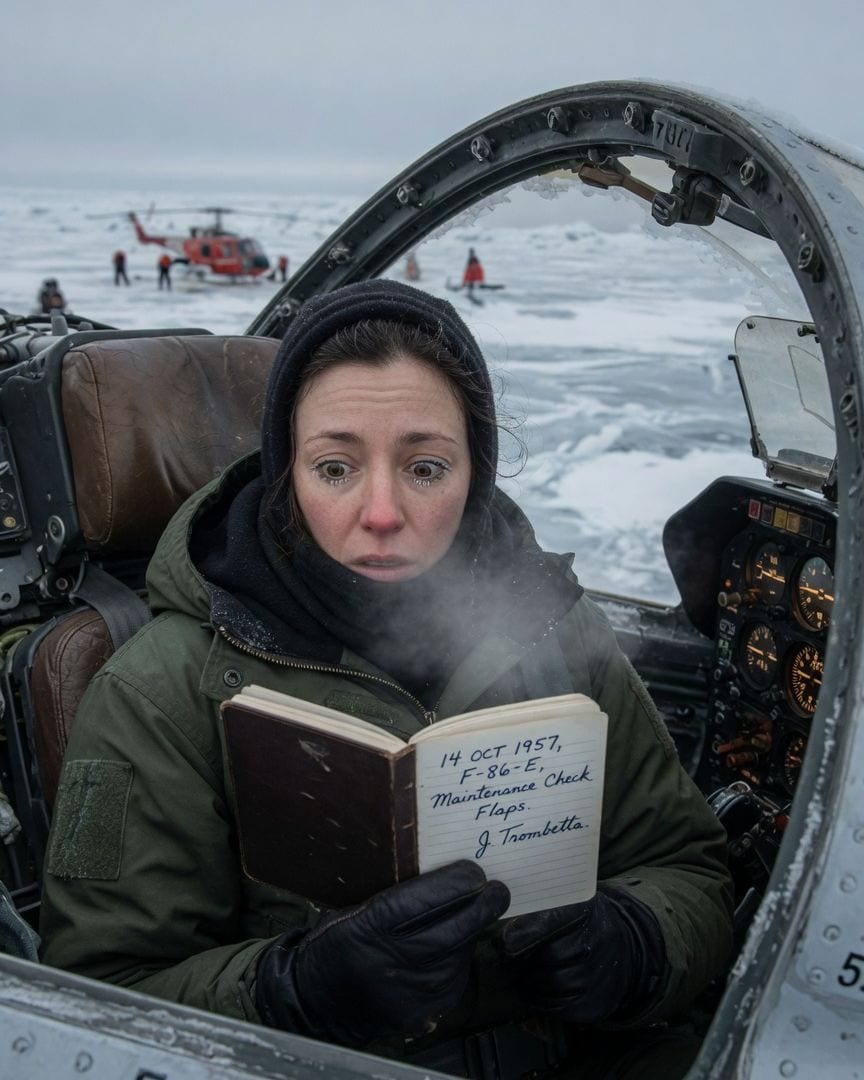
Faye Trombetta braced against the shuddering vibration of the helicopter as it sliced through the frigid Bering air. Below, the ice pack stretched, an endless, fractured white. Three weeks.
That was all the time left before the sea froze solid for the season, shutting down her expedition for good.
She was here for ice cores, for climate data, but her eyes, trained to spot anomalies, caught something unexpected in a jagged pressure ridge below.
A glint of black, impossibly out of place, rose from the white like a shark’s fin. It was the tail of an F-86 Sabre fighter jet.
A cold knot tightened in Faye’s stomach. Her grandfather, Julian Trombetta, had flown Sabres during the Korean War. He had vanished, officially, on a ferry leg from Alaska to Japan in 1951. Missing in action.
A lifetime of quiet grief and unanswered questions. But this… this was too much. As the helicopter dropped lower, circling the impossible find, Faye could make out more details.
The fighter jet was remarkably intact, canted slightly in the ice, as if it had simply landed there. Its canopy, incredibly, was closed. The cockpit, through the clear plexiglass, appeared dry.
She leaned forward, pressing her face against the cold window of the chopper, and stared. The fuel gauges on the instrument panel, stark and unambiguous, read full. Every last tank. Ice did not fill a fuel tank.
Neither did the Bering Sea. The sheer wrongness of it, a perfectly preserved ghost fighter, made her stomach clench, a dread far deeper than the biting cold.
It waited, silent and perfect, under a sky that had surely swallowed it decades ago.
Driven by a gut feeling and the faded photograph of her grandfather in a similar cockpit, Faye directed her team to land. The helicopter’s blades kicked up a flurry of snow and ice before settling onto a makeshift pad nearby.
She led the way, bundled in her arctic gear, her breath pluming in the minus-forty air, towards the F-86 Sabre. The jet stood like a sentinel, its silver-gray skin gleaming under the pale sun.
Her team, a mix of seasoned glaciologists and hardy engineers, worked carefully, cutting into the ice around the fuselage with specialized heated tools, creating a work platform.
The cockpit interior, once exposed, appeared remarkably pristine, sealed against the elements as if time itself had forgotten to touch it.
Faye knelt on the ice, her gloved fingers tracing the seam of the canopy. The metal was cold, unforgiving. She fumbled for the latch, her movements stiff. Years of ice and neglect had frozen the mechanism solid.
She grunted with effort, pulling and twisting, until finally, with a groan of ancient metal and a puff of compressed air, the canopy released. It swung upwards, revealing the interior. The air inside was still, cold, but surprisingly dry.
No frost, no damp, just the faint, metallic scent of aviation fuel and old leather. On the instrument panel, tucked into a small, worn leather clip, lay a small, dark-bound book. A flight logbook.
Her hands, usually steady and precise, trembled as she reached for it. She pulled it free, the leather cold and smooth beneath her fingertips.
She opened it, and on the first page, beneath a stamped serial number matching the F-86’s fuselage, she saw it: 'Trombetta, J.'
Her breath hitched. She started flipping through the meticulous entries, each one a neat, confident scrawl. Routine flights, maintenance checks, fuel loads.
She tried to rationalize what she was seeing – a misidentification, a replica, a cruel joke played by the ice.
But the serial number was undeniable, and the handwriting, the specific curl of the 'J,' the firm cross of the 'T,' was exactly as she remembered from her grandfather's old letters, stored in a dusty box back home.
It couldn't be anything else. Yet it was. The world tilted, the vast white plain seeming to spin around her.
Faye, shivering despite her layers of arctic gear, focused on the final entry in the logbook. Her breath misted in the cold, dry cockpit, ghosting over the page. It read: '14 OCT 1957, F-86-E, Maintenance Check, Flaps. J. Trombetta.'
The date stood out like a brand, a stark, impossible fact. Her grandfather, Julian Trombetta, had vanished, declared missing in action, in 1951.
This entry, detailing a routine check on this exact aircraft, signed in his familiar, steady hand, was dated six years later. Six years.
The ice-choked air suddenly felt impossibly thin, stealing the breath from her lungs, and the vast, silent Bering Sea seemed to hold its breath with her.
Back at the temporary research station, the constant hum of the generators filled the dome. Faye worked through the night, meticulously photographing every page of the logbook with her satellite phone.
The ice pack was closing fast, three weeks turning into two, forcing her to abandon her core samples, her entire expedition’s purpose, for this new, chilling mystery.
She started with the military, the arduous process of trying to access declassified records for Julian Trombetta. She hit bureaucratic dead end after bureaucratic dead end.
Official after official offered bland, mundane explanations for the logbook: a clerical error, a second pilot with the same name, a post-crash forgery.
None of it fit the pristine jet, the full fuel tanks, or the deeply personal connection of her grandfather’s unmistakable hand. Each failed attempt chipped away at her professional composure, leaving raw nerves.
Exhausted, on a whim, she finally traced an obscure reference to a regional archives facility – a last resort for forgotten files. There, in a dusty, forgotten annex of the building, she found Samuel Norwood, a grizzled, nearing-retirement records clerk.
He looked up from a stack of brittle ledgers, his eyes, magnified by thick glasses, blinking slowly. “Trombetta, Julian?” he repeated, the name sounding strange and ancient in the quiet room.
A flicker of something unreadable, a brief, almost imperceptible widening, crossed his eyes before he looked down again. He tapped a gnarled finger on a faded register. “I’ve seen that name.”
He mused, almost to himself, about a peculiar, unusually thick file that was never properly closed, a ghost in the system he’d always wondered about.
He’d seen other ‘incomplete’ files, he murmured, his voice a low rasp, but nothing quite like this one. It had always felt… different.
Samuel Norwood, his usual gruff demeanor replaced by a nervous energy, agreed to help Faye access Julian's file after hours. He cited “personal curiosity,” but his eyes kept darting to the clock.
The archive, once the regular staff had left, was vast, silent, and dimly lit, the towering shelves of paper seeming to lean in on them.
As they navigated the narrow aisles, the faint red glow of a security camera light seemed to follow their movements, sweeping their aisle like a watchful eye.
A distant door clicked shut down a hall where no one should have been. Samuel visibly jumped, his face pale, his breath catching in his throat.
“This isn't just a misfile, Dr. Trombetta,” he whispered, his voice tight, barely audible above the low hum of the fluorescent lights.
He pressed himself closer to a stack of old map drawers, as if trying to shrink away from something unseen. “I've tried to look into files like these before. Some things… some things are meant to stay buried.
You start digging, and sometimes, someone notices. Someone who doesn't like digging.” He pointed, his hand trembling slightly, to a faint, smudged fingerprint on the side of a file cabinet that he swore wasn't there an hour ago.
The air grew heavy, thick with an unseen presence, pressing in around them. He warned her again, his voice barely audible, his eyes wide and fearful. “You're not just looking for a record, you're looking for what put it here.
And it's still active.” The archive itself seemed to hold its breath.
Samuel finally retrieved the file for 'Trombetta, Julian.' It was a heavy, oversized binder, unnaturally thick, with a faded 'DECOMMISSIONED' stamp clumsily crossed out in red ink. The binder felt cold, almost clammy, in Faye’s hands.
Inside, she found not dusty history, but a chillingly active administrative record.
Routine payroll entries, requisition forms for aircraft parts, and even annual flight physical sign-offs for Julian Trombetta, all dated well into the late 1960s—decades after he was officially declared KIA.
Her fingers brushed over a typed entry: 'Quarterly Fuel Resupply, F-86-E, Bering Sector,' dated 1965. Another: 'Canopy Seal Replacement, F-86-E, Ice Station 7,' dated 1967.
The full fuel gauges, the dry cockpit in the ice, the logbook entry from 1957—it all snapped into horrifying focus, a cold, precise click in her mind. He wasn't lost; he was simply... transferred.
Samuel, his voice low and strained, sensing her realization, explained. “These aren't ghost files, Dr. Trombetta. These are… active accounts. For personnel who were never truly lost, but… re-designated. Absorbed. The institution doesn't lose people; it files them.
And the file keeps writing.” He pulled out several other similar binders he’d secretly cataloged over the years, a pattern of 'lost' personnel whose records continued, meticulously updated, for years, sometimes decades, after their official disappearances.
Each one was an unnaturally thick testament to lives that continued, just out of public sight. The names were different, the dates varied, but the chilling consistency was the same. A system, vast and patient, operating in the shadows.
Faye's mind raced, piecing together the implications. Her grandfather, alive, working for some clandestine operation for years after his 'death,' his plane maintained, fueled, filed away. It was too much, too grand, too patient, too horrifying.
She looked at Samuel, a silent question in her eyes, a plea for some alternative explanation, some way to unravel this impossible knot.
He sighed, running a hand over his thinning hair, his gaze fixed on the open file, on her grandfather’s name.
“There's one more thing,” he said, his voice barely a whisper, strained with an emotion Faye couldn't quite place. “A recent addition. It's… unusual.” His face was pale, eyes wide with a dawning horror that mirrored her own.
He pushed a newly declassified sheet from the very bottom of the Trombetta file across the table. It was an internal security access log, crisp and new amidst the yellowed paper, dated just last Tuesday.
Her own name, 'Trombetta, Faye, G-010-B,' was printed clearly beneath a security access stamp, granting her access to a restricted 'Archive Sub-Level 7.'
The paper felt cold in her hands, colder than the Bering ice, and the date stared back at her, implicating her in the very system she was trying to expose.
She wasn't just observing the file; she was already a part of it.
Faye slammed her hand on the table, the sharp crack echoing through the silent archive. “My name. What does this mean?” she demanded, her voice tight with a mixture of fear and fury, addressing Samuel.
He flinched, startled, then collected himself, his gaze flickering to the security camera’s unblinking red eye. “Archive Sub-Level 7 isn’t just for historical records, Dr. Trombetta,” he explained, his voice low and urgent. “That’s where the active files are kept.
For those who are… ‘filed.’” He revealed what he understood, what his decades among these impossible records had taught him. The institution didn't merely record disappearances; it orchestrated them.
The full fuel, the dry cockpit, the perfectly preserved jet in the ice pack – it wasn't a crash. It was prepared, a waiting asset, stored for a later use.
Her grandfather wasn't lost; he was recruited, or taken, and his file was kept meticulously updated for decades, not as a ghost, but as an active, if unlisted, operative for some ongoing, unknown purpose.
The entries in the logbook and the payroll records now made terrifying sense: not a ghost pilot flying a ghost plane, but a continuation of his service in a black operation, his existence simply shifted from public record to internal ledger.
The institution, Samuel continued, had been watching her. Waiting for her. Perhaps for years, knowing her connection to Julian, knowing she would eventually come looking.
She wasn’t a discoverer, an intrepid geologist stumbling upon a cold case; she was a target, drawn in by the very history she sought to unravel. A new entry, waiting to be filled.
A low, metallic clang echoed from the main hallway of the archives, a sound too heavy to be accidental, too close to be ignored.
Footsteps, slow and deliberate, began to approach their aisle, each one a hammer blow against the silence. Samuel's eyes darted to the security camera, its red light now fixed steadily on their position, unmoving.
He grabbed a handful of the most incriminating documents – the access log with Faye's name, several of Julian's later payroll slips, and a blank 'Next Assignment' form – and shoved them into Faye's hands.
The paper felt like a live thing, twitching in her grasp. “Go!” he hissed, pointing to a nondescript maintenance exit tucked behind a towering stack of old microfiche readers.
Faye hesitated, her gaze fixed on the open file, on her grandfather’s name, on the decades of his life meticulously accounted for, on the blank form with her own name waiting. It was all real.
The footsteps were closer now, turning into their aisle, slow and heavy, no longer just approaching, but searching. Samuel, his face grim, shoved her violently towards the exit, forcing her through the narrow doorway.
She stumbled, clutching the papers, and heard the sharp click of the lock as he sealed the door from the inside. A muffled thud, then silence, thick and absolute, followed.
Faye pressed herself against the cold metal door, the documents clutched tight, knowing Samuel had just sacrificed himself for her escape, and that the institution had claimed another ‘file.’
Faye escaped into the biting night, the handful of documents her only proof.
Samuel Norwood was never seen again; his disappearance was officially ruled a 'voluntary separation' by the archives, his file closed with a chilling efficiency that Faye now recognized as a hallmark of the institution.
Within days, a specialized, unidentifiable team recovered the F-86 Sabre from the Bering ice pack. Its existence was officially denied, its recovery operation shrouded in absolute secrecy, a ghost ship vanishing into the ether.
The ice closed over the site soon after, erasing any trace of the impossible discovery.
Faye was left with the cold knowledge that the institution operated silently, patiently, and without oversight, erasing and acquiring lives as if they were mere paperwork.
Miles from the archives, Faye pored over the documents Samuel gave her, illuminated by the harsh glare of a motel room lamp. Among Julian’s payroll slips and requisition forms, she found it: a blank requisition form for 'Personnel Transfer.'
At the top, printed in the same official, stark font as her grandfather's name on his decades-old records, was her own: 'Trombetta, Faye, G-010-B.' Below it, a blank space awaited 'Next Assignment.' She understood now.
The filing system was still active, still writing, still acquiring. The institution wasn't done with her. She was not a witness; she was an open file, waiting for the next entry.
Months later, a new records clerk, fresh out of training, noticed a peculiar, unusually thick file for a recently separated Samuel Norwood.
A faint, almost imperceptible signature appeared at the bottom of a new entry, dated last Tuesday, beneath a security access stamp. The file is still being signed.
If this one got to you
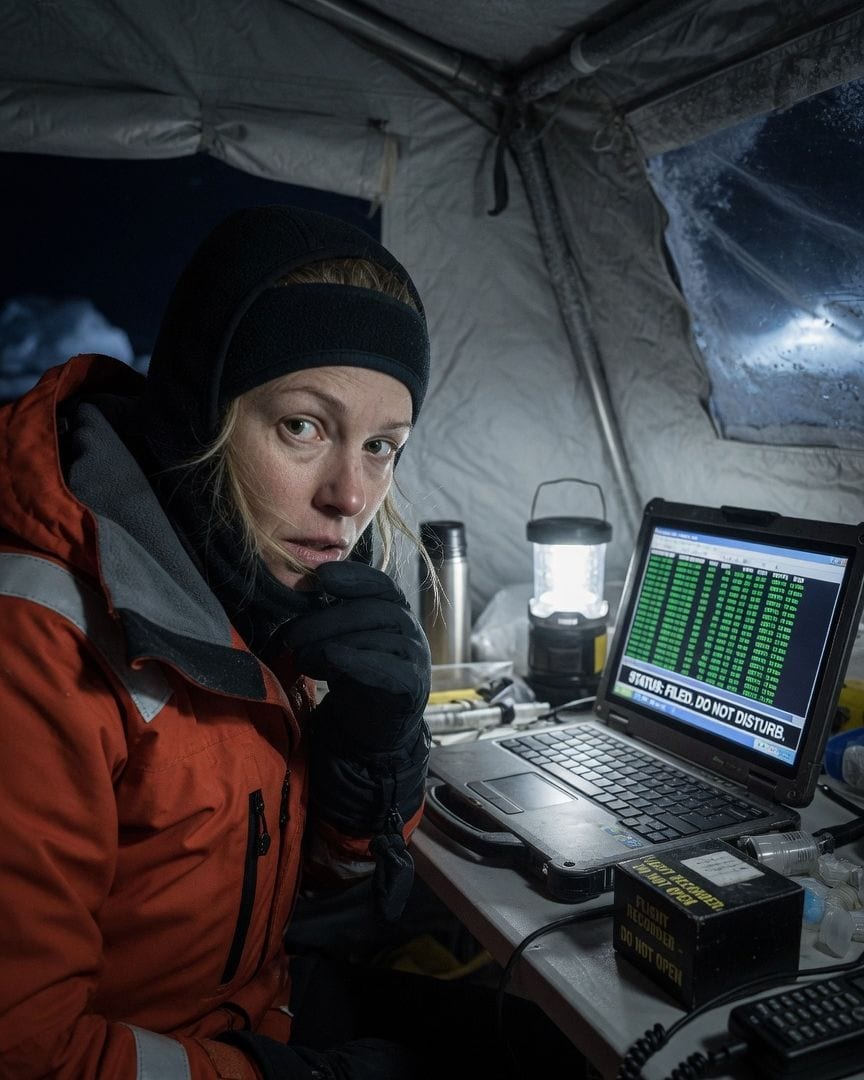
A glaciologist finds a Cold War plane 60 feet down in Greenland ice, its navigation lights still burning after sixty years.
Glaciologist Ines Faurholt skied across the vast, blinding Greenland ice cap when her path was abruptly blocked by a dark, corroded antenna mast. Beneath it, sixty feet down in ancient ice, a Cold War reconnaissance aircraft sat with its navigation lights eerily burning and its cockpit clock steadily keeping time. The sight was a violation of everything Ines knew about time and preservation in this frozen world. She called for a team, and days later, they extracted the plane's flight recorder, revealing data that showed the aircraft still flying years after its disappearance.
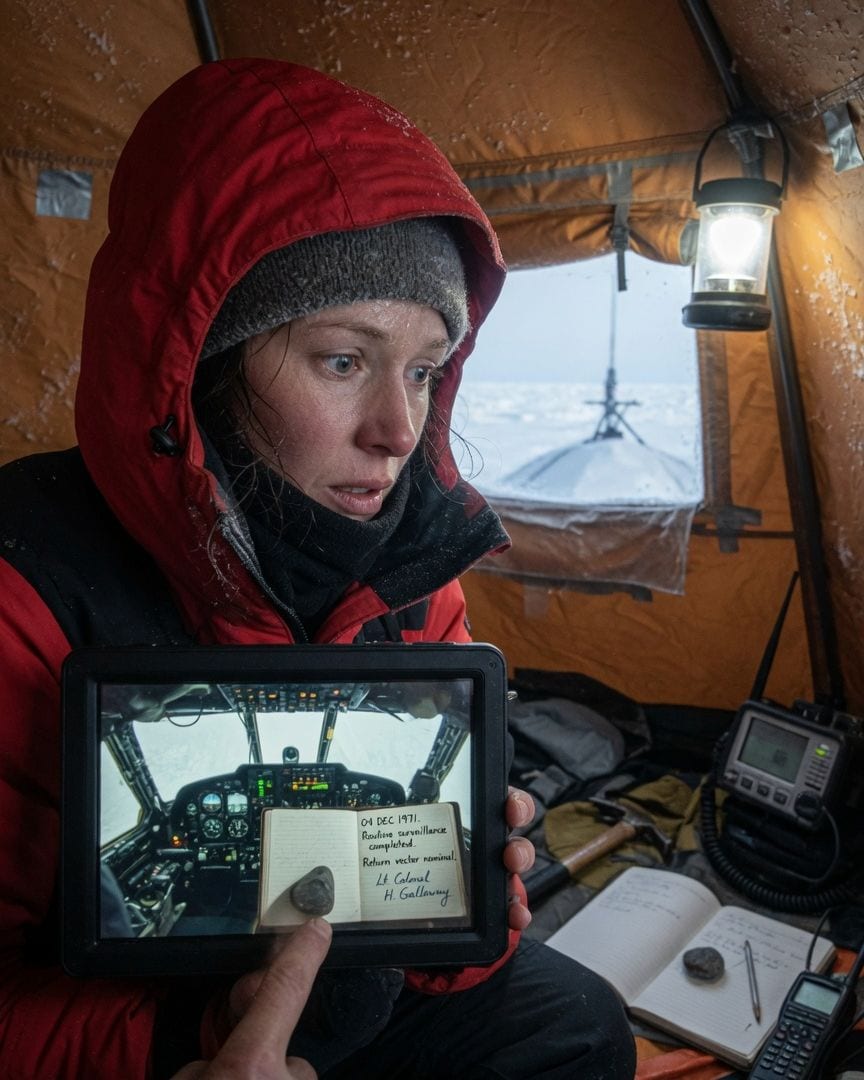
An explorer found a Cold War spy plane lost for sixty years beneath Greenland ice, but its pilot's log was dated almost a decade after it vanished.
Geophysicist Ines Faurholt pushed her ski pole into the Greenland ice, the sub-zero wind biting at her brow during a white noon. What began as a routine expedition turned chilling when her ski struck an antenna mast, leading her to a Cold War spy plane entombed sixty feet below in decades of ice. Its navigation lights still glowed, a faint hum vibrated through the frozen depths, and an impossible digital clock in the cockpit meticulously kept time. But the true impossibility emerged from the pilot's logbook: an entry dated eight years after the aircraft and its pilot, Lt. Col. Hugo Galloway, were officially declared lost. How could a vanished pilot have logged a flight almost a decade after he disappeared?
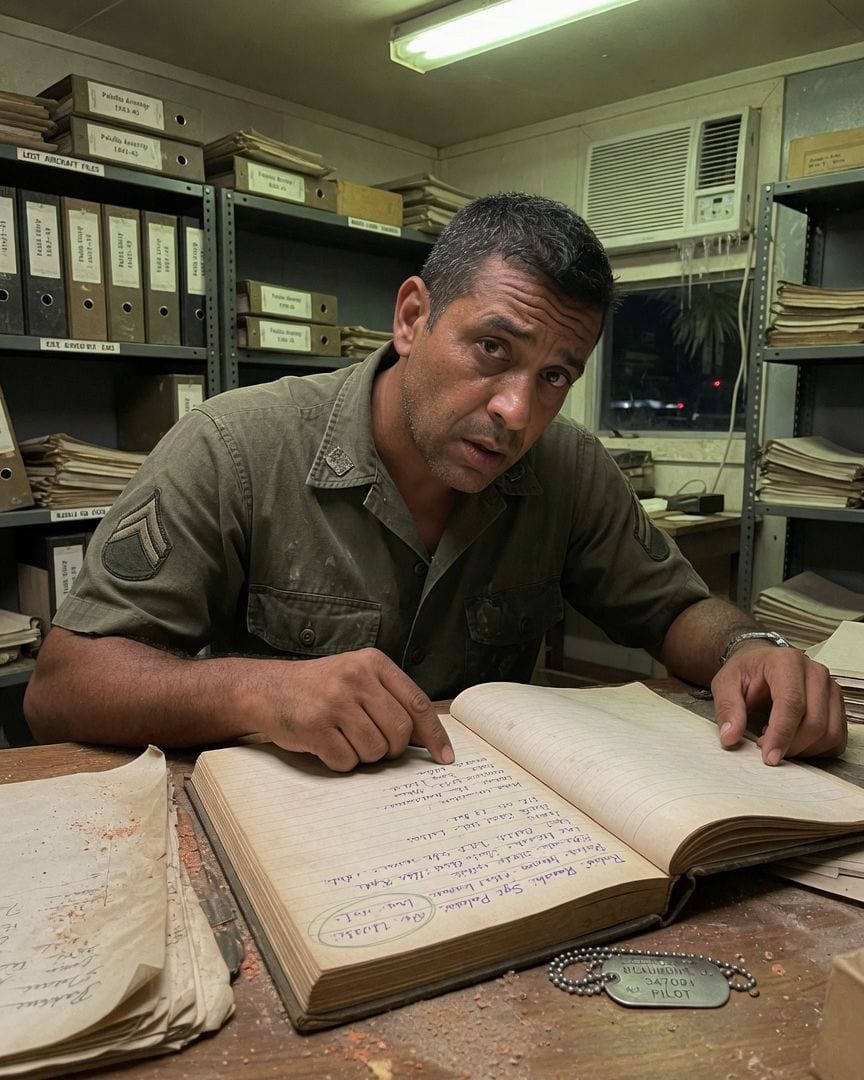
A sergeant's last watch on a forgotten outpost: His own name appeared on an 80-year-old crash manifest.
Sergeant Leon Pulaski spent his last night at the remote Peleliu Atoll Airstrip, its final closure imminent, listening to the rhythmic sigh of the Pacific. Just after 0330, a garbled distress call pierced the silence, requesting the field for a plane with a tail number, 'Ghost Two-Niner-Niner,' retired since World War II. Though Pulaski, disciplined and rational, logged the impossible call as a phantom, the crash crew later found a fresh gouge in the coral and a shard of cockpit glass, still warm, where no wreck existed. His quiet unease only deepened when he discovered a dog tag belonging to a pilot declared lost eighty years prior. But the true chill landed when he found his own name on that same eighty-year-old crash manifest.
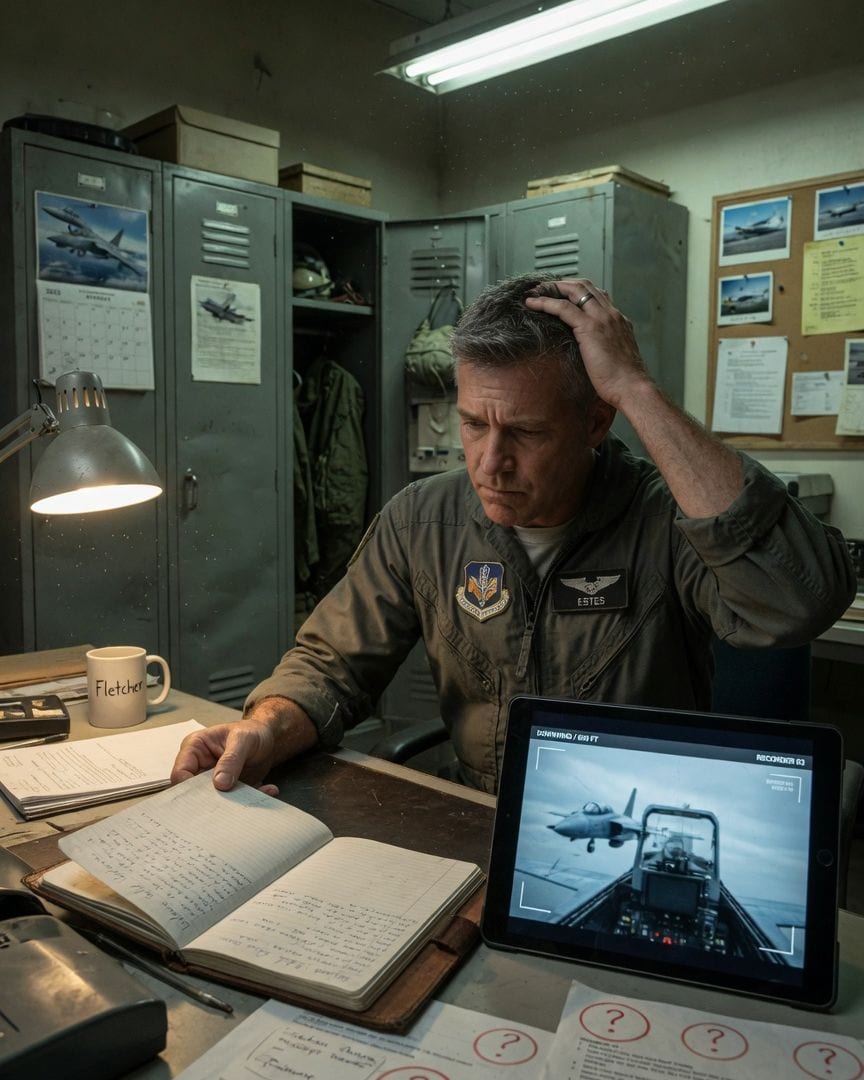
A Chief Warrant Officer's HUD tape shows a phantom jet, impossibly close, off his wing. Forty years ago, another Cold War pilot logged the same impossible sight.
Chief Warrant Officer Nathaniel Estes, a pilot whose career hinged on absolute precision, was under evaluation for a critical promotion. His nightly review of HUD tapes from routine Mojave test flights was a meticulous habit, but for a week, it revealed an impossible detail. At precisely 800 feet, one frame showed a sleek, experimental jet tucked impossibly close off his left wing—a craft ground radar never detected. When his maintenance chief found no equipment fault, Estes unearthed a dusty, decades-old logbook detailing identical phantom sightings from 1978. What unseen presence shadowed the desert skies?
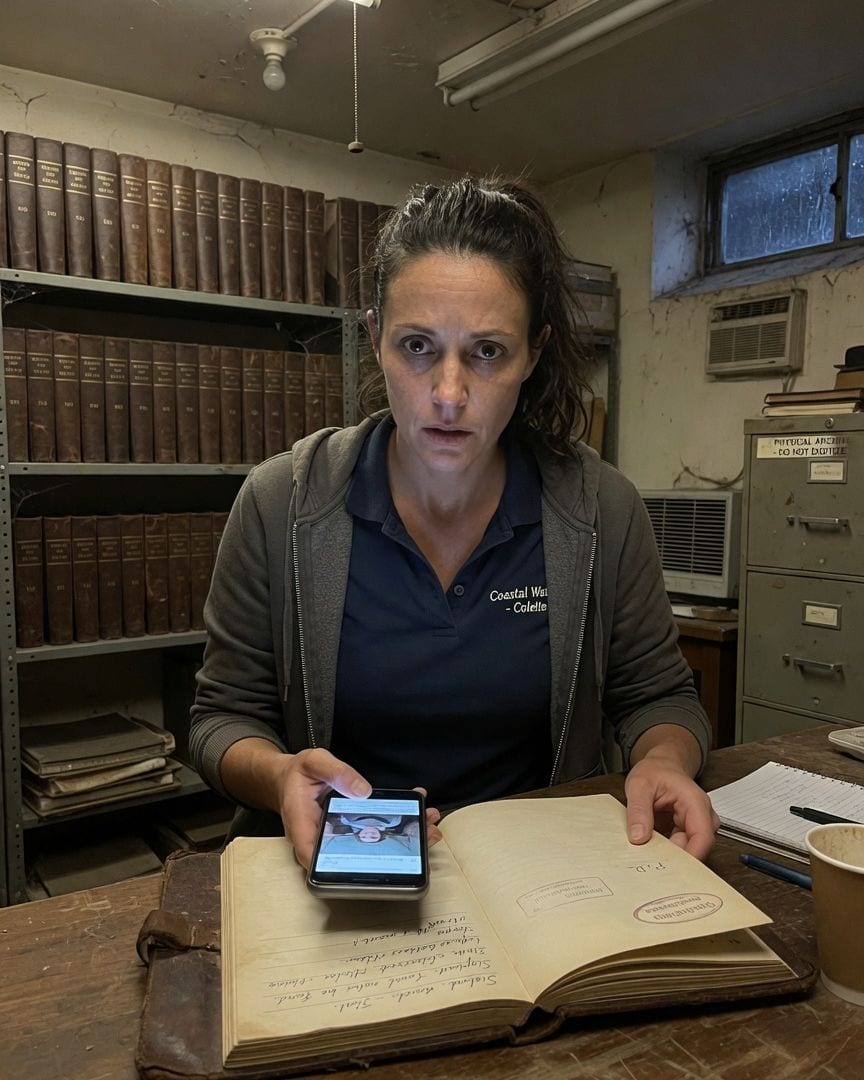
My coastguard log noted Sighting 9 again tonight, a light where no vessel showed. The old logs carry Sighting 9 off Skerry Point at 3:14am every tenth year since 1954, always 'nothing found,' always 'send no boat.'
On my watchtower night shift, the radar screen glowed green and the ocean was quiet. Then, a familiar light appeared off Skerry Point, exactly on cue, just as it had every tenth year for decades. But digging deeper, I found a hidden stamp in an old logbook: 'Operation Skerry. Status: Complete.' It left me with a chilling sense of finality.
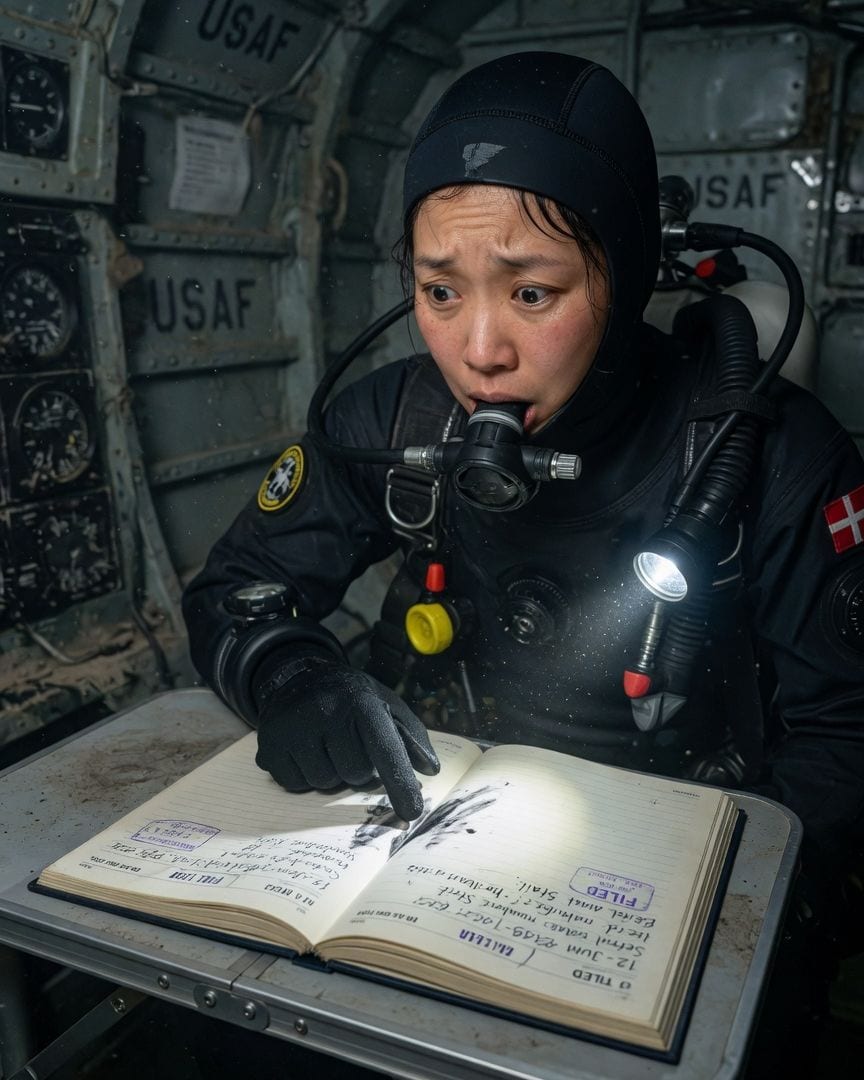
A deep-sea diver finds a Cold War bomber's logbook open to today's date. Her father's service number is 'FILED' in its wet ink, reflecting her face.
Yuki Ammann descended into the crushing dark of the Denmark Strait, her nine-hour bottom window stretching ahead. She hoped for a glimpse of the lost B-52 bomber her father spoke of, a relic of a vanished crew. Instead, her sonar painted a perfect profile: a pristine B-52, sitting upright on the continental shelf, dry inside. A logbook lay open on its flight deck, the last entry dated today, June 12, 2024. The ink was still wet. Could her father’s stories be more than just sailor’s myths?