A deep-sea diver finds a Cold War bomber's logbook open to today's date. Her father's service number is 'FILED' in its wet ink, reflecting her face.
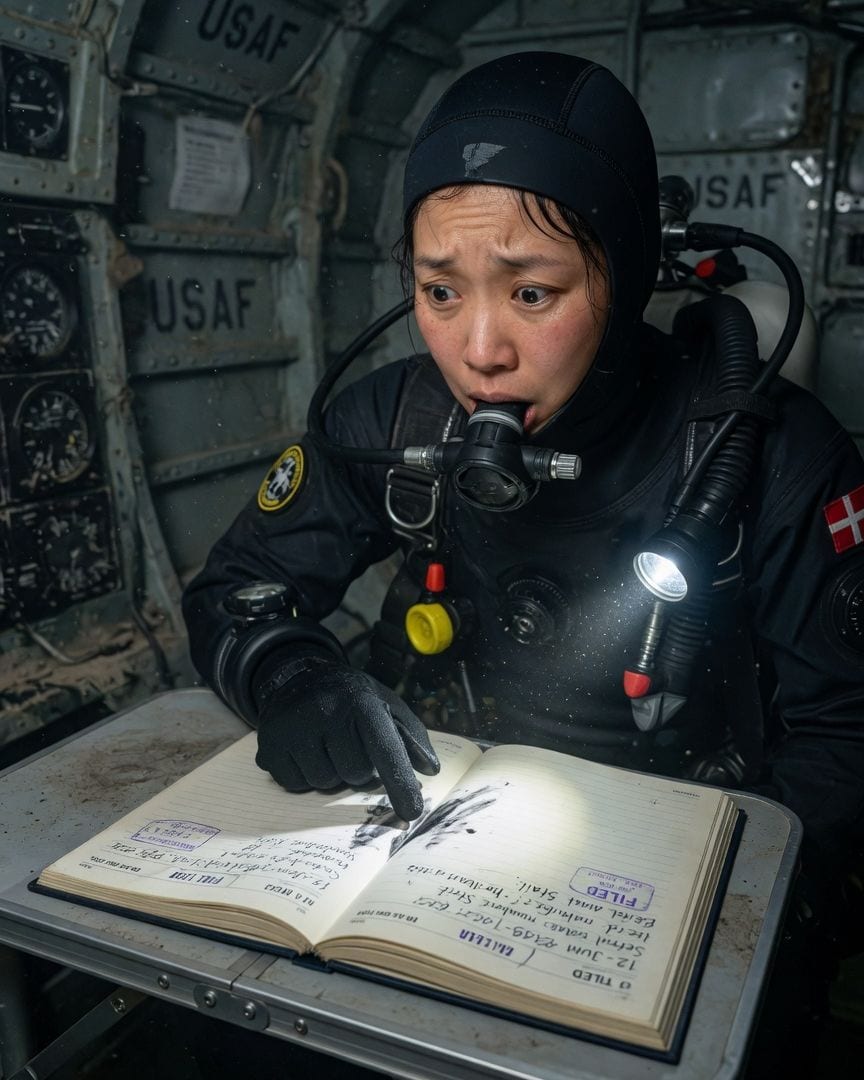
Yuki Ammann adjusted the rebreather’s mouthpiece, the cold, stale air a familiar comfort in the crushing dark of the Denmark Strait. Her nine-hour bottom window stretched before her, an eternity of methodical scanning.
Her father, Bernard, used to tell stories about the ’68 bomber crew, how they’d ‘gotten out’ before the B-52 vanished. A sailor’s myth, probably, a way to cope with the deep ocean’s indifferent appetite.
Today, though, the ocean had offered up a ghost. Her sonar had painted a perfect profile: a B-52 Stratofortress, sitting upright on the continental shelf, just as if it had settled there gently. Not a wreck, but a relic.
As her dive light cut through the gloom, the bomber resolved into impossible clarity. Its vast fuselage was unmarked, the silver skin dull with decades of silt but otherwise pristine.
The propellers, all eight of them, were feathered – a controlled shutdown. She cycled the outer hatch, the heavy metal groaning, and then the inner, breaching the pressure differential with a soft hiss.
The flight deck beyond was dry, the air within smelling faintly of ozone and old paper, utterly untouched by the deep. On a fold-down table, secured against turbulence that had never come, a bound logbook lay open.
Its last entry, written in crisp, dark ink, was dated today: June 12, 2024. The ink had not finished setting.
Yuki hovered, her breath a silent fog within the rebreather. She reached out, her gloved fingertip brushing the fresh ink of the logbook’s last entry. It smeared, a dark, viscous trail against the cream-colored page.
A list of service numbers followed the date, stark and official. Her mind scrambled for a mundane explanation. A research vessel, a secret project, a prop for some deep-sea exercise?
But the bomber itself, sitting here for fifty-six years, perfectly preserved, perfectly dry, defied it all. This wasn't a prop. This was… found.
She scanned the older entries. Pages turned, revealing a meticulous record spanning decades. An entry from 1968, precise and formal, noted a patrol manifest for the Denmark Strait. Another from 1975, different service numbers, same neat, almost calligraphic hand.
Then 1988. The 2000s. All in ink that looked equally fresh, despite the dates. It was as if time hadn’t touched these pages, or rather, had touched them all simultaneously, the ink drying only now.
Her gaze fell on a particular entry from 1988, a familiar-looking service number followed by a single, chilling word, stamped in faded, official purple ink: 'FILED.'
The word was so mundane, so bureaucratic, but its context, beneath the ocean in a bomber that shouldn’t be active, made it a pronouncement. It wasn't 'lost' or 'missing.' It was filed.
Her heart hammered against her ribs, a frantic drum against the silence of the deep. Yuki tore her gaze from the fresh ink, from the unsettling stamp, and frantically flipped back through the logbook.
She searched for the earliest entries, for anything connected to the bomber’s original disappearance in 1968. Her finger traced down a list of service numbers, a patrol manifest from that very year. Then she stopped. There it was.
Bernard Ammann’s unique identifier, her father’s service number, clearly written among the others. Next to it, the same chilling stamp, faded but unmistakable: 'FILED.' Her father hadn’t ‘gotten out.’ He had been accounted for. He had been designated.
Yuki Ammann, her dive light illuminating the page, saw her own reflection caught in the still-wet ink of an entry dated to this very year, the fresh script detailing a patrol manifest that included her father's service number, followed by the chilling stamp: 'FILED.'
Back on the surface, the chill of the deep still clung to Yuki. She offered a terse, clinical debriefing, fabricating a minor equipment malfunction as the reason for her limited data return on the target, buying herself time.
The official reports would reflect a recovered wreckage, nothing more. As soon as she was cleared, she headed for her terminal, her fingers flying across the keyboard. Using her security clearances, she accessed her father’s service record. Bernard Ammann.
Former patrol crew. Deceased.
The file was thinner than she remembered, almost skeletal. Whole sections seemed to be missing, their page numbers skipped entirely. Control numbers for certain documents led to empty directories or generic 'Access Denied' messages.
The classification downgrade schedule was the most unnerving: a cascade of 'Top Secret' ratings, finally resolving into 'DECLASSIFY NEVER.' She stared at the phrase, a chill tracing her spine. It wasn't 'classified indefinitely,' but 'never.' A definitive, almost aggressive finality.
Yuki found Eugene Kingsley’s number in a dusty Cold War history forum. Kingsley, a retired archivist, specialized in naval disappearances in the North Atlantic. He answered on the second ring, his voice raspy with age.
Yuki laid out the anomalies of her father’s file, then, cautiously, mentioned the B-52 logbook and her father's service number next to the ‘FILED’ stamp. She half-expected him to dismiss it as a hallucination. Instead, there was a pause.
A long, weighted silence.
“Fascinating,” Kingsley finally said, his voice now sharper, more alert. He asked for the specific control number from her father’s file. Yuki read it out. “That’s not a standard control,” Kingsley muttered, tapping away on his end.
“It’s a project code. For an operation supposedly terminated in… 1972.” He didn’t elaborate, but the implication hung heavy in the air: a supposedly dead project had just logged a new entry.
A day later, Kingsley called, his voice now strained, tight with an edge of fear. “Yuki,” he began, “I just got a call. From a Commander Vance. Special Records Oversight. He wanted to know about my recent inquiries.
Said I should… ‘redirect my focus.’ Warned me about the dangers of… ‘unauthorized deep-diving into historical records.’” Yuki’s unease escalated into a cold dread. Vance. A name from another era, now resurfacing like the bomber itself.
She tried to access her father's file again. 'Access Revoked,' the screen declared. 'Temporarily Unavailable.' Not even an explanation. They had locked her out. She stared at the blank screen, the blue light of the monitor reflecting her pale face.
The room felt colder, the hum of the computer suddenly like a predatory growl.
That evening, a subtle scratching at her apartment door drew her attention. She peered through the peephole, seeing only the empty hallway. When she opened the door, a small, unmarked manila envelope lay on the floor.
Her name, printed in block letters, formal and stark, was the only identification. She snatched it up, her fingers trembling slightly. Inside, a single sheet of paper, thick with institutional red tape.
Most of it was blacked out, redacted with heavy ink. But one line, chillingly precise and untouched, stood out: 'Amateur inquiry noted. Further action pending.'
The paper felt cold, almost wet, as if it had been handled by the sea itself. The formal warning, the exact language, made it clear: they were watching. And they knew.
Kingsley, now genuinely rattled by the warning, pushed deeper. He called Yuki, his voice low and urgent.
He’d found a second, higher-classified copy of Bernard Ammann’s service record, archived not in the standard system but in a separate, older repository—a “dead letter office” he called it, for cases that never quite closed.
He insisted she come to his small, cluttered office immediately.
When Yuki arrived, Kingsley had both copies spread across his desk. Her father’s initial declassified file, with its missing pages, lay next to the newly found classified version. “Look,” Kingsley said, his finger tapping the newer document.
The familiar black-ink redactions were there, obscuring blocks of text. But on the classified copy, those same redacted sections weren’t blacked out. They were gone.
Perfectly punched-out holes, clean and precise, as if a specialized tool had physically removed the information. The holes aligned perfectly across multiple pages, a ghostly negative of the missing data. It wasn't black ink concealing text; it was an absence.
A physical removal.
“It’s not redaction, Yuki,” Kingsley whispered, his eyes wide. “It’s extraction. They physically removed the data. Not just from this copy, but from its source, from the record itself.”
He then pulled out a stack of similar files, all from the Denmark Strait sector, personnel listed as ‘missing in action’ or ‘presumed lost.’ Dozens of them, spanning from the late 60s through the early 2000s.
All had similar physical ‘redactions.’ And more chillingly, many of these files, despite being decades old, showed last modification dates from within the last decade. Some, even, from last year.
“This isn’t a record of historical disappearances,” Kingsley concluded, his voice barely audible. “This is an ongoing filing system. The information isn’t being hidden; it’s being… processed. Extracted from the physical record.
And someone is still actively signing these records, still updating the system.” Yuki stared at the clean, empty spaces on the page, the perfectly formed holes. Her father hadn't just gone missing.
He had been processed, not by the indifference of the ocean, but by an active, ongoing bureaucratic mechanism. He was gone, but his file remained, an open wound in the annals of history, still being picked over.
The ‘redactions that had a shape,’ the chilling precision of the punched-out holes, and the horrifying implication of an active, ongoing system filled Yuki with a terror colder than any ocean.
If this system was still filing, still extracting, then who was next? The question burned in her mind, a searing brand. She looked at Kingsley, her voice hoarse. “Search for me,” she ordered. “Yuki Ammann. My service number. My records.
Everything.” Kingsley hesitated, then nodded, the gravity of her request weighing heavily on him.
Hours later, the phone rang, its sudden shrill cutting through the silent apartment like a knife. Kingsley’s voice, when she answered, was barely a whisper. “Yuki,” he breathed, “I… I found something.” His words were clipped, ragged.
He described a new control number, created just last week, tied directly to her service records. Another 'DECLASSIFY NEVER' downgrade. Then, his voice dropped further, as if afraid to speak the words aloud. “The last page, Yuki.
An entry dated today. Your full name.” He paused, a shaky intake of breath. “Followed by the bold, official stamp. The same word, Yuki. The one you found in the bomber.” Yuki didn’t need him to say it. She knew.
The file was open. And it was still being written for her.
The full horror detonated within Yuki. The bomber wasn't merely a wreck or a tomb; it was a physical component, a 'station' or 'processing center' for this terrifying, ongoing bureaucratic machine.
Her dive had stumbled into an active, anomalous vessel, a place where time and the deep were somehow insulated, where 'disappearances' weren't passive losses but active designations.
Kingsley, his voice now imbued with a grim resolve, confirmed her theory. He had spent the night digging deeper, driven by the personal threat to Yuki.
He unearthed heavily redacted schematics of the B-52, not from military archives, but from a forgotten, obscure government repository for 'special projects.' These schematics showed no bomb bay, but a 'containment module' where the ordnance should have been.
A specialized, insulated chamber. Then, a 1970 memo, signed by a then-Captain Vance, discussing 'personnel re-assignment protocols' for 'sensitive assets' in the 'Denmark Strait sector.' The pieces clicked into place with a terrible, undeniable precision.
The 'filed' weren't merely gone; they were held, suspended, their records actively maintained by the very institution that had declared them lost.
Vance, now a retired Commander, was not just an archivist but the architect and quiet guardian of this terrible, ongoing bureaucracy.
Yuki decided she needed irrefutable proof, something concrete. Kingsley, his contact network surprisingly deep for a retired archivist, located Commander Vance. He was an unnervingly calm octogenarian, living in a quiet, unassuming house in a suburb outside D.C.
Posing as a researcher from a historical preservation society, Yuki confronted him. She presented blurred printouts of the logbook entries, careful to obscure her father's service number, and the redacted pages of her father's file, with their unsettling perforations.
Vance listened, his pale blue eyes unblinking, a thin smile playing on his lips. He admitted nothing explicitly, never breaking his composure. Instead, he spoke in measured, almost philosophical terms.
“The record,” he mused, his voice soft, “is comprehensive, Ms. Ammann. It must be. For historical accuracy, for public knowledge, for… continuity.” He gestured vaguely, as if encompassing all the unseen mechanisms of the world.
“Some processes, once initiated, require continuous oversight. For the greater good, you understand.” As Yuki, feeling a profound despair at his unshakeable calm, prepared to leave, Vance reached into his jacket pocket.
He produced a small, sealed envelope, worn and aged, and pressed it into her hand. “A small souvenir,” he said, his smile widening slightly, “from a truly remarkable history.”
Inside, Yuki felt the cold, heavy shape of an antique brass key. She had her proof, she thought – the living architect’s tacit admission – but it was too abstract, too oblique. Who would ever believe her?
She escaped his unnervingly placid presence, but the cost was immeasurable: the system was still running, still filing, and her own name was now on its active ledger.
Yuki returned to her base, her mind a whirlwind of schematics, redacted documents, and the image of Vance’s knowing smile. She compiled her findings, painstakingly detailing the bomber’s impossible state, the live logbook, the perforated files, Vance’s cryptic words.
She presented it all to her superiors. She was met first with polite skepticism, then quiet dismissal. Her service file was flagged for 'stress-related leave,' an easy way to sideline her without addressing her claims.
Kingsley received a more severe warning, his archive access revoked permanently, cutting him off from the very records he’d sought to expose. The vast, patient machine simply absorbed her attempts to expose it. Nothing changed.
The bomber remained on the continental shelf, the files in their vaults, and the world moved on, oblivious.
Yuki kept the brass key on her nightstand, a cold, heavy truth. She continued her work, but every sonar ping, every shadow on the deep, carried a new weight.
She knew the bomber was still active, a dark heart beating silently, part of the unseen machinery. Her father was right in a way: the crew hadn't 'gotten out,' they had been 'filed.'
And now, so was she, in the bureaucratic ledger of the disappeared. She never tried to find out what the key opened, knowing some doors, once opened, could never be closed.
The brass key sits on her empty nightstand, untouched.
If this one got to you
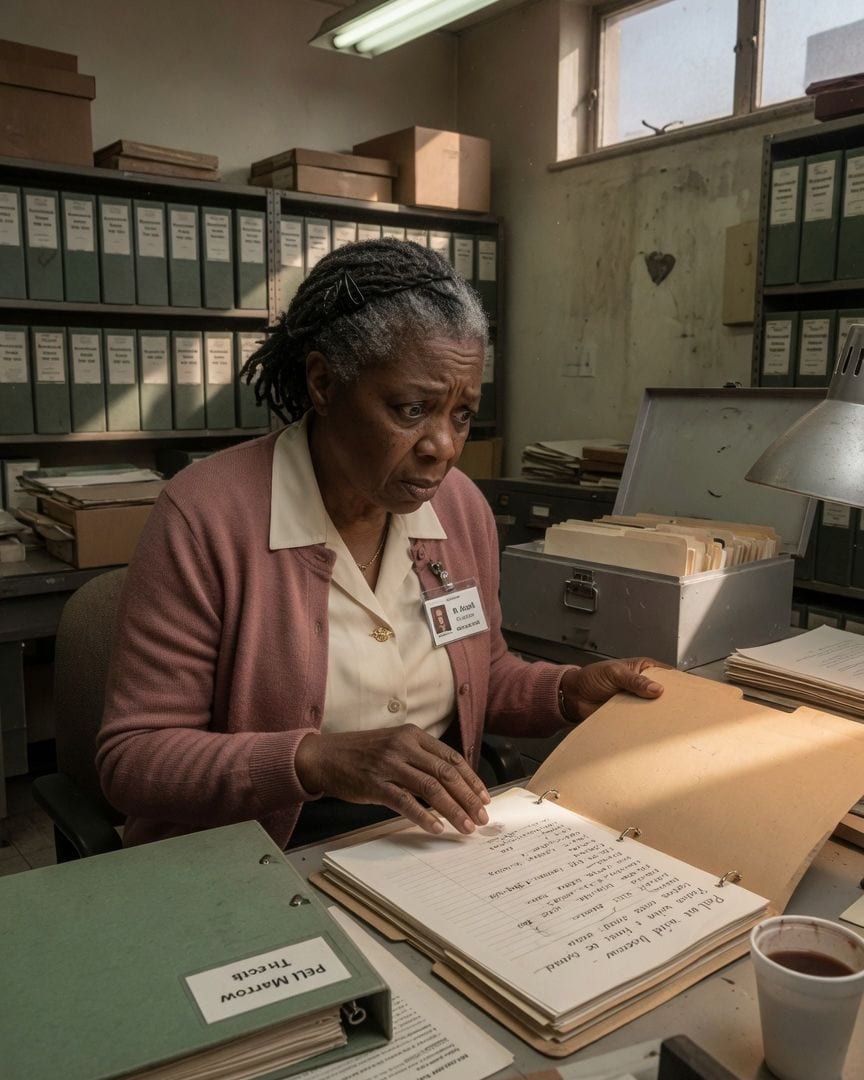
A records clerk's archive file for a Cold War reconnaissance plane lost in 1968 showed it flew yesterday to her own building.
Marguerite Ansell, a records clerk nearing her final week before retirement, meticulously audited Cold War-era files. In the cool, dusty archive, she pulled a file for an oiler declared missing in 1951. Inside, she found a fueling schedule with entries stretching into the present, the last dated just eleven days ago. Then, a second lost ship revealed a similar impossible log, and a cold certainty began to bloom in her chest. Deep in the shadows, Marguerite found an unmarked steel box containing a file for a reconnaissance plane lost in 1968. Its flight log showed a final flight yesterday, to the precise coordinates of her own archive building.
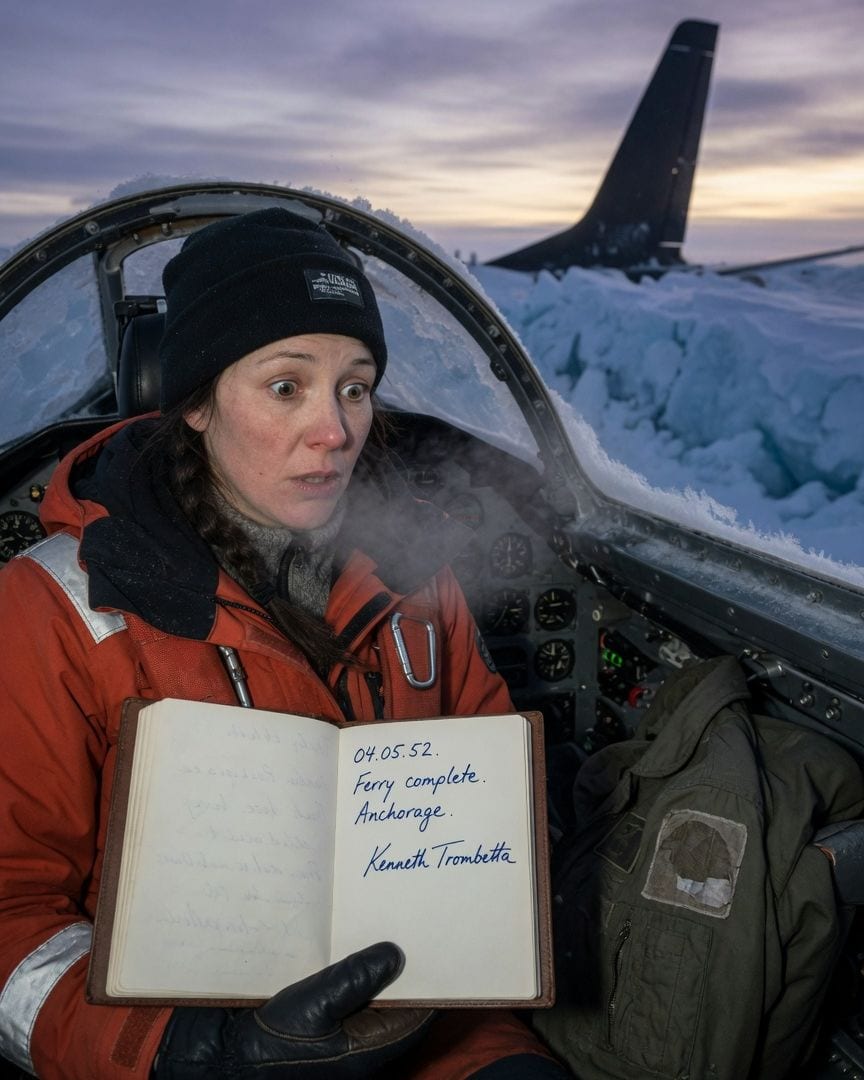
A geologist found her grandfather's lost fighter jet in the Bering ice. Its flight log showed his own hand signing off on a landing three days after he vanished.
Geologist Faye Trombetta had only a two-week window on the Bering ice before the pack closed, but she found more than ice cores. A black fin of metal, impossibly upright, rose from a pressure ridge: the tail of an F-86 Sabre jet, like the one her grandfather vanished in over that very sea. Approaching, she found the jet impossibly preserved, gleaming under the weak Arctic sun, its cockpit pristine and smelling faintly of new leather. Her heart hammered as she saw the tail number matched her grandfather's lost aircraft, then discovered his own unmistakable signature in the logbook on an entry dated three days after he was declared missing.
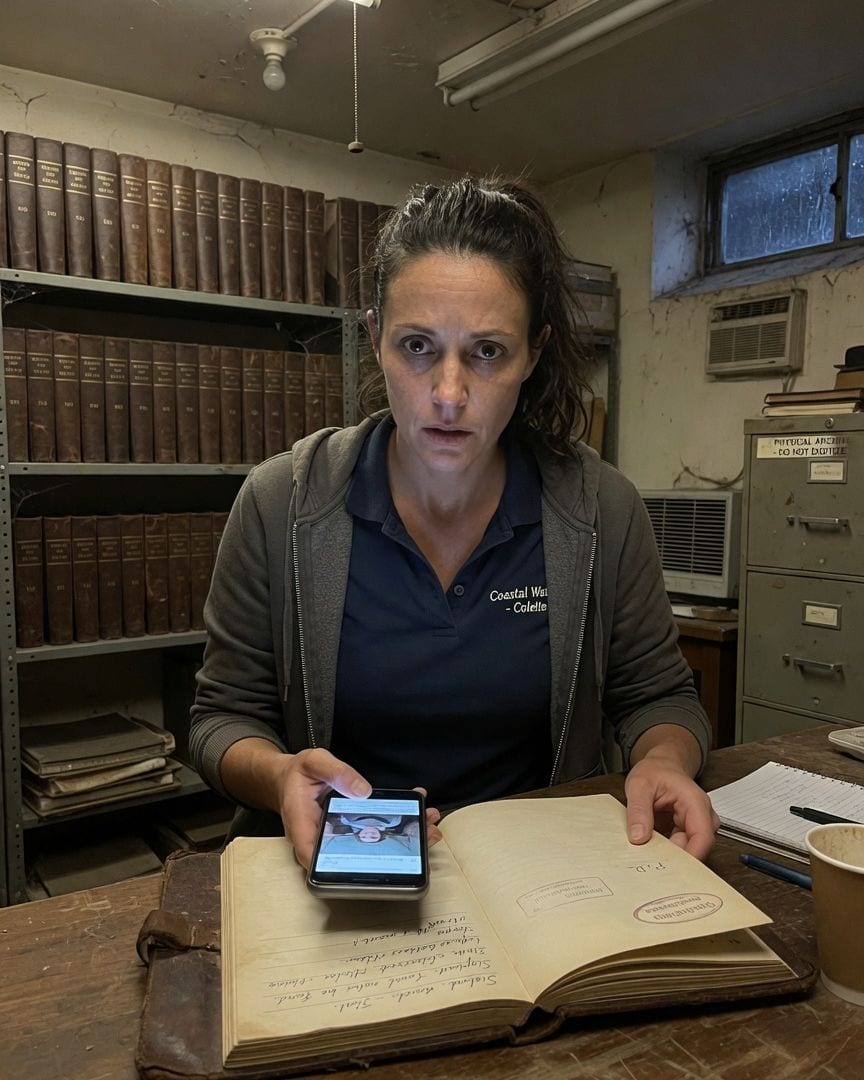
My coastguard log noted Sighting 9 again tonight, a light where no vessel showed. The old logs carry Sighting 9 off Skerry Point at 3:14am every tenth year since 1954, always 'nothing found,' always 'send no boat.'
On my watchtower night shift, the radar screen glowed green and the ocean was quiet. Then, a familiar light appeared off Skerry Point, exactly on cue, just as it had every tenth year for decades. But digging deeper, I found a hidden stamp in an old logbook: 'Operation Skerry. Status: Complete.' It left me with a chilling sense of finality.
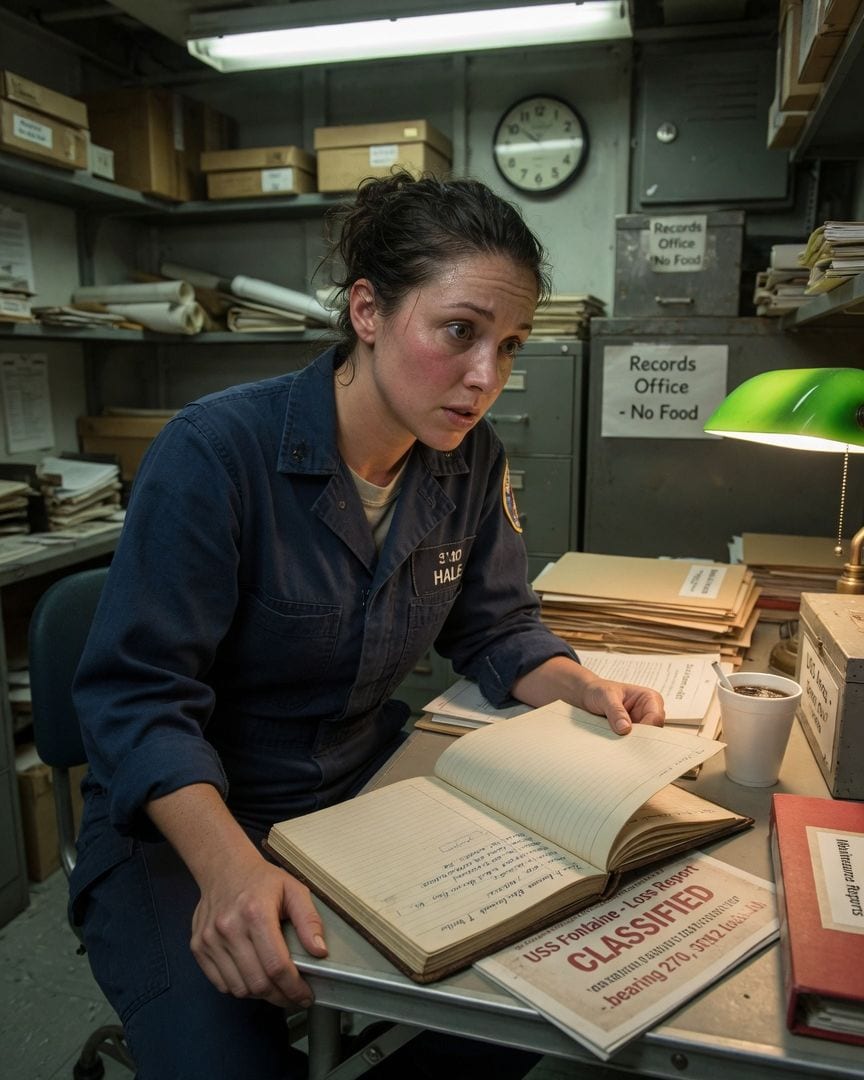
Petty Officer Hale needs a spotless record for her transfer. But the USS Ares sonar logs show an identical, impossible contact, logged to the minute, years apart, and tied to a classified loss report.
Petty Officer Sarah Hale needed a spotless record for her coveted shore duty transfer, a posting she'd worked five years to secure. Alone in the USS Ares sonar shack, three days out from San Diego, her midwatch was broken by an impossible contact: a close, slow echo holding perfect pace, invisible to radar, then vanishing. Her heart hammered, not from fear, but from the data's impossibility. When she found an identical entry in her own log from just one week prior, the cold dread tightened its grip. But the true chill settled when she unearthed decades of similar records, signed by other sonar officers, all showing the same impossible contact at 0212, off the port beam, for nineteen minutes, on the same ship, stretching back years—a persistent echo tied to a classified loss report.
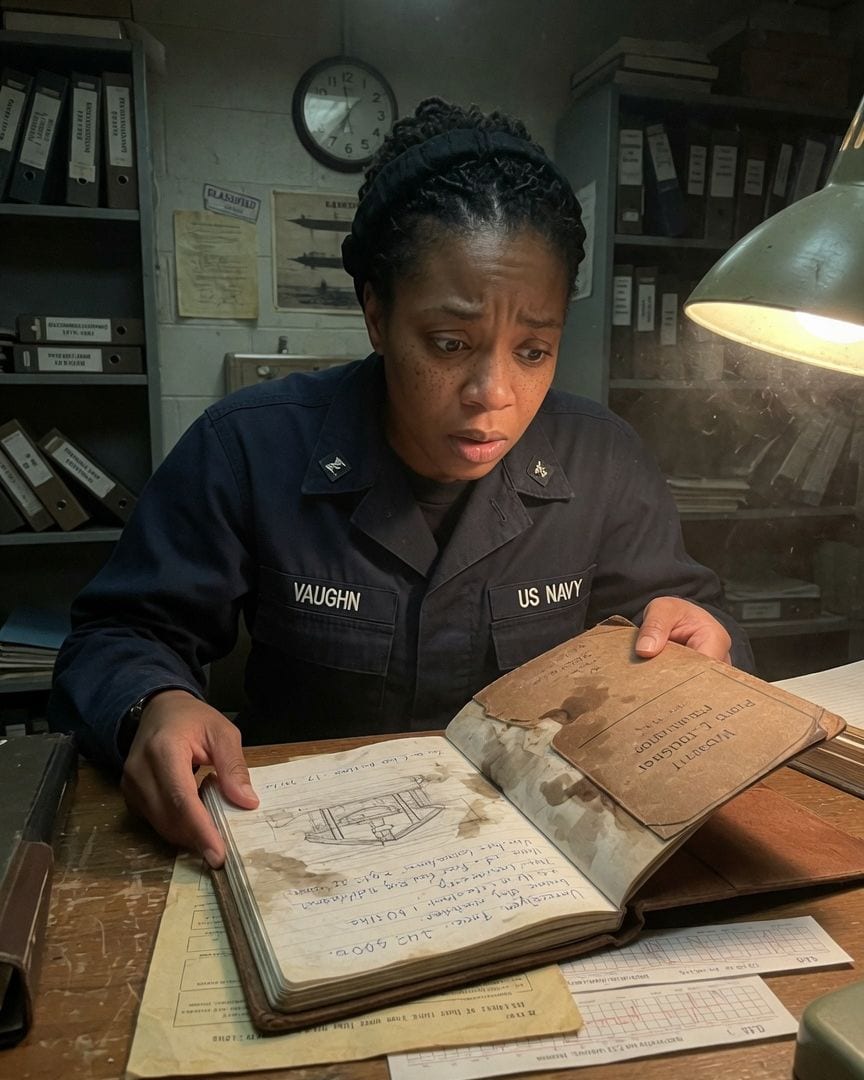
A Petty Officer's sensor logged a man-sized heat bloom at 0405. The camera saw nothing, and a journal from 1978 logged that same trace, then a Cold War Petty Officer gone MIA.
Petty Officer Rose Vaughn knew the meticulous order of Naval Submarine Base Bangor's pier by heart, especially her midnight watch routine. Every night at 0405, her IR sensor logged a man-sized heat bloom moving along the concrete path, vanishing at the pier's edge, but the watch camera showed only empty mist. This phantom warmth had walked the identical path for five years, yet the supposed steam line beneath it had been cold and dry for over a year. Her unofficial investigation led her to a faded 1978 journal, where a vanished Petty Officer, F. Pennington, logged an 'unresolved trace' at the exact same coordinates and 0405 hour, just before he went MIA. The system swore it was there, but the world swore it wasn’t – what was walking the pier, decades after it was lost?
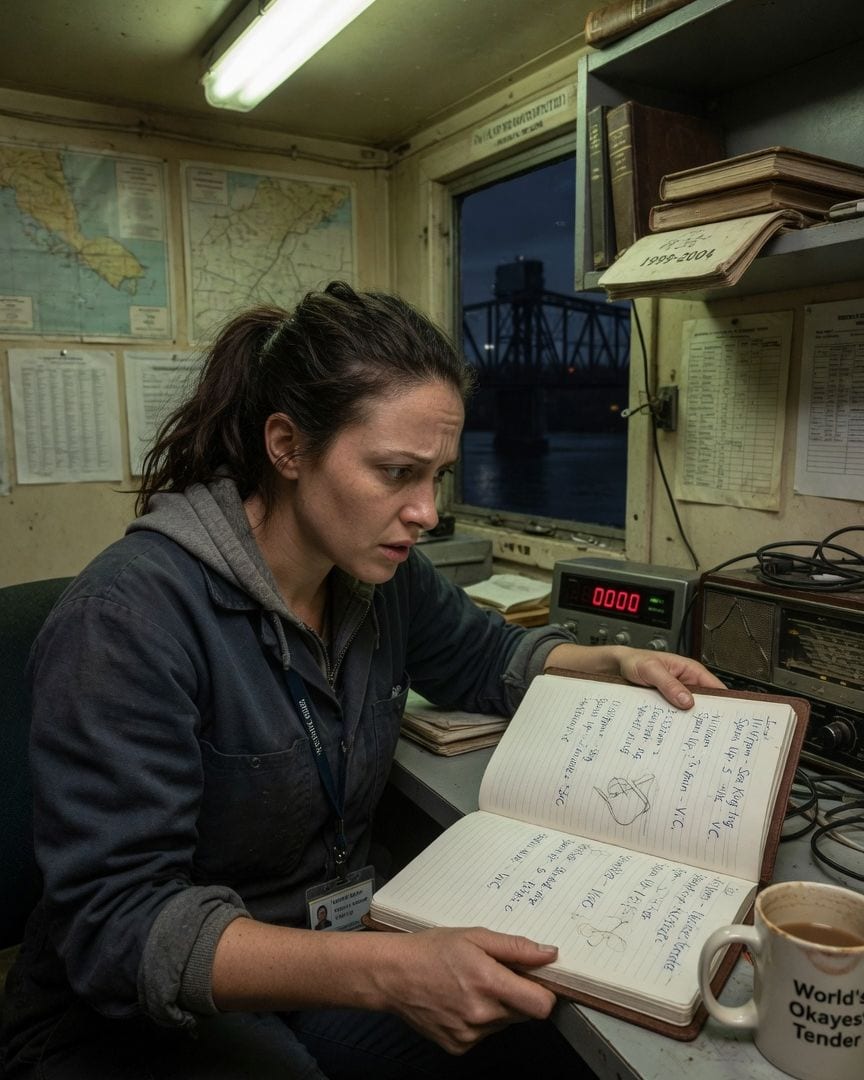
My drawbridge log shows a 2:33am lift I didn't make. The span counter never moved.
As a drawbridge tender, my midnight to dawn shift is usually quiet, a routine of monitoring traffic and logging lifts. But tonight, my own logbook shows an impossible entry for a bridge lift I have no memory of making. My initials and handwriting are there, yet the span counter above my panel reads a steady zero. No boat called, no span ever went up.