A geologist found her grandfather's lost fighter jet in the Bering ice. Its flight log showed his own hand signing off on a landing three days after he vanished.
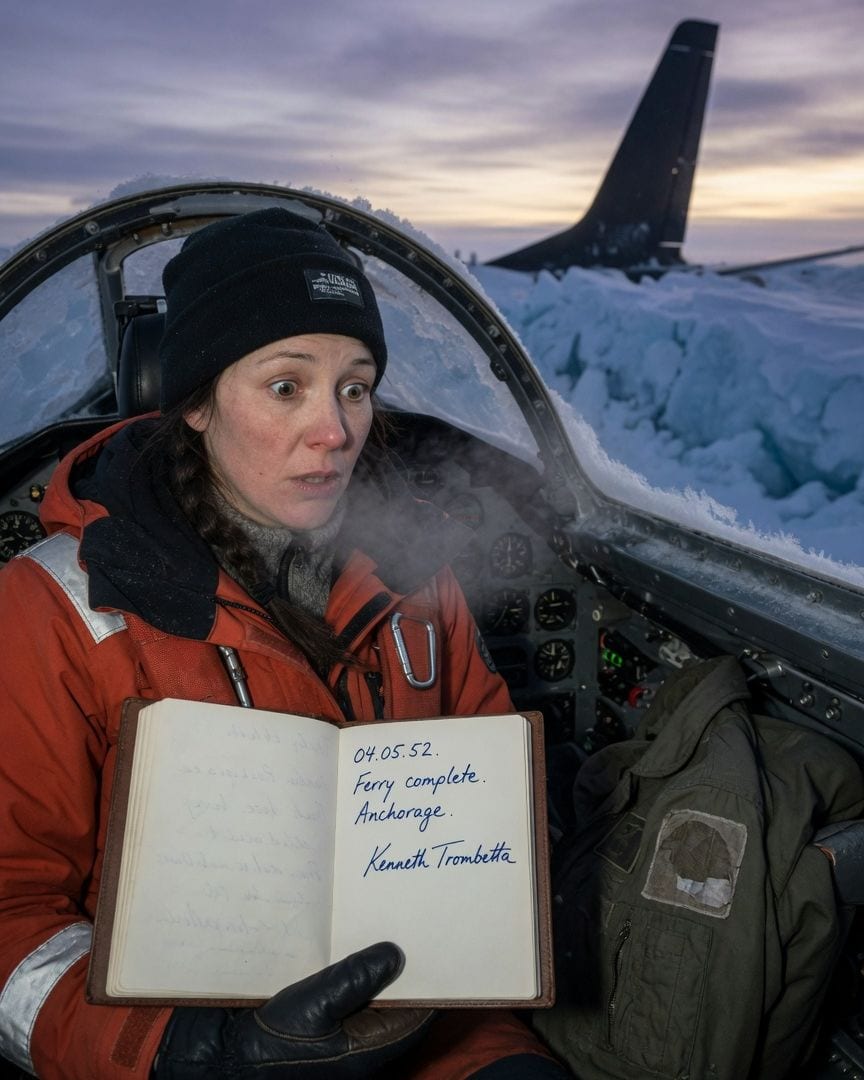
Geologist Faye Trombetta, on her two-week window before the Bering ice pack closed, spotted it: a black fin of metal, impossibly upright, rising from a pressure ridge.
It was the tail of an F-86 Sabre fighter jet, the same type her grandfather, Kenneth Trombetta, had flown in Korea before vanishing on a ferry leg over this very sea.
She’d come for ice cores, but the sight froze her. A deep tremor ran through the ice under her boots, a low groan, like the ancient sea itself was making its disapproval known.
Landing her helicopter nearby, she approached the anomaly on foot. The jet was impossibly preserved, the metal gleaming under the weak Arctic sun. The canopy was closed, intact, and the cockpit appeared dry.
Through the plexiglass, she could make out the gauges. Her breath hitched. The fuel indicators on the instrument panel read full.
Faye’s breath misted in the cold air as she circled the fighter. The tail number, stenciled in faded but legible black, matched the last known aircraft assigned to her grandfather. Her heart hammered, an irrational hope warring with stark disbelief.
It was a trick, of course. A salvage operation, perhaps, a training exercise, some forgotten stunt.
She tried to dismiss it, but the pristine sheen of the metal, the sheer wrongness of it standing there, defying time and rust, kept her rooted.
With a gloved hand, she carefully worked the canopy release. It hissed, dry and smooth, as if recently serviced, then slid back with an unnerving ease.
The cockpit was immaculate, not a speck of dust or ice, the air still, cold, but strangely fresh. It smelled faintly of leather and something metallic, like a new car, not a relic submerged for seventy years.
On the pilot’s seat, a flight jacket lay folded, its olive drab faded but remarkably intact. Beneath it, a pristine, leather-bound flight logbook.
She recognized the jacket immediately: a specific, careful patch on the left sleeve, a precise rectangle of slightly darker fabric, a repair her grandmother had described in detail.
A patch Kenneth had sewn himself after a snag on a hangar door. Her hands, despite the cold, felt clammy as she reached for the logbook. Its pages were crisp, the ink unsmudged.
She flipped past entries detailing training flights and combat patrols, all meticulously recorded in a familiar, precise hand. A hand she’d only ever seen on old letters and birthday cards from her childhood, always a little too neat, too deliberate.
Faye’s gaze snagged on the last entry. The date leaped out at her, an impossible sequence of numbers that made her stomach clench. Her grandfather, Kenneth Trombetta, had been officially declared missing in action on May 1st, 1952.
The final, neatly penned line in the logbook read: '04.05.52. Ferry complete. Anchorage.' Below it, Kenneth’s signature, unmistakable, resolute. Three days after he vanished, his own hand had recorded his safe arrival.
Faye immediately tried to report her find, the logbook clutched tight. Her expedition lead, Simon Rutherford, a grizzled veteran with sun-baked skin and eyes that had seen too much ice, listened with a skeptical frown.
He dismissed it as a misidentification, a trick of the ice, or a logbook from a different plane. He suggested the tail number was common, the patch a coincidence. "People want to believe what they want to believe, Dr. Trombetta.
Especially when it comes to family," he’d said, his voice firm but not unkind. The metal walls of the prefab hut around them seemed to hum with his unspoken dismissal.
Faye pushed back, citing the impossible date, the pristine condition of the jet, the full fuel tanks. Rutherford simply reiterated the official story, the plane lost, the pilot gone. "The ice works in strange ways. Preserves things, yes.
But not like that."
Undeterred, Faye began her own research, using her geologist’s methodology for data collation. Back in her isolated camp, hunched over her laptop, she used the limited satellite internet to search declassified military records. She cross-referenced 'lost aircraft' and 'unexplained recovery.'
Slowly, a pattern began to emerge. Not just her grandfather’s F-86.
There were other cases: a patrol boat from the Vietnam era found in the Philippine Sea, decades later, its engines cool but perfectly preserved; a a B-29 bomber from the late 40s discovered in the Nevada desert, its crew compartment dry, its radios powered on, but transmitting only static.
Each case, officially dismissed as a fluke or a mistaken identity, shared a signature wrongness: inexplicable preservation, operational status, or impossible dates in recovered logs.
The official reports were riddled with inconsistencies, almost as if designed to obscure rather than explain.
Faye's requests for more specific declassified files, particularly those mentioning 'anomalous recovery,' were met with increasingly vague responses or outright denials. One morning, she found an anonymous email in her inbox, the subject line simply 'Ice.'
The body read: 'Let sleeping ice lie. Some things are better left buried.' A chill, colder than the Bering wind, ran down her spine, not from the temperature in her heated tent, but from the words themselves.
The screen seemed to glow with a sickly, knowing light.
The next day, as she tried to transmit a detailed summary of her findings to a trusted academic contact, her satellite comms system sputtered, then died.
It wasn't just a signal drop; the system itself seemed to have been forcefully reset, its diagnostic logs wiped clean. She felt profoundly isolated, the vast, empty ice pack suddenly less a wilderness and more a cage.
Later that afternoon, a faint drone echoed in the distance. A helicopter, not hers, passed high overhead, its dark silhouette visible against the pale sky, moving on an irregular course. It made no sense.
No other expeditions were in the area, and it wasn't a commercial flight path. The feeling of being watched, of being known, grew into a gnawing certainty.
Faye remembered an old university contact, Edmund Holloway, a retired archivist with a reputation for navigating government databases.
She managed to get a garbled message through to him on a backup satellite phone, carefully omitting sensitive details but hinting at her need for 'unusual recovery protocols.' A few days later, a reply came, a series of encrypted links.
Edmund had found a pattern: 'reclassification events' tied to certain 'lost' incidents. These weren't just declassifications; they were cases where files were moved to an entirely separate, highly restricted classification tier, often decades after the initial incident.
He'd even found a specific control number, a seven-digit alphanumeric sequence, that reoccurred across these reclassified files.
When Faye cross-referenced this control number, she discovered it consistently traced to an originating office code that had been officially dissolved in 1958. Yet, the control number continued to appear on documents dated as late as the early 2000s.
The files associated with this control number often contained phrases like 'asset recovery complete,' 'condition anomalous,' or 'storage protocols initiated.' It wasn't a clerical error. It was a system. The 'lost' were never lost. They were filed.
And the original reports, the ones dismissing the anomalies, suddenly re-meaninged themselves as deliberate, official misdirections, carefully constructed to maintain the illusion of loss. The air in her tent grew heavy, dense with a truth she wished she hadn't found.
Driven by a chilling premonition, Faye searched for her grandfather's name within the 'anomalous recovery' database. It took hours, sifting through layers of encrypted and mislabeled data. Her fingers cramped from gripping the mouse, her eyes burned from the screen.
Finally, she found it: a secondary file, not the publicly accessible one, but a 'reclassified' version of Kenneth Trombetta’s service record. It was heavily redacted, far more so than the public copy.
As she scrolled, comparing it to the other 'anomalous recovery' files, a detail emerged that made her heart seize. In several sections, where the public file had solid black blocks, this reclassified copy showed something else.
Not text, but a partial, irregular geometric pattern peeking through the black, like a broken symbol or a fragment of a complex diagram.
It was non-textual, almost organic in its asymmetry, and it was identical, pixel for pixel, in every 'anomalous recovery' file she had open.
She traced the edge of the blacked-out area in a declassified memo from 1968, then overlaid it on another from 1974, and a third from 1981.
The irregular, non-textual shape, a precise, repeating pattern, was identical in every one, a silent, impossible signature.
The irregular shape, repeating across decades and classifications, snapped into a horrifying coherence. It was a symbol, a logo, or perhaps even a stylized representation of whatever entity was behind the 'filing.'
Faye found a heavily redacted memo from 1970, marked 'INTERNAL USE ONLY – PROJECT ICEPICK.' Its remaining fragments spoke of 'asset maintenance' and 'storage protocols for recovered units.' The words felt cold, clinical, chilling her to the bone.
It became clear: the secrecy machine wasn't just covering up; it was actively involved in a process of 'recovery' and 'maintenance.'
The full fuel in her grandfather’s jet, the dry cockpit, the impossible log entry – these weren’t anomalies of time or ice. They were hallmarks of a system that took, preserved, and then, occasionally, returned.
Her grandfather hadn't just disappeared; he had been 'filed.' The F-86 she found wasn't a wreck; it was a 'filed asset' that had been released, its 'maintenance' complete, for reasons Faye couldn't fathom.
The pattern was monstrous, not because it was evil, but because it was so utterly coherent, so bureaucratic in its horror. It wasn't a secret; it was a process.
And she realized with a sickening lurch that she, too, was now part of its file.
Faye’s two weeks were almost up, the ice pack beginning its final, inexorable shift. The ice groaned and creaked outside, a living, hungry sound. Her helicopter pickup was scheduled for dawn. She had to get out.
She tried one last time to transmit her full report, attaching the images of the redacted shape and the cross-referenced files. Her comms system, which she'd managed to partially restore, sputtered and died again, the signal flatlining.
This time, there was no mistaking the deliberate interference.
Outside, the light was fading, casting long, blue shadows across the ice. In the distance, a figure moved.
Too far to make out details, but it was unmistakably human, and it was moving towards her camp with a slow, relentless stride that spoke of purpose. It wasn't a search and rescue team. It was the 'watcher.'
Faye scrambled, grabbing her essential gear – the logbook, her satellite phone, her hard drives. She could hear the faint, crunching sound of footsteps on the frozen snow, growing steadily louder.
Her helicopter was still a quarter mile away, tethered to its landing pad. She didn't look back. She ran, the weight of the files, the shape, the impossible truth, pressing down on her.
The figure was closer now, a dark silhouette against the deepening twilight. She reached the helicopter, fumbling with the ignition, the rotors slowly beginning to turn, a desperate whine against the vast silence of the ice.
The figure was almost at the camp’s edge, its presence a cold, undeniable dread. She pulled the collective, the helicopter lifting off just as the first shadow stretched across her abandoned tent.
Faye made it back to civilization, her story dismissed by her superiors as 'isolation-induced hallucination' and 'data corruption.' Her academic grants were mysteriously pulled, her research funding frozen.
She tried to publish her findings independently, but her data files, even those on encrypted backups, were either corrupted or vanished. The 'secrecy machine' worked silently, efficiently, leaving no trace.
The F-86 Sabre was never officially recovered; the ice pack had closed over it, erasing it from the map once more. The official file on Kenneth Trombetta remained closed, 'Lost in Action.'
Faye Trombetta returned to her quiet life, but the world was no longer the same.
She saw patterns everywhere: in the strange regularity of news reports, in the bureaucratic language of official documents, in the way certain 'cold cases' were quietly relegated to obscurity. The comfortable illusion of mundane chaos had shattered.
She knew what she had seen. She knew what was being done.
The ice had closed, but the file was still open.
If this one got to you
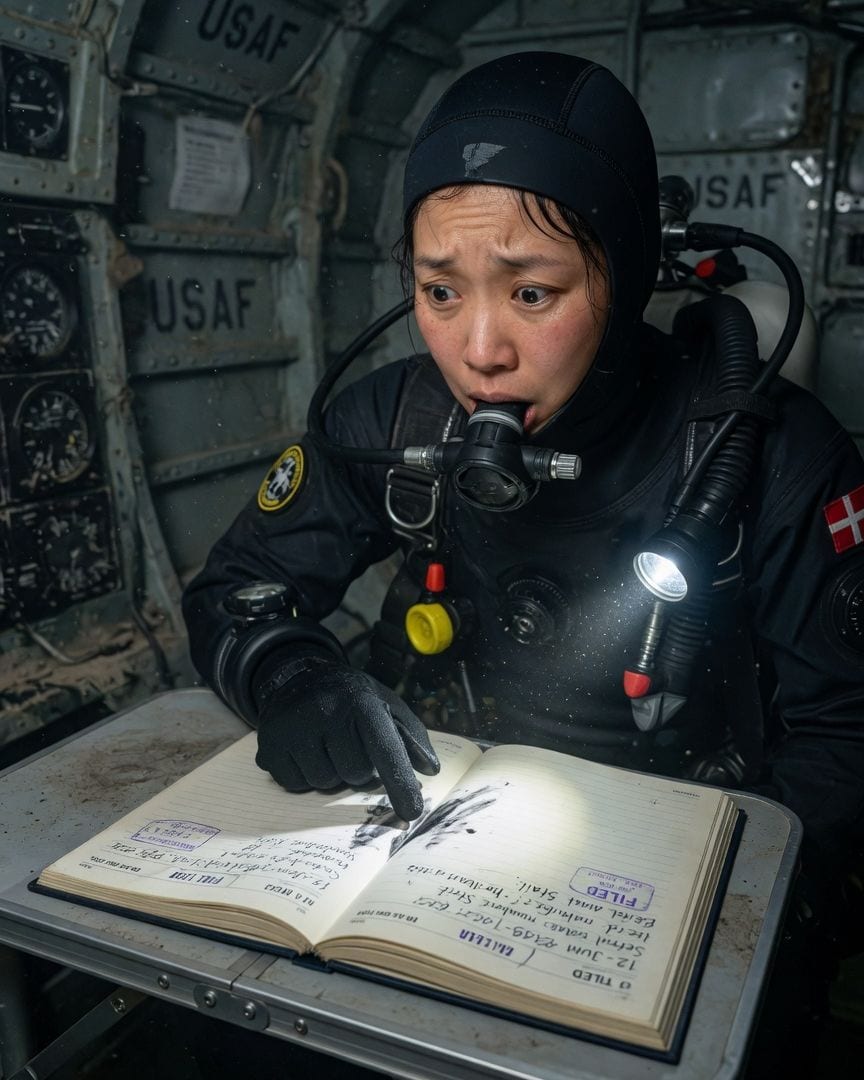
A deep-sea diver finds a Cold War bomber's logbook open to today's date. Her father's service number is 'FILED' in its wet ink, reflecting her face.
Yuki Ammann descended into the crushing dark of the Denmark Strait, her nine-hour bottom window stretching ahead. She hoped for a glimpse of the lost B-52 bomber her father spoke of, a relic of a vanished crew. Instead, her sonar painted a perfect profile: a pristine B-52, sitting upright on the continental shelf, dry inside. A logbook lay open on its flight deck, the last entry dated today, June 12, 2024. The ink was still wet. Could her father’s stories be more than just sailor’s myths?
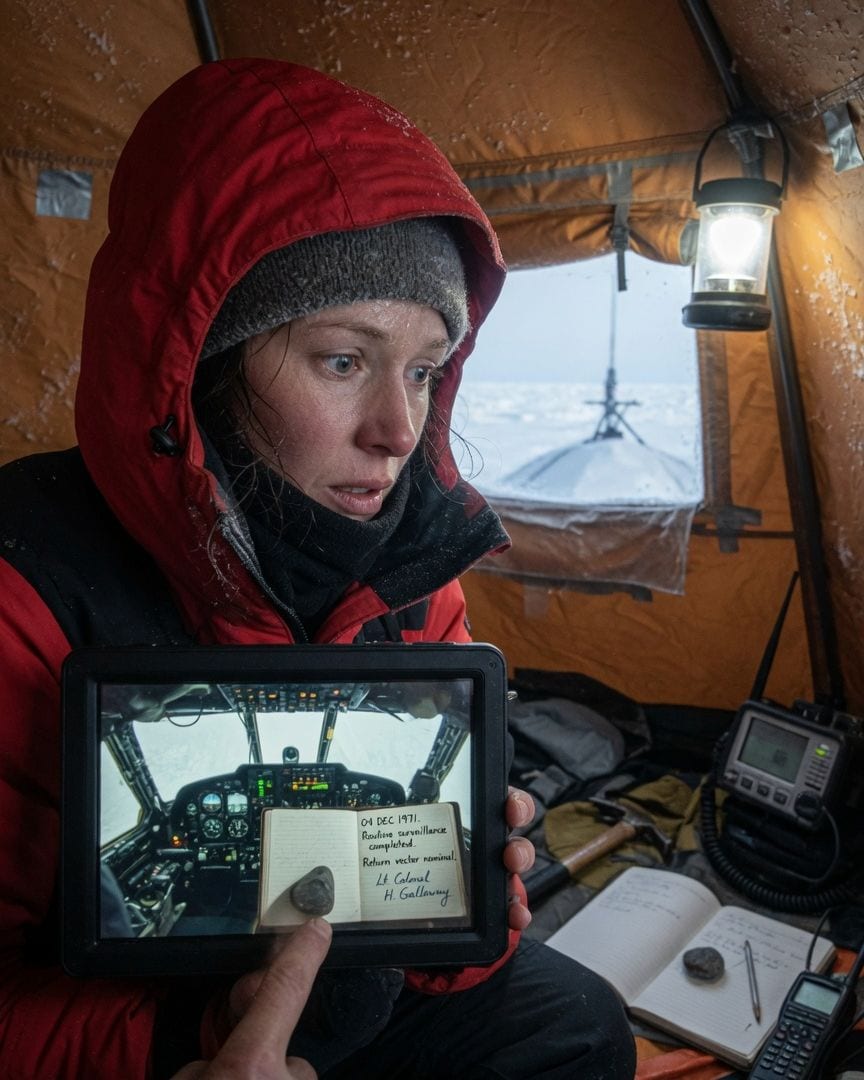
An explorer found a Cold War spy plane lost for sixty years beneath Greenland ice, but its pilot's log was dated almost a decade after it vanished.
Geophysicist Ines Faurholt pushed her ski pole into the Greenland ice, the sub-zero wind biting at her brow during a white noon. What began as a routine expedition turned chilling when her ski struck an antenna mast, leading her to a Cold War spy plane entombed sixty feet below in decades of ice. Its navigation lights still glowed, a faint hum vibrated through the frozen depths, and an impossible digital clock in the cockpit meticulously kept time. But the true impossibility emerged from the pilot's logbook: an entry dated eight years after the aircraft and its pilot, Lt. Col. Hugo Galloway, were officially declared lost. How could a vanished pilot have logged a flight almost a decade after he disappeared?
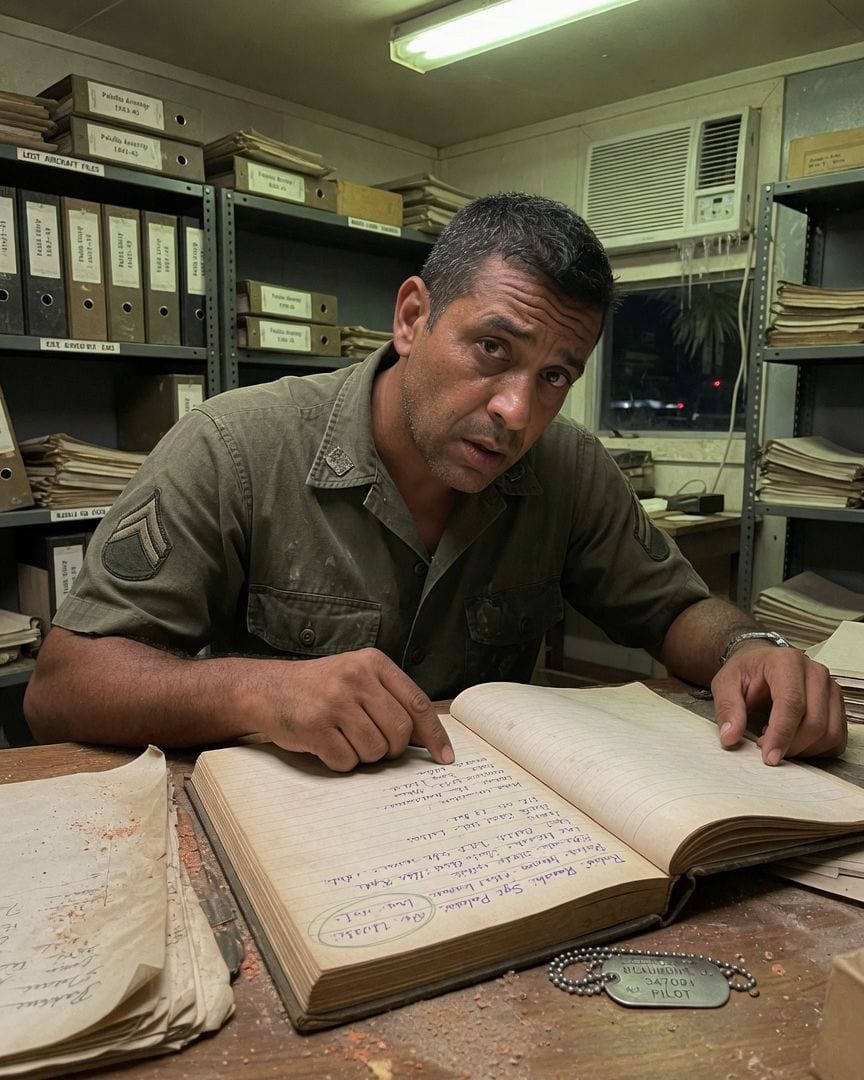
A sergeant's last watch on a forgotten outpost: His own name appeared on an 80-year-old crash manifest.
Sergeant Leon Pulaski spent his last night at the remote Peleliu Atoll Airstrip, its final closure imminent, listening to the rhythmic sigh of the Pacific. Just after 0330, a garbled distress call pierced the silence, requesting the field for a plane with a tail number, 'Ghost Two-Niner-Niner,' retired since World War II. Though Pulaski, disciplined and rational, logged the impossible call as a phantom, the crash crew later found a fresh gouge in the coral and a shard of cockpit glass, still warm, where no wreck existed. His quiet unease only deepened when he discovered a dog tag belonging to a pilot declared lost eighty years prior. But the true chill landed when he found his own name on that same eighty-year-old crash manifest.
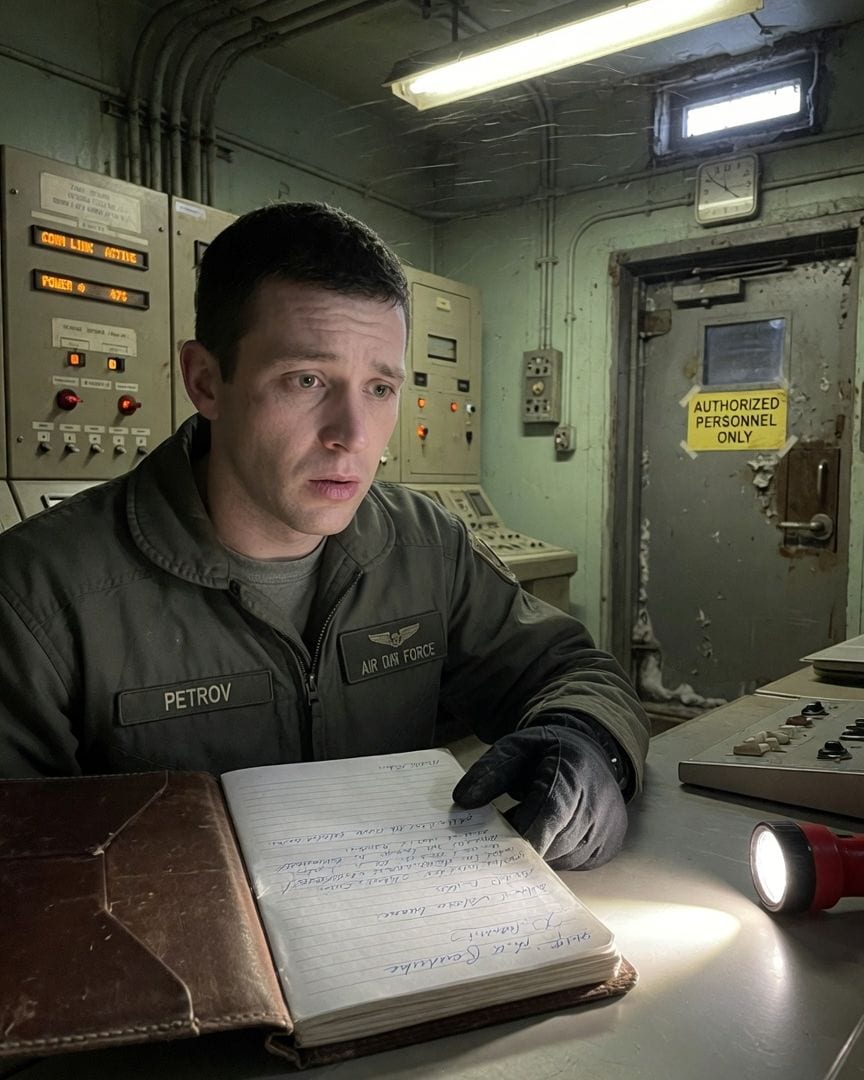
On his lonely watch at Site 73, Airman Petrov's logbook is signed by a man declared MIA forty years ago.
Airman Thomas Petrov squinted against the horizontal sleet, counting down his final two weeks at Site 73, a lonely decommissioned missile silo in North Dakota. His only job was to keep the comms humming, but a peculiar detail in the dusty control room logbook caught his eye. Open to today’s date, the meticulous entries were signed by a name he didn't recognize: A1C R. Fontaine. Petrov was the sole occupant, and official rosters confirmed no Fontaine had been assigned there for decades. As unease mounted, Petrov searched the bunker's forgotten levels, discovering a hidden locker holding a water-stained service record for Richard Fontaine, declared Missing In Action forty years ago. The faded signature in the record was identical to the fresh ink in the logbook. What chilling presence kept the logs current at Site 73?
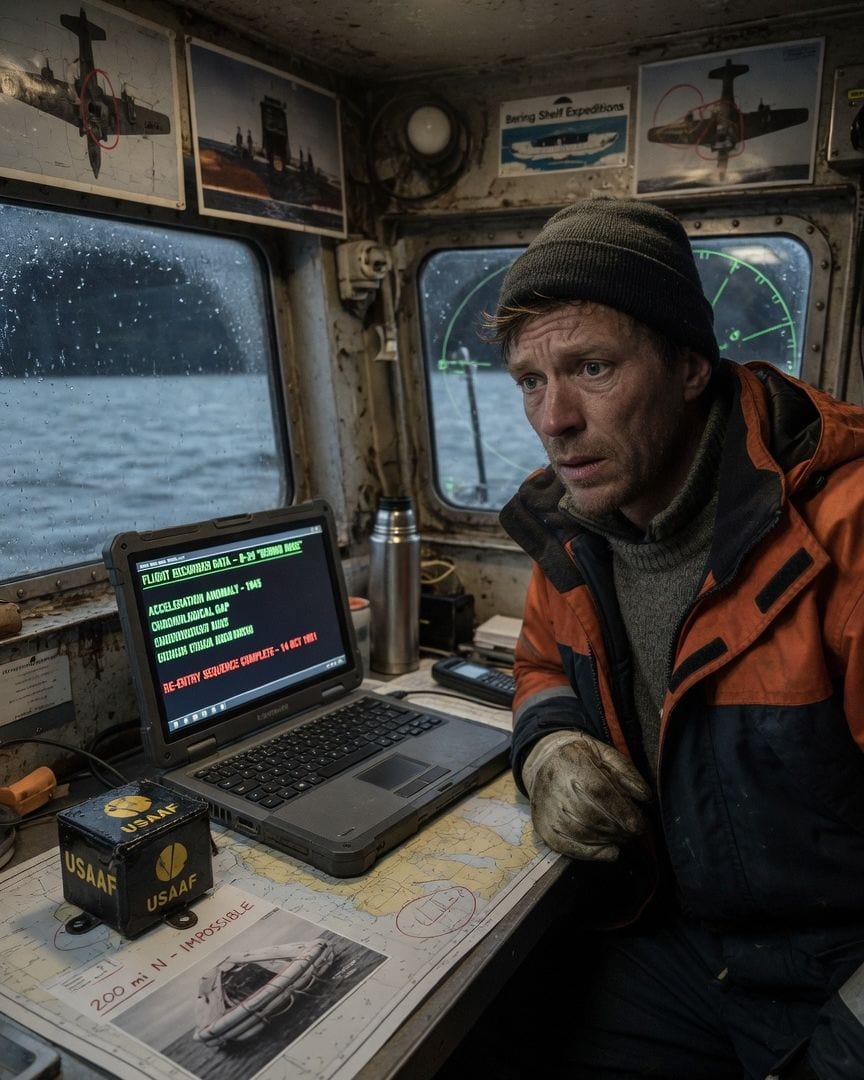
A wreck-hunter found the Cold War B-29 lost in 1945. Its upper escape hatch was open, from the inside.
Wreck-hunter Sten Höglund embarked on a decades-old promise to his 98-year-old aunt, seeking the B-29 bomber lost with eleven men in 1945. Deep on the Bering Shelf, his sonar found the 'Bering Rose' impossibly intact, a ghost in the mud plain. But the drop camera revealed a chilling detail: the bomber's upper escape hatch was not merely damaged, but wide open from the inside, and its life raft was gone. What impossible truth did the ocean hide from a crew that seemingly escaped a crash, only to vanish into the Bering Sea?
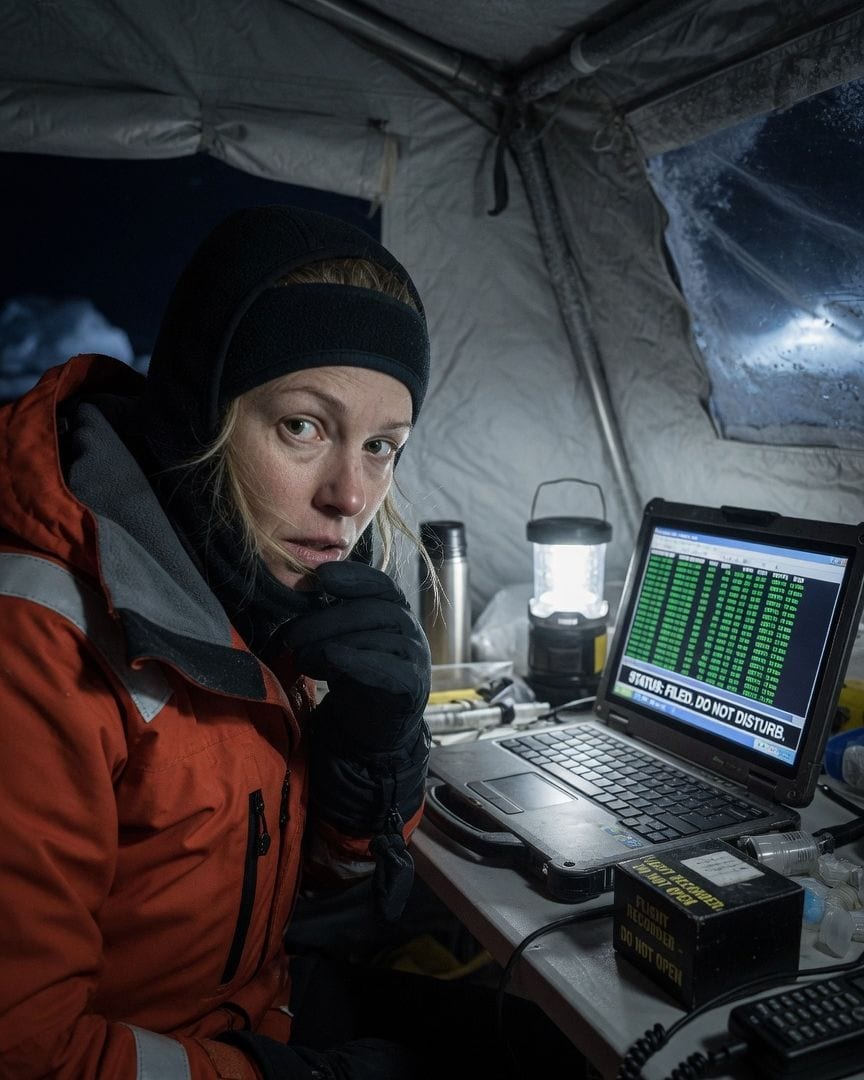
A glaciologist finds a Cold War plane 60 feet down in Greenland ice, its navigation lights still burning after sixty years.
Glaciologist Ines Faurholt skied across the vast, blinding Greenland ice cap when her path was abruptly blocked by a dark, corroded antenna mast. Beneath it, sixty feet down in ancient ice, a Cold War reconnaissance aircraft sat with its navigation lights eerily burning and its cockpit clock steadily keeping time. The sight was a violation of everything Ines knew about time and preservation in this frozen world. She called for a team, and days later, they extracted the plane's flight recorder, revealing data that showed the aircraft still flying years after its disappearance.