My bl**d type keeps changing. My old donor card says AB negative. Every test since has come back O positive. Doctors can't explain my own handwriting.
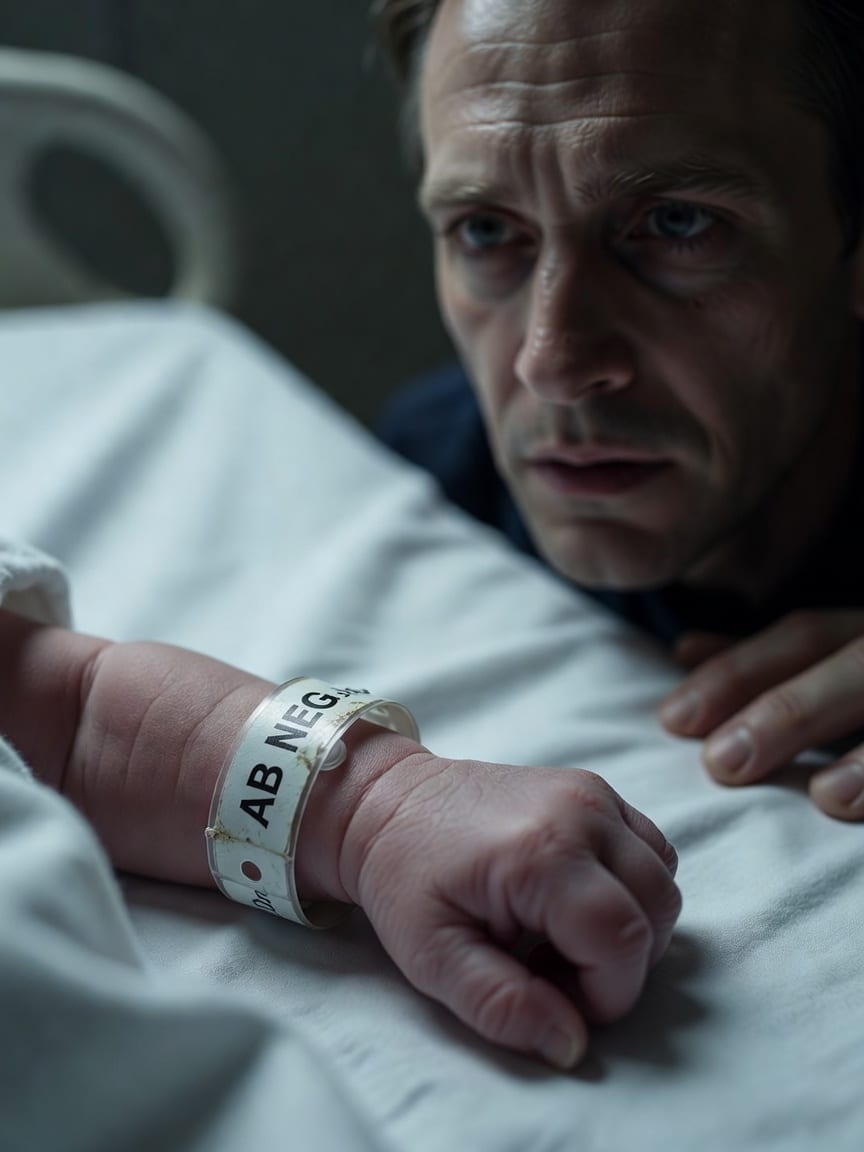
The sterile scent of antiseptic usually calms me, a strange comfort in its promise of control. Not today. I sat in Dr. Marcus Mitchell's office, my hands sweating, an old bl**d-donor card clutched tight.
It was mine, dog-eared and familiar, my own slightly shaky teenage handwriting proclaiming 'Genevieve Walsh – AB Negative' in black ink.
Dr. Mitchell, a man whose composure I’d always admired, leaned forward, the usual easy confidence gone from his face. He gestured to a stack of lab reports, pristine white sheets contrasting with my grubby card.
“Ms. Walsh,” he began, his voice tight, like a knot pulled too snug. “Every draw since has come back O positive. We’ve retyped you three times this week. Fresh samples. All O positive.”
I felt a cold dread spread through my chest, slow and insidious. It wasn’t just a clerical error; I understood bl**d. It was a physical impossibility.
My body, the one I’d lived in for thirty-eight years, my entire medical history, was telling two violently different stories. One of them, the one written on my old donor card, could not be true, not for me.
AB negative can't just become O positive. It just can’t. But there it was, my own hand, my own bl**d.
A relic of my youth, insisting on a bl**d type that could not have naturally changed to what I am now.
Back home, the discrepancy gnawed at me like a persistent ache. I started sifting through boxes of my late mother’s belongings, hoping for a clue, any explanation for this impossible fact.
Her things were organized chaos, a lifetime contained in labeled boxes in the attic. I found my own baby photos, a lock of dark hair tied with a pink ribbon – mine, undoubtedly.
Then, tucked deep beneath yellowed christening gowns, in a box marked 'Genevieve - Infant', I found it. A worn baby blanket.
It was soft, faded blue, so thin in places you could almost see through it. My fingers traced the intricate stitching of a single, looping initial: a 'V'.
I remembered it vaguely, always in my crib, then later relegated to a toy chest. But my name starts with a 'G'.
My mother had always said, in that gentle, evasive way she sometimes had, “That’s your special blanket, darling,” but she never explained the initial. It felt wrong, out of place, a quiet anomaly I’d never questioned as a child.
A detail out of context.
I pulled out my own baby book, a thick, pastel-colored tome filled with my mother’s proud scrawl. No 'V'. No mention of another child, no twin, no sibling. Just page after page of me, Genevieve, a single, healthy infant.
The blanket, soft against my fingers, now felt heavy with an unspoken history, like it was whispering a name that wasn't mine.
The blanket’s quiet insistence, combined with Dr. Mitchell’s bewildered frown, spurred a sudden, chilling intuition. If my mother had withheld information about a blanket, what else? I needed to see my original birth certificate.
It was tucked away in an old metal strongbox, buried under old deeds and insurance policies. Inside, nestled beneath the folded paper, I found not just the certificate, but a sealed, cream-colored envelope.
It was brittle with age, marked in my mother’s looping hand: 'Hospital Records - DO NOT DISCARD'.
My hands trembled as I carefully broke the seal. Inside was a single, faded sheet of paper – an early hospital birth record. My name, 'Walsh, Genevieve,' was printed clearly at the top.
My date of birth, October 12, 1986, was correct. But beneath 'Bl**d Type:' it read, in stark, undeniable print, 'AB Negative.' Next to it, a handwritten note, almost erased, barely legible: 'Transient Chimerism? See Ref. #44-A.'
The reference number didn't match anything in my official medical ID, which I'd pulled from my wallet to compare. It was an orphan number, without context.
I stared at the faded hospital record, my thumb tracing the unfamiliar bl**d type. The name 'Walsh' was undeniable, my birthdate correct. But the bl**d type, AB Negative, was equally clear, right next to a cryptic, almost erased note.
It's a record of her, and it insists she was someone else.
The 'Ref. #44-A' haunted me, a tiny, impossible detail on a decades-old document, now burrowed deep into my mind. I returned to Dr. Mitchell, the faded record feeling like a physical weight in my hands.
I laid it on his desk, the fluorescent light of his office illuminating the impossible letters. He frowned, pushing his glasses up his nose, examining it closely.
“This is… highly unusual, Ms. Walsh,” he murmured, his voice low. “'Transient chimerism' is a rare condition. It’s when an individual carries cells from another, often a twin, temporarily.
But for it to be recorded so early, then seemingly vanish… and for your donor card to reflect it decades later…” He shook his head, a gesture of profound bewilderment.
“It suggests a deeper, more persistent presence than 'transient' would imply.”
He agreed to help me search for the reference, suggesting the hospital archives. The next day, I found myself in the musty, silent basement of St. Jude's Hospital, the place of my birth.
The archives were a labyrinth of towering, steel shelves, each groaning under the weight of forgotten histories. The air felt heavy, as if holding its breath, thick with the scent of old paper and dust.
The archives were overseen by Ruth Lockwood, a woman with neat grey hair pulled back in a severe bun. Her demeanor was unnervingly calm, her eyes sharp and knowing.
She didn't bat an eye at my request for decades-old, obscure records. “Ref. #44-A, you say? From 1986? I remember that period. Busy year.” Her voice was flat, devoid of curiosity, almost as if she’d been expecting me.
My skin prickled.
Ruth Lockwood moved with quiet efficiency through the towering shelves, her presence almost ghost-like between the stacks. I felt an unsettling prickle on my skin, a sense of being observed, not with malice, but with a deep, unsettling knowledge.
It wasn’t a look of recognition, more like… I’d been expected. Or perhaps, that she knew what I was looking for before I even asked.
The fluorescent lights hummed overhead, a cold, clinical sound that seemed to mock the warmth of human curiosity.
After several minutes of rustling through ancient index cards and dusty binders, Ruth pulled out a thick, leather-bound ledger. The cover was cracked and worn, its edges smoothed by countless hands.
“Ah, here we are,” she said, a soft, almost triumphant note in her otherwise flat voice. “Case files from ‘86. Many unusual cases that year.” She flipped through pages, her finger stopping on an entry.
I leaned closer, my heart thumping against my ribs. The entry for Ref. #44-A was brief, clinical, written in a cramped, formal hand. It mentioned 'Infant Walsh' and 'Infant Thatcher,' followed by 'shared placental anomaly.'
Then, chillingly, a note about 'partial cellular integration' and 'bl**d type discrepancy'. Below it, a single, typed comment, perfectly centered: 'Resolution: Infant Thatcher deceased. Infant Walsh stable. Records adjusted.'
Ruth closed the ledger with a soft thud that echoed in the quiet space. “There you have it,” she said, as if she’d just confirmed a minor appointment. “A very rare occurrence. Nothing to worry about now.”
Her eyes met mine, calm and unblinking. It wasn’t a warning, not exactly, but a statement of fact, delivered with the cold authority of someone who knew exactly what she was saying, and expected no further questions.
I felt like I’d been found out, not for what I was doing, but for what I was.
I returned to Dr. Mitchell’s office, the ledger entry burning in my mind, the names 'Infant Walsh' and 'Infant Thatcher' echoing in my head. “Infant Thatcher,” I whispered, placing the ledger details on his desk. “Who was Vivian Thatcher?”
Dr. Mitchell looked grim. He’d clearly been doing his own digging. “I took the liberty of cross-referencing that name from the ledger with local birth and death records.
Vivian Thatcher was born in St. Jude's just weeks before you, Ms. Walsh. She died shortly after, listed as 'failure to thrive'.” He paused, rubbing his temples. “Her bl**d type, according to her death certificate, was AB negative.”
The pieces clicked into place with terrifying precision. The AB negative card from my youth. The 'V' blanket, a silent witness. The cryptic hospital record, speaking of chimerism. It wasn’t a mistake on the card, or a childish fancy.
It was a ghost. A forgotten history, now whispering through my very cells.
“I’ve ordered a comprehensive genetic screening,” Dr. Mitchell continued, his voice softer now, more cautious. “To rule out any underlying condition. But given this…” He gestured to the ledger entry, then to my old record.
“We need to investigate the possibility of chimerism more deeply. True chimerism, not just transient.”
I felt a profound shift within me, a dawning horror that was both intellectual and deeply, physically unsettling.
My body, the one I’d always known, the one that responded to my thoughts and carried me through life, was not entirely my own. A part of me was another. A child who had died.
The bl**d that ran through my veins, in some forgotten corner of my past, had once belonged to Vivian.
The implications were staggering, reshaping my entire understanding of myself, a self that the official record now insisted was not quite the self I’d lived in for nearly four decades. It wasn't a question anymore.
It was a fact, as cold and hard as the hospital ledger.
Days later, the results of the genetic screening arrived. Dr. Mitchell called me into his office, his face pale, his usual composure completely gone.
He held a printout in his hand, a sheet covered in a dense thicket of scientific jargon, but his finger pointed to one simple, horrifying line. “Ms. Walsh, your mitochondrial DNA…” He trailed off, taking a deep, shuddering breath.
“It shows a partial but undeniable match. To Vivian Thatcher.”
I felt the floor drop out beneath me. “Vivian Thatcher? The child who died?”
Dr. Mitchell nodded slowly, his eyes wide and shocked. “A sample of her tissue was preserved for research, given the unusual circumstances of her passing. Your mitochondrial DNA… it's consistent with hers. This is beyond rare, Ms. Walsh.
It suggests you absorbed her cells, perhaps in utero, or during the earliest moments of life. You are, in a biological sense, a mosaic of two individuals.”
He pushed a faded municipal map across the desk, a small red circle marking a spot. “Vivian Thatcher is buried in Section C of the old municipal cemetery.
The lab stands by the result, stating it's a rare mosaicism or chimerism. But the name on the headstone is clearly Vivian.”
The lab technician, voice clinical but strained, confirms the mitochondrial DNA match. 'It's… consistent with Vivian Thatcher,' he says, 'from a sample collected post-mortem in 1986. A rare, complex mosaicism, Ms. Walsh. But it's there.
A part of her, inside you.'
I stood before Vivian Thatcher's small, weathered headstone in Section C of the old municipal cemetery. The marble was stained with lichen, the carved letters softened by decades of rain and sun. The date of birth, October 1, 1986.
The date of death, November 15, 1986. Her own birth year. My birth year. I felt a profound, almost physical connection to the cold stone, a sense of shared breath that transcended the silence of the grave.
Later that week, I confronted Ruth Lockwood again, not in the quiet archives, but as she was leaving the hospital for the day. “Vivian Thatcher,” I stated, my voice steady, though my hands were clenched in my pockets.
“The child whose DNA is now partly mine. The child who died weeks after I was born.”
Ruth sighed, a calm, almost weary sound, as if she’d been waiting for this conversation for thirty-eight years. She didn’t look surprised, or scared. “A difficult time,” she said, her eyes fixed somewhere beyond me, on the distant hospital entrance.
“There were… complications. A shared placenta, a compromised twin. Vivian was weaker. They tried to save them both, but…” She gestured vaguely, a small, tired flick of her wrist. “The doctors, they were young. Experimental.
They believed the stronger infant, you, would benefit from the cellular integration. A desperate measure, Genevieve. To ensure at least one healthy life. They adjusted the records to minimize the trauma. To ensure you had a clean start.
Your bl**d type, that AB negative, it was Vivian's. For a while, it was yours too. We thought it would fade entirely, leave no trace.” Ruth looked at me then, her expression unreadable, calm. “It was decided for the best.
To let one live, fully.”
The worn 'V' on the blanket, the early AB negative record, the donor card with my own handwriting, the chilling mitochondrial DNA match – it all coalesced into a chilling, coherent truth. I wasn’t just Genevieve.
I was also, in part, Vivian.
The truth settled over me like a shroud, heavy and inescapable. I was not a victim of some monster, but of a desperate, long-buried medical decision.
Ruth Lockwood, the 'one who knew,' offered no apology, only a quiet explanation of the context – the fear, the experimental nature of early neonatal care, the agonizing desire to ensure at least one healthy life.
There was no one to fight, no evil to conquer, no escape from this biological reality. The doctors involved were long retired or deceased. The institution itself had changed hands multiple times, the old records gathering dust, almost forgotten.
The truth was understood, a crystal-clear horror, but it could not be undone. I walked through my life, touching my own skin, feeling the subtle echoes of another.
I looked at my reflection in the mirror, seeing not just myself, but a faint, almost imperceptible shadow of Vivian Thatcher, a ghost in the corners of my eyes.
The bl**d that runs in my veins is mine, now, purely O positive, a fact reaffirmed by countless tests. But the memory of another bl**d type, another life, is etched into my very being, a phantom limb of identity.
The knowing is the ending. It’s a quiet, internal reckoning, a permanent alteration of my self-perception. I carry Vivian, not as a burden, but as an inescapable part of my own existence.
The world continues, oblivious to the twin lives intertwined within me, a secret history flowing just beneath the surface of my skin. I am left with an identity that is both singular and irrevocably dual.
I never discussed it again with Dr. Mitchell or Ruth Lockwood. What was there to say? The records remain, quietly confirming a past that few would ever seek or understand.
I kept the 'V' blanket, now folded neatly in a cedar chest, a tangible connection to the sister I never knew, the sister who became part of me. My bl**d type remains O positive, a constant, clinical fact.
But the knowledge of the AB negative, of Vivian, lives deep within me, a core truth. The world sees Genevieve Walsh, but I know a quiet, profound secret about the body I inhabit.
It’s a secret that changes nothing outwardly, but everything inwardly.
I sometimes visit the municipal cemetery, finding Vivian Thatcher’s small stone. I don't grieve in the traditional sense; there's no memory to mourn, only a quiet acceptance of a shared fate.
I stand there, a living monument to a life that ended too soon, yet continued, in part, within me. When people ask me about my family, about my roots, I smile, a faint, almost imperceptible shift in my expression.
The bl**d card is gone, discarded. The bl**d in her veins is O positive. But the memory, the truth, is AB negative. The name on the stone was hers, but the reflection in the glass was mine.
If this one got to you
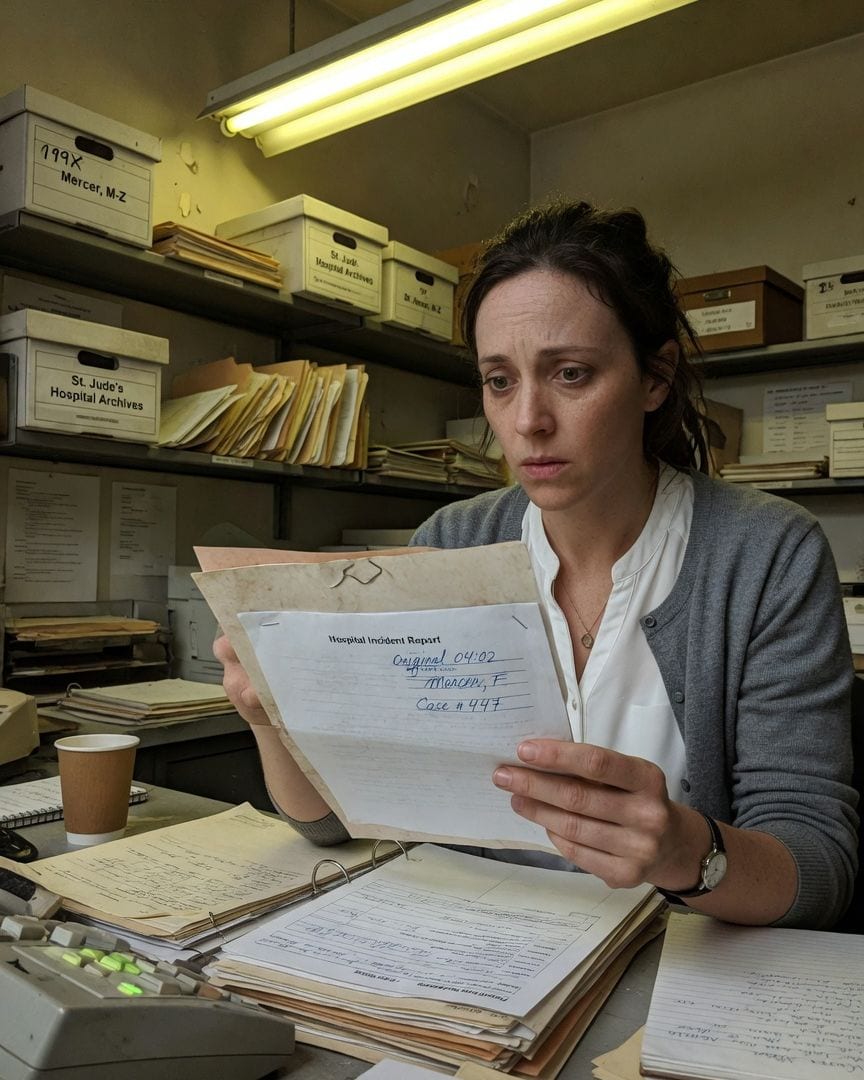
My newborn bl**d card doesn't match my DNA today. The lab ran it three times, confirming the dried spot and my living self are two different people.
Alice Mercer, a geneticist, sends her decades-old newborn bl**d sample for DNA analysis, expecting ancestral markers. Instead, the lab calls with an anomaly: her baby bl**d and current DNA are from two different people. As her mother grows evasive, Alice uncovers a hospital incident report that lists two distinct birth times for her on the same day.
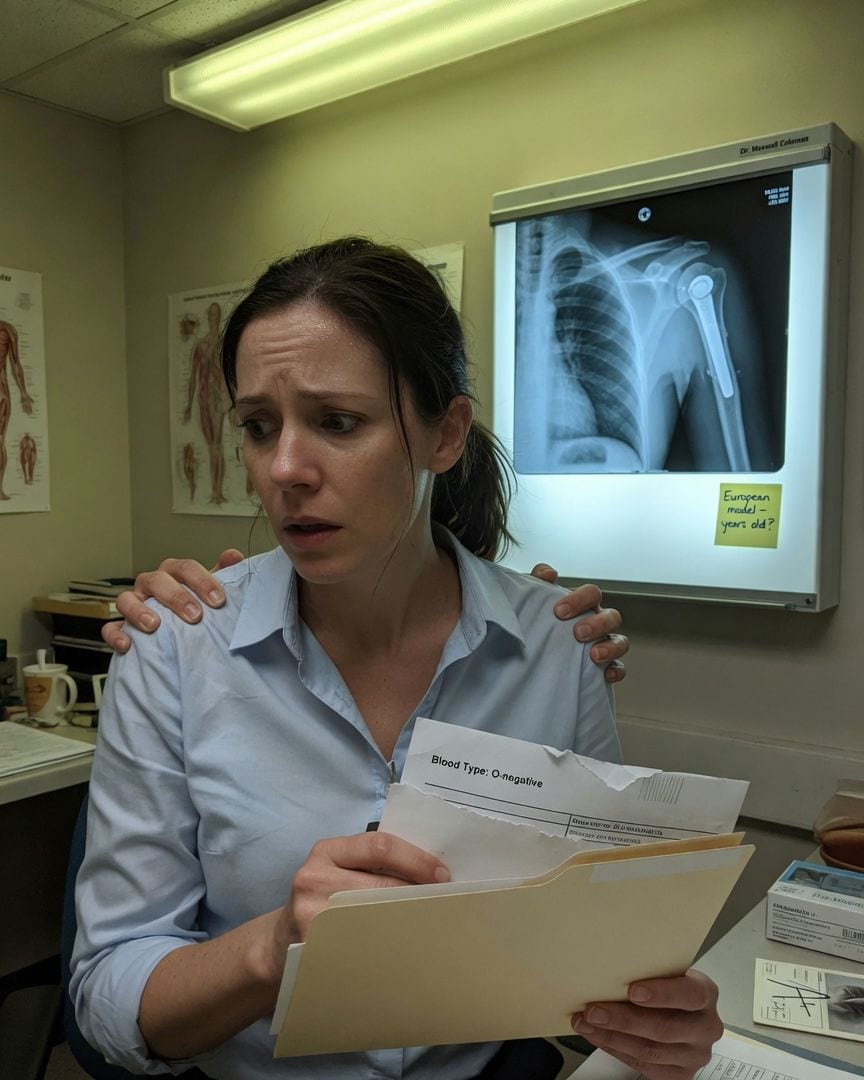
My shoulder X-ray showed a metal ball-and-socket joint. It's been in for years, the consultant said, but I've never had surgery.
After a baffling doctor's visit, I sought concrete proof of my identity, requesting a comprehensive blood panel. The results arrived, stating my blood type was O-negative. Yet, my mother vividly recalled A-positive, and my childhood vaccination card confirmed it, leaving me with a profound, unshakeable dread.
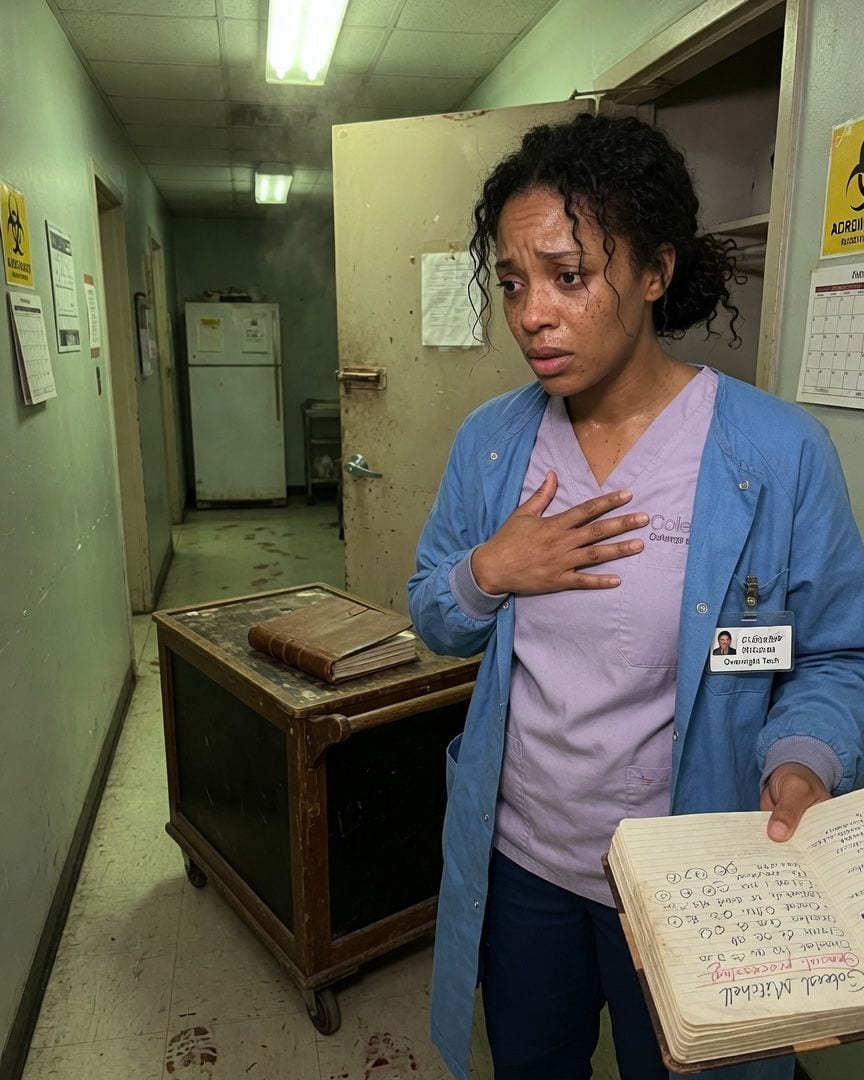
My boss says no one named Grace has ever worked here. But Grace stands beside me every night, reminding me to label the third rack — and I work the overnight shift alone.
On my quiet night shift at the blood bank, Grace always appears around 3 AM. I hear her familiar cart, smell her antiseptic scent, and follow her precise instructions. But my lab director insists no one named Grace has ever been credentialed here, leaving me to wonder who I've been working with.
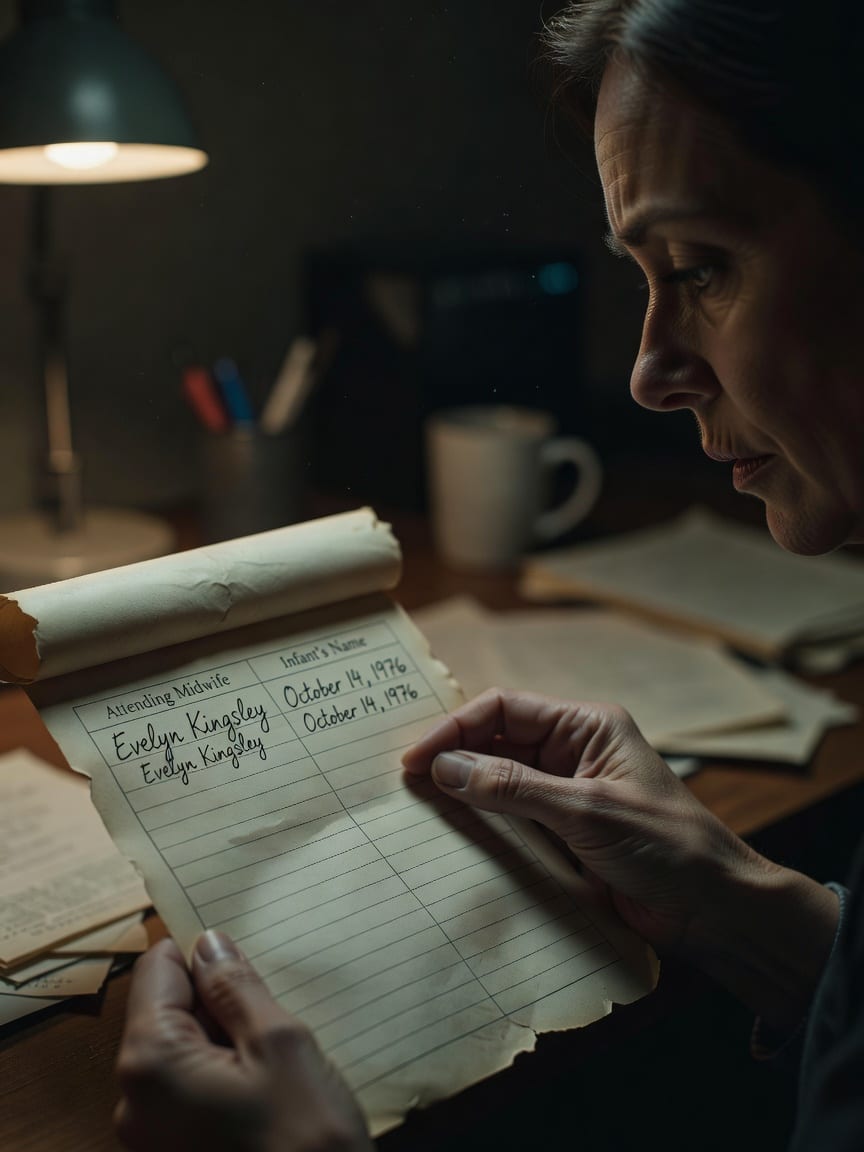
My own handwriting is on my birth certificate, signed as the attending midwife. I was the baby born that night.
I found my adult signature scrawled across my mother’s maternity file, right on my own birth register page. Forensic analysis confirmed it was genuinely my handwriting, dated 1976. But that was the year I was born, and my signature was listed as the attending midwife.
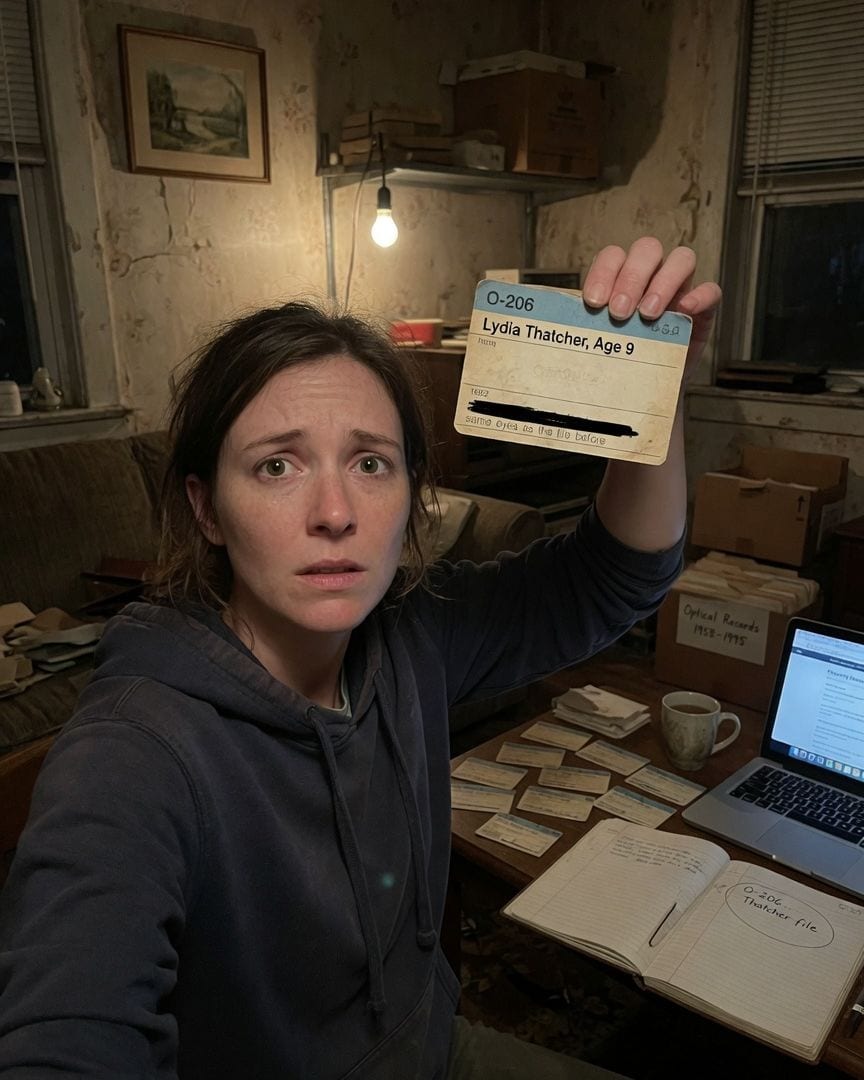
My own optical card is dated 1962, with my name on it. I wasn't born until 1993.
Sifting through old patient files from my former optical practice, I found my own O-206 card. It had my name, Lydia Thatcher, and my current home address printed on it. But the card was dated 1962, decades before I was even born, and a redacted note mentioned 'same eyes.'
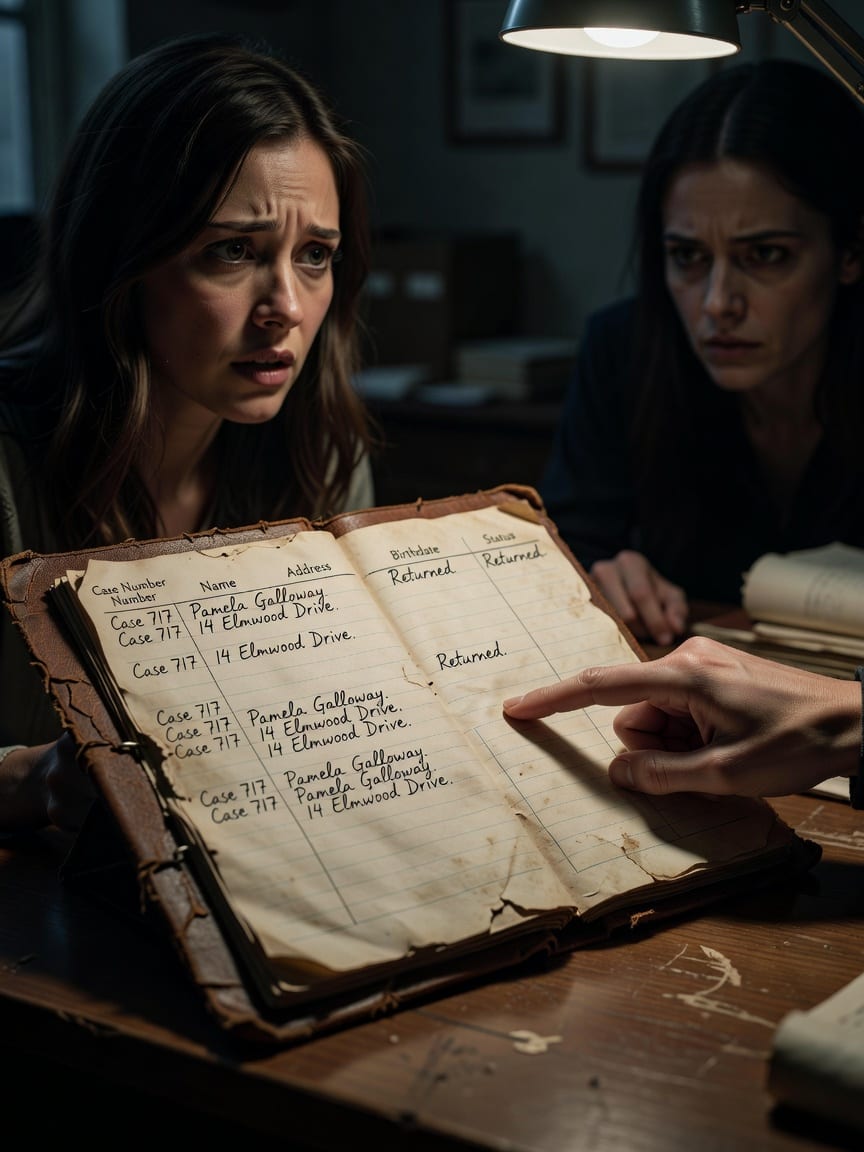
My hospital file has a blacked-out line from 1988. It names my street address, decades before I lived here. Then: 'returned'.
I finally got my medical file, hoping to clear up a ridiculous bill. Inside, I found an entry from 1988: my current home address, scrawled on a partial intake form and marked 'returned.' I was six then, living fifty miles away.