A Cold War petty officer, deep into his last hitch on Adak, heard a ship's bell ringing from four thousand fathoms of empty Bering Sea.
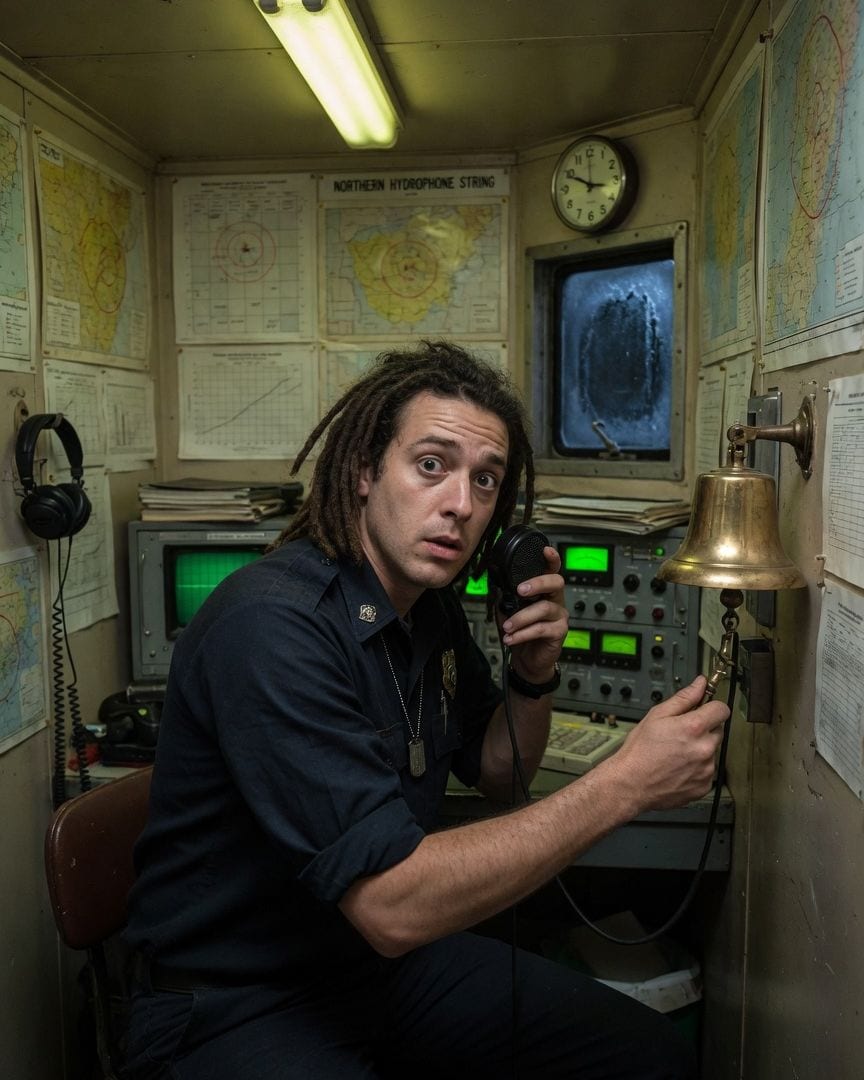
Petty Officer Ruel Marchetti was thirty-one days into the last hitch of his career at the ocean-surveillance station on Adak in October 1958.
The solitude of the Bering Sea was a familiar, droning presence, broken only by the hum of the hydrophone arrays.
He knew the sounds of the deep: whale song, shifting ice, distant subs, the deep seismic rumble of the earth itself. But he had never once heard the array put a ship's bell in the water.
It came in on the northern hydrophone string, a clear, resonant chime, rung in a slow, deliberate watch pattern. The bearing pointed to survey coordinates mapping four thousand fathoms of empty Bering silt.
Ruel checked the equipment, recalibrated the sensors, ran diagnostics on the hydrophones. Nothing. The signal remained clean, distinct, and utterly impossible.
He logged the anomaly, his hand steady in the flickering console light, but the Aleutian dark seemed to ring it back, right on the half hour, for six nights running. A patient, rhythmic toll from nothing.
Ruel spent his off-watch hours poring over old survey charts, cross-referencing every known wreck, every geological anomaly, every deep-sea feature within hundreds of miles.
The coordinates were unequivocal: a vast, featureless plain of abyssal mud, utterly devoid of structure or life, far from any shipping lanes, far from any known hazards.
He checked for other stations, other vessels, trying to find a mundane source, but the signal was isolated, originating from that single, impossible point in the void.
The bell’s tone was deep, unchanging, almost mournful, its timing so precise it felt mechanical. It wasn't a buoy, tossed by currents. It wasn't a lost anchor, shifting with the tides.
It wasn't even a rogue deep-sea current striking a piece of debris. This was a deliberate, consistent pattern, a measured beat in the crushing silence of the abyss.
He consulted an obscure naval regulation he’d once skimmed, a low-priority directive regarding 'unidentified acoustic phenomena in deep-water sectors.'
It detailed a specific, convoluted reporting chain, buried deep within the operations manual, a bureaucratic ghost in the machine that seemed to anticipate the impossible.
He began drafting his official report, feeling a growing, cold certainty that this wasn't a malfunction. This was a signal.
On the seventh night, the bell tolled its half-hourly rhythm, and Ruel felt a strange, undeniable compulsion. It pulled him from his console, across the small hydrophone room.
He walked to the brass bell mounted on the station’s wall, used for internal alarms, its polished surface reflecting the dim green glow of the monitors.
He found a spare microphone, a heavy, old-fashioned thing, and connected it carefully to the hydrophone array's input, aligning it with the bell.
He took a deep breath, his heart thrumming a frantic rhythm in his chest, a counterpoint to the distant chime from the deep.
Then, he lifted the clapper and swung it, ringing the station's bell, a clear, sharp sound that reverberated in the small room. He counted out seven distinct chimes.
The sound echoed briefly, then vanished into the hydrophone feed, swallowed by the vast silence. A moment of profound quiet stretched, heavy and still, a breath held by the entire Bering Sea.
Then, from the abyssal darkness, the northern hydrophone string picked up a clear, resonant seven chimes, answered back, precise and undeniable.
Ruel, profoundly disturbed, filed his report the next morning, meticulously detailing the incident. He included the exact coordinates, the precise timing of the chimes, and the impossible, answering echo.
His commanding officer, Captain Jeffrey Easton, a man whose skepticism was as deep and cold as the Bering Sea itself, dismissed it with a wave of his hand.
Easton attributed it to a combination of equipment malfunction and the psychological toll of isolation, the common culprit for any oddity at Adak.
Still, he accepted the log, citing regulation, and Ruel finished his hitch, leaving Adak with the metallic echo of the answering bell seared into his memory.
Years blurred into decades. Ruel, now a civilian working a quiet job as an accountant in Seattle, couldn't shake the memory of those seven chimes. The impossible precision of the answer haunted him.
He found himself occasionally searching obscure online archives and university databases for anything related to Adak, 1958, or 'unexplained maritime events.'
His persistence eventually unearthed a heavily redacted document from the early 1970s: an 'Acoustic Anomaly Report - Bering Sea Sector Gamma.' It referenced 'recurring sonic emissions' and 'unidentified submerged objects' in the very area Ruel had logged.
The report was an anchor dropped into his past, confirming he hadn't imagined it, that the bell had been real, but it offered no explanation.
The red ink that obscured vast sections of text seemed to mock him, highlighting the secrets still kept.
Emboldened by the report, Ruel submitted a formal request for further declassification. He cited the precise coordinates and the specific timeframe from the now partially declassified document, hoping to pry open more of the truth.
The response was unusually swift and unequivocal, delivered in a terse, official letter: 'Request Denied. Classification maintained.' A few days later, an anonymous, untraceable email landed in his inbox. The subject line read: 'Heard You Ring.'
Ruel stared at it, a cold prickle starting at the back of his neck. The body contained a single attachment: a grainy, blurry photograph.
It showed an old, corroded ship's bell, partially obscured by deep-sea silt, resting on what looked like an impossible, smooth, dark surface, like obsidian or polished stone. A faint, almost imperceptible glow emanated from its clapper, a pale green light.
The image was clearly from deep underwater, and it was undeniably the bell from his memory, the one that had chimed back from the void. Ruel felt a cold dread settle in his stomach, turning it to ice. Someone knew.
Someone was watching. He deleted the email, unplugged his internet cable with trembling fingers, and sat in the sudden, echoing silence of his apartment, the photograph's impossible glow burned into his mind.
He was no longer just hunting for answers; he was being hunted.
Ruel knew he couldn't pursue this alone. He needed someone with access, with a mind that could untangle bureaucratic knots. He sought out Dorothy Marsh, a retired naval archivist known for her meticulous work on Cold War-era declassified documents.
She was initially skeptical, a woman who had seen too many conspiracy theories and dismissed them as combinations of coincidence and overactive imagination.
But as Ruel recounted the events of Adak, presented the redacted report, and described the anonymous photograph, Dorothy's professional curiosity was piqued. The precision of his account, the official documentation, began to chip away at her cynicism.
She agreed to dig, cross-referencing Ruel's experience with other seemingly unrelated 'acoustic anomaly' reports and 'unidentified submerged object' incidents from various remote, deep-water locations. Slowly, painstakingly, a terrifying pattern emerged.
These incidents, often dismissed as hoaxes or glitches, were invariably followed by the unexplained disappearance of small survey vessels or deep-sea craft in the vicinity.
Dorothy noticed a peculiar, highly unusual code in the margins of these disparate reports: 'FILE: [date]'.
It wasn't a standard classification or a filing instruction; it was a status, appearing next to the name of a missing vessel or a reassigned crew member. Her finger traced the cryptic notation on a faded microfilm printout.
'It's like a ledger,' Dorothy murmured, her voice hushed, the implication chilling the air around them, 'a record of what's been... processed.' The bell, she realized, wasn't just a signal. It was a registry point.
Dorothy, now fully invested and visibly shaken by the implications of her findings, continued her relentless search. The weight of what she was uncovering seemed to press down on the small, dusty archive room.
She delved into obscure, unindexed archives, forgotten corners of naval history, eventually unearthing a dusty, yellowed 'Personnel Review' document from 1962. It was a cross-reference of all Adak personnel from 1958, a routine post-tour assessment compiled years after their deployments.
She scrolled through the names, her eyes scanning for any mention of the 'FILE' code, or any unusual 'Disposition' remarks in the columns.
Her finger moved down the list, past familiar names and service numbers, past promotions and transfers, until it stopped. Her breath hitched. Her eyes widened, fixed on an entry half-hidden by a coffee stain.
She pointed, her hand trembling slightly, to a familiar name, the letters blurred by decades of poor reproduction but still legible. 'Ruel Marchetti, Petty Officer, Service Number...' Her voice was barely a whisper, a strained sound in the quiet room.
Her finger traced the line to the 'Disposition' column, where, in stark, precise official type, was the chilling, impossible entry: 'FILE: October 25, 1958.' The precise date Ruel had rung the station's bell, and something had answered.
Dorothy stared at the entry, her gaze snapping from the document to Ruel’s pale face. 'The 'FILE' status isn't about being in a file, Ruel,' she explained, her voice low and strained with the horror of discovery. 'It means being registered by the thing itself.
The bell isn't just a signal; it's a registry point, a lure, a way to mark. The Navy wasn't covering up an anomaly; they were meticulously recording the actions of something else.
The 'secrecy machine' isn't hiding what they did, but what it did. The lost ships weren't just lost; they were collected, filed away into whatever realm the bell guards.'
Ruel felt a cold, crushing weight descend, pressing on his chest, constricting his breath. 'And my name?' he asked, his voice hoarse, barely audible.
'Your entry,' Dorothy continued, her finger still hovering over the impossible date, 'means you were registered by the entity. It recorded your interaction. The Navy simply documented its own 'filing' action.
The pattern across decades shows that some 'filed' individuals eventually vanish, collected like the ships, their names disappearing from the rolls. Others, like you, are simply 'marked' and observed, left to wait.
The bell is the Thing That Came Back Wrong, a beacon for whatever is doing the collecting, and these files are its patient, silent ledger.'
Every clue, every impossible detail Ruel had encountered over the decades, snapped into horrifying focus, forming a coherent, terrifying whole. The dread was in the simple, bureaucratic language of the file itself.
The realization hit Ruel with the force of a physical blow. He'd been living on borrowed time, unknowingly tracked for decades, a marked entry in an alien ledger.
He and Dorothy knew they had to act, to expose the quiet horror they had unearthed. They compiled their findings: the redacted reports, the 'FILE' codes, Ruel's own chilling entry, and Dorothy's meticulous analysis of the pattern of disappearances.
Their plan was to send it all to an investigative journalist, hoping the sheer volume and internal consistency of the documentation would force a public inquiry, tear back the veil.
As they finalized their package, stuffing photocopies and notes into a secure envelope on Ruel’s study table, his old, now civilian, maritime radio crackled to life.
It sat in the corner, a relic he’d kept since leaving the Navy, its dial dark, untouched for years. The static cleared, replaced by a series of clear, resonant chimes, precisely seven. Ruel froze, his blood turning to ice.
Then, a voice, synthesized and flat, devoid of any human inflection, recited his old service number: 'Nine-Zero-Three-Four-Seven-One-Two.' The sound was not a warning; it was a final confirmation.
Ruel grabbed the compiled proof, his hands shaking so violently the papers rustled. A primal, absolute fear seized him.
'It's time to go,' he told Dorothy, his voice strained, knowing the call was not a threat, but an active location, a signal that his 'filing' was moving to the next stage.
They fled, leaving the house, the radio still chiming its seven precise tolls into the empty air, the front door ajar.
They could feel an unseen pressure, a cold, patient presence closing in, a silent pursuit gaining ground in the sudden autumn chill.
Their frantic efforts to leak the information proved futile. The journalist, initially intrigued by their story, abruptly ceased all communication after receiving a series of vague, unsettling phone calls from an unlisted number.
The compiled evidence, lacking official endorsement and labeled as 'unsubstantiated claims,' was dismissed by every agency they approached as a sophisticated hoax, a collection of misinterpretations and forged documents.
Ruel and Dorothy, now fugitives from an unseen tracking system, went deep underground, living off the grid. They moved constantly, adopting new identities, always looking over their shoulders, forever aware of the cold, patient scrutiny.
The world remained oblivious, turning its back on the silent, patient ledger being maintained in the deep. Their old lives vanished, replaced by a perpetual vigilance, a quiet, gnawing dread that never truly left them.
Ruel lives a quiet life now, far from the ocean, but the sea is always with him.
He never looks at the vast expanse of water the same way again, seeing it not as freedom, but as a dark, patient ledger beneath the waves.
The proof he carried, the coherence of the horror, never saw the light of day, dismissed, vanished into the ether of forgotten truths.
He still feels the subtle hum of the world's indifference, a chilling counterpoint to the deep, patient ringing he now knows is always there, waiting. He keeps his old maritime radio, but he never turns it on.
He just watches the horizon, waiting for the next echo from the deep.
If this one got to you
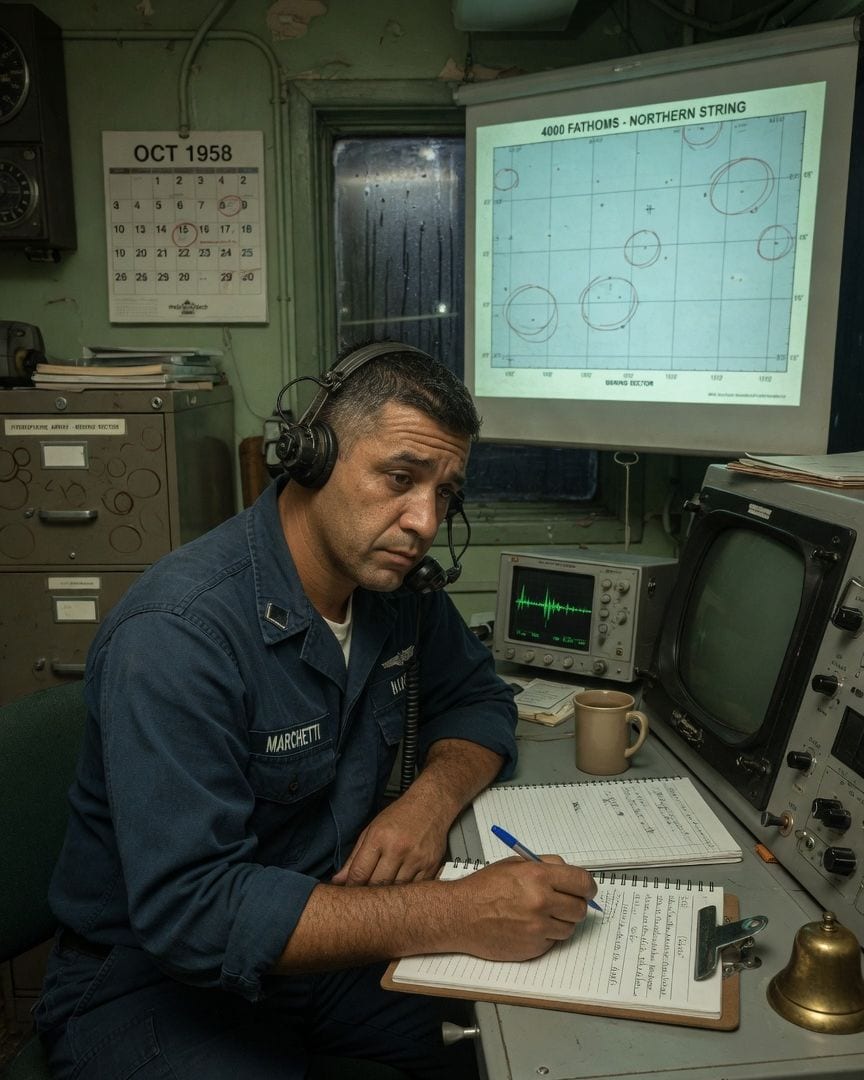
A Cold War Petty Officer, 31 days from retirement, heard a ship's bell answer his own, from 4000 fathoms of empty Bering Sea.
Petty Officer Ruel Marchetti had just thirty-one days left on his career, monitoring the frigid Bering Sea from the lonely Adak surveillance station in October 1958. His headphones, usually filled with the hum of equipment, picked up an impossible sound: a ship’s bell chiming from 4000 fathoms of empty ocean. For six nights, the bell rang precisely on the half-hour, dismissing all his rationalizations and his Chief's easy explanations. On the seventh night, Marchetti rang the station’s fire bell into the churning black sea, and moments later, the deep-sea bell answered his exact count, chime for chime. What was speaking back from the silent depths, and what did its rhythmic chimes truly say?
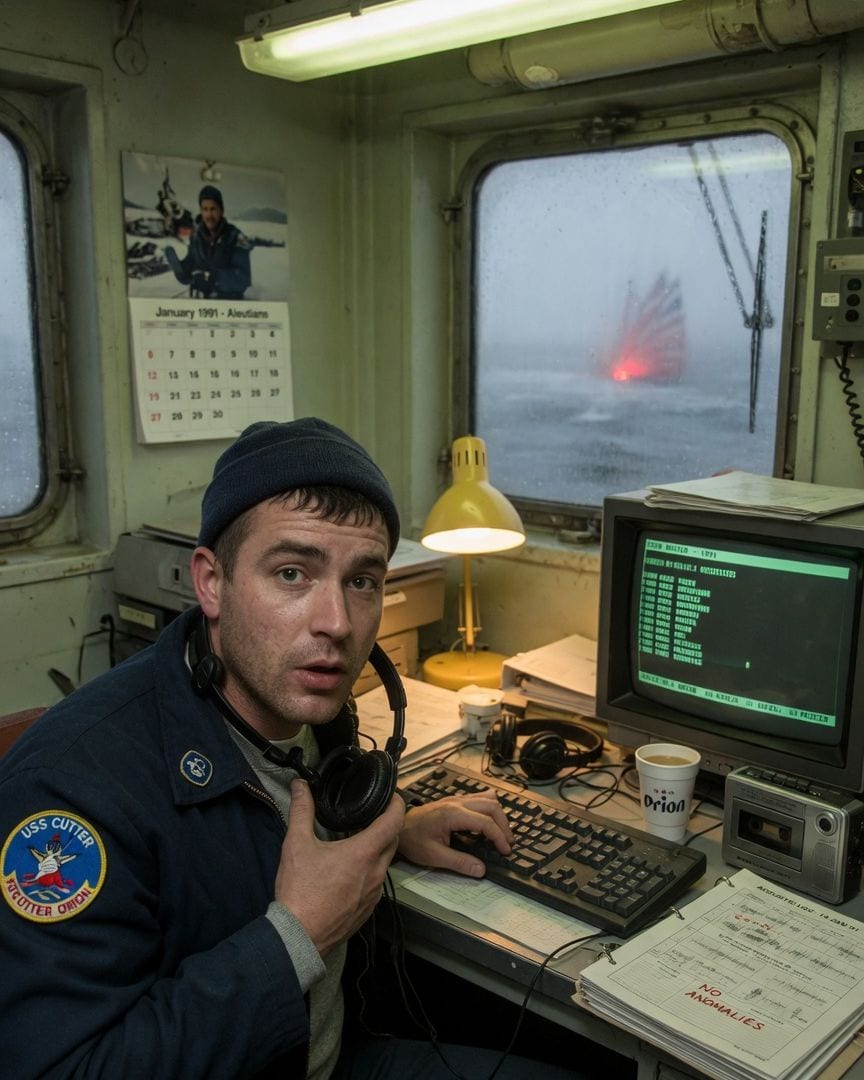
A cutter's watchman whistled a tune into the Aleutian fog, and a reply came back, pitch perfect, from the black water. Then his recorder whispered a name.
Oscar Petro stood alone on midwatch aboard the USS Cutter Orion, enveloped by the Aleutian fog and the endless, black water. To break the biting cold and monotony, he whistled a familiar tune into the vast quiet. But from the impenetrable darkness, closer than the ship's rail, a precise reply echoed back, the exact same melody, pitch perfect. Later, his personal recorder captured not just the impossible tune, but a chilling whisper: a name, 'Mercer,' that appeared on no ship's roster. Who was this phantom voice in the freezing black?
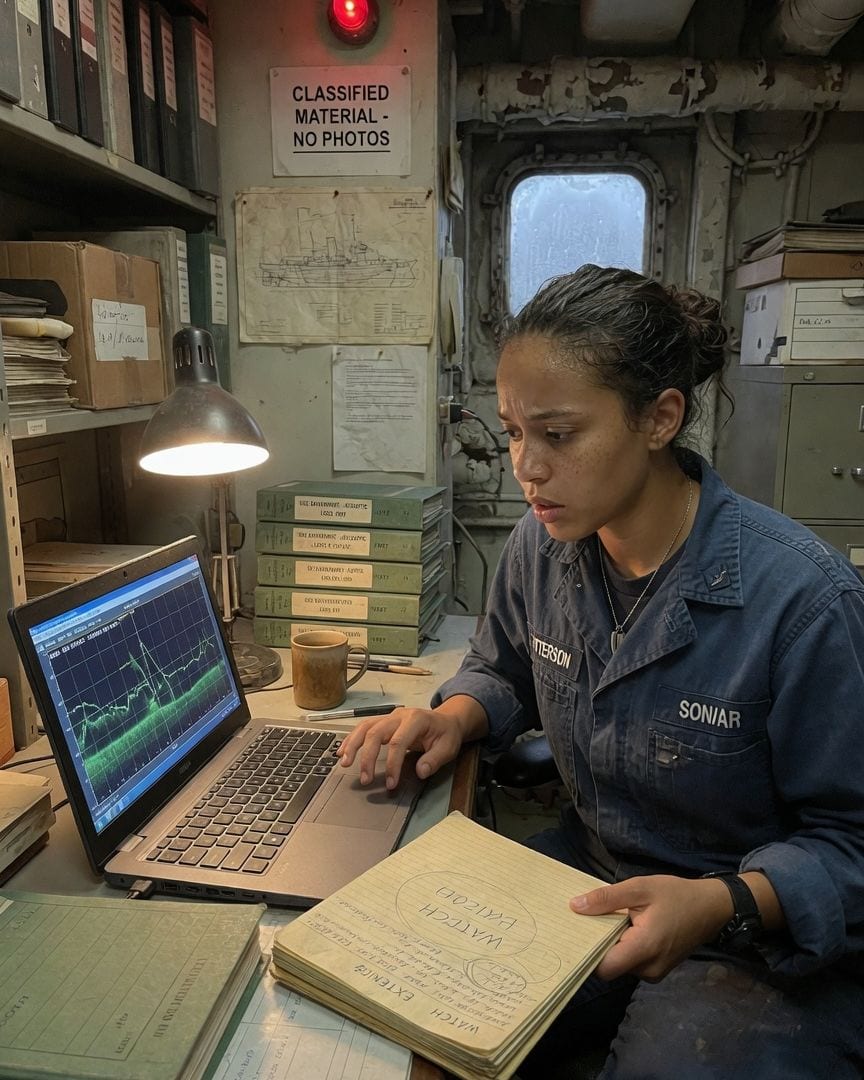
On the USS Calloway's final patrol, a sonar technician found an old log with two chilling words: 'WATCH EXTENDED.'
Sonar Technician Brooke Patterson had only two days left on the USS Calloway's last patrol, a finality that hung heavy in the humid sonar room. Through the impenetrable fog, her radar showed only empty water, but then an impossible biologic contact pinged, mimicking a vessel with eerie precision for three silent hours. It vanished at 0400, just as an identical trace had done weeks before. Searching old archives, Brooke found the precise pattern in a decades-old log from a scrapped destroyer. Scrawled next to it, in faded ink, were two words: "WATCH EXTENDED." What did those words truly mean?
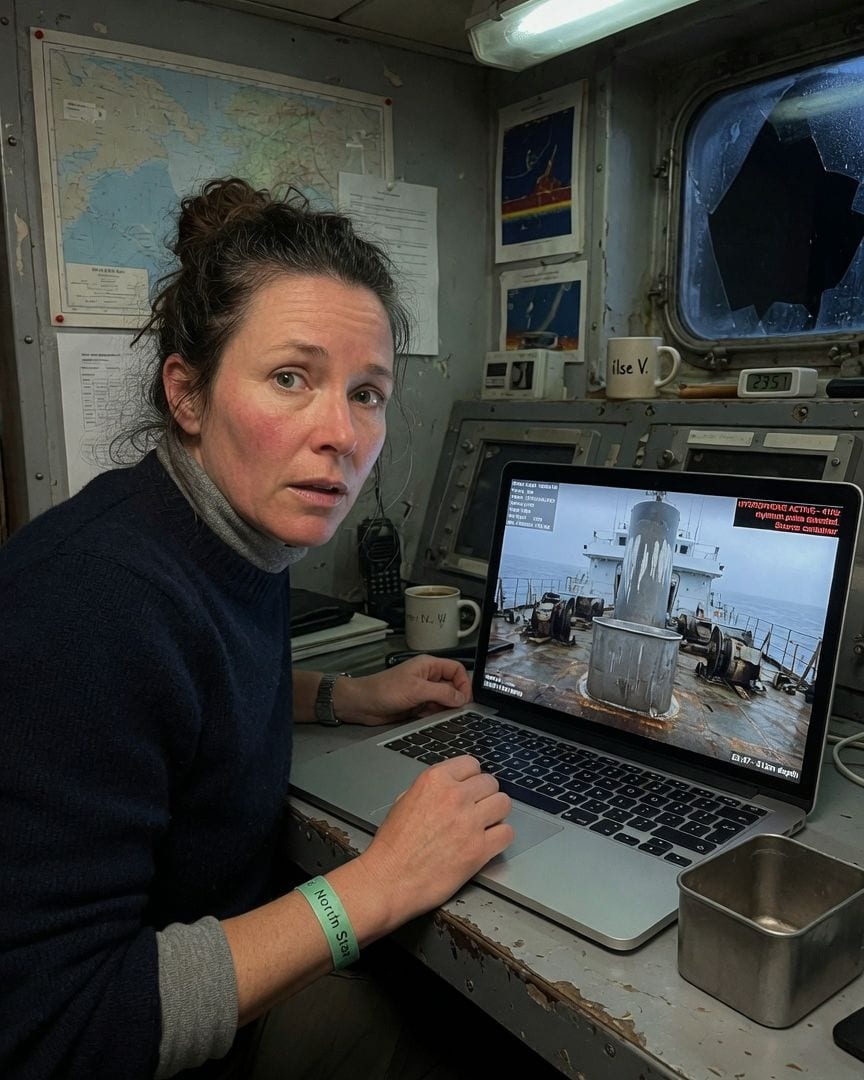
A marine archaeologist's final search for her uncle's lost ship found a container humming eighty years deep.
Marine archaeologist Dr. Ilse Varren had four days left to find the *Cadmus Hale* before the Bering Sea ice ended all operations. Her uncle Joseph was among the 311 men lost with the transport ship in 1944, and this was her last chance to locate it. When her AUV finally found the wreck, perfectly preserved on the abyssal plain, Dr. Varren was stunned. Yet, a modern, unmarked container sat on the ship's main deck, utterly devoid of marine growth and humming a faint, rhythmic pulse from the deep.
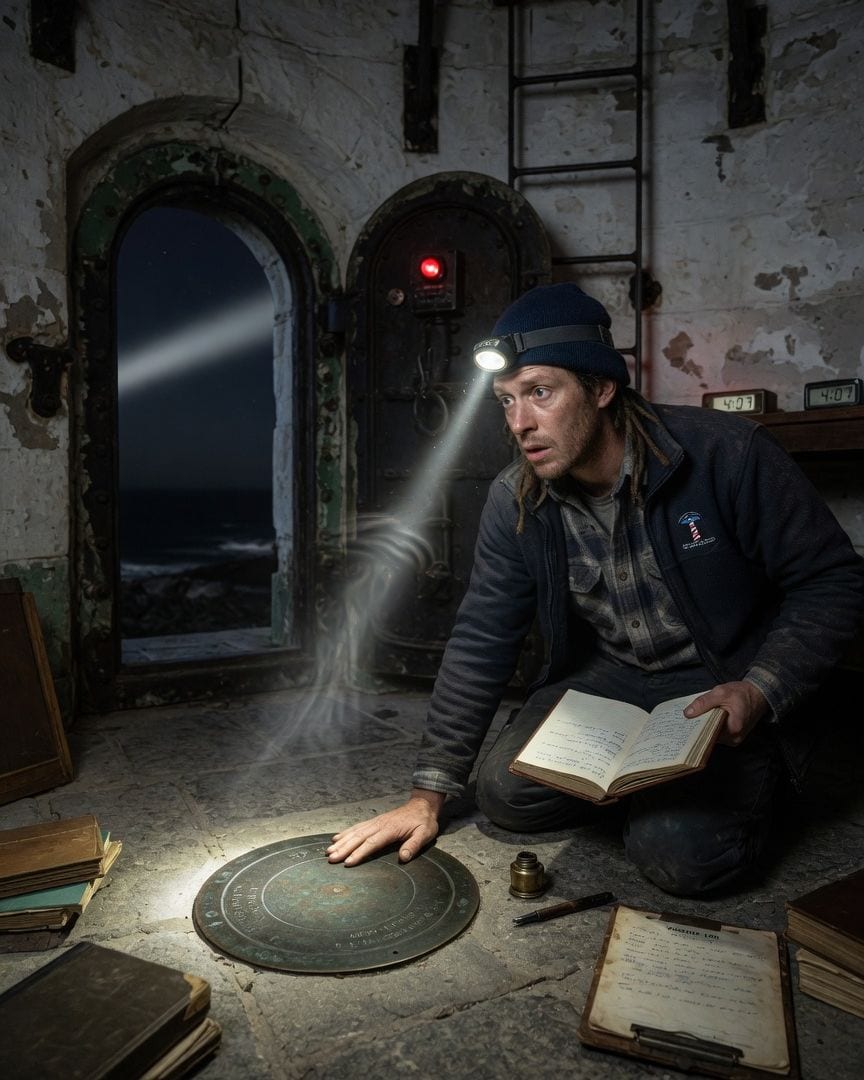
Every ninth year since 1901, my logbook records a boat through the gate at 4:05am — 'vessel through, none seen.' I was on watch tonight. Nothing passed.
As the lighthouse keeper, I log the same impossible entry every nine years, a lie I'm compelled to write. But tonight, a hidden brass disc in the floor, not on any blueprint, feels oddly warm. Hours later, it hums, and the air above it shimmers and distorts, then vanishes.
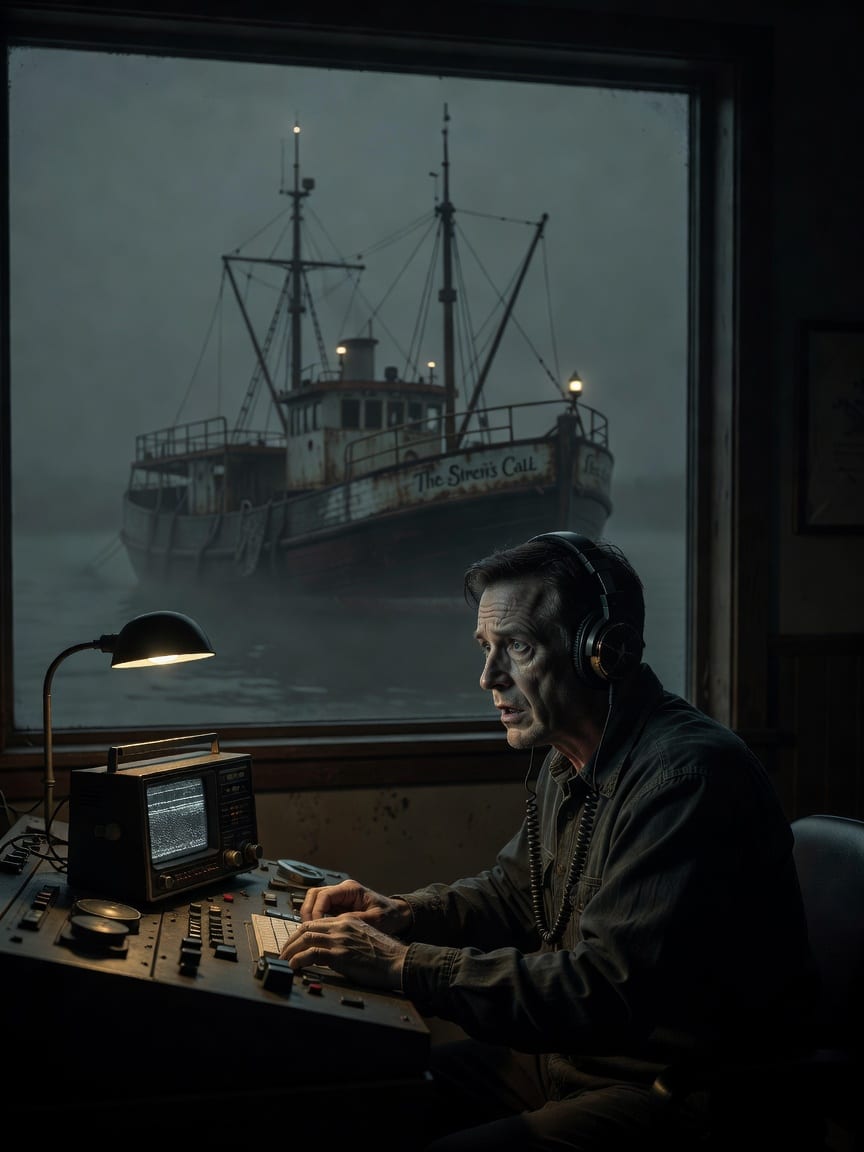
My radio picked up a skipper at 3 AM every night, asking about the bar. The harbourmaster's tapes show no calls, and that boat sank ten years ago.
Every night, as the harbour night watchman, I have a comforting ritual: guiding Tom of 'The Siren's Call' through the channel. But the harbourmaster just reviewed the tapes, and my voice is there, clear as day, while Tom's response is utter silence. And official records show his vessel, 'The Siren's Call,' sank a decade ago with all hands.