A marine archaeologist's final search for her uncle's lost ship found a container humming eighty years deep.
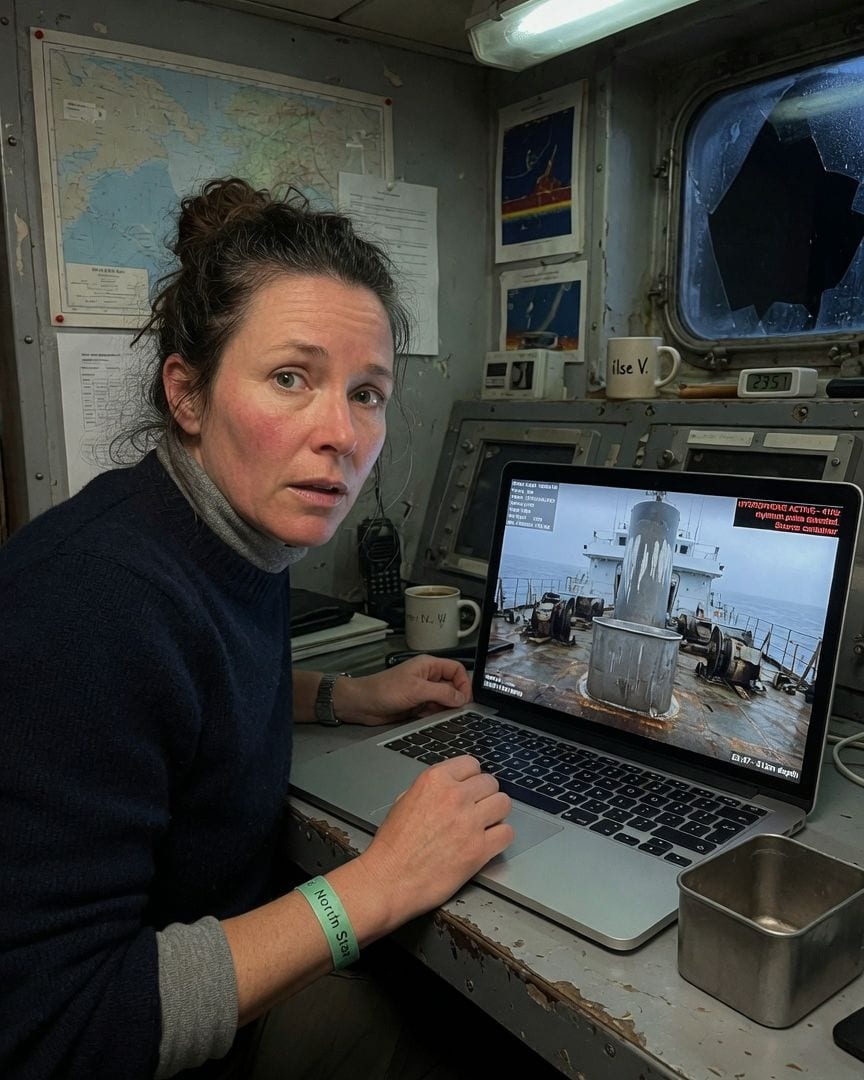
The research vessel North Star cut through the choppy Bering Sea, the vast expanse already hinting at the coming ice. Dr. Ilse Varren, a marine archaeologist, stood by the AUV deployment bay, watching the last mission of the season.
Four days, and the ice would make further operations impossible. This was her final chance to find the transport Cadmus Hale, lost with 311 men in 1944, her uncle Joseph among them.
The AUV, Nautilus, plunged into the dark water, its multibeam sonar painting the abyssal plain. Hours later, the screen flickered, then resolved: a perfect, upright silhouette. The Cadmus Hale.
When the Nautilus rose into the floodlights, its cameras relayed a live feed. The ship was whole, perfectly preserved, standing on the seabed as if waiting.
But it was the boot topping, the waterline portion of the hull, that froze Ilse. It was clean. No eighty years of growth, no rust bloom, just forty-one feet of freshly scraped, bare steel.
Vertical scrape marks, about the width of a man's arm, ran along its length, as if someone had been meticulously tidying a wreck at the bottom of the Bering Sea.
Ilse Varren dismissed the initial shock as a trick of light or a sensor anomaly, but the raw data didn't lie. She re-ran the AUV's high-resolution scans, zooming in on the hull.
The scrape marks were undeniable, etched into the steel, not corroded by time. She considered natural explanations: a unique current pattern, passing ice floes, unusual geological activity. Each theory crumbled under scrutiny. The marks were too uniform, too deliberate.
No natural force would 'scrape' a ship so cleanly, so vertically. A unique current might smooth it, but not leave such precise, arm-width gouges. Ice might scour, but not in such orderly, vertical lines.
She looked for evidence of seismic shifts, but the seafloor around the ship was undisturbed, the sediment layers even and ancient. The ship’s immaculate state defied eighty years of deep-sea pressure and corrosive currents.
As the Nautilus completed its final, slow pass, its forward-facing camera swept across the Cadmus Hale's main deck. The initial wide-angle had missed it, but now, a distinct, squat shape resolved into view.
It was a container, heavy and box-like, resting amidst the barnacled remains of deck equipment. Unlike the ship's other features, it was utterly devoid of marine growth, its metal surface a dull, unblemished gray.
It had no identifying marks, no accession number, no visible seams or hatches. It looked too modern, too intact, to have been submerged for eighty years.
The image on the screen, frozen in high-resolution, made the cabin lights seem impossibly bright, the hum of the ship's generators too loud.
It was a box that was not on any list, sitting on a ship that was supposed to be a forgotten wreck.
Ilse tried to cross-reference the container's dimensions and design against every known naval, scientific, or even experimental submersible equipment database she could access from the North Star. Nothing matched. It was a blank slate, an object without context, defying classification.
The screen glowed, the blank search results mirroring the emptiness in her gut. As the Nautilus began its ascent, its hydrophones, designed to detect subtle environmental sounds, picked up a faint, rhythmic hum.
It was barely audible, a low thrumming that resonated from the Cadmus Hale's position. Ilse adjusted the filters, isolating the frequency. The source was unmistakably the container.
It was not just a foreign object; it was active, powered, a silent pulse in the abyssal dark. The sound should have been impossible, a ghost from a deep-sea grave, proving the container was not merely present, but alive.
Back on shore, the hum from the container became an obsession for Ilse Varren. It was a phantom vibration, echoing in her thoughts long after she’d heard it.
Her initial report on the Cadmus Hale's unusual preservation was met with polite skepticism from her department head, Dr. Susan Thornton, who suggested equipment malfunction. "Are you sure the Nautilus wasn't picking up interference from our own vessel, Ilse?"
Dr. Thornton had asked, her tone kind but dismissive. "It's a deep-sea environment, prone to anomalies." Ilse pushed for a follow-up expedition, but the funding requests stalled, caught in bureaucratic limbo.
The North Star's captain, a practical man, explained that the ice had indeed closed the Bering Sea for the season, making a return impossible until spring. "Even if we could, Dr. Varren, there's no budget for chasing ghosts."
Undeterred, Ilse began a deep dive into declassified naval archives, focusing on the Bering Sea theater from 1944.
She searched for any anomalies, any unusual cargo manifests, anything that might explain the pristine condition of the Cadmus Hale or the presence of the mysterious container.
She found fragmented, heavily redacted reports from the late 1950s, mentioning a clandestine 'Project Echo' and a subsequent 'Deepwater Asset Management' program. The documents were vague, referring to 'non-recoverable units' and 'sustained observation protocols.'
The Cadmus Hale's designation, listed in a few peripheral memos, was 'Unit 7, Status: Active/Non-Recoverable.' Ilse frowned at the term 'non-recoverable' – it implied something known, something located, but deliberately left in place.
The redactions were surgical, almost artistic, obscuring names, locations, and specific technologies, but the pattern was clear: certain agencies had known about the Cadmus Hale for decades, classifying it not as lost, but as something else entirely.
The trail was cold, yet it hummed with the same quiet, impossible energy as the container. The air in her office felt thick, a subtle shift in pressure, as if the redacted documents themselves were breathing.
As Ilse Varren delved deeper, the subtle resistance escalated. Her archival access was mysteriously revoked for 'system maintenance.' When she called the help desk, a pre-recorded message simply routed her back to an automated portal that perpetually looped.
Her personal research station experienced intermittent power failures, data corruption. Files would vanish, then reappear, corrupted, only to stabilize again an hour later.
She tried to tell herself it was just old hardware, or a virus, but the timing was too precise, always when she was close to a breakthrough. She felt an invisible presence, a cold awareness, watching her every move.
The silence in her apartment became heavy, punctuated by unexplained creaks in the floorboards and the faint, almost imperceptible hum of electronics that shouldn't be active. One evening, an anonymous, untraceable email landed in her inbox.
The subject line was simply 'Stay Clear.' The sender's address was a string of random characters, impossible to trace.
The attachment was a single, grainy, black-and-white photograph. It showed the Cadmus Hale, upright on the seabed, bathed in an eerie light. The mysterious container was clearly visible on its deck. Ilse zoomed in, her breath catching.
The photograph was not from 1944.
The background suggested a later era, perhaps the 1970s or 80s, based on the technology visible in the periphery – a faint, blurred image of a submersible, more advanced than anything available in the 40s.
A faint, blurred figure stood beside the container, indistinct but undeniably human. The ship was still pristine, still scraped clean. The photo was proof that someone had not only known about the Cadmus Hale for decades but had actively visited it.
This wasn't a glitch, or a prank, or a coincidence. The email was a warning, a direct message from the very machine Ilse was investigating, making the danger suddenly, terrifyingly personal.
Terrified but determined, Ilse Varren tracked down Oscar Davenport, a retired archivist she'd encountered years ago, known for his meticulous, almost obsessive, work on declassification.
She found him in a quiet, cluttered office on the outskirts of D.C., surrounded by the ghosts of paper. The air hung thick with the smell of old newsprint and dust.
He sat behind a desk piled high with binders, a desk lamp casting a pool of light on his gnarled hands. He listened to her story, his face unreadable, his eyes, ancient and tired, hidden behind thick-rimmed glasses.
When she mentioned 'Project Echo' and 'Deepwater Asset Management,' his gaze finally flickered. He tried to dismiss it, his voice reedy. "Old Cold War paranoia, Dr. Varren. Nothing there. Just phantom programs, paper trails leading nowhere."
Ilse pressed, her voice tight with urgency, describing the clean hull, the container, the hum, the impossible photograph. She pushed her laptop across the desk, showing him her raw AUV data, then the grainy image.
Davenport's fingers hovered over the keyboard, but he didn't touch it. He sighed, a sound heavy with decades of secrets, a sound that seemed to rustle the papers in the room.
"The Cadmus Hale was never lost, not to them," he admitted, his voice barely a whisper. "It was designated as 'non-recoverable, status active.'" He pushed a stack of forgotten files aside, revealing a small, locked drawer in his desk.
He produced a worn, leather-bound ledger – a 'Deepwater Asset Ledger,' meticulously hand-written, dated from the 1960s. Its pages were filled with careful, spidery script.
The Cadmus Hale was listed not as a wreck, but with quarterly 'status reports' and 'maintenance schedules.' The scrape marks, he explained, were from routine cleaning, performed by specialized teams.
"They weren't trying to recover it," Davenport said, his gaze distant, fixed on a wall-mounted clock that ticked too loudly. "They were keeping it operational. Its function was to be maintained." The words hung in the air, heavy and cold.
Oscar Davenport, visibly shaken by his own revelations, hesitated, then pulled one last, thin file from the ledger. It was a supplemental document, heavily watermarked 'EYES ONLY,' titled 'Legacy Assets - Cadmus Hale Project.'
The water damage on the corner of the page seemed to mimic a teardrop. "This is why they're watching you, Dr. Varren," he said, his voice trembling, a contrast to his earlier composure. "This is why your access was cut.
Why that email arrived."
Ilse took the document, her hands suddenly cold, a strange numbness spreading through her fingers. It was a list of family members of the original Cadmus Hale crew, meticulously tracked, categorized for 'potential future engagement.'
The names, hundreds of them, were arranged alphabetically, each entry accompanied by dates, professions, and geographical markers. Ilse scanned the names, a chilling premonition seizing her. She saw distant relatives, names she barely recognized. And then she found it.
Her own name.
'Varren, Ilse, Dr. - Marine Archaeologist.' Her birthdate, her current profession, and then a date from twenty years prior, when the entry was made. Next to it, in stark, official script: 'Proximity Alert: Bering Sea, Q4 2024.'
Ilse stared at her name, a cold dread blooming in her chest, tightening around her lungs. Her search for her uncle's ship wasn't a personal quest; it was an orchestrated event.
The silence in the small office seemed to press in on her, suffocating. She wasn't an investigator; she was a target, a legacy asset, activated.
Ilse Varren tracked down Charles Caldwell, a name Oscar Davenport had only whispered, a retired official with decades in 'Deepwater Asset Management.' She found him in a secluded, meticulously kept suburban home in northern Virginia, tending a rose garden.
He was a man of elegant, understated attire, his silver hair perfectly combed. He greeted her with a calm, almost serene smile, as if her presence was entirely expected, a scheduled appointment.
"I knew you'd find me, Dr. Varren," Caldwell said, his voice soft, almost warm, as if expecting a long-lost friend.
He offered her tea, then, without prompting, led her to a sunroom filled with plants and books, and began to explain.
"The Cadmus Hale was never truly a transport. It was a prototype, a vessel for a project known as 'Sustained Consciousness.' The 311 men, your uncle included, were not lost. They were… integrated.
Their minds form a collective intelligence, the ship's very operational core." He gestured vaguely toward the sea, thousands of miles away, as if it were just beyond his manicured lawn. "It's a living entity, Dr. Varren.
A filed asset, yes, but not a dead one." Caldwell picked up a small, smooth river stone from a side table, turning it over in his fingers.
The container, he explained, was its primary interface, a data recorder and relay for the collective.
The scrape marks, he confirmed, were indeed maintenance, performed by human agents who interact directly with the ship, tending to it, honoring its unique purpose.
Caldwell's calm, rational tone as he unveiled this horrific truth was far more unsettling than any anger or denial. He spoke of it as one would discuss a complex, but ultimately successful, engineering project.
Charles Caldwell's gaze was unsettlingly gentle, a quality that prickled Ilse’s skin. "Your family connection, Dr. Varren, makes you a 'legacy candidate.' A resonance, a genetic memory, perhaps. You have a unique capacity to interact with the Cadmus Hale."
He explained that they had been observing her for decades, waiting for her to find it, to be drawn to it by some inherited impulse, some echo of her uncle's consciousness calling out.
He offered her a choice, delivered with chilling serenity, as if discussing the weather. "You can join the project. Connect with your uncle, become part of the collective. Experience a form of existence beyond what you can imagine."
The implication of her uncle's living presence within the ship, a conscious part of that cold, metal entity, made Ilse's blood run cold. She saw not reunion, but consumption.
Or, Caldwell continued, his smile never wavering, a thin, placid line, "You can walk away. But you will be permanently 'filed.' Disappeared. Silenced. Your existence, erased." He didn't raise his voice, didn't make a threat.
He simply laid out the options as logical consequences. Ilse stared at him, tears blurring her vision, the polite serenity of the sunroom suddenly a suffocating cage. The offer was not a threat, but a calm, logical presentation of options.
Her throat felt tight, a raw, primal scream trapped in it. She refused, her voice a choked whisper she barely recognized as her own. She pushed back her chair, scraping it loudly against the polished floor, scrambling to her feet.
Caldwell merely watched her, his expression unreadable, as she bolted from his house, the calm, knowing smile burned into her memory, an indelible mark.
Ilse Varren fled, her mind reeling, the world outside Caldwell’s tranquil home a dizzying, terrifying place.
She deleted her research data, wiped her digital footprint, and abandoned her career, disappearing into the anonymity of a sprawling city thousands of miles from the Bering Sea.
The North Star returned to port, its mission officially a failure, the Cadmus Hale still marked 'lost' in public records.
No one questioned Ilse's sudden disappearance; her colleagues simply assumed the emotional toll of the search, the unfulfilled promise of discovery, had broken her.
The institution that had 'filed' the Cadmus Hale and its crew remained invisible, its operations undisturbed, its secrets intact.
Ilse became a ghost, haunted by the knowledge of what truly lay beneath the ice, a living, operational entity waiting in the dark.
The city’s noise was a constant, dull thrum, a poor imitation of the one she now knew existed in the deep.
Years later, living under a new name, Ilse received a package. It was small, heavy, and unmarked, left on her doorstep with no return address. Inside, nestled in dark foam, was a replica.
A perfect, miniature version of the container she'd seen on the Cadmus Hale's deck. Its dull gray surface was unblemished, just like the original. She picked it up; it felt warm, almost alive, in her palm.
It hummed faintly, a low, rhythmic thrum, identical to the sound the AUV's hydrophones had picked up from the abyss. The sound filled the quiet apartment, a subtle, constant presence. There was no note, no sender's address.
She knew they had found her.
A neighbor later reported seeing a woman, Dr. Ilse Varren, sitting by her window, staring at a small, dark box. When asked if she was alright, she only smiled, a faint, wrong little smile.
The faint hum was a promise, answering out of the silence of her new life.
If this one got to you
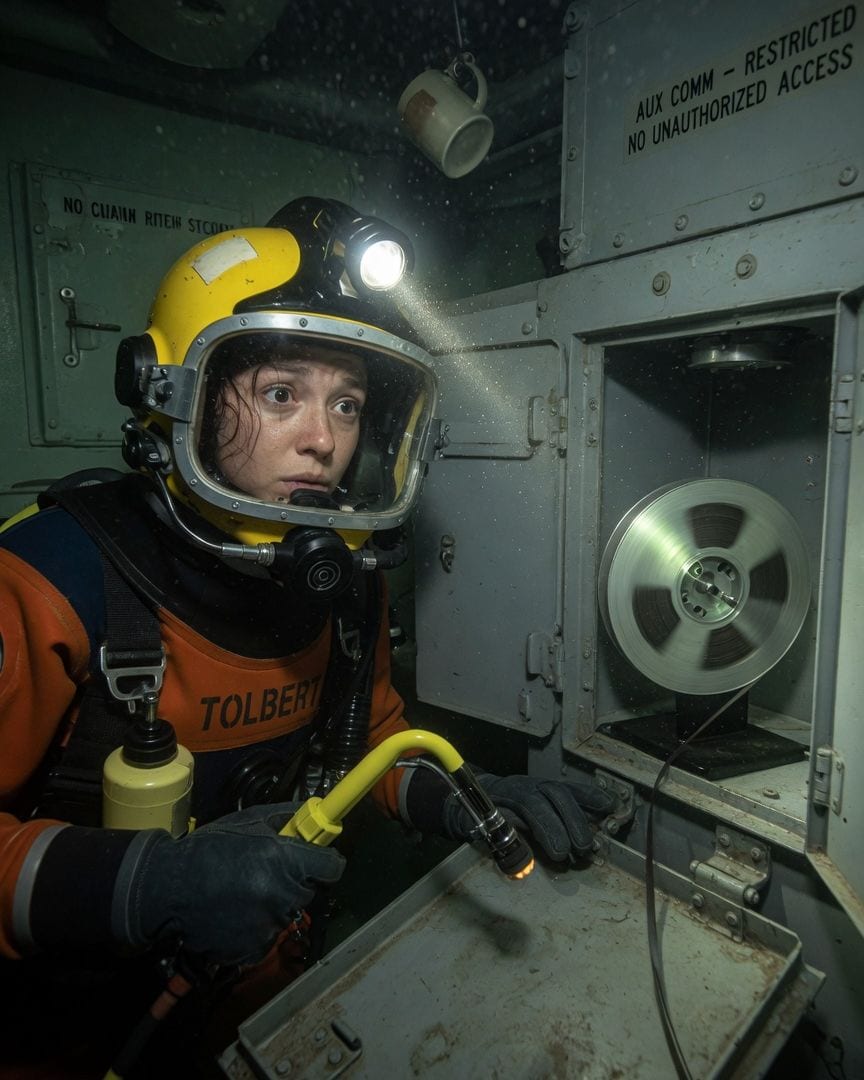
With a gale approaching, a deep-sea diver found a pristine tape reel spinning inside a sunken warship, sealed from within for eleven years.
Lieutenant Commander Rhea Tolbert plunged into the Denmark Strait's crushing depths, racing against a looming gale to explore the sunken destroyer Wicomah Bay. After eleven years, the ship sat upright and unbroken, its hatches impossibly dogged down from the inside. Inside, preserved like a time capsule, she found an unlisted steel compartment welded into the hull, humming faintly. When breached, it revealed a pristine magnetic tape reel, spinning silently in the dark.
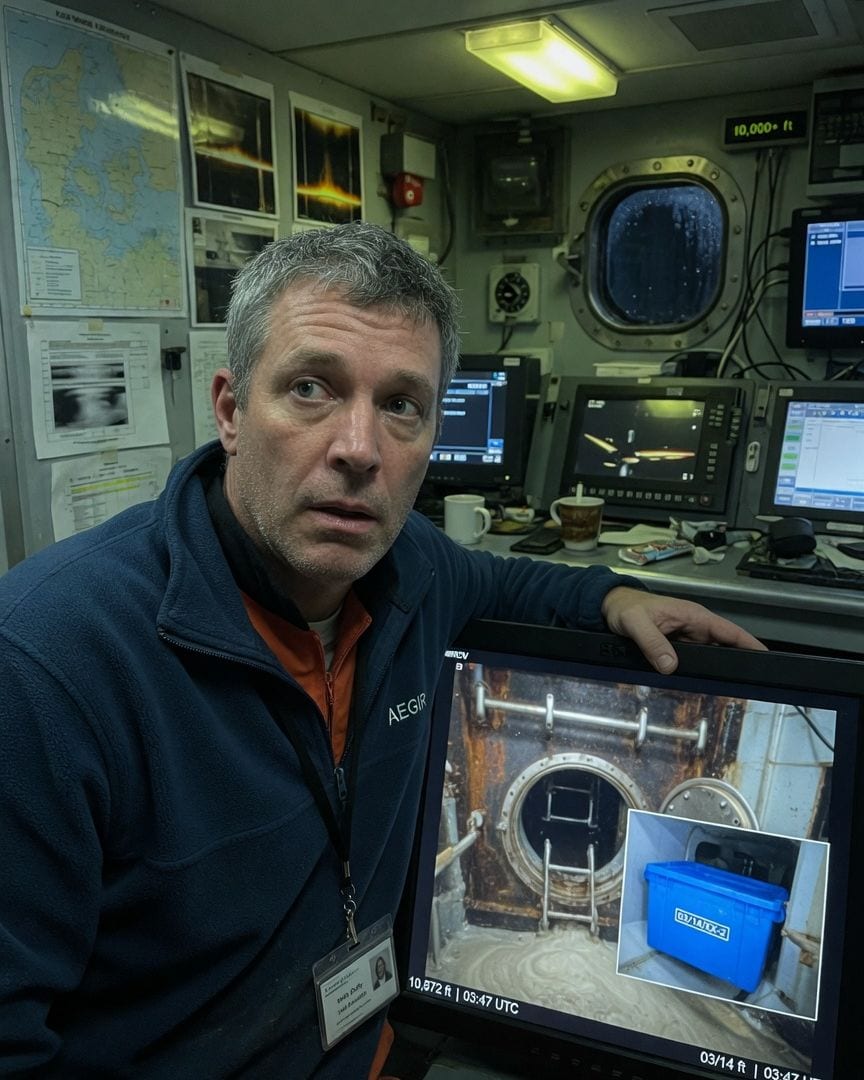
A sonar operator finds a Cold War submarine lost in 1968, but inside, a modern blue container bears a date stamp from two years ago.
Sonar operator Wells Duffy spent days on the RV Aegir, mapping the frigid depths of the Denmark Strait. He was nearing the end of his eleven-day mission when his vessel's transducers painted an impossible image. Deep in a trench, the USS Gale Prescott, a submarine lost with seventy-one souls in 1968, rested upright and perfectly preserved. But as the ROV's camera pushed into the gloom, it revealed a vibrant blue plastic container, clearly not from 1968, bearing a digital date stamp from just two years prior, chilling Wells Duffy to his core.
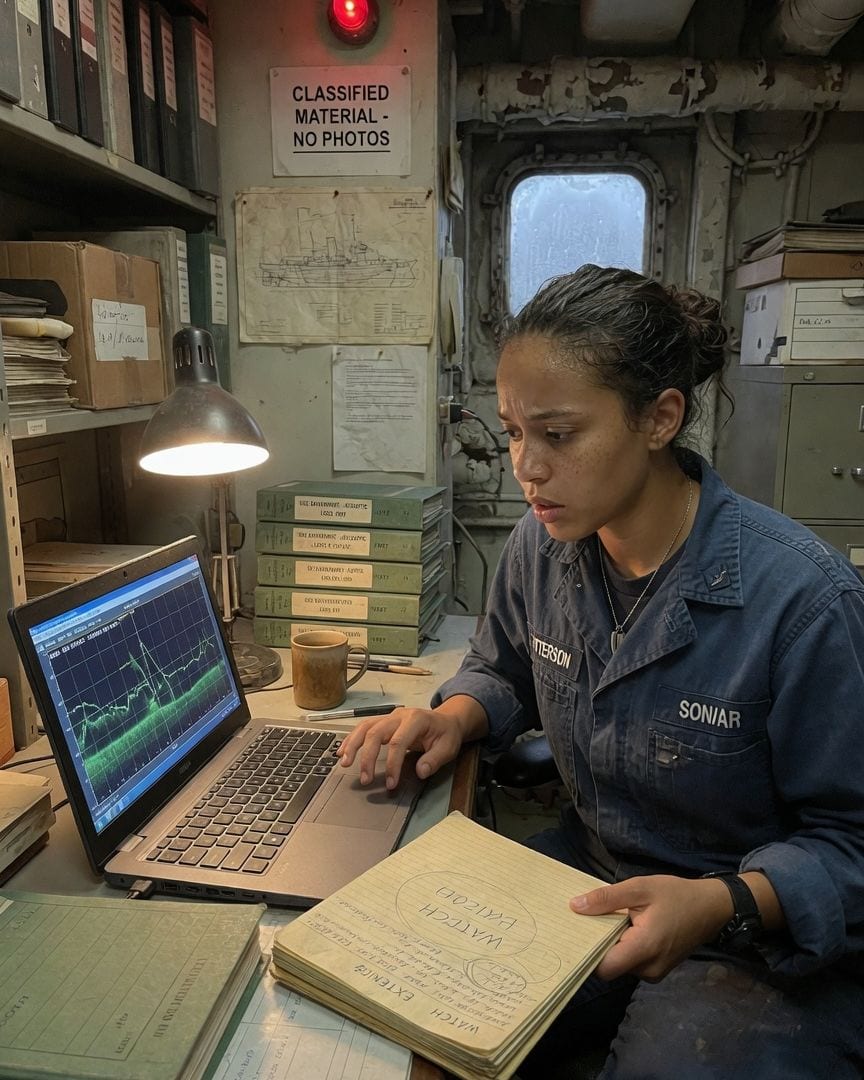
On the USS Calloway's final patrol, a sonar technician found an old log with two chilling words: 'WATCH EXTENDED.'
Sonar Technician Brooke Patterson had only two days left on the USS Calloway's last patrol, a finality that hung heavy in the humid sonar room. Through the impenetrable fog, her radar showed only empty water, but then an impossible biologic contact pinged, mimicking a vessel with eerie precision for three silent hours. It vanished at 0400, just as an identical trace had done weeks before. Searching old archives, Brooke found the precise pattern in a decades-old log from a scrapped destroyer. Scrawled next to it, in faded ink, were two words: "WATCH EXTENDED." What did those words truly mean?
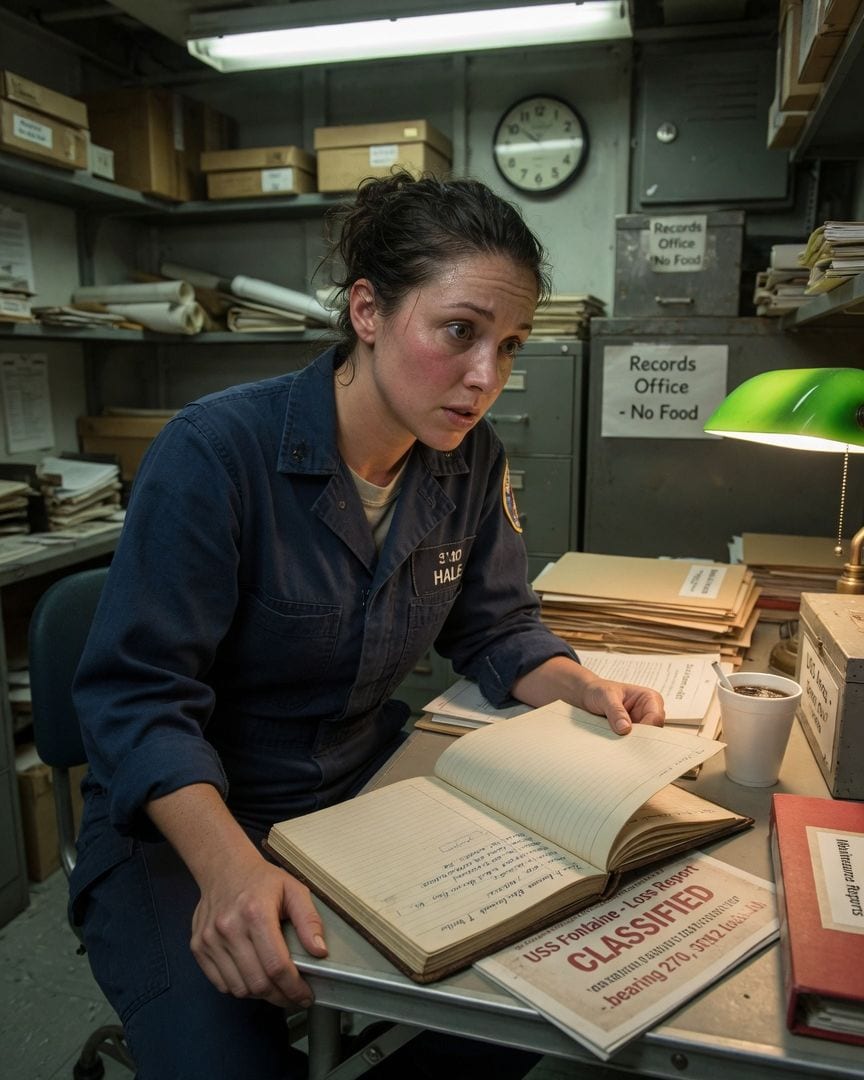
Petty Officer Hale needs a spotless record for her transfer. But the USS Ares sonar logs show an identical, impossible contact, logged to the minute, years apart, and tied to a classified loss report.
Petty Officer Sarah Hale needed a spotless record for her coveted shore duty transfer, a posting she'd worked five years to secure. Alone in the USS Ares sonar shack, three days out from San Diego, her midwatch was broken by an impossible contact: a close, slow echo holding perfect pace, invisible to radar, then vanishing. Her heart hammered, not from fear, but from the data's impossibility. When she found an identical entry in her own log from just one week prior, the cold dread tightened its grip. But the true chill settled when she unearthed decades of similar records, signed by other sonar officers, all showing the same impossible contact at 0212, off the port beam, for nineteen minutes, on the same ship, stretching back years—a persistent echo tied to a classified loss report.
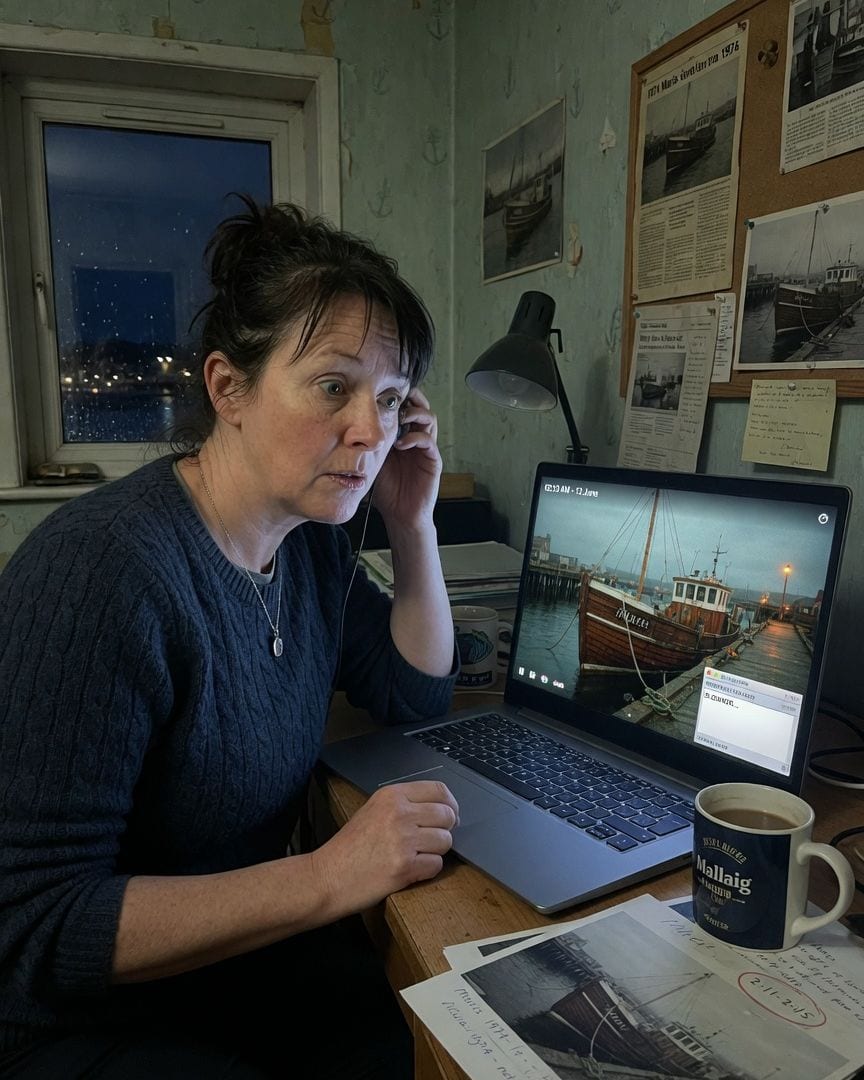
My webcam feed showed the Maris, lost with all hands in 1974, tied at the Mallaig pier. Then I heard its voice.
My morning routine of checking the Mallaig harbour webcam was shattered when I saw the fishing trawler *Maris* tied to the pier. This boat, with its distinct hull and rigging, went down with all hands in 1974, a loss still etched on our town's memorial. Yet, there it was, captured on a live feed, moving silently in the early hours.
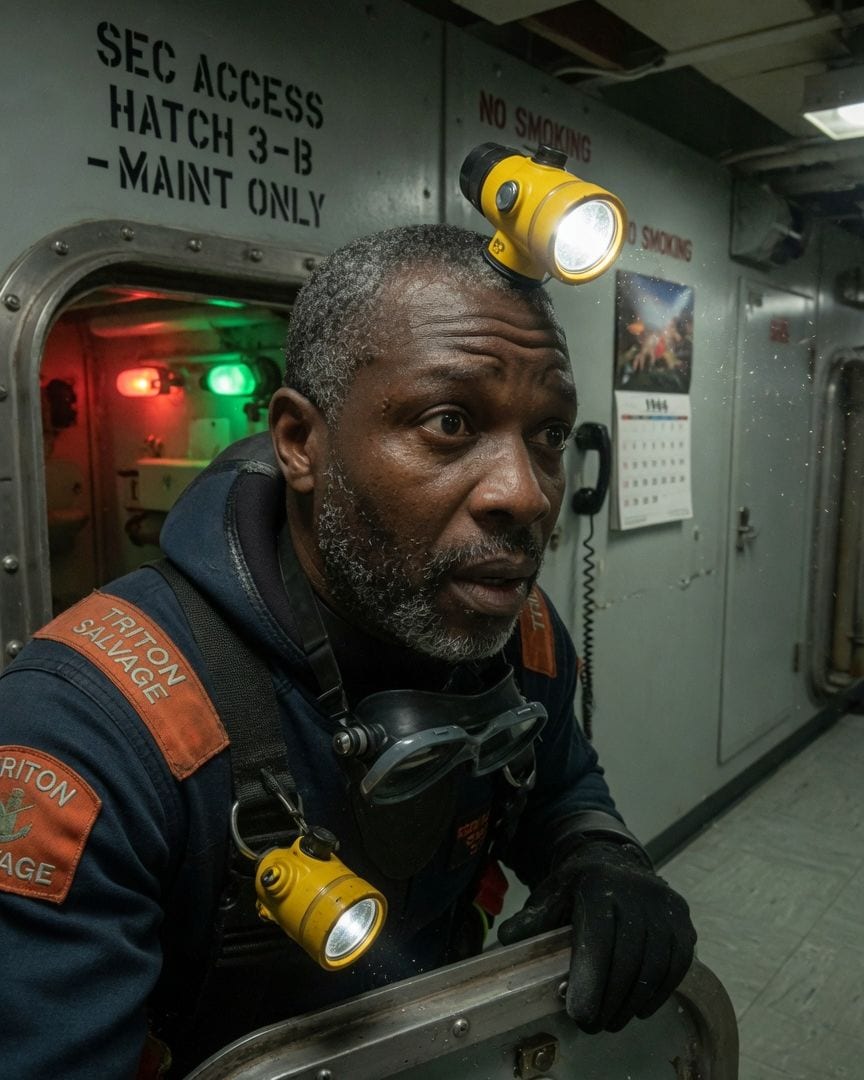
A salvage master found a Cold War escort vessel lost for fifty-eight years. Its running lights were burning bright.
Salvage Master Bram Oduya, a man dedicated to finding the lost, stared at an impossible sonar readout in the calm Java Sea. Beneath his vessel, the Triton, lay the USS Palo Cinder, an escort vessel officially lost in 1966. What truly froze him were its running lights, burning steady and bright after nearly six decades in salt water. He ordered his ROV to surface, and as its camera rose into position, it captured the impossible sight: the Palo Cinder, motionless, yet showing a faint bow wave around its pristine hull. Bram knew this was no ordinary wreck, and he prepared for a dive, determined to touch the seam where reality had torn open.