With a gale approaching, a deep-sea diver found a pristine tape reel spinning inside a sunken warship, sealed from within for eleven years.
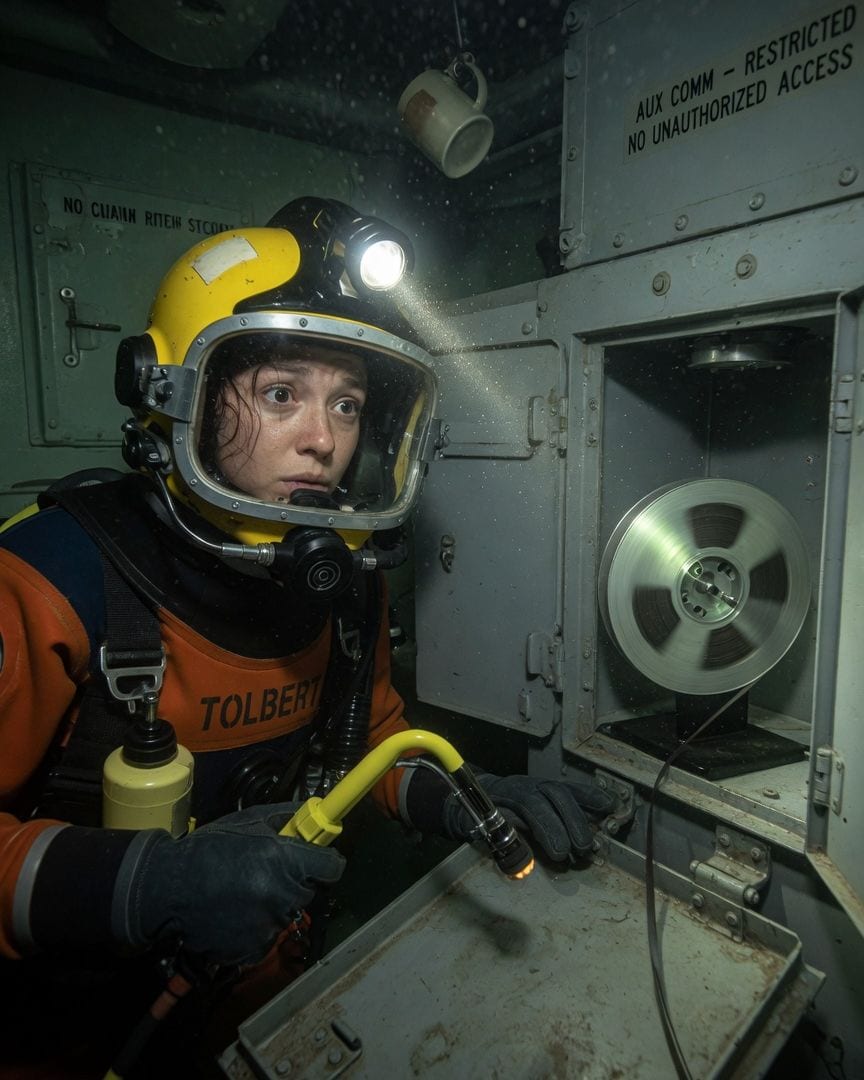
Lieutenant Commander Rhea Tolbert descended into the crushing depths of the Denmark Strait, the frigid water closing in around her heavy dive gear.
Her powerful helmet lights cut through the silt, illuminating the ghostly silhouette of the destroyer escort Wicomah Bay, upright and unbroken on the seabed after eleven years. The sight alone was impossible.
Every boat was still swung in its davits, every antenna mast intact, as if time had simply stopped the moment it sank.
She swam closer, the cold seeping into her bones despite her dry suit, her heart hammering against her ribs. The impossible quickly became horrifying. Every single hatch on the Wicomah Bay's weather deck was dogged down hard, from the inside.
The heavy locking mechanisms were clearly set in the 'secure' position, not rusted open or blown out, but deliberately fastened. The sheer, physical wrongness of it made her pause.
A hundred and ninety men were gone, yet the ship was sealed tight, a perfect tomb, locked from within. They had either sealed themselves in, or something else had done it for them.
Rhea’s team worked against the clock, knowing a gale would return to the Strait in hours.
They gained entry to the Wicomah Bay not through any of the impossibly sealed hatches, but through a breach in the hull, likely an old torpedo scar, long-since stabilized by the deep-sea pressure.
Inside, the destroyer was a time capsule, perfectly preserved by the cold.
Navigation charts were still pinned to the plotting table on the bridge, the lines of latitude and longitude crisp, as if the last watch officer had just stepped away.
Coffee mugs sat undisturbed in their gimbals, waiting for hands that would never return.
Rhea methodically swept the bridge, her helmet light moving across every surface, and then navigated to the captain’s quarters, documenting everything with her suit camera.
She found the ship’s log, its final entry detailing a routine patrol, the handwriting precise and unhurried.
But then, deep within a rarely used auxiliary communications room, behind a bolted-down locker that looked like standard Navy issue, she discovered something else entirely.
It was a small, perfectly sealed steel compartment, about the size of a footlocker, welded directly into the hull. It was not present on any of the ship’s schematics.
Its door was secured with heavy, unfamiliar bolts, not standard naval hardware, but something more robust, integrated into the very structure of the hull itself. They, too, were sealed from the inside.
She tried to rationalize it as a forgotten modification, perhaps a secure locker for sensitive equipment, but the construction was too alien, too precise.
A faint, rhythmic vibration emanated from within the compartment, a low hum that seemed to resonate through the very hull of the sunken ship, a living pulse in a metal corpse.
With a specialized cutting torch, Rhea carefully breached the unlisted compartment’s door. The low hum inside intensified slightly, a subtle thrumming that resonated against her dive suit, a quiet pressure against her helmet.
Inside, the compartment was bare, save for a single item: a pristine, unmarked reel of magnetic tape, resting on a small, perfectly balanced pedestal.
It looked like something from a 1970s mainframe, a relic of an older era, yet it was utterly free of corrosion, gleaming as if it had been manufactured yesterday.
There were no labels, no identifying marks, nothing to indicate its purpose or origin. But it wasn’t just sitting there. The tape was slowly, almost imperceptibly, spinning. It was moving, playing, decades after the Wicomah Bay went down.
Back on the research vessel, the gale now just hours away, Rhea carefully extracted the reel.
She connected it to an antique tape reader, a piece of equipment salvaged years ago from a decommissioned intelligence ship, its beige plastic yellowed with age.
Her old friend, Gordon Pierce, a retired naval archivist with a reputation for finding the unfindable, watched skeptically from across the cramped lab.
Gordon initially dismissed the hum. “Residual magnetism,” he offered, his voice a low rumble. “Or the reader’s faulty. It’s a relic, Rhea, like the ship itself.” He tapped a pencil against his teeth.
But Rhea, methodical and precise, ran spectral analysis. The hum wasn’t random static; it was a rhythmic pulse, a complex, repeating sequence of tones and clicks, almost like data bursts. It was clearly artificial, a deliberate signal.
She cleaned up the signal, filtering out the ambient noise of the deep, the distortions of the old tape. A faint, distorted voice emerged from the white noise. It was a series of numbers, spoken in a flat, synthesized tone.
Gordon, his skepticism momentarily forgotten, leaned closer. He tried to find a database match for the format, the modulation, the voice itself. He ran queries against every known military and civilian encryption protocol, every old communications standard. Nothing.
The ordinary explanations — a misfile, faulty equipment, some forgotten, elaborate practical joke — fell away, one by one, leaving a cold, impossible void. This was something else entirely.
As Rhea and Gordon worked tirelessly, the atmosphere aboard the research vessel grew tense. The air itself seemed to hum with suppressed anxiety.
Gordon, frustrated by the lack of official records matching the tape’s unique modulation, began cross-referencing old, declassified intelligence reports.
He found a few oblique references to “anomalous acoustic signatures” in deep water, buried deep in reports from the Cold War era, but nothing concrete, nothing that explained the tape. Then, a strange email arrived in Gordon’s inbox.
The sender was a string of meaningless characters, the subject line blank. It contained a single attachment named 'BLANK.WAV.'
When he clicked it, his computer’s speakers emitted only white noise for ten seconds, followed by a sudden, sharp, chilling tone – a perfect match for a specific, almost subliminal tone Rhea had found buried deep within her cleaned-up recording from the Wicomah Bay.
It wasn't random; it was a direct, undeniable message. Later that evening, as Rhea reviewed her dive logs, a faint, almost imperceptible ping registered on her ship's long-range sonar.
It was a small contact, moving fast, shadowing them just outside their detection range. The contact didn't respond to their hails, and its transponder remained stubbornly off. Someone knew what they’d found.
The danger was no longer abstract, confined to the sunken ship; it was personal, out here in the black water.
Driven by the anonymous warning, Rhea and Gordon pushed harder. They isolated a cleaner segment of the recording. The synthesized voice repeated a series of numbers, clearer now, sharp and cold, detached.
Gordon, his hands shaking slightly, entered the first sequence into a restricted military database, a relic from the Cold War that he still had access to through his old connections. The numbers resolved into a service number.
He checked the next sequence. Another service number. Then another. He cross-referenced them with the Wicomah Bay’s crew roster.
They were the service numbers of the men lost on the destroyer, one after another, an automated inventory, a roster of the dead. The horror bloomed in the small, cramped lab, pushing the air out of the room.
Gordon, his voice barely a whisper, entered the final numbers from the sequence into the database. The screen flickered, a sudden, cold shudder across its surface. It displayed his own service number. And then, Rhea’s.
The recording wasn't just a record of the lost; it was an active, ongoing inventory. The Wicomah Bay hadn't been lost; it had been processed.
The hatches hadn't just been dogged; they were the final seal on a file that was still being signed, still being written.
The realization that their own numbers were on the tape sent a chill through them, colder than the Denmark Strait itself.
Gordon, frantic, began cross-referencing the other service numbers on the recording, not just to the Wicomah Bay, but to every 'lost at sea' report he could access from his vast, unofficial archives.
He discovered that many of these 'lost' individuals were linked to a specific, obscure classification code – not 'MIA' or 'KIA,' but 'CONTAINMENT.'
It was a designation he had only ever seen in the most heavily redacted black-budget documents, a code that suggested observation, not recovery.
The code appeared across decades, attached to ships, aircraft, even a small, remote ground unit in the Arctic, all officially declared 'lost.' It wasn’t a series of accidents; it was a pattern, a silent, systematic filing process.
Then, a new entry appeared on his screen, just weeks old, under the same 'CONTAINMENT' classification: a commercial fishing trawler, the Sea Witch, officially reported lost off the Grand Banks just last month due to a rogue wave.
Beneath its name, a sequence of numbers scrolled, identical in rhythm and tone to the Wicomah Bay recording, and then, slowly, a new series of digits began to appear, its service number forming line by line, as if being written in real-time.
The file was still being written, and they were now the latest entries.
The full horror of the pattern across decades and classifications clicked into place with sickening precision. The 'containment' events weren't random accidents, not acts of malevolent destruction.
They occurred when a vessel or unit crossed an invisible boundary, a threshold of an unseen, silent mechanism. The entity didn't destroy or attack in any way they understood; it assimilated, it recorded, it filed.
The Wicomah Bay's crew, in their final moments, must have understood this.
Their desperate act of dogging the hatches from the inside wasn't an attempt to keep something out, but to contain what had already infiltrated, or to seal themselves within a last, futile defense against a process that was already underway.
The unmarked reel wasn't just a record; it was the ship's final, active data log, its 'filing receipt,' a record of its own disappearance.
The Navy's 'secrecy machine' wasn't just covering up; it was a long-term, detached observation and archiving of an undeniable, recurring phenomenon, a vast, patient study of something utterly beyond human comprehension.
The entity wasn't hostile in a way they understood; it was simply a force that organized, that categorized, that filed. And they, Rhea and Gordon, were now the latest entries pending categorization.
The gale roared around the research vessel, whipping up monumental waves that crashed against the hull, shuddering through the deck. The small, silent contact on their sonar was closer now, its presence unmistakable, unwavering in the storm.
Rhea and Gordon knew they could not stay, could not fight. Their only option was to escape, taking their proof with them.
They frantically downloaded the cleaned-up recording and Gordon’s cross-referenced files onto a single, encrypted data chip, small enough to hide in a pocket.
As they prepared to abandon ship, a dark, unmarked vessel, seemingly defying the storm, pulled alongside their research vessel. Its deck was devoid of lights or visible crew, a black silhouette against the churning spray.
A grapple hook thudded against their hull, scraping metal. Rhea shoved the data chip into Gordon’s hand. "Go!" she shouted over the shriek of the wind, pointing to the emergency raft already inflated on the davits.
She set a timed charge on their main server racks, ensuring all other copies of their data would be destroyed.
They scrambled into the raft as indistinct figures, tall and silent, began to appear on the deck of the silent vessel.
The raft was launched into the raging sea just as the charges detonated, sending a shower of sparks and smoke into the black sky.
They were out, but at an incalculable cost: their vessel, their careers, their old lives – all gone, exchanged for a single, terrifying truth that no one would ever believe.
The research vessel was reported lost in the gale, presumed sunk with all hands.
Official records now showed Lieutenant Commander Rhea Tolbert and Gordon Pierce as 'lost at sea,' their distinguished careers ending abruptly in a blank space, a closed file.
A week later, a small, untraceable data packet, containing only a sound file and a cryptic sequence of dates and coordinates, appeared on a dark web forum specializing in 'unexplained phenomena.'
It sat unread, buried beneath layers of static and noise, for months.
The data packet remained untouched for nearly a year. Then, late one night, a lone user, browsing the archived threads of the forum, clicked on the obscure link. The sound file downloaded, a small, innocuous .wav file. They opened it.
The rhythmic sequence of numbers began to play, cold and synthesized, filling the quiet room. It looped, again and again, an endless inventory.
The download completed, and the numbers began to play for the first time in a new, quiet room.
If this one got to you
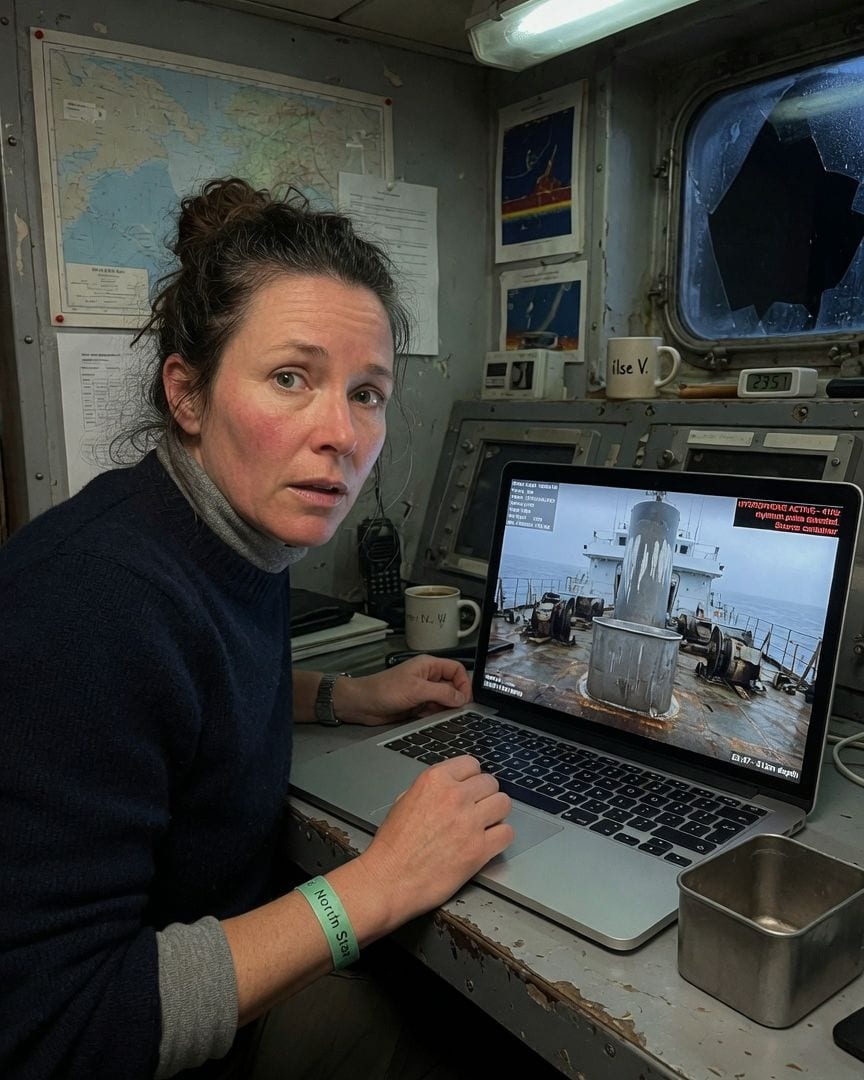
A marine archaeologist's final search for her uncle's lost ship found a container humming eighty years deep.
Marine archaeologist Dr. Ilse Varren had four days left to find the *Cadmus Hale* before the Bering Sea ice ended all operations. Her uncle Joseph was among the 311 men lost with the transport ship in 1944, and this was her last chance to locate it. When her AUV finally found the wreck, perfectly preserved on the abyssal plain, Dr. Varren was stunned. Yet, a modern, unmarked container sat on the ship's main deck, utterly devoid of marine growth and humming a faint, rhythmic pulse from the deep.
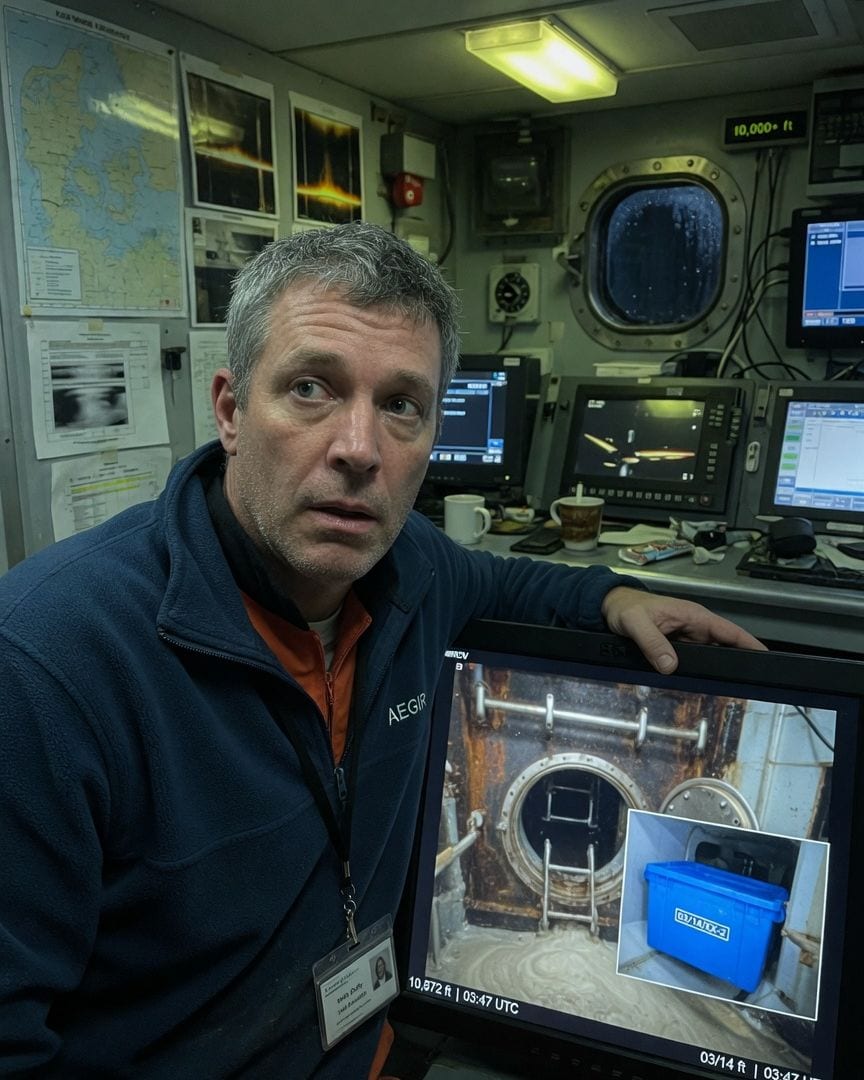
A sonar operator finds a Cold War submarine lost in 1968, but inside, a modern blue container bears a date stamp from two years ago.
Sonar operator Wells Duffy spent days on the RV Aegir, mapping the frigid depths of the Denmark Strait. He was nearing the end of his eleven-day mission when his vessel's transducers painted an impossible image. Deep in a trench, the USS Gale Prescott, a submarine lost with seventy-one souls in 1968, rested upright and perfectly preserved. But as the ROV's camera pushed into the gloom, it revealed a vibrant blue plastic container, clearly not from 1968, bearing a digital date stamp from just two years prior, chilling Wells Duffy to his core.
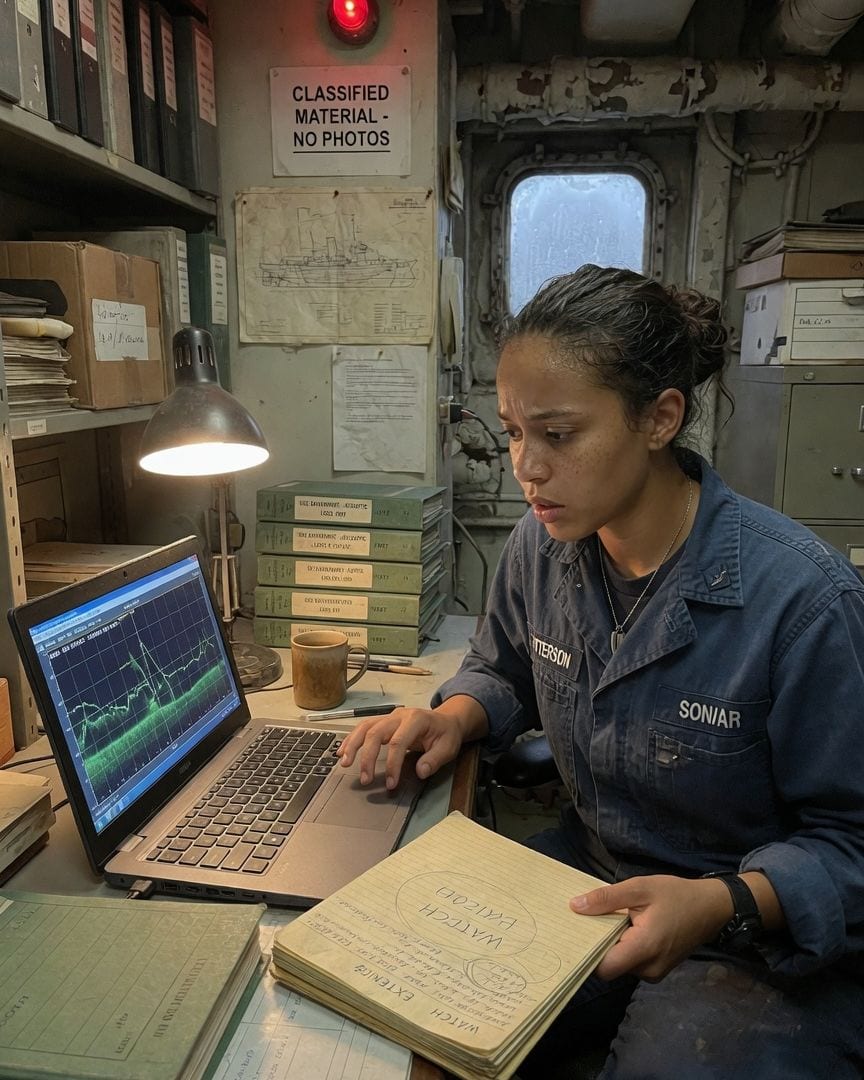
On the USS Calloway's final patrol, a sonar technician found an old log with two chilling words: 'WATCH EXTENDED.'
Sonar Technician Brooke Patterson had only two days left on the USS Calloway's last patrol, a finality that hung heavy in the humid sonar room. Through the impenetrable fog, her radar showed only empty water, but then an impossible biologic contact pinged, mimicking a vessel with eerie precision for three silent hours. It vanished at 0400, just as an identical trace had done weeks before. Searching old archives, Brooke found the precise pattern in a decades-old log from a scrapped destroyer. Scrawled next to it, in faded ink, were two words: "WATCH EXTENDED." What did those words truly mean?
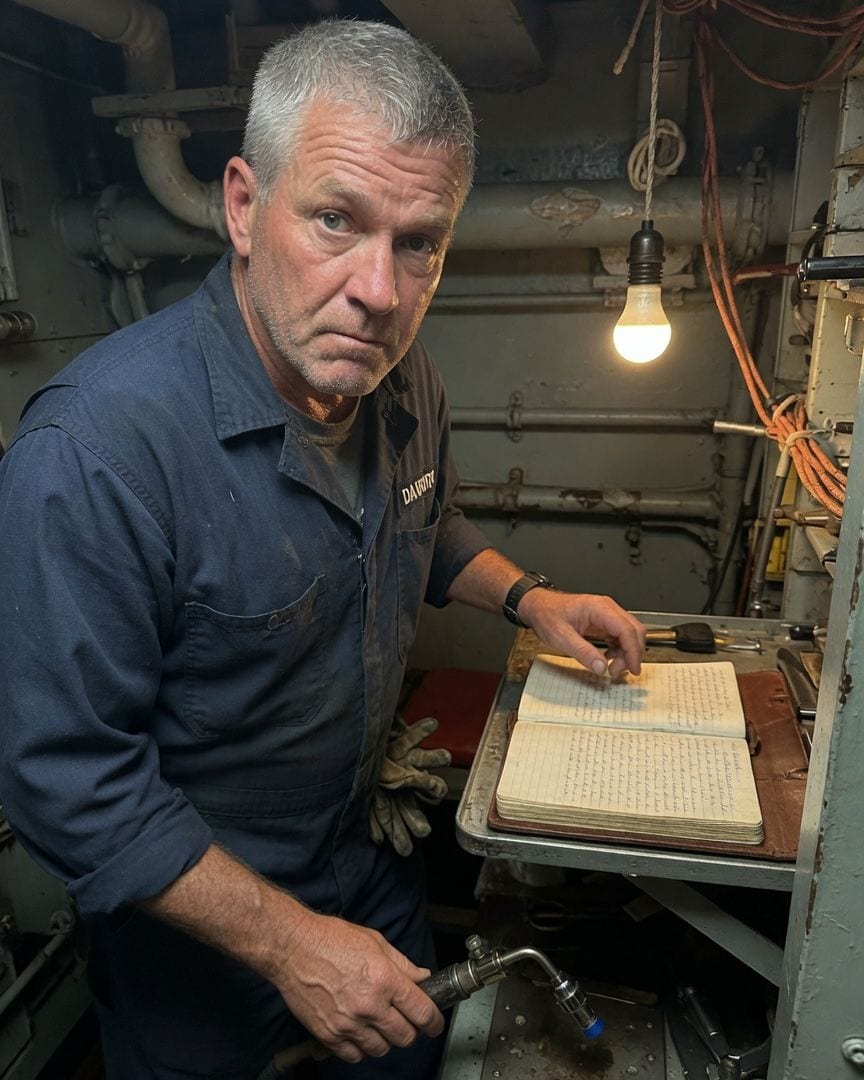
A week from shore duty, Chief Danforth cut a hatch where his ship's plans showed solid steel. An hour later, the wall was seamless, but the Cold War logbook from inside appeared under his mattress.
Chief Petty Officer Raymond Danforth, just a week from ending three decades of service, was intimately familiar with every pipe and plate of the guided-missile destroyer Weatherall. During a mid-cruise overhaul, his gloved hand found a sealed hatch where schematics promised only a solid bulkhead. He cut through the impossible seam to reveal a small, dry compartment, softly lit, containing a logbook filled with an unsettlingly familiar hand. When he returned an hour later with a witness, the hatch was gone, the wall seamless. Later that night, the same logbook appeared beneath his mattress, its pages revealing an entry: 'Petty Officer Howard Montgomery, missing, 1972.' How could a compartment vanish, yet leave its secrets behind?
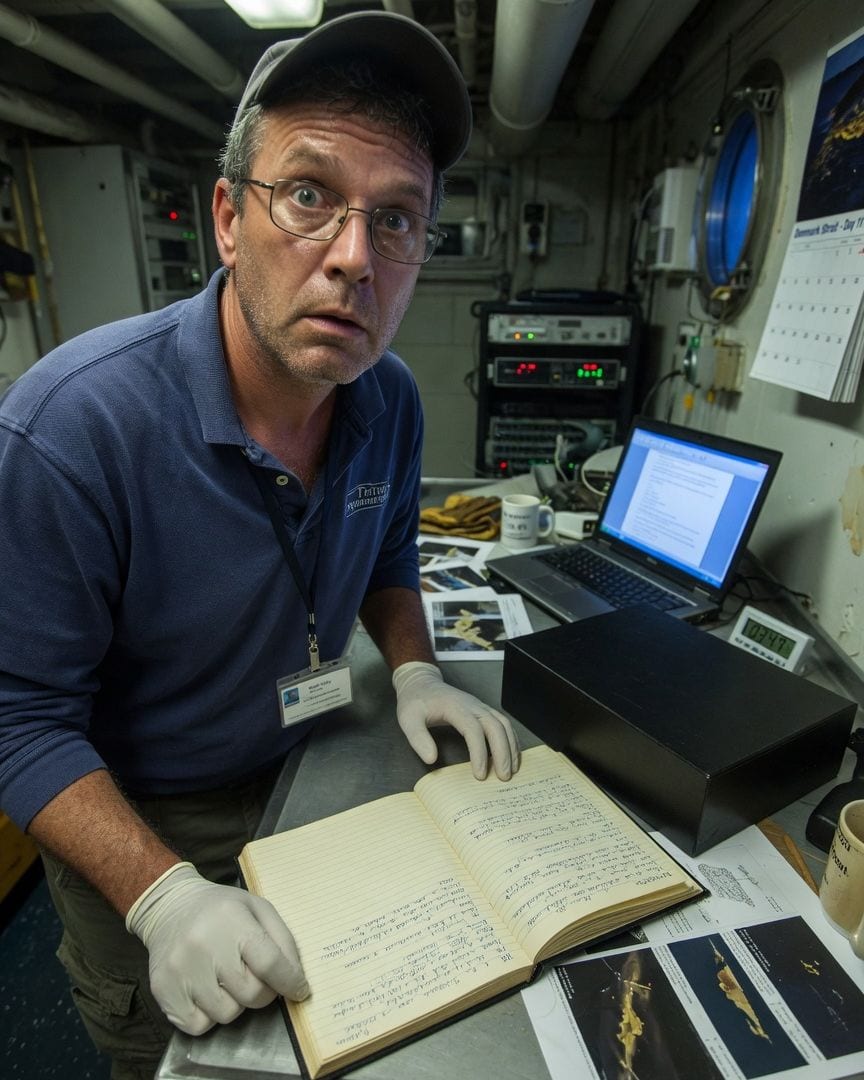
A hydrographer found a lost Cold War submarine from 1968. Inside, its logbook carried entries dated '12.03.2012'.
Hydrographer Wells Duffy had spent eleven days in the *Triton*'s control room, guiding the deep-sea submersible through the crushing dark of the Denmark Strait, chasing a phantom sonar signature. When the USS *Gale Prescott*, lost with all hands in 1968, finally resolved on his monitors, triumph turned to unease as he saw its escape hatch stood simply ajar. The hatch rim and ladder rungs were eerily clean and worn bright, used repeatedly long after the ocean claimed the vessel, prompting Captain Crane to authorize an unauthorized dive. Inside the frigid wreck, Wells discovered a non-Navy container, strangely warm, holding a logbook whose precise entries continued across the decades, ending in the impossible date of '12.03.2012'.
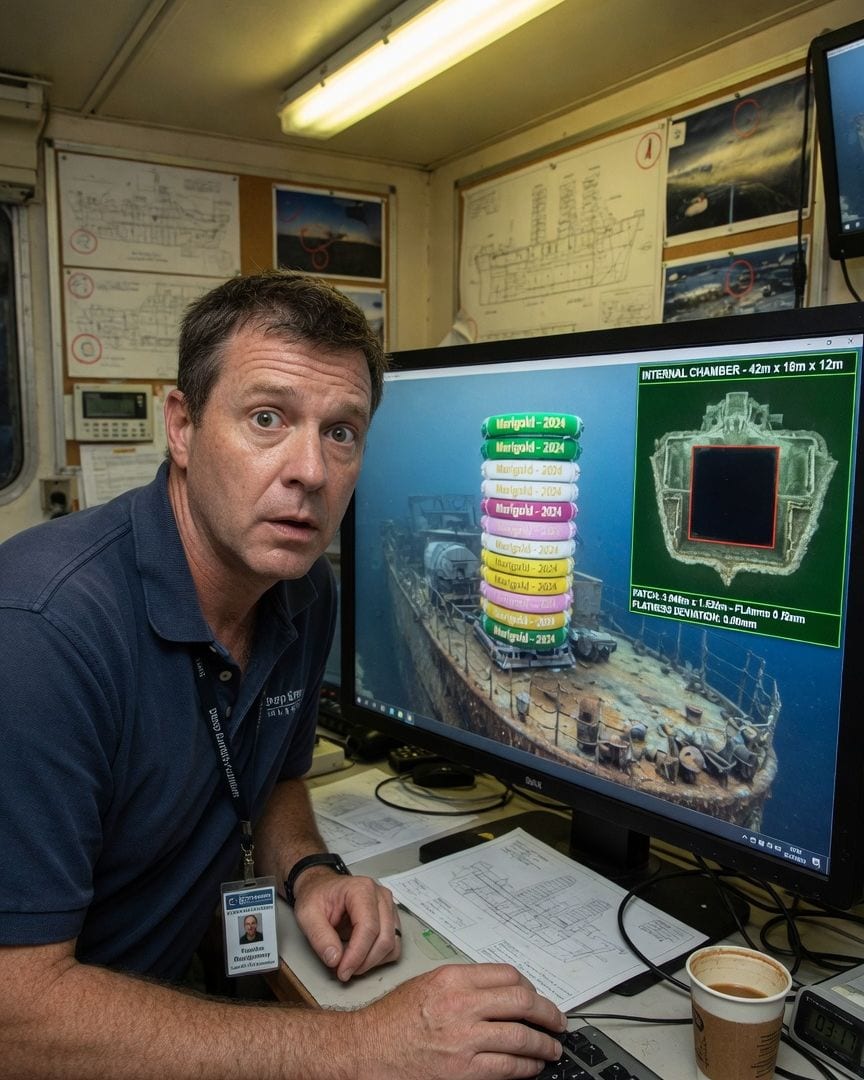
A Cold War trawler, lost since 1978, has a seamless metal patch. ROV operator Franklin Montgomery's sonar then finds an impossible void, too vast to fit inside, sealed behind it.
Deep-sea ROV operator Franklin Montgomery watches an impossible sight unfold on his monitor: forty-six wreaths, stacked perfectly, one atop the other, on a trawler lost to the Grand Banks in 1978. The newest wreath, vibrant green and white, mocked the decades of skeletal foam beneath it, and the wreck lay two hundred miles from its annual drop point, defying all logic and currents. Driven by a gnawing certainty, Franklin later discovered a seamless, impossible metal patch on the trawler's hull, a modification with no record, appearing post-sinking. But it was the deep-penetrating sonar that revealed the true defiance of physics: an impossibly vast, empty chamber sealed within the hull, far larger than the trawler itself could ever contain.