My GoPro footage shows a panelled staircase climbing into the dark where our airing cupboard actually is. It lingers there for a full minute, but there's no such staircase.
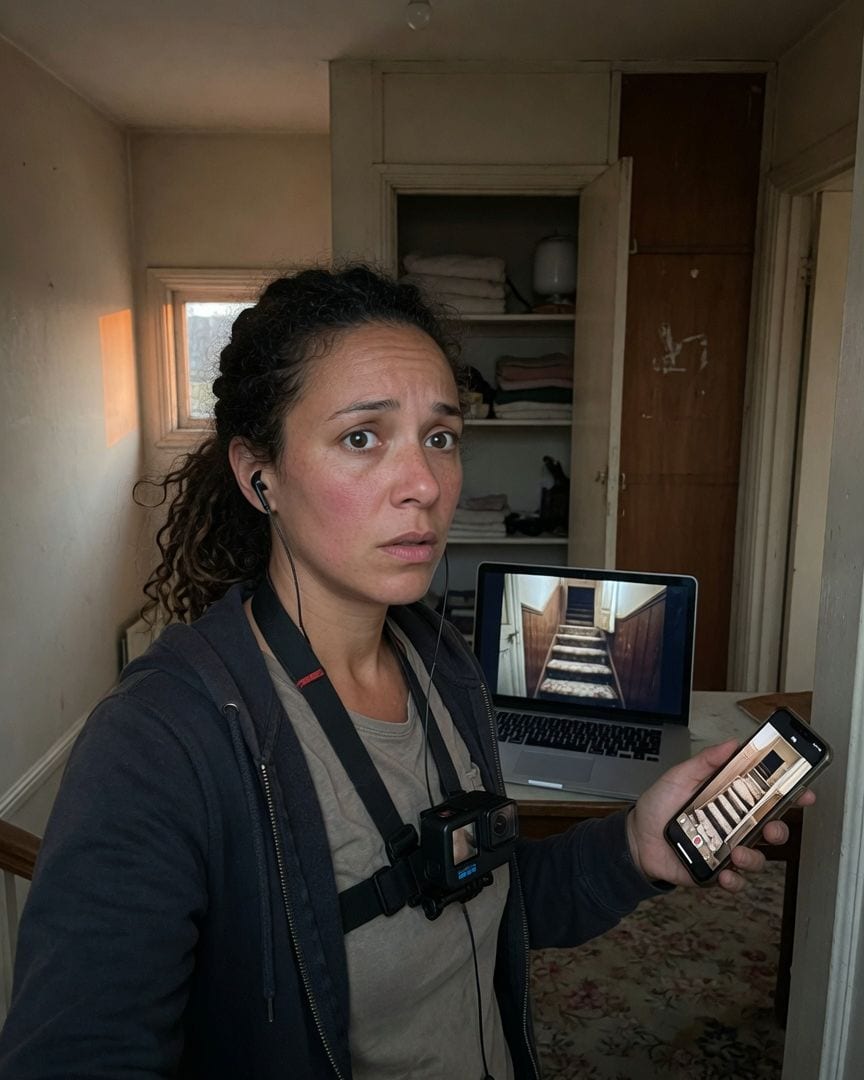
I cinched the GoPro to my chest, the strap digging slightly into my collarbone. Insurance claim for storm damage. Just a quick walk-through, they said. Every room, every angle, meticulously recorded.
I remember thinking how tedious it was, how much I just wanted to get it done. The living room, kitchen, downstairs bathroom – all normal. Just water stains on the ceiling, a few cracked tiles.
Nothing out of the ordinary, nothing to make me pause. Then I went up the stairs, past the landing window, the late afternoon sun already dipping, toward the bedrooms. That’s where it happened.
On the upstairs landing, when I later reviewed the footage, the image flickered slightly, then stabilized. And there it was. Not the beige airing cupboard door I’d lived with for years, but a second staircase.
It was panelled, an older style, carpeted in a faded floral pattern, climbing into absolute dark. It rose exactly where our airing cupboard had always been.
I watched the playback, my heart thrumming a frantic rhythm against my ribs, as the camera lingered on this impossible structure for a full minute, just... staring.
A distinct, inexplicable chill seemed to settle over the recorded frame, even on the screen. There was no such staircase, and there never has been. Not in this house.
I replayed the footage, again and again, my breath catching in my throat with each loop. I checked the date stamp, the timecode: July 14th, 2023, 3:14 PM. All correct. No gaps, no jumps.
Just a solid, unbroken minute of a staircase that did not exist. I even went upstairs, opened the airing cupboard door, and filmed inside with my phone, just to prove I wasn't losing it.
Just shelves, neat stacks of towels, the hum of the water tank. Nothing but the mundane reality.
I sat back down at my laptop, comparing the two recordings side-by-side.
The GoPro’s wide-angle lens did seem to warp the perspective slightly at the edges, giving everything a faint fish-eye effect, but not enough to conjure an entire, solid-looking staircase out of thin air. I tried to rationalize it.
A digital glitch? Some kind of lens flare, a trick of the fading afternoon light catching on something I hadn't noticed? I even considered a prank, a really elaborate one, but I’d been alone in the house all day.
Oscar was at work. There was no one else here.
I pulled up the house's original blueprints, filed away in a dusty drawer since we bought the place in June. The plans were clear, precise. They showed the airing cupboard, exactly where it was now, a small, unremarkable utility space.
No indication of any previous staircase, hidden or otherwise. No odd angles, no sealed-off sections. Nothing.
The more I tried to find a logical explanation, a way to fold this impossible image back into the known world, the more the dread solidified, like cold cement in my stomach.
It was there, on the file, undeniable, yet physically absent from my house.
A strange hunch, a desperate hope for a mundane answer, made me isolate the audio track from the GoPro footage. Maybe a strange hum, a creak, something that could explain a visual anomaly.
I put on my headphones, scrubbing through the silence.
I scrubbed the audio track under the phantom staircase segment. Static, the faint hum of the house, my own breathing. Normal. Then, a distinct break in the white noise. A whisper.
It wasn’t a word, at first, just a breathy, almost musical sound, like air moving through dry leaves. I cleaned it up, boosted the volume until the hiss of the headphones was almost unbearable. Played it again. And again.
Clearer this time. A child's voice, soft but utterly distinct, repeated a single name. 'Eleanor.'
I froze, my finger hovering over the playback button, the sound vibrating directly into my ear, as if the child was right there, speaking only to me.
I showed the footage to Oscar. He watched the impossible staircase for a full minute, then glanced at me, a smirk already forming. "Okay, very funny," he said, trying to sound amused. "New GoPro effect?
Bad lens, maybe a reflection from something outside?" He suggested a dozen mundane things, practical jokes by previous owners, elaborate digital filters.
He was always like that, trying to find the logical explanation for everything, especially anything that edged toward the inexplicable.
But then I played the isolated audio. The whisper. 'Eleanor.' He listened, his head cocked, and his smile faltered. He rewound it, played it again, then slowly took off the headphones. "Eleanor?" he murmured, a frown creasing his brow.
"Who's Eleanor?" His eyes met mine, and for the first time, I saw a flicker of the same unease I felt.
I didn't have an answer. The name felt too specific, too personal to be random. I began researching. I spent hours online, pouring over local property records, old newspaper archives, digitized census data. Nothing.
Nothing about a hidden staircase, nothing about an Eleanor connected to our house or even our street. Our house was built in 1958. It was a relatively new build in an older neighborhood, the land it sat on previously undeveloped.
Or so I thought.
Desperate, I found an online forum for local history buffs. I posted an anonymous query about any unusual architectural features in houses built in the 1950s in our neighborhood, careful not to mention the staircase directly.
A day later, an email arrived. The sender was Constance Vaughn, 78, a retired local historian. Constance's email was polite but cryptic.
She mentioned vague rumors of 'discrepancies' in the original town planning documents for our area, particularly concerning the land the houses were built on.
She invited me to visit her at the old Historical Society Annex, hinting at records that were 'difficult to access.' The unease ratcheted up another notch.
I felt a growing certainty that I wasn't just looking at a glitch; I was looking at a deliberate omission.
And the cold spot on the landing, once fleeting, now seemed to persist, a faint, inexplicable chill radiating from the airing cupboard wall, almost as if something was breathing on the other side.
I drove to the Historical Society Annex, a dusty, red-brick building tucked away behind the main library, smelling faintly of old paper and neglect.
Constance Vaughn greeted me at the door, a small, bird-like woman with sharp, knowing eyes that seemed to take everything in. As I explained the GoPro footage and the name 'Eleanor,' she listened, unblinking, betraying no surprise, no disbelief.
Just a steady, quiet attention.
"Ah, yes," Constance said, her voice a dry rustle, like leaves skittering across pavement. "Eleanor. She tends to surface when people start looking too closely at the foundations."
Her words hung in the air, weighted with a history I couldn't yet grasp.
Constance led me through cramped aisles of forgotten ledgers and brittle maps, the air thick with the scent of aged paper. She stopped at a large, yellowed survey map, dated 1898, spreading it out on a dusty table.
She pointed out a section of land that was conspicuously blank, a white space where Rachel’s house now stood. "This section," Constance explained, tapping the blank space with a bony finger, "was once Hawthorne Institute property. A private asylum.
But it closed down rather abruptly in the early 20th century. All records… well, they disappeared."
As I leaned closer, examining the blank space, a shadow passed the frosted window, too quick to identify.
It was gone before I could even turn my head fully, leaving only a faint darkening on the glass, as if a cloud had just blotted out the sun.
Constance didn't seem to notice, or perhaps chose not to, but a prickle of unease ran down my spine. The feeling of being watched, or even of someone wanting to keep this blank space blank, grew.
Later that week, I found a small, handwritten note tucked under my car's windshield wiper. It simply read: 'Some things are better left sealed.' No signature. No return address.
The message felt like a direct response to my visit with Constance, a cold warning that someone was watching, someone who knew.
I called Constance, my voice tight with alarm about the note. "They don't like it when the past stirs," she said, her voice calm, almost resigned. "Especially that past." She agreed to meet me again, this time at my house.
She said it was time I understood what I was seeing.
Constance arrived with a heavy, leather-bound volume – a privately printed local history, its cover worn smooth, its pages soft with age. "This book was... suppressed," she said, handing it to me. "Decades ago.
It tells stories the town council preferred to keep buried." Inside, among faded, grainy photographs of the Hawthorne Institute, its grand, imposing facade belying its darker purpose, was a chapter titled 'The Hidden Wards.'
It detailed the existence of a 'Remedial Ward C,' an experimental wing for 'difficult' patients, designed to be completely isolated from the main institution.
"The Institute believed in... erasure," Constance explained, her eyes fixed, not on me, but on the airing cupboard door, as if she could see through it. "Not just from memory, but from the very structure of the building itself.
They used a specific kind of architectural trickery, an optical illusion in the original construction, that made certain parts of the building visible only from certain angles, or through specific lenses."
She flipped to a faded, hand-drawn diagram showing a concealed stairwell leading down from what was then the staff quarters – precisely where my airing cupboard now stood.
"The records were purged," Constance continued, her voice low, "all except for a few, carefully hidden, and often damaged. The patients in Ward C... they were meant to be forgotten entirely."
My mind reeled. The GoPro's unique lens. The impossible staircase. The persistent cold spot radiating from that wall. It all clicked into place with a horrifying certainty.
The camera hadn't glitched; it had seen through the illusion, captured the residual truth of a place meant to be unseen.
"Eleanor," I whispered, the child's name from the footage, a desperate plea now given context.
Constance nodded gravely. "Eleanor Vance. One of the last patients recorded in Ward C. A child. Her 'disposition' was listed as 'unresolved.' They say she never truly left."
Constance then pulled out a brittle, yellowed document from between the pages of her book, its edges crumbling like old toast. "This," she said, her voice barely audible, "I found in an old legal box, misfiled.
It's an 'Annexation Amendment' from 1912. The legal document that officially declared Ward C 'non-existent' and allowed the land to be redeveloped for, well, for later builds like yours."
I took the document, my fingers tracing the faded script. It was a formal legal text, densely packed.
It explicitly detailed the 'closure and sealing' of the ward, the 'restricted access stairwell' leading to it, and listed patient names from the ward.
My eyes scanned the list, jumping past unfamiliar names, then fixed on one entry, stark and chilling even in the dim light: 'Eleanor Vance.' Below it, a single, horrifying addendum in slightly different ink, as if scrawled later: 'Disposition: Unresolved.'
I looked up, my gaze snapping from the fragile document to the silent, innocuous airing cupboard door. Then to Oscar. He had just walked into the room, home from work, and stood transfixed, staring at the cupboard.
His breath misted faintly in the air, though the house was comfortably warm. A deep, bone-chilling cold radiated from the wall, making the hairs on his arms visibly stand on end.
Oscar shivered, rubbing his arms vigorously. "What is that?" he whispered, his eyes wide, fixed on the airing cupboard. "It's freezing in here, suddenly."
Still clutching the 'Annexation Amendment,' I explained everything, pointing from the faded document in my hand to the benign-looking cupboard door. Constance confirmed it, her voice calm, a low, steady drone. "The cold is a persistent trace. A bleed-through.
The Institute, in its hubris, believed that by erasing the physical space, they could erase the suffering within it. But some things don't simply vanish."
She explained that the 'restricted access stairwell' was designed to be optically elusive, a clever architectural deception from the late 19th century, appearing only to those sensitive enough, or to devices that could capture beyond the typical visible spectrum.
The GoPro, with its specific lens and digital sensor, had done precisely that – it had peeled back a century of deception. The 'unresolved disposition' for Eleanor Vance, Constance explained, was a euphemism, a bureaucratic shrug. "They couldn't contain her.
Or perhaps, she simply refused to leave. Her presence, her memory, her trauma, it became tied to that hidden space, a permanent resident in a place that technically ceased to exist, yet continued to exert its influence."
The whisper, the inexplicable cold spot that Oscar was now feeling so acutely, the impossible staircase—all were echoes of a suppressed truth, a child's lingering imprint on a place that tried, and failed, to bury her.
Our house wasn't just built on a former asylum; it was built around its most terrible secret, a secret that Eleanor, through the very mundane lens of my GoPro, was finally trying to reveal.
The dread was no longer abstract, a chill down my spine from a whisper. It was pressing, a palpable weight in the house, a presence that filled the room. Oscar, now fully convinced, his face pale, urged me to leave.
"We can't stay here, Rachel. Not with... with that." He gestured vaguely toward the cupboard, his voice shaking.
But I felt a strange, almost magnetic pull, a need to understand what Eleanor was trying to show me. I couldn't just run.
I replayed the GoPro footage, focusing intently on the dark opening of the phantom staircase, the place where the shadows deepened into oblivion.
This time, as the camera lingered, I noticed something new, something I’d missed in my initial shock: a faint, almost imperceptible shimmer, like heat haze rising from hot asphalt, at the very bottom of the steps, just before the darkness became absolute.
Constance, seeing it too, peered over my shoulder and gasped, a sharp intake of breath. "That's the threshold," she whispered, her voice tight with a profound understanding. "She's trying to show you the way in."
As she spoke, a sudden, intense cold swept across the landing, making the light bulb in the hallway flicker violently. The air grew heavy, thick with an unseen, yet utterly tangible, presence.
I felt a distinct pressure, as if unseen hands were gently, yet insistently, pushing me toward the airing cupboard door, toward that impossible staircase. Oscar grabbed my arm, his grip like a vice, his face a mask of pure terror.
"No! We're leaving, now!" He pulled me, almost dragging me, down the stairs, his feet thudding on the treads. I snatched the GoPro from the coffee table, along with the 'Annexation Amendment' and Constance's history book, clutching them like talismans.
As we fled out the front door, the cold followed us, seeping from the house, a mournful whisper seeming to echo from the now-empty rooms behind us, a final, despairing cry.
We drove away, leaving everything else behind, the house a silent sentinel of its hidden horrors.
Rachel and Oscar never returned to the house. They sold it at a significant loss, never disclosing the true reason, knowing no one would believe them.
The new owners, a young couple, bought it for a steal, charmed by the low price and the 'quirky' older neighborhood. Rachel kept the GoPro footage, the fragile deed, and Constance's book, proof of a truth too horrifying to articulate.
She tried to publish her findings, to share Eleanor's story, but was met with polite skepticism, outright dismissal, or accusations of elaborate hoaxes. The 'Annexation Amendment' was deemed a forgery, the GoPro footage a sophisticated deepfake.
Rachel sits in her new, smaller apartment, the GoPro footage playing silently on a loop on her laptop. The phantom staircase, the dark opening. She knows what she saw, what she heard. What she escaped.
She carries the weight of Eleanor's forgotten existence, a silent witness to a history that refuses to stay buried.
Oscar, watching her from the doorway, asks, 'Are you ever going to let that go, Rachel?' She looks up, a faint, wrong little smile playing on her lips. 'Is that so?'
If this one got to you
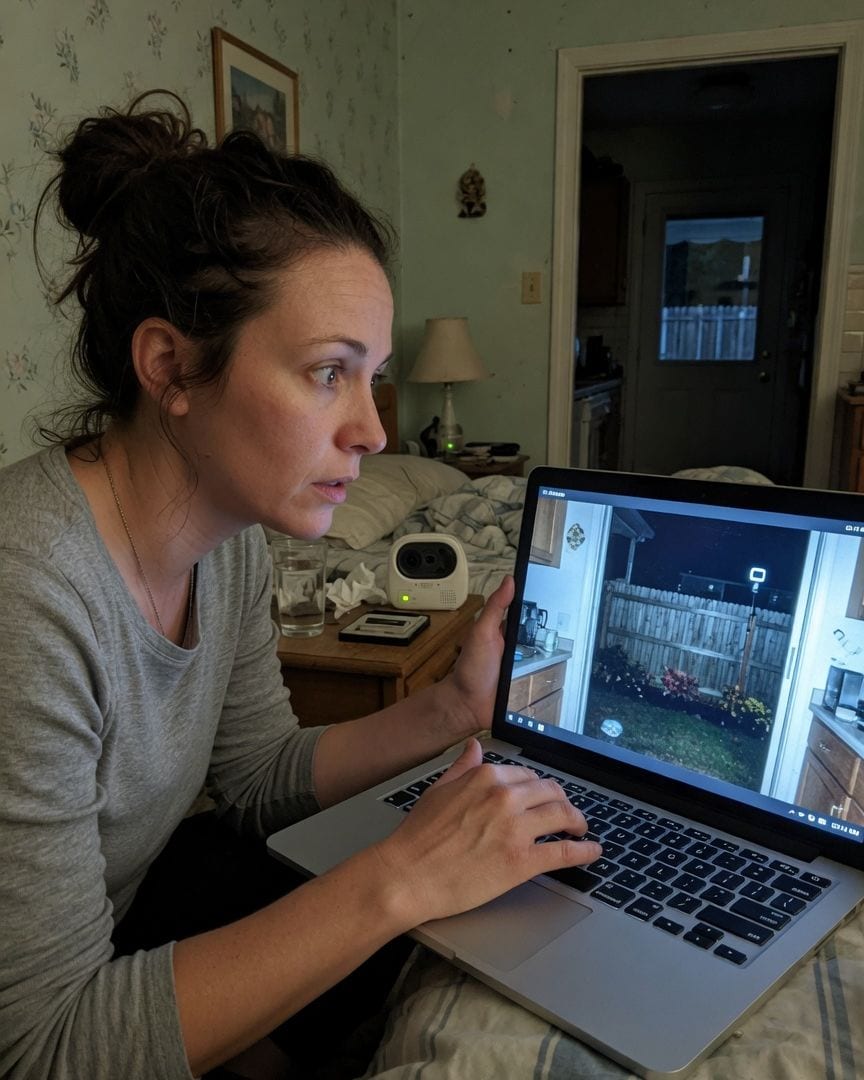
My game camera caught my back door from the inside. For three nights, it showed my door from the yard, getting closer. The last picture is from inside the glass, looking out at the fence.
I had set my game camera on the back fence, aimed at my house, to catch whatever I'd seen moving outside my kitchen window. But the last photo, taken after midnight, showed my kitchen from *inside* the locked back door, looking out.
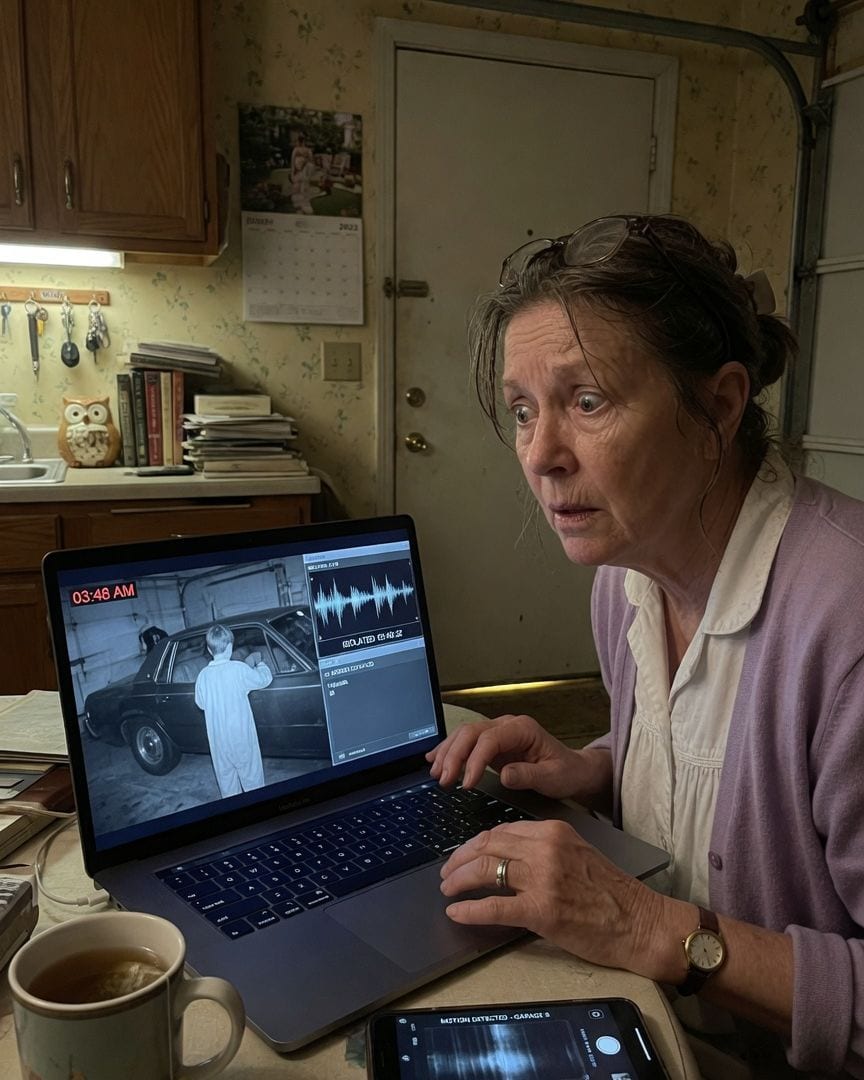
My garage camera filmed a boy of six walk out of a locked door at 3:48am, stare into my empty car, then vanish. My children live abroad.
I live in a quiet, solid house, my children grown and gone. But one night, my garage camera caught an impossible sight: my internal door, locked and bolted, slowly opened. A small, solid boy, no older than six, stepped through, then stood staring into the driver's seat of my empty car.
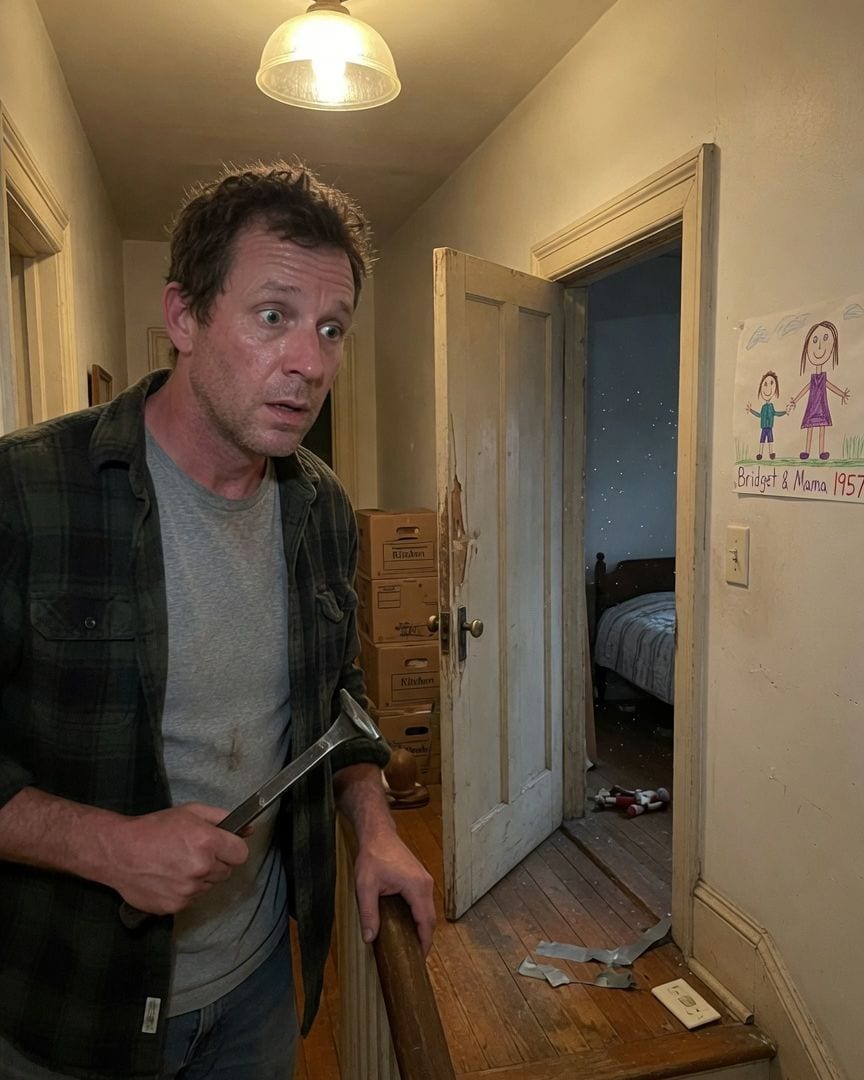
My landing light switches itself off at 9:40 every night. I've watched the switch flick down under nothing, the tape peeled back. The house holds its breath.
My great-uncle's old house was a quiet gift, a place to finally settle. But as I unpacked, a strange worn path on the floorboards led me to a small, barely visible door, perfectly blended into the wall. It was undeniably locked, and felt like a deliberately obscured secret.
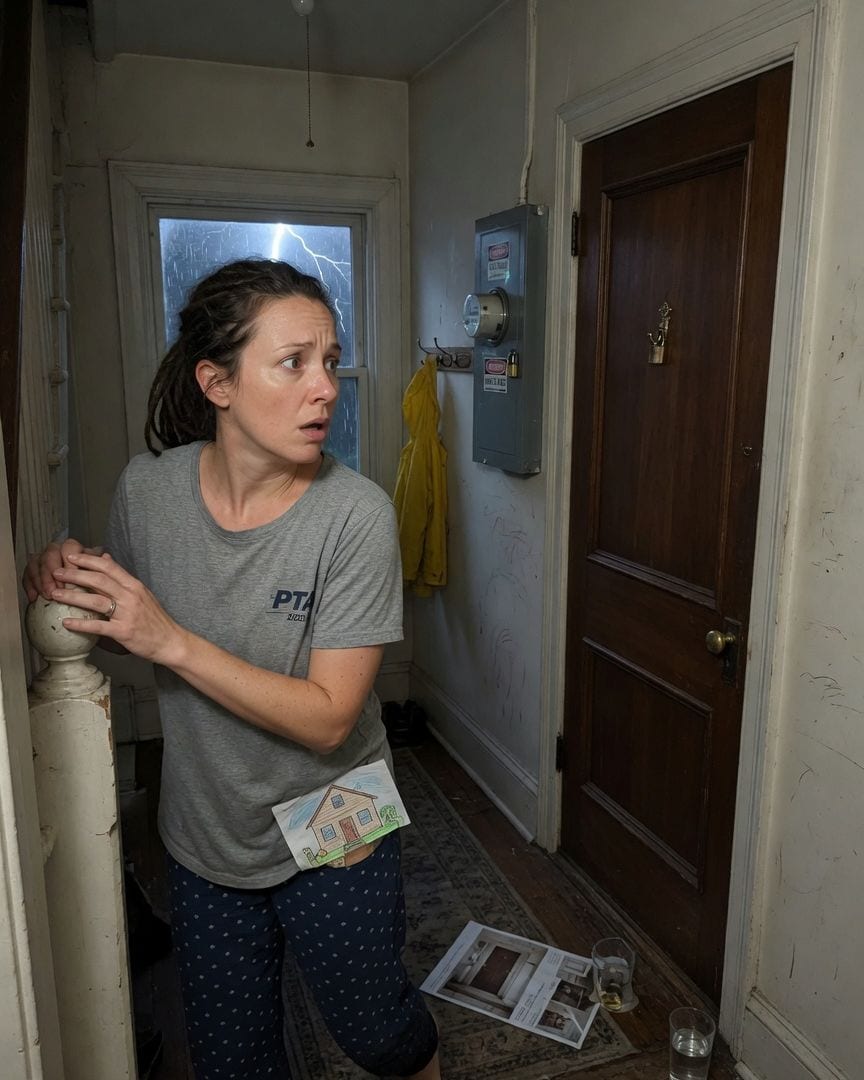
My son drew a door under our stairs. Tonight, I touched its cold brass handle.
My son Oliver drew our house with a small, panelled door under the main staircase, a detail I quickly dismissed because only a solid wall stood there. But an old real estate listing photograph revealed the exact door, perfectly placed, where no door could possibly exist.
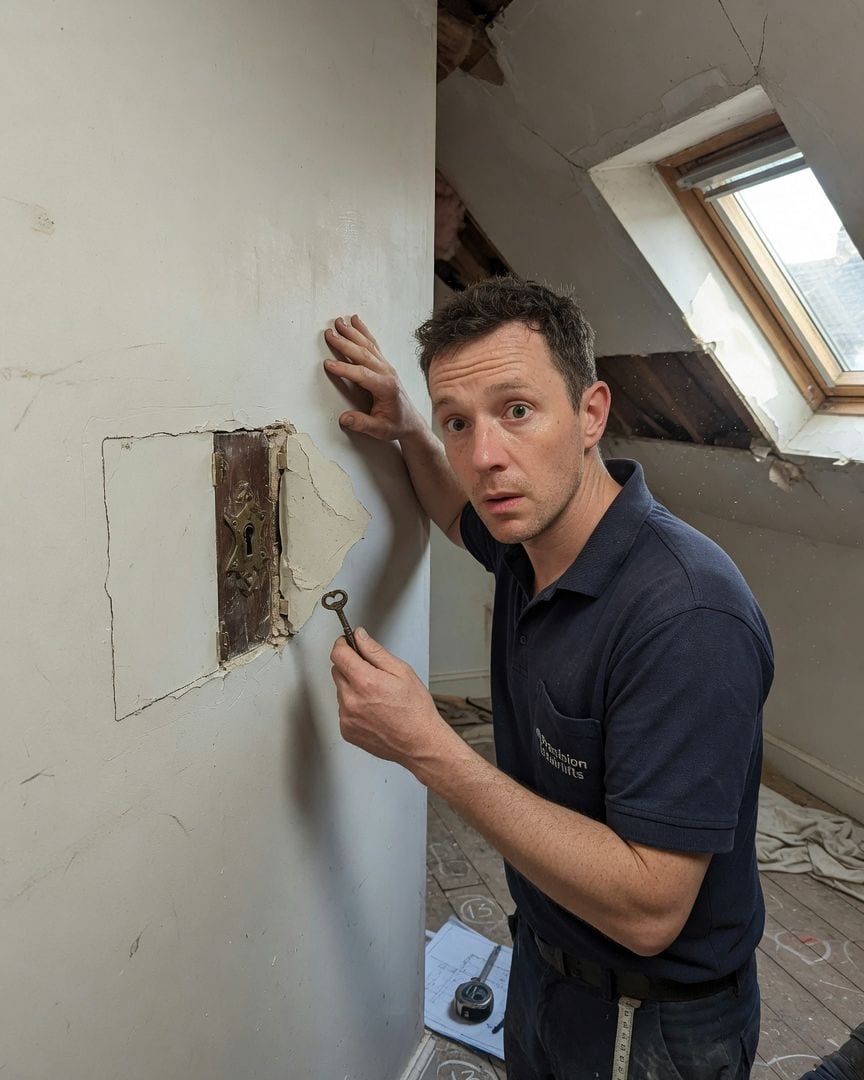
My stairlift tape measures thirteen steps, but my own feet always find a fourteenth — to a door that isn't there.
As a meticulous fitter, I measured my client's new loft stairs, confirming thirteen solid steps. But my foot found a shallow, impossible half-step, leading to a plain wooden door that shouldn't exist. Now the door is gone, leaving only a ghost outline.
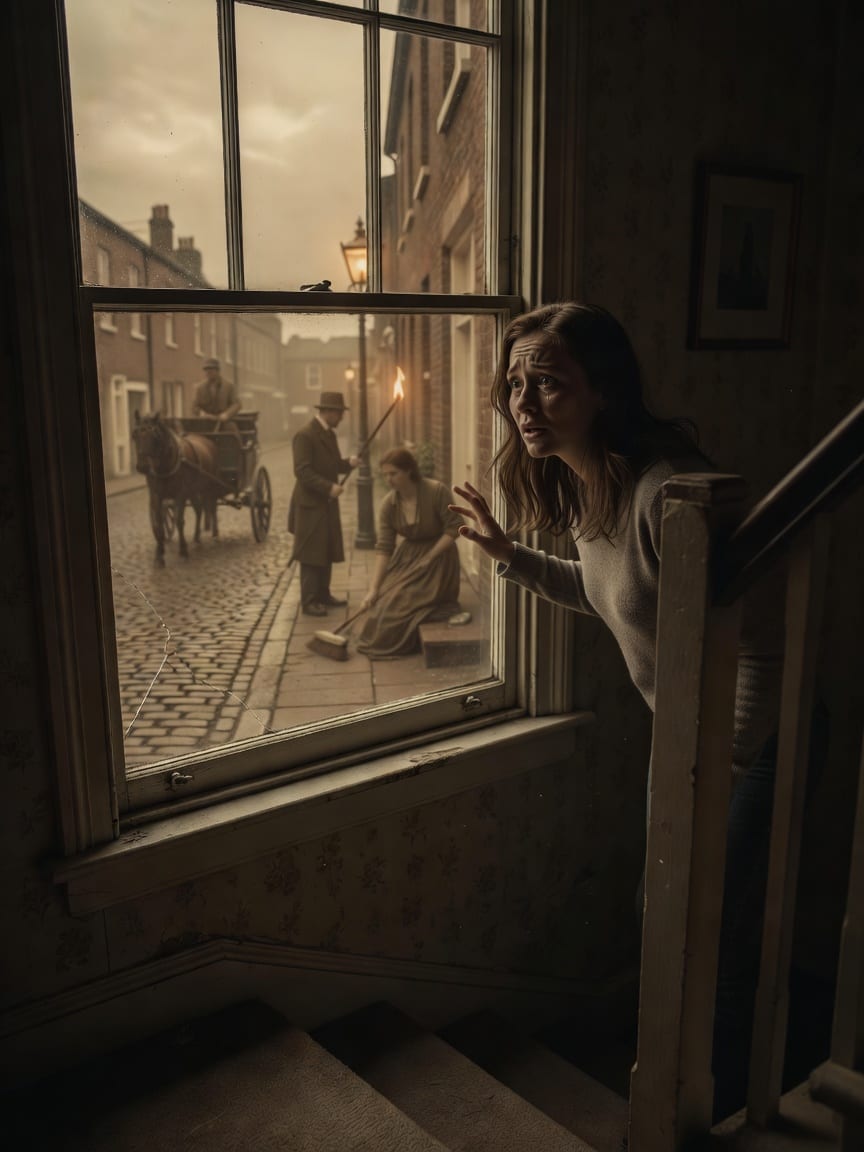
My half-landing window looked down on a cobbled street, a horse and cart. My panes, same crack. Below, only the bins.
I moved into this inherited house for a fresh start, living alone in the quiet. But the third stair on the main flight is deeply worn, a ghostly scoop hinting at decades of unseen footsteps. It feels hollow, and the wall beside it hides a faint, inexplicable seam.